
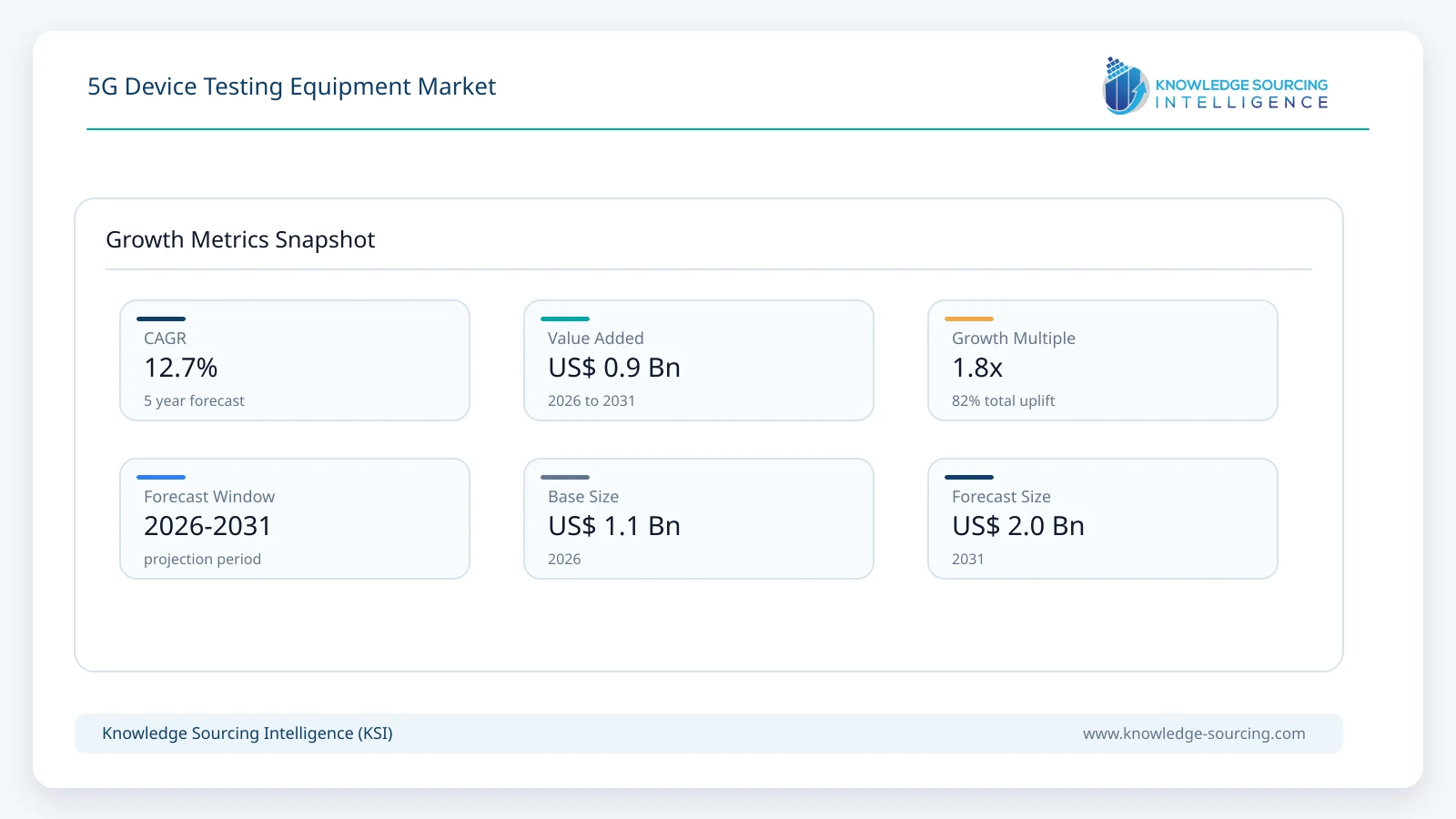
The global 5G Device Testing Equipment market is forecast to grow at a CAGR of 12.7%, reaching USD 2.0 billion in 2031 from USD 1.1 billion in 2026.
Highlights:
- 1RF and parametric testing represents approximately 32.0% of market revenue in 2026supported by continuing requirements to validate transmitter, receiver, spectrum and RF performance across expanding band combinations.
- 2Smartphones and mobile broadband devices account for an estimated 50.0% of market demand in 2026although their share is expected to decline as RedCap, IoT, automotive and NTN-capable devices expand.
- 3Asia Pacific accounts for approximately 41.0% of market revenue in 2026reflecting the concentration of smartphone, module, chipset and electronics manufacturing across China, South Korea, Japan, Taiwan and other Asian production centers.
- 417.6% annually through 2031RedCap, IoT and wearable-device testing is projected to grow at approximately substantially faster than the overall market.
- 5NR-NTN, satellite mobility, Release 18 mobility features and AI-assisted device behaviour5G device validation is increasingly extending beyond terrestrial FR1 and FR2 testing into .
- 6Conformance platforms are expanding to support Release 18 capabilities such as Lower Layer Triggered Mobility, while commercial RedCap test systems increasingly evaluate throughput, power consumption and IMS behaviour rather than basic connectivity alone.
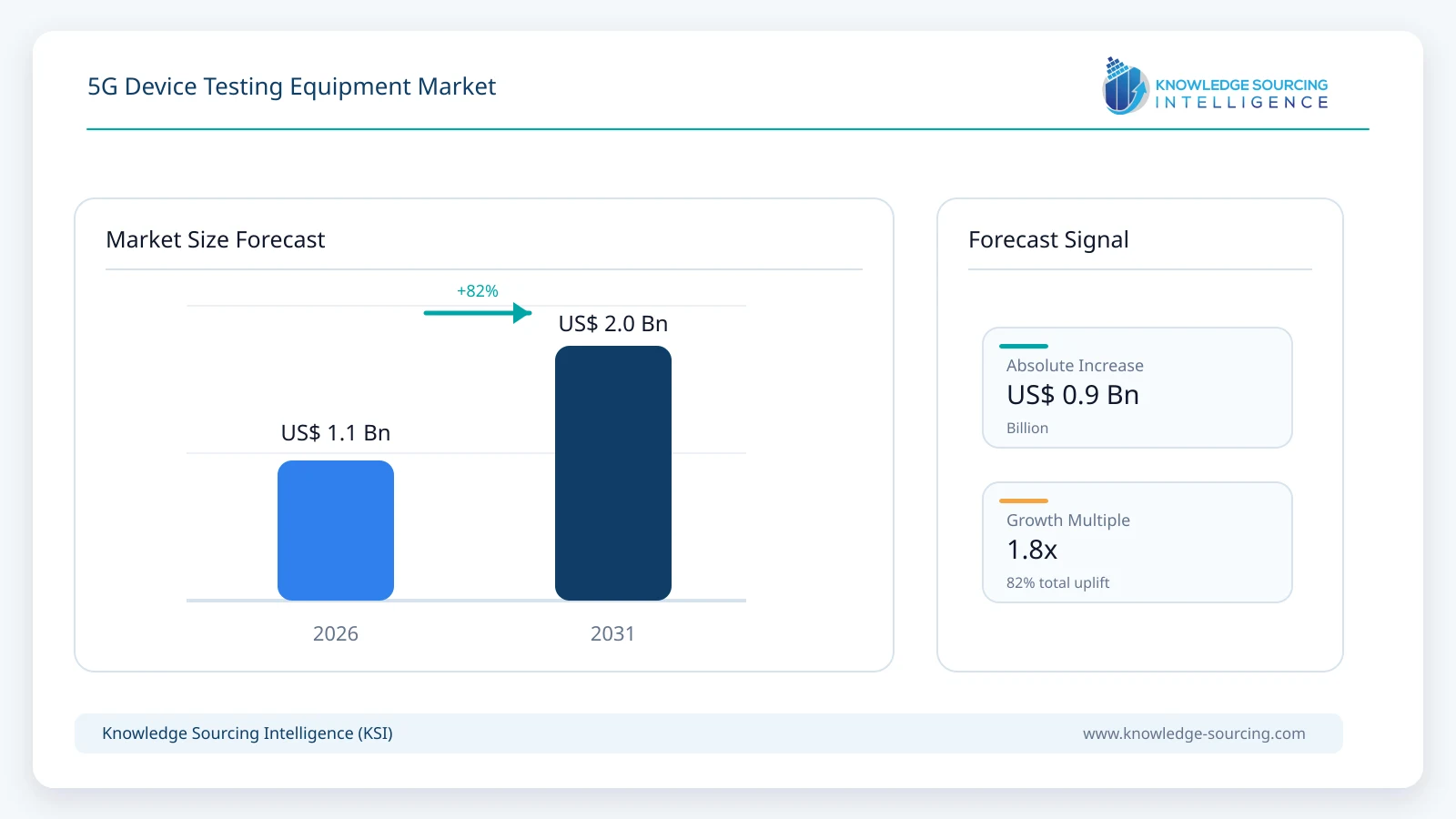
Demand is being supported by the transition toward 5G-Advanced, increasing numbers of supported frequency combinations, RedCap commercialization, non-terrestrial network connectivity, more complex MIMO architectures and the need to validate device performance under increasingly realistic radio conditions before commercial launch.
5G device testing equipment covers hardware and software used to evaluate user equipment, chipsets, modules, customer-premises equipment and other 5G-connected devices during development, certification, operator acceptance and manufacturing. The market includes RF and parametric test systems, protocol and conformance systems, network and device emulators, over-the-air and MIMO testing systems, channel emulators and application-performance testing platforms.
The scope excludes field-only network optimization equipment, standalone network service-assurance platforms, infrastructure-only base-station testers and general-purpose laboratory instruments where wireless-device testing is not a material use case.
Market Overview
5G device testing is becoming more complex even as the underlying radio standard matures. Early 5G equipment development concentrated heavily on establishing basic NR connectivity across Sub-6 GHz and mmWave frequency bands. By 2026, the testing requirement has expanded into multiple layers of functionality, including Standalone operation, carrier aggregation, advanced MIMO, RedCap, non-terrestrial networks, power efficiency, mobility and application performance under realistic radio conditions.
The number of combinations that device developers need to validate is also increasing. Frequency refarming following the retirement of 3G networks adds new band combinations, while operator-specific carrier aggregation and MIMO requirements increase the number of test scenarios. Anritsu identified this directly when expanding its RedCap application-testing platform in June 2026, noting that increasing combinations of bands, carrier aggregation and MIMO configurations are raising test complexity and engineering workload.
Device testing is consequently shifting from isolated measurement instruments toward integrated test environments. Keysight’s S8708A platform combines network emulation, channel emulation, OTA infrastructure and software into an end-to-end performance-testing environment. Rohde & Schwarz similarly uses its CMX500 platform across terrestrial 5G, RedCap and NTN device validation. Anritsu’s ME7834NR integrates protocol conformance, carrier-acceptance testing and OTA capabilities across several radio-access technologies.
The commercial requirement is not simply to determine whether a device can connect to a network. Manufacturers increasingly need to demonstrate that products maintain throughput, mobility, battery efficiency and application performance across complex real-world conditions. This raises the value of network emulation, channel emulation and automated performance testing relative to conventional standalone RF measurements.
Market Drivers
5G-Advanced introduces new device behaviours that require additional validation
Release 18 and 5G-Advanced introduce new mobility, MIMO and service capabilities that require chipset and device manufacturers to expand their validation programs. Lower Layer Triggered Mobility is one example. Rather than relying exclusively on Layer 3 signalling for handovers, LTM allows lower-layer information to trigger faster mobility procedures, reducing service interruption for time-sensitive applications.
Anritsu announced on June 1, 2026, that its ME7834NR platform supported industry-first verification of 3GPP RAN5 Release 18 LTM test cases. The platform is registered with both GCF and PTCRB and supports protocol conformance and carrier-acceptance testing across 5G SA, NSA, LTE, and NTN configurations.
Testing requirements expand further as Release 18 and later releases incorporate advanced MIMO, extended reality, AI-assisted radio capabilities and additional satellite integration. Device manufacturers consequently need platforms that can be upgraded through software and modular hardware rather than replaced for every specification change.
RedCap creates a new class of lower-cost 5G devices requiring different test priorities
Reduced Capability devices are designed to provide 5G connectivity with lower complexity, cost and power consumption than conventional smartphones. Target applications include wearables, industrial sensors, cameras, routers and selected CPE.
The test requirements differ from flagship smartphone testing. Battery life, simplified bandwidth configurations, handover behaviour, IMS support and application throughput can be more important than maximum peak data rate.
On June 18, 2026, Anritsu expanded SmartStudio NR and SmartStudio NR IP Performance to support RedCap devices. The platform evaluates IP throughput, handover, power consumption and temperature and can automatically identify device-supported band combinations, including MIMO configurations and channel bandwidth.
Under the KSI segment model, RedCap, IoT and wearable-device testing expands considerably faster than mature smartphone testing as operators commercialize lower-complexity 5G device categories.
NTN requires laboratory reproduction of conditions that are difficult to test in live networks
Non-terrestrial networks add substantially different testing requirements because satellites move relative to the device, propagation delays vary and users can transition between satellite beams or satellites.
Early device developers frequently cannot rely on live commercial satellite networks during the engineering cycle. They therefore need network and channel emulators capable of reproducing orbital movement, Doppler effects, delays, handovers and changing link conditions inside a controlled laboratory.
Keysight and Samsung demonstrated this requirement during 2026. On January 8, the companies announced a live NR-NTN connection in the new n252 S-band that included satellite-to-satellite mobility using commercial-grade modem silicon. On February 26, Keysight announced additional laboratory NR-NTN mobility validation with Samsung using network emulation aligned with planned LEO satellite deployments.
Rohde & Schwarz is similarly expanding NR-NTN conformance testing, including RF, radio-resource-management and protocol-conformance test cases validated through GCF.
More complex MIMO and OTA configurations increase laboratory capital requirements
Advanced 5G devices use multiple antennas, beamforming and increasingly sophisticated channel-state information. Performance therefore depends not only on conducted RF measurements but on the interaction between the complete antenna system and the surrounding propagation environment.
OTA chambers and channel emulators reproduce multipath, fading, mobility and beam conditions in the laboratory. Keysight’s performance-testing architecture combines its PROPSIM channel emulator, UXM network emulator and OTA infrastructure to validate FR1 and FR2 MIMO performance under controlled radio conditions.
This part of the market gains further relevance as testing moves toward digital-twin techniques. Keysight and Qualcomm demonstrated RF digital-twin workflows during March 2026 that link simulated propagation environments with real-world measurements to improve Massive MIMO development.
Device development cycles require greater automation
The number of potential combinations of frequencies, network modes, mobility scenarios and applications makes manual testing increasingly impractical. Device developers need automated execution, data analysis and regression testing to maintain product-development schedules.
AI is beginning to enter these workflows. Keysight’s AI Device Testbed evaluates AI-enabled devices under controlled 5G-Advanced conditions and automates analysis of throughput, mobility, battery efficiency and user experience. VIAVI introduced AI Experts in June 2026 to automate configuration, analysis, diagnostics and reporting within wireless laboratory and field-test environments.
Automation does not remove the need for test hardware, but it increases the value of integrated platforms capable of supporting repeatable large-scale test execution.
Market Restraints and Challenges
High-end 5G test systems require substantial capital expenditure
Network emulators, channel emulators, OTA chambers and advanced RF instrumentation can require significant laboratory investment. Device OEMs therefore concentrate the most sophisticated testing environments in central engineering locations rather than replicating them across every development site.
Smaller module and IoT vendors may depend on third-party laboratories or shared certification facilities, limiting the number of systems purchased directly.
Equipment vendors increasingly address this issue through modular platforms, software licensing and scalable configurations, but high-capability FR2, MIMO and NTN environments remain capital intensive.
Test complexity is growing faster than engineering resources
Each additional band, carrier aggregation combination, MIMO mode and device feature creates new test cases. The problem becomes more pronounced when products must also support LTE fallback, multiple regional carrier requirements and different certification organizations.
Anritsu’s RedCap enhancements specifically address the need to retrieve device-supported combinations automatically because manually designing tests across a rapidly growing number of configurations increases engineering effort.
Automation becomes essential, but building automated test workflows can itself require specialized expertise.
Mature smartphone testing faces replacement rather than greenfield demand
Smartphones remain the largest device-testing category, but the basic 5G smartphone testing environment is substantially more mature than during the first commercial NR launches. Manufacturers already possess installed test infrastructure that can often be upgraded through software and modular hardware.
This moderates greenfield equipment demand. Growth increasingly comes from new specifications, higher-order MIMO, advanced mobility, NTN and new device categories rather than replacing entire test laboratories.
Standards and certification requirements continue evolving
Device manufacturers need to satisfy 3GPP requirements together with certification and operator-acceptance programs. GCF, PTCRB and individual carriers can introduce additional test cases as features mature.
The evolving standards environment supports equipment demand but increases uncertainty for buyers. Laboratories prefer platforms with upgrade paths across multiple releases, which strengthens larger test vendors capable of maintaining long-term standards-development programs.
Scope overlap between device, network and semiconductor testing requires careful procurement
Modern platforms can test chipsets, user equipment and network functions using the same emulation architecture. Channel emulators may also support infrastructure or 6G research.
This creates efficiency for customers but makes procurement decisions more complex. Laboratories increasingly purchase platforms based on future multi-purpose use rather than one device class, placing pressure on vendors offering narrowly specialized systems.
Major Segment Analysis
By Test Function
RF and parametric testing remains the largest test function in 2026, accounting for approximately 32.0% of market revenue. Devices still require transmitter, receiver, spectrum, power and RF-performance verification across every supported band. However, this category grows more slowly than the market as mature measurement functions become increasingly integrated into multi-purpose platforms.
Protocol, conformance and interoperability testing records stronger growth as 5G-Advanced, RedCap and NTN expand the number of standardized device behaviours requiring verification. The segment is projected to reach approximately USD 580 million by 2031, supported by GCF, PTCRB, operator acceptance and 3GPP-related testing.
OTA, MIMO and channel-emulation systems also expand above the overall market average. Beamforming, FR2 operation, NTN propagation and higher-order antenna systems make conducted measurements alone insufficient for many performance questions.
Application, performance and mobility testing is the fastest-growing major functional group, expanding at approximately 15.0% annually through 2031. Manufacturers increasingly need to understand how devices behave under realistic application traffic, mobility, fading and power-consumption conditions rather than simply proving standards compliance.
By Device Type
Smartphones and mobile broadband devices account for the largest share of spending but grow below the overall market rate as the installed testing base matures. Their contribution is projected to decline from approximately half of market revenue in 2026 to around 42% by 2031.
CPE and FWA devices expand faster as operators increase fixed-wireless deployments and introduce higher-performance indoor and outdoor gateways incorporating more sophisticated antenna configurations and newer Wi-Fi standards.
RedCap, IoT and wearable testing represents one of the strongest growth opportunities. The category is projected to grow at approximately 17.6% annually through 2031, supported by industrial sensors, wearables, cameras, routers and lower-cost cellular devices.
Automotive, industrial and NTN-capable terminals also grow well above the market average as cellular connectivity expands into vehicles and satellite-enabled devices. Laboratory simulation becomes particularly important where connectivity depends on mobility, satellite movement or environments that cannot be reproduced economically through conventional field testing.
By End User
Device and chipset manufacturers account for the largest proportion of market expenditure because they conduct design verification, RF testing, protocol validation and performance optimization throughout the product-development cycle.
Telecom operators and certification laboratories represent another important category. Operators require carrier-acceptance testing and can reproduce their network characteristics in laboratories before approving devices.
ODMs and contract manufacturers focus more heavily on manufacturing test and automated production validation, while automotive and industrial developers become increasingly relevant as 5G modules move into non-smartphone products.
Regional Analysis
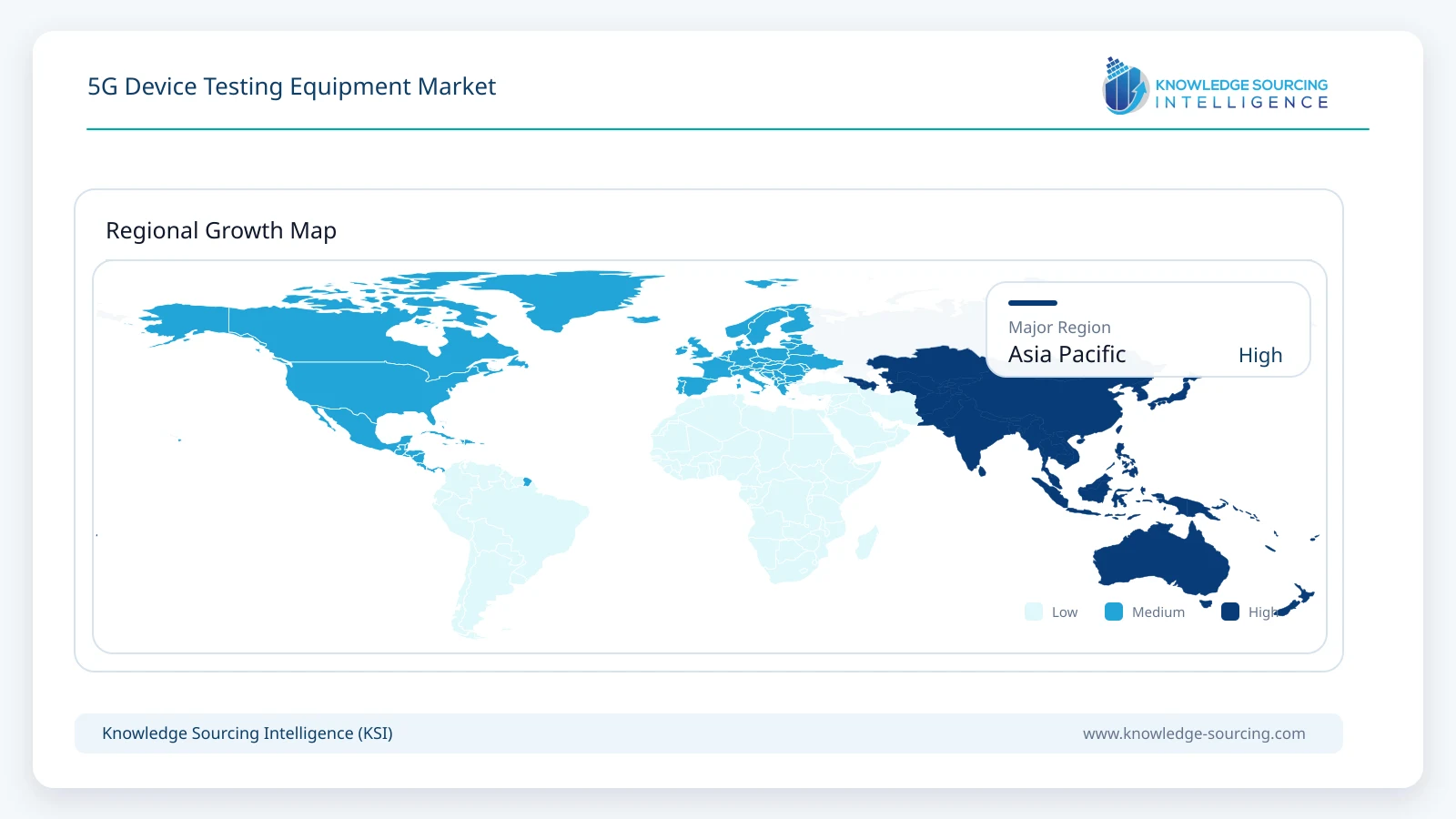
Asia Pacific is the largest regional market, accounting for approximately 41.0% of global revenue in 2026. The region combines large smartphone and electronics manufacturing bases with major chipset, module and telecommunications-equipment ecosystems in China, South Korea, Japan and Taiwan.
Asia Pacific’s share is projected to increase gradually through 2031 as RedCap modules, CPE, automotive connectivity and other device categories scale alongside smartphones. Anritsu’s major mobile-testing operations in Japan and the presence of large device-development ecosystems across the region reinforce its importance.
North America accounts for approximately 28% of 2026 demand. The United States hosts Keysight, VIAVI, Qualcomm and a large semiconductor and wireless-development ecosystem. The region is also particularly active in NTN, AI-enabled device validation and advanced wireless R&D.
Europe maintains a significant market through Rohde & Schwarz, major automotive manufacturers, certification laboratories, telecom equipment development and satellite connectivity programs. Germany is particularly important through its wireless test-and-measurement industry and automotive engineering base.
Middle East and Africa and South America remain smaller markets but grow as regional operators introduce newer devices, private 5G networks and local certification capabilities.
Technology Outlook
5G-Advanced and Release 18 Conformance Automation
Release 18 expands the range of device behaviours that laboratories need to validate, including advanced mobility and additional performance features. Test vendors are increasingly implementing new test cases before large-scale commercial deployment so chipset and device companies can develop products in parallel with standards maturation.
Automated standards testing reduces the engineering effort required to repeat hundreds or thousands of configurations across software releases.
NTN Device and Satellite-Mobility Emulation
NTN is creating a new testing layer based on orbital motion, Doppler effects, large propagation delays and satellite handovers. Laboratory environments increasingly combine network emulation, channel emulation and positioning simulation to reproduce these conditions.
The technology is moving quickly from research toward certification. Rohde & Schwarz reported on June 16, 2026 that its CMX500 had achieved extensive GCF validation across NR-NTN RF, RRM and protocol-conformance domains.
RF Digital Twins and AI-Assisted Test Automation
Digital twins allow engineers to recreate complex radio environments virtually and connect those models with physical devices and test equipment. This can reduce field-testing requirements and allow scenarios to be repeated exactly during development.
AI increasingly assists engineers with test setup, diagnostics, data interpretation and performance optimization. The combination of high-fidelity radio emulation and automated analysis is likely to become a central differentiator in advanced device-testing platforms.
Recent Developments
June 18, 2026: Anritsu announced enhanced SmartStudio NR and SmartStudio NR IP Performance software with 5G RedCap device support. The solutions enable application-level testing including throughput, handover, power-consumption and temperature measurements and support increasingly complex band and MIMO combinations.
June 16, 2026: Rohde & Schwarz announced that it had achieved the highest number of GCF-validated 3GPP NR-NTN test cases across RF, RRM and protocol-conformance domains on its CMX500 testing platform. The development directly expands certification capability for NR-NTN devices.
June 1, 2026: Anritsu announced support for industry-first verification of 3GPP Release 18 Lower Layer Triggered Mobility test cases using its ME7834NR 5G NR Mobile Device Test Platform. The platform supports protocol conformance and carrier-acceptance testing for 5G SA and NSA devices.
February 26, 2026: Keysight announced collaboration with Samsung on laboratory NR-NTN LEO mobility testing for devices, including satellite mobility, handover, service continuity and higher-throughput MIMO configurations using Keysight network emulation.
February 19, 2026: Rohde & Schwarz announced expanded CMX500 capabilities covering NR-NTN, NB-NTN and Direct-to-Cell testing at both device and network level. The platform provides one integrated environment for testing several non-terrestrial connectivity architectures.
January 8, 2026: Keysight and Samsung announced an end-to-end NR-NTN connection in 3GPP n252 S-band with satellite-to-satellite mobility, validating commercial-grade modem silicon and interoperability using Keysight’s NTN network-emulation environment.
Competitive Landscape
Keysight Technologies, Rohde & Schwarz and Anritsu form the strongest specialist competitive group in cellular device testing. Each provides extensive RF, protocol, conformance and network-emulation capabilities and participates actively in emerging 5G-Advanced, RedCap and NTN testing.
Keysight’s wireless portfolio spans network emulation, channel emulation, OTA performance testing and advanced device-validation workflows. Its acquisition of Spirent Communications in October 2025 expanded its network automation, positioning and test capabilities, although Spirent’s high-speed Ethernet, network-security and channel-emulation businesses were divested to VIAVI as part of the transaction. Spirent should therefore no longer be presented as a standalone current competitor.
Rohde & Schwarz competes through platforms including CMX500, which supports conventional 5G NR, RedCap and NTN device testing and increasingly covers certification workflows. Anritsu’s MT8000A and ME7834NR platforms address RF, signalling, OTA and conformance requirements across 5G device-development and certification environments.
VIAVI has a broader wireless test portfolio spanning laboratory, channel-emulation and network validation. Its acquisition of Spirent’s channel-emulation business strengthens its ability to reproduce real-world radio conditions, and the company introduced the Vertex 6.0 platform in August 2026 building on the acquired technology.
Teradyne participates through LitePoint, which has a strong position in wireless production and device test. Emerson’s Test & Measurement business, incorporating NI, provides modular instrumentation and automated test systems used in RF and wireless development environments.
ETS-Lindgren and Microwave Vision Group provide OTA chambers and antenna-measurement infrastructure, while LIG Accuver supplies mobile-network and device-test solutions including NTN channel-emulation capabilities. Averna and Artiza Networks provide additional automated wireless and telecom test systems.
The competitive market is consequently moving away from isolated measurement instruments toward integrated platforms. Vendors capable of combining RF measurements, network emulation, channel modelling, OTA performance and test automation within one environment are increasingly positioned to capture a larger portion of laboratory spending.
Analyst View
The commercial opportunity in 5G device testing is shifting away from basic proof of 5G connectivity. Most leading chipset and handset manufacturers already possess substantial NR testing infrastructure, so incremental spending increasingly depends on new complexity entering the device rather than simple growth in 5G subscriptions.
RedCap and NTN are particularly important because both create genuinely new device-testing workflows. RedCap expands 5G into lower-cost, lower-power products where battery behaviour and application performance matter more than peak data rates. NTN requires laboratories to reproduce orbital movement, rapidly changing channels and satellite handovers that are difficult to validate using conventional terrestrial field tests.
5G-Advanced adds another layer through enhanced mobility, MIMO and AI-assisted operation. These capabilities increase the number of software-defined behaviours that need regression and conformance testing and therefore strengthen demand for automated test environments.
The market also benefits from increasing integration between hardware and software. Test-equipment vendors are no longer differentiated solely by RF specifications. Customers increasingly evaluate how effectively the platform automates configuration, reproduces real-world radio conditions, manages test data and allows engineers to diagnose failures.
This favors companies with broad device-development ecosystems and upgradeable platforms. It also increases the value of channel emulation and digital-twin capabilities as manufacturers attempt to replace expensive and inconsistent field testing with repeatable laboratory conditions.
Smartphone testing remains the largest revenue pool, but incremental growth increasingly migrates toward RedCap and IoT devices, NTN-capable terminals, advanced CPE, automotive connectivity and integrated application-performance testing. The suppliers best positioned through 2031 are therefore those that can support a device across RF design, conformance, OTA performance, network interoperability and realistic end-user performance rather than serving only one stage of the engineering cycle.
5G Device Testing Equipment Market Scope:
| Report Metric | Details |
|---|---|
| Total Market Size in 2026 | USD 1.1 billion |
| Total Market Size in 2031 | USD 2.0 billion |
| Forecast Unit | Billion |
| Growth Rate | 12.7% |
| Study Period | 2021 to 2031 |
| Historical Data | 2021 to 2024 |
| Base Year | 2025 |
| Forecast Period | 2026 – 2031 |
| Segmentation | Test Function, Device Type, End User, Geography |
| Companies |
|
Market Segmentation
Market Segmentation
By Test Function
· RF & Parametric Testing
· Protocol, Conformance & Interoperability Testing
· OTA, MIMO & Channel Emulation Testing
· Application, Performance & Mobility Testing
By Device Type
· Smartphones & Mobile Broadband Devices
· CPE & Fixed Wireless Access Devices
· RedCap, IoT & Wearable Devices
· Automotive, Industrial & NTN-Capable Devices
By End User
· Device & Chipset Manufacturers
· Telecom Operators & Certification Laboratories
· ODMs & Contract Manufacturers
· Automotive & Industrial Device Developers
By Geography
North America
· United States
· Canada
· Mexico
South America
· Brazil
· Argentina
· Others
Europe
· Germany
· United Kingdom
· France
· Italy
· Spain
· Others
Middle East and Africa
· Saudi Arabia
· UAE
· South Africa
· Others
Asia Pacific
· China
· Japan
· South Korea
· India
· Taiwan
· Others
Table of Contents
1. EXECUTIVE SUMMARY
2. MARKET SNAPSHOT
2.1. Market Overview
2.2. Market Definition and Scope
2.3. Scope Exclusions
2.4. Market Segmentation
2.5. Key Market Indicators
3. BUSINESS LANDSCAPE
3.1. Market Drivers
3.2. Market Restraints and Challenges
3.3. Market Opportunities
3.4. 5G Device and Chipset Development Outlook
3.5. 3GPP Release and Certification Environment
3.6. Device-Test Automation and Laboratory Economics
3.7. GCF, PTCRB and Carrier-Acceptance Requirements
3.8. Porter’s Five Forces Analysis
3.9. Strategic Recommendations
4. TECHNOLOGY OUTLOOK
4.1. 5G-Advanced and Release 18 Conformance Automation
4.2. NTN Device and Satellite-Mobility Emulation
4.3. RF Digital Twins and AI-Assisted Test Automation
5. 5G DEVICE TESTING EQUIPMENT MARKET BY TEST FUNCTION
5.1. Introduction
5.2. RF & Parametric Testing
5.3. Protocol, Conformance & Interoperability Testing
5.4. OTA, MIMO & Channel Emulation Testing
5.5. Application, Performance & Mobility Testing
6. 5G DEVICE TESTING EQUIPMENT MARKET BY DEVICE TYPE
6.1. Introduction
6.2. Smartphones & Mobile Broadband Devices
6.3. CPE & Fixed Wireless Access Devices
6.4. RedCap, IoT & Wearable Devices
6.5. Automotive, Industrial & NTN-Capable Devices
7. 5G DEVICE TESTING EQUIPMENT MARKET BY END USER
7.1. Introduction
7.2. Device & Chipset Manufacturers
7.3. Telecom Operators & Certification Laboratories
7.4. ODMs & Contract Manufacturers
7.5. Automotive & Industrial Device Developers
8. 5G DEVICE TESTING EQUIPMENT MARKET BY GEOGRAPHY
8.1. Introduction
8.2. North America
8.2.1. United States
8.2.2. Canada
8.2.3. Mexico
8.3. South America
8.3.1. Brazil
8.3.2. Argentina
8.3.3. Others
8.4. Europe
8.4.1. Germany
8.4.2. United Kingdom
8.4.3. France
8.4.4. Italy
8.4.5. Spain
8.4.6. Others
8.5. Middle East and Africa
8.5.1. Saudi Arabia
8.5.2. UAE
8.5.3. South Africa
8.5.4. Others
8.6. Asia Pacific
8.6.1. China
8.6.2. Japan
8.6.3. South Korea
8.6.4. India
8.6.5. Taiwan
8.6.6. Others
9. COMPETITIVE ENVIRONMENT AND ANALYSIS
9.1. Competitive Positioning
9.2. RF and Protocol-Test Capability
9.3. OTA and Channel-Emulation Capability
9.4. RedCap and NTN Device-Test Capability
9.5. 5G-Advanced and Release 18 Readiness
9.6. Automation and Digital-Twin Capability
9.7. Strategic Developments
9.8. Competitive Dashboard
10. COMPANY PROFILES
10.1. Keysight Technologies, Inc.
10.2. Rohde & Schwarz GmbH & Co. KG
10.3. Anritsu Corporation
10.4. VIAVI Solutions Inc.
10.5. Teradyne, Inc. / LitePoint
10.6. Emerson Test & Measurement / NI
10.7. ETS-Lindgren
10.8. Microwave Vision Group
10.9. LIG Accuver
10.10. Artiza Networks, Inc.
10.11. Averna Technologies Inc.
10.12. EXFO Inc.
10.13. DEKRA SE
10.14. Anokiwave / Qorvo Test Ecosystem
10.15. Chroma ATE Inc.
11. ANALYST VIEW
12. APPENDIX
12.1. Research Methodology
12.2. Market Estimation and Assumptions
12.3. Scope and Double-Counting Controls
12.4. Definitions and Abbreviations
Navigate
Trusted by the world's leading organizations











