
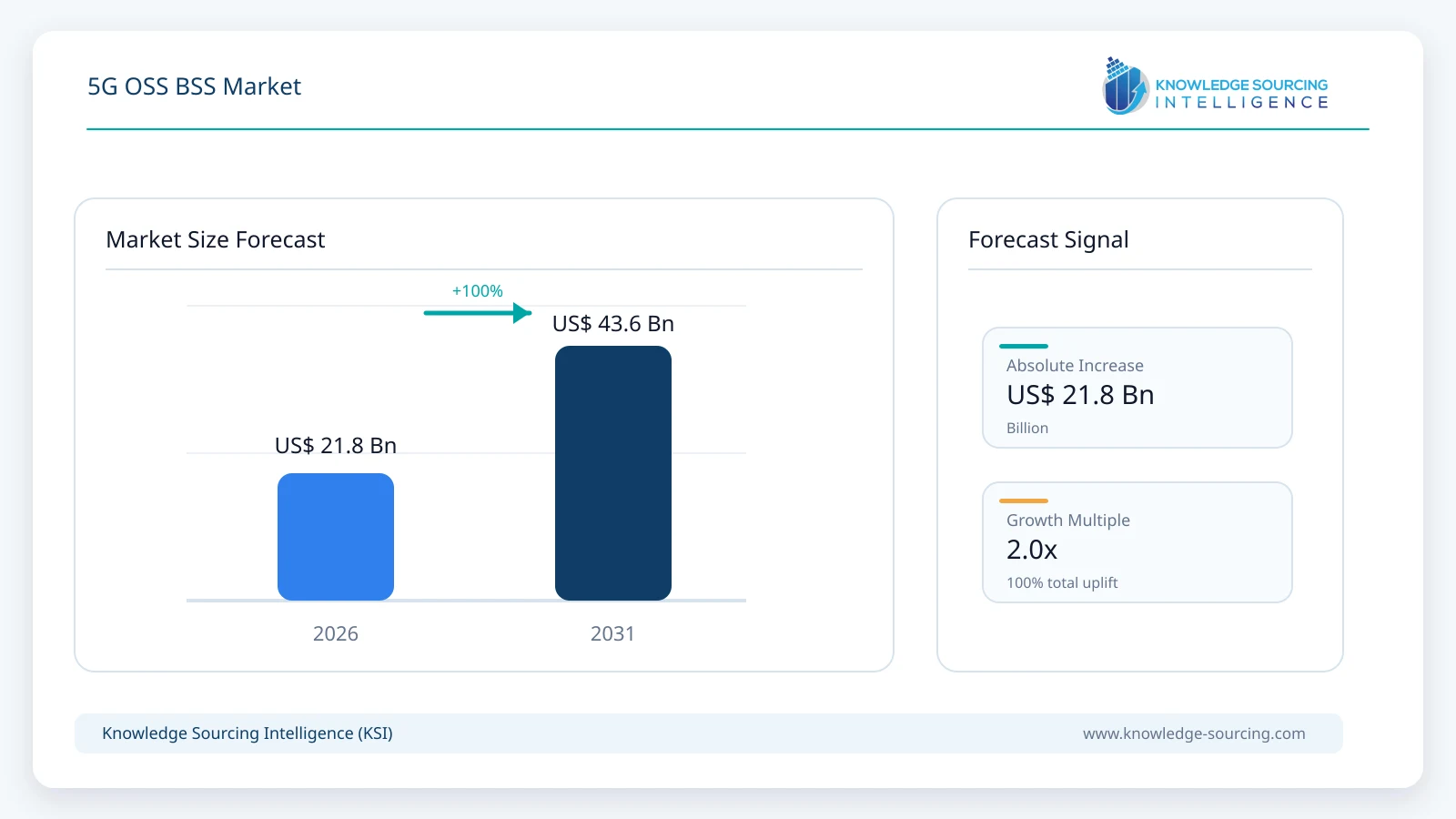
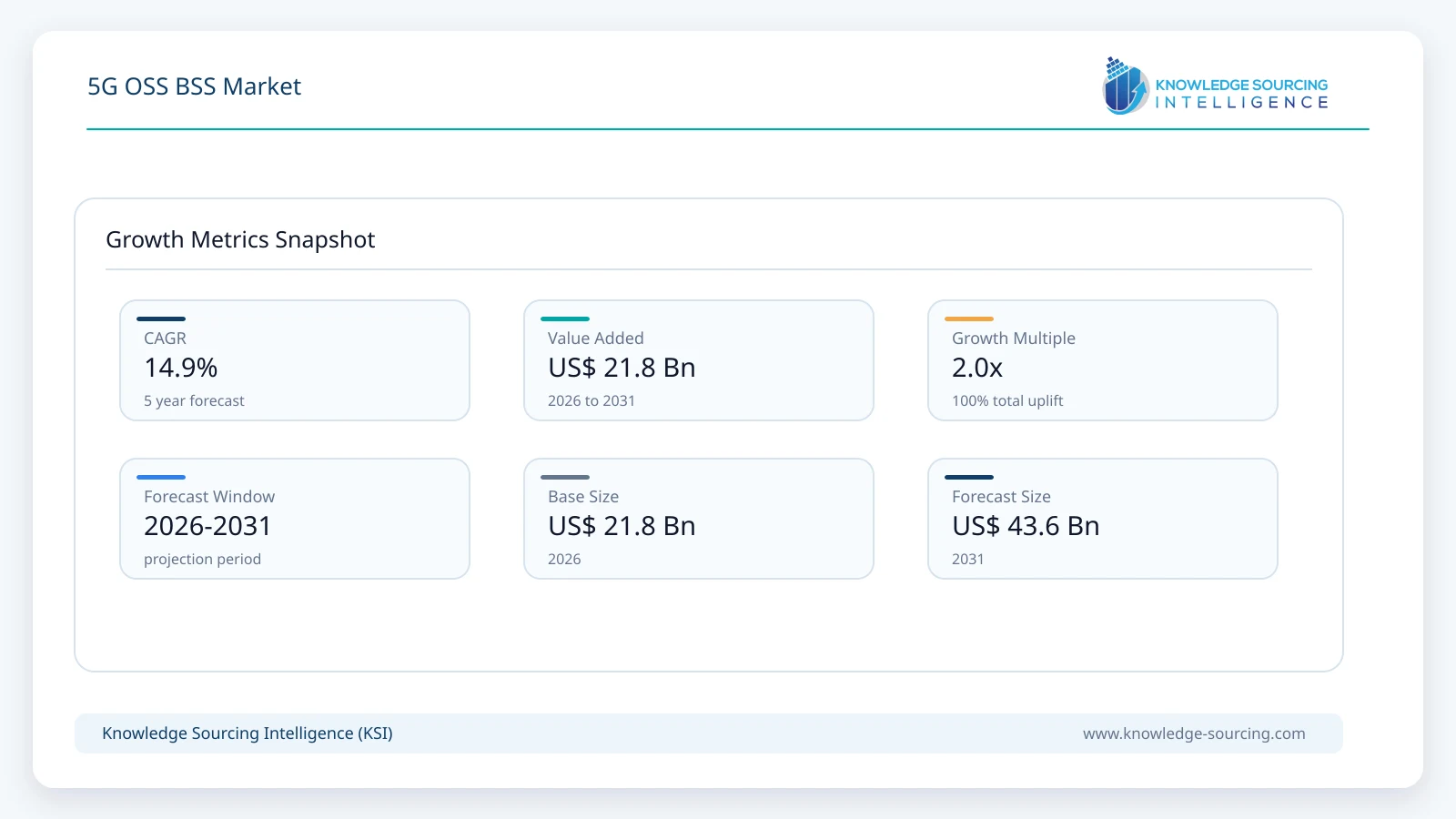
The 5G OSS/BSS Market is projected to expand at a CAGR of 14.9%, reaching USD 43.6 billion in 2031 from USD 21.8 billion in 2026.
Highlights:
- 1OSS accounts for approximately 56% of the market in 2026, supported by increasing requirements for network orchestration, assurance and autonomous operations.
- 2Cloud-native and hybrid-cloud deployments represent approximately 61% of 2026 revenue, as operators increasingly modernize monolithic telecom IT platforms.
- 3Network and service automation is the fastest-growing major functional domain, supported by closed-loop operations, agentic AI and multi-domain orchestration.
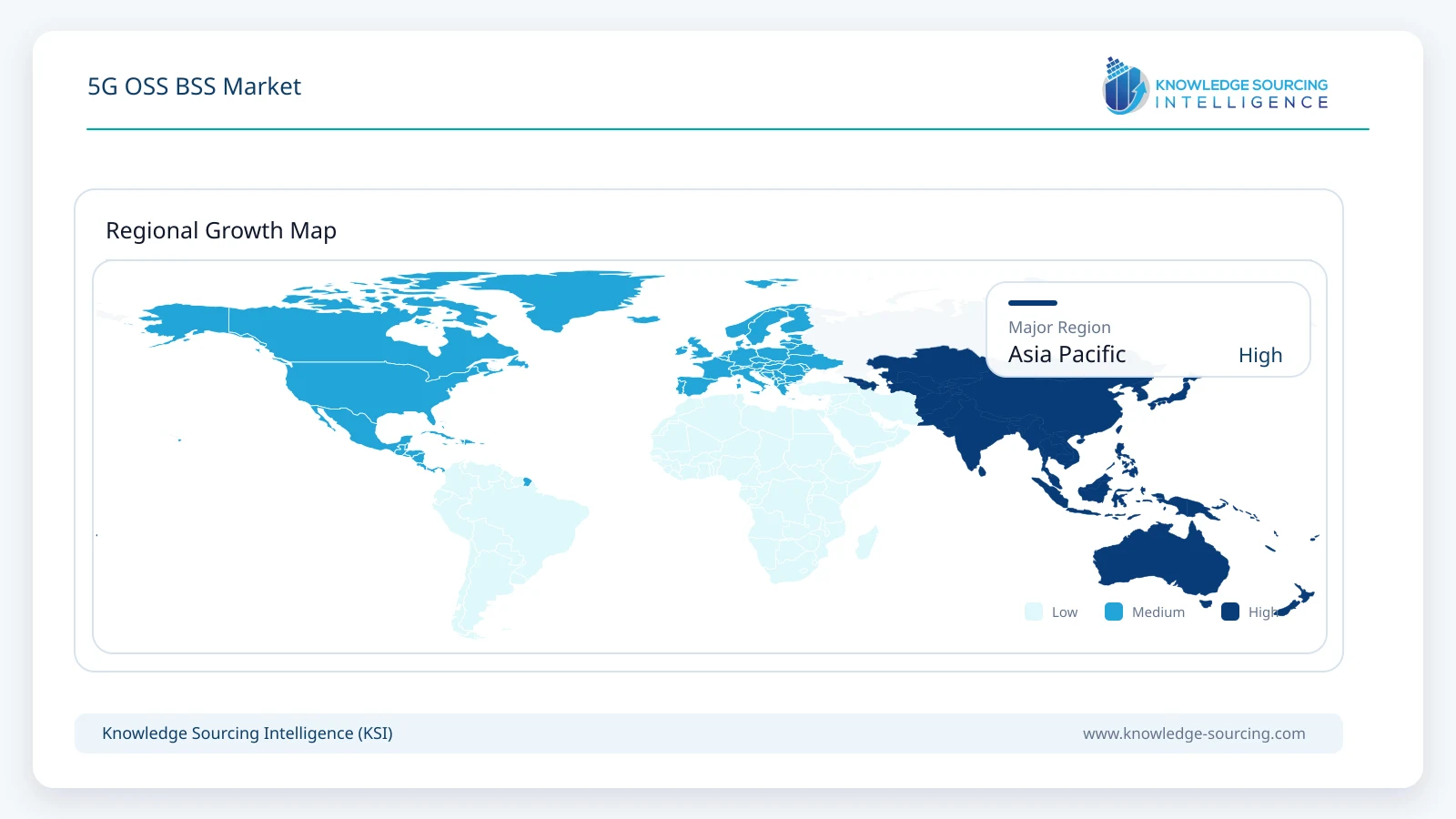
- 4North America remains the largest regional market in 2026, while Asia Pacific is projected to generate the strongest growth among the major regions.
- 5AI is shifting from an analytical overlay toward an operational layer inside OSS/BSS, allowing software agents to execute workflows across network, service, customer and monetization domains.
Growth is being supported by 5G standalone deployment, increasing network virtualization, service differentiation, enterprise 5G monetization and the transition from conventional rule-based network management toward cloud-native, AI-assisted and increasingly autonomous telecom operations.
5G Operations Support Systems and Business Support Systems provide the software and associated services required to operate, automate, assure and monetize increasingly complex mobile networks. OSS covers functions such as network and service orchestration, inventory, provisioning, assurance, performance management and automation, while BSS includes charging, billing, product management, order management, customer management and revenue-related functions. The market includes software licenses and subscriptions, cloud deployments and directly associated implementation and managed services used to support 5G-enabled telecom operations.
General enterprise IT systems, conventional CRM platforms without telecom-specific functionality, network equipment hardware and software unrelated to OSS/BSS workflows are excluded. The market is therefore centered primarily on communications service providers rather than industries such as banking or retail simply because those industries consume 5G connectivity.
The commercial opportunity is moving beyond the initial requirement to support a new radio generation. Operators increasingly need OSS/BSS platforms capable of coordinating cloud-native network functions, network slices, enterprise SLAs, real-time charging and multi-domain services while reducing the operational complexity created by several generations of legacy systems. Amdocs, Ericsson, Nokia and Netcracker are consequently embedding agentic AI, closed-loop automation and intent-based operations directly into their current telecom software portfolios.
The evolution of 5G changes the role of OSS/BSS because the underlying network is becoming substantially more programmable. Earlier mobile networks relied heavily on predefined service packages and relatively static network configurations. In a 5G Standalone environment, operators can create differentiated connectivity, network slices, private-network services, low-latency enterprise products and API-based capabilities whose operational requirements vary by customer and application. These services need to be provisioned, monitored, charged and modified across several network domains without requiring a large increase in manual operations.
The scale of established telecom software companies provides an important indication of the underlying addressable market. Amdocs generated USD 4.53 billion of revenue in fiscal 2025, with managed services representing approximately two-thirds of revenue. Its business includes BSS, network automation, cloud modernization and telecom software services rather than 5G OSS/BSS alone. Nokia’s Cloud and Network Services business similarly generated several billion euros of annual revenue while covering network automation, core software and related telecom applications. These vendor economics support a global 5G-specific OSS/BSS opportunity measured in tens of billions of dollars rather than the much broader scale of the entire telecom IT and services industry.
The market is also changing technically. Cloud-native architecture allows operators to update individual capabilities without replacing a complete monolithic platform, while open APIs make it easier to connect charging, orchestration, assurance and customer systems. AI is now being layered across these environments. Amdocs’ aOS operates over existing BSS/OSS systems and uses telecom-specific AI agents to coordinate workflows across customer care, monetization, service delivery and network operations. Ericsson is extending automation from RAN into core networks, while Nokia is developing agent libraries and autonomous-network software across several network domains.
Market Drivers
Autonomous network operations are becoming a direct OSS investment priority
The strongest structural driver is the movement from conventional network-management systems toward increasingly autonomous operations. 5G networks combine physical infrastructure, virtualized network functions, cloud workloads, multiple vendors and differentiated service requirements. The resulting operational complexity makes manual correlation of alarms, topology, performance and service data increasingly difficult.
Ericsson expanded its Intelligent Automation Platform into core-network operations in June 2026, creating a common automation environment across RAN and core. The architecture introduces core-specific automation applications, or cApps, and low-latency streaming of network-event data to support closed-loop operations. Ericsson states that the platform is already used by operators including AT&T, Swisscom, Telstra and Vodafone.
Nokia is following a similar direction through its Autonomous Networks Suite, MantaRay SMO and agentic-AI frameworks. In June 2026 the company introduced an Autonomous Networks Agent Library alongside broader software upgrades intended to increase the level of autonomous network operation.
These developments expand OSS spending beyond conventional fault monitoring and provisioning. The software increasingly becomes an execution layer capable of interpreting intent, correlating data and initiating network changes with progressively less human involvement.
5G monetization requires more flexible BSS architecture
5G revenue models are becoming more complex than conventional monthly mobile subscriptions. Operators are introducing differentiated connectivity, enterprise service guarantees, network APIs, fixed wireless services, private networks and partner-based digital products. Supporting these services requires product catalogs, charging and billing systems capable of handling more granular service definitions.
Traditional billing systems designed around voice, messaging and mobile-data allowances can become a constraint when operators need to charge by quality of service, latency tier, network slice, API usage or enterprise SLA.
Amdocs’ current CES26 platform combines real-time charging, digital commerce, customer management and network orchestration while supporting B2C, B2B and B2B2X business models. Its architecture illustrates how BSS is moving toward real-time product and revenue management rather than periodic billing alone.
Netcracker is taking a similar approach through AI-enabled revenue management and customer operations. Its September 2026 expansion with C Spire combines additional revenue-management capabilities with agentic AI for automated customer interactions and digital billing processes.
The monetization requirement becomes more important as operators seek commercial returns from 5G investments rather than focusing primarily on coverage.
Cloud-native modernization is replacing tightly coupled telecom IT stacks
Many established operators continue to operate OSS/BSS environments assembled over several decades. Mergers, network generations and repeated product additions have often created hundreds of interconnected applications with duplicated customer, service and network data.
This architecture makes change expensive because modifying one function can require extensive integration testing across several dependent systems. Cloud-native platforms reduce this rigidity through modular services, containerized applications and API-based integration.
Ericsson and AWS are jointly promoting cloud-native OSS/BSS architectures that support differentiated connectivity and autonomous operations, while Nokia and AWS announced in June 2026 that Nokia’s Autonomous Networks Fabric would be made available on AWS infrastructure.
Cloud adoption does not mean that all telecom operational data moves into a public cloud. Operators frequently use hybrid architectures, retaining sensitive network functions or regulated workloads within private environments while moving selected software components onto public or distributed cloud infrastructure.
The transition therefore favors vendors that can support hybrid operating models rather than requiring a single deployment environment.
Agentic AI is moving from customer support into network and business workflows
Generative AI initially entered telecom operations primarily through customer-service assistants and employee productivity tools. The current development cycle is substantially broader. AI agents are increasingly being designed to execute multi-step processes across OSS/BSS environments.
Amdocs introduced aOS in February 2026 as an agentic operating system capable of working on top of existing OSS/BSS stacks. Its Cognitive Core provides telecom-specific agents that can operate across product, sales, care, monetization, network and service-delivery processes.
Ericsson’s OSS/BSS Business Value Pathways similarly combine agentic AI with data modernization, zero-touch product launch and automated service experience. The objective is not simply to generate recommendations but to allow systems to plan, validate and perform operational changes within defined controls.
This extends the economic value of OSS/BSS platforms because AI adoption depends on access to accurate service, network, customer and billing data. Vendors controlling those operational systems are consequently well positioned to provide the intelligence layer operating on top of them.
Multi-vendor networks increase orchestration requirements
5G networks increasingly combine equipment and software from multiple vendors across RAN, transport, core and cloud infrastructure. Open RAN adds further disaggregation by separating radio, baseband and management components.
The operational layer therefore needs to create a consistent view across heterogeneous infrastructure. Ericsson and Nokia announced cooperation in March 2026 to improve compatibility between their respective rApp ecosystems and support multi-vendor SMO environments.
This is commercially important because operators want greater equipment choice without creating a separate management silo for every supplier. OSS vendors capable of normalizing data and automating workflows across domains gain strategic importance as the physical network becomes more open.
Market Restraints and Challenges
Legacy-system migration creates significant operational risk
Replacing OSS/BSS is fundamentally different from upgrading many other enterprise software applications. Charging, provisioning, assurance and customer systems operate continuously and are directly connected to revenue-generating services. Migration failure can affect billing, service activation or network availability.
Operators therefore often modernize progressively rather than replacing complete platforms at once. This extends deployment cycles and means legacy and cloud-native systems can coexist for several years.
The challenge strengthens demand for modular architectures but also slows revenue recognition because transformation programs can require lengthy integration, data migration and testing.
Fragmented telecom data can limit AI effectiveness
Autonomous operations depend on high-quality data describing network topology, service relationships, customer impact and operational history. Many operators still store these datasets across multiple OSS/BSS systems built using different data models.
Nokia and Databricks highlighted this issue in June 2026 when demonstrating a unified data architecture for autonomous networks, noting that operators commonly manage hundreds of siloed OSS and BSS platforms.
AI agents cannot reliably automate complex processes when their underlying service or network context is incomplete. Data federation, inventory accuracy and governance therefore become prerequisites for higher levels of autonomy.
AI governance limits immediate movement toward full autonomy
A telecom AI agent can potentially modify network configuration, customer billing or service provisioning. Errors can therefore have direct financial or operational consequences.
Operators need explainability, access controls, audit trails and human approval for higher-risk actions. Amdocs’ Cognitive Core incorporates governance and observability across AI agents, while Nokia’s current agentic frameworks emphasize operator-defined policies and controlled execution.
The transition toward autonomous operations is therefore gradual. AI assistance and closed-loop automation in narrowly defined workflows scale earlier than unrestricted autonomous decision-making across the entire network.
Large installed bases increase integration complexity
Major operators rarely operate one vendor’s OSS/BSS environment end to end. Customer management may come from one supplier, charging from another and network assurance from several additional systems.
This creates substantial integration work for new platforms and protects established suppliers with deep knowledge of the operator’s environment. At the same time, it can slow transformation because operators need to preserve existing workflows while introducing newer API-driven systems.
Major Segment Analysis
OSS: Largest Solution Category
OSS remains the largest solution category because 5G increases the operational complexity of the network itself. Service orchestration, inventory, assurance and automation need to operate across physical, virtualized and cloud infrastructure while maintaining an accurate relationship between network resources and customer services.
OSS revenue is projected to exceed USD 25 billion by 2031, with network automation and orchestration growing faster than traditional inventory and fault-management functions.
The next phase of competitive differentiation is centered on cross-domain automation. Ericsson is extending its automation architecture across RAN and core, Nokia is building a broader Autonomous Networks Fabric, and Netcracker combines orchestration, unified inventory and closed-loop assurance within its autonomous-operations portfolio.
Cloud-Native & Hybrid Cloud: Fastest-Growing Deployment Architecture
Cloud-native and hybrid-cloud OSS/BSS are projected to grow at approximately 19.7% annually through 2031. The transition is supported by operators seeking modular upgrades, faster service launches and reduced dependence on customized monolithic platforms.
Cloud architecture also supports AI adoption because agents and analytics need access to APIs, streaming data and scalable compute resources across multiple telecom domains.
The market will nevertheless remain hybrid. Large operators continue to keep selected workloads on private infrastructure for latency, security, sovereignty or operational-control reasons. The growth opportunity therefore lies primarily in cloud-native software architecture rather than public-cloud deployment alone.
Network & Service Automation: Fastest-Growing Functional Domain
Network and service automation captures the strongest functional growth as operators move toward intent-based and closed-loop operations. The segment is projected to reach more than USD 15 billion by 2031, supported by multi-domain orchestration, service lifecycle automation, AI-assisted assurance and autonomous remediation.
The requirement becomes especially important as 5G SA enables differentiated enterprise connectivity. A premium service has limited commercial value if it requires extensive manual configuration each time it is provisioned or modified. Automation therefore connects network capability directly with monetization and customer experience.
Regional Analysis
North America: Largest Current Regional Market
North America remains the largest regional market because major operators have large existing OSS/BSS spending bases, extensive 5G deployments and substantial cloud-modernization programs. Amdocs generated almost two-thirds of its fiscal 2025 revenue from North American customers, illustrating the scale of telecom software and services spending in the region.
The region’s share gradually declines as Asia Pacific operators increase investment in 5G SA, cloud-native telecom software and autonomous operations.
Asia Pacific: Fastest-Growing Major Region
Asia Pacific becomes increasingly important as China, India, Japan, South Korea and Southeast Asian markets move from network rollout toward monetization and operational automation. Regional revenue is projected to exceed USD 14 billion by 2031.
Large subscriber bases amplify the value of automation because even small reductions in provisioning cost, customer-care workload or network incidents can produce significant financial benefits. 5G SA and enterprise-network growth also increase requirements for real-time charging and service orchestration.
Technology Outlook
Agentic OSS/BSS
Agentic AI is becoming the principal architectural transition in telecom operations software. Rather than waiting for a user to query a dashboard, agents can monitor data, identify a condition, determine an appropriate workflow and execute approved actions across several applications.
The transition is likely to begin with bounded processes such as fault diagnosis, bill explanation, service activation and configuration validation before progressing toward broader autonomous control.
Unified Data and Knowledge Layers
Network autonomy depends on a consistent understanding of resources, services and customers. Future OSS/BSS platforms increasingly use federated data architectures and knowledge layers that allow AI systems to access information across domains without requiring every dataset to be moved into a single repository.
This becomes particularly important for operators with decades of legacy-system data.
Intent-Based Multi-Domain Orchestration
Intent-based systems translate an operational or commercial objective into the technical actions needed across several network domains. A request for an enterprise connectivity service, for example, can trigger configuration across RAN, transport, core, security and charging systems.
This reduces the direct relationship between network complexity and operational headcount and becomes an important enabler of differentiated 5G services.
Recent Developments
September 2026: Netcracker expanded its partnership with C Spire, adding further Netcracker Revenue Management capabilities and new agentic-AI use cases for automated customer interactions and digital billing processes.
June 2026: Ericsson introduced OSS/BSS Business Value Pathways combining AI, automation and its cloud-native OSS/BSS portfolio around data transformation, zero-touch product launch and agentic service experience.
June 2026: Nokia introduced an upgraded Autonomous Networks portfolio, including an Autonomous Networks Agent Library, the latest version of its Autonomous Networks Suite and additional agentic-AI capabilities for network operations.
March 2026: Ericsson and Nokia announced cooperation between their respective rApp and SMO ecosystems, enabling automation applications to operate across both platforms and supporting greater interoperability within multi-vendor autonomous networks.
February 2026: Amdocs introduced aOS, an agentic operating system designed to operate across existing BSS and OSS environments and automate telecom workflows using a library of domain-specific AI agents.
Competitive Landscape
Amdocs remains one of the largest independent telecom software and services suppliers, with a portfolio spanning customer management, charging, billing, digital commerce, network automation and managed services. The company’s strategy is increasingly centered on embedding agentic AI across these domains rather than providing AI as a separate application layer.
Ericsson combines OSS/BSS with a large installed network-equipment and core-software base. Its ability to integrate operational software with RAN and core-network data is particularly relevant as operators move toward closed-loop automation.
Nokia competes strongly in network automation, orchestration, assurance and inventory through its autonomous-network portfolio, MantaRay SMO and domain-management software. Its strategy increasingly combines network-domain expertise with cloud and AI partners including AWS, Google Cloud and Databricks.
Netcracker, an NEC company, maintains a broad telecom-specific BSS/OSS portfolio spanning revenue management, customer management, orchestration, inventory and assurance. Its current competitive positioning emphasizes AI-native operations and the integration of network and business workflows.
Oracle remains important in charging, policy, communications applications and telecom database infrastructure, while CSG contributes substantial expertise in billing, payments and customer management. NEC’s acquisition of CSG in 2026 and the resulting alignment with Netcracker creates a broader combination of BSS, customer-experience and network-operations capabilities.
Additional competitors include Comarch, Optiva, Hansen Technologies, Tecnotree, MATRIXX Software, Totogi, IBM, Hewlett Packard Enterprise, Salesforce and regional telecom-software specialists. Their competitive positions vary considerably because OSS/BSS is not one homogeneous product category. Some suppliers concentrate on charging and monetization, while others focus on orchestration, assurance, customer experience or cloud transformation.
Competitive advantage increasingly depends on telco-specific AI, migration capability, open APIs, cloud-native architecture, multi-vendor automation and the ability to connect operational decisions directly with commercial outcomes.
Analyst View
The 5G OSS/BSS opportunity is increasingly less about supporting another network generation and more about changing the operating model of the telecom company. Adding 5G radios and core software creates more network capability, but the commercial value of that capability depends on whether operators can provision, assure and monetize new services without proportionally increasing operational complexity.
OSS has the strongest near-term strategic importance because network autonomy is becoming a direct cost and performance requirement. Cloud RAN, 5G Core, network slicing and multi-vendor infrastructure generate too much operational data for traditional manual workflows to scale efficiently. AI-driven orchestration and assurance therefore become embedded operational capabilities rather than optional analytics tools.
BSS remains equally important to revenue realization. Differentiated 5G connectivity creates little incremental value if operators continue selling only conventional data allowances. Charging, product management and partner systems need to support enterprise SLAs, APIs, private-network services and other usage models that differ fundamentally from traditional consumer subscriptions.
Agentic AI creates the largest architectural change through 2031, but adoption will be progressive rather than instantaneous. Operators are likely to automate narrowly defined, high-volume processes first and expand autonomy only after governance, data quality and operational trust improve.
The strongest incremental opportunities are consequently concentrated in cloud-native modernization, network and service orchestration, autonomous assurance, real-time monetization and agentic AI layered across existing telecom workflows. Vendors able to modernize legacy environments without forcing operators into disruptive full-stack replacement are likely to capture a disproportionate share of transformation spending.
5G OSS BSS Market Scope:
| Report Metric | Details |
|---|---|
| Total Market Size in 2026 | USD 21.8 billion |
| Total Market Size in 2031 | USD 43.6 billion |
| Forecast Unit | Billion |
| Growth Rate | 14.9% |
| Study Period | 2021 to 2031 |
| Historical Data | 2021 to 2024 |
| Base Year | 2025 |
| Forecast Period | 2026 – 2031 |
| Segmentation | Solution, Deployment Architecture, Functional Domain, Geography |
| Companies |
|
Market Segmentation
By Solution
Operations Support Systems
Business Support Systems
By Deployment Architecture
Cloud-Native & Hybrid Cloud
On-Premise & Private Hosted
By Functional Domain
Network & Service Automation and Orchestration
Assurance, Inventory & Network Operations
Charging, Billing & Monetization
Customer, Product & Order Management
By Geography
North America
United States
Canada
Mexico
South America
Brazil
Argentina
Others
Europe
United Kingdom
Germany
France
Italy
Spain
Others
Middle East and Africa
Saudi Arabia
UAE
South Africa
Others
Asia Pacific
China
India
Japan
South Korea
Australia
Indonesia
Others
Table of Contents
1. EXECUTIVE SUMMARY
2. MARKET SNAPSHOT
2.1. Market Overview
2.2. Market Definition and Scope
2.3. Scope Exclusions
2.4. Market Segmentation
2.5. Key Market Indicators
3. BUSINESS LANDSCAPE
3.1. Market Drivers
3.2. Market Restraints and Challenges
3.3. Market Opportunities
3.4. 5G Standalone and Service Monetization
3.5. Autonomous Network Transformation
3.6. Legacy OSS/BSS Modernization
3.7. Telecom Data Architecture and Governance
3.8. AI Governance and Operational Risk
3.9. Porter’s Five Forces Analysis
3.10. Strategic Recommendations
4. TECHNOLOGY OUTLOOK
4.1. Agentic OSS/BSS
4.2. Unified Data and Knowledge Layers
4.3. Intent-Based Multi-Domain Orchestration
5. 5G OSS/BSS MARKET BY SOLUTION
5.1. Introduction
5.2. Operations Support Systems
5.3. Business Support Systems
6. 5G OSS/BSS MARKET BY DEPLOYMENT ARCHITECTURE
6.1. Introduction
6.2. Cloud-Native & Hybrid Cloud
6.3. On-Premise & Private Hosted
7. 5G OSS/BSS MARKET BY FUNCTIONAL DOMAIN
7.1. Introduction
7.2. Network & Service Automation and Orchestration
7.3. Assurance, Inventory & Network Operations
7.4. Charging, Billing & Monetization
7.5. Customer, Product & Order Management
8. 5G OSS/BSS MARKET BY GEOGRAPHY
8.1. North America
8.1.1. United States
8.1.2. Canada
8.1.3. Mexico
8.2. South America
8.2.1. Brazil
8.2.2. Argentina
8.2.3. Others
8.3. Europe
8.3.1. United Kingdom
8.3.2. Germany
8.3.3. France
8.3.4. Italy
8.3.5. Spain
8.3.6. Others
8.4. Middle East and Africa
8.4.1. Saudi Arabia
8.4.2. UAE
8.4.3. South Africa
8.4.4. Others
8.5. Asia Pacific
8.5.1. China
8.5.2. India
8.5.3. Japan
8.5.4. South Korea
8.5.5. Australia
8.5.6. Indonesia
8.5.7. Others
9. COMPETITIVE ENVIRONMENT AND ANALYSIS
9.1. Competitive Positioning
9.2. OSS Automation and Orchestration Capability
9.3. BSS Monetization and Charging Capability
9.4. Cloud-Native Architecture
9.5. Agentic AI and Autonomous Operations
9.6. Legacy Migration and Integration Capability
9.7. Strategic Developments
9.8. Competitive Dashboard
10. COMPANY PROFILES
10.1. Amdocs Limited
10.2. Ericsson
10.3. Nokia Corporation
10.4. Netcracker Technology
10.5. Oracle Corporation
10.6. CSG
10.7. Comarch SA
10.8. Optiva Inc.
10.9. Hansen Technologies
10.10. Tecnotree Corporation
10.11. MATRIXX Software
10.12. Totogi
10.13. IBM Corporation
10.14. Hewlett Packard Enterprise
11. ANALYST VIEW
12. APPENDIX
12.1. Research Methodology
12.2. Market Estimation and Assumptions
12.3. Scope and Double-Counting Controls
12.4. Definitions and Abbreviations
Navigate
Trusted by the world's leading organizations











