
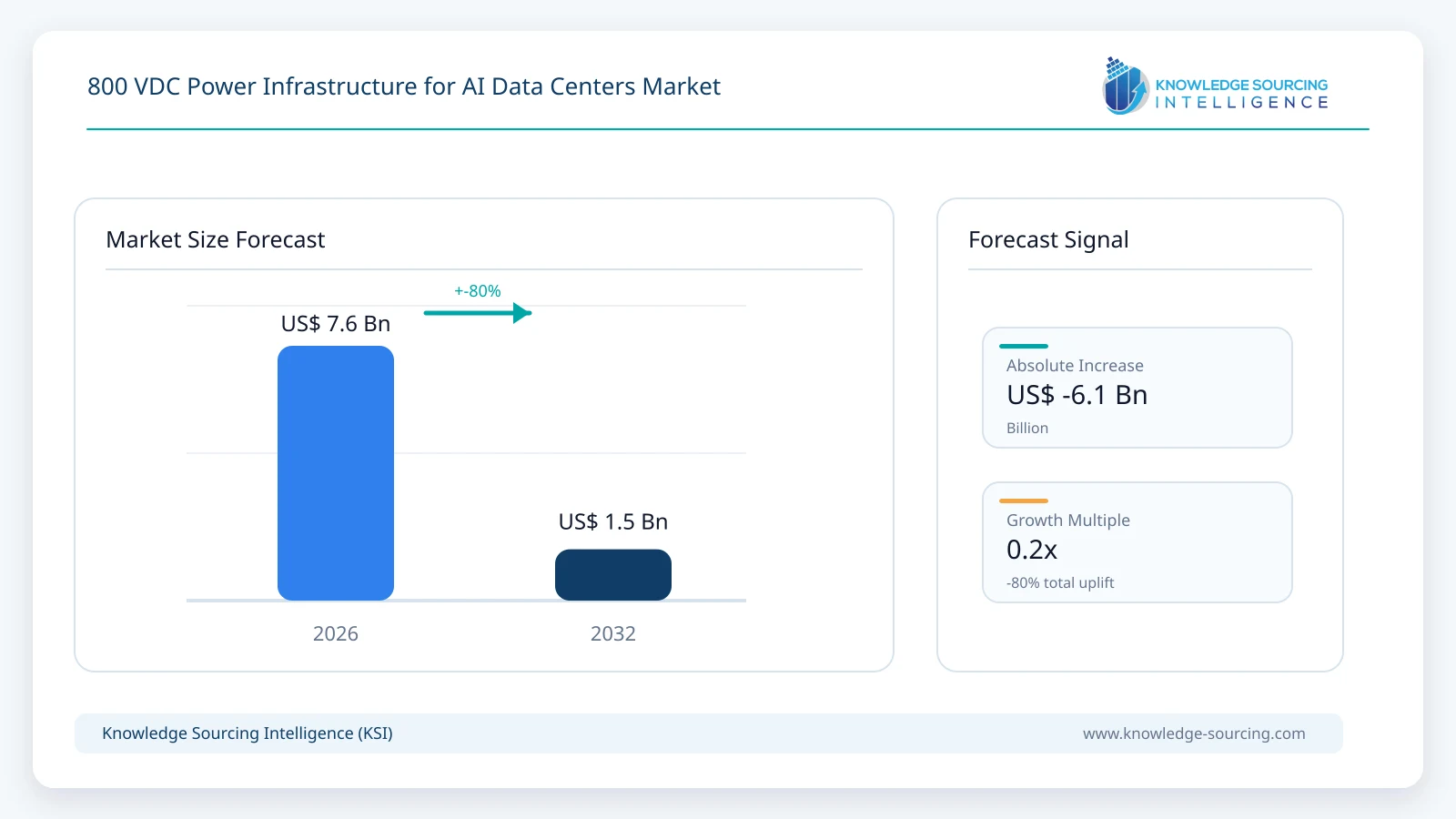
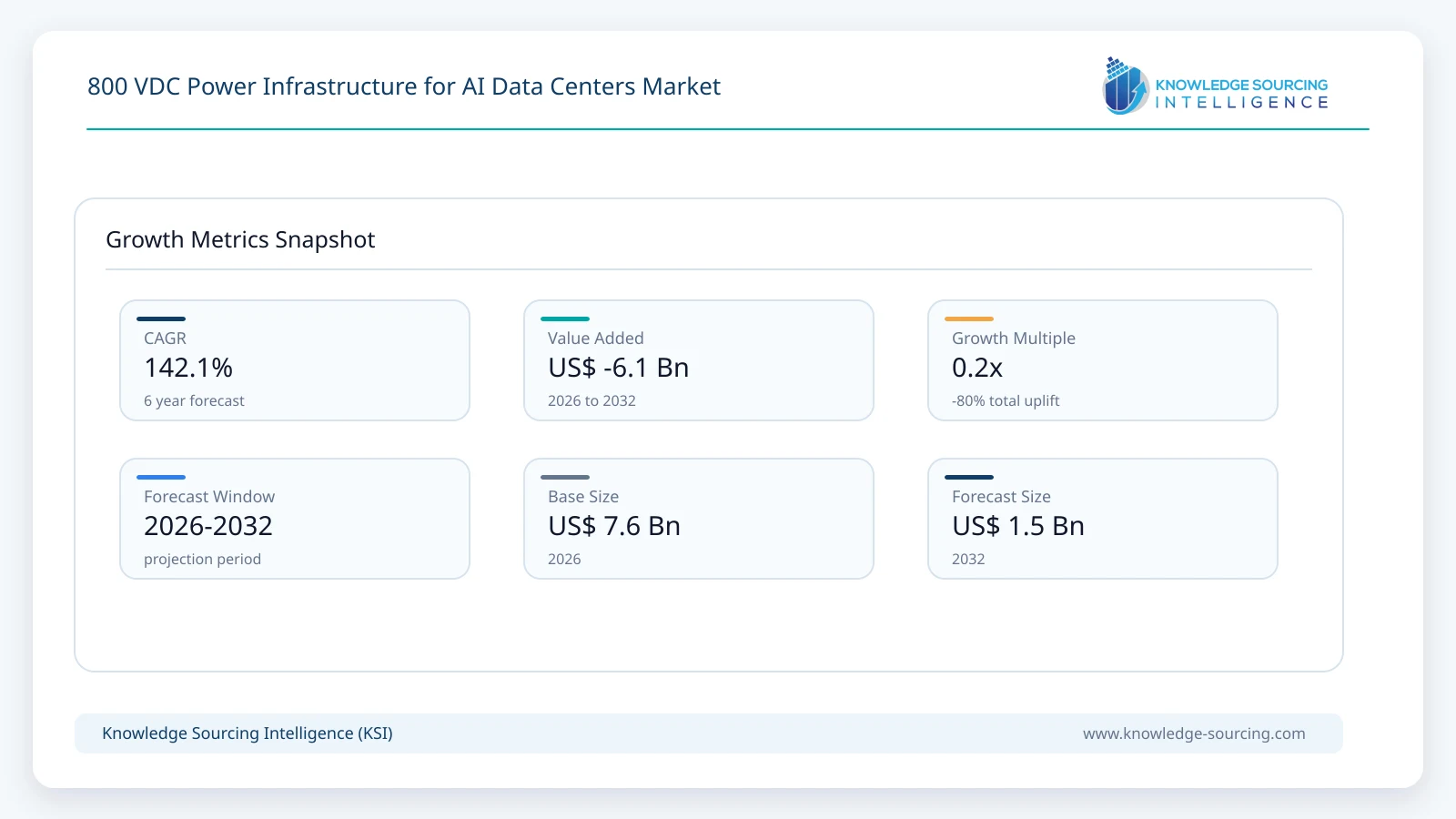
The global 800 VDC power infrastructure market is forecast to grow at a CAGR of 142.1%, reaching USD 1,530.00 million in 2032 from USD 7.60 million in 2026.
Key Highlights
• The market is entering commercial deployment as high-density AI racks create demand for a new power distribution architecture.
• AC-fed side power racks offer the clearest near-term adoption route because operators can preserve much of their existing upstream electrical infrastructure.
• Row-level 800 VDC distribution is expected to expand as operators design larger, dedicated clusters around common DC power systems.
• Safety certification, DC fault protection and interoperability are becoming decisive factors in equipment procurement.
• Suppliers are developing opportunities across conversion equipment, DC busways, connectors, protection devices and rack-level electronics.
Growth is closely linked to the availability of compatible AI computing racks and the qualification of the electrical systems supplying them. Initial spending focuses on dedicated power racks that work with existing AC infrastructure. As the technology matures, purpose-built facilities are expected to make greater use of row-level DC distribution and integrated power conversion.
Commercial activity advanced during 2026. NVIDIA, Google and Microsoft are working through the Open Compute Project to align interfaces and operating requirements for high-voltage DC systems. NVIDIA has outlined AC-fed power racks for the near term and row power centers for the next stage of development. In July 2026, Chindata announced commercial operation of a 10 kV AC-to-800 VDC conversion installation in China. These developments demonstrate technical progress while underlining the need for wider supplier qualification before deployment scales across AI data centers.
Market Overview
800 VDC demand is concentrated where power density makes existing distribution arrangements increasingly difficult to scale. The technology offers a route to higher-power rows without a proportional increase in conductor bulk or power shelves inside compute racks. However, system architecture is not determined by rack density alone. Operators weigh conversion efficiency, facility space, electrical redundancy, fault isolation and maintenance access when choosing between dedicated AC-fed power racks and more integrated DC designs.
The underlying demand for AI data-center infrastructure continues to expand. The International Energy Agency projects that global data-center electricity consumption could rise from approximately 485 TWh in 2025 to about 950 TWh in 2030. Greater electrical demand increases pressure on grid connections and facility power systems, while newer accelerated-computing platforms are changing the distribution requirements within the data hall. The strongest commercial case for 800 VDC arises when power density, equipment compatibility and site readiness align.
The market covers electrical equipment specific to an 800 VDC AI data-center power path, including AC-to-DC and medium-voltage conversion systems, dedicated distribution hardware, DC protection and switching, rack-level DC-DC modules, energy-storage interface electronics, and associated monitoring and controls. General building switchgear, conventional unmodified AC equipment, generators, battery cells, cooling systems and IT hardware are outside this equipment market. This distinction separates the emerging technology opportunity from the wider expenditure on data-center construction.
Market Drivers
Higher power per rack changes distribution economics
Higher rack power density is the primary technical driver for 800 VDC adoption. As load rises, lower-voltage distribution requires proportionally more current. That increases copper use, cable and connector dimensions, resistive losses and the physical space needed to move power. Higher-voltage DC reduces current for the same delivered power and provides greater design flexibility for dense accelerator systems. NVIDIA has associated the architecture with future megawatt-class AI racks. Electrical design is consequently becoming an earlier part of compute-platform planning, because busway capacity, fault protection, cooling interfaces and service access must be specified before dense IT racks are delivered.
Transition without wholesale facility replacement
Most operating data centers rely on established AC distribution. Replacing the full electrical backbone to support a new rack technology can disrupt operating halls and increase project cost. An AC-fed side power rack offers a narrower transition: the facility continues to provide AC power, while conversion to 800 VDC occurs close to the compute row. This approach can preserve upstream investments and accelerate the introduction of compatible high-density racks. Schneider Electric identifies this architecture as an immediate implementation route, while NVIDIA's product roadmap places compatible power racks ahead of more integrated row-level systems.
Grid constraints increase the value of electrical efficiency
Grid constraints strengthen interest in designs that use available power more effectively. In established data-center clusters, interconnection queues and transformer availability can limit the speed at which operators expand IT capacity. Reducing avoidable conversion stages may improve delivered electrical efficiency, although the benefit depends on the complete topology and its redundancy requirements. When utility capacity is scarce, the commercial value of additional usable compute power can exceed the direct savings in cabling or conversion equipment. This creates incentives to assess the entire power train when specifying a new AI facility.
Power smoothing becomes part of rack-scale design
AI training and inference can create rapid changes in electrical demand. Power smoothing and short-duration energy storage help manage those changes without exposing upstream equipment to equally abrupt fluctuations. An 800 VDC backbone can provide a common interface for suitable storage and power-conversion equipment, potentially simplifying how these functions are coordinated. The design still requires dependable fault protection, thermal management and maintenance procedures. The opportunity is therefore strongest for suppliers that can combine fast power control with robust system-level protection.
Market Restraints
Safety and qualification are central constraints on adoption. Unlike AC currents, DC currents do not cross zero during each cycle, which changes how arcs and faults must be interrupted. Large 800 VDC systems require coordinated grounding, selective isolation, suitable breakers, safe service disconnects and proven protection under rapidly changing loads. UL Solutions introduced a certification program for medium-voltage solid-state power supplies in September 2026 based on UL 2877. Wider deployment nevertheless depends on the qualification of complete systems, including converters, busways, cabling and rack interfaces.
Hardware roadmaps do not immediately translate into data-center orders. Operators need compatible accelerators, liquid-cooling capacity, qualified electrical equipment and an energized facility at the same time. Delays in any of these areas can defer 800 VDC procurement. Established AC architectures also remain practical for conventional and lower-density workloads. The transition is therefore expected to proceed through dedicated high-density clusters before spreading to larger DC distribution zones.
Segmentation Analysis
By Power Architecture
The market is segmented into AC-to-800 VDC side power racks, row-level DC distribution and direct medium-voltage AC-to-800 VDC facility architectures. Side power racks offer the most immediate commercial opportunity because they allow an operator to introduce high-density AI systems without redesigning the building's complete electrical network. Power is converted close to the compute row, where relatively short DC distribution runs can serve compatible racks. This reduces the extent of upstream work and allows new compute capacity to be added within existing halls or facilities that are already under construction. The decision is particularly attractive when the owner has adequate incoming power but limited space or time for major electrical alterations.
The economic case depends on installation complexity as much as on converter efficiency. Operators must assess upstream capacity, rack adjacency, fault protection, battery ride-through and the availability of trained maintenance personnel. Larger greenfield deployments can consider row power centers and dedicated DC busways, which shift conversion away from individual equipment rows and allow a more integrated distribution layout. Direct medium-voltage conversion extends this approach by eliminating intermediate conversion stages, but it introduces additional protection and qualification challenges. Siemens and Reinhausen have announced development of a modular transformer accepting grid voltages up to 36 kV and producing 800 VDC. Chindata's commercial installation illustrates the potential of this architecture, although broader procurement will depend on operating experience and interoperability.
By Component
By component, demand spans conversion systems, DC distribution hardware, circuit protection, rack-level DC-DC modules, energy-storage interfaces, and monitoring and controls. Power conversion is the foundation of every installation because facility electricity must be delivered at a controlled 800 VDC level before it reaches computing equipment. For AC-fed side power racks, the main requirements are high-efficiency conversion, modular scalability, cooling, redundancy and rapid field service. In larger row and facility designs, converter selection also determines where electrical losses occur, how power is routed to multiple racks and which equipment must be isolated during maintenance.
Commercial product development is advancing across these functions. Delta has disclosed a 660 kW 800 VDC in-row power rack with battery backup and high stated AC-to-DC efficiency, while LITEON demonstrated an 800 VDC liquid-cooled power rack and compatible power shelves at COMPUTEX 2026. Such products connect the new architecture to familiar modular maintenance practices. Equally important is DC protection: high-energy faults must be detected and interrupted quickly without unnecessarily shutting down adjacent equipment. As distribution expands beyond a dedicated rack or row, protection coordination, monitoring and system integration become more demanding. Suppliers able to offer tested combinations of conversion, switching and control equipment can reduce the implementation burden for customers.
By Customer Type
Customer demand is led by hyperscale cloud providers and specialist AI compute operators, with additional opportunities in colocation, sovereign AI facilities and high-performance computing. Hyperscalers are particularly influential because they specify accelerator platforms, electrical interfaces, serviceability requirements and long-term deployment patterns. Their purchasing decisions can establish common technical requirements across multiple facilities and equipment suppliers. GPU-cloud providers often place greater weight on time to energized compute capacity, making modular conversion equipment attractive when the upstream AC network is already available.
For colocation operators, adoption depends on contracted tenant requirements rather than the total size of a campus. A hall serving conventional workloads may have little reason to adopt 800 VDC, while a dedicated accelerator tenant may justify a high-voltage DC zone. Greenfield operators can evaluate integrated distribution at the design stage, whereas operators of existing buildings may favor side power racks to reduce reconstruction. Across customer groups, equipment reliability, compatibility with IT roadmaps and responsibility for maintenance are likely to determine purchasing decisions more strongly than the voltage specification alone.
Regional Analysis: North America
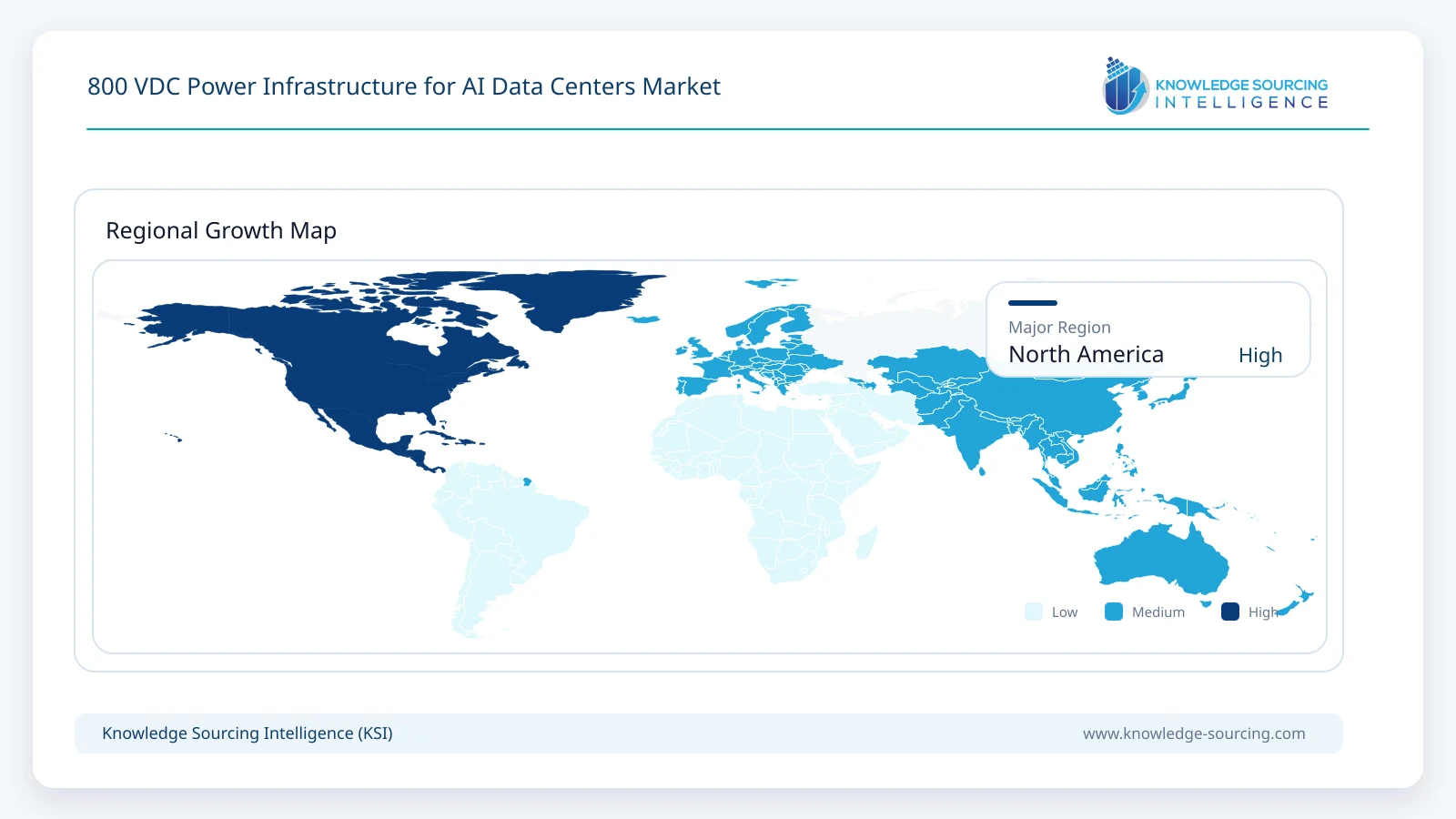
North America is positioned as an important early commercialization region because major AI platform companies, hyperscale cloud providers and electrical infrastructure suppliers are active in high-density power architecture development. The United States has a broad pipeline of AI data-center projects where electrical system design is increasingly tied to the requirements of accelerated computing. Nevertheless, the most immediate market opportunities are associated with projects that have confirmed utility capacity, qualified high-density racks and a defined commissioning schedule. Equipment suppliers therefore benefit when they can support design, installation and operational qualification together.
Grid availability and construction sequencing shape purchasing decisions across major U.S. data-center clusters. In existing facilities, operators may prefer AC-fed 800 VDC power racks because this allows a high-density compute row to be introduced without reopening the whole electrical design. At new campuses, developers can evaluate DC busways, segmented protection zones and centralized conversion equipment before civil construction is complete. The choice affects floor-space utilization, spare-capacity planning, maintenance access and the ability to upgrade compute racks without replacing electrical equipment each generation.
Commercial progress also depends on supplier readiness. North American buyers require clear evidence of DC fault interruption, power quality under transient AI loads, redundancy behavior and replacement-part availability. They also need compatible equipment from multiple suppliers to avoid dependence on a single converter or connector design. Open architecture development through the Open Compute Project can reduce these barriers, while the existing base of electrical engineering and data-center service providers supports implementation. This combination of customer concentration and systems-integration capability underpins the region's early market opportunity.
Competitive and Technology Landscape
The competitive environment includes facility-level electrical suppliers, rack-power manufacturers and component specialists. ABB, Delta Electronics, Eaton, LITEON Technology, Schneider Electric, Siemens and Vertiv participate in power architecture and system supply. Infineon, Analog Devices, Monolithic Power Systems, Navitas, onsemi, Renesas, ROHM, STMicroelectronics and Texas Instruments provide power semiconductor, control and conversion capabilities. Reinhausen is active in medium-voltage solid-state transformer development, and SolarEdge is collaborating with Infineon on solid-state protection technologies. NVIDIA, Google and Microsoft are shaping system requirements through platform and standards work, rather than occupying the same equipment-supplier role.
Competitive differentiation is likely to rest on system reliability and the ability to support deployment at scale. Customers need power systems that can sustain changing AI loads, selectively isolate faults, fit serviceable layouts and remain maintainable through successive compute generations. Broad electrical manufacturers can integrate upstream power and protection, while specialists can differentiate through high-density conversion modules, silicon-carbide and gallium-nitride devices, and fast electronic switching. Demonstrated interoperability and lifecycle support will become as important as efficiency or power density alone.
Recent Developments
In July 2026, Chindata, Meituan, HEC Group and Delta reported commercial operation of a 10 kV AC-to-800 VDC solid-state transformer system at Chindata's Sangyuan campus following performance and safety testing. In August, the Open Compute Project described alignment among Google, Microsoft and NVIDIA on common 800 VDC interfaces. NVIDIA also outlined the progression from AC-fed power racks toward row power centers and, eventually, direct medium-voltage power blocks. Together, these developments demonstrate the transition from power architecture design to equipment development and selected commercial deployment.
In September 2026, ABB introduced its Infinitus direct-current power portfolio, covering conversion, distribution and protection technologies. Infineon and SolarEdge described collaboration on solid-state circuit breakers, while Infineon and Eaton outlined cooperation on silicon-carbide technology for medium-voltage solid-state transformers. UL Solutions launched a certification program for medium-voltage solid-state power supplies based on UL 2877. These initiatives broaden the available technology base and help operators evaluate suppliers against emerging safety and performance requirements.
800 VDC Power Infrastructure for AI Data Centers Market Scope:
| Report Metric | Details |
|---|---|
| Total Market Size in 2026 | USD 7.6 million |
| Total Market Size in 2032 | USD 1.53 billion |
| Forecast Unit | USD Billion |
| Growth Rate | 142.1% |
| Study Period | 2021 to 2032 |
| Historical Data | 2021 to 2024 |
| Base Year | 2025 |
| Forecast Period | 2026 – 2032 |
| Segmentation | Power Architecture, Component, Rack Power Density, Customer Type, Geography |
| Companies |
|
Market Segmentation
By Power Architecture
AC-to-800 VDC Side Power Racks
Row-Level 800 VDC Distribution
Direct MVAC-to-800 VDC Facility Architecture
By Component
Power Conversion Systems
AC-to-DC Power Racks
Transformer-Rectifier Units
Solid-State Transformers
DC Distribution Equipment
Busway and Busbar
Cable, Connectors and Terminations
DC Protection and Switching
Rack-Level DC-DC Conversion
Energy Storage and DC UPS Interfaces
Monitoring and Control
By Rack Power Density
100–250 kW Rack Power Systems
250–500 kW Rack Power Systems
Above 500 kW and Megawatt-Class Racks
By Customer Type
Hyperscale Cloud Providers
AI Compute and GPU Cloud
Colocation Operators
Sovereign AI Infrastructure
Enterprise and High-Performance Computing
By Geography
North America
United States
Canada
China
Asia Pacific Excluding China
India
Japan and South Korea
Southeast Asia and Australia
Europe
Middle East and Rest of World
Table of Contents
1. EXECUTIVE SUMMARY
1.1. Market Opportunity and Key Findings
1.2. Global Market Outlook
1.3. Commercialization Milestones
1.4. Supplier Opportunity and Customer Implications
2. RESEARCH SCOPE AND METHODOLOGY
2.1. Market Definition and System Boundary
2.2. Included Components and Equipment
2.3. Exclusions and Revenue Allocation
2.4. Market Estimation Approach
2.5. Adoption and Deployment Assumptions
2.6. Equipment Scope and Valuation
2.7. Forecast Sensitivity
3. AI DATA CENTER POWER ARCHITECTURE
3.1. Conventional AC and Low-Voltage DC Systems
3.2. 800 VDC Power Quality and Interface Requirements
3.3. AC-to-800 VDC Side Power Rack
3.4. Row Power Center and DC Busway
3.5. Direct Medium-Voltage AC-to-800 VDC Conversion
3.6. Rack-Level DC-DC Architecture
3.7. Energy Storage, Ride-Through and Load Smoothing
3.8. Grounding, Fault Protection and Safe Maintenance
4. MARKET SIZE AND FORECAST
4.1. Global Equipment Revenue
4.2. AI Infrastructure Demand Indicators
4.3. Adoption and Commercial Readiness
4.4. Power Infrastructure Demand Outlook
4.5. Equipment Spending Drivers
4.6. Forecast Sensitivity
5. RACK POWER DENSITY AND DEPLOYABLE CAPACITY
5.1. AI Rack Density Roadmap
5.2. 100–250 kW Rack Power Systems
5.3. 250–500 kW Rack Power Systems
5.4. Above 500 kW and Megawatt-Class Racks
5.5. Power Infrastructure Requirements by Rack Density
6. MARKET DYNAMICS
6.1. Accelerator Density and Electrical Distribution
6.2. Copper Use, Losses and Layout Economics
6.3. Retrofit Versus Greenfield Investment
6.4. Grid Connection and Site Energization
6.5. Load Transients and Energy Storage
6.6. Electrical Safety and Certification
6.7. Equipment Availability and Supplier Qualification
7. MARKET BY POWER ARCHITECTURE
7.1. AC-to-800 VDC Side Power Racks
7.2. Row-Level 800 VDC Distribution
7.3. Direct MVAC-to-800 VDC Facility Architecture
7.4. Deployment Considerations by Architecture
8. MARKET BY COMPONENT
8.1. Power Conversion Systems
8.1.1. AC-to-DC Power Racks
8.1.2. Transformer-Rectifier Units
8.1.3. Solid-State Transformers
8.2. DC Distribution Equipment
8.2.1. Busway and Busbar
8.2.2. Cable, Connectors and Terminations
8.3. DC Protection and Switching
8.4. Rack-Level DC-DC Conversion
8.5. Energy Storage and DC UPS Interfaces
8.6. Monitoring and Control
8.7. Component Compatibility and Qualification
9. MARKET BY CUSTOMER TYPE
9.1. Hyperscale Cloud Providers
9.2. AI Compute and GPU Cloud
9.3. Colocation Operators
9.4. Sovereign AI Infrastructure
9.5. Enterprise and High-Performance Computing
9.6. Customer Adoption Criteria
10. REGIONAL MARKET
10.1. North America
10.1.1. United States
10.1.2. Canada
10.2. China
10.3. Asia Pacific Excluding China
10.3.1. India
10.3.2. Japan and South Korea
10.3.3. Southeast Asia and Australia
10.4. Europe
10.5. Middle East and Rest of World
10.6. Regional Deployment Readiness
11. TECHNOLOGY AND COMMERCIAL READINESS
11.1. Product Availability and Qualification
11.2. OCP Interface and Architecture Alignment
11.3. DC Protection and UL 2877
11.4. Medium-Voltage Solid-State Transformer Roadmap
11.5. Brownfield and Greenfield Readiness
11.6. Deployment Timeline and Procurement Risks
12. COMPETITIVE ENVIRONMENT
12.1. Value Chain and Procurement Roles
12.2. System-Level Power Infrastructure Suppliers
12.3. Power Shelf and DC-DC Module Suppliers
12.4. Semiconductor and Protection Suppliers
12.5. Partnerships and Technical Specifications
12.6. Product-Readiness and Capability Comparison
13. COMPANY PROFILES
13.1. ABB
13.2. Analog Devices
13.3. Delta Electronics
13.4. Eaton
13.5. Infineon Technologies
13.6. LITEON Technology
13.7. Monolithic Power Systems
13.8. Navitas Semiconductor
13.9. onsemi
13.10. Reinhausen (Maschinenfabrik Reinhausen)
13.11. Renesas Electronics
13.12. ROHM Semiconductor
13.13. Schneider Electric
13.14. Siemens
13.15. SolarEdge Technologies
13.16. STMicroelectronics
13.17. Texas Instruments
13.18. Vertiv
14. APPENDIX
14.1. Definitions and Units
14.2. Equipment Classification and Scope
14.3. Forecast Methodology
14.4. Source Documentation
14.5. Abbreviations
Navigate
Trusted by the world's leading organizations











