
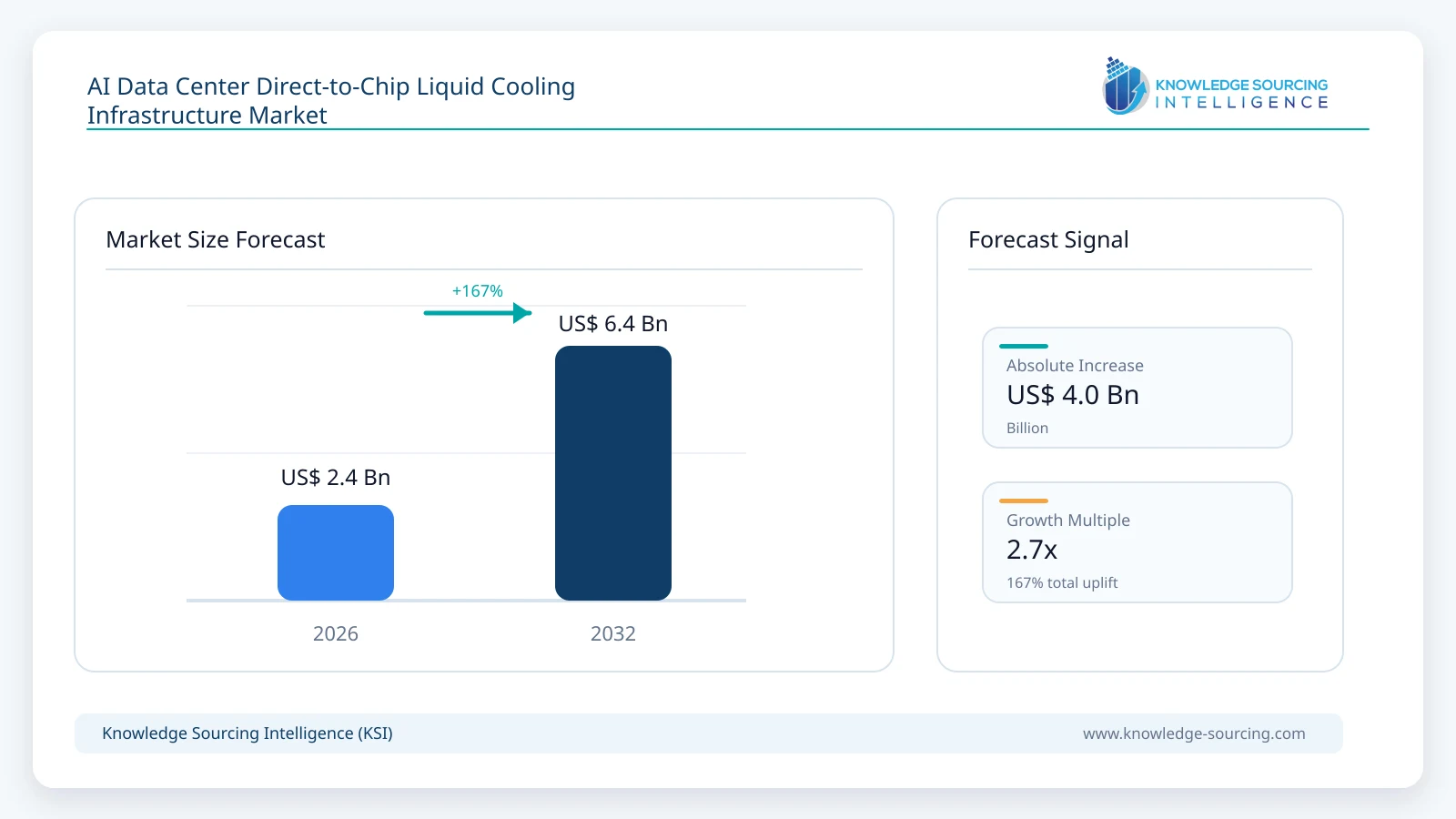
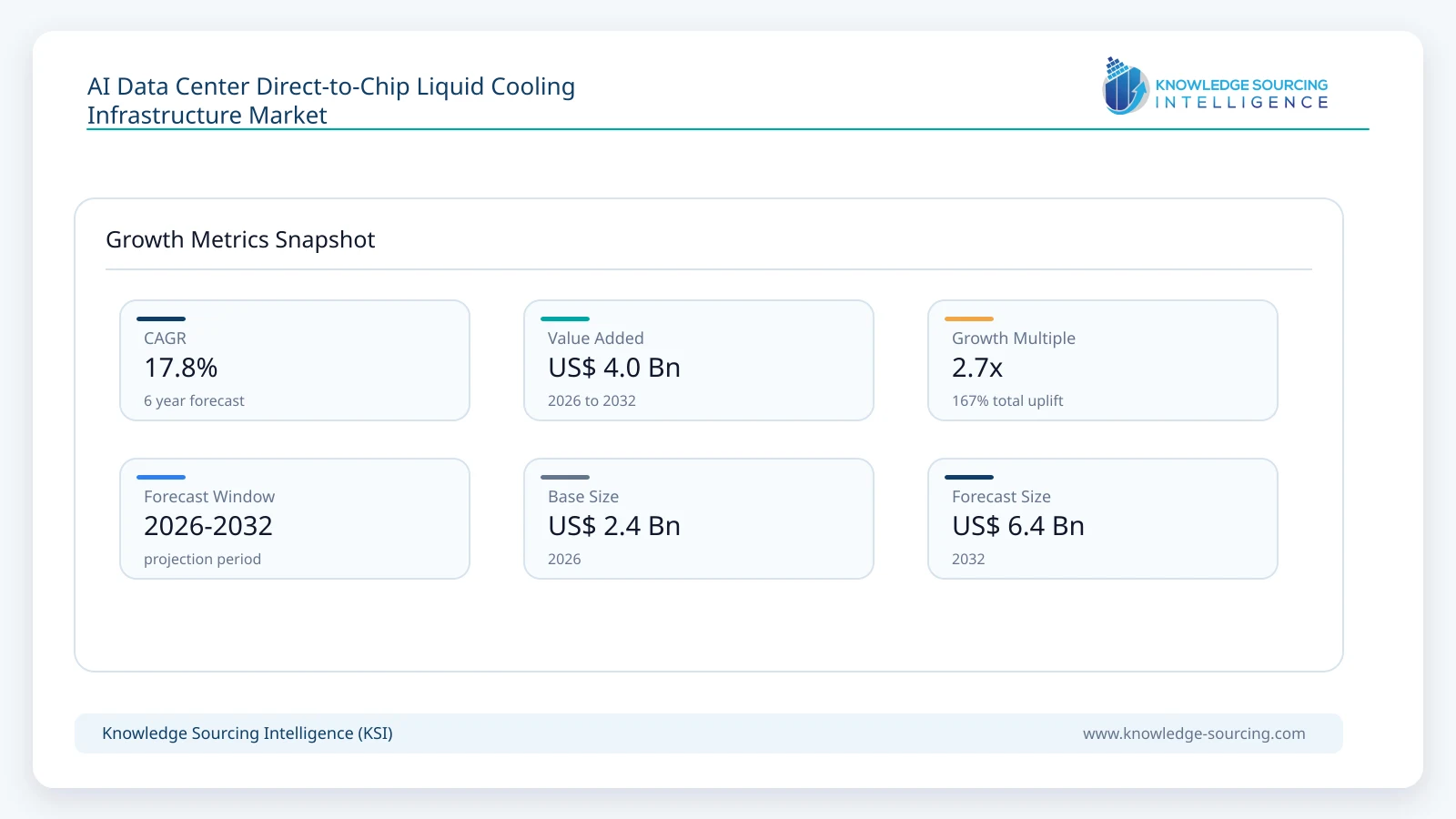
The global AI data center direct-to-chip liquid cooling infrastructure market at USD 2.4 billion in 2026, increasing to USD 6.4 billion by 2032, at a compound annual growth rate of 17.8% during the forecast period.
Highlights:
- 1NVIDIA’s GB200 NVL72 design provides a practical 120 kW rack-level reference for liquid cooling, showing why thermal architecture is now specified alongside the computing platform.
- 2Motivair introduced a 2.5 MW CDU in January 2026, while Vertiv lists liquid-to-liquid CDU configurations up to 2.3 MW, enabling several dense racks to share redundant thermal equipment.
- 3Ecolab completed its acquisition of CoolIT Systems for approximately USD 4.75 billion in July 2026, bringing cold plates and CDUs into a broader fluid-management platform.
- 4The primary procurement constraint is integration across servers, fluids, CDU redundancy and facility-water interfaces, not maximum nameplate cooling capacity alone.
- 5Brownfield sites can add high-density liquid-cooled capacity through in-row and liquid-to-air CDUs, but existing heat-rejection capability remains a binding limitation.
- 6Single-phase water-based cold plates lead mainstream deployments, while two-phase designs target selected heat-flux, warm-water and deployment-complexity requirements.
The growth is being driven by the new AI capacity requirements increasingly needing direct-to-chip thermal infrastructure. Commercial purchasing is shifting from stand-alone components toward qualified thermal chains. AI operators increasingly select cold plates, CDUs, quick-disconnect couplings, secondary loops and service processes as an interdependent system. The transition is also reshaping supplier positioning: Ecolab completed its acquisition of CoolIT Systems in July 2026; Schneider Electric is scaling Motivair CDU manufacturing; Vertiv, nVent and LiquidStack offer increasingly high-capacity distribution equipment; and specialists including Accelsius and ZutaCore are commercializing two-phase alternatives. Performance claims are only commercially relevant where equipment can be manufactured consistently, commissioned repeatably and operated without jeopardizing expensive compute assets.
Market Overview
The economic case begins at rack density; with the rising chip power, a facility cannot indefinitely compensate by increasing fan speeds and circulating more room air. Heat must instead be removed at the device, routed through sealed server and rack manifolds, and transferred through a CDU to the facility system. NVIDIA’s 120 kW reference rack makes the interdependence tangible: a cooling fault affects an entire integrated compute platform, so redundancy, rapid isolation, quick-disconnect durability and fluid quality become availability requirements rather than minor mechanical specifications.
CDU design has advanced from equipment serving individual racks to systems capable of supporting full rows and pods. Motivair’s January 2026 MCDU-70 is rated at up to 2.5 MW; Vertiv’s CoolChip family extends to a 2.3 MW liquid-to-liquid model; and nVent markets an 800 kW RackChiller CDU for direct-to-chip applications. These capacities cannot be compared without considering supply and return temperatures, approach temperatures, pressure drop, pump redundancy and the expected ratio between nominal and actual thermal load. A purchaser choosing a higher-capacity CDU can consolidate equipment and maintenance, but may also create a larger fault domain unless backup and isolation are designed correctly.
The shift also changes the equipment bill for the server manufacturer. A cold plate must hold junction temperatures within limits while managing coolant flow, pressure losses, corrosion risk, connector tolerances and manufacturability at large volumes. CoolIT demonstrated a 15 kW single-phase cold plate in June 2026, nearly four times the capability of its earlier demonstrated design. The advance signals additional engineering headroom for future accelerators, but utility depends on repeatable production and reliable interfaces across the complete rack, not only peak laboratory thermal performance.
Direct-to-chip deployments that target processors alone still leave memory, networking, storage and power-electronics heat for air systems. CoolIT illustrates that a 250 kW rack with a 70:30 liquid-to-air split would leave a 75 kW air load. This makes near-total heat capture commercially important at higher density, even where the technology remains single phase. Suppliers capable of extending liquid loops beyond CPUs and GPUs gain a broader equipment opportunity, but must also manage additional connections, service points and coolant compatibility requirements.
Market Drivers
High-Density AI Platforms and the Cost of Residual Heat
Liquid cooling adoption is driven by the heat removed per rack and the consequences of that heat for floor space and operating efficiency. A 120 kW GB200 NVL72 rack already concentrates the thermal duty that previously would have been distributed across numerous lower-density racks. At 250 kW, even 30% residual air cooling implies 75 kW of air-side capacity at a single rack. Providing that airflow, pressure management and localized heat removal can offset some of the floor-area and power benefits of dense accelerator deployment. Operators therefore increasingly seek complete rack thermal designs with high liquid heat capture rather than treating the cold plate as an optional processor accessory.
Time-to-Compute and Repeatable Commissioning
Data centers earn revenue from operational compute rather than installed pipework. A high-density rack that arrives before its fluid systems are commissioned cannot be put into service at rated performance. Consequently, procurement favors pre-engineered distribution skids, standardized hose routing, tested cold-plate assemblies and verified facility interfaces. Supermicro now offers integrated racks with CDUs, manifolds and cold plates, while OCP workstreams address coolant fluids, wetted materials, quick-disconnect specifications and test practices. The competitive advantage is reduced commissioning variability and fewer late-stage incompatibilities between server and mechanical contractors.
Existing Facility Reuse and Brownfield Economics
Established facilities often possess a grid connection and mechanical infrastructure that are difficult to replicate. In-rack, in-row and liquid-to-air CDU architectures allow operators to introduce liquid-cooled clusters in stages. However, the retrofit cannot be evaluated by CDU capital cost alone: the amount of heat ultimately rejected through existing facility systems, available chilled-water temperatures, floor loading, leak containment and maintenance access determine whether an installation is viable. A retrofit that requires a major heat-rejection or electrical overhaul may lose its time-to-market advantage over a purpose-built hall.
Market Restraints
Reliability, Fluid Qualification and Ownership of the Complete Loop
Direct liquid cooling crosses the warranty boundary between servers and buildings. A poorly qualified seal, contaminated fluid or pressure transient can affect multiple high-value compute assemblies. Operators therefore require defined responsibility for filling, flushing, filtration, leak detection, corrosion control, service procedures and spares. OCP’s ongoing work on coolants, wetted materials and standardized couplings responds directly to these procurement barriers. Suppliers able to qualify the complete technology cooling system and provide field support can command preference even when individual components are not the cheapest.
Facility Water and Heat-Rejection Limits
A CDU transfers heat; it does not make the thermal load disappear. The capacity of a facility water system, dry cooler, chiller or other heat-rejection path must be adequate at the design operating temperatures. Warm-water direct-to-chip designs can improve the opportunities for economization and reduce chiller dependence in suitable climates, but such benefits are site- and temperature-dependent. Planning must account for ambient weather, simultaneous peak load, redundant equipment and water availability rather than assuming cooling-energy savings for every liquid-cooled installation.
Capital Efficiency and Commercial Adoption Outside AI
Most general-purpose enterprise server rooms still lack the rack power density that forces a change to liquid cooling. Uptime Institute observed in 2026 that direct liquid cooling remained concentrated in high-density applications and was unlikely to become broadly mainstream in conventional mission-critical IT within three years. This limits a uniform adoption model across all data-center racks and makes accelerator-heavy deployments, rather than total rack counts, the more relevant demand base.
Segmentation Analysis
By Component
The market is segmented into coolant distribution units; cold plates and server loops; rack and row manifolds; pumps and heat exchangers; quick disconnects and fluid connections; dedicated secondary distribution networks; and filtration, sensors, leak detection and controls. CDUs are a central procurement category because they define temperature and pressure control between the technology cooling system and facility water. An operator must decide whether to distribute redundancy by rack, row or pod. A centralized 2.5 MW CDU can reduce equipment duplication, but may increase the consequences of a common-mode failure; smaller CDUs isolate rack clusters at the cost of additional maintenance points and space.
Cold plates and associated server loops are the other critical source of differentiated performance. Greater heat flux puts pressure on microchannel design, flow distribution and hydraulic resistance. CoolIT’s 15 kW demonstration reflects potential thermal headroom, while Flex-owned JetCool reported a direct-to-chip development with Broadcom for multi-kilowatt AI accelerators and device heat flux of 4 W/mm² in March 2026. These demonstrations influence design-in decisions for future server generations, but the commercial purchase order depends on reliability qualification, repeatable yields, price and integration into the OEM’s production line. Manifolds and connectors should not be treated as commodity afterthoughts because they determine safe service access, pressure loss and rack replacement time.
By Cooling Architecture
Single-phase direct-to-chip cooling remains the established architecture for high-volume deployments because water-based and compatible glycol-containing loops build on extensive high-performance-computing experience and a large component ecosystem. Two-phase direct-to-chip uses fluid vaporization and condensation at or near the heat source. Accelsius made its 150 kW integrated two-phase IR150 system generally available in April 2026, while ZutaCore continues developing its waterless direct-to-chip cold-plate systems. Selection depends on working-fluid compliance, service procedures, operating temperatures and the cost of integrating the full loop. These alternatives should not be assumed to displace single-phase systems across all AI racks.
By CDU Deployment Form Factor
In-rack CDUs serve contained deployments where operators prioritize a small fault domain or lack row-level distribution. In-row designs balance centralized equipment with incremental expansion across several racks. Perimeter and facility-level CDUs consolidate pumping and heat exchange for larger AI pods where network piping, control strategy and redundancy can be engineered together. The engineering trade-off is not simply cooling nameplate capacity: operators must weigh flow head, maintenance accessibility, power availability, and the consequences of a distribution outage.
By Rack-Density Class and Customer Type
The study distinguishes 100–250 kW, 250–500 kW and above-500 kW configurations, using the ranges to frame infrastructure requirements rather than to assert that each tier is already deployed at scale. The initial commercial base is concentrated in high-density hyperscale and GPU-cloud clusters. Colocation providers increasingly need liquid-ready suites because tenants may bring different server designs and service expectations. Sovereign AI and public HPC facilities typically place additional weight on resilience, long equipment lifetimes and maintainability. Above 250 kW, residual air duty becomes an increasingly important design constraint, shifting purchases toward broader component liquid-cooling coverage and larger secondary loop capabilities.
Regional Analysis: North America
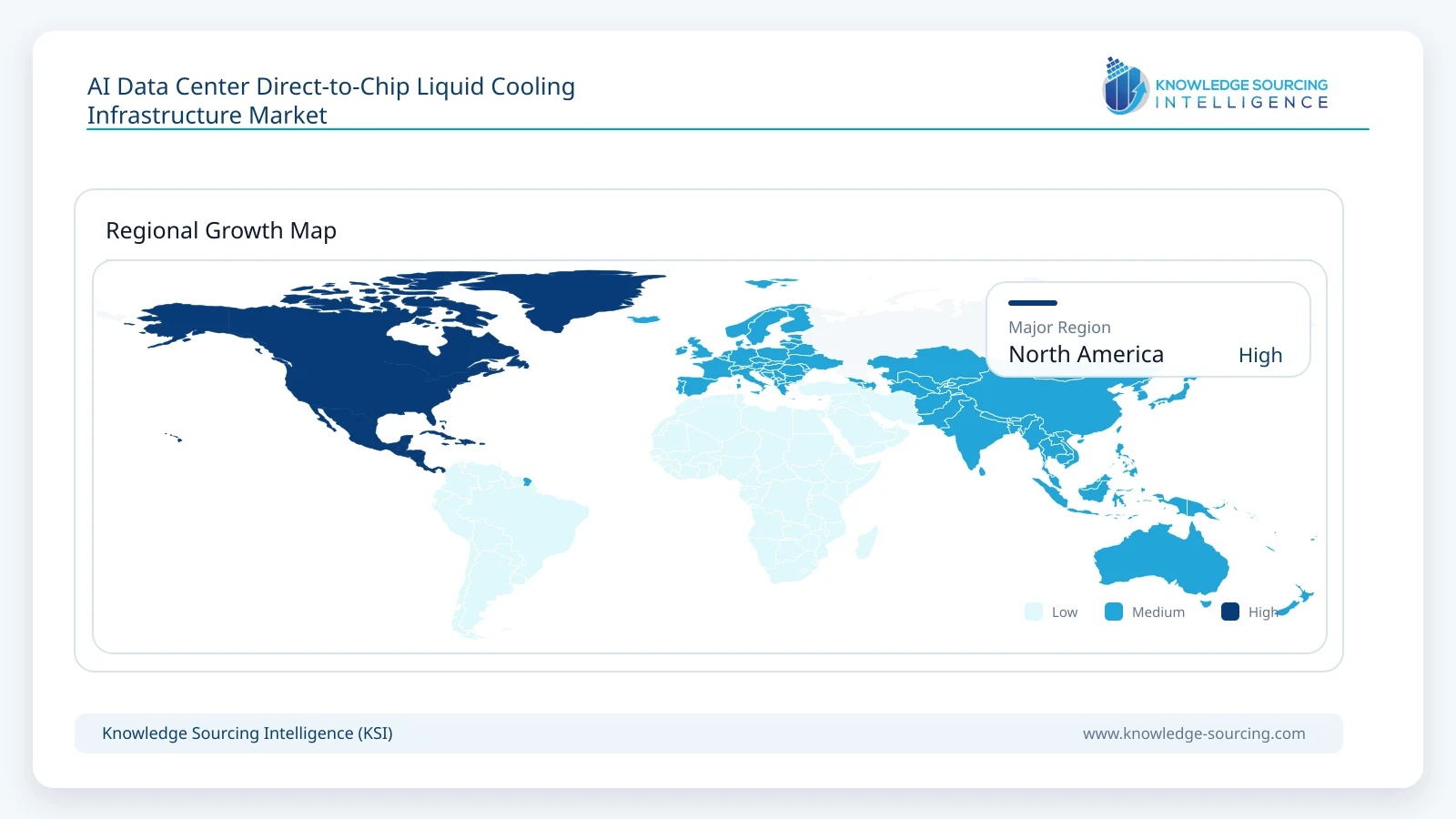
North America is the strongest near-term commercial center for this market because a high concentration of GPU infrastructure buyers and thermal-equipment developers is located in the United States and Canada. The International Energy Agency reported that global AI-focused data-center electricity consumption increased 50% in 2025 and expects AI-focused demand to triple between 2025 and 2030. North American operators are at the forefront of procurement decisions that determine whether liquid cooling is integrated by server OEMs, supplied as an independent mechanical package or purchased as a complete rack-and-row architecture.
Commercialization is visible in both products and corporate investment. Ecolab closed the CoolIT Systems acquisition for approximately USD 4.75 billion in July 2026, after previously citing approximately USD 550 million of expected CoolIT sales over the ensuing 12 months. That disclosed commercial scale provides evidence of a material direct-liquid-cooling supplier revenue pool, while highlighting the attraction of integrating cold-plate hardware with fluid chemistry, monitoring and services. Vertiv, Schneider Electric’s Motivair business, nVent, LiquidStack and specialist cold-plate firms compete on different portions of that thermal chain.
Deployment pressure is greatest where hyperscale and GPU-cloud construction concentrates unusually high IT load at a limited number of campuses. Utilities and grid operators can delay electrical energization, making the ability to commission cooling at the exact moment a compute cluster becomes available an operational constraint. For brownfield colocation sites, the value proposition is different: a phased liquid retrofit can bring higher-density tenants into an existing property, provided primary water, heat rejection, mechanical space and maintenance procedures are sufficient. That distinction affects product selection, project risk and the mix of integrated versus modular supply contracts.
Competitive and Technology Landscape
The supplier base is broader than a traditional chiller market because procurement spans chip-level hardware, rack assemblies, fluid distribution and mechanical interfaces. Schneider Electric (Motivair), Vertiv, Ecolab (CoolIT Systems), Delta Electronics, LiquidStack, Modine (Airedale), STULZ, nVent and Rittal provide different portions of the CDU and fluid-network chain. Boyd supplies thermal components; Supermicro integrates rack-scale liquid cooling with its server platforms. Flex (JetCool), Daikin Applied (Chilldyne), Accelsius and ZutaCore pursue differentiated direct-to-chip technologies, including precision microfluidic and two-phase architectures. These suppliers compete in overlapping equipment categories, but are not interchangeable across every cooling architecture.
The competitive test is whether a provider can supply a qualified, maintainable thermal system at a dependable scale. Ecolab’s acquisition positions CoolIT within a wider fluid-management offering; Flex’s ownership of JetCool connects chip-level thermal design with manufacturing and turnkey server integration; and Daikin’s acquisition of Chilldyne extends its portfolio into negative-pressure cooling. These changes increase the importance of manufacturing reach, service networks and systems responsibility. Other manufacturers including Asia Vital Components, Auras Technology, Envicool and LITEON remain important component or regional ecosystem participants, while Lenovo should be considered principally as an IT system integrator and deployment partner rather than equated with independent cooling-infrastructure suppliers.
Recent Developments
October 2026: ZutaCore announced its Two-Phase Matrix Flow Boiling technology and OmniTherm cold-plate family, extending development of dielectric direct-to-chip heat-transfer designs.
September 2026: CoolIT described its near-total liquid heat-capture roadmap, demonstrating how a 250 kW rack with a 70:30 liquid-to-air split still leaves 75 kW of residual air cooling duty.
July 2026: Ecolab completed its approximately USD 4.75 billion acquisition of CoolIT Systems, broadening its position from water and fluid services to cold plates and CDUs.
June 2026: CoolIT demonstrated a single-phase cold-plate design rated to dissipate 15 kW under demonstration conditions.
June 2026: Flex-owned JetCool launched a liquid-cooled Dell server offering combining cooling infrastructure, commissioning and support.
April 2026: Accelsius announced general availability of its NeuCool IR150, integrating a two-phase CDU and manifolds into a 150 kW rack-level system.
February 2026: Schneider Electric opened a Motivair liquid-cooling manufacturing facility in Bengaluru, adding regional production capacity.
January 2026: Motivair introduced its MCDU-70, rated at up to 2.5 MW and intended for scaled, centrally managed AI cooling deployments.
AI Data Center Direct-to-Chip Liquid Cooling Infrastructure Market Scope:
| Report Metric | Details |
|---|---|
| Total Market Size in 2026 | USD 2.4 billion |
| Total Market Size in 2032 | USD 6.4 billion |
| Forecast Unit | USD Billion |
| Growth Rate | 17.8% |
| Study Period | 2021 to 2032 |
| Historical Data | 2021 to 2024 |
| Base Year | 2025 |
| Forecast Period | 2026 – 2032 |
| Segmentation | Component, Cooling Architecture, CDU Deployment Form Factor, Rack Density, Customer Type, Geography |
| Companies |
|
Market Segmentation
By Component
Coolant Distribution Units
Cold Plates and Server Liquid Loops
Rack and Row Manifolds
Pumps and Heat Exchangers
Quick Disconnects and Fluid Connectors
Secondary Fluid Distribution Networks
Monitoring, Filtration and Leak Detection
By Cooling Architecture
Single-Phase Direct-to-Chip Cooling
Two-Phase Direct-to-Chip Cooling
Hybrid Air-Liquid and Near-Total Heat Capture
By CDU Deployment Form Factor
In-Rack CDUs
In-Row CDUs
Perimeter and Facility-Level CDUs
Redundancy and Service Requirements
By Rack Density
100–250 kW Racks
250–500 kW Racks
Above 500 kW and Megawatt-Class Designs
By Customer Type
Hyperscale Cloud Providers
Neocloud and GPU Cloud Providers
Colocation Operators
Sovereign AI and Public-Sector Compute
Enterprise AI and HPC
By Geography
North America
Europe
China
Asia Pacific Excluding China
Middle East and Rest of World
Table of Contents
1. EXECUTIVE SUMMARY
1.1. Market Opportunity
1.2. Key Findings
1.3. Revenue and Adoption Outlook
1.4. Competitive Positioning
2. RESEARCH SCOPE AND METHODOLOGY
2.1. Market Definition and Revenue Scope
2.2. Equipment Inclusion and Exclusion Criteria
2.3. Annual Liquid-Cooled IT Load Model
2.4. Cooling Equipment Content per MW
2.5. Forecast Methodology and Validation
3. DIRECT-TO-CHIP COOLING TECHNOLOGY
3.1. Thermal Constraints in AI Accelerators
3.2. Cold Plates and Server Loops
3.3. Rack and Row Manifolds
3.4. Coolant Distribution Units
3.5. Facility Water Interface and Heat Rejection
3.6. Coolant Qualification, Filtration and Leak Detection
3.7. Monitoring, Controls and Redundancy
4. MARKET SIZE AND FORECAST, 2026–2032
4.1. Global Market Revenue
4.2. Annual Direct-to-Chip-Cooled IT Load (MW)
4.3. Installed Liquid-Cooled AI IT Capacity
4.4. Equipment Content and Commissioning Demand
4.5. Forecast Sensitivities
5. MARKET BY COMPONENT
5.1. Coolant Distribution Units
5.2. Cold Plates and Server Liquid Loops
5.3. Rack and Row Manifolds
5.4. Pumps and Heat Exchangers
5.5. Quick Disconnects and Fluid Connectors
5.6. Secondary Fluid Distribution Networks
5.7. Monitoring, Filtration and Leak Detection
6. MARKET BY COOLING ARCHITECTURE
6.1. Single-Phase Direct-to-Chip Cooling
6.2. Two-Phase Direct-to-Chip Cooling
6.3. Hybrid Air-Liquid and Near-Total Heat Capture
7. MARKET BY CDU DEPLOYMENT FORM FACTOR
7.1. In-Rack CDUs
7.2. In-Row CDUs
7.3. Perimeter and Facility-Level CDUs
7.4. Redundancy and Service Requirements
8. MARKET BY RACK DENSITY
8.1. 100–250 kW Racks
8.2. 250–500 kW Racks
8.3. Above 500 kW and Megawatt-Class Designs
8.4. Heat-Capture Requirements by Density
9. MARKET BY CUSTOMER TYPE
9.1. Hyperscale Cloud Providers
9.2. Neocloud and GPU Cloud Providers
9.3. Colocation Operators
9.4. Sovereign AI and Public-Sector Compute
9.5. Enterprise AI and HPC
10. REGIONAL MARKET
10.1. North America
10.2. Europe
10.3. China
10.4. Asia Pacific Excluding China
10.5. Middle East and Rest of World
11. MARKET DYNAMICS AND PROCUREMENT ECONOMICS
11.1. Higher Accelerator and Rack Heat Loads
11.2. Time-to-Compute and Commissioning
11.3. Brownfield Retrofit and Heat-Rejection Constraints
11.4. Coolant Qualification and Warranty Boundaries
11.5. Reliability, Serviceability and Total Cost of Ownership
12. TECHNOLOGY AND COMMERCIALIZATION OUTLOOK
12.1. Expanded Liquid Heat Capture
12.2. Warm-Water and Free-Cooling Interfaces
12.3. Single-Phase Cold-Plate Advances
12.4. Two-Phase Direct-to-Chip Systems
12.5. Open Compute Project Interface Specifications
12.6. Manufacturing Scale and Service Infrastructure
13. COMPETITIVE LANDSCAPE
13.1. Technology Cooling System Value Chain
13.2. Integrated Infrastructure Suppliers
13.3. Cold-Plate and Server-Loop Specialists
13.4. Two-Phase and Differentiated Cooling Suppliers
13.5. OEM and Rack-System Integration
13.6. Mergers, Partnerships and Manufacturing Expansion
14. COMPANY PROFILES
14.1. Schneider Electric (Motivair)
14.2. Vertiv
14.3. Ecolab (CoolIT Systems)
14.4. Delta Electronics
14.5. Boyd
14.6. LiquidStack
14.7. Modine (Airedale)
14.8. STULZ
14.9. nVent
14.10. Rittal
14.11. Supermicro
14.12. Flex (JetCool)
14.13. Daikin Applied (Chilldyne)
14.14. Accelsius
14.15. ZutaCore
15. APPENDIX
Navigate
Trusted by the world's leading organizations











