
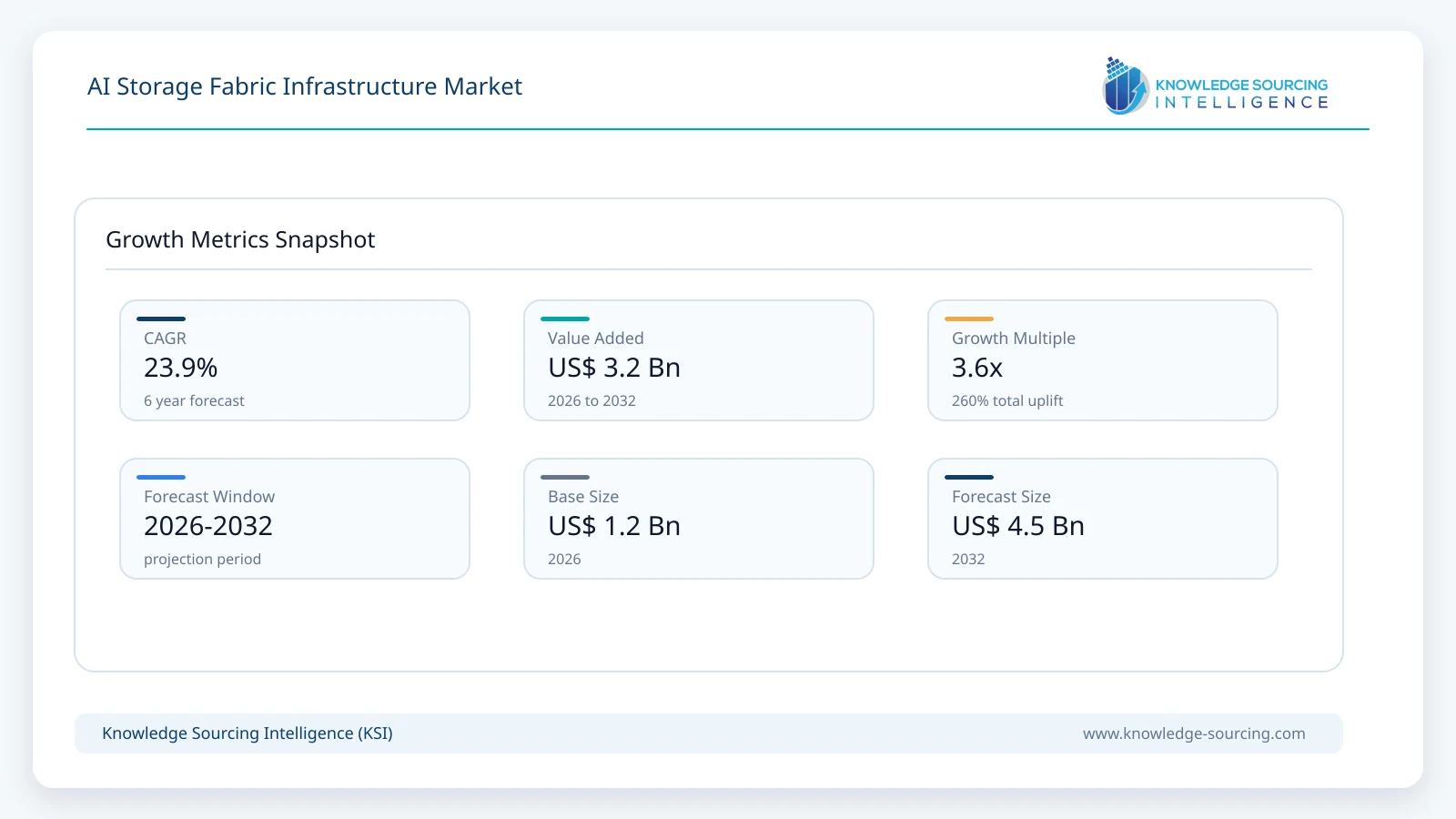
The global AI storage fabric infrastructure market is forecast to grow at a CAGR of 23.9%, reaching approximately USD 4.47 billion by 2032 from USD 1.24 billion in 2026.
Demand is moving beyond additional storage capacity toward the ability to supply accelerators with consistent data throughput, to absorb synchronized training checkpoints and to retrieve inference context without introducing idle time into expensive compute clusters. The market covers the identifiable network and processing layer between AI compute and shared storage: storage-attributable switches, adapters, data processing units, gateways, interconnects and dedicated fabric management. It does not include flash capacity, full storage appliances, GPU compute fabrics or general data-center networking.
Highlights:
- 1Checkpoint incast, not just average bandwidth consumption, drives premium switching, endpoint and congestion-management requirements in large training systems.
- 2Disaggregated flash and RDMA-enabled file and object data paths increase the value of qualified storage networking as GPU nodes and storage pools scale independently.
- 3Dedicated fabrics retain an advantage where predictable performance and fault isolation justify additional switching capacity; shared Ethernet architectures compete where utilization and segregation are manageable.
- 4The largest equipment suppliers and AI storage-platform partners hold different positions in the value chain; participation in an STX ecosystem does not by itself establish storage-fabric hardware market share.
Market Overview
In a large training environment, data-ingestion throughput and checkpoint recovery influence the proportion of time that installed accelerators spend producing useful work. Checkpoint traffic arrives in waves, and an otherwise fast fabric can experience incast at storage-side links or oversubscribed switching stages. A five-minute synchronized storage stall across 10,000 accelerators removes approximately 833 accelerator-hours from productive processing. The financial consequence scales with accelerator lease cost, electrical consumption and delayed model completion, making predictable completion time a more meaningful purchase criterion than nominal peak throughput alone.
NVIDIA’s DGX GB200 SuperPOD architecture illustrates the separation of functions. An eight-rack scalable unit contains 576 GPUs, while the compute fabric and storage/in-band Ethernet fabric are separately designed. The storage path uses RoCE and the reference architecture reserves two of the available BlueField-3 DPU ports for storage access. NVIDIA specifies Spectrum-4 SN5600 switching, with 64 high-speed ports rated up to 800 Gb/s. These specifications create identifiable storage-switch and endpoint content, although some physical switches also support the in-band network and cannot be entirely attributed to storage revenue.
The resulting procurement chain is broader than a switch sale. Storage OEMs must demonstrate that their system can sustain target bandwidth under concurrent clients, that storage-side adapters and network paths are qualified, and that congestion telemetry links the fabric to operational controls. NVIDIA’s February 2025 storage tests offer a measurable indication of this value: adaptive routing and congestion control improved realized read and write throughput over a standard RoCE comparison under defined conditions. Operators can then prioritize fewer stalled GPU cycles and stable application throughput rather than selecting the fabric solely on cost per nominal gigabit.
Context-memory systems create a second demand mechanism, but should not be treated as a fully mature installed market in 2026. Persistent conversations and agentic workloads may offload KV cache and intermediate state beyond high-bandwidth accelerator memory. Remote retrieval reduces expensive recomputation only if latency and throughput remain predictable under multiple concurrent sessions. NVIDIA announced its BlueField-4 STX modular architecture on 16 March 2026, involving dedicated storage processors, Spectrum-X networking and software services. Partner product availability was scheduled for the second half of 2026, so announced collaboration and planned adoption are distinct from verified installed volume.
Market Drivers
Checkpoint and Ingestion Performance
Large-scale training creates high-throughput reads followed by highly concentrated write periods. If a shared storage fabric is optimized for average throughput, checkpoint bursts can saturate leaf or uplink resources and delay the return of accelerators to training. Advanced routing, congestion management and consistent storage-side provisioning therefore protect accelerator utilization. The economic benefit is strongest for clusters with many simultaneous clients and high hourly compute costs; smaller environments with spare bandwidth may not justify a dedicated premium fabric.
GPU Utilization and Storage Disaggregation
High-performance storage pools can scale independently from GPU infrastructure, reducing stranded capacity and allowing datasets to be shared by multiple training and inference tenants. This shifts the bottleneck from local I/O into network endpoints and storage-access scheduling. RDMA, GPUDirect-compatible data paths and DPU-assisted services can reduce unnecessary host-CPU handling, but actual gains depend on software support, memory registration, protocol implementation and storage-controller performance.
Context Memory for Agentic Inference
Long-lived multi-agent applications require access to context that exceeds the economical limits of accelerator HBM. Shared flash can become a lower-cost context tier, but only if retrieval does not undermine time to first token or sustained inference throughput. Storage-side processing and high-speed Ethernet are therefore evolving together. Buyers must evaluate cache hit rates, retrieval latency and working-set behavior before committing to dedicated context-memory fabric capacity.
Market Restraints
Physical Fabric Convergence and Revenue Attribution
A storage service can operate over a dedicated physical network or share an Ethernet plant with controlled traffic separation. Converged designs reduce duplicated switching and optics, lowering the market opportunity for dedicated storage equipment. Even where storage remains logically isolated, equipment expenditure should be allocated by actual storage use rather than counting all ports as a storage-fabric sale.
Bandwidth Overprovisioning and Upgrade Cycles
Peak checkpoint requirements can materially exceed average sustained traffic. Building every network stage for simultaneous unconstrained peak writes may result in poor port utilization outside those windows. Scheduling, buffering, data reduction and better storage software can defer hardware purchases. At the same time, 400G-to-800G and future 1.6T transitions shorten depreciation horizons and complicate interoperability across optical transceivers, switch silicon and endpoint generations.
Standards and Operating Complexity
RoCE, InfiniBand and TCP-based storage access offer different congestion, telemetry and operational profiles. NVMe-oF is a storage access protocol family that can run over more than one transport, not a mutually exclusive physical-network category. File and object systems also use multiple underlying data paths. Vendor lock-in, security domains and storage-stack qualification remain important purchasing constraints, particularly in multitenant AI clouds.
Segmentation Analysis
By Component
The market includes storage-attributable switches, NICs and SuperNICs, DPUs and storage processors, RDMA/NVMe-oF gateways and management or acceleration equipment. The central commercial opportunity is in coordinated switching and endpoint capability. Switching supplies port capacity, adaptive routing and congestion visibility; endpoint hardware determines how storage traffic reaches accelerators and servers without unnecessary host processing. Because a single DPU can serve both networking and storage functions, revenue must be assigned to its storage-related use rather than counted again under compute networking.
Storage processing is expected to become more valuable where security isolation, data placement and context-memory management move closer to the network. The launch of NVIDIA STX and Marvell’s September 2026 discussion of OCTEON DPU-based network storage indicate supplier commitment to that approach. Adoption remains contingent on demonstrable reductions in total GPU waiting time and enterprise-grade serviceability, not merely higher processor throughput.
By Transport and Storage Data Path
The transport view distinguishes RoCE-based Ethernet, InfiniBand and conventional TCP/IP paths. NVMe-oF, parallel file services and high-performance object storage are assessed in a separate protocol and storage-service view because each may use more than one underlying transport. This structure prevents protocol overlap from being misrepresented as additive revenue. Ethernet benefits from wide supplier availability and operations familiarity, while InfiniBand remains relevant to existing HPC and selected AI storage environments.
By Workload and Customer Type
Training ingestion and checkpointing remain the most established sources of high-performance storage-fabric demand. Inference retrieval and external context memory present a newer growth opportunity with a different performance envelope: read amplification, concurrency and tail latency can matter more than aggregate sequential bandwidth. Hyperscale cloud providers and GPU-focused cloud operators lead deployment because they can measure fabric performance against fleet-wide accelerator utilization; research, sovereign AI and enterprise buyers favor validated system designs and predictable lifecycle support.
Regional Analysis: North America
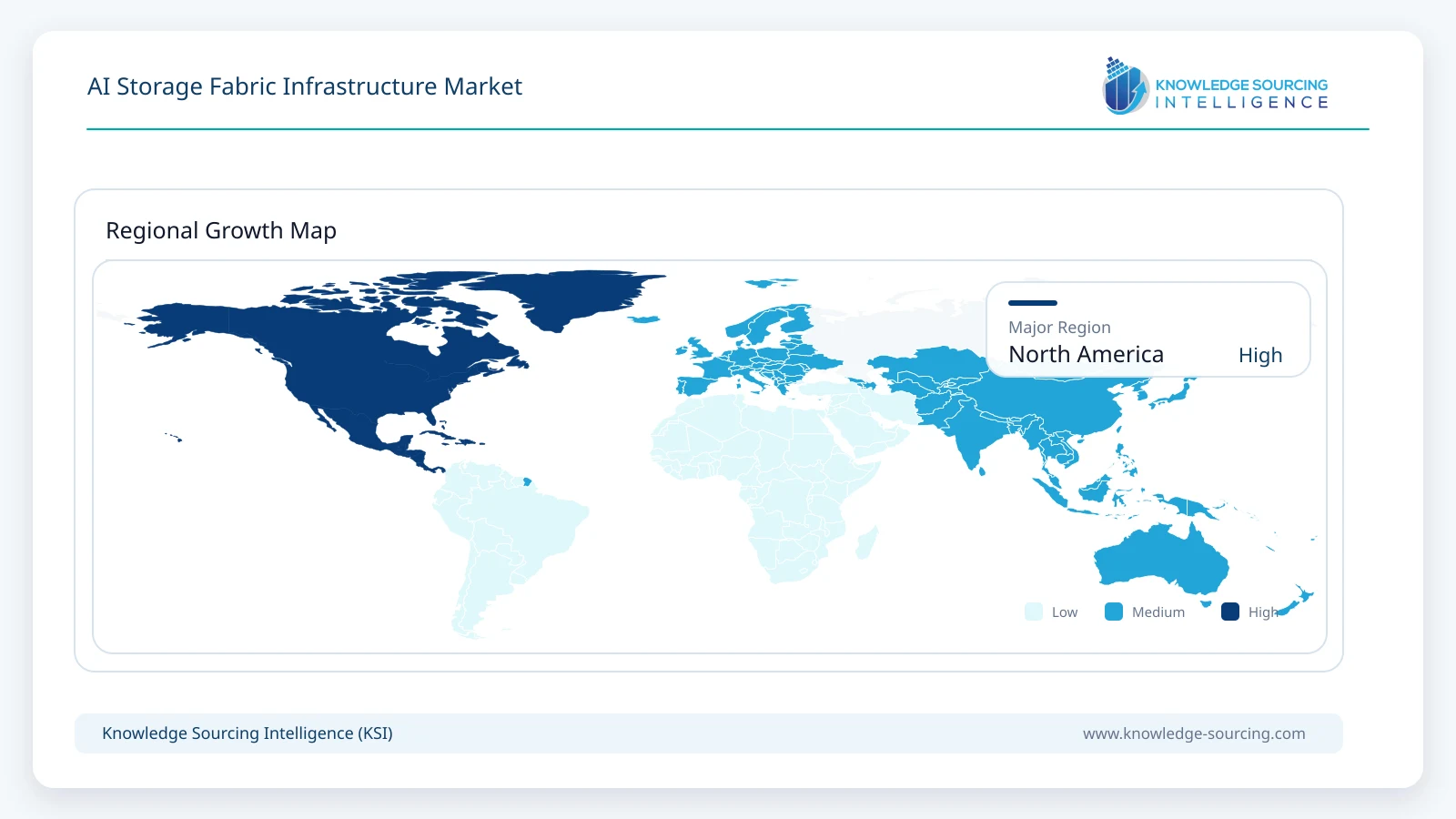
North America is a principal center for AI storage-fabric purchasing and technical development. Major AI model developers, hyperscale operators, GPU-cloud providers and infrastructure suppliers are based in the region, while NVIDIA, Broadcom, Cisco, Arista, Marvell, DDN, VAST Data and WEKA contribute to the hardware and integrated platform ecosystem. The opportunity is concentrated in high-density AI clusters where network-related GPU delays are costly enough to justify dedicated high-speed storage access and management.
The most commercially attractive projects are not necessarily those with the largest raw storage capacity. The deciding factors are concurrent accelerator count, checkpoint size and frequency, storage throughput per GPU, desired recovery time, need for strict tenant isolation, and whether existing Ethernet ports can be reused. Operators combining compute and storage traffic may spend less on separate switches but more on telemetry, qualification and endpoint acceleration. As North American AI campuses standardize repeatable pod designs, suppliers with validated switch-NIC-storage combinations can gain purchasing advantages despite competition from generic Ethernet platforms.
Competitive and Technology Landscape
Competition operates across two distinct but interdependent groups. Fabric silicon and networking companies provide the switching, adapter, DPU and control technologies that constitute direct storage-fabric hardware revenue. AI storage platform developers specify throughput and protocol requirements, qualify those technologies, and help determine the amount of fabric hardware deployed. A storage company supplying a complete appliance is therefore relevant to the ecosystem, but its total appliance revenue should not be treated as storage-fabric market revenue.
NVIDIA brings an integrated portfolio through Spectrum-X, ConnectX/SuperNIC, BlueField and STX. Broadcom, Cisco and Arista participate through high-speed Ethernet silicon, systems or validated AI data-center networking. Marvell offers DPU-based storage processing and connectivity. On the storage solution side, DDN, VAST Data and WEKA are important specialists, alongside enterprise system suppliers Dell Technologies, HPE, IBM, NetApp, Everpure and Hitachi Vantara. NVIDIA’s STX announcement also includes Cloudian, MinIO, Nutanix, Supermicro and QCT as platform or manufacturing participants. Everpure is the current corporate name of the former Pure Storage, effective 23 February 2026.
Commercial Procurement and System Qualification
AI storage networking is normally purchased against an application-level service objective, not a catalogue port count. A procurement specification must identify the number of concurrently active accelerators, dataset ingest rates, checkpoint interval and completion target, traffic segregation, recovery requirements and acceptable tail latency. For example, adding nominal 800 Gb/s ports does not solve a checkpoint bottleneck if insufficient storage-controller throughput or oversubscribed uplinks remain at the same point in the data path. Operators that verify the full chain can avoid expensive switching upgrades that fail to increase completed training steps.
Qualification also changes the supplier economics. An end-to-end reference stack reduces integration uncertainty but can concentrate procurement with a smaller group of approved vendors. Open Ethernet and merchant switch silicon offer greater price competition, while tuning congestion management, adapter firmware and storage file systems can shift more responsibility to the operator. In a shared fabric, the buyer should evaluate whether software isolation genuinely preserves storage service levels during simultaneous AI compute traffic. Physical separation remains more defensible where workloads have stringent checkpoint or recovery deadlines.
For context-memory applications, the critical calculation is not flash capacity alone but the cost of retrieving useful state within the inference budget. Expanding the external tier reduces dependence on expensive HBM only when retrieval, cache placement and network scheduling prevent additional GPU stalls. These workloads can therefore favor DPU-enabled security, network telemetry and data placement even before they require another full tier of storage-fabric switches. Suppliers are increasingly competing over validated workload outcomes rather than isolated device speed.
Recent Developments
September 2026: Marvell described the use of OCTEON DPUs for network-attached storage and KV-cache data paths, emphasizing CPU offload and access between flash and AI compute.
July 2026: WEKA introduced WEKApod 3 appliances with NeuralMesh 6 to support denser AI storage and memory deployments. This is a storage-platform development, not a measured global storage-fabric revenue milestone.
June 2026: DDN announced AI400X3M and distributed KV-cache acceleration integrated with NVIDIA Dynamo. The company cited up to 190 GB/s appliance read throughput; the figure is an appliance specification rather than a fabric-wide guarantee.
March 2026: NVIDIA introduced BlueField-4 STX as a modular accelerated-storage reference architecture with storage, system and cloud partners. Partner offerings were scheduled for the second half of 2026.
March 2026: HPE reported NVIDIA-Certified Storage validation for Alletra MP X10000 object storage and expanded its NVIDIA AI platform collaboration.
February 2026: Pure Storage changed its corporate name to Everpure. The competitive landscape reflects the current name.
February 2025: NVIDIA published Spectrum-X storage results from Israel-1, with defined testing showing improved realized read and write bandwidth against standard RoCE configurations.
AI Storage Fabric Infrastructure Market Scope:
| Report Metric | Details |
|---|---|
| Total Market Size in 2026 | USD 1.24 billion |
| Total Market Size in 2032 | USD 4.47 billion |
| Forecast Unit | USD Billion |
| Growth Rate | 23.9%. |
| Study Period | 2021 to 2032 |
| Historical Data | 2021 to 2024 |
| Base Year | 2025 |
| Forecast Period | 2026 – 2032 |
| Segmentation | Component, Network Transport, Storage Access and Data-Path, Workload, Customer Type, Geography |
| Companies |
|
Market Segmentation
By Component
Storage-Fabric Switches
NICs and SuperNICs
DPUs and Storage Processors
Network Gateways and Controllers
Optics, Cables and Interconnects
Fabric Management and Acceleration
By Network Transport
RoCE Ethernet
InfiniBand
Conventional TCP/IP Ethernet
Dedicated versus Shared Network Transport
By Storage Access and Data-Path
NVMe over Fabrics
Parallel File and RDMA-Enabled File Access
Accelerated Object Data Paths
Context-Memory and KV-Cache Access
By Workload
Model Training and Checkpointing
Data Ingestion and Preprocessing
Retrieval-Augmented Generation
Agentic Inference and Context Memory
AI and HPC Mixed Workloads
By Customer Type
Hyperscale Cloud
GPU and Neocloud Operators
Sovereign AI and Research
Enterprise AI
High-Performance Computing
By Geography
North America
China
Asia Pacific Excluding China
Europe
Middle East and Rest of World
Table of Contents
1. EXECUTIVE SUMMARY
1.1. Market Opportunity and Key Findings
1.2. Global Revenue Outlook
1.3. Commercial Drivers and Constraints
1.4. Competitive Positioning
2. RESEARCH SCOPE AND METHODOLOGY
2.1. Equipment Revenue Boundary
2.2. Dedicated versus Shared Fabric Allocation
2.3. Accelerated IT Capacity and Adoption Model
2.4. Switch, Endpoint and Processor Content
2.5. Forecast Scenarios and Validation
3. AI STORAGE FABRIC ARCHITECTURE
3.1. Storage versus Compute Fabric
3.2. Training Ingestion and Checkpoint Data Paths
3.3. Ethernet and InfiniBand Transport
3.4. RDMA, GPUDirect and NVMe-oF
3.5. NIC, SuperNIC and DPU Offload
3.6. Dedicated and Converged Ethernet
3.7. Fabric Congestion Management
3.8. Telemetry, Security and Isolation
4. MARKET SIZE AND FORECAST, 2026–2032
4.1. Global Market Revenue
4.2. Annual AI Capacity Connected to Storage Fabrics
4.3. Storage-Fabric Equipment Content per MW
4.4. Switch Ports and Endpoint Demand
4.5. Upgrade and Replacement Demand
4.6. Scenario and Sensitivity Analysis
5. MARKET BY COMPONENT
5.1. Storage-Fabric Switches
5.2. NICs and SuperNICs
5.3. DPUs and Storage Processors
5.4. Network Gateways and Controllers
5.5. Optics, Cables and Interconnects
5.6. Fabric Management and Acceleration
6. MARKET BY NETWORK TRANSPORT
6.1. RoCE Ethernet
6.2. InfiniBand
6.3. Conventional TCP/IP Ethernet
6.4. Dedicated versus Shared Network Transport
7. STORAGE ACCESS AND DATA-PATH ANALYSIS
7.1. NVMe over Fabrics
7.2. Parallel File and RDMA-Enabled File Access
7.3. Accelerated Object Data Paths
7.4. Context-Memory and KV-Cache Access
7.5. Protocol Interoperability and Qualification
8. MARKET BY WORKLOAD
8.1. Model Training and Checkpointing
8.2. Data Ingestion and Preprocessing
8.3. Retrieval-Augmented Generation
8.4. Agentic Inference and Context Memory
8.5. AI and HPC Mixed Workloads
9. MARKET BY CUSTOMER TYPE
9.1. Hyperscale Cloud
9.2. GPU and Neocloud Operators
9.3. Sovereign AI and Research
9.4. Enterprise AI
9.5. High-Performance Computing
10. REGIONAL MARKET
10.1. North America
10.2. China
10.3. Asia Pacific Excluding China
10.4. Europe
10.5. Middle East and Rest of World
11. COMMERCIAL AND TECHNOLOGY OUTLOOK
11.1. 400G-to-800G Transition
11.2. 1.6T Roadmap
11.3. Storage-Side DPU Processing
11.4. Agentic Context-Memory Demand
11.5. Converged versus Dedicated Fabric Economics
11.6. Storage Performance and GPU Utilization
12. COMPETITIVE LANDSCAPE
12.1. Network Switch and Silicon Suppliers
12.2. NIC and DPU Providers
12.3. AI Storage Platform Suppliers
12.4. OEM and Integration Partners
12.5. Partnerships and Product Qualification
13. COMPANY PROFILES
13.1. NVIDIA
13.2. Broadcom
13.3. Cisco Systems
13.4. Arista Networks
13.5. Marvell Technology
13.6. DDN
13.7. VAST Data
13.8. WEKA
13.9. Dell Technologies
13.10. Hewlett Packard Enterprise
13.11. Everpure (formerly Pure Storage)
13.12. NetApp
13.13. IBM
13.14. Hitachi Vantara
14. APPENDIX
Navigate
Trusted by the world's leading organizations











