
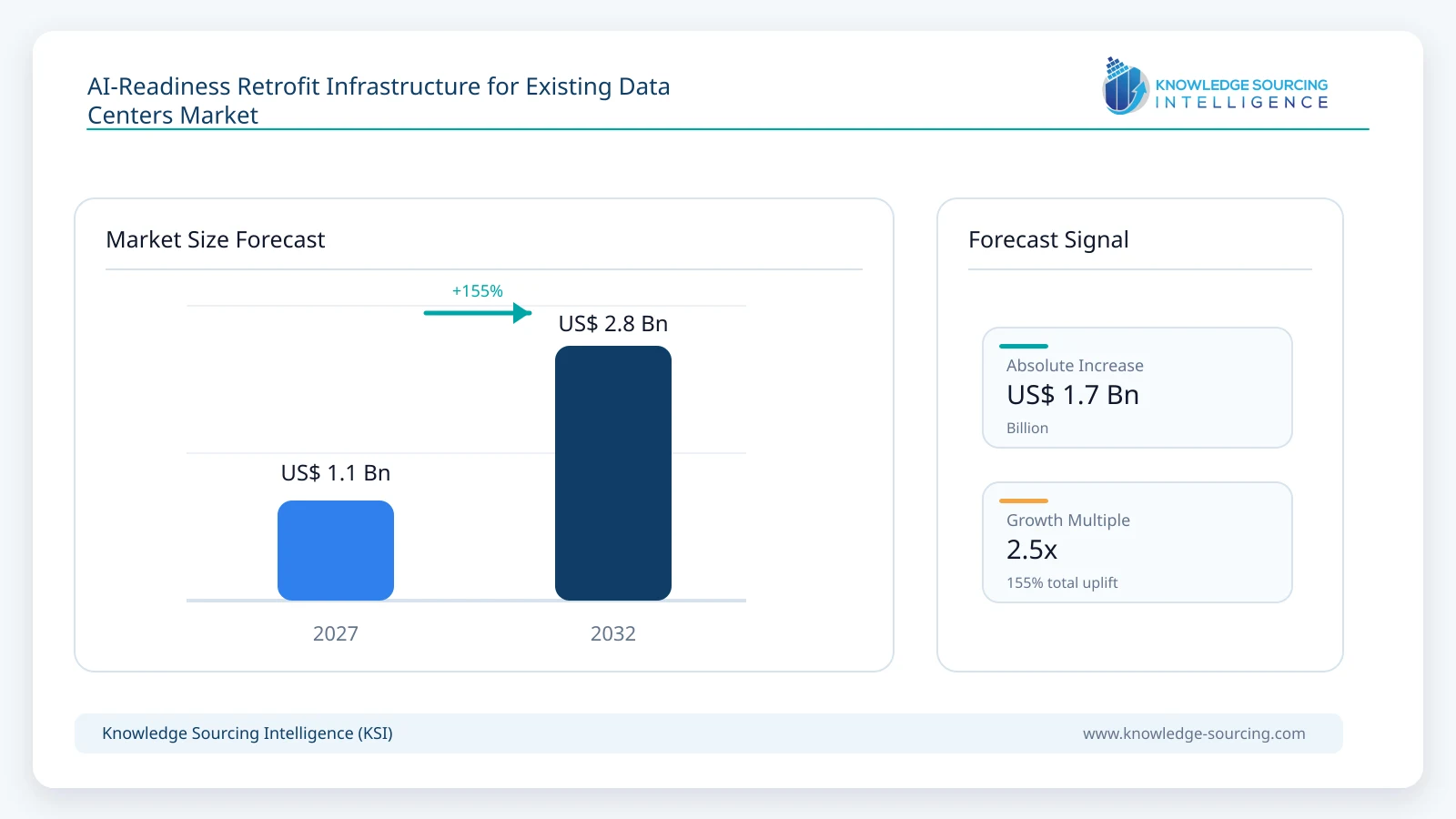
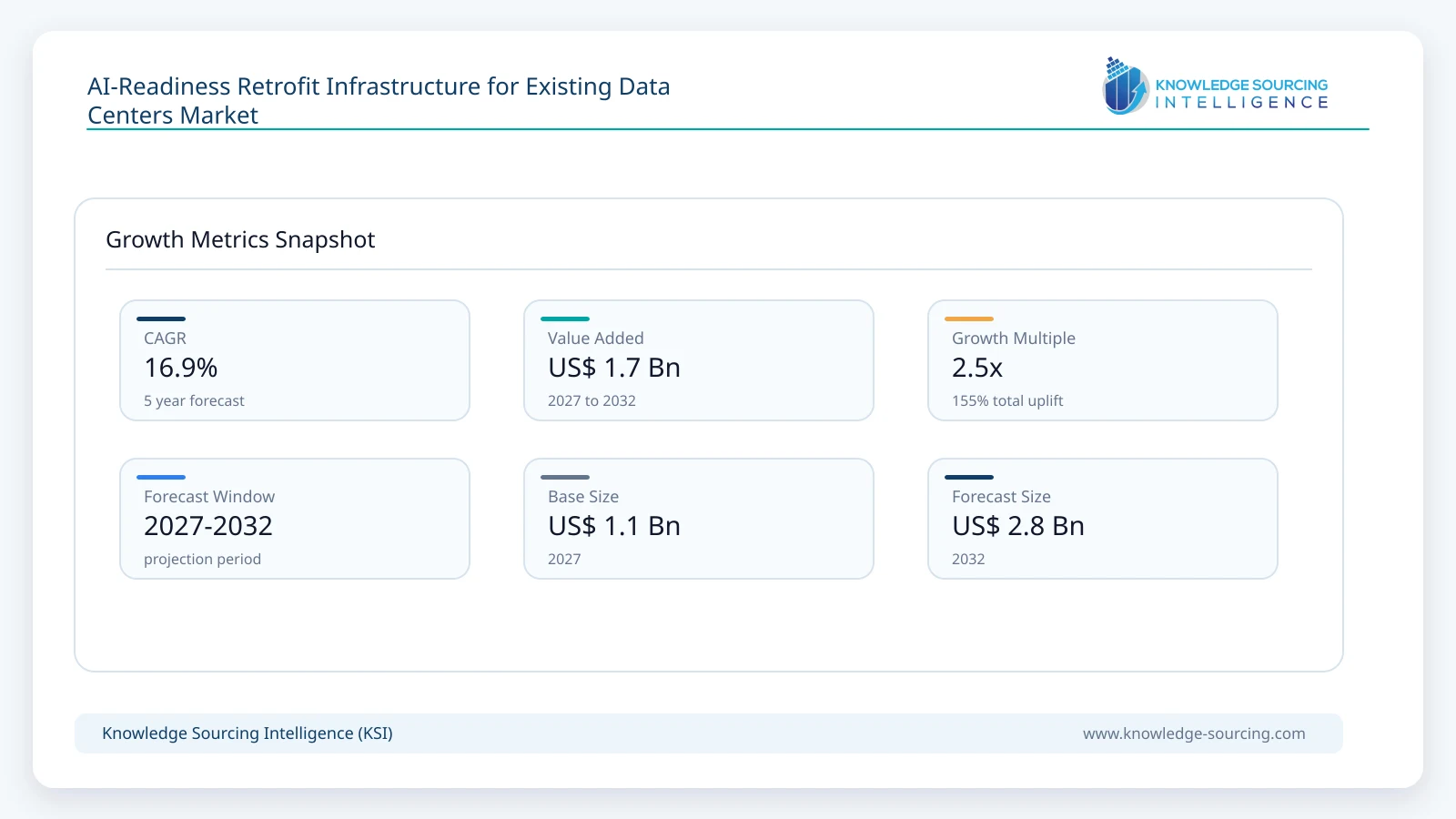
The global AI-readiness retrofit infrastructure market is forecast to grow at a CAGR of 16.9%, reaching approximately USD 2.8 billion by 2032 from USD 1.1 billion in 2026.
Highlights:
- 1Converting an existing powered site can advance AI deployment without repeating a full grid-interconnection or land-acquisition process, provided unused upstream capacity is available.
- 2Liquid-to-air and liquid-to-liquid CDU architectures allow operators to choose between localized heat rejection and connection to an existing facility water network.
- 3Vertiv states its prefabricated SmartRun system can reduce on-site infrastructure deployment time by up to 85% versus conventional methods; project-specific benefits depend on site conditions.
- 4Colocation operators must balance AI tenant revenue against downtime exposure, existing lease commitments and the value of continuing to serve lower-density customers.
Demand is developing around operating data centers that already have a utility connection, network access and established customers, but cannot deliver the concentrated power and heat rejection required by modern accelerator racks. Unlike new-build projects, a retrofit must preserve operating continuity while selectively upgrading rack power, liquid cooling, fluid distribution, heat rejection, controls and white-space infrastructure. The value of an existing powered site is therefore determined by its reusable electrical and thermal headroom, not by its available floor area alone.
Market Definition
The market covers equipment and integrated physical-infrastructure assemblies purchased specifically to make an existing operational data center suitable for AI and high-density accelerated computing. Included spending comprises incremental power distribution and rack power, coolant distribution units and dedicated piping, rack and structural modifications, containment and overhead assemblies, residual air-cooling systems, monitoring, leak detection and retrofit-specific integrated power-and-cooling modules. Revenue is measured at supplier-equipment level when the equipment is supplied for the conversion; construction labor, professional services, GPUs and servers, land, utility-grid extension, general-purpose HVAC replacement and new-build data halls are excluded.
A dedicated direct-to-chip cooling market and an AI-readiness retrofit market can intersect when cold plates, CDUs and distribution systems are supplied for a brownfield conversion. Such spending is included here only when attributable to an existing-facility retrofit. Global market totals across those two categories are not additive. Installed AI-ready retrofit MW refers to the IT load supported by the upgraded zone and is not the same as incremental grid-service capacity. A facility can shift its existing power allocation from general compute to AI without securing new utility megawatts.
Market Overview
Most traditional data halls were engineered around distributed air-cooled loads, with rack circuits, busways, chilled-water systems and operating processes sized for relatively modest rack densities. Uptime Institute’s 2026 operator survey finds that average rack density continues to rise gradually, while more sites are encountering peak racks at 30 kW or above. The contrast with rack-scale AI systems is sharp: Schneider Electric and AMD’s 2026 reference design addresses 246 kW racks. Replacing a conventional row with an AI pod is therefore not simply a question of acquiring more powerful servers. It requires the electrical path, liquid-cooling loop and residual-air architecture to be redesigned as a coordinated system.
This explains why power headroom governs retrofit economics. A hall with unused 10 MW of facility power may still need new busway segments, branch distribution, rack PDUs and protection coordination before any individual AI rack can receive its required load. Conversely, a hall with numerous empty rack positions but little upstream spare capacity cannot convert them all to AI without disturbing existing tenants or upgrading transformers, UPS modules, generators and switchgear. A technically feasible retrofit can become commercially unattractive if the power train must be rebuilt while the facility remains live. Operators increasingly assess sellable AI capacity after redundancy and contingency margins, rather than calculating opportunity from nameplate capacity alone.
Cooling creates a separate decision. Direct-to-chip cold plates shift much of the accelerator heat into a technology cooling loop, but the heat must still be transferred outside the building. Liquid-to-air equipment can support smaller installations where a facility water system is absent or inaccessible, although it returns heat to room air and cannot bypass the room’s heat-rejection limits. Liquid-to-liquid CDUs offer an effective bridge where facility water is available at compatible temperatures and flow conditions. As converted load rises, secondary pipework, pump capacity, redundancy, coolant quality, heat-exchanger approach temperature and central plant capacity can determine whether a site remains viable.
Retrofit infrastructure is also becoming more industrialized. Vertiv SmartRun integrates busbar, liquid-cooling piping, network pathways and containment in factory-prefabricated overhead modules. This can reduce the number of specialist trades working simultaneously over active IT rows, a material benefit where outage windows are short and operating facilities cannot tolerate uncontrolled work. Factory assembly, however, does not remove the need to verify ceiling clearances, structural attachment points, existing piping routes and commissioning interfaces. The strongest suppliers combine standardized components with engineering support that adapts them to the physical limits of the site.
Market Drivers
Existing Grid Connections and Time to Revenue
Grid access increasingly determines where AI computing can be deployed. The IEA’s 2026 energy outlook projects data-center electricity consumption rising from about 485 TWh in 2025 to 950 TWh in 2030 and recognizes near-term power-supply and equipment bottlenecks. An existing facility with secured service capacity therefore has an asset that cannot be recreated rapidly. Brownfield conversion can monetize that entitlement by delivering a smaller high-density AI zone ahead of a full new-campus project. The commercial benefit comes from earlier workload commissioning, lower exposure to development delays and more productive use of existing power allocations, rather than from a universal reduction in cooling-equipment prices.
Uneven Rack Density and the Need to Reallocate Power
The commercial opportunity is concentrated where legacy halls have both available upstream capacity and localized distribution constraints. Replacing three or four air-cooled rows with an AI pod can require fewer rack positions but far greater power per rack. That demands new branch protection, larger busway tap-offs, suitable rack PDUs and coordination with the existing UPS architecture. Operators that cannot relocate conventional IT workloads may lose revenue-producing space during construction, while those with consolidated legacy workloads can create a higher-value AI tenancy without expanding the facility shell. Density uplift is valuable only when the resulting compute capacity can be powered and cooled under normal and contingency conditions.
Liquid-Cooling Integration and Modular Deployment
An operator can introduce direct-liquid cooling at rack, row or pod level without converting an entire campus at once. Schneider Electric’s 2026 retrofit reference designs illustrate liquid-to-air and liquid-to-liquid configurations, allowing different responses to the same shortage of facility water access. The demand for CDUs, manifolds, quick disconnects, fluid filtration and leak detection is consequently tied to site readiness. Buyers increasingly value qualified cooling chains that reduce field engineering, commissioning time and the probability of leaks or pressure-control faults during live operations.
Market Restraints
Electrical and Thermal Limits Beyond the Rack
High-density IT equipment does not create additional utility capacity. A site already operating near its contracted import limit, transformer rating or standby-generation threshold may need major upstream reinforcement before a meaningful AI conversion is possible. The same applies to chilled-water production, dry-cooler capacity and water-system temperature requirements. A project that starts as a row-level cooling upgrade can become a multi-building electrical and mechanical program if those upstream limits are overlooked. Site qualification therefore needs to identify the actual binding constraint, not merely the lowest-density component.
Live-Site Execution and Tenant Protection
Existing data centers are revenue-generating environments. Installing liquid pipework, overhead electrical distribution or additional structural supports may require service windows, dust controls and carefully managed work near live loads. Contractors must coordinate protection testing, coolant flushing, pressure tests, commissioning and rollback plans with facility operators. Multi-tenant colocation adds contractual service obligations and dependencies between adjacent halls. These costs can outweigh apparent savings from reusing the building, especially where tenancy disruption and workload migration must be compensated.
Architecture Obsolescence and Supplier Qualification
AI platform thermal interfaces, rack footprints and input-power requirements are developing quickly. Equipment selected for one accelerator generation can become restrictive if the next generation requires higher coolant flow, different supply temperature or a larger power-feed envelope. Operators must therefore value spare piping capacity, modular connection points and validated controls alongside immediate equipment cost. A lower-price retrofit that cannot support later deployments can create another disruptive capital cycle within a few years.
Segmentation Analysis
By Retrofit Infrastructure
The market is segmented into power-distribution and rack power upgrades, liquid-cooling and thermal infrastructure, rack and structural modifications, overhead and connectivity infrastructure, monitoring and controls, and integrated prefabricated retrofit modules. Cooling and power distribution account for the most significant equipment decisions because each must work within the inherited facility capacity. For the liquid-cooling workstream, CDU selection depends on access to facility water, residual air loads and the number of racks served. For electrical upgrades, procurement depends on the required rack load, spare upstream power-train capacity, circuit protection and redundancy. These workstreams are interdependent: an oversized cooling system does not create sellable capacity if the power path remains constrained, and new rack power alone cannot support high-density accelerators without sufficient heat rejection.
Integrated overhead solutions have a distinct commercial advantage where field installation risk is the main constraint. A factory-built combination of busbar, piping, networking and containment reduces the interfaces a facility owner must coordinate in a live hall. It does not, however, replace major chiller or switchgear upgrades when the site cannot support the additional thermal or electrical load. This limits the attractive addressable base for modular retrofits and separates repeatable row-level projects from complex building-wide refurbishments.
By Retrofit Scale and Starting Density
Rack-level and row-level retrofits serve constrained enterprise sites and phased colocation upgrades. Pod-level conversions offer stronger economics where one package of electrical and cooling work can support a predictable cluster rather than several scattered high-density racks. Full data-hall upgrades require broader operational coordination and may need the temporary evacuation of legacy tenants. Starting rack density affects project cost because older low-density halls often lack modern cable pathways and suitable water-system interfaces. The analysis therefore compares facilities below 10 kW per rack, 10–20 kW and above 20 kW as starting conditions, without assuming every facility in a given range has the same retrofit suitability.
By Target AI Density and Customer Type
The report evaluates 40–100 kW, 100–250 kW and above-250 kW target rack environments. Moderate-density conversions can rely more heavily on hybrid air-liquid systems and localized infrastructure changes, while higher-density projects demand increasingly integrated cooling, power distribution and structural engineering. Colocation providers prioritize contractual uptime and tenant-ready AI suites; enterprise operators favor staged upgrades that preserve production workloads; hyperscalers and AI cloud operators seek repeatable multi-megawatt pod architectures. Equipment selection follows these purchasing constraints rather than a uniform adoption curve across all customers.
Regional Analysis
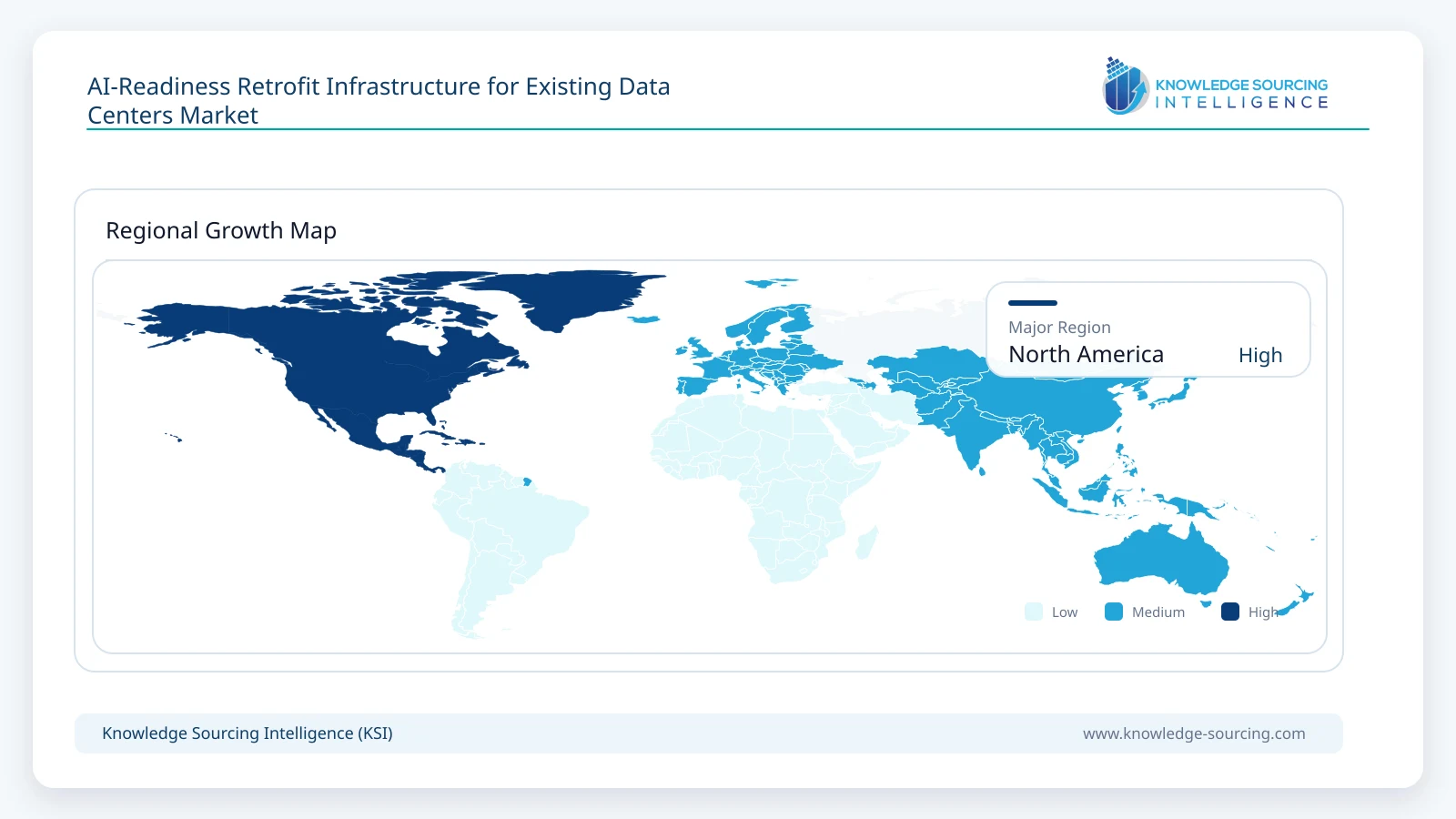
North America
North America represents the most significant early opportunity because the region combines a large installed enterprise and colocation base with concentrated demand for high-density AI capacity. Mature facilities in established hubs already possess utility connections and network ecosystems that can be more valuable than the building itself. A retrofit is attractive where an operator can release power through consolidation of conventional workloads and convert that capacity into a higher-value AI deployment. The economics are less compelling where electrical redundancy must be rebuilt or where liquid cooling requires extensive central-plant replacement.
Supplier activity reflects the importance of shorter, repeatable installation cycles. Schneider Electric has published retrofit reference designs covering high-density AMD systems and different liquid-cooling configurations. Vertiv is deploying factory-integrated overhead infrastructure with Compass Datacenters, while nVent introduced cooling architectures addressing residual rack heat in October 2026. These examples illustrate the shift toward system qualification and commissioning support. For customers, the decision is primarily between adding near-term AI capacity to an existing powered asset and waiting for a more standardized greenfield facility, with downtime risk, reusability and future-generation compatibility determining the outcome.
Competitive and Technology Landscape
Competition is shaped by the completeness of the retrofit solution rather than by the number of individual product categories. Schneider Electric, Vertiv and Eaton are positioned across multiple electrical and thermal layers; Eaton’s completed acquisition of Boyd Thermal in March 2026 expands its cold-plate, manifold and CDU capabilities. Ecolab completed its acquisition of CoolIT Systems in July 2026, adding a specialist liquid-cooling platform to its broader water-management business. These changes strengthen integrated suppliers’ ability to offer a coordinated cooling chain, although buyer qualification still occurs at the equipment and architecture level.
Legrand, Socomec, ABB, Siemens and Delta Electronics participate in critical power distribution, rack power and associated infrastructure, while STULZ, Modine and Munters are relevant to thermal conversion and facility heat rejection. Rittal, nVent and Panduit participate in rack, cooling or integrated white-space systems. The competitive analysis evaluates each firm by actual equipment supplied to existing data-center conversions. Raritan is discussed within Legrand, and Boyd Thermal within Eaton, rather than as separate independent corporate competitors. General building-HVAC and connectivity suppliers remain relevant to project execution but should not be represented as direct competitors for the full retrofit equipment package.
Recent Developments
October 2026: nVent and AMD announced a rack-level cooling collaboration for the AMD Helios platform, including a rear-door heat exchanger designed to remove residual heat not captured by direct-to-chip cooling.
September 2026: Vertiv detailed its SmartRun collaboration with Compass Datacenters for factory-integrated overhead power, liquid-cooling piping, networking and containment infrastructure.
July 2026: Schneider Electric and AMD announced a validated Helios infrastructure reference design supporting 246 kW racks, with an existing-data-hall retrofit configuration.
July 2026: Ecolab completed its acquisition of CoolIT Systems, expanding its direct liquid-cooling portfolio.
June 2026: Vertiv outlined a SmartRun-based digital-twin workflow integrated with NVIDIA Omniverse DSX for infrastructure configuration and validation.
March 2026: Eaton completed its acquisition of Boyd Thermal, adding liquid-cooling components, assemblies and systems to its critical-power portfolio.
January 2026: Vertiv launched SmartRun in Asia for high-density greenfield and retrofit projects, integrating busbar, liquid-cooling pipework, containment and network pathways.
AI-Readiness Retrofit Infrastructure for Existing Data Centers Market Scope:
| Report Metric | Details |
|---|---|
| Total Market Size in 2027 | USD 1.1 billion |
| Total Market Size in 2032 | USD 2.8 billion |
| Forecast Unit | USD Billion |
| Growth Rate | 16.9% |
| Study Period | 2022 to 2032 |
| Historical Data | 2022 to 2025 |
| Base Year | 2026 |
| Forecast Period | 2027 – 2032 |
| Segmentation | Retrofit Infrastructure, Retrofit Scale, Starting Facility Density, Target AI Rack Density, Customer Type, Geography |
| Companies |
|
Market Segmentation
By Retrofit Infrastructure
Power Distribution and Rack Power
Liquid-Cooling and Thermal Infrastructure
Rack and Structural Modifications
Network, Containment and Overhead Infrastructure
Monitoring, Controls and DCIM
Prefabricated Integrated Retrofit Modules
By Retrofit Scale
Rack-Level Conversion
Row-Level Conversion
Pod-Level Conversion
Full Data-Hall Upgrade
By Starting Facility Density
Below 10 kW per Rack
10–20 kW per Rack
Above 20 kW per Rack
By Target AI Rack Density
40–100 kW Rack Environment
100–250 kW Rack Environment
Above 250 kW Rack Environment
By Customer Type
Colocation Providers
Hyperscale and Cloud Operators
Neocloud and GPU Cloud Operators
Enterprise Data Centers
Research and HPC Facilities
By Geography
North America
Europe
Asia Pacific Excluding China
China
Middle East and Rest of World
Table of Contents
1. EXECUTIVE SUMMARY
1.1. Market Opportunity and Key Findings
1.2. Retrofit-Ready Capacity Outlook
1.3. Equipment Revenue and Customer Economics
1.4. Market Constraints and Competitive Positioning
2. RESEARCH SCOPE AND METHODOLOGY
2.1. Market Definition and Equipment Boundary
2.2. Brownfield versus Greenfield Qualification
2.3. Retrofit AI-Ready IT Capacity Measurement
2.4. Equipment Revenue Recognition
2.5. Capacity Conversion and Forecast Method
3. AI-READINESS RETROFIT ARCHITECTURE
3.1. Existing Facility Technical Assessment
3.2. Upstream Electrical Headroom and Redundancy
3.3. Busway, Branch Circuits and Rack Power
3.4. Direct-to-Chip Cooling Retrofit
3.5. Residual Air Cooling and Heat-Rejection Interfaces
3.6. Secondary Fluid Distribution and Water Quality
3.7. Rack, Structural and Overhead Modifications
3.8. DCIM, Controls and Commissioning
4. GLOBAL MARKET SIZE AND FORECAST, 2026–2032
4.1. Global Retrofit Equipment Revenue
4.2. Annual AI-Ready Retrofit IT Capacity
4.3. Equipment Spend per Retrofitted MW
4.4. Brownfield Conversion Adoption
4.5. Equipment Pricing and Deployment Sensitivity
5. MARKET BY RETROFIT INFRASTRUCTURE
5.1. Power Distribution and Rack Power
5.2. Liquid-Cooling and Thermal Infrastructure
5.3. Rack and Structural Modifications
5.4. Network, Containment and Overhead Infrastructure
5.5. Monitoring, Controls and DCIM
5.6. Prefabricated Integrated Retrofit Modules
6. MARKET BY RETROFIT SCALE
6.1. Rack-Level Conversion
6.2. Row-Level Conversion
6.3. Pod-Level Conversion
6.4. Full Data-Hall Upgrade
7. OPPORTUNITY BY STARTING FACILITY DENSITY
7.1. Below 10 kW per Rack
7.2. 10–20 kW per Rack
7.3. Above 20 kW per Rack
7.4. Reusable Infrastructure and Qualification
8. MARKET BY TARGET AI RACK DENSITY
8.1. 40–100 kW Rack Environment
8.2. 100–250 kW Rack Environment
8.3. Above 250 kW Rack Environment
8.4. Liquid Heat Capture and Plant Headroom
9. MARKET BY CUSTOMER TYPE
9.1. Colocation Providers
9.2. Hyperscale and Cloud Operators
9.3. Neocloud and GPU Cloud Operators
9.4. Enterprise Data Centers
9.5. Research and HPC Facilities
10. REGIONAL MARKET
10.1. North America
10.2. Europe
10.3. Asia Pacific Excluding China
10.4. China
10.5. Middle East and Rest of World
11. RETROFIT PROJECT ECONOMICS AND FEASIBILITY
11.1. Existing Grid-Service Capacity and Redundancy
11.2. Utility Connection and Development-Time Advantage
11.3. Reuse of Existing Cooling Plant
11.4. Downtime, Tenant Migration and Live-Site Risk
11.5. Retrofit versus Greenfield Evaluation
11.6. Future Rack-Density Compatibility
12. TECHNOLOGY AND COMMERCIALIZATION OUTLOOK
12.1. Modular Hybrid Liquid-Air Retrofits
12.2. Integrated Overhead Power and Cooling
12.3. Localized Heat-Rejection Systems
12.4. Higher-Density Rack Power Distribution
12.5. Digital Twins and Pre-Deployment Validation
12.6. Repeatable AI Pods and Commissioning
13. COMPETITIVE LANDSCAPE
13.1. Integrated Power and Thermal Infrastructure
13.2. Electrical and Rack Power Suppliers
13.3. Liquid Cooling and Heat-Rejection Specialists
13.4. Rack, Containment and Prefabrication Suppliers
13.5. Ownership Changes and Technology Partnerships
14. COMPANY PROFILES
14.1. Schneider Electric (Motivair)
14.2. Vertiv
14.3. Eaton (Boyd Thermal)
14.4. Legrand (including Raritan)
14.5. ABB
14.6. Siemens
14.7. Delta Electronics
14.8. Socomec
14.9. STULZ
14.10. Rittal
14.11. nVent
14.12. Modine
14.13. Ecolab (CoolIT Systems)
14.14. Munters
14.15. Panduit
15. APPENDIX
Navigate
Trusted by the world's leading organizations











