
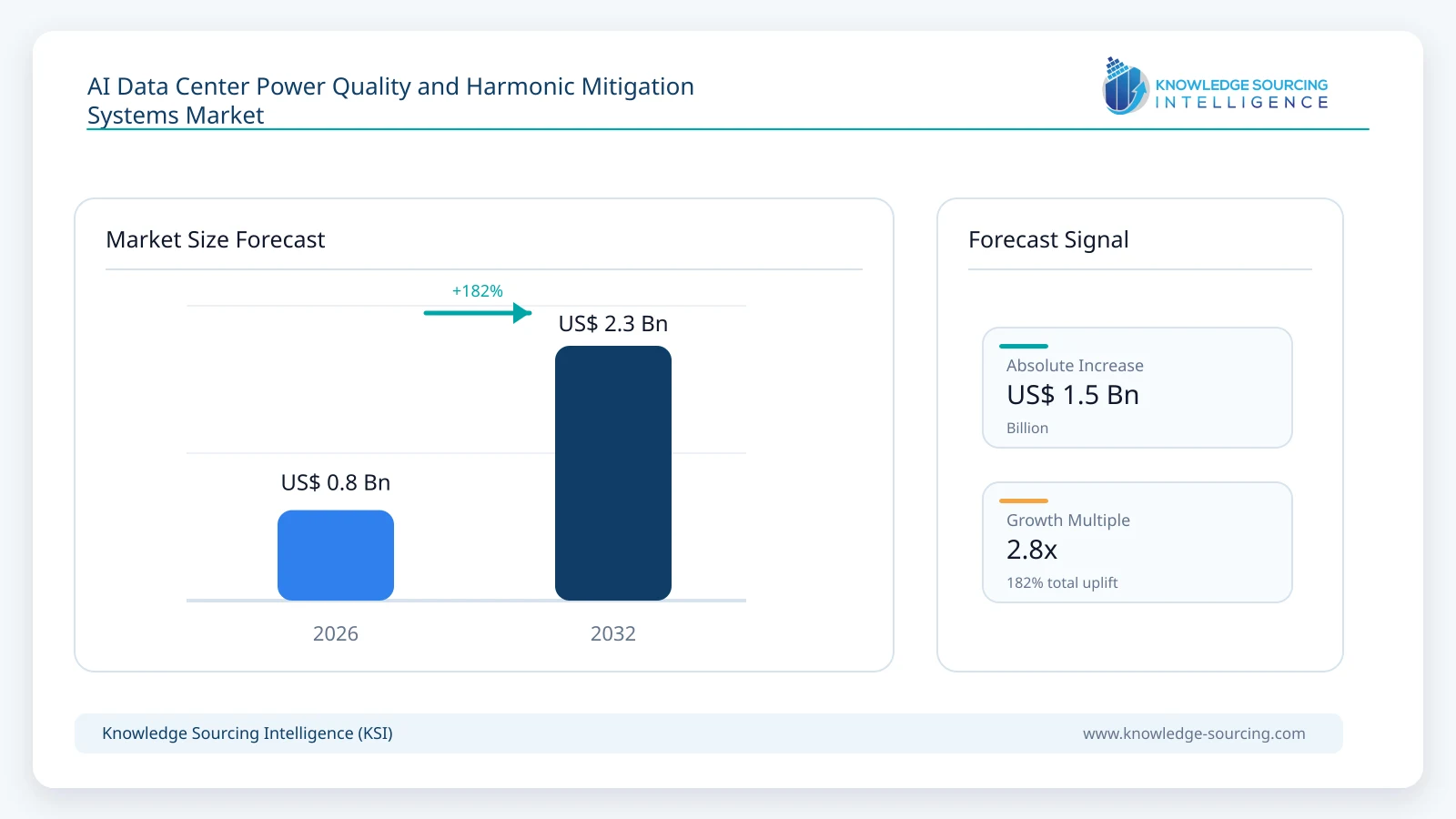
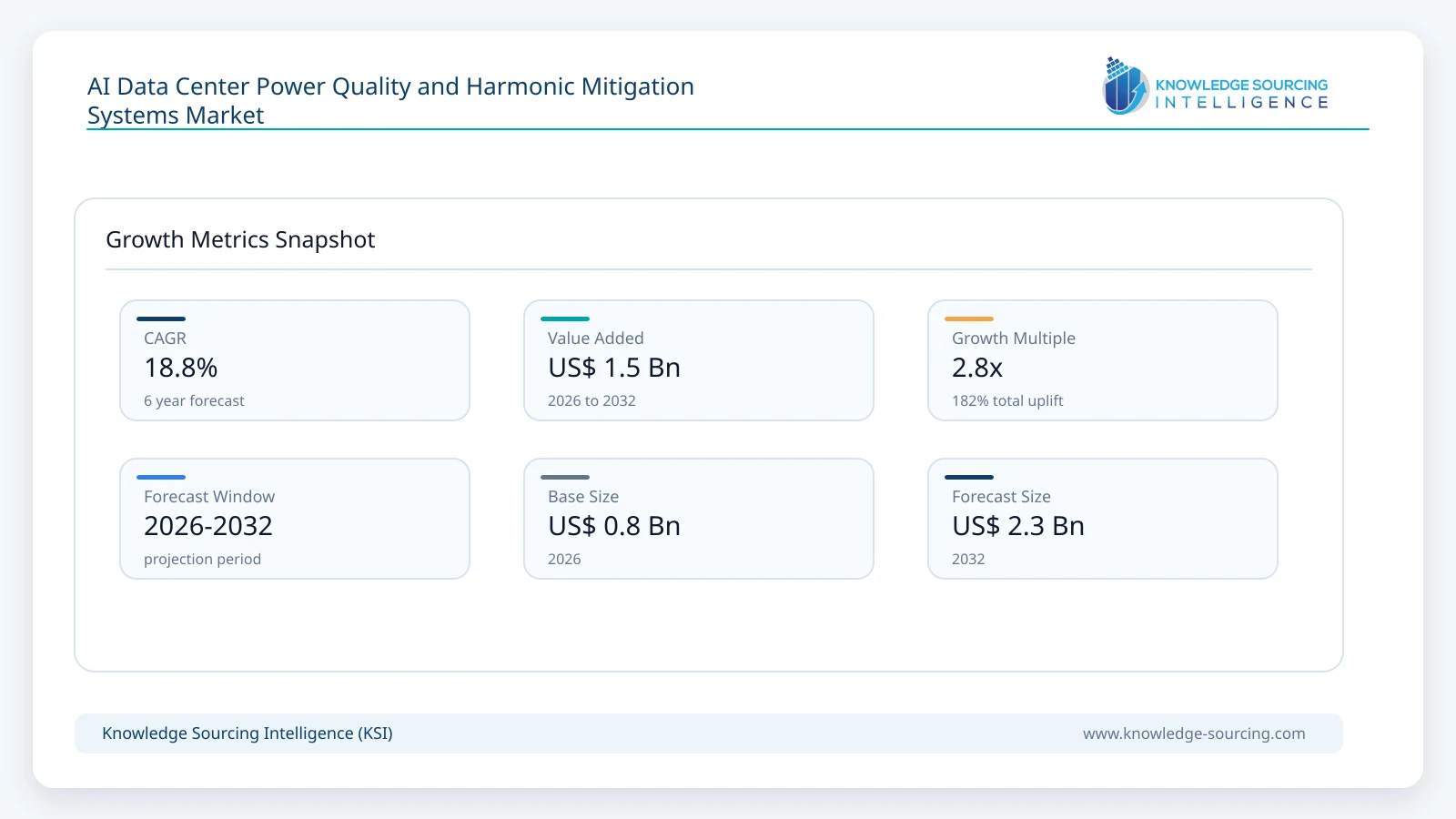
The AI Data Center Power Quality and Harmonic Mitigation Systems Market is estimated at USD 0.82 billion in 2026 and is projected to reach USD 2.31 billion by 2032, representing a CAGR of 18.8% during the forecast period.
Key Highlights
· GPU power bursts increase demand for faster event detection and electrical diagnostics.
· Active harmonic filters remain the largest dedicated mitigation category in 2026.
· Power-quality analytics is the fastest-growing layer as AI load volatility increases.
· High nonlinear-load density raises harmonic, thermal and power-factor management requirements.
· Grid-connection rules increasingly include harmonics, flicker and power-quality operating limits.
· Dynamic compensation protects transformers, cables and generators from distorted current profiles.
· Power-quality meters are moving from passive logging toward edge-based event analytics.
· Brownfield AI retrofits create strong demand for localized filtering and diagnostic upgrades.
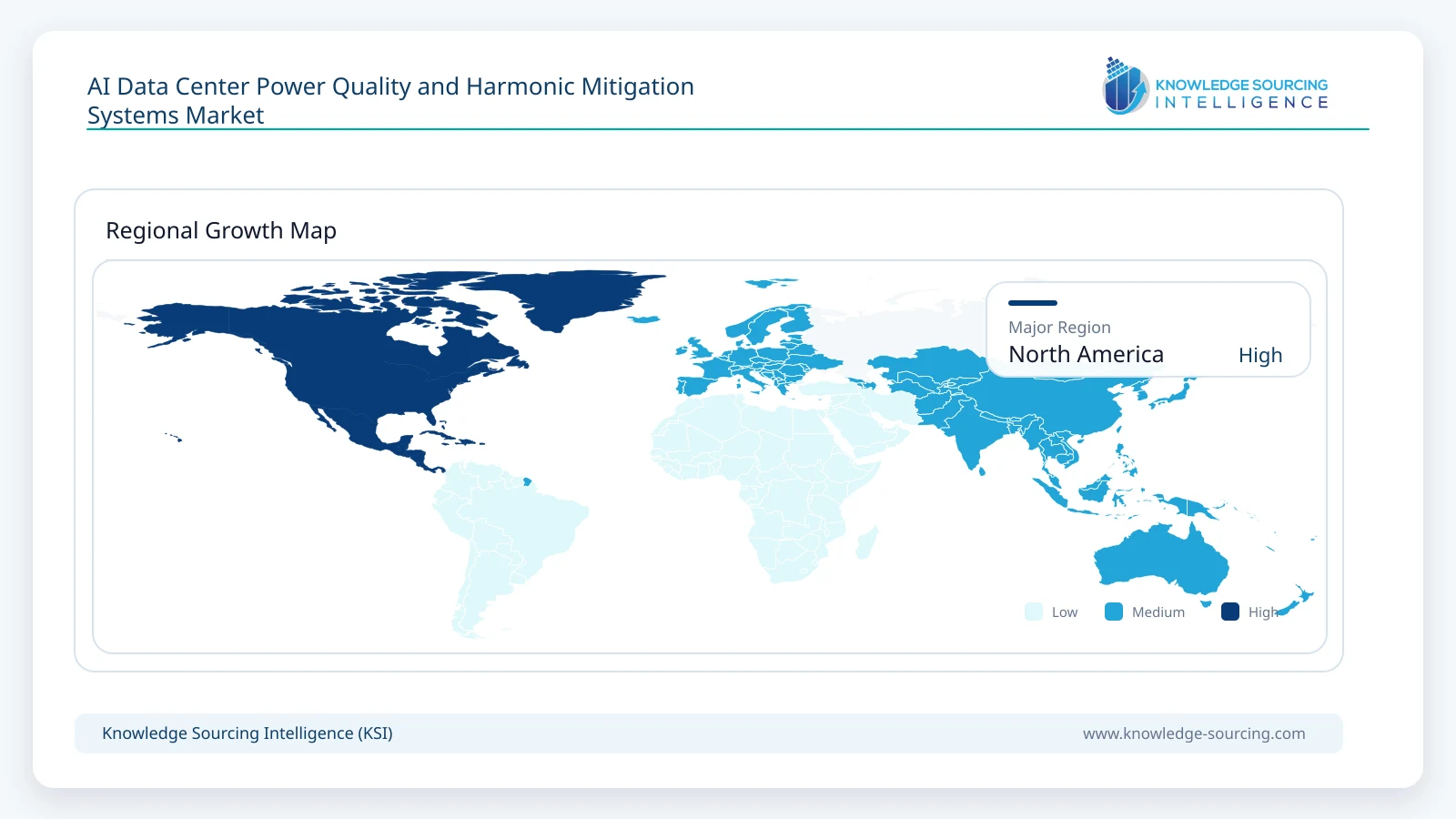
· North America leads early adoption through hyperscale AI and constrained grid connections.
· 800 VDC architectures reduce some conversion losses but do not remove monitoring requirements.
· Generator compatibility becomes more difficult when GPU clusters create repeated rapid load swings.
· Integrated monitoring increasingly links utility interconnection, switchgear, UPS and rack-level events.
Market Overview
Power quality describes how closely electrical voltage and current remain within the operating conditions required by connected equipment and the upstream network. Important parameters include harmonic distortion, voltage sags and swells, transients, flicker, unbalance, power factor and rapid changes in active or reactive power. Data centers have always contained nonlinear electronic loads, but AI increases both the magnitude and speed of change. Eaton notes that AI training environments can move from low to high power quickly enough to create multi-megawatt swings at facility scale, while NVIDIA has documented GPU power spikes that can trip breakers even when average consumption remains below static design limits.
The challenge extends beyond the data hall. Rapid AI load changes can interact with UPS controls, generator governors, transformers and utility networks. Eaton's 2026 grid-connection guidance specifically identifies power quality and harmonics as compliance issues for large data-center loads, alongside fault ride-through and frequency response. Poor power quality can delay interconnection, trigger operating restrictions, increase losses or require late-stage redesign. This makes monitoring and mitigation relevant before a site is energized as well as during operation.
Mitigation is increasingly layered. Active harmonic filters dynamically inject compensating current to reduce total harmonic distortion and improve power factor without relying on fixed passive components. Dynamic reactive-power systems address rapidly changing displacement power factor and voltage behavior. High-resolution power-quality meters capture waveform events and correlate disturbances across electrical zones, while surge and transient protection protects sensitive power electronics from fast overvoltage events. In large AI facilities, these systems are increasingly coordinated across medium-voltage distribution, UPS inputs, low-voltage switchboards and selected high-density load blocks rather than installed as isolated devices.
Market Drivers
Rapid GPU load swings create a new diagnostic requirement
Conventional power-quality monitoring is often focused on utility disturbances, switching events or persistent harmonic distortion. AI creates an additional category: internally generated, rapidly repeating load changes originating in GPU clusters. Eaton's Power Xpert Quality update was designed to identify power-burst behaviour and potential subsynchronous oscillations that can affect transformers and other infrastructure. NVIDIA's power-flexibility guidance similarly describes sudden GPU bursts capable of tripping breakers. The operational value of seeing these events at high resolution increases as facilities attempt to use electrical capacity more aggressively rather than overprovision every layer around worst-case transient demand.
Harmonic content rises with dense power-electronic conversion
AI data centers contain large numbers of switched-mode power supplies, UPS rectifiers, variable-speed drives and other power-electronic converters. Harmonic currents increase heating and losses in transformers, cables and neutral conductors and can interact with capacitors or generators. Active filters are attractive because they can respond dynamically to changing nonlinear loads instead of being tuned around a fixed harmonic profile. Eaton, Schneider Electric and Vertiv all position active harmonic filtering for data-center or mission-critical applications, providing an established equipment base that can scale as AI power density increases.
Grid interconnection is making power quality a project-level issue
Large AI facilities are increasingly treated by utilities as grid-significant loads. Connection requirements can include harmonic limits, flicker, power factor, ride-through behaviour and dynamic load response. Eaton notes that failure to meet grid-code requirements can delay or restrict connection and force redesign. As individual campuses move into the hundreds of megawatts, a disturbance generated inside the facility can no longer be treated purely as an internal maintenance issue. This shifts spending toward system studies, high-resolution metering, dynamic compensation and verified harmonic performance at the point of connection.
Brownfield AI retrofits expose legacy electrical limitations
Existing data centers were not designed around the electrical behaviour of large accelerator clusters. Adding high-density AI capacity can expose weak power-factor correction, transformer derating, generator instability, insufficient event visibility or harmonic problems that were tolerable under conventional server loads. Retrofit projects therefore create a targeted market for active filters, meters, transient monitoring and localized compensation without requiring replacement of the complete electrical distribution system. This is particularly relevant where operators want to deploy AI in facilities with established utility connections and limited room for major electrical reconstruction.
Restraints and Adoption Challenges
The principal restraint is that some power-quality functionality is increasingly embedded inside UPS systems, power-conversion equipment and digital switchgear, reducing the amount of stand-alone hardware required. Operators also vary widely in how much harmonic mitigation they need because results depend on converter topology, transformer configuration, generator design and utility limits. Active filtering can add capital cost and electrical losses if oversized, while detailed metering creates large volumes of waveform data that require skilled interpretation. The shift toward higher-voltage direct-current architectures may also change the mix of alternating-current harmonic products after 2028, although monitoring, transient protection and power-quality validation remain necessary across both AC and DC systems.
Segment Analysis
By Solution Type
Active harmonic filtering and dynamic compensation represent the largest dedicated revenue pool in 2026 because high-current filters, reactive-power equipment, current transformers, switchboard integration and commissioning create significant hardware value. These systems are deployed at low-voltage distribution boards, UPS inputs, generator interfaces and selected medium-voltage points according to the electrical architecture. Their role expands where operators must maintain total harmonic distortion, power factor and voltage behaviour across rapidly changing nonlinear loads.
Power-quality monitoring and event analytics are expected to grow faster through 2032. The category includes high-resolution meters, waveform capture, edge analytics, event correlation and software used to identify sags, swells, harmonics, flicker, oscillations and AI power bursts. Eaton's addition of AI-specific burst detection to the PXQ platform illustrates how monitoring is moving from retrospective reporting toward continuous operational diagnostics. Voltage regulation, transient protection and power-quality engineering remain important supporting categories, particularly at grid interfaces and during brownfield upgrades.
Solution | 2026 Position | Growth Direction | Primary AI Data Center Role |
Active harmonic filters | Largest dedicated category | Strong | Dynamic cancellation of nonlinear-load harmonic current |
Dynamic reactive-power / power-factor compensation | Large supporting category | Strong | Power factor, voltage support and load balancing |
Power-quality monitoring and analytics | Established base | Fastest-growing | Waveform capture, event diagnosis and AI burst detection |
Voltage regulation / conditioning | Selective high-value category | Moderate to strong | Manage sags, swells and sensitive equipment voltage limits |
Transient and surge protection | Broad installed layer | Steady | Protect power electronics and distribution from overvoltage events |
Engineering, studies and integration | Recurring project layer | Strong | Harmonic studies, grid compliance, commissioning and remediation |
Market and Technology Indicators
Indicator | Latest Development | Market Impact |
AI load volatility | Eaton reports AI environments can create rapid multi-megawatt load swings. | Raises need for high-speed monitoring, filtering and coordinated power controls. |
AI power-burst detection | Eaton added subsynchronous-oscillation and AI burst detection to Power Xpert Quality. | Creates an AI-specific analytics layer within power-quality monitoring. |
GPU pulse validation | NVIDIA's DCGM pulse test intentionally generates rapid GPU current and power transitions. | Shows power-delivery stability is becoming part of AI platform validation. |
Grid compliance | Eaton identifies harmonics, flicker and power factor as large-load connection requirements. | Links power-quality performance directly to data-center interconnection approval. |
Active harmonic filtering | Eaton, Schneider Electric and Vertiv market dynamic filters for data-center or critical-load applications. | Provides a mature mitigation technology that can scale with AI deployment. |
800 VDC transition | NVIDIA and industry partners are developing higher-voltage DC AI power architectures. | Changes future mitigation mix but increases need for cross-architecture monitoring and validation. |
Regional Opportunity
North America
North America is the largest early market for AI data-Center Power-quality and harmonic-mitigation systems because the United States combines rapid hyperscale AI investment with increasingly constrained utility networks and a growing number of very large load interconnection requests. AI campuses in regions such as Northern Virginia, Texas, the Midwest and the Pacific Northwest can reach hundreds of megawatts, making their electrical behaviour relevant to both facility uptime and grid operation. Utilities and system operators are therefore placing greater emphasis on modelling, ride-through, load ramps, harmonic performance and power-factor behaviour before large sites are fully connected.
The region also contains a strong supplier and engineering base. Eaton provides Power Xpert Quality analytics, active harmonic filters and data-center power systems; Schneider Electric offers PowerLogic monitoring and AccuSine filtering; Vertiv supplies Liebert active harmonic filters and AI-oriented critical-power platforms; ABB and Siemens participate across power-quality measurement, compensation and electrical distribution; and Legrand, Socomec and Delta Electronics provide additional monitoring, UPS and power-management technologies. This gives North American projects access to both stand-alone mitigation devices and integrated power architectures.
Brownfield demand is a major part of the opportunity. Existing data centers can add AI clusters faster than utilities can deliver new campuses, but legacy transformers, generators and low-voltage distribution may react poorly to fast GPU transients or higher nonlinear-load concentration. Operators can therefore add meters, active filtering, protection upgrades and targeted dynamic compensation at selected electrical nodes while retaining the existing building and utility service. Through 2032, these retrofit projects are expected to remain important even as new AI factories increasingly incorporate power-quality requirements directly into reference designs.
Europe combines data-center expansion with detailed grid-code and energy-quality requirements, supporting demand for monitoring and compensation at large-load connections. Asia Pacific is expanding rapidly across China, Japan, South Korea, Singapore, Malaysia, India and Australia, while the region also hosts major electrical-equipment manufacturing. The Middle East is developing large greenfield AI campuses where harmonic studies, dynamic compensation and high-resolution monitoring can be incorporated early rather than added after commissioning.
Competitive Landscape
The competitive landscape spans global electrical-equipment suppliers, critical-power specialists, metering companies and power-quality specialists. Eaton and Schneider Electric have particularly broad positions because they combine monitoring, harmonic filtering, UPS, switchgear and engineering capabilities. Vertiv participates from the critical-power side with active harmonic filters and AI-focused infrastructure, while ABB and Siemens combine digital electrical distribution, protection and power-quality technologies. Socomec, Legrand and Delta Electronics participate strongly in data-center power monitoring and critical-power systems.
Specialized power-quality vendors remain relevant where operators require stand-alone active filters, harmonic studies or targeted remediation. TCI, Comsys, CIRCUTOR and Danfoss offer harmonic filtering and compensation technologies used across critical and industrial facilities. Mitsubishi Electric and Fuji Electric participate in power electronics, UPS and conditioning systems, while Janitza and PQube / Powerside focus on measurement, analytics and power-quality diagnostics. Competitive advantage increasingly depends on response speed, harmonic range, modular scalability, digital event analysis, ease of retrofit and the ability to integrate measurements from the utility connection down to AI load blocks.
Major companies and ecosystem participants covered: Eaton, Schneider Electric, Vertiv, ABB, Siemens, Socomec, Legrand, Delta Electronics, Mitsubishi Electric, Fuji Electric, TCI, Comsys, CIRCUTOR, Danfoss, Janitza Electronics, Powerside and GE Vernova.
Recent Developments
· September 2026: ABB introduced the Infinitus source-to-rack direct-current portfolio for AI data centers, extending power-distribution and protection options as facilities move toward higher-voltage DC architectures.
· September 2026: Vertiv, ST Telemedia Global Data Centres and Baudouin published AI-load testing results showing how rapid GPU demand changes can destabilize generator operation and how advanced UPS controls can restore stability.
· August 2026: Eaton and Trane Technologies introduced an AI-factory reference design integrating higher-density electrical and thermal infrastructure around NVIDIA DSX architectures.
· May 2026: Schneider Electric published updated guidance for retrofitting existing data-center power systems to support megawatt-scale AI clusters and fast-changing electrical loads.
· 2026: Eaton expanded data-center grid-connection guidance covering power quality, harmonics, flicker, power factor and dynamic large-load behaviour.
· 2026: Eaton's Power Xpert Quality platform continued commercialization of edge analytics for detecting AI power bursts and potential subsynchronous oscillations.
· 2026: Socomec highlighted voltage and frequency instability created by simultaneous AI high-power demand and expanded AI-ready power-management guidance for critical facilities.
AI Data Center Power Quality and Harmonic Mitigation Systems Market Scope:
| Report Metric | Details |
|---|---|
| Total Market Size in 2026 | USD 0.82 billion |
| Total Market Size in 2032 | USD 2.31 billion |
| Forecast Unit | USD Billion |
| Growth Rate | 18.8% |
| Study Period | 2021 to 2032 |
| Historical Data | 2021 to 2024 |
| Base Year | 2025 |
| Forecast Period | 2026 – 2032 |
| Segmentation | Solution Type, Electrical Layer, Disturbance Type, Project Type, Customer Type, Geography |
| Companies |
|
Market Segmentation
By Solution Type
Active Harmonic Filters
Dynamic Reactive-Power and Power-Factor Compensation
Power-Quality Monitoring and Event Analytics
Voltage Regulation and Conditioning
Transient and Surge Protection
Engineering, Studies and Integration Services
By Electrical Layer
Utility / Point of Interconnection
Medium-Voltage Distribution
UPS and Generator Interface
Low-Voltage Switchboards and PDUs
Rack and AI Load Blocks
By Disturbance Type
Harmonic Distortion
Voltage Sags and Swells
Rapid Power Ramps and AI Power Bursts
Flicker and Voltage Fluctuation
Power-Factor and Reactive-Power Variation
Transients and Surge Events
By Project Type
Greenfield AI Factories
Hyperscale and Colocation Expansions
Brownfield AI Retrofits
Sovereign and Enterprise AI Facilities
By Customer Type
Hyperscale Cloud Providers
Neocloud and GPU-Cloud Operators
Colocation Providers
Sovereign AI Infrastructure
Enterprise and High-Performance Computing
By Geography
North America
United States
Canada
Europe
Asia Pacific
Middle East and Rest of World
Table of Contents
1. EXECUTIVE SUMMARY
1.1. Market Opportunity and Key Findings
1.2. AI Power-Quality Risk Timeline
1.3. Principal Revenue Pools
2. MARKET OVERVIEW
2.1. AI Load Volatility and Electrical Behaviour
2.2. Harmonics and Nonlinear Loads
2.3. Voltage, Flicker and Power-Factor Requirements
2.4. Utility and Grid-Connection Requirements
2.5. AC and Emerging DC Power-Quality Architectures
3. MARKET SIZE AND FORECAST, 2026-2032
3.1. Global Market Revenue
3.2. Annual Growth Analysis
3.3. Greenfield versus Retrofit Demand
3.4. Power-Quality Content per MW
4. MARKET BY SOLUTION TYPE
4.1. Active Harmonic Filters
4.2. Dynamic Reactive-Power and Power-Factor Compensation
4.3. Power-Quality Monitoring and Event Analytics
4.4. Voltage Regulation and Conditioning
4.5. Transient and Surge Protection
4.6. Engineering, Studies and Integration Services
5. MARKET BY ELECTRICAL LAYER
5.1. Utility / Point of Interconnection
5.2. Medium-Voltage Distribution
5.3. UPS and Generator Interface
5.4. Low-Voltage Switchboards and PDUs
5.5. Rack and AI Load Blocks
6. MARKET BY DISTURBANCE TYPE
6.1. Harmonic Distortion
6.2. Voltage Sags and Swells
6.3. Rapid Power Ramps and AI Power Bursts
6.4. Flicker and Voltage Fluctuation
6.5. Power-Factor and Reactive-Power Variation
6.6. Transients and Surge Events
7. MARKET BY PROJECT TYPE
7.1. Greenfield AI Factories
7.2. Hyperscale and Colocation Expansions
7.3. Brownfield AI Retrofits
7.4. Sovereign and Enterprise AI Facilities
8. MARKET BY CUSTOMER TYPE
8.1. Hyperscale Cloud Providers
8.2. Neocloud and GPU-Cloud Operators
8.3. Colocation Providers
8.4. Sovereign AI Infrastructure
8.5. Enterprise and High-Performance Computing
9. REGIONAL MARKET
9.1. North America
9.1.1. United States
9.1.2. Canada
9.2. Europe
9.3. Asia Pacific
9.4. Middle East and Rest of World
10. MARKET DYNAMICS
10.1. Drivers
10.1.1. GPU Power Bursts and Rapid Load Ramps
10.1.2. Growth in Power-Electronic Conversion
10.1.3. Grid-Connection Power-Quality Requirements
10.1.4. Brownfield AI Retrofit Demand
10.2. Restraints
10.2.1. Integration of Filtering into UPS and Power Electronics
10.2.2. Site-Specific Harmonic Requirements
10.2.3. Cost and Efficiency of Over-Specified Mitigation
10.2.4. AC-to-DC Architecture Transition
11. COMPETITIVE LANDSCAPE
11.1. Value Chain
11.2. Power-Quality Monitoring and Analytics
11.3. Active Harmonic Filtering and Dynamic Compensation
11.4. Voltage Conditioning and Protection
11.5. Integrated Data Center Power Platforms
11.6. Engineering and Power-System Studies
12. COMPANY PROFILES
12.1. Eaton
12.2. Schneider Electric
12.3. Vertiv
12.4. ABB
12.5. Siemens
12.6. Socomec
12.7. Legrand
12.8. Delta Electronics
12.9. Mitsubishi Electric
12.10. Fuji Electric
12.11. TCI
12.12. Comsys
12.13. CIRCUTOR
12.14. Danfoss
12.15. Janitza Electronics
12.16. Powerside
12.17. GE Vernova
13. RECENT DEVELOPMENTS
14. APPENDIX
14.1. Definitions and Abbreviations
14.2. Power-Quality Disturbance Classification
14.3. Harmonic and Monitoring Architecture
14.4. Source and Data Notes
Navigate
Trusted by the world's leading organizations











