
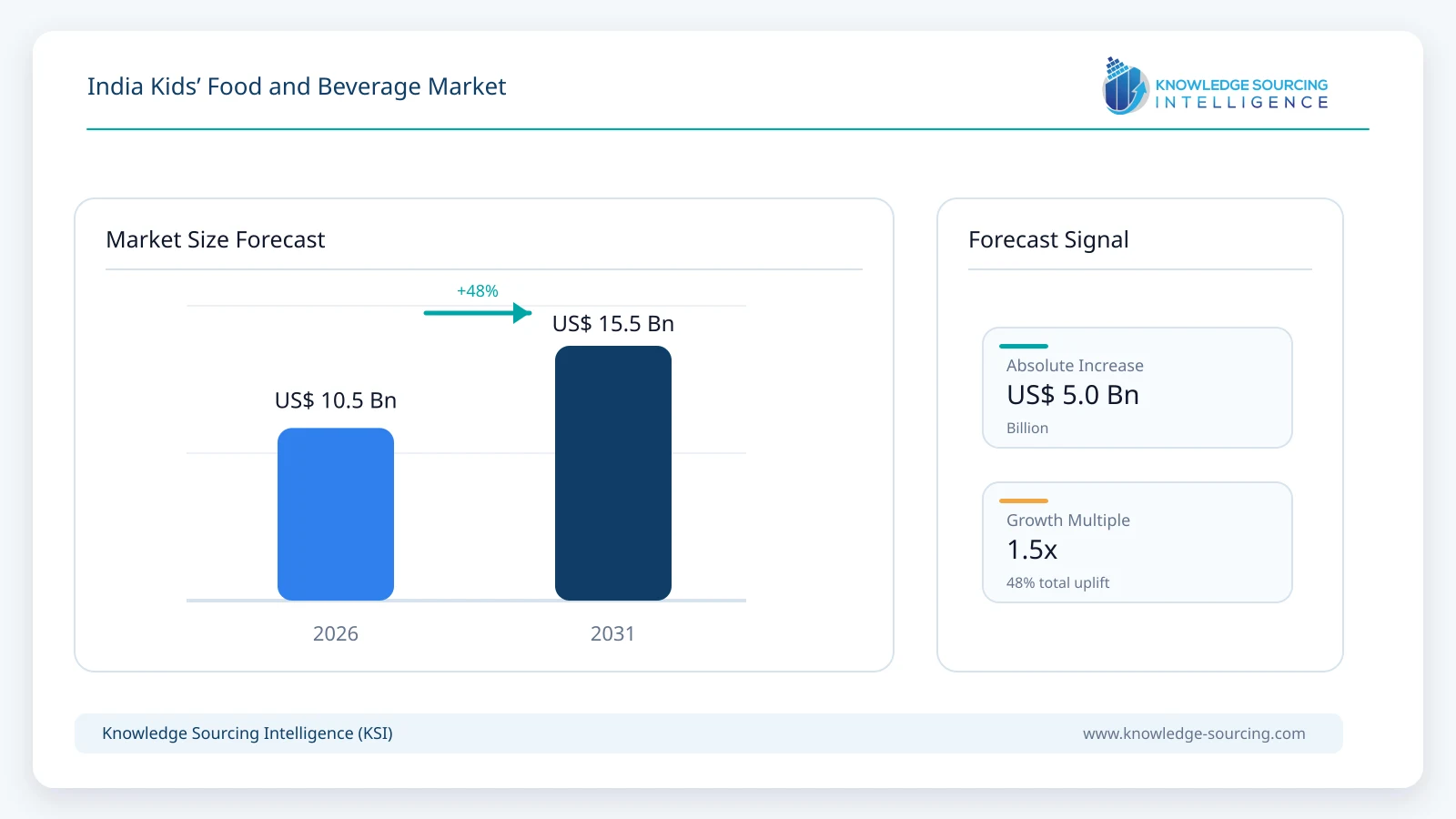
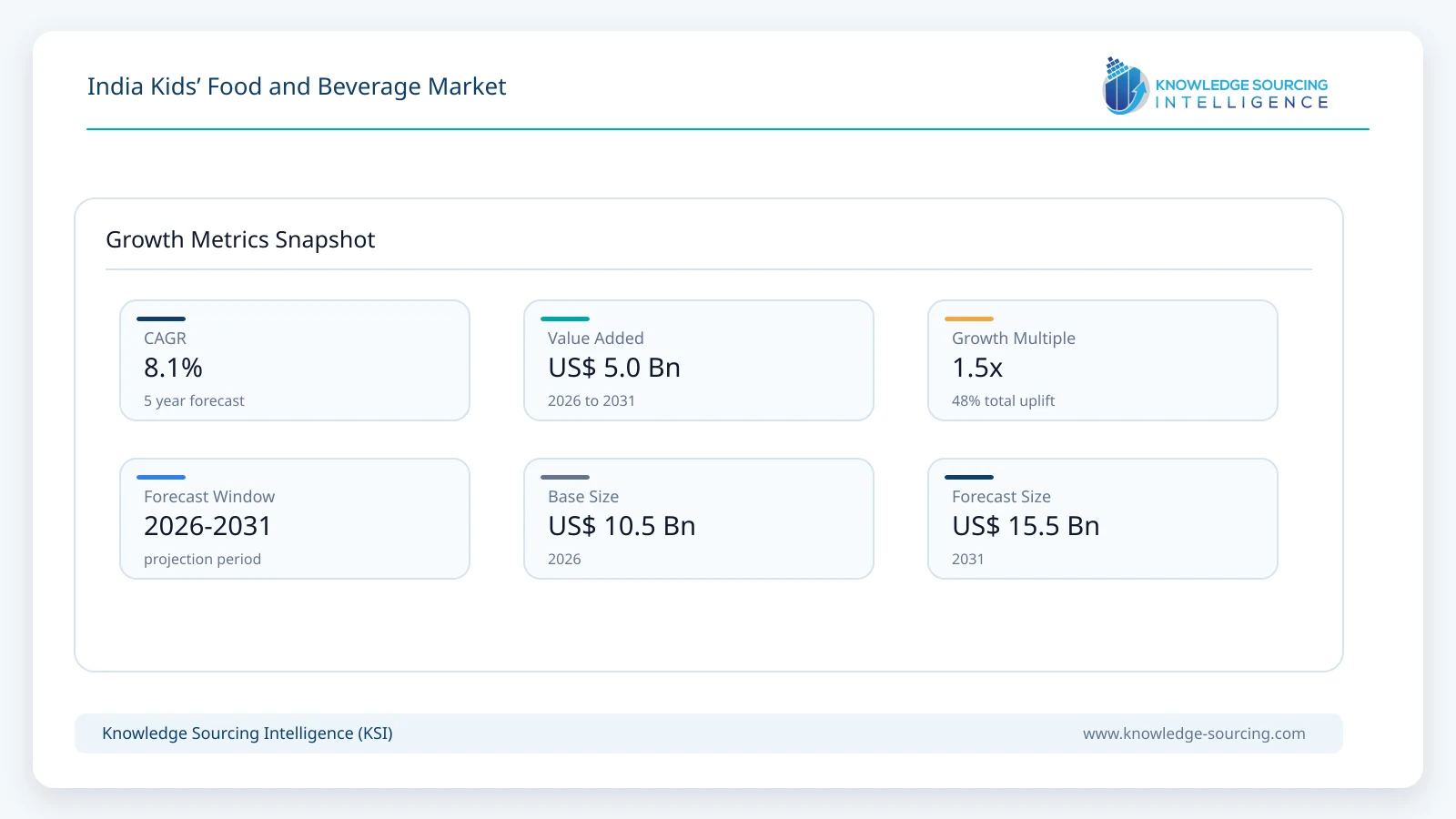
India’s kids' food and beverage market is anticipated to expand at a CAGR of 8.1%, increasing from USD 10.5 billion in 2026 to USD 15.5 billion by 2031.
Highlights:
- 1Largest End-User SegmentThe 4–8 and 9–13 age groups constitute the most significant demand clusters, as these stages involve peak physical and cognitive development, leading to high household penetration of health food drinks and fortified snacks.
- 2Regulatory ImpactStrict FSSAI mandates on sugar reduction and "Front of Pack" (FOP) labeling are compelling a wholesale reformulation of beverages, resulting in a surge of "Zero Added Sugar" variants to maintain market eligibility and parental trust.
- 3Regional Growth ConcentrationTier 1 and Tier 2 cities in South and West India, particularly Tamil Nadu and Maharashtra, serve as the primary hubs for premium product adoption due to higher disposable incomes and greater digital penetration for e-commerce.
- 4Technology TransitionThe shift from basic mixing to advanced enzymatic processing and nutrient-protection technologies is increasing the cost of production while creating a high-entry barrier for non-specialized manufacturers.
- 5Pricing Sensitivity and PremiumizationWhile the mass market remains price-sensitive, there is a clear structural shift toward premiumization in urban centers, where parents are willing to pay a 15–20% premium for products certified as organic or clean-label.
The Indian kids' food and beverage market is currently shaped by structural demand drivers that transcend short-term consumption spikes. A primary driver is the rising health consciousness among urban Indian households, leading to a demand for "clean labels" and the elimination of synthetic additives, artificial colors, and excessive refined sugars. This shift is not merely a preference but an industry-wide realignment as parents increasingly scrutinize ingredient lists for developmental efficacy. Industry dependency factors are heavily tied to the "first 1,000 days" and subsequent developmental windows, where the government’s Mission Saksham Anganwadi and Poshan 2.0 reinforce the strategic importance of nutritional fortification at a national scale.
Technology and process evolution are becoming central to product differentiation. Recent developments, such as the introduction of "NutriMax" technology by major players, demonstrate a shift toward enhancing the bioavailability of minerals like iron and zinc by reducing anti-nutrients like phytates. This technological transition is coupled with a sustainability shift, where companies are increasingly focusing on hermetically sealed, BPA-free packaging and localized sourcing to secure supply chains against global volatility. The strategic importance of the product category is further elevated by its role in addressing national health priorities, including the reduction of stunting, wasting, and micronutrient deficiencies (anaemia) among the school-going population.
Regulatory influence remains the most potent structural force in the market. The FSSAI Labelling and Display Regulations of 2020, and subsequent amendments effective through 2025, have mandated clear "Front of Pack" labeling and restricted the use of misleading claims. These regulations directly impact demand by empowering consumers to report non-compliant products via digital portals, thereby forcing manufacturers to reformulate legacy SKUs. Consequently, the market is transitioning from a high-volume, mass-market approach to a value-driven, science-backed model where transparency and verified nutritional claims are the primary levers for market share retention.
Market Dynamics
Market Drivers
Heightened Nutritional Awareness and Clean-Label Demand: Modern Indian parents are increasingly prioritizing ingredient transparency and functional benefits over brand legacy. This demand for "clean" formulations, free from artificial preservatives and high fructose corn syrup, is driving the adoption of premium health food drinks and organic snacks, as shoppers reassess everyday choices for long-term health outcomes.
Government-Led Fortification Initiatives: National programs such as Poshan Abhiyaan and Mission Poshan 2.0 create a supportive ecosystem for the fortified food sector. By standardizing the requirements for micronutrients like iron, iodine, and Vitamin A in public distribution and school meal programs, the government indirectly validates the demand for fortified products in the private retail market.
Rapid Expansion of Digital and Quick-Commerce Infrastructure: The proliferation of 10-minute delivery platforms and specialized e-commerce channels has reduced the friction for discovery and purchase of niche kids' food brands. This digital infrastructure allows smaller, specialized "clean-label" players to bypass traditional retail barriers and reach high-intent urban consumers directly.
Integration of Traditional Grains (Millet Revolution): The Indian government's push for millets (the "Global Hub for Millets") has catalyzed a structural shift in the cereal and snack segments. Manufacturers are reformulating products to include Ragi, Bajra, and Jowar, aligning with cultural familiarity while meeting modern nutritional requirements for fiber and minerals.
Market Restraints and Opportunities
Stringent Regulatory Compliance Costs: The frequent updates to FSSAI labeling and advertising standards impose high costs on manufacturers for packaging redesign and laboratory verification. While these ensure safety, they act as a restraint for small and medium enterprises (SMEs) struggling with the financial burden of constant compliance.
Supply Chain Vulnerability for Specialized Ingredients: The demand for high-quality, organic raw materials often outstrips local supply, leading to a reliance on imported ingredients. This creates exposure to currency fluctuations and international trade disruptions, which can compress margins for premium kids' food brands.
Emerging Opportunity in Allergy-Friendly and Plant-Based Segments: There is a growing, underserved market for allergen-free (gluten-free, nut-free) and plant-based dairy alternatives for children with specific dietary restrictions. Companies that can scale these specialized offerings in Tier 1 cities face limited competition and high brand loyalty.
Innovation in Nutrient Absorption Technologies: As consumers become more educated, the focus is shifting from "what is in the food" to "how much is absorbed." Technologies that reduce anti-nutrients (like phytates) offer a significant opportunity for brands to claim superior efficacy in cognitive and physical development over traditional competitors.
Supply Chain Analysis
The supply chain for the Indian kids’ food and beverage market is characterized by high production concentration in specific industrial clusters, particularly in Maharashtra, Gujarat, and Tamil Nadu, where dairy and cereal processing infrastructure is most developed. Energy intensity is a significant factor in the production of health food drinks and powdered beverages, as the drying and extrusion processes require consistent power and heat. Furthermore, the supply chain is increasingly moving toward integrated manufacturing strategies where companies like Abbott and Hindustan Unilever invest in local dairy development (e.g., Abbott’s Project Ksheersagar) to ensure a dependable supply of high-quality, contaminant-free raw milk.
Transportation constraints remain a critical challenge, particularly for the cold chain required for fresh dairy snacks and fruit-based products. Hazard classifications for infant and child nutrition are extremely high; FSSAI requires hermetically sealed packaging for infant nutrition and strict adherence to the Food Safety and Standards (Packaging) Regulations of 2018. Regional risk exposure is primarily linked to the procurement of agricultural raw materials like barley and millets, which are susceptible to climate-driven yield variations. To manage these risks, major players are adopting decentralized warehousing and multi-tier distribution models to ensure product availability across both traditional kirana stores and modern e-commerce fulfillment centers.
Government Regulations
Jurisdiction | Key Regulation / Agency | Market Impact Analysis |
India | FSSAI (Labelling and Display) Regulations, 2020 | Mandates Front-of-Pack (FOP) labeling and restricts the use of pictures of infants or mothers on products not classified as infant food. This forces clear categorization between infant and kids' food. |
India | FSSAI (Foods for Infant Nutrition) Regulations, 2020 | Strictly prohibits the addition of preservatives, artificial colors, and flavors in infant nutrition. Limits sucrose and fructose to 20% of total carbohydrates, driving cleaner formulations. |
India | Ministry of Women and Child Development (Poshan 2.0) | Standardizes the fortification of staple foods and snacks, influencing the private sector to align with national RDA (Recommended Dietary Allowance) values for minerals and vitamins. |
International | Codex Alimentarius (WHO/FAO) | Serves as the benchmark for Indian regulations where local RDA values are unavailable, particularly for novel ingredients and bio-available mineral compounds. |
Key Developments
August 2026: Danone India introduced Vanilla and Chocolate flavour sachets for Dexogrow, expanding its toddler nutrition drink with kid-oriented flavour choices while retaining its nutrition-focused proposition.
August 2026: Zydus Wellness strengthened Complan’s children’s portfolio with Complan Powerplay, a ready-to-drink nutritional milkshake designed specifically for children aged 7–9 years.
April 2026: Green Gold Animation partnered with Indo Nissin Foods to launch Nissin Chhota Bheem Masala Noodles, featuring a mild, kid-friendly flavour and QR-enabled Chhota Bheem games.
January 2026: Nestlé India’s CEREGROW launched a new brand film emphasizing nutrient-dense meals for young children, reinforcing its positioning around nutrition during early childhood growth and development.
Market Segmentation
By Product Type: Beverages (Health Food Drinks and Fortified Juices)
The beverage segment is the largest contributor to the Indian kids' food and beverage market, driven by a deep-seated cultural habit of mixing nutritional powders with milk. Demand in this segment is shifting away from traditional high-sugar malt drinks toward functional "growth" formulas that claim to support cognitive development and immunity. The introduction of technologies that reduce anti-nutrients, allowing for better absorption of iron and zinc, is a primary demand driver among health-conscious urban parents. Furthermore, the rise of "Zero Added Sugar" variants is a direct response to FSSAI’s anti-obesity measures, making these products more palatable to the modern, label-reading consumer.
By Age Group: 9–13 Years (Pre-Adolescents)
The 9–13 years segment represents a critical growth window, driven by the specific physiological needs of puberty and increased academic/athletic pressure. Unlike the toddler segment, demand here is influenced by both the parents’ nutritional concerns and the child’s flavor preferences. This has led to the proliferation of "stealth nutrition" products, snacks and beverages that provide high protein and micronutrients but in formats (like chocolate pastes or savory puffs) that appeal to older children. Marketing strategies for this segment have shifted toward digital engagement and sports-based endorsements to align the products with an active, aspirational lifestyle.
By Distribution Channel: Online (E-commerce and Quick-Commerce)
The online distribution channel is experiencing the fastest growth, particularly for niche and premium kids' food brands. The primary operational advantage of this channel is the ability to provide detailed product information and "clean-label" certifications that are often lost on crowded physical retail shelves. Quick-commerce platforms have fundamentally changed purchase behavior from planned monthly grocery trips to "on-demand" replenishment, which is particularly beneficial for the snacks and beverages category. For manufacturers, this channel provides real-time consumer data and a direct feedback loop, allowing for faster product iteration and targeted promotions based on parental search behavior.
List of Companies
PediaSure (Abbott India)
Cadbury Bournvita (Mondelez International, Inc.)
Horlicks (Hindustan Unilever)
Groviva (Signutra)
Complan (Zydus Wellness)
Boost (Hindustan Unilever)
Protinex (Danone)
Himalaya Quista Kidz (Himalaya Wellness Company)
DFM Foods Ltd.
Timios
Wellbeing Nutrition
Twirtles
PediaSure (Abbott India)
Abbott India’s PediaSure holds a dominant market position in the "Scientifically Proven" nutrition segment, specifically targeting children with growth concerns. Its strategy focuses on clinical validation, often positioning the product as a bridge for "fussy eaters" to meet their Recommended Dietary Allowance (RDA). The brand's competitive advantage lies in its healthcare-professional-led distribution model, where it is frequently recommended by pediatricians for catch-up growth.
Geographically, PediaSure maintains a strong presence across Tier 1 and Tier 2 cities through an integrated model that combines hospital-channel availability with aggressive e-commerce expansion. The brand's technology differentiation is centered on its "Triple Sure" system, which includes a blend of 37 nutrients, including prebiotics and probiotics. Recent initiatives, such as the partnership with Sesame Workshop in early 2026, highlight its commitment to building healthy habits beyond just supplementation.
Horlicks (Hindustan Unilever)
Hindustan Unilever’s Horlicks is the market leader in the mass-premium health food drink (HFD) category. Its strategy revolves around constant innovation to stay relevant to changing nutritional standards, as evidenced by the late-2025 launch of its superfood blend featuring "NutriMax" technology. This technological differentiation, reducing phytates to improve mineral absorption, positions Horlicks as a science-forward brand rather than just a malt-based drink.
The company leverages HUL’s massive "Shakti" and traditional distribution networks, ensuring deep penetration even in rural markets. Its competitive advantage is its high brand equity and the ability to offer specialized variants, such as Horlicks Growth+ and Junior Horlicks, covering the entire developmental spectrum. The shift toward zero-added-sugar formulations reflects its strategic alignment with national health goals regarding the reduction of non-communicable diseases (NCDs).
Complan (Zydus Wellness)
Zydus Wellness’s Complan is a major player in the "Planned Growth" segment, famously known for its "2x Faster Growth" claim. Following its acquisition from Heinz, Zydus has reframed Complan’s participation by focusing on contemporary needs like immunity and brain development. Its strategy involves a mix of product relaunches and geographic expansion into underserved markets in East and North India.
Complan’s competitive advantage is its "100% Milk Protein" formulation, which it uses to differentiate itself from cereal-based malt drinks. The integration model includes a mix of its own manufacturing facilities in Aligarh and Sikkim along with co-manufacturing partners. The recent strategy to engage with young sports icons like Vaibhav Suryavanshi demonstrates a shift toward the 14-18 age group, aiming to capture the demand for high-performance nutrition in older children.
Analyst View
The Indian kids' food and beverage market is undergoing a structural pivot toward science-backed, clean-label nutrition driven by stringent FSSAI labeling mandates. Success will depend on technological innovations in nutrient bioavailability and the strategic integration of traditional superfoods like millets. While regulatory costs remain a barrier, the expansion of quick-commerce offers a high-growth pathway for premiumized, transparent brands to capture urban demand.
India Kids' Food and Beverage Market Scope:
| Report Metric | Details |
|---|---|
| Total Market Size in 2026 | USD 10.5 billion |
| Total Market Size in 2031 | USD 15.5 billion |
| Forecast Unit | Billion |
| Growth Rate | 8.1% |
| Study Period | 2021 to 2031 |
| Historical Data | 2021 to 2024 |
| Base Year | 2025 |
| Forecast Period | 2026 – 2031 |
| Segmentation | Product Type, Age Group, Distribution Channel |
| Companies |
|
Market Segmentation
BY PRODUCT TYPE
- Bakery Products
- Dairy Products
- Cereals and Grains
- Snacks
- Fruits and Vegetables
- Beverages
- Others
BY AGE GROUP
- 2-3 years
- 4-8 years
- 9-13 years
- 14-18 years
BY DISTRIBUTION CHANNEL
- Online
- Offline
Table of Contents
1. INTRODUCTION
1.1. Market Overview
1.2. Market Definition
1.3. Scope of the Study
1.4. Market Segmentation
1.5. Currency
1.6. Assumptions
1.7. Base and Forecast Years Timeline
2. RESEARCH METHODOLOGY
2.1. Research Data
2.2. Assumptions
3. EXECUTIVE SUMMARY
3.1. Research Highlights
4. MARKET DYNAMICS
4.1. Market Drivers
4.2. Market Restraints
4.3. Porter’s Five Force Analysis
4.3.1. Bargaining Power of Suppliers
4.3.2. Bargaining Power of Buyers
4.3.3. Threat of New Entrants
4.3.4. Threat of Substitutes
4.3.5. Competitive Rivalry in the Industry
4.4. Industry Value Chain Analysis
5. GROWTH RATE OF KEY INDICATORS OF CHILD NUTRITION
6. INDIA KIDS' FOOD AND BEVERAGE MARKET, BY PRODUCT TYPE
6.1. Introduction
6.2. Bakery Products
6.3. Dairy Products
6.4. Cereals and Grains
6.5. Snacks
6.6. Fruits and Vegetables
6.7. Beverages
6.8. Others
7. INDIA KIDS' FOOD AND BEVERAGE MARKET, BY AGE GROUP
7.1. Introduction
7.2. 2-3 years
7.3. 4-8 years
7.4. 9-13 years
7.5. 14-18 years
8. INDIA KIDS' FOOD AND BEVERAGE MARKET, BY DISTRIBUTION CHANNEL
8.1. Introduction
8.2. Online
8.3. Offline
9. COMPETITIVE ENVIRONMENT AND ANALYSIS
9.1. Major Players and Strategy Analysis
9.2. Market Share Analysis (over 3 years with revenue)
9.2.1. Bournvita
9.2.2. Pediasure
9.2.3. Groviva
9.2.4. Horlicks
9.3. Mergers, Acquisitions, Agreements, and Collaborations
10. COMPANY PROFILES
9.1 PediaSure (Abbott)
9.2 Cadbury Bournvita (Mondelz International, Inc.)
9.3 Horlicks (Unilever)
9.4 Groviva (Signutra)
9.5 Complan (Zydus Wellness)
9.6 Boost (Unilever)
9.7 Protinex (Danone)
9.8 Himalaya Quista kidz (Himalaya Wellness Company)
9.9 DFM Foods Ltd.
LIST OF FIGURES
LIST OF TABLES
Navigate
Trusted by the world's leading organizations











