
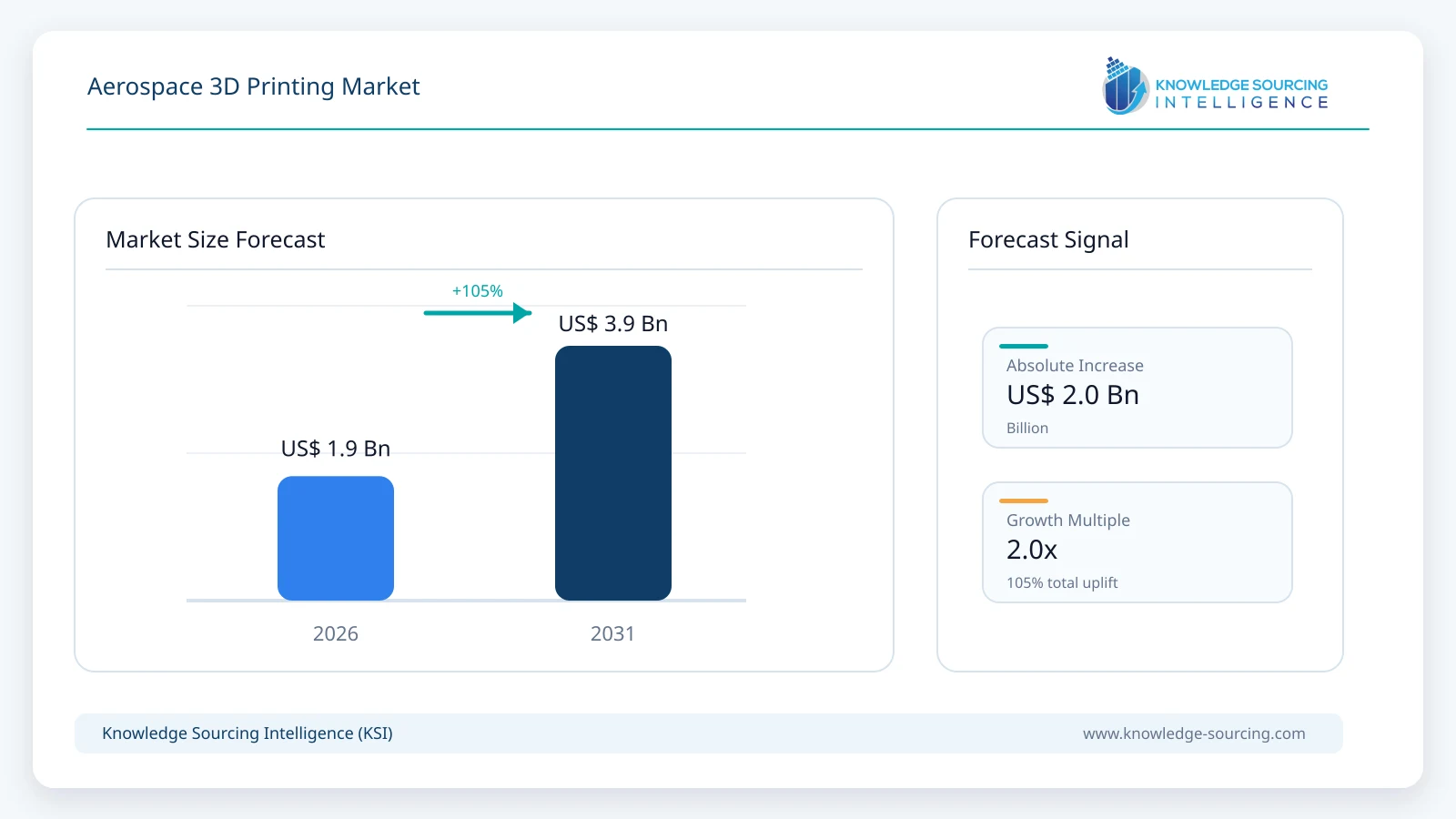
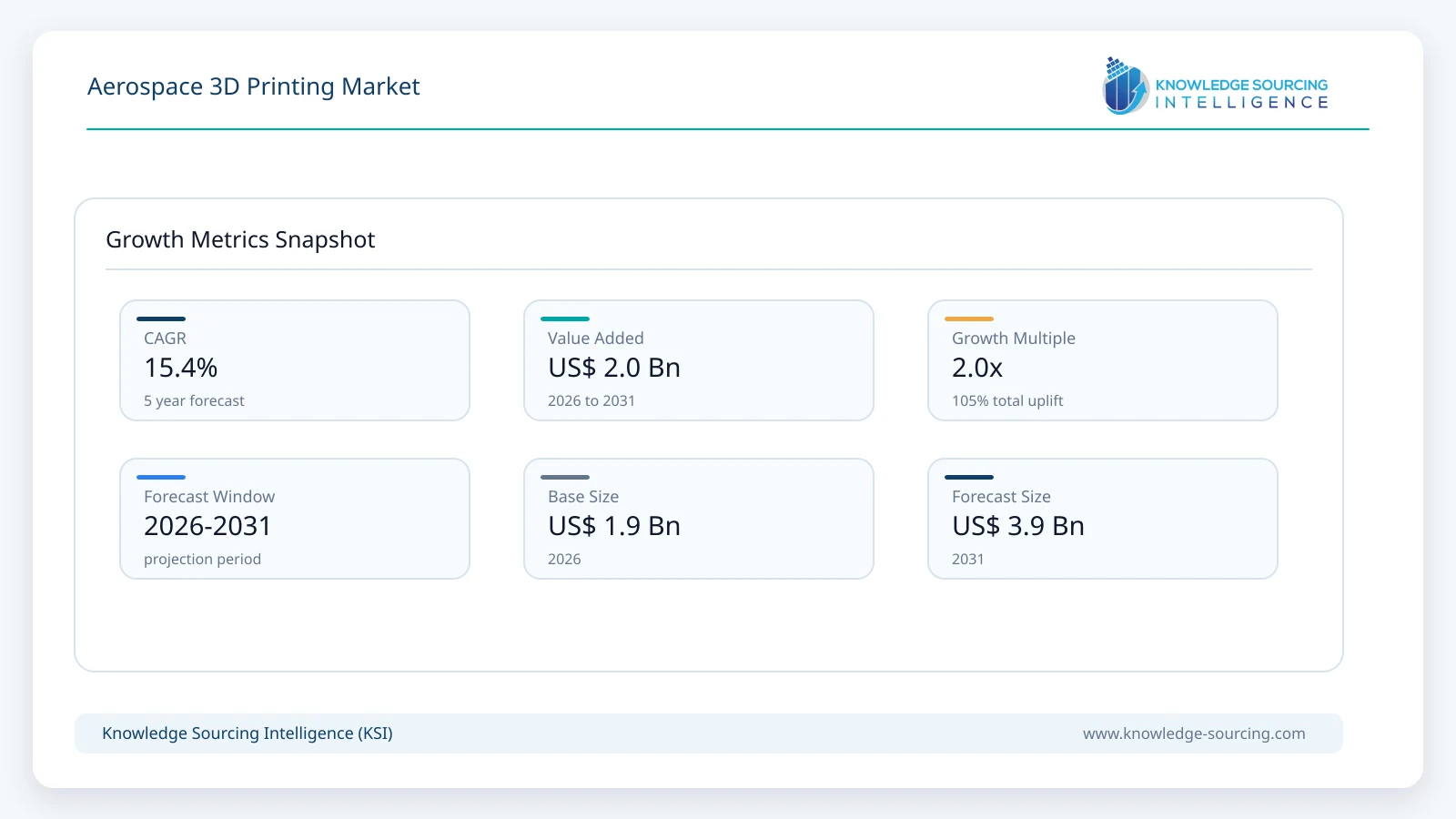
The global Aerospace 3D Printing Market is expected to expand at a CAGR of approximately 15.4%, reaching an estimated USD 3.85 billion in 2031 from USD 1.88 billion in 2026 over the forecast period.
Highlights:
- 1Titanium and nickel-based metal printing commands the most demanding aerospace applications, with material certification and fatigue performance determining recurring production orders.
- 2Production parts are gaining commercial importance over demonstration prototypes, particularly in engines, aircraft structural fittings and spacecraft assemblies.
- 3Laser powder bed fusion is the largest individually identifiable technology category; directed energy deposition is increasing its role in larger titanium structures.
- 4North America remains the largest regional market, supported by engine, commercial-aircraft, defense-aviation and launch-industry manufacturing.
- 5Asia Pacific offers the fastest growth among the major regional markets as aircraft, space and supplier manufacturing capabilities deepen.
- 6Airworthiness documentation, fatigue performance and process repeatability determine the pace at which printed aerospace parts move into recurring production.
The aerospace 3D printing market comprises aerospace-attributable purchases of industrial additive-manufacturing systems, consumables for captive production, externally supplied printed components and independently purchased engineering or process services. Its commercial applications extend from prototype verification and assembly tooling to certified aircraft components, rocket propulsion hardware and satellite assemblies. Laser powder bed fusion, polymer printing and directed energy deposition serve different technical and economic requirements rather than competing as interchangeable processes.
Airbus has begun incorporating selected wire-directed-energy-deposition titanium parts into A350 cargo-door-surround assemblies. Meanwhile, jet-engine manufacturing has established the value of integrated printed components, and spacecraft manufacturers continue using additive methods for highly customized structures. Production adoption remains conditioned on material traceability, validated machine settings, post-processing and release documentation. The aerospace customer consequently buys a repeatable manufacturing process, not simply a geometrically accurate printed object.
Nickel-alloy fuel passages and titanium aircraft fittings impose manufacturing constraints that can make additive processes attractive despite their higher process-control costs. Nickel-alloy engine passages, titanium load-bearing fittings and integrated heat-transfer geometries can justify higher unit manufacturing costs through weight reduction, consolidation or shorter delivery schedules. Airbus’s transition to wire-fed titanium deposition also illustrates a different economics: near-net-shape structural blanks use material more efficiently than machining large forgings and can bypass some long-lead tooling requirements.
For serial aerospace work, production approvals and traceable material/process specifications carry as much weight as nominal machine capability. The Aviation AM Centre’s 2025 qualification of EOS-based metal printing within its EASA Part-21/G production organization approval provides a practical example because it links machines to a controlled manufacturing and release system. Separately, Norsk Titanium reported the progression of structural titanium components developed with General Atomics Aeronautical Systems toward implementation in unmanned aircraft. These milestones indicate an expanding production base, although individual part approvals do not eliminate design-specific evidence requirements.
Aerospace orders are distributed across machine builders, qualified feedstock specialists, service bureaus and OEM-controlled production cells. EOS, Nikon SLM Solutions, 3D Systems, Stratasys and Velo3D compete in different equipment and process niches, while firms such as Norsk Titanium commercialize the manufacture of qualified near-net-shape parts. Aerospace procurement rewards documented material histories, process control, available inspection capacity and supplier continuity, which can matter more than headline machine productivity.
Market Trends
Large Titanium Structures Move Beyond Powder-Bed Build Envelopes
Wire-directed energy deposition is widening the range of aircraft structures considered suitable for additive production. Airbus describes the use of titanium-wire deposition to form near-net-shape components subsequently inspected and machined to final dimensions. Its initial A350 cargo-door-surround integration brings this approach into an operating aircraft program, distinguishing it from earlier laboratory demonstrations.
The opportunity is concentrated in relatively large, low-to-medium-volume structural blanks where forging lead times, titanium waste and machining effort are substantial. Directed energy deposition does not remove final machining or approval requirements. It changes the sequence of value creation, giving specialist suppliers opportunities in deposition equipment, process engineering, structural part supply and non-destructive inspection.
Qualified Production Cells Gain Value Over Standalone Printers
Aerospace buyers increasingly evaluate additive equipment as part of a validated production cell that includes powder handling, machine calibration, process monitoring and post-build inspection. The Aviation AM Centre’s approved production arrangement with EOS and AMCM demonstrates why a printer sale alone does not secure recurring aerospace business. Organizations must establish a defined and auditable route from a controlled build process to released parts.
Qualification support is therefore becoming a commercial differentiator. Equipment suppliers able to provide repeatable process parameters, material data and implementation support may reduce the effort required for a customer to introduce the same family of parts across production lines. Approvals remain specific to organizations, materials, machines and parts, which limits any claim that one successful qualification opens the entire aircraft market.
Propulsion and Space Programs Favor Integrated Geometries
Jet engines and space systems offer strong economic reasons to consolidate assemblies into printed geometries. GE Aerospace has documented fuel-nozzle and engine-component applications, while Boeing reported a printed satellite solar-array substrate design integrating routing paths and attachment features. Boeing’s 2025 announcement described qualification work and anticipated spacecraft use, rather than claiming the new substrates had already flown.
Such programs shift revenue toward production-grade metal platforms, stable feedstocks and engineering services for thermal, structural and fatigue validation. The suppliers that benefit are those able to reproduce complicated internal features with predictable quality while maintaining cost control across successive builds. High complexity alone is not sufficient: a printed component must outperform or commercially justify replacing a conventional assembly.
Polymer Printing Retains a Distinct Cabin and Tooling Role
High-performance polymer systems remain embedded in aerospace development and lower-load applications. Stratasys markets ULTEM- and PEKK-based materials for production tooling and selected aircraft interior components subject to applicable material and flammability requirements. These applications typically use smaller machines and lower material costs than metal propulsion or structural programs, but still demand controlled fabrication procedures.
The commercial appeal is strongest for low-volume interior geometries, assembly aids and replacement parts that would otherwise require dedicated tooling or long supplier replenishment. Polymer printing can also shorten engineering iterations before a design is committed to high-cost certification and production. Its growth should not be mistaken for substitution into all load-bearing aircraft parts, where mechanical performance and certification place different constraints.
Aerospace 3D Printing Market Segment Analysis
By Material Type
Metals
Metal additive manufacturing leads aerospace revenue because engine, aerostructure and spacecraft applications place high value on strength, temperature resistance and geometric freedom. Titanium offers attractive strength-to-weight performance in structural applications, while nickel-based alloys are used for components exposed to engine heat. Material selection is tied to a qualified combination of feedstock chemistry, machine parameters, heat treatment, fatigue behavior and inspection procedures, not simply to powder specification.
Metals are estimated to represent approximately 62% of 2026 expenditure and around 68% by 2031. Airbus’s wire-fed titanium developments and the increasing use of qualified metal powder-bed processes help explain this trajectory. Revenue expands through higher-value production parts and industrialized operating cells rather than an assumption that powder price will continually rise. Polymers retain substantial expenditure in tooling and aircraft interiors, but generally offer different structural and unit-value economics.
By Technology Type
Metal Laser Powder Bed Fusion
Laser powder bed fusion is the principal identifiable technology category for intricate metal aerospace components. Multiple controlled laser exposures can produce complex cooling channels, dense alloy parts and consolidated assemblies with geometries difficult to achieve through casting or machining. The aerospace case, however, rests on reproducibility: powder condition, build location, support removal, stress relief and inspection influence the usable output of each machine.
The technology represents approximately 46% of modeled 2026 market expenditure and remains a leading source of spending through 2031. Its installed-base expansion benefits qualified hardware, material supply, post-processing and engineering capabilities. Selective laser sintering and fused deposition modelling continue serving polymer functions, while directed energy deposition addresses a growing portion of larger structures. These are complementary process families rather than interchangeable machine specifications.
By Application
Production Parts
Production parts are the largest application because qualified components can generate repeat business over aircraft, engine and spacecraft program lifecycles. Parts for propulsion, structural fittings and satellite systems often require multiple builds with the same process parameters and documented inspection records. A completed development print becomes commercially valuable only when the customer authorizes its recurrent use and manufacturing capability can support delivery schedules.
This application is estimated at USD 0.98 billion in 2026, equivalent to approximately 52% of the total, and reaches USD 2.26 billion by 2031. Boeing’s space-components work and the qualified production progression reported by Norsk Titanium support the direction of demand. Prototyping, production tooling and jigs remain necessary markets, especially where they reduce program-development delays, but their economics are less closely tied to recurring end-use component shipments.
Market Drivers
Assembly Consolidation and Aircraft Weight Economics
Airframe and engine engineers are using additive design to combine separate brackets, ducts and fluid-handling features into fewer manufactured items. Airbus displayed an A350 titanium door-latch shaft that replaces ten individual parts with a single printed part, reporting a 45% component weight reduction. The significance is component-specific, not a corresponding reduction in aircraft weight.
Fewer joints and fasteners can reduce assembly operations and simplify some inspection or inventory requirements. Commercial adoption is strongest where those savings offset higher printer, powder, finishing and qualification costs.
Serial Aircraft and Engine Production Requirements
Aircraft production programs reward suppliers that can deliver qualified parts repeatedly across changing build schedules. Conventional forgings and castings require tooling, capacity commitments and long production cycles, whereas additive manufacturing offers a route for selected difficult geometries and low-volume components. The approach does not make serial production automatically economical.
Once an additive part is approved, recurring production creates demand for traceable feedstock, controlled machines and inspection services. This supports a more durable revenue base than prototype-only printing.
Structural Titanium Yield and Supply-Chain Performance
Large titanium parts can generate significant machining waste when cut from forged stock. Airbus is testing and incorporating wire-deposition methods that create near-net-shaped blanks before final machining. The economic benefit is linked to lower material removal, faster availability of selected geometries and reduced dependence on specific forging capacity.
These gains support demand for directed energy deposition and qualified structural-part suppliers, particularly when customers are willing to establish long-term production agreements rather than make isolated experimental purchases.
Spacecraft and Launch-System Production Cycles
Launch and satellite programs require specialized geometries that can change between development iterations. Boeing’s printed solar-array substrate program integrates assembly features and is designed to shorten manufacturing cycles, while Velo3D’s relationship with iRocket links metal printers to reusable-launch and propulsion manufacturing programs. Both cases show additive manufacturing moving closer to mission-specific production.
Space programs can accept higher component complexity and lower batch volumes than many conventional industrial sectors, creating demand for high-value printers and engineering services.
Controlled Certification and Process Repeatability
Aerospace approval processes reward manufacturing methods capable of producing consistent material properties and retaining complete production histories. The Aviation AM Centre’s EASA Part-21/G qualified metal production capability is a useful example of certification infrastructure developing around additive technologies. Such milestones give buyers evidence that the process can fit established aerospace quality systems.
The resulting demand extends beyond printers to material characterization, process verification, digital records and post-processing, while still requiring separate validation for individual components.
Market Restraints
Lengthy Part-Specific Qualification
Airworthiness and propulsion requirements place extensive demands on material allowables, fatigue testing, manufacturing repeatability and inspection evidence. Approval of an additive production organization does not automatically qualify every part it makes. New materials or significant process changes may require additional testing and documentation.
The elapsed time between technical feasibility and recurring deliveries can therefore be considerable, particularly for safety-critical components. This limits near-term equipment utilization and favors suppliers already embedded in aerospace quality systems.
High Total Cost of Finished Metal Parts
The purchase price of a metal printer represents only one element of aerospace production economics. Inert-gas facilities, powder safety controls, heat treatment, machining, support removal, non-destructive inspection and skilled staff all add cost after the build. Material costs can also rise where strict powder traceability or high-purity alloy requirements apply.
Additive manufacturing is harder to justify for simple, high-volume geometries already produced efficiently by forging or casting. Buyers therefore evaluate finished-part economics rather than comparing printing time with machine time alone.
Build-to-Build Variability and Inspection Burden
Metal properties can be affected by powder reuse, thermal history, scan strategy, build orientation and defects within complex geometries. Internal passageways that create the design advantage of additive parts may also be difficult to inspect or finish.
Manufacturers must maintain repeatable process windows and suitable testing procedures across machines and locations. If a part fails post-build inspection, the accumulated machine, material and finishing expense can substantially raise the true delivered cost.
Material Qualification and Feedstock Constraints
Aerospace-grade titanium, nickel-alloy and specialist polymer feedstocks require consistent composition, controlled storage and verified production histories. Changing powder or filament suppliers may affect process performance and require further validation. Higher-performance materials also impose handling and safety requirements not found in conventional engineering plastics.
These conditions narrow the supplier pool and can complicate localization of manufacturing. They particularly affect smaller manufacturers attempting to introduce additive processes without an established materials qualification capability.
Uneven Economics Across Aerospace Applications
Aerospace adoption is concentrated where low volumes, part consolidation or manufacturing complexity justify the additive route. Conventional tools and processes remain effective for many straightforward components. Space propulsion hardware and high-value aircraft spares may have a strong case, while commodity brackets and simple molded parts often do not.
Project-specific economics can produce uneven purchasing cycles for additive equipment. Equipment providers consequently depend on a relatively concentrated set of qualified programs and must support customers through extended technical evaluation periods.
Regional Outlook
North America
North America is the largest regional aerospace additive-manufacturing market, supported by established aircraft and engine manufacturers, satellite and launch companies, specialist service bureaus and aviation quality infrastructure. The United States hosts GE Aerospace engine production activity, Boeing aerospace programs and suppliers such as 3D Systems and Velo3D. These demand centers purchase a combination of metal systems, polymer tools, certified components and qualification services.
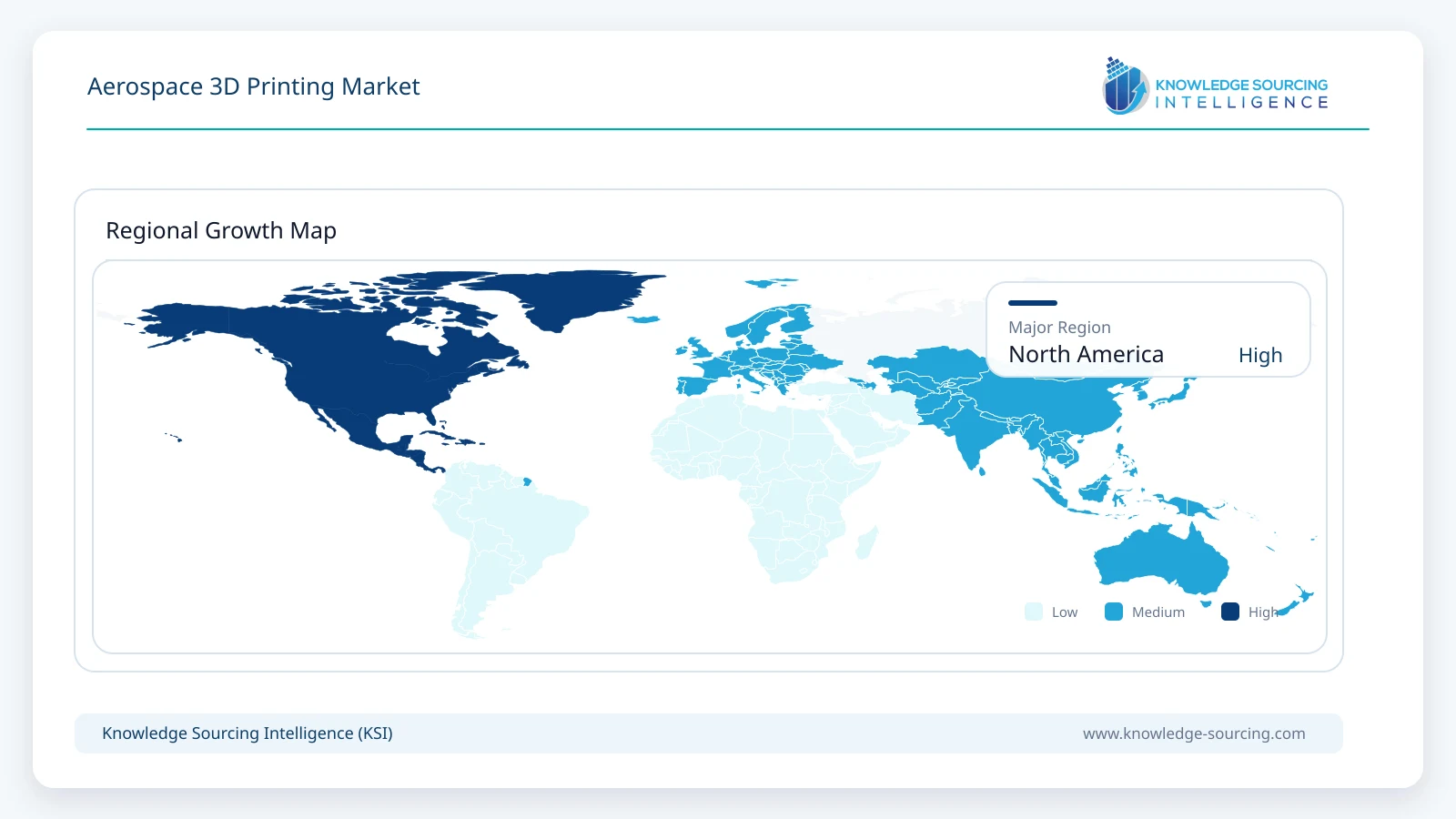
North America is estimated to account for approximately 37% of 2026 global spending. U.S. defense aviation and space activity provide additional demand, but qualification capacity and secure supply requirements often determine which suppliers can win production contracts. The region is expected to retain its lead through 2031 while suppliers expand process development and local output capability.
Asia Pacific
Asia Pacific is gaining relevance through aircraft industrialization, domestic space programs, precision manufacturing and specialist materials development. China and Japan have large industrial manufacturing bases, while India is developing rocket and aerospace additive capabilities. The regional opportunity spans metal aerospace parts and equipment, together with more established polymer prototyping and production-support applications.
Regional spending is estimated at USD 0.46 billion in 2026 and projected to exceed USD 1.1 billion in 2031, representing the fastest expansion among the major regions over the forecast period. The pace will depend on whether suppliers can translate manufacturing investment into qualified, repeatable aerospace part deliveries. Large printer installations alone are not a reliable indicator of sustained revenue.
Competitive Landscape
EOS and Nikon SLM Solutions supply metal powder-bed systems to programs that place unusual weight on repeatability and qualified process windows. EOS and Nikon SLM Solutions compete in metal powder-bed technology; Velo3D focuses on demanding metal geometries and integrated process control; 3D Systems combines industrial metal systems and customer applications engineering. Stratasys is particularly relevant to polymer tooling and selected interior applications, where materials qualification and dimensional repeatability shape procurement.
Aircraft and engine customers assess printer suppliers against reproducible material data, field support and the time needed to qualify a new build configuration. Customers assess qualified material libraries, aerospace references, monitoring software, field-service capability and the resources available for part development. Nikon’s expansion in large-format metal platforms and Airbus’s work on titanium wire deposition demonstrate distinct approaches to scaling structural components. The ability to support industrialization of a specific application can be more valuable than a broad technology catalogue.
Norsk Titanium and other specialist manufacturers compete on demonstrated part delivery and inspection capability, rather than on equipment specifications alone. Norsk Titanium offers a process-led route to near-net-shaped structural titanium parts, while Materialise and other software/service providers support process preparation and manufacturing integration. OEMs commonly retain design authority and final approval, creating a commercial distinction between a technology vendor, a printed-part supplier and the aircraft manufacturer receiving the part. Numerical market-share rankings are not presented without verified comparable aerospace-only revenues.
Recent Developments
March 2026: Nikon described space-additive manufacturing partnerships and its investment in Vast, including ongoing large-format metal-printing work with launch and spacecraft companies. Agreements and reserved equipment were not represented as completed installations.
February 2026: Norsk Titanium announced that titanium components developed with General Atomics Aeronautical Systems had qualified and were advancing toward implementation across unmanned aircraft products.
January 2026: Airbus reported initial serial integration of wire-directed-energy-deposition titanium components in the A350 cargo-door-surround area, extending additive manufacturing to larger structural blanks.
January 2026: 3D Systems planned a multi-phase expansion of up to 80,000 square feet at its Littleton, Colorado facility, which culminated in the grand opening of a 50,000-square-foot Industrial Technology Center on October 21, 2026
October 2025: The Aviation AM Centre qualified EOS/AMCM metal-printing technology within its EASA Part-21/G approval, establishing a defined route for approved aviation component manufacture.
Market Outlook
Titanium forgings, turbine assemblies and maintenance components will continue to be assessed part by part, with additive production expanding first where conventional routes carry a clear cost, lead-time or performance penalty. Recurring parts production should account for a growing proportion of expenditure as customers accumulate material data, establish inspection procedures and bring additional designs through qualification. Metal technologies will retain a central role because the economic benefits of consolidated structures and high-performance alloys are especially relevant to aerospace.
Suppliers with demonstrated production histories, material data and customer qualification capabilities should have a stronger position than manufacturers competing on machine specifications alone. Directed energy deposition can expand the addressable range of titanium structures, while powder bed fusion remains important for smaller, intricate parts. Polymer technologies will continue meeting practical tooling and interior needs where strength, flammability and quality requirements can be satisfied.
The strongest commercial outcomes will arise where aerospace manufacturers align part design, build process, finishing and release documentation early in the program. Procurement decisions should increasingly favor complete industrial solutions that shorten total time to an accepted component. Adoption nevertheless remains program-specific, and future investment will be shaped by proven part costs and production reliability as much as by new printer capability.
Aerospace 3D Printing Market Scope:
| Report Metric | Details |
|---|---|
| Total Market Size in 2026 | USD 1.88 billion |
| Total Market Size in 2031 | USD 3.85 billion |
| Forecast Unit | Billion |
| Growth Rate | 15.4% |
| Study Period | 2021 to 2031 |
| Historical Data | 2021 to 2024 |
| Base Year | 2025 |
| Forecast Period | 2026 – 2031 |
| Segmentation | Material Type, Technology Type, Application, Geography |
| Companies |
|
Market Segmentation
By Material Type
Metals
Polymers
Ceramics
Others
By Technology Type
Metal Laser Powder Bed Fusion
Selective Laser Sintering (SLS)
Stereolithography (SLA)
Fused Deposition Modelling (FDM)
Others
By Application
Prototyping
Tooling
Parts
Jigs & Fixtures
By Geography
North America
United States
Canada
Mexico
South America
Brazil
Argentina
Others
Europe
United Kingdom
Germany
France
Spain
Others
Middle East and Africa
Saudi Arabia
UAE
Israel
Others
Asia Pacific
China
India
Japan
South Korea
Taiwan
Indonesia
Others
Table of Contents
1. EXECUTIVE SUMMARY
1.1. Market Size and Growth
1.2. Key Findings
1.3. Segment and Regional Outlook
2. MARKET SNAPSHOT
2.1. Market Overview
2.2. Market Definition
2.3. Scope of the Study
2.4. Market Segmentation
3. BUSINESS LANDSCAPE
3.1. Market Drivers
3.1.1. Assembly Consolidation and Aircraft Weight Economics
3.1.2. Serial Aircraft and Engine Production Requirements
3.1.3. Structural Titanium Yield and Supply-Chain Performance
3.1.4. Spacecraft and Launch-System Production Cycles
3.1.5. Controlled Certification and Process Repeatability
3.2. Market Restraints
3.2.1. Lengthy Part-Specific Qualification
3.2.2. High Total Cost of Finished Metal Parts
3.2.3. Build-to-Build Variability and Inspection Burden
3.2.4. Material Qualification and Feedstock Constraints
3.2.5. Uneven Economics Across Aerospace Applications
3.3. Market Opportunities
3.4. Porter’s Five Forces Analysis
3.5. Industry Value Chain Analysis
3.6. Policies and Regulations
3.7. Strategic Recommendations
4. TECHNOLOGICAL OUTLOOK
4.1. Laser Powder Bed Fusion
4.2. Selective Laser Sintering
4.3. Stereolithography
4.4. Fused Deposition Modelling
4.5. Directed Energy Deposition and Other Metal Processes
4.6. Aerospace Materials and Production Qualification
5. AEROSPACE 3D PRINTING MARKET BY MATERIAL TYPE
5.1. Introduction
5.2. Metals
5.3. Polymers
5.4. Ceramics
5.5. Others
6. AEROSPACE 3D PRINTING MARKET BY TECHNOLOGY TYPE
6.1. Introduction
6.2. Metal Laser Powder Bed Fusion
6.3. Selective Laser Sintering (SLS)
6.4. Stereolithography (SLA)
6.5. Fused Deposition Modelling (FDM)
6.6. Others
7. AEROSPACE 3D PRINTING MARKET BY APPLICATION
7.1. Introduction
7.2. Prototyping
7.3. Tooling
7.4. Parts
7.5. Jigs & Fixtures
8. AEROSPACE 3D PRINTING MARKET BY GEOGRAPHY
8.1. Introduction
8.2. North America
8.2.1. United States
8.2.2. Canada
8.2.3. Mexico
8.3. South America
8.3.1. Brazil
8.3.2. Argentina
8.3.3. Others
8.4. Europe
8.4.1. United Kingdom
8.4.2. Germany
8.4.3. France
8.4.4. Spain
8.4.5. Others
8.5. Middle East and Africa
8.5.1. Saudi Arabia
8.5.2. UAE
8.5.3. Israel
8.5.4. Others
8.6. Asia Pacific
8.6.1. China
8.6.2. India
8.6.3. Japan
8.6.4. South Korea
8.6.5. Taiwan
8.6.6. Indonesia
8.6.7. Others
9. COMPETITIVE ENVIRONMENT AND ANALYSIS
9.1. Major Players and Strategy Analysis
9.2. Market Share Analysis
9.3. Mergers, Acquisitions, Agreements and Collaborations
9.4. Competitive Dashboard
10. COMPANY PROFILES
10.1. EOS GmbH
10.2. Nikon Corporation
10.3. 3D Systems Corporation
10.4. Stratasys Ltd.
10.5. Velo3D, Inc.
10.6. Renishaw plc
10.7. TRUMPF SE + Co. KG
10.8. Materialise NV
10.9. Norsk Titanium AS
10.10. GE Aerospace
10.11. Oerlikon AM
10.12. AddUp SAS
11. APPENDIX
11.1. Currency
11.2. Assumptions
11.3. Base and Forecast Years Timeline
11.4. Key Benefits for Stakeholders
11.5. Research Methodology
11.6. Abbreviations
Navigate
Trusted by the world's leading organizations











