
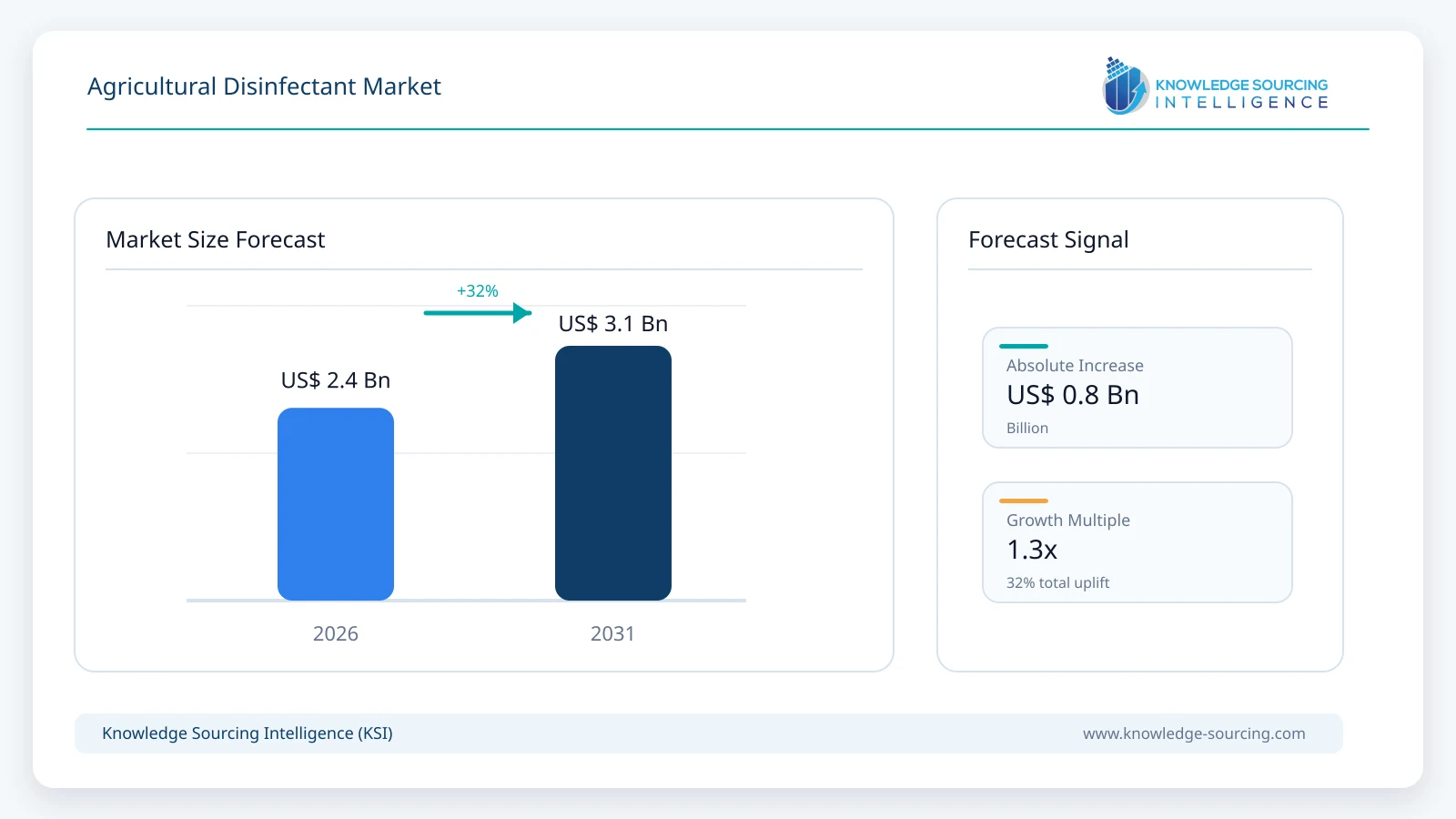
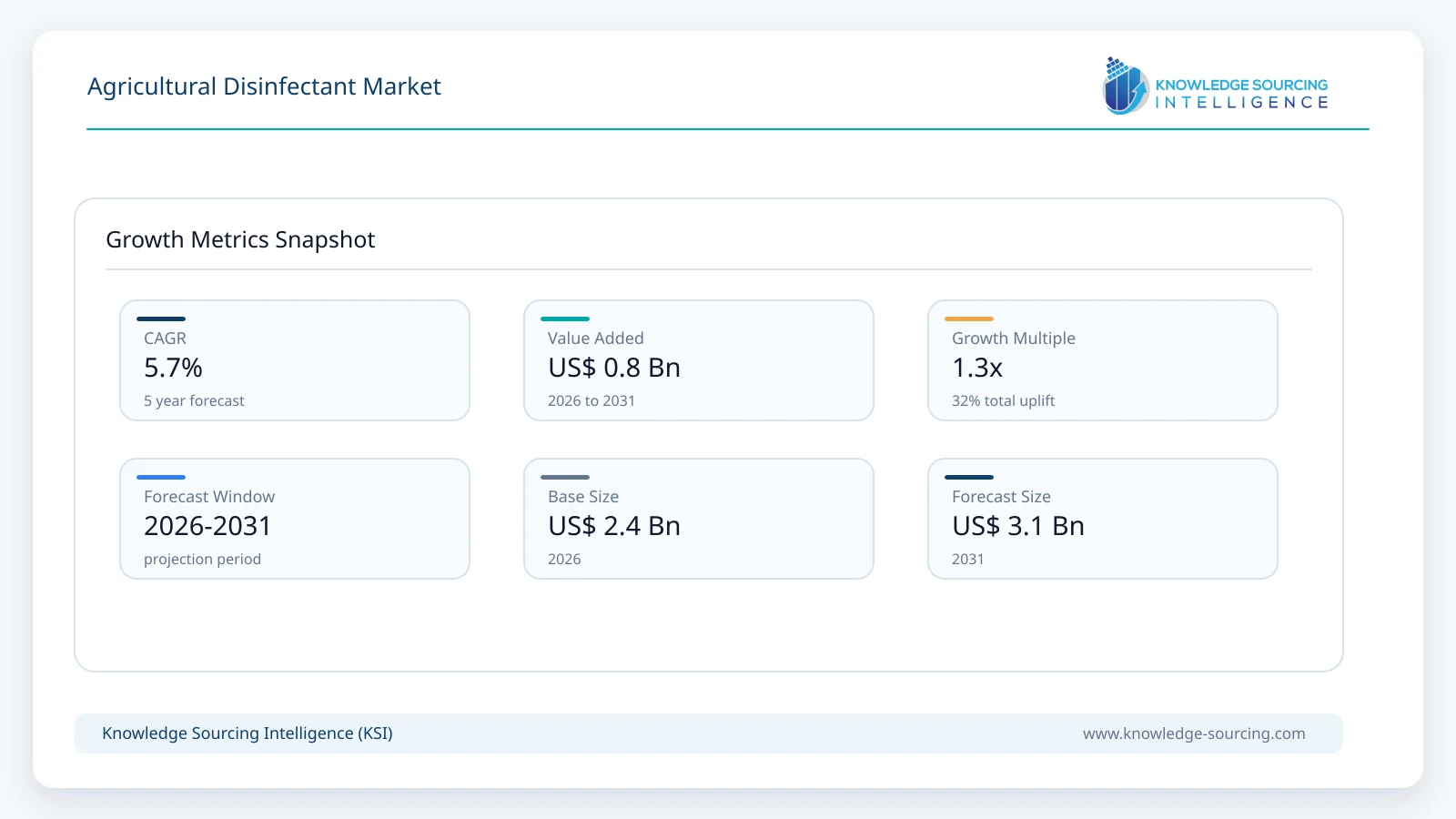
The global agricultural disinfectant market is estimated at USD 2.36 billion in 2026 and is projected to reach USD 3.12 billion by 2031, growing at a CAGR of 5.7% during 2026-2031.
Highlights:
- 1Livestock, poultry, and dairy farming represents approximately 74% of global 2026 demand.
- 2Peroxygen chemistries gain adoption through broad-spectrum efficacy and flexible farm-biosecurity applications.
- 3Disease outbreaks increase emergency disinfection while strengthening routine prevention protocols between outbreaks.
- 4Water-system hygiene is becoming a distinct growth application across poultry and controlled-environment agriculture.
- 5Europe has a strong specialist supplier base, while Asia Pacific leads incremental volume growth.
Demand is fundamentally linked to biosecurity rather than discretionary cleaning. Highly pathogenic avian influenza, African swine fever, salmonella, mastitis, and other infectious threats can create severe production losses and trade restrictions, making routine disinfection of premises, vehicles, water systems, and equipment a core component of modern farm management. At the same time, greenhouse and controlled-environment agriculture are increasing demand for water-system and surface disinfection that can control biofilms and plant pathogens without unacceptable residues or phytotoxicity.
Market Drivers
Farm biosecurity remains essential against high-impact animal disease
Outbreaks of avian influenza, African swine fever, foot-and-mouth disease, and other contagious diseases reinforce investment in cleaning and disinfection. WOAH continues to emphasize biosecurity and hygiene measures in animal production, while commercial suppliers maintain products with specific efficacy claims against high-consequence pathogens. LANXESS markets Virkon S for routine disinfection and emergency disease response in poultry, swine, and cattle environments, and Ecolab through CID LINES provides farm biosecurity programs across more than 100 countries. The economic value of disinfection is therefore tied to disease prevention, continuity of production, and protection of animal-health status.
Water and irrigation hygiene creates a broader application base
Disinfectant use extends beyond floors and housing. Poultry farms increasingly manage drinking-water biofilms and microbial loads, while greenhouses and hydroponic operations require clean irrigation lines, tanks, nutrient systems, surfaces, and humidification equipment. Intracare markets hydrogen-peroxide-based water hygiene solutions for poultry, while Sanosil supplies agricultural formulations for irrigation systems, nutrient solutions, surfaces, and whole-room applications. These uses broaden the addressable market beyond traditional livestock premises and support growth in crop and horticulture settings.
Pressure to reduce routine antibiotic dependence supports preventive hygiene
Commercial producers are seeking better preventive health management to lower disease incidence, reduce mortality, improve feed conversion, and limit unnecessary antimicrobial use. Hygiene suppliers increasingly sell protocols and monitoring support alongside chemistry. MS Schippers positions its HyCare method around systematic farm hygiene, while Ecolab, Kersia, Neogen, Virox, and other companies combine products with application guidance and biosecurity programs. This service-led model raises the strategic role of disinfection within farm operating procedures.
Market Restraints
Biocidal registrations and permitted-use patterns vary by country and application environment.
Organic load, water quality, temperature, and contact time can materially affect real-world efficacy.
Improper dilution or use may create corrosion, residue, worker-safety, or animal-compatibility concerns.
Price-sensitive farms may underinvest in routine hygiene when disease pressure appears temporarily low.
Global Agricultural Disinfectant Market Segment Analysis
By Chemistry
Peroxygen chemistries, including hydrogen peroxide, peracetic acid, and persulfate-based formulations, are among the fastest-growing product groups because they provide broad-spectrum activity and can be used across surfaces, equipment, water systems, and selected fogging applications. Livestock-focused demand is expected to grow at approximately 5.3% annually through 2031, while crop and horticulture applications expand faster from a smaller base as greenhouse and irrigation hygiene becomes more systematic. Quaternary ammonium compounds, aldehydes, halogens, iodophors, organic acids, and blended formulations remain important where cost, residual action, organic-load tolerance, or regulatory approvals favor their use.
By Application and End User
Surface, housing, and equipment disinfection is the largest application, followed by drinking-water and irrigation-system hygiene, vehicle and transport biosecurity, and fogging or aerial treatment. Poultry, swine, cattle, and dairy operations dominate end use because animal density and movement create strong infection-control requirements. Greenhouses and horticulture form the fastest-developing non-livestock segment as growers manage waterborne pathogens, biofilms, tools, benches, rooms, and post-harvest environments. Aquaculture and other specialized agricultural uses provide additional demand where approved water-compatible chemistries are available.
Regional Analysis
Europe has a strong base of specialist farm-hygiene suppliers and detailed biocidal regulation, supporting high-value demand for registered professional products.
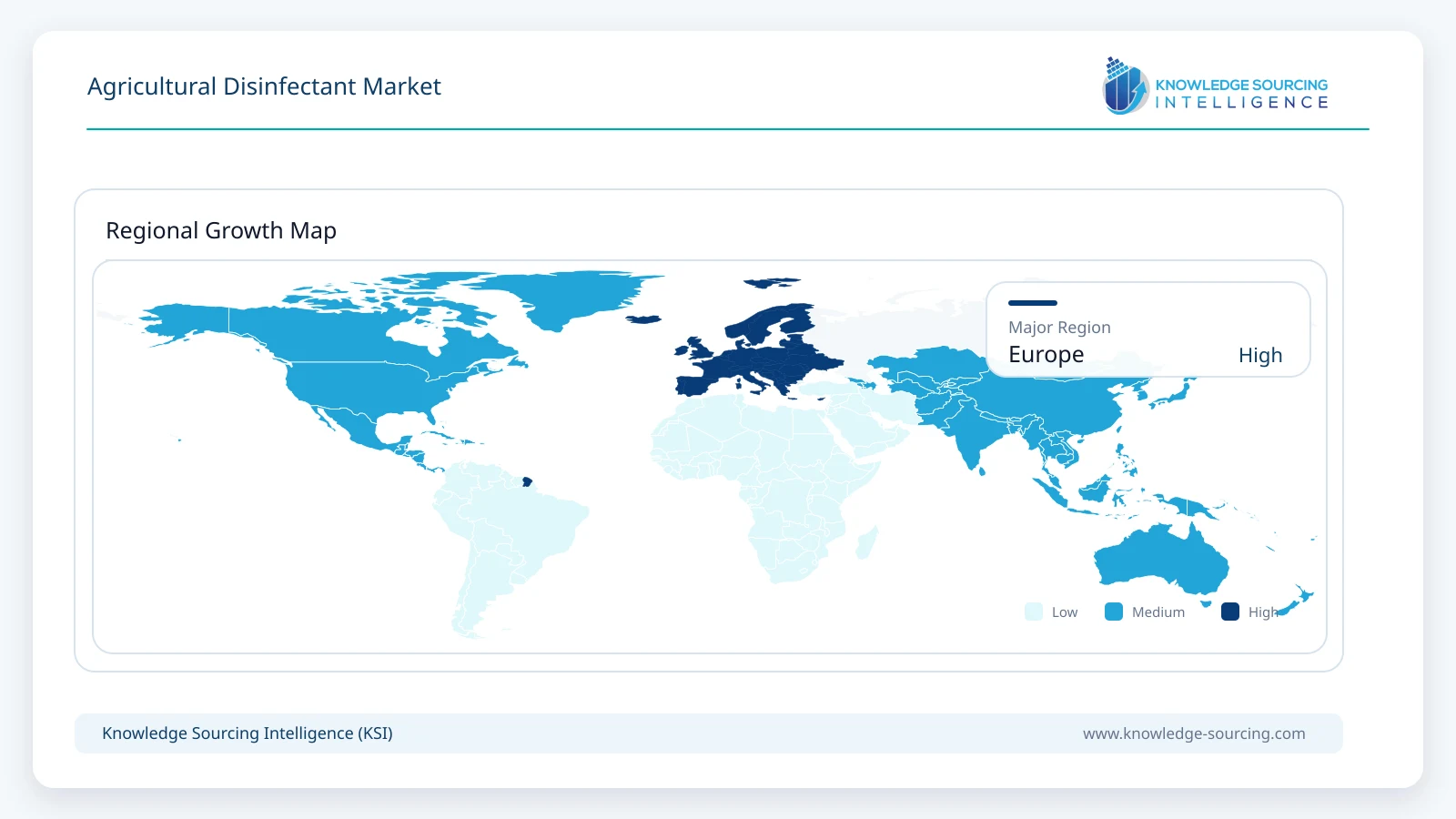
Asia Pacific represents the largest incremental opportunity because of its poultry and livestock populations, expanding commercial farm systems, and increasing biosecurity investment. North America has established disease-control protocols and strong adoption of registered farm and transport disinfectants. Latin America is significant in poultry, pork, beef, and export agriculture, while the Middle East and Africa show selective growth around commercial livestock, dairy, poultry, and protected horticulture.
Competitive Environment
The competitive landscape includes global hygiene companies, animal-health specialists, and regional farm-biosecurity suppliers. Ecolab participates through CID LINES, LANXESS through Virkon products, and Neogen through its animal-safety and biosecurity portfolio. Kersia, Virox, MS Schippers, DeLaval, GEA, Intracare, Sanosil, FINK TEC, and Evans Vanodine compete with specialized chemistry and application support. Supplier differentiation depends on pathogen efficacy, approved use claims, material compatibility, water-system performance, farm protocols, local registration, technical service, and the ability to serve both routine and emergency biosecurity needs.
Recent Developments
March 2026: LANXESS marked 40 years of Virkon S, a broad-spectrum farm biosecurity disinfectant used in routine and emergency disease-control programs.
2026: LANXESS continued commercialization of Virkon LSP, including claims for rapid inactivation of African swine fever and avian influenza viruses in approved applications.
2025-2026: Virox expanded current farm-animal positioning for Intervention and Prevail accelerated-hydrogen-peroxide disinfectants.
November 2025: Intracare highlighted its poultry hygiene and water-treatment portfolio at Poultry India Expo 2025.
2025-2026: Ecolab continued expanding CID LINES animal-health and horticulture hygiene programs across livestock and plant-production environments.
Market Outlook
Agricultural disinfectant demand is expected to grow steadily as biosecurity becomes more formalized in commercial animal production and controlled-environment agriculture. High-consequence disease outbreaks will continue to create episodic demand spikes, but the larger structural opportunity is routine prevention through validated cleaning, disinfection, water hygiene, and transport protocols. Suppliers with broad registrations, pathogen-specific evidence, user-safe formulations, and practical application support are positioned to gain share, particularly in Asia Pacific and in greenhouse or water-system applications that are expanding beyond traditional livestock premises.
Global Agricultural Disinfectant Market Scope:
| Report Metric | Details |
|---|---|
| Total Market Size in 2026 | USD 2.36 billion |
| Total Market Size in 2031 | USD 3.12 billion |
| Forecast Unit | Billion |
| Growth Rate | 5.7% |
| Study Period | 2021 to 2031 |
| Historical Data | 2021 to 2024 |
| Base Year | 2025 |
| Forecast Period | 2026 – 2031 |
| Segmentation | Chemistry, Form, Application, End User, Geography |
| Companies |
|
Market Segmentation
By Chemistry
Peroxygen and Peracetic-Acid Formulations
Quaternary Ammonium Compounds
Aldehydes
Halogens and Iodophors
Organic Acids and Other Formulations
By Form
Liquids and Concentrates
Powders and Tablets
Fogging and Other Formats
By Application
Surfaces, Housing and Equipment
Drinking Water and Irrigation Systems
Transport, Vehicle and Entry Biosecurity
Aerial and Fogging Applications
By End User
Livestock, Poultry and Dairy
Crop, Greenhouse and Horticulture
Aquaculture and Others
By Geography
North America
South America
Europe
Middle East and Africa
Asia Pacific
Table of Contents
1. INTRODUCTION
1.1 Market Definition and Scope
1.2 Inclusion and Exclusion Criteria
2. RESEARCH METHODOLOGY
2.1 Market Estimation and Validation
3. EXECUTIVE SUMMARY
4. MARKET DYNAMICS
4.1 Drivers
4.2 Restraints
4.3 Opportunities
4.4 Regulatory and Biosecurity Trends
5. AGRICULTURAL DISINFECTANT MARKET BY CHEMISTRY
5.1 Peroxygen and Peracetic-Acid Formulations
5.2 Quaternary Ammonium Compounds
5.3 Aldehydes
5.4 Halogens and Iodophors
5.5 Organic Acids and Other Formulations
6. AGRICULTURAL DISINFECTANT MARKET BY FORM
6.1 Liquids and Concentrates
6.2 Powders and Tablets
6.3 Fogging and Other Formats
7. AGRICULTURAL DISINFECTANT MARKET BY APPLICATION
7.1 Surfaces, Housing and Equipment
7.2 Drinking Water and Irrigation Systems
7.3 Transport, Vehicle and Entry Biosecurity
7.4 Aerial and Fogging Applications
8. AGRICULTURAL DISINFECTANT MARKET BY END USER
8.1 Livestock, Poultry and Dairy
8.2 Crop, Greenhouse and Horticulture
8.3 Aquaculture and Others
9. AGRICULTURAL DISINFECTANT MARKET BY GEOGRAPHY
9.1 North America
9.2 South America
9.3 Europe
9.4 Middle East and Africa
9.5 Asia Pacific
10. COMPETITIVE ENVIRONMENT
11. COMPANY PROFILES
11.1 Ecolab Inc. (CID LINES)
11.2 LANXESS AG
11.3 Neogen Corporation
11.4 Kersia Group
11.5 Virox Technologies Inc.
11.6 MS Schippers
11.7 DeLaval
11.8 GEA Group AG
11.9 Intracare
11.10 Sanosil Ltd.
11.11 FINK TEC GmbH
11.12 Evans Vanodine International plc
11.13 BouMatic LLC
11.14 Solenis LLC (Diversey / Deosan)
11.15 Anpario plc
Navigate
Trusted by the world's leading organizations











