
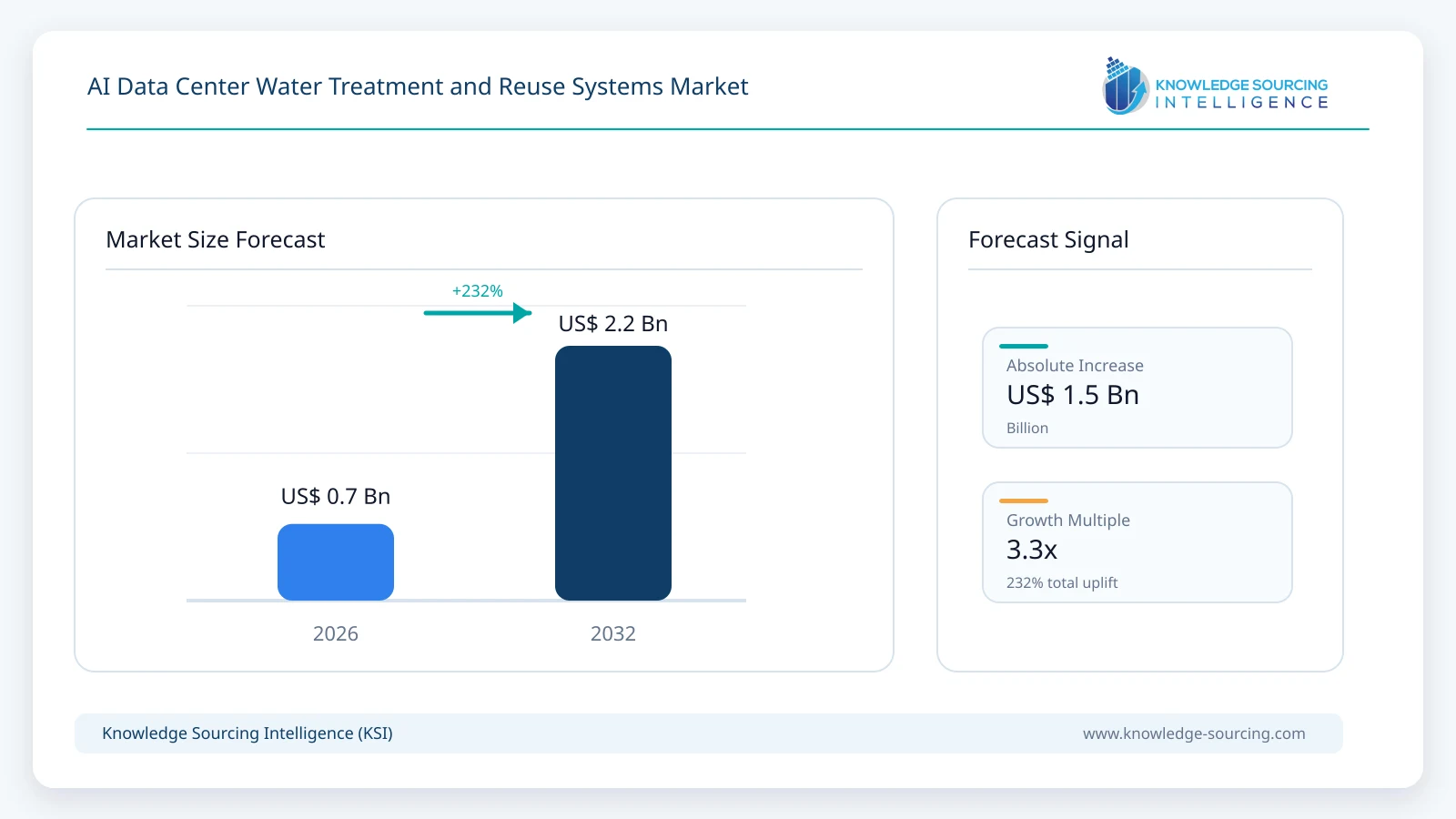
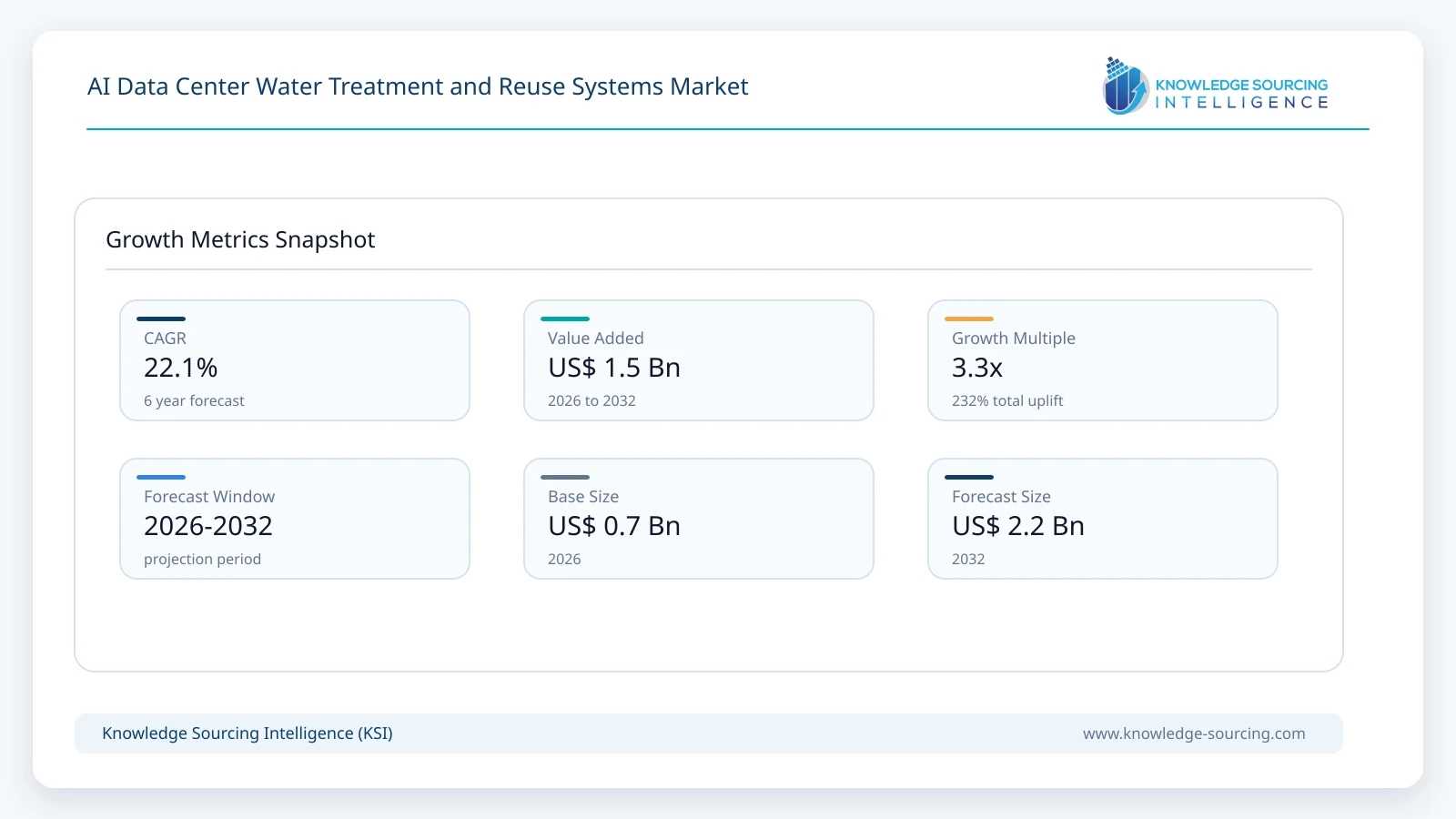
The AI Data Center Water Treatment and Reuse Systems Market is estimated at USD 0.65 billion in 2026 and is projected to reach USD 2.16 billion by 2032, representing a CAGR of 22.1% during the forecast period.
Key Highlights
• Water treatment is becoming a permitting and resilience issue for large AI campuses.
• Reclaimed-water systems reduce dependence on potable supplies across increasingly water-constrained data-center regions worldwide.
• Closed-loop liquid cooling shifts spending toward coolant quality, monitoring and lifecycle management.
• Gradiant is deploying integrated water and wastewater systems specifically for hyperscale AI campuses.
• Veolia and Amazon are developing reclaimed-water cooling infrastructure for Mississippi data centers.
• Microsoft reduced fleet water use effectiveness to 0.27 liters per kilowatt-hour in 2025.
• Zero-water cooling moderates freshwater-treatment demand but increases closed-loop fluid-quality and lifecycle-management requirements.
• North America leads spending because hyperscale growth increasingly intersects with local water constraints.
• Reverse osmosis and membrane treatment remain central to higher-recovery reuse and recycling architectures.
• Direct-to-chip cooling creates a new market for coolant chemistry and contamination monitoring.
• Redundant treatment trains are increasingly designed as mission-critical infrastructure supporting facility uptime.
• Growth remains slower than AI capacity because many new facilities minimize evaporative water consumption.
Market Overview
Traditional data-center water management was concentrated around cooling towers, make-up water and blowdown control. AI infrastructure changes this requirement in two directions. First, larger campuses increase the absolute scale of utilities required at a site, making local water availability and wastewater discharge capacity relevant to site selection. Second, direct-to-chip liquid cooling creates a separate closed technology loop in which fluid quality affects cold plates, heat exchangers, pumps and expensive information-technology equipment. The result is a broader treatment architecture spanning source water, facility cooling water, technology cooling fluid and wastewater recovery.
The market does not grow in direct proportion to AI computing capacity. Microsoft is moving new AI-optimized facilities toward closed-loop designs that avoid evaporating water for cooling, and other operators are reducing water intensity through dry cooling, higher-temperature liquid cooling and improved controls. These changes limit the amount of make-up water that must be treated per megawatt. At the same time, the water that remains in the system becomes more operationally important. Reclaimed-water projects require advanced pretreatment and disinfection; liquid loops need tighter chemistry control; and sites in constrained regions increasingly require higher recovery rates, wastewater treatment or near-zero-discharge configurations. The commercial value therefore shifts from simple water consumption toward reliability, reuse and quality management.
North American hyperscale developments illustrate this transition. Microsoft reports that around 90% of its owned fleet operated with low- to zero-water cooling in 2025, while its newest AI design uses recirculating direct-to-chip cooling without water evaporation. Amazon Web Services reports continued progress toward water-positive operations and is expanding reclaimed-water sourcing. Gradiant's 2026 data-center projects combine intake, treatment, wastewater and reuse into integrated packages, showing that water infrastructure is increasingly procured as a site-level system rather than a collection of unrelated utility components.
Market Drivers
Water availability is becoming part of data-center site selection
Large AI campuses can place new demand on local water and wastewater systems even when cooling architectures are designed for high efficiency. In water-constrained regions, a project may need reclaimed water, on-site treatment, storage or higher-recovery systems before it can secure permits and community support. Gradiant's 2026 West Texas contract illustrates the purchasing response: the hyperscale campus is using a combined water and wastewater package rather than relying only on conventional municipal service. This increases demand for integrated engineering, treatment and long-term operations support.
Reclaimed water is expanding the addressable source-water mix
Hyperscale operators increasingly use treated municipal effluent and other non-potable sources where local conditions permit. Reclaimed water reduces competition with drinking-water supplies but typically requires filtration, disinfection, chemistry adjustment and monitoring before it can be introduced into cooling systems. Veolia's work with Amazon in Mississippi is a current example of this model. As utilities and operators build dedicated reuse connections, the treatment content per site can increase even when total freshwater withdrawal falls.
Liquid cooling creates a separate coolant-quality market
Direct-to-chip cooling uses closed fluid loops that must protect microchannels, cold plates, pumps and heat exchangers from corrosion, fouling, biological growth and contamination. Ecolab's 3D TRASAR platform monitors coolant concentration, temperature, pH and flow, while Solenis is providing fluid-management and lifecycle-assurance services within Dow's Coolant Care Network. These systems are purchased for uptime and equipment protection rather than water conservation alone, creating recurring monitoring, testing and service revenue as liquid-cooled AI capacity expands.
Restraints and Adoption Challenges
The largest structural restraint is that new cooling architectures can reduce the amount of water requiring treatment. Closed-loop direct-to-chip systems, air-cooled chillers and dry heat rejection can operate with little or no evaporative water consumption, especially in favorable climates. This prevents the water-treatment market from growing at the same pace as AI computing capacity. Economics are also highly site-specific. Reuse projects depend on local wastewater availability, pipeline distance, discharge rules, water prices and treatment quality. High-recovery or zero-liquid-discharge systems can materially increase capital and energy costs, while direct-to-chip fluid management requires compatibility with server-vendor specifications. These constraints favor modular treatment architectures and data-driven monitoring rather than a single global water design.
Segment Analysis
By Solution
Cooling water treatment and conditioning represents the largest 2026 revenue pool because conventional cooling towers, hybrid systems and facility-water loops remain widespread across the installed base. Reclaimed-water and wastewater-reuse systems are expected to expand faster as hyperscalers seek non-potable sources in constrained regions. Direct-to-chip coolant management is a smaller but high-growth category, driven by liquid-cooled AI racks and the operational importance of fluid purity, corrosion control and contamination detection.
By Treatment Technology
Membrane filtration, reverse osmosis and advanced pretreatment form the core of higher-recovery reuse systems. Disinfection, ion exchange, softening and chemical treatment remain important for cooling-water reliability, while sensor-driven chemistry management is gaining value across both facility and technology loops. Zero- or minimal-liquid-discharge systems remain concentrated in locations where discharge capacity or water scarcity justifies the additional cost and energy intensity.
Table 2. Principal Water Treatment and Reuse Revenue Pools
Solution Category | 2026 Position | Primary Function | Representative Participants |
Cooling-water treatment and conditioning | Largest value pool | Scale, corrosion, biological control and water-efficiency optimization | Ecolab, Solenis, Kurita, ChemTreat |
Reclaimed-water and reuse systems | Fast-growing infrastructure segment | Condition municipal effluent or alternative sources for cooling use | Veolia, Gradiant, Xylem, SUEZ |
Wastewater recovery and high-recovery treatment | Growing in constrained regions | Increase recycling and reduce freshwater withdrawal or discharge | Gradiant, Aquatech, H2O Innovation, IDE Technologies |
Direct-to-chip coolant management | Fastest-growing niche | Monitor fluid quality, contamination, corrosion and coolant health | Ecolab, Solenis, ChemTreat, Dow ecosystem |
Digital water monitoring and optimization | Recurring software/service layer | Track quality, consumption, recovery and treatment performance | Ecolab, Gradiant, Xylem, Veolia |
Market and Adoption Indicators
Table 3. Indicators Supporting AI Data Center Water Treatment and Reuse Demand
Indicator | Recent Evidence | Market Relevance |
Microsoft fleet water intensity | Microsoft reported average WUE of 0.27 L/kWh in 2025, down nearly 90% from early designs. | Shows strong efficiency gains, limiting water-volume growth while increasing importance of engineered systems. |
Low- and zero-water cooling | Microsoft reported about 90% of its 2025 owned fleet uses highly efficient low- to zero-water cooling. | Caps freshwater-treatment growth and shifts demand toward closed-loop fluid management. |
AWS water-positive progress | AWS reported reaching 75% of its water-positive goal in 2025 through efficiency, reclaimed water and replenishment. | Supports continued investment in reuse and alternative water sources. |
Hyperscale integrated water systems | Gradiant deployed HyperSolved with hyperscalers and won a West Texas turnkey water/wastewater contract in 2026. | Demonstrates procurement of water as mission-critical AI infrastructure. |
Reclaimed-water partnership | Veolia and Amazon announced reclaimed-water cooling work in Mississippi in April 2026. | Expands addressable demand for treatment of non-potable cooling water. |
Direct-to-chip fluid monitoring | Ecolab and Solenis expanded coolant-health and lifecycle services for liquid-cooled data centers. | Creates recurring treatment and monitoring revenue independent of evaporative water use. |
Regional Opportunity
North America
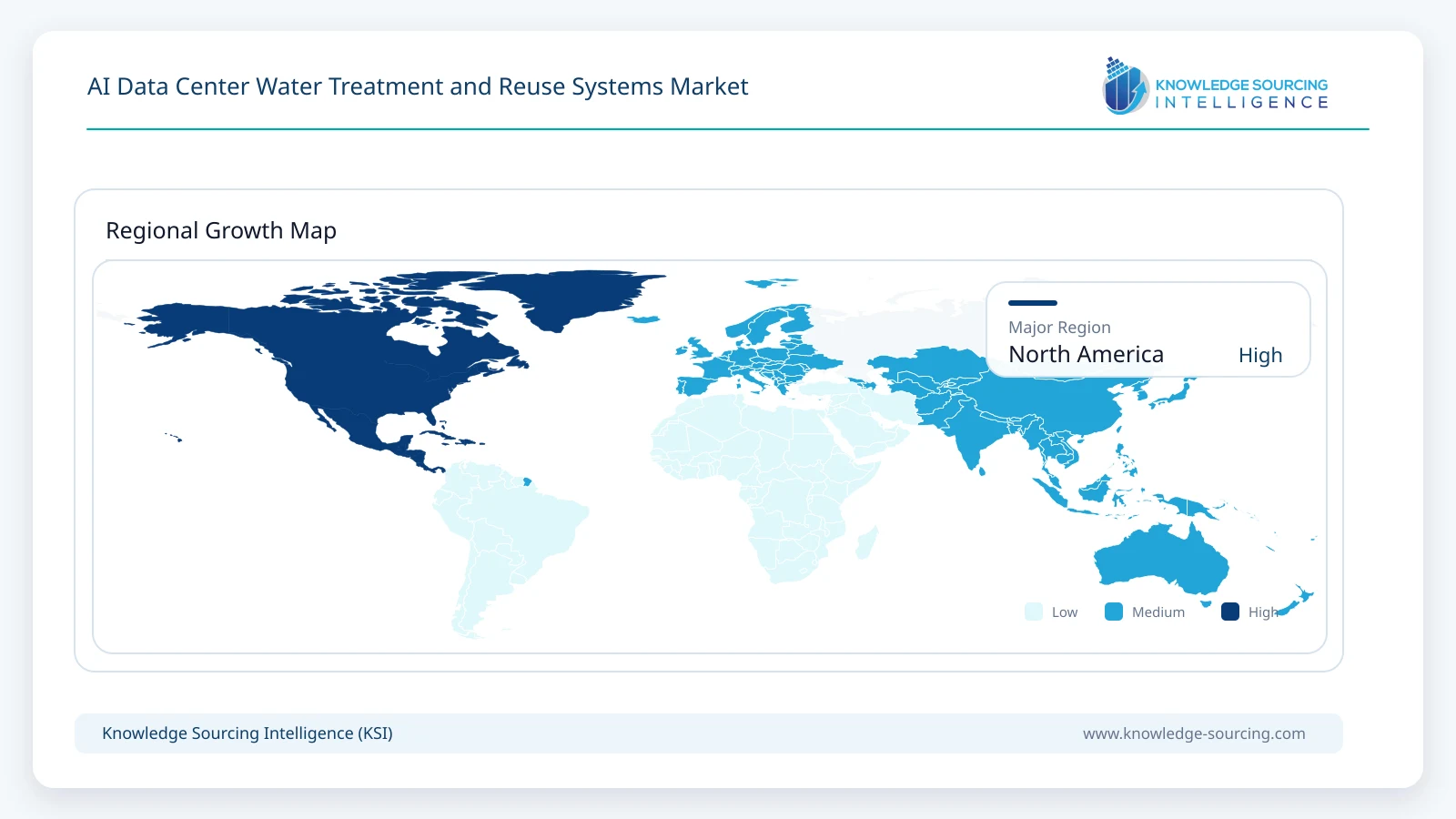
North America is the largest early market because the region combines the world's largest hyperscale and AI data-center buildout with growing water constraints in several major development corridors. Northern Virginia, Texas, Arizona and parts of the western United States are expanding digital infrastructure while utilities and communities pay closer attention to freshwater withdrawals, wastewater capacity and drought resilience. This creates a direct purchasing case for reclaimed-water conditioning, high-recovery treatment, redundant treatment trains and real-time monitoring.
The United States is also becoming a proving ground for new commercial models. Gradiant is supplying integrated water and wastewater infrastructure to hyperscale operators, including a 2026 West Texas project using a zero-surface-discharge design. Veolia and Amazon are working on reclaimed-water cooling in Mississippi. Xylem has documented hyperscale facilities using redundant treatment capacity to make cooling water infrastructure consistent with mission-critical uptime requirements. These projects expand supplier value beyond conventional chemicals toward engineered systems, controls, long-term operations and water-risk management.
At the same time, the regional growth rate is moderated by rapid adoption of low-water cooling. Microsoft reports that about 90% of its owned data-center fleet used low- to zero-water cooling approaches in 2025 and is deploying new AI designs that avoid evaporative water consumption. As this architecture spreads, the strongest market opportunity shifts toward sites that still use evaporative or hybrid heat rejection, campuses requiring reclaimed-water infrastructure, and liquid-cooled systems that need continuous coolant chemistry management. North American suppliers therefore need portfolios that cover both traditional facility water and closed-loop technology cooling.
Europe, Asia Pacific and Middle East
Europe emphasizes reuse, environmental reporting and efficient cooling, while water availability and permitting vary significantly by country. Asia Pacific combines rapid data-center construction with highly diverse water conditions, creating strong opportunities in Singapore, India, Australia and selected Chinese markets for reuse and high-recovery systems. Middle Eastern AI campuses face high ambient temperatures and water scarcity, favoring dry or hybrid cooling where possible but also increasing the value of treated wastewater and desalinated or reclaimed sources for facilities that retain water-based heat rejection.
Competitive Landscape
Competition spans global water-services companies, industrial treatment specialists, membrane and equipment suppliers, digital water platforms and data-center-specific coolant-management providers. Ecolab combines cooling-water chemistry, digital monitoring and direct-to-chip coolant management. Veolia and SUEZ bring municipal and industrial water-reuse capabilities that are relevant when hyperscale campuses connect to reclaimed-water networks. Xylem supplies pumps, treatment and monitoring infrastructure, while Gradiant is positioning an integrated design-build-operate model specifically around AI and semiconductor water constraints.
Solenis, ChemTreat, Kurita and other treatment specialists compete around chemistry, monitoring and lifecycle services, particularly where cooling-water reliability and direct-to-chip fluid quality are critical. DuPont Water Solutions, Pentair and membrane specialists participate through filtration and separation technologies used in reuse systems. Aquatech, H2O Innovation, IDE Technologies and Ovivo compete in higher-recovery, wastewater and engineered treatment packages. Differentiation increasingly depends on the ability to integrate source-water treatment, cooling loops, wastewater recovery and digital monitoring under one performance framework while meeting hyperscale uptime requirements.
Major companies and ecosystem participants covered: Ecolab, Veolia, Xylem, Gradiant, Solenis, SUEZ, DuPont Water Solutions, Kurita Water Industries, ChemTreat, Aquatech International, H2O Innovation, IDE Technologies, Ovivo, Pentair and Thermax.
Recent Developments
• September 2026: Gradiant announced a turnkey water and wastewater contract for a hyperscale AI data-center campus in West Texas, using a zero-surface-discharge design.
• September 2026: Xylem detailed a Northern Virginia hyperscale project using redundant treatment capacity to protect cooling-water availability and facility uptime.
• July 2026: Amazon Web Services began exposing data-center water-withdrawal information through its Sustainability Console and reported reaching 75% of its water-positive goal in 2025.
• June 2026: Microsoft reported average fleet water use effectiveness of 0.27 L/kWh in 2025 and said about 90% of its owned fleet uses low- to zero-water cooling.
• June 2026: Solenis joined Dow's Coolant Care Network to provide fluid-management, monitoring and lifecycle-assurance services for direct-to-chip data-center cooling.
• May 2026: Gradiant announced deployment of its HyperSolved end-to-end cooling-water platform with several global hyperscale operators.
• April 2026: Veolia and Amazon announced work on reclaimed-water cooling infrastructure for Amazon data-center operations in Mississippi.
• June 2025: Ecolab launched 3D TRASAR Technology for Direct-to-Chip Liquid Cooling, adding real-time coolant health monitoring for AI and high-performance computing systems.
AI Data Center Water Treatment and Reuse Systems Market Scope:
| Report Metric | Details |
|---|---|
| Total Market Size in 2026 | USD 0.65 billion |
| Total Market Size in 2032 | USD 2.16 billion |
| Forecast Unit | USD Billion |
| Growth Rate | 22.1% |
| Study Period | 2021 to 2032 |
| Historical Data | 2021 to 2024 |
| Base Year | 2025 |
| Forecast Period | 2026 – 2032 |
| Segmentation | Solution, Treatment Technology, Water Source, Cooling Interface, Data Center Type, Geography |
| Companies |
|
Market Segmentation
By Solution
Cooling-Water Treatment and Conditioning
Reclaimed-Water and Reuse Systems
Wastewater Recovery and High-Recovery Treatment
Direct-to-Chip Coolant Management
Digital Water Monitoring and Optimization
By Treatment Technology
Membrane Filtration and Reverse Osmosis
Softening, Demineralization and Ion Exchange
Disinfection and Biological Control
Chemical Treatment and Corrosion Control
Zero- and Minimal-Liquid-Discharge Systems
Sensors, Analytics and Water-Quality Monitoring
By Water Source
Potable / Municipal Water
Reclaimed Municipal Wastewater
Industrial or Alternative Water Sources
On-Site Recycled Water
By Cooling Interface
Cooling Towers and Evaporative Systems
Hybrid / Adiabatic Cooling
Closed-Loop Facility Water Systems
Direct-to-Chip Technology Cooling Loops
By Data Center Type
Hyperscale and AI Factories
Colocation Data Centers
Enterprise and Sovereign AI Facilities
Edge and Distributed Data Centers
By Geography
North America
United States
Canada
Europe
Asia Pacific
Middle East and Rest of World
Table of Contents
1. EXECUTIVE SUMMARY
1.1. Market Opportunity and Key Findings
1.2. Water Infrastructure Adoption Timeline
1.3. Principal Revenue Pools
2. MARKET OVERVIEW
2.1. AI Data Center Water Requirements
2.2. Water Use Effectiveness and Cooling Architecture
2.3. Reclaimed Water and Alternative Sources
2.4. Closed-Loop Coolant Quality Management
3. MARKET SIZE AND FORECAST, 2026-2032
3.1. Global Market Revenue
3.2. Annual Growth Analysis
3.3. Revenue by New Build and Retrofit
3.4. Treatment Content per MW of Data Center Capacity
4. MARKET BY SOLUTION
4.1. Cooling-Water Treatment and Conditioning
4.2. Reclaimed-Water and Reuse Systems
4.3. Wastewater Recovery and High-Recovery Treatment
4.4. Direct-to-Chip Coolant Management
4.5. Digital Water Monitoring and Optimization
5. MARKET BY TREATMENT TECHNOLOGY
5.1. Membrane Filtration and Reverse Osmosis
5.2. Softening, Demineralization and Ion Exchange
5.3. Disinfection and Biological Control
5.4. Chemical Treatment and Corrosion Control
5.5. Zero- and Minimal-Liquid-Discharge Systems
5.6. Sensors, Analytics and Water-Quality Monitoring
6. MARKET BY WATER SOURCE
6.1. Potable / Municipal Water
6.2. Reclaimed Municipal Wastewater
6.3. Industrial or Alternative Water Sources
6.4. On-Site Recycled Water
7. MARKET BY COOLING INTERFACE
7.1. Cooling Towers and Evaporative Systems
7.2. Hybrid / Adiabatic Cooling
7.3. Closed-Loop Facility Water Systems
7.4. Direct-to-Chip Technology Cooling Loops
8. MARKET BY DATA CENTER TYPE
8.1. Hyperscale and AI Factories
8.2. Colocation Data Centers
8.3. Enterprise and Sovereign AI Facilities
8.4. Edge and Distributed Data Centers
9. REGIONAL MARKET
9.1. North America
9.1.1. United States
9.1.2. Canada
9.2. Europe
9.3. Asia Pacific
9.4. Middle East and Rest of World
10. MARKET DYNAMICS
10.1. Drivers
10.1.1. Water Availability and Permitting Constraints
10.1.2. Expansion of Reclaimed-Water Infrastructure
10.1.3. Direct-to-Chip Coolant Quality Requirements
10.1.4. Hyperscale Water-Positive Commitments
10.2. Restraints
10.2.1. Shift Toward Zero-Water Cooling
10.2.2. Site-Specific Economics of Water Reuse
10.2.3. Energy Cost of High-Recovery Treatment
10.2.4. Fluid Compatibility and Reliability Requirements
11. COMPETITIVE LANDSCAPE
11.1. Value Chain
11.2. Water Treatment and Service Providers
11.3. Membrane and Equipment Suppliers
11.4. Digital Monitoring and Chemistry Platforms
11.5. Partnerships and Hyperscale Projects
12. COMPANY PROFILES
12.1. Ecolab
12.2. Veolia
12.3. Xylem
12.4. Gradiant
12.5. Solenis
12.6. SUEZ
12.7. DuPont Water Solutions
12.8. Kurita Water Industries
12.9. ChemTreat
12.10. Aquatech International
12.11. H2O Innovation
12.12. IDE Technologies
12.13. Ovivo
12.14. Pentair
12.15. Thermax
13. APPENDIX
13.1. Definitions and Abbreviations
13.2. Water Treatment Technology Classification
13.3. Application and Deployment Framework
13.4. Source and Data Notes
Navigate
Trusted by the world's leading organizations











