
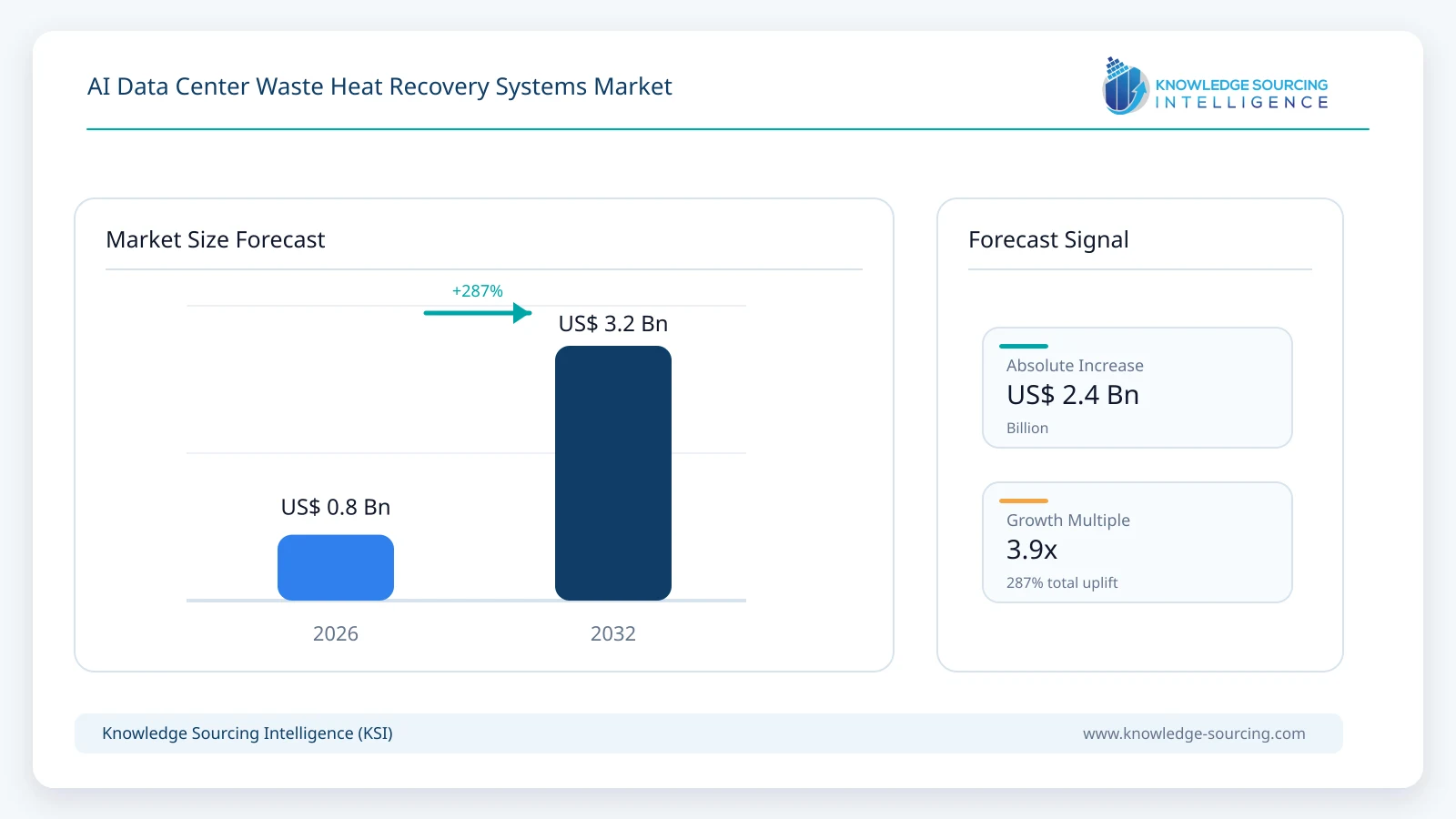
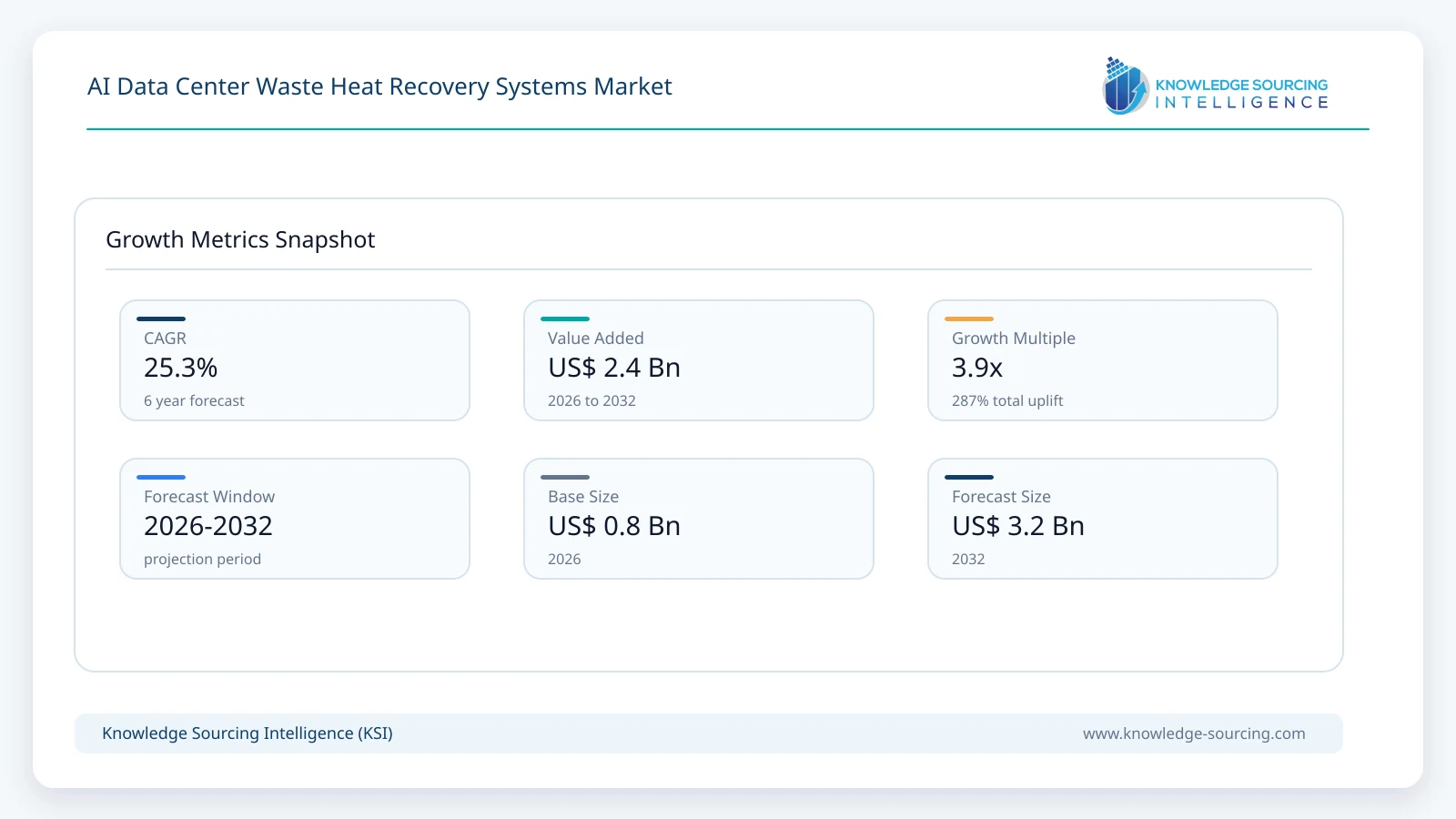
The AI Data Center Waste Heat Recovery Systems Market is estimated at USD 0.82 billion in 2026 and is projected to reach USD 3.17 billion by 2032, representing a CAGR of 25.3% during the forecast period.
Key Highlights
• Europe is the largest early market because regulation, district-heating density and data-center growth are converging.
• European Union rules require waste-heat utilization for data centers above 1 MW unless technically or economically infeasible.
• Liquid cooling raises the temperature and recoverability of server heat compared with conventional room-air cooling architectures.
• Large industrial heat pumps remain the main enabling technology where district-heating supply temperatures exceed data-center return-water temperatures.
• Equinix and A2A's Milan project targets 225 GWh of annual heat recovery through 72 MW of heat-pump capacity.
• Microsoft and Fortum are developing one of the world's largest data-center heat-recycling schemes in Finland.
• Heat exchangers, recovery substations and controls gain value as operators seek standardized interfaces between cooling and heat-export systems.
• Thermal storage helps balance continuous data-center heat output against seasonal and hourly heating demand.
• High-temperature liquid-cooled AI systems can reduce the lift required from heat pumps and improve project economics.
• District heating is the largest external reuse pathway, while campus heating and industrial heat use provide site-specific alternatives.
• Brownfield adoption is constrained by low return-water temperatures, physical connection costs and distance from suitable heat demand.
• Waste heat recovery is increasingly evaluated during site selection and cooling-system design rather than added after construction.
Market Overview
Data centers are continuous thermal-energy sources. Server processors, memory, power electronics and networking equipment convert most incoming electrical energy into heat that must be removed to maintain reliable operation. Historically, cooling design treated this heat only as a load to be rejected. Waste heat recovery changes the energy balance by preserving usable temperature, transferring the heat into a clean hydronic loop and matching it with a nearby consumer. For AI facilities, the opportunity increases because rack power densities are rising and direct liquid cooling places the heat into water at higher and more stable temperatures than many traditional air-cooled systems.
The commercial system normally begins at the data-center cooling loop. Heat exchangers isolate the information-technology cooling circuit from the recovery network, while pumps, valves and controls maintain safe hydraulic separation. Where recovered water is below the temperature required by the receiving network, industrial heat pumps raise it to a useful level. Thermal storage can buffer differences between constant server heat output and variable heating demand. The final connection may serve a district-heating utility, nearby campus, industrial process, greenhouse or another local thermal load. The economics therefore depend not only on the data center but also on the temperature, distance and utilization profile of the heat sink.
Regulation is making the capability more important in Europe. Directive (EU) 2023/1791 requires Member States to ensure that data centers with more than 1 MW of total rated energy input use waste heat or another waste-heat recovery application unless technical or economic infeasibility can be demonstrated. The European Commission also requires installation-level cost-benefit assessments for relevant new or substantially refurbished facilities. This creates a structural demand driver for heat-recovery-ready cooling design, even when an immediate district-heating connection is not available at the time of construction.
Market Drivers
AI liquid cooling increases the quality of recoverable heat
Air-cooled data centers often produce relatively low-grade heat, which requires a large temperature lift before it can enter conventional district-heating networks. Direct-to-chip and warm-water liquid cooling can move heat into a hydronic loop at materially higher temperatures. This reduces compressor work in downstream heat pumps and can, in optimized high-temperature systems, allow direct or near-direct heat exchange. As AI rack densities increase, heat recovery therefore benefits from the same architectural shift that is already driving coolant distribution units, cold plates and facility water systems.
European regulation is converting heat reuse into a design requirement
The European Union's Energy Efficiency Directive creates a clear regulatory catalyst by requiring waste-heat utilization for data centers above the 1 MW threshold unless the project can demonstrate infeasibility. This moves heat recovery earlier in the engineering process. New facilities increasingly need to preserve useful return-water temperatures, reserve space for heat-exchange and heat-pump equipment, evaluate local heat demand and coordinate with utilities before finalizing cooling architecture. The requirement does not guarantee that every project will export heat, but it expands the addressable market for recovery-ready equipment and engineering services.
District heating partnerships are reaching utility scale
The scale of announced projects is increasing. Equinix and A2A's Milan collaboration is designed around 72 MW of heat pumps, 6,000 cubic metres of thermal storage and up to 225 GWh of recovered heat per year. Microsoft and Fortum's Finnish development is intended to recover most of the waste heat from large data-center campuses and eventually supply a substantial share of local district-heating demand. These projects demonstrate that data-center heat can become a utility-scale heat source rather than a small building-efficiency measure, supporting larger equipment packages and multi-year integration contracts.
Restraints and Adoption Challenges
The strongest constraint is the mismatch between continuous data-center heat production and economically accessible heat demand. Large heat networks are concentrated in Europe and selected Asian cities, while many North American data centers are located far from district-heating infrastructure. Low recovery temperatures can also require significant heat-pump electricity, reducing the net economic benefit when power prices are high. Seasonal heat demand, customer contracts, network connection costs and ownership of the heat-recovery equipment can complicate project financing. Operators must also protect cooling-system reliability; heat export cannot create backpressure, contamination or control dependencies that threaten information-technology uptime. These factors favor modular systems with hydraulic separation and projects where the heat offtaker participates directly in design and investment.
Segment Analysis
By System Component
Industrial and high-temperature heat pumps represent the largest value pool because most data-center heat must be upgraded before it can enter existing district-heating networks. Their share is especially high in projects using conventional chilled-water or lower-temperature liquid-cooling loops. Heat exchangers form the second critical layer because they isolate the data-center cooling circuit from the external heat network and preserve equipment reliability. Recovery modules, hydraulic skids, thermal storage and controls form a growing packaged-systems segment as vendors standardize what previously required bespoke engineering.
By Heat Reuse Pathway
District heating is the leading commercial reuse pathway because a single network can absorb large, continuous heat volumes and monetize them across many buildings. Campus and adjacent-building heating is attractive where the end user is under common ownership and connection distances are short. Industrial applications, greenhouses and aquaculture can absorb lower-temperature heat where local demand exists. On-site reuse is smaller in revenue terms but can support domestic hot water, process heat or thermally driven cooling depending on the facility design. The common requirement is a stable off-taker capable of using heat at the temperatures and hours available from the data center.
Table 2. Principal Data Center Heat-Recovery Architectures and Reuse Pathways
Recovery Source | Typical Heat Quality | Primary Recovery Equipment | Commercial Reuse |
Air / chilled-water cooling | Low-grade, typically around 25-35°C | Heat exchanger, large temperature-lift heat pump, controls | Campus heating, low-temperature networks, district heating with heat pump |
Rear-door / moderate-temperature liquid cooling | Moderate-grade, often around 35-50°C | Heat exchanger, heat pump, hydraulic skid | District heating, campus heating, industrial low-temperature loads |
Direct-to-chip warm-water cooling | Higher-grade hydronic heat, often 45-65°C or above | Heat exchanger, lower-lift heat pump, controls | District heating, commercial heating, selected industrial uses |
High-temperature liquid-cooled AI / HPC | High-grade recovery loops approaching district-heat temperatures | High-efficiency heat exchanger, limited temperature lift or direct transfer | District heating and high-value local heat applications |
Market and Adoption Indicators
Table 3. Indicators Supporting Data Center Waste Heat Recovery Adoption
Indicator | Recent Evidence | Market Relevance |
European regulatory threshold | EU rules require data centers above 1 MW to use waste heat unless technically or economically infeasible. | Makes recovery assessment and heat-ready design a structural requirement across the EU. |
Milan utility-scale project | Equinix and A2A plan up to 225 GWh/year of recovered heat using 72 MW of heat pumps and 6,000 m³ of thermal storage. | Demonstrates large equipment packages and city-scale heat export outside the Nordics. |
Microsoft-Fortum Finland scheme | Microsoft states the completed regional project could provide about 40% of district-heating demand across the served area. | Shows hyperscale data centers becoming strategic heat sources for municipal networks. |
AWS Tallaght heat reuse | AWS supplies recycled data-center heat to a district-heating scheme serving 55,000 m² of public, residential and commercial space. | Confirms operating commercial heat reuse beyond Nordic markets. |
Odense heat recovery | The Odense data-center system recovers about 100,000 MWh/year, enough to heat roughly 7,000 homes. | Provides a mature operating reference for industrial heat pumps and heat exchangers. |
Regional Opportunity
Europe
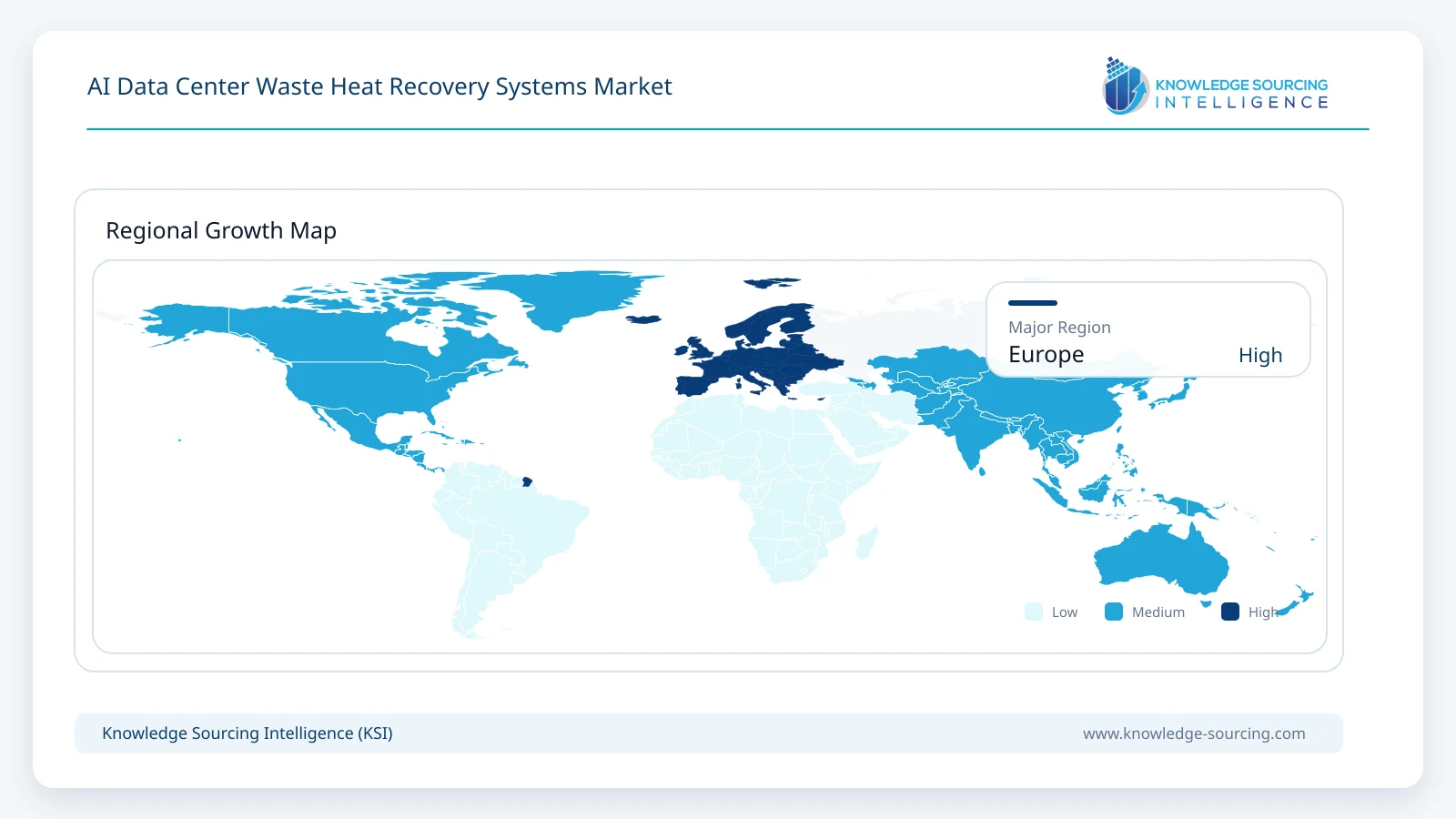
Europe is the principal early market for data-center waste heat recovery because three conditions are present simultaneously: a dense installed base of district-heating networks, policy support for recovered heat, and rapid construction of high-density digital infrastructure. Nordic markets have the longest operating history because utilities already use low-carbon electricity, large heat pumps and centralized heat networks. Finland, Denmark and Sweden therefore provide the strongest technical reference base for heat-export design. The market is now expanding into France, Germany, Italy, Ireland, Switzerland and other European countries as cities seek lower-carbon heat sources and data-center developers face tighter efficiency requirements.
Regulation materially changes project economics and planning. The EU Energy Efficiency Directive requires facilities above 1 MW to use waste heat or another recovery application unless infeasibility is demonstrated, while installation-level assessments must consider local demand and district-network connections. This does not eliminate commercial constraints, but it raises the probability that heat recovery is designed into new cooling plants even when the final heat-offtake agreement is signed later. Vendors that can provide heat-recovery-ready cooling interfaces, standardized substations and modular high-temperature heat-pump systems are therefore positioned to benefit before every site reaches full heat-export operation.
The project scale is also increasing. Equinix and A2A's Milan development is designed to supply enough recovered thermal energy for more than 21,000 homes, while Fortum's Finnish infrastructure around Microsoft's campuses is being built as part of a broader regional heating transition. ENGIE and Equinix are using recovered heat from the PA10 data center in Saint-Denis, where heat pumps upgrade data-center water to support the local network and Olympic Aquatic Centre area. This mix of utility, colocation and hyperscale projects creates a broad purchasing base across heat pumps, exchangers, thermal storage, hydraulic equipment, controls and integration services.
North America has substantial technical potential but a smaller district-heating footprint, so adoption is more site-specific and often focused on campus heating, adjacent buildings or on-site thermal reuse. Asia Pacific combines major data-center growth with district-energy opportunities in selected cities, particularly where dense urban development supports centralized heating or industrial heat demand. In warmer regions, the strongest opportunity may come from converting waste heat into cooling or industrial use rather than space heating.
Competitive Landscape
Competition spans industrial heat-pump manufacturers, heat-exchanger suppliers, data-center thermal-management companies, district-energy utilities and specialized system integrators. Danfoss offers data-center heat recovery modules, heat pumps, heat exchangers and district-energy controls. Johnson Controls, Trane Technologies, Carrier and MAN Energy Solutions participate through large-scale heat-pump and thermal systems, while Alfa Laval, GEA, Kelvion and Oilon provide critical heat-transfer and heat-pump technology. The market increasingly rewards vendors that can combine efficient heat capture with controls and prefabricated integration rather than sell individual components only.
Utilities and heat-network operators are equally important because many large projects require a long-term heat offtake agreement. Fortum, ENGIE Solutions and A2A are developing or operating data-center heat-recovery schemes at city scale, while Equinix, Microsoft, AWS and other data-center operators provide the heat source and influence cooling-system design. Hewlett Packard Enterprise and Danfoss have also packaged heat recovery into modular data-center infrastructure, indicating that heat reuse can move upstream into the data-center procurement process rather than remain a separate utility project.
Technology differentiation is increasingly linked to temperature. Systems that preserve higher coolant temperatures can reduce the heat-pump lift and improve coefficient of performance, making the recovered heat more valuable. Heat exchanger approach temperature, refrigerant choice, compressor efficiency, modularity, thermal storage integration and control of variable IT loads therefore influence total project economics. Vendors that can support both traditional low-temperature recovery and newer high-temperature liquid-cooled AI systems are positioned to address the widest installed base through 2032.
Major companies and ecosystem participants covered: Danfoss, Johnson Controls, Trane Technologies, Carrier Global, Alfa Laval, GEA Group, Kelvion, Oilon, Mayekawa, MAN Energy Solutions, Schneider Electric, Fortum, ENGIE Solutions, Equinix, Hewlett Packard Enterprise and HeatChain.
Recent Developments
• September 2026: The European Commission opened consultation on minimum performance standards for data centers as part of its energy-efficiency package, with waste-heat reuse included among the environmental-performance priorities.
• July 2026: Equinix and A2A announced a Milan heat-export project designed for up to 225 GWh of recovered heat per year, supported by four heat pumps with 72 MW of combined capacity and 6,000 cubic metres of thermal storage.
• May 2026: Fortum started heat production at large heat-pump plants in Espoo and Kirkkonummi that will progressively integrate waste heat from Microsoft data centers as the facilities enter operation.
• April 2026: Microsoft confirmed the second construction phase of its Finland data-center region; the associated Fortum heat-recycling scheme is expected to supply about 40% of the district-heating demand in the served area when fully developed.
• February 2026: Alfa Laval published operating results from HeatChain data-boiler facilities in Finland, reporting 50 GWh of clean district heat delivered during 2025 with high-temperature liquid cooling and heat-transfer technology.
• January 2026: Alfa Laval detailed the Odense data-center heat-recovery system, which captures about 100,000 MWh of heat annually for the local district-heating network, sufficient for roughly 7,000 homes.
AI Data Center Waste Heat Recovery Systems Market Scope:
| Report Metric | Details |
|---|---|
| Total Market Size in 2026 | USD 0.82 billion |
| Total Market Size in 2032 | USD 3.17 billion |
| Forecast Unit | USD Billion |
| Growth Rate | 25.3% |
| Study Period | 2021 to 2032 |
| Historical Data | 2021 to 2024 |
| Base Year | 2025 |
| Forecast Period | 2026 – 2032 |
| Segmentation | System Component, Heat Source Architecture, Heat Reuse Pathway, Data Center Type, Deployment, Geography |
| Companies |
|
Market Segmentation
By System Component
Industrial and High-Temperature Heat Pumps
Heat Exchangers
Heat Recovery Modules and Substations
Thermal Storage
Pumps, Valves and Hydronic Equipment
Controls, Metering and Integration Services
By Heat Source Architecture
Air and Chilled-Water Cooling
Rear-Door Heat Exchangers
Direct-to-Chip Liquid Cooling
High-Temperature Liquid-Cooled AI and HPC
By Heat Reuse Pathway
District Heating Networks
Campus and Adjacent-Building Heating
Industrial and Process Heat
Agriculture, Greenhouses and Aquaculture
On-Site Thermal Reuse and Cooling
By Data Center Type
Hyperscale and AI Factories
Colocation Data Centers
Enterprise and HPC Facilities
Modular and Distributed Data Centers
By Deployment
New Build
Retrofit and Expansion
By Geography
Europe
Nordic Countries
Germany
France
United Kingdom and Ireland
Italy and Rest of Europe
North America
Asia Pacific
Middle East and Rest of World
Table of Contents
1. EXECUTIVE SUMMARY
1.1. Market Opportunity and Key Findings
1.2. Heat-Recovery Adoption Timeline
1.3. Principal Revenue Pools
2. MARKET OVERVIEW
2.1. Data Center Heat Generation and Recoverability
2.2. Impact of AI Rack Density and Liquid Cooling
2.3. Heat Recovery System Architecture
2.4. Heat Offtake and Commercial Models
3. MARKET SIZE AND FORECAST, 2026-2032
3.1. Global Market Revenue
3.2. Annual Growth Analysis
3.3. Installed Heat-Recovery Capacity
3.4. Revenue by New Build and Retrofit
4. MARKET BY SYSTEM COMPONENT
4.1. Industrial and High-Temperature Heat Pumps
4.2. Heat Exchangers
4.3. Heat Recovery Modules and Substations
4.4. Thermal Storage
4.5. Pumps, Valves and Hydronic Equipment
4.6. Controls, Metering and Integration Services
5. MARKET BY HEAT SOURCE ARCHITECTURE
5.1. Air and Chilled-Water Cooling
5.2. Rear-Door Heat Exchangers
5.3. Direct-to-Chip Liquid Cooling
5.4. High-Temperature Liquid-Cooled AI and HPC
6. MARKET BY HEAT REUSE PATHWAY
6.1. District Heating Networks
6.2. Campus and Adjacent-Building Heating
6.3. Industrial and Process Heat
6.4. Agriculture, Greenhouses and Aquaculture
6.5. On-Site Thermal Reuse and Cooling
7. MARKET BY DATA CENTER TYPE
7.1. Hyperscale and AI Factories
7.2. Colocation Data Centers
7.3. Enterprise and HPC Facilities
7.4. Modular and Distributed Data Centers
8. MARKET BY DEPLOYMENT
8.1. New Build
8.2. Retrofit and Expansion
9. REGIONAL MARKET
9.1. Europe
9.1.1. Nordic Countries
9.1.2. Germany
9.1.3. France
9.1.4. United Kingdom and Ireland
9.1.5. Italy and Rest of Europe
9.2. North America
9.3. Asia Pacific
9.4. Middle East and Rest of World
10. TECHNOLOGY AND COMMERCIALIZATION OUTLOOK
10.1. Warm-Water Liquid Cooling and Heat Quality
10.2. High-Temperature Heat Pumps
10.3. Direct Heat Transfer and Low-Temperature District Heating
10.4. Thermal Storage and Seasonal Demand Matching
10.5. Heat-Recovery-Ready Data Center Design
10.6. Heat Purchase Agreements and Utility Partnerships
11. COMPETITIVE LANDSCAPE
11.1. Value Chain
11.2. Industrial Heat Pump Suppliers
11.3. Heat Exchanger and Hydronic Equipment Suppliers
11.4. Data Center Thermal Management Vendors
11.5. District Energy Utilities and Integrators
11.6. Partnerships and Project Development
12. COMPANY PROFILES
12.1. Danfoss
12.2. Johnson Controls
12.3. Trane Technologies
12.4. Carrier Global
12.5. Alfa Laval
12.6. GEA Group
12.7. Kelvion
12.8. Oilon
12.9. Mayekawa
12.10. MAN Energy Solutions
12.11. Schneider Electric
12.12. Fortum
12.13. ENGIE Solutions
12.14. Equinix
12.15. Hewlett Packard Enterprise
12.16. HeatChain
13. APPENDIX
13.1. Definitions and Abbreviations
13.2. Heat-Recovery Architecture Classification
13.3. Heat Temperature and Reuse Framework
13.4. Source and Data Notes
Navigate
Trusted by the world's leading organizations











