
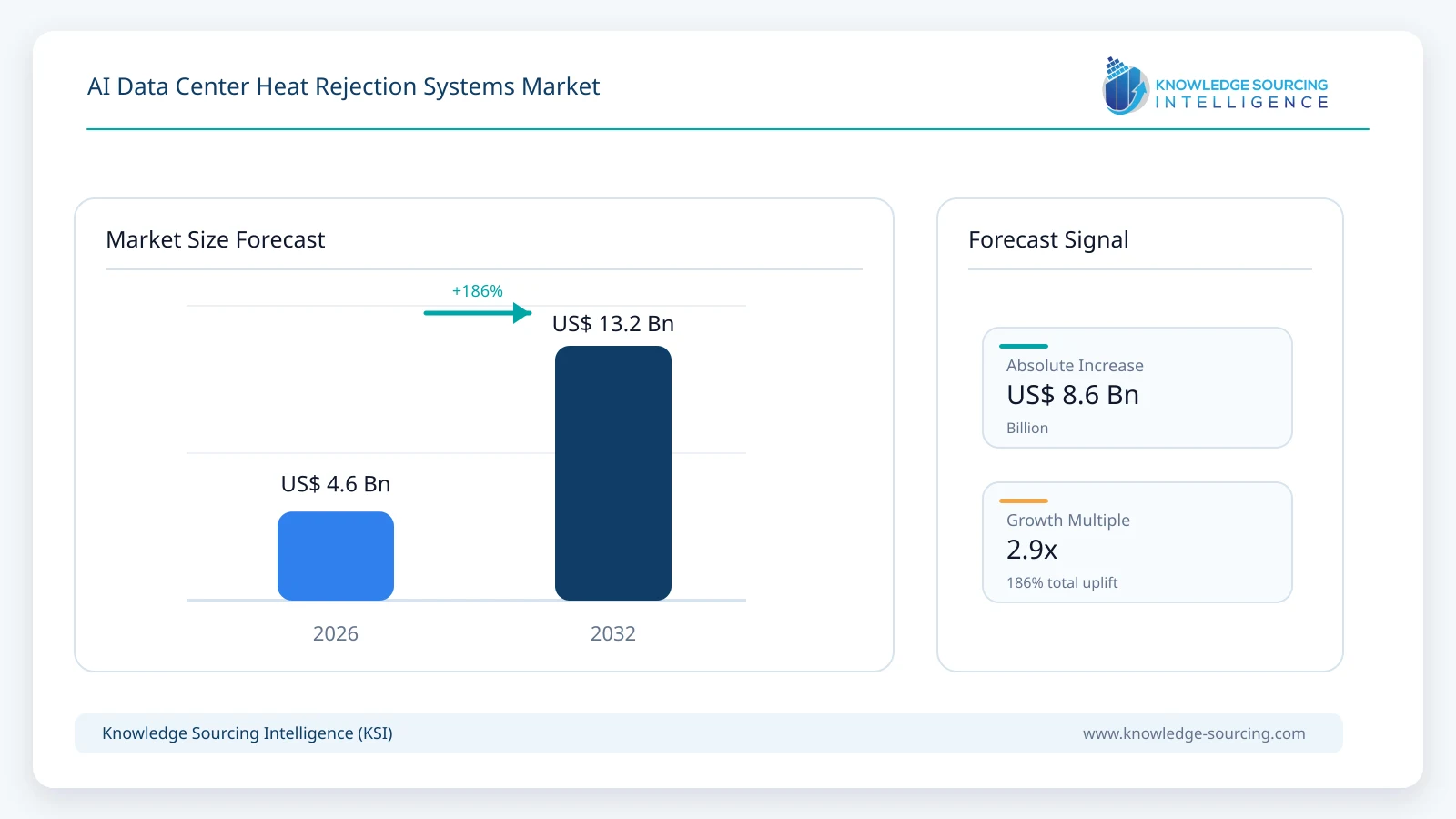
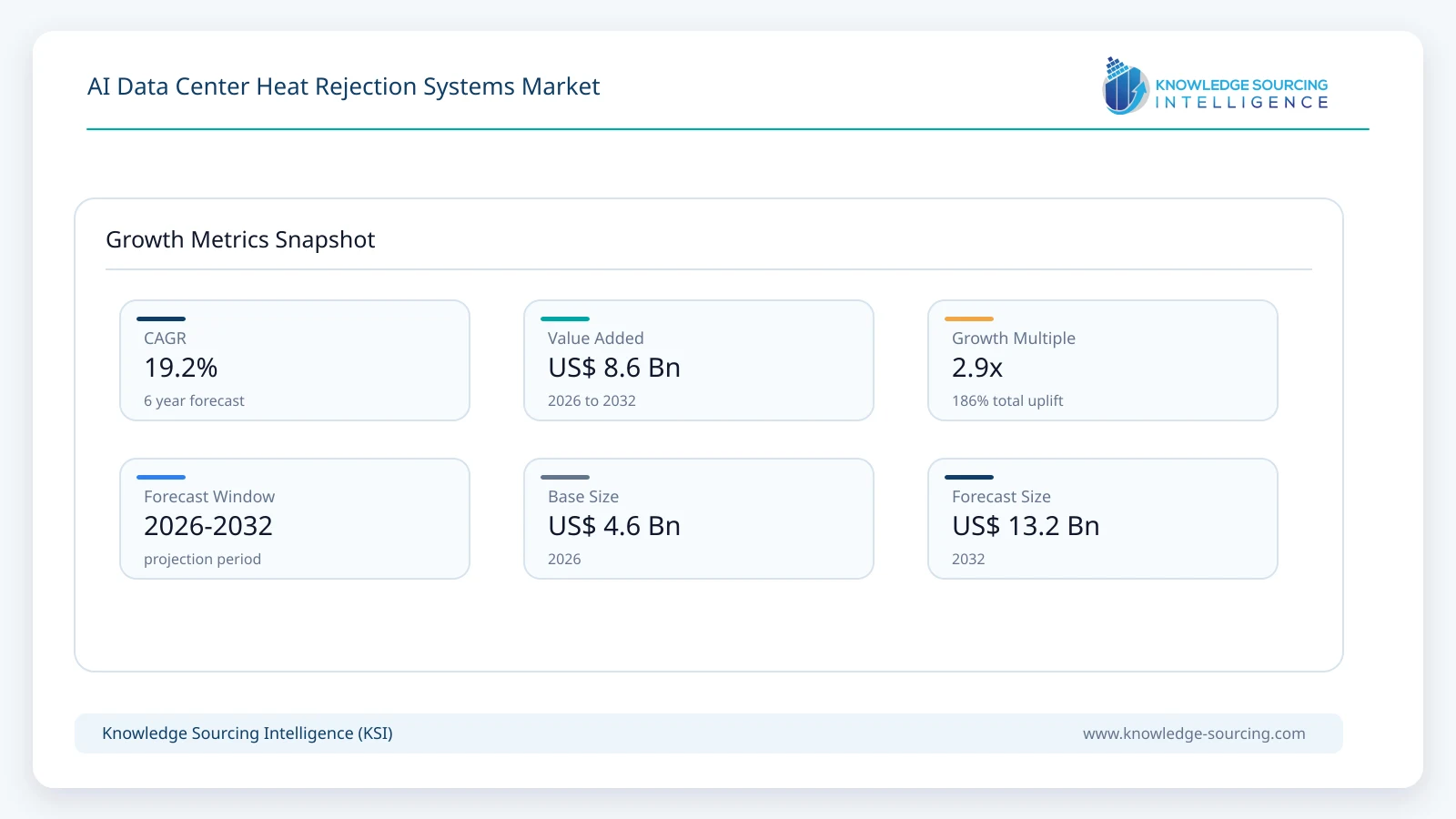
The AI Data Center Heat Rejection Systems Market is estimated at USD 4.60 billion in 2026 and is projected to reach USD 13.17 billion by 2032, representing a CAGR of 19.2% during the forecast period.
Key Highlights
· Chiller-based heat rejection remains the largest 2026 revenue pool across global AI campuses.
· Dry coolers and adiabatic fluid coolers are the fastest-growing heat-rejection architecture.
· Zero-water cooling is becoming a core design option for large greenfield AI factories.
· AI reference designs are scaling heat-rejection blocks from multi-megawatt to gigawatt campuses.
· North America leads spending through hyperscale, neocloud and large colocation development.
· Equipment density and modularity are becoming critical where sites have limited mechanical-yard space.
Market Overview
Direct-to-chip liquid cooling moves heat efficiently from graphics processing units and central processing units into a technology cooling loop, but the heat still has to leave the facility. A coolant distribution unit transfers that load into a facility loop that ultimately rejects it through a chiller, dry cooler, cooling tower or hybrid system. This final step becomes more important as AI compute density rises because the quantity of heat per building increases even if room-level airflow declines. Facility cooling therefore shifts from large numbers of computer room units toward fewer, higher-capacity central thermal systems.
AI also changes the temperature profile. Traditional chilled-water systems often operated around lower water temperatures to support air-cooled servers. Liquid-cooled AI hardware can tolerate much warmer coolant, allowing operators to raise facility-water temperatures and use dry coolers or economizers for more hours each year. Johnson Controls' 2026 AI-factory reference designs explicitly use high-temperature technology cooling loops to reduce water use and heat-rejection equipment. Trane and Schneider Electric are similarly designing around higher-temperature loops, dry coolers and adiabatic fluid coolers. The economic result is a shift in equipment mix rather than a simple increase in chiller capacity.
Climate remains decisive. Dry coolers can reject heat without process water and eliminate cooling-tower water treatment, but their approach temperature rises with ambient conditions. Modine notes that heat waves, local air recirculation and mixed rack-temperature requirements can make dry-cooler-only systems impractical in many regions. Hybrid architectures therefore combine free cooling during favorable conditions with mechanical refrigeration for peak ambient temperatures. Water-cooled chillers and cooling towers remain attractive where lower condenser temperatures, compact footprint or very high efficiency justify water consumption.
Market Drivers
AI capacity growth increases thermal load at campus scale
AI infrastructure is adding large blocks of high-density compute capacity whose electrical input ultimately becomes heat. The International Energy Agency expects electricity consumption from AI-focused data centers to rise sharply through 2030, while current AI campuses are increasingly planned in 100 MW to gigawatt increments. Heat-rejection equipment therefore scales with deployed megawatts even when liquid cooling reduces white-space air requirements. Large projects also require N+1 or other redundancy, increasing installed heat-rejection capacity above the steady-state thermal load.
Warmer liquid loops expand compressor-free operation
Higher technology-cooling-loop temperatures improve the thermodynamic position of dry coolers, fluid coolers and waterside economizers. Munters notes that elevated liquid temperatures can substantially increase the number of hours in which heat is rejected directly to ambient air. Johnson Controls, Trane and Schneider Electric have incorporated this principle into current AI-factory reference designs. The resulting demand benefits dry and hybrid heat-rejection equipment while reducing annual compressor runtime in suitable climates.
Water constraints are accelerating dry and hybrid systems
Large evaporative cooling systems can require substantial make-up water and water-treatment infrastructure. Water availability, permitting and community scrutiny are therefore influencing site design. Johnson Controls' 2026 air-cooled AI-factory reference design describes zero-water heat rejection and elimination of cooling towers, while Schneider Electric's latest high-density reference designs use adiabatic dry coolers to balance water use against peak-temperature performance. Operators increasingly evaluate heat rejection and water strategy together at the site-selection stage.
Modular reference designs are increasing equipment standardization
Thermal systems are moving toward repeatable multi-megawatt building blocks. Schneider Electric, Trane, Johnson Controls and Vertiv are all publishing or deploying validated AI cooling architectures that align chillers, dry coolers, CDUs and controls around standardized compute blocks. This reduces project engineering time and supports factory-built skids, modular piping and pre-integrated controls. Suppliers with scalable platforms and global manufacturing are advantaged as the same AI reference architectures are repeated across multiple regions.
Restraints and Adoption Challenges
The main restraint is that rising liquid-cooling temperatures can reduce equipment intensity per megawatt. Warmer loops improve free-cooling hours and can reduce the number of chillers or dry coolers required for a given IT load, partially offsetting capacity growth. Heat-rejection design is also highly climate-specific, which limits global standardization. Dry coolers become larger or less effective in hot climates, while cooling towers introduce water use and treatment requirements. Mechanical yards can face space, noise and recirculation constraints, particularly in dense urban locations. Operators must also preserve redundancy during maintenance and extreme-weather conditions, preventing simple optimization around average annual temperature.
Segment Analysis
By Heat-Rejection Architecture
Chiller-based systems represent the largest 2026 revenue pool because water-cooled and air-cooled chillers remain central to hyperscale and high-density data centers across a wide range of climates. The category includes centrifugal, screw and magnetic-bearing platforms with increasingly wide operating ranges and free-cooling integration. Water-cooled chiller plants often pair with cooling towers, while air-cooled units combine refrigeration and ambient heat rejection in one package.
Dry coolers and adiabatic fluid coolers are expected to grow fastest through 2032. Elevated liquid temperatures increase the number of climates and operating hours where compressor-free or low-compressor operation is feasible. Hybrid systems combine dry cooling with adiabatic assist or mechanical refrigeration for peak conditions, making them particularly attractive for global operators that want lower water consumption without sacrificing thermal headroom. Cooling towers remain important for high-efficiency water-cooled plants, especially in hot climates and sites where water is readily available.
Heat-Rejection Architecture | Revenue Contribution | Growth Direction | Primary AI Data Center Application |
Air-cooled chillers | Large revenue pool | Strong | Water-free refrigeration and peak-load heat rejection |
Water-cooled chillers + cooling towers | Largest established architecture | Strong | High efficiency and compact large-campus thermal plants |
Dry / fluid coolers | Fast-growing | Fastest | Ambient heat rejection for warm liquid loops |
Adiabatic / hybrid coolers | Growing | Very strong | Lower water use with improved hot-weather performance |
Waterside economizers / heat exchangers | Established support layer | Above average | Increase compressor-free cooling hours |
Controls, integration and lifecycle services | Recurring service layer | Strong | Plant optimization, redundancy and performance management |
Market and Technology Indicators
Indicator | Latest Development | Market Impact |
Gigawatt-scale reference designs | Johnson Controls released 1 GW AI-factory cooling blueprints in 2026. | Shows heat rejection moving to industrial-scale repeatable architectures. |
Zero-water heat rejection | Johnson Controls' designs use dry coolers and eliminate cooling towers in selected configurations. | Accelerates dry-cooler and air-cooled chiller adoption. |
Adiabatic dry cooling | Schneider Electric uses adiabatic dry coolers in AMD MI455X and NVIDIA GB300 AI reference designs. | Supports hybrid low-water heat rejection for high-density clusters. |
1 GW chiller + dry-cooler design | Trane reference architecture combines chillers, dry coolers and waterside economizing. | Confirms hybrid systems at hyperscale capacity. |
3+ MW air-cooled chiller | Modine launched TurboChill 3+MW for AI data centers in January 2026. | Increases single-unit capacity for large AI thermal blocks. |
AI dry-cooler deployment | Vertiv deployed dry-cooler heat rejection for NxtGen AI in India. | Shows commercial adoption outside reference-design environments. |
Regional Opportunity
North America
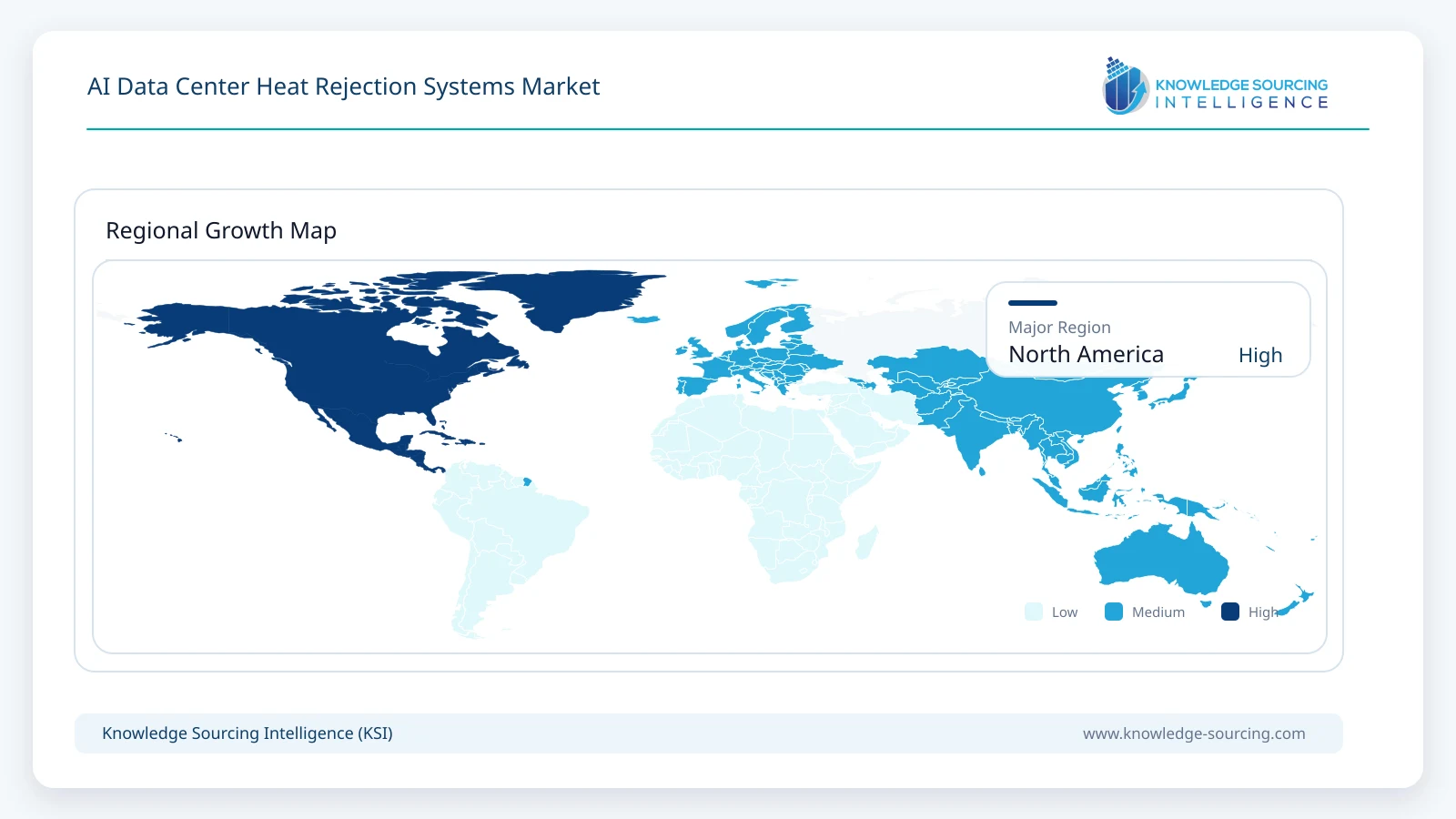
North America is the largest market for AI data-center heat-rejection systems because the United States combines the world's largest hyperscale and neocloud investment base with rapid adoption of liquid-cooled accelerator infrastructure. Large campuses increasingly require central heat-rejection plants in the tens or hundreds of megawatts, creating demand for multi-megawatt chillers, dry coolers, towers, pumps, heat exchangers and controls. Northern Virginia, Texas, the Midwest and western U.S. markets present very different climate and water conditions, making the region a major deployment environment for both evaporative and water-free architectures.
The supplier ecosystem is also concentrated in the region. Johnson Controls, Trane, Carrier and Daikin Applied provide large chiller platforms and AI-specific reference architectures. Modine's Airedale business is expanding high-capacity air-cooled and free-cooling chillers, while EVAPCO and Baltimore Aircoil Company participate in dry, evaporative and hybrid heat-rejection equipment. Vertiv and Schneider Electric integrate facility heat rejection with liquid-cooling and power systems, which is increasingly important as hyperscalers procure validated end-to-end AI infrastructure rather than isolated mechanical components.
North American growth is also influenced by water and grid constraints. Dry cooling and air-cooled chillers reduce on-site water consumption but can increase fan or compressor power during high ambient conditions. Water-cooled systems can deliver high efficiency but require make-up water, treatment and permitting. Through 2032, operators are expected to use a broader mix of hybrid designs, including dry coolers for most annual hours with chillers or adiabatic assist for peak conditions. Brownfield sites will add modular heat-rejection capacity where existing plants cannot support new liquid-cooled AI clusters.
Europe benefits from cooler climates in many major data-center hubs and strong incentives around water and energy efficiency, supporting dry cooling, economization and heat-reuse-compatible architectures. Asia Pacific combines very large AI infrastructure growth with wide climate variation, creating demand for both high-efficiency water-cooled plants and air-cooled or hybrid systems. The Middle East is emerging as a major greenfield AI market where extreme ambient temperatures favor robust mechanical cooling and carefully engineered hybrid rejection systems.
Competitive Landscape
The market is led by large thermal-equipment suppliers with the manufacturing scale to support multi-megawatt and campus-level projects. Johnson Controls, Trane, Carrier and Daikin Applied compete across centrifugal, screw, magnetic-bearing and air-cooled chiller platforms. Schneider Electric and Vertiv integrate heat rejection with coolant distribution, facility power and AI reference architectures. Modine / Airedale, Munters and STULZ compete strongly in data-center-specific cooling, including free-cooling and dry-cooler solutions.
Heat-rejection specialists remain important where projects require dry coolers, closed-circuit coolers, cooling towers or hybrid systems at scale. EVAPCO, Baltimore Aircoil Company and Güntner offer broad air-side and evaporative heat-rejection portfolios, while Alfa Laval and Kelvion participate through plate heat exchangers and fluid-cooling systems. Delta Electronics and Rittal add integrated data-center thermal infrastructure. Competitive advantage increasingly depends on capacity density, ambient operating range, free-cooling capability, water consumption, modularity, refrigerant profile, controls and the ability to guarantee performance under rapidly changing AI thermal loads.
Major companies and ecosystem participants covered: Johnson Controls, Trane Technologies, Carrier, Daikin Applied, Schneider Electric / Motivair, Vertiv, Modine / Airedale, Munters, STULZ, EVAPCO, Baltimore Aircoil Company, Güntner, Alfa Laval, Kelvion, Delta Electronics, Rittal and Mitsubishi Electric.
Recent Developments
· September 2026: Munters outlined next-generation two-phase AI cooling architectures that can enable warmer return temperatures and substantially more compressor-free heat rejection.
· July 2026: Johnson Controls released an absorption-chiller AI-factory reference design aimed at reducing cooling electrical demand by using waste heat from on-site power generation.
· July 2026: Schneider Electric released an AMD MI455X AI data-center reference design using liquid-to-liquid CDUs and adiabatic dry coolers.
· May 2026: Johnson Controls introduced an air-cooled AI-factory reference design targeting zero on-site cooling water and lower annual cooling energy.
· May 2026: Trane expanded AI-factory reference designs combining chillers, dry coolers and waterside economizing across 250 MW and 1 GW deployments.
· February 2026: Carrier introduced the AquaEdge 30CF air-cooled centrifugal chiller for data-center reliability and high-density thermal loads.
· February 2026: Vertiv announced a dry-cooler-based heat-rejection architecture for NxtGen AI's Blackwell infrastructure deployment in India.
· January 2026: Modine / Airedale launched TurboChill 3+MW, combining air-cooled heat rejection and expanded free-cooling operation for AI data centers.
AI Data Center Heat Rejection Systems Market Scope:
| Report Metric | Details |
|---|---|
| Total Market Size in 2026 | USD 4.60 billion |
| Total Market Size in 2032 | USD 13.17 billion |
| Forecast Unit | USD Billion |
| Growth Rate | 19.2% |
| Study Period | 2021 to 2032 |
| Historical Data | 2021 to 2024 |
| Base Year | 2025 |
| Forecast Period | 2026 – 2032 |
| Segmentation | Heat-Rejection Architecture, Cooling Interface, Project Type, Water Strategy, Customer Type, Geography |
| Companies |
|
Market Segmentation
By Heat-Rejection Architecture
Air-Cooled Chillers
Water-Cooled Chillers and Cooling Towers
Dry and Fluid Coolers
Adiabatic and Hybrid Coolers
Waterside Economizers and Heat Exchangers
Controls, Integration and Lifecycle Services
By Cooling Interface
Direct-to-Chip Liquid-Cooled AI Infrastructure
Hybrid Air-Liquid Data Halls
Conventional Chilled-Water AI Environments
Two-Phase and High-Temperature Emerging Systems
By Project Type
Greenfield AI Factories
Hyperscale and Colocation Expansions
Brownfield AI Retrofits
Sovereign and Enterprise AI Facilities
By Water Strategy
Zero-Water / Dry Heat Rejection
Low-Water / Adiabatic Systems
Evaporative / Cooling-Tower Systems
Hybrid Climate-Optimized Systems
By Customer Type
Hyperscale Cloud Providers
Neocloud and GPU-Cloud Operators
Colocation Providers
Sovereign AI Infrastructure
Enterprise and High-Performance Computing
By Geography
North America
United States
Canada
Europe
Asia Pacific
Middle East and Rest of World
Table of Contents
1. EXECUTIVE SUMMARY
1.1. Market Opportunity and Key Findings
1.2. Heat-Rejection Architecture Transition
1.3. Principal Revenue Pools
2. MARKET OVERVIEW
2.1. From Chip Heat Capture to Facility Heat Rejection
2.2. Elevated Temperature Liquid Cooling
2.3. Climate and Water Constraints
2.4. Mechanical Refrigeration and Free Cooling
2.5. Hybrid and Modular Thermal Plants
3. MARKET SIZE AND FORECAST, 2026-2032
3.1. Global Market Revenue
3.2. Annual Growth Analysis
3.3. Greenfield versus Retrofit Demand
3.4. Heat-Rejection Content per MW
4. MARKET BY HEAT-REJECTION ARCHITECTURE
4.1. Air-Cooled Chillers
4.2. Water-Cooled Chillers and Cooling Towers
4.3. Dry and Fluid Coolers
4.4. Adiabatic and Hybrid Coolers
4.5. Waterside Economizers and Heat Exchangers
4.6. Controls, Integration and Lifecycle Services
5. MARKET BY COOLING INTERFACE
5.1. Direct-to-Chip Liquid-Cooled AI Infrastructure
5.2. Hybrid Air-Liquid Data Halls
5.3. Conventional Chilled-Water AI Environments
5.4. Two-Phase and High-Temperature Emerging Systems
6. MARKET BY PROJECT TYPE
6.1. Greenfield AI Factories
6.2. Hyperscale and Colocation Expansions
6.3. Brownfield AI Retrofits
6.4. Sovereign and Enterprise AI Facilities
7. MARKET BY WATER STRATEGY
7.1. Zero-Water / Dry Heat Rejection
7.2. Low-Water / Adiabatic Systems
7.3. Evaporative / Cooling-Tower Systems
7.4. Hybrid Climate-Optimized Systems
8. MARKET BY CUSTOMER TYPE
8.1. Hyperscale Cloud Providers
8.2. Neocloud and GPU-Cloud Operators
8.3. Colocation Providers
8.4. Sovereign AI Infrastructure
8.5. Enterprise and High-Performance Computing
9. REGIONAL MARKET
9.1. North America
9.1.1. United States
9.1.2. Canada
9.2. Europe
9.3. Asia Pacific
9.4. Middle East and Rest of World
10. MARKET DYNAMICS
10.1. Drivers
10.1.1. Growth in AI Thermal Load
10.1.2. Warmer Liquid Cooling Loops
10.1.3. Water-Constrained Data Center Development
10.1.4. Modular AI Factory Reference Designs
10.2. Restraints
10.2.1. Falling Heat-Rejection Equipment Intensity per MW
10.2.2. Climate-Specific Design Requirements
10.2.3. Mechanical Yard, Noise and Recirculation Constraints
10.2.4. Water, Refrigerant and Regulatory Tradeoffs
11. COMPETITIVE LANDSCAPE
11.1. Value Chain
11.2. Chiller Manufacturers
11.3. Dry Cooler and Fluid Cooler Suppliers
11.4. Cooling Tower and Hybrid Heat-Rejection Suppliers
11.5. Heat Exchanger and Economizer Suppliers
11.6. Integrated AI Thermal Infrastructure Providers
12. COMPANY PROFILES
12.1. Johnson Controls
12.2. Trane Technologies
12.3. Carrier
12.4. Daikin Applied
12.5. Schneider Electric / Motivair
12.6. Vertiv
12.7. Modine / Airedale
12.8. Munters
12.9. STULZ
12.10. EVAPCO
12.11. Baltimore Aircoil Company
12.12. Güntner
12.13. Alfa Laval
12.14. Kelvion
12.15. Delta Electronics
12.16. Rittal
12.17. Mitsubishi Electric
13. RECENT DEVELOPMENTS
14. APPENDIX
14.1. Definitions and Abbreviations
14.2. Heat-Rejection Architecture Classification
14.3. Climate and Water Strategy Framework
14.4. Source and Data Notes
Navigate
Trusted by the world's leading organizations











