
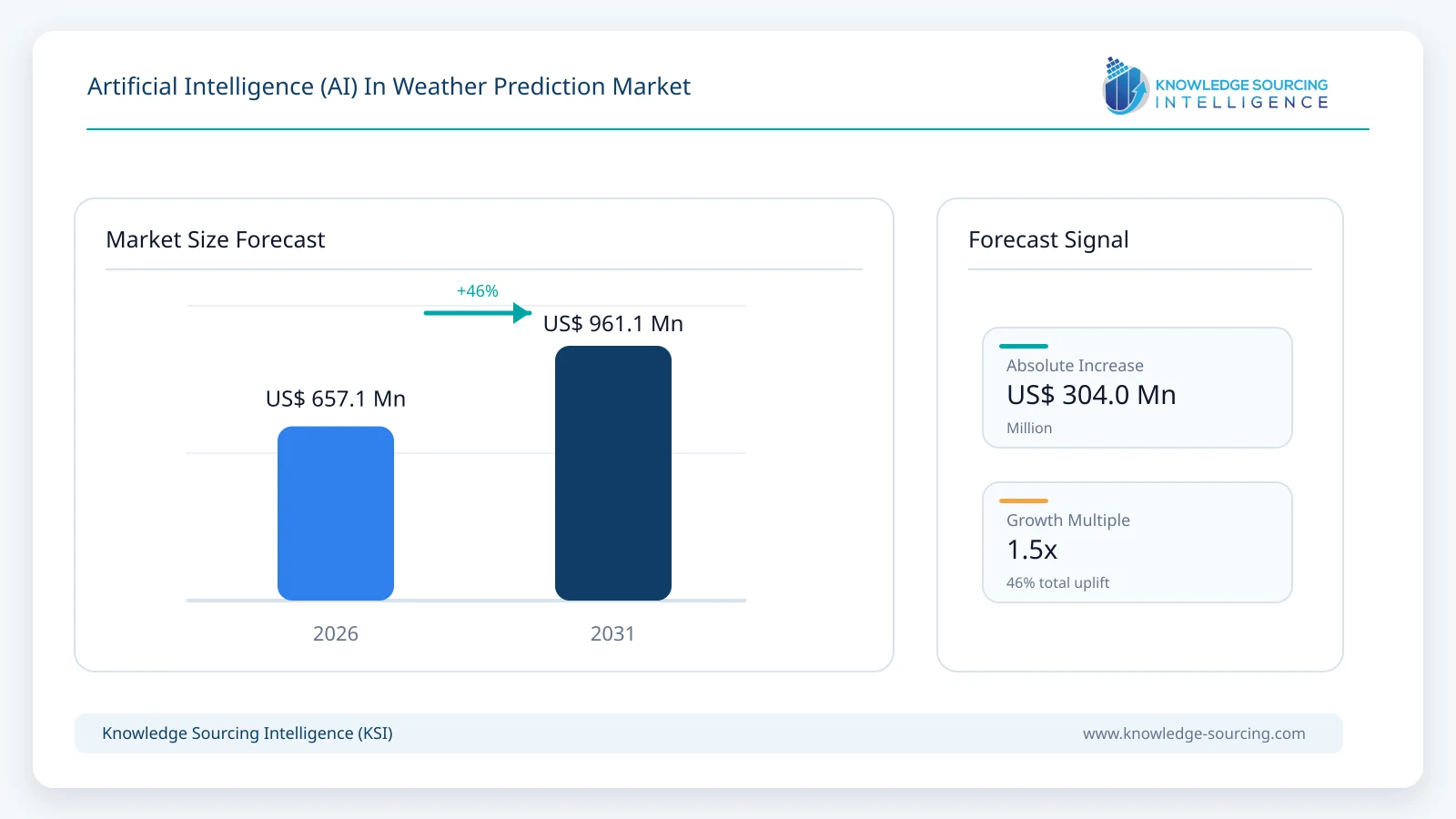
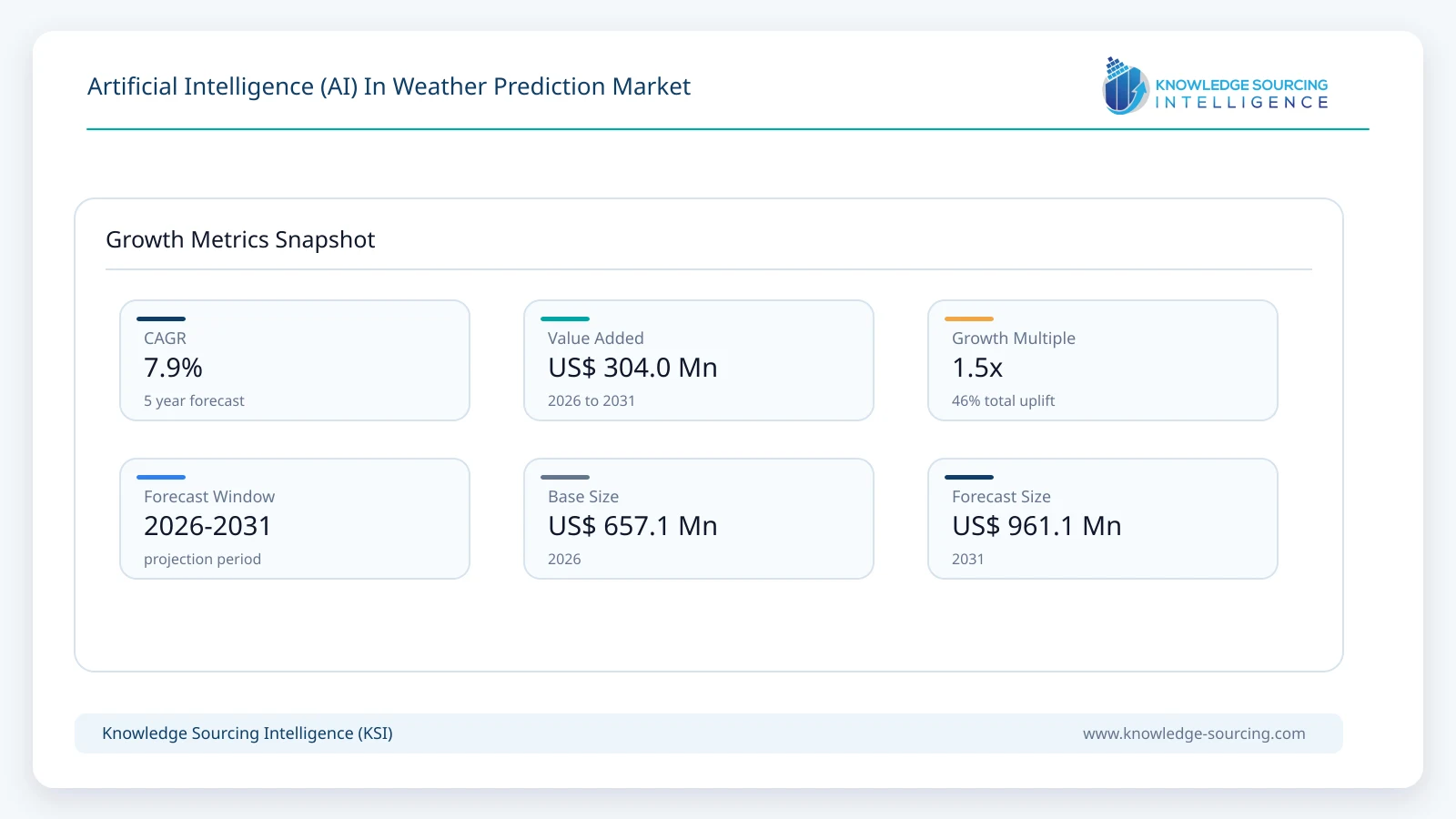
The Artificial Intelligence (AI) in Weather Prediction market is forecast to grow at a CAGR of 7.90%, reaching USD 961.09 million in 2031 from USD 657.14 million in 2026.
Highlights:
- 1Growing financial exposure to extreme weather events is accelerating enterprise investment in AI-enabled forecasting platforms.
- 2Hybrid AI combined with numerical weather prediction represents one of the most commercially important technology approaches due to improved forecast reliability.
- 3North America remains an important demand center because of advanced meteorological infrastructure, cloud adoption, and strong commercial weather services.
- 4Aviation, energy, agriculture, and disaster management continue to account for substantial enterprise procurement activity.
- 5Government investments in climate resilience and weather modernization programs support long-term technology adoption.
- 6Competition increasingly focuses on proprietary weather data, computational efficiency, industry-specific analytics, and strategic technology partnerships.
The Artificial Intelligence (AI) in Weather Prediction Market comprises software, computational infrastructure, analytics platforms, and specialized services that apply artificial intelligence to improve weather forecasting, climate risk assessment, and decision support across commercial and public-sector applications. AI techniques, including machine learning, deep learning, and hybrid models that combine data-driven algorithms with numerical weather prediction (NWP), are changing how atmospheric data is processed, interpreted, and delivered to end users. The market serves organizations requiring higher forecast accuracy, shorter computation times, and location-specific weather intelligence for operational planning.
Commercial demand is expanding because weather-related disruptions impose substantial financial costs across aviation, agriculture, energy, logistics, insurance, and disaster response. Organizations increasingly require probabilistic forecasts, hyperlocal weather intelligence, and predictive analytics rather than conventional weather bulletins. Procurement decisions therefore extend beyond forecast accuracy to include system interoperability, application programming interfaces (APIs), cloud deployment flexibility, cybersecurity, and the ability to integrate satellite, radar, sensor, and Internet of Things (IoT) data into enterprise workflows.
The industry structure combines global technology companies, meteorological intelligence providers, satellite data specialists, AI software developers, and weather analytics firms. Suppliers compete by improving model performance, expanding proprietary observation networks, reducing computational costs, and delivering industry-specific forecasting applications. Strategic collaborations with meteorological agencies, cloud infrastructure providers, satellite operators, and research institutions have become an important route to accelerate product development while improving model validation.
Revenue generation increasingly depends on subscription-based analytics platforms, enterprise software licensing, cloud-hosted forecasting services, customized weather intelligence solutions, and decision-support applications tailored to industry requirements. Commercial buyers generally evaluate total operational value rather than forecast accuracy alone. Reduced weather-related downtime, optimized fleet utilization, lower insurance losses, better crop planning, and enhanced energy balancing provide measurable financial returns that support purchasing decisions.
Technology adoption also reflects changing computing economics. Cloud computing, graphics processing units (GPUs), and AI accelerators have reduced the time required to train complex forecasting models. Organizations can now process petabytes of atmospheric observations collected from satellites, weather stations, radar systems, drones, aircraft, and connected sensors within operational forecasting windows. This computational capability allows AI models to complement rather than replace traditional physics-based forecasting systems.
Public investment further supports market expansion. National meteorological agencies continue modernizing forecasting infrastructure, while governments invest in climate resilience, disaster preparedness, and digital weather observation systems. These initiatives create demand for AI-enabled forecasting platforms capable of supporting emergency management, infrastructure planning, and public warning systems with improved temporal and spatial resolution.
Market Drivers
Rising economic impact of weather-related disruptions
Weather volatility has become a material operational risk across transportation, utilities, agriculture, and industrial operations. Enterprises seek forecasting systems capable of improving operational planning several hours or days before weather events occur. Buyers increasingly prioritize forecast precision at the asset level, encouraging suppliers to develop AI models that deliver localized predictions for airports, wind farms, logistics hubs, and agricultural fields. This creates recurring demand for enterprise forecasting subscriptions and customized analytics.
Expansion of satellite and sensor observation networks
Modern forecasting increasingly depends on high-volume environmental observations generated through satellites, Doppler radar, connected weather stations, aircraft telemetry, marine buoys, and IoT devices. AI systems can process these heterogeneous datasets more efficiently than conventional analytical workflows. Technology providers therefore invest in scalable data ingestion platforms and automated quality-control systems to improve forecast consistency while supporting new commercial applications across multiple industries.
Growing adoption of cloud-based high-performance computing
AI weather prediction requires substantial computational resources for model training and operational deployment. Cloud computing has lowered infrastructure barriers by allowing organizations to access scalable processing capacity without maintaining dedicated supercomputers. Enterprises benefit from flexible computing costs while suppliers accelerate product deployment through cloud-native architectures, supporting broader adoption among commercial customers.
Increased emphasis on climate adaptation planning
Governments, utilities, insurers, and infrastructure operators increasingly incorporate climate intelligence into investment planning. Long-term weather analytics assist organizations in evaluating flood exposure, wildfire risk, drought conditions, and infrastructure resilience. This broadens purchasing decisions beyond operational forecasting toward strategic risk management, expanding addressable market opportunities for AI weather analytics providers.
Market Restraints and Challenges
Dependence on high-quality observational data
AI forecasting performance depends heavily on the availability, accuracy, and consistency of observational datasets. Data gaps, inconsistent sensor calibration, and limited monitoring infrastructure reduce model reliability, particularly in developing regions. Suppliers mitigate these limitations through satellite integration, synthetic data generation, and collaborative data-sharing agreements, although implementation costs remain substantial.
High computational requirements
Training sophisticated AI forecasting models demands considerable processing power and energy consumption. Organizations without access to advanced computing infrastructure may experience higher implementation costs, limiting adoption among smaller enterprises. Technology vendors increasingly optimize algorithms and adopt efficient hardware architectures to improve cost competitiveness.
Regulatory and operational trust considerations
Critical sectors including aviation, disaster management, and public weather services require transparent forecasting methodologies and validated operational performance. Decision-makers often prefer explainable AI systems capable of demonstrating prediction confidence and model accountability. Suppliers therefore invest in validation frameworks, scientific benchmarking, and hybrid forecasting architectures that combine AI outputs with established meteorological models.
Integration complexity within enterprise operations
Many organizations operate legacy operational technology platforms that were not designed to incorporate AI-generated weather intelligence. Integration challenges increase implementation timelines and consulting costs while delaying return on investment. Vendors respond by expanding API capabilities, standardized software connectors, and configurable enterprise platforms.
Major Segment Analysis
Hybrid AI + Numerical Weather Prediction
Hybrid AI combined with numerical weather prediction represents one of the most commercially valuable technology segments because it combines the scientific reliability of physics-based atmospheric models with AI's capability to identify complex patterns within massive observational datasets. Rather than replacing conventional forecasting systems, hybrid approaches improve forecast correction, computational efficiency, and spatial resolution.
Enterprise buyers prefer hybrid forecasting because operational decisions often require scientifically validated outputs that satisfy regulatory expectations while delivering measurable improvements in accuracy. Aviation operators, power grid managers, shipping companies, and government meteorological agencies prioritize forecasting systems capable of reducing uncertainty during high-impact weather events.
Competition within this segment increasingly depends on proprietary model optimization techniques, GPU-enabled computing performance, exclusive weather observation datasets, and software integration capabilities. Vendors also differentiate through sector-specific forecasting modules addressing renewable energy production, flood prediction, crop management, and transportation safety.
Commercially, hybrid forecasting generates recurring revenue through software licensing, cloud subscriptions, enterprise integration services, and industry-specific analytical applications. As computational efficiency improves, adoption is expected to extend beyond large institutions into mid-sized commercial organizations seeking operational weather intelligence.
Regional Analysis
North America maintains strong commercial demand because of advanced weather observation infrastructure, mature cloud computing adoption, and widespread use of weather intelligence across aviation, agriculture, insurance, logistics, and energy industries. Federal investment in meteorological modernization and climate resilience supports continued procurement of AI-enabled forecasting technologies.
Europe benefits from coordinated meteorological collaboration, climate adaptation initiatives, renewable energy expansion, and environmental monitoring policies. Energy transition objectives increase demand for accurate wind and solar forecasting, while transportation operators seek improved weather intelligence to optimize network performance and safety.
Asia Pacific presents substantial long-term opportunities due to expanding digital infrastructure, growing exposure to extreme weather events, agricultural modernization, and government investment in disaster preparedness. Rapid industrialization and infrastructure development encourage adoption across transportation, utilities, and public-sector agencies despite differences in forecasting infrastructure between countries.
Middle East & Africa and South America represent developing opportunities supported by investments in agriculture, water resource management, aviation, mining, and disaster resilience. Adoption remains constrained by uneven meteorological infrastructure and limited access to advanced computing resources, although satellite-based forecasting services reduce some implementation barriers.
Competitive Landscape
The competitive environment combines global cloud technology companies, specialized weather intelligence providers, AI software developers, satellite analytics companies, and atmospheric data specialists. Competition increasingly centers on forecast quality, proprietary observational datasets, computational performance, industry-specific analytical capabilities, and enterprise integration.
Strategic partnerships remain central to competitive positioning. Suppliers collaborate with cloud infrastructure providers, satellite operators, meteorological agencies, universities, and industrial customers to strengthen model validation and expand geographic coverage. Product differentiation increasingly depends on hyperlocal forecasting, AI-assisted decision support, scalable cloud deployment, and sector-focused forecasting applications rather than generalized weather reporting.
Geographic expansion also remains important as vendors seek access to emerging markets investing in climate resilience, disaster preparedness, and digital weather infrastructure.
Recent Developments
April 2026: Spire Global expanded its Agriculture Intelligence platform by integrating AI-driven weather forecasting with satellite-derived soil moisture data, providing up to 45-day forecasts to support climate-resilient agricultural decision-making.
April 2026: MITRE and The Weather Company announced a strategic collaboration under which The Weather Company licensed MITRE's Weather 1K high-resolution AI training dataset to improve AI-based global weather forecast accuracy.
January 2026: Tomorrow.io announced DeepSky, the world's first AI-native space-based weather-sensing constellation, designed to continuously observe Earth's atmosphere and oceans, strengthening AI-driven global weather prediction and resilience capabilities.
Regulatory and Policy Environment
Government meteorological agencies remain influential purchasers and regulators within the AI weather prediction ecosystem. Forecasting systems deployed for aviation, disaster management, marine navigation, and public safety must satisfy established operational standards governing forecast quality, system reliability, cybersecurity, and data integrity.
Climate adaptation policies, national digital infrastructure programs, and disaster risk reduction initiatives encourage modernization of weather observation networks and forecasting capabilities. International meteorological cooperation also promotes standardized data exchange, improving interoperability between forecasting platforms and supporting broader AI adoption.
Data governance requirements increasingly influence procurement decisions as organizations process environmental observations collected from satellites, IoT networks, drones, and connected infrastructure. Compliance with cybersecurity requirements, cloud security standards, and responsible AI governance frameworks has become an important evaluation criterion for enterprise buyers.
Outlook and Strategic Implications
Over the next five years, procurement priorities are expected to emphasize operational decision support rather than forecast generation alone. Buyers will increasingly evaluate solutions according to measurable business outcomes including reduced operational disruption, improved resource allocation, enhanced infrastructure resilience, and lower weather-related financial losses.
Investment is likely to concentrate on hybrid AI forecasting architectures, cloud-native deployment models, proprietary environmental data acquisition, and GPU-accelerated computing infrastructure. Industry demand will increasingly favor integrated platforms capable of combining weather prediction with climate risk analytics, asset monitoring, and enterprise planning systems.
Competitive positioning will depend on sustained investment in model validation, explainable AI, observational data quality, and industry-specific forecasting applications. Organizations capable of demonstrating operational value across multiple sectors while maintaining scientific credibility are expected to strengthen long-term customer relationships.
Market expansion nevertheless depends on continued improvements in computational efficiency, broader availability of high-quality environmental observations, evolving regulatory guidance for AI deployment, and ongoing investment in meteorological infrastructure. Suppliers that balance technological innovation with transparent forecasting performance and scalable commercial delivery models are expected to capture the strongest opportunities during the 2026–2031 forecast period.
Artificial Intelligence (AI) in Weather Prediction Market Scope
| Report Metric | Details |
|---|---|
| Total Market Size in 2026 | USD 657.14 million |
| Total Market Size in 2031 | USD 961.09 million |
| Forecast Unit | Million |
| Growth Rate | 7.90% |
| Study Period | 2021 to 2031 |
| Historical Data | 2021 to 2024 |
| Base Year | 2025 |
| Forecast Period | 2026 – 2031 |
| Segmentation | Component, Technology Type, End-User, Geography |
| Companies |
|
Market Segmentation
By Component
By Technology Type
By End-user
By Geography
Table of Contents
1. EXECUTIVE SUMMARY
2. MARKET SNAPSHOT
2.1. Market Overview
2.2. Market Definition
2.3. Scope of the Study
2.4. Market Segmentation
3. BUSINESS LANDSCAPE
3.1. Market Drivers
3.2. Market Restraints
3.3. Market Opportunities
3.4. Porter’s Five Forces Analysis
3.5. Industry Value Chain Analysis
3.6. Policies and Regulations
3.7. Strategic Recommendations
4. TECHNOLOGICAL OUTLOOK
4.1. AI Foundation Models
4.2. Numerical Weather Prediction (NWP) Integration
4.3. Satellite Image Analytics
4.4. AI-Based Data Assimilation
4.5. High-Performance Computing (HPC)
4.6. Explainable AI (XAI)
5. AI IN WEATHER PREDICTION MARKET BY COMPONENT
5.1. Introduction
5.2. Software & Platforms
5.3. Hardware
5.4. Services
6. AI IN WEATHER PREDICTION MARKET BY TECHNOLOGY TYPE
6.1. Introduction
6.2. Machine Learning
6.3. Deep Learning
6.4. Generative AI/Foundation Models
6.5. Hybrid AI + Numerical Weather Prediction
6.6. Others
7. AI IN WEATHER PREDICTION MARKET BY END-USER
7.1. Introduction
7.2. Aviation
7.3. Maritime and Shipping
7.4. Agriculture & Forestry
7.5. Energy and Utilities
7.6. Disaster Management
7.7. Transportation and Logistics
7.8. Government Meteorological Agencies
7.9. Insurance
7.10. Media and Consumer Services
7.11. Defense
7.12. Others
8. AI IN WEATHER PREDICTION MARKET BY GEOGRAPHY
8.1. Introduction
8.2. North America
8.2.1. By Component
8.2.2. By Technology Type
8.2.3. By End-User
8.2.4. By Country
8.2.4.1. United States
8.2.4.2. Canada
8.2.4.3. Mexico
8.3. South America
8.3.1. By Component
8.3.2. By Technology Type
8.3.3. By End-User
8.3.4. By Country
8.3.4.1. Brazil
8.3.4.2. Argentina
8.3.4.3. Others
8.4. Europe
8.4.1. By Component
8.4.2. By Technology Type
8.4.3. By End-User
8.4.4. By Country
8.4.4.1. United Kingdom
8.4.4.2. Germany
8.4.4.3. France
8.4.4.4. Italy
8.4.4.5. Spain
8.4.4.6. Others
8.5. Middle East & Africa
8.5.1. By Component
8.5.2. By Technology Type
8.5.3. By End-User
8.5.4. By Country
8.5.4.1. Saudi Arabia
8.5.4.2. UAE
8.5.4.3. South Africa
8.5.4.4. Others
8.6. Asia Pacific
8.6.1. By Component
8.6.2. By Technology Type
8.6.3. By End-User
8.6.4. By Country
8.6.4.1. Japan
8.6.4.2. China
8.6.4.3. India
8.6.4.4. South Korea
8.6.4.5. Australia
8.6.4.6. Taiwan
8.6.4.7. Others
9. COMPETITIVE ENVIRONMENT AND ANALYSIS
9.1. Major Players and Strategy Analysis
9.2. Market Share Analysis
9.3. Mergers, Acquisitions, Agreements, and Collaborations
9.4. Competitive Dashboard
10. COMPANY PROFILES
10.1. Tomorrow.io
10.2. Google LLC (Alphabet Inc.)
10.3. IBM Corporation
10.4. AccuWeather, Inc.
10.5. Microsoft Corporation
10.6. NVIDIA Corporation
10.7. Jupiter Intelligence, Inc.
10.8. DTN, LLC
10.9. Tempest Weather (WeatherFlow-Tempest)
10.10. Open Climate Fix
10.11. Climavision, Inc.
10.12. Spire Global, Inc.
10.13. Meteomatics AG
11. RESEARCH METHODOLOGY
Navigate
Trusted by the world's leading organizations











