
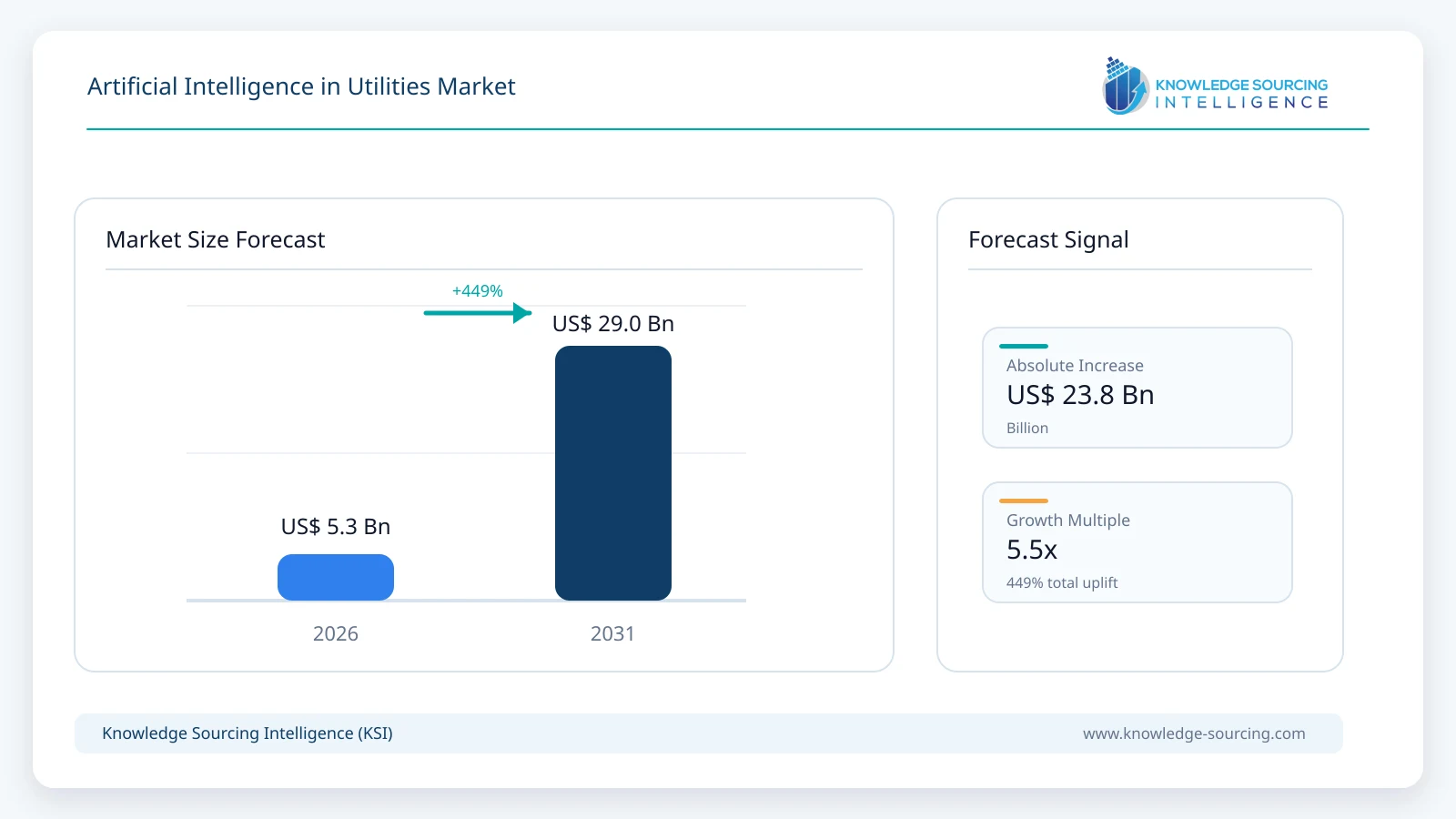
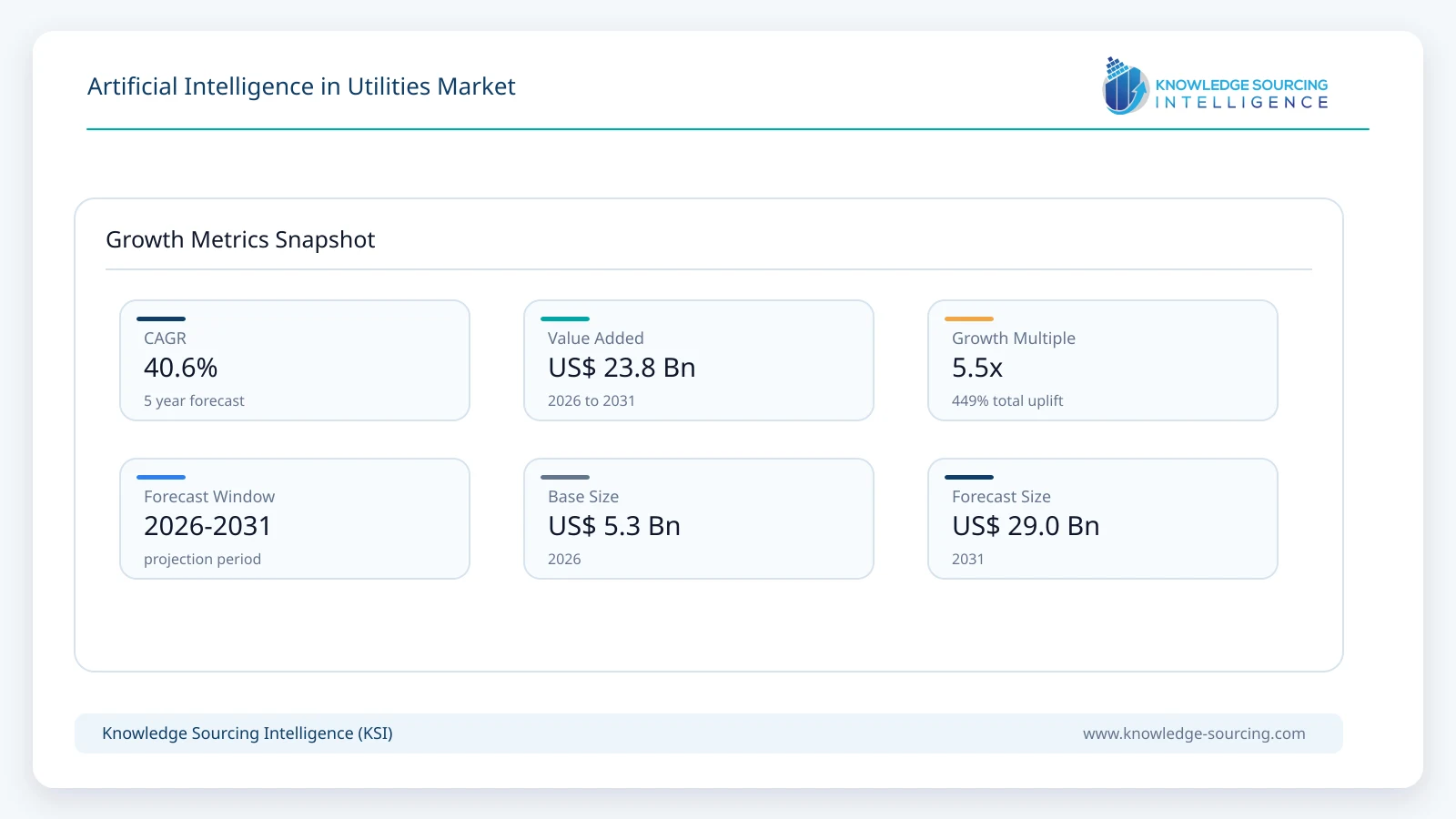
The Artificial Intelligence in Utilities Market is forecast to grow at a CAGR of 40.6%, reaching USD 29.04 billion in 2031 from USD 5.29 billion in 2026.
Highlights:
- 1Utilities are leveraging ML and deep-learning models for load forecasting, asset-health monitoring, anomaly detection, customer segmentation, renewable-energy forecasting, and grid optimization.
- 2AI is being embedded into ADMS, DERMS, grid-intelligence platforms, and control-room workflows in broad swathes of outage response for network optimization or distributed-resource management.
- 3Specialized analytical skills were largely required for employees and customers to interact with complex datasets from utilities, but now GenAI interfaces enable such interactions using natural language instead.
- 4AI has set itself up for major gains, including the exponential need for electricity to power AI-Powered computing, and then urging utilities to leverage AI in managing emissions and the complexity that it will introduce into the grid.
The artificial intelligence (AI) in utilities market is segmented on the basis of mode, utility type, and function. Utilities are gradually transitioning from traditional rule-based automation to predictive and adaptive systems. Smart-meter data, weather conditions, historical consumption and equipment performance, network topology, customer behavior, and market information are fed to AI models, which determine patterns that conventional systems do not detect.
The technology is being used in centralized as well as distributed environments. They offer cloud-enabled AI platforms for big-data analytics and model training, and edge AI allows faster analysis closer to substations, meters, sensors, and other grid assets.
Oracle's Utilities Data Intelligence platform brings together utility data and leverages AI-driven analytics spanning customer, grid, and asset operations. It features customer analytics, grid-operation insights, work and asset analytics, and customer-program management.
Along with this, the market is also drifting from generic AI models to utility-specific AIs. For example, Bidgely's UtilityAI platform leverages AMI, customer, grid, and EV data to deliver appliance intelligence, load forecasting, DER planning, and customer analytics. Thus, AI is increasingly becoming a linkage layer to bridge utility data, operational systems, and decision-making, rather than being just a standalone analytical tool.
Market Dynamics
Market Drivers
Growing Complex Grids and Renewable Energy Generation: the electricity grid is getting harder to operate as utilities add solar, wind, battery storage, EVs, distributed generation, and flexible loads. AI allows us to look at huge numbers of variables that are changing and, at the same time, identify relationships that conventional deterministic systems seem unable to identify. The One Digital Grid Platform from Schneider Electric utilizes AI and real-time information to streamline planning, grid operations, asset management, outage response, and DER integration.
Rising Demand for Predictive Maintenance: Utilities manage some of the most expensive and critical infrastructure assets, such as transformers, generators, substations, transmission lines, pipelines, and distribution equipment. Unexpected equipment breakdowns can cause outages, emergency repairs, loss of income, and risks to safety.
Growing Demand for Electricity in Data Centers and Electrification: Large loads, including data centers, EVs, Industrial and network electrification pressures, are increasing across electricity networks. That means utilities need more accurate load forecasts and greater visibility into where and when extra capacity will be needed. In December 2025, NextEra Energy announced a strategic technology partnership with Google Cloud to accelerate NextEra's digital transformation and AI capabilities, utilizing Google Cloud AI and infrastructure. They are also engaging in constructing huge data-center campuses and energy infrastructure.
Development of Smart Meter and AMI Data: The rollout of smart meters is giving utilities more detailed information about customer consumption. AI makes it possible to analyze this data for load patterns, appliance behavior, customer segments, DER adoption, abnormal consumption, and demand-response opportunities. Bidgely offers UtilityAI, which uses AMI and smart-meter data for appliance-level disaggregation, EV detection, load forecasting, customer programs, and grid planning.
Market Restraints & Opportunities
One of the challenges utilities face when deploying AI is that their operational systems are often siloed, with old infrastructure, inconsistent asset records, and different communication protocols.
Apart from the need for large volumes of data, AI models have a compulsion to consume high-quality and granular datasets. Unreliable models can also stem from incorrect meter data, lack of asset information, evolving grid designs, and sparse history.
However, those constraints are leading to new opportunities for utility-specific AI platforms, edge AI technology, governed GenAI and explainable AI solutions, managed AI services and tools for monitoring ML models, as well as cybersecurity data-quality systems and hybrid-cloud deployment.
There are also major opportunities for smaller utilities that cannot afford to build large internal AI teams. Some of these organizations can engage in AI without owning an entire data-science infrastructure, thanks to managed services and pre-trained utility models.
Key Developments
August 2026: Qcells and Microsoft announced expanding their partnership to add the addition of new energy capacity to AI data-center infrastructure. Qcells will build generation and flexible energy resources for Microsoft or local utilities under a planned "bring-your-own-capacity" framework.
April 2026: Oracle reported new AI features across customer, grid, and asset operations, which include AI-supported asset-risk identification, machine-learning model development, load-growth forecasting, and customer next-best-action recommendations for improved management of DERs.
Market Segmentation
The market is segmented by AI technology, component, application, end user, and geography.
By AI Technology: Machine Learning & Deep Learning
Machine Learning & Deep Learning is projected to be the largest AI Technology share, as utilities have rich historical datasets which can likely favor supervised, unsupervised, and time-series modeling. Machine Learning is used in load forecasting, equipment-health prediction, anomaly detection, customer segmentation, renewable generation forecasting, and demand-response optimization.
In its 2025 utility research, Itron found that utilities believe these AI and ML technologies hold substantial opportunities in predictive maintenance, renewable-energy integration, grid resilience, demand forecasting, and consumer engagement.
Landis+Gyr employs its AI/ML analytics as key inputs in supporting predictive maintenance, load forecasting, outage detection, and customer engagement using data from utilities.
By Application: Grid Management & Optimization
By Application, Grid Management & Optimization is projected to account for the largest market segment as the increasing complexity of utilities' networks due to renewable generation, DERs, EVs, storage, extreme weather, and growing electricity demand creates a need for optimized grid IT solutions.
AI can provide grid analysis, predict demand using historical data, detect areas that could be overloaded, and optimize DER dispatch for outage resolution and network planning.
The One Digital Grid Platform by Schneider Electric is an integrated platform powered by AI, real-time data, ADMS, DERMS, and GIS that supports grid planning, operations, asset management, outage response, and network-model accuracy.
Oracle uses its AI-enabled grid solutions for DER management, network operations, grid optimization, demand response, and resiliency.
By Component: Software
Software is anticipated to maintain its market position because the AI functionality is mainly delivered as an analytic platform, machine- learning models, AI agents with a grid-management system, a customer platform, and cloud applications.
For instance, Oracle Utilities Data Intelligence offers a common data environment for AI-powered analytics across customer, grid, and asset operations. Similarly, the One Digital Grid Platform from Schneider Electric provides an AI-based software architecture that brings together planning, operational, asset management, and grid-resilience abilities.
Landis+Gyr Software offers Artificial Intelligence/ Machine Learning, dedicated to connecting grid-edge data with applications that are cloud-native and analytics-ready in real time: predictive maintenance, load forecasting, Outage detection, customer engagement.
Regional Analysis
North America Market Analysis
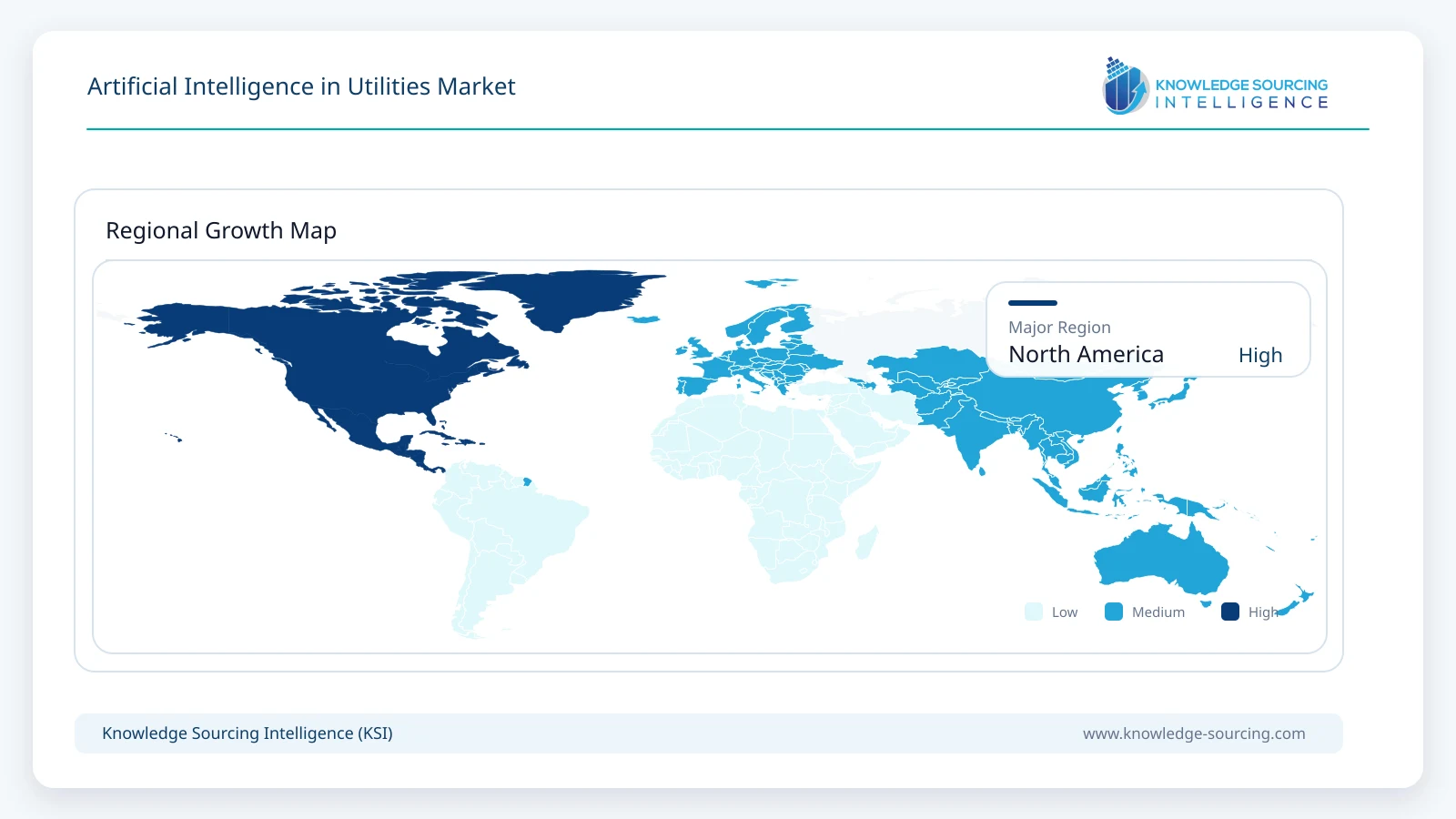
North America is one of the leading markets for AI in utilities due to utilities facing multiple challenges simultaneously, such as aging grid infrastructure, increasing electricity demand, renewable-energy penetration, data-center growth, and severe-weather risk. The US is the primary market, backed by large utility tech budgets, high levels of AMI deployment, robust cloud infrastructure, and strong spending on grid modernization.
South America Market Analysis
South America is an emerging market driven by the rise in upgrading electricity networks and states as enhanced renewable-energy capacity. The biggest opportunity is present in Brazil, which has one of the largest electricity systems, a high share of hydropower, rapidly growing solar and wind generation capacity, and a geographically dispersed transmission and distribution network.
Europe Market Analysis
Europe is an advanced market as utilities partner AI adoption with grid modernization, renewable-energy integration, electrification, and decarbonization. The United Kingdom, Germany, France, and other regions are driven by AI-enabled energy management.
Middle East and Africa Market Analysis
The Middle East & Africa market is evolving due to investments by the governments and utilities in renewable generation, smart grid infrastructure, digital transformation, and energy diversification. The UAE and Saudi Arabia are important markets since large-scale solar, battery storage, smart-city development, and industrial projects need sophisticated forecasting and energy-management systems.
Asia Pacific Market Analysis
Asia Pacific is witnessing strong growth in the market driven by rapid electricity-demand growth, large-scale renewable-energy deployment, industrialization, electrification, and smart-grid investment. China has the biggest regional opportunity, with its comprehensive electricity grid, scale of penetration of renewable generation and energy storage, as well as digital grid technology investment.
List of Companies
Oracle
Bidgely Inc.
Uplight Inc.
GE Vernova
Schneider Electric
Itron
Landis+Gyr
SAP SE
Octopus Energy Group
NextEra Energy Inc.
Oracle
The company offers AI-enabled software from Oracle Utilities across customer management, grid operations, asset management, analytics, demand response, and utility data management. Oracle Utilities Data Intelligence converges utility data and enables AI-powered analytics for the customer, grid, and asset operations.
Bidgely Inc.
Bidgely offers AI and machine learning energy analytics for utilities. Its UtilityAI Platform translates AMI and smart-meter data into appliance-level intelligence, as well as load forecasting, electric vehicle detection, distributed energy resource management, grid planning, customer engagement, and energy-efficiency programs.
Uplight Inc.
Uplight is a customer-ahead AI, demand response, energy efficiency, and distributed-energy-resource management. The AI platform utilizes data from integrated smart meters and customer profile prospects to identify the ownership of DERs and other customer models.
Analyst View
The Artificial Intelligence in Utilities Market is progressing from proof of concept to production use; machine learning continues as the core technology, and GenAI, vision-based & agentic AI technologies broaden application domains. However, the potential for both generation and utility markets is highest, as the continuous integration of renewables alongside DER growth will boost grid management and optimization needs, coupled with aging infrastructure, extreme weather impacting outages and availability of generation sources, uncertainties in demand by data centers, and complexities related to electricity flows. Oracle, Schneider Electric, GE Vernova, Itron, and Landis+Gyr are building AI into utility operating environments, while Bidgely and Uplight empower on-behind-the-meter and demand-side intelligence. Commercial deployment is strong in North America; Europe is expanding on AI-enabled flexibility and digital-grid platforms, while Asia Pacific stands to benefit from rapid growth as electricity demand, smart-meter rollout, renewable generation, and grid modernization speed up.
Market Segmentation
By AI Technology
Machine Learning & Deep Learning
Natural Language Processing
Generative AI & Computer Vision
Others
By Component
Software
Hardware
Services
By Application
Grid Management & Optimization
Predictive Maintenance
Demand Forecasting & Management
Energy Trading Optimization & Pricing
Customer Analytics & Demand Response
Others
By End User
Residential
Commercial
Industrial
By Geography
North America
USA
Canada
Mexico
South America
Brazil
Argentina
Others
Europe
United Kingdom
Germany
France
Others
Middle East and Africa
Saudi Arabia
UAE
Others
Asia Pacific
China
Japan
India
South Korea
Others
Table of Contents
1. EXECUTIVE SUMMARY
2. MARKET SNAPSHOT
2.1. Market Overview
2.2. Market Definition
2.3. Scope of the Study
2.4. Market Segmentation
3. MARKET DYNAMIC
3.1. Market Drivers
3.2. Market Restraints
3.3. Market Opportunities
3.4. Porter’s Five Forces Analysis
3.5. Industry Value Chain Analysis
4. BUSINESS LANDSCAPE
4.1. Regulatory and Standards Landscape
4.2. Utility Data Infrastructure and Data Availability Analysis
4.3. AI Infrastructure and Computing Ecosystem Analysis
4.4. Utility AI Supply Chain, Vendor Ecosystem and Competitive Landscape Analysis
4.5. Strategic Recommendations
5. TECHNOLOGICAL OUTLOOK
5.1. Machine Learning and Predictive Analytics Technologies
5.2. Deep Learning and Neural Network Technologies
5.3. Natural Language Processing and Conversational AI Technologies
5.4. Generative AI and Large Language Model Technologies
6. ARTIFICIAL INTELLIGENCE IN UTILITIES MARKET BY AI TECHNOLOGY
6.1. Introduction
6.2. Machine Learning & Deep Learning
6.3. Natural Language Processing
6.4. Generative AI & Computer Vision
6.5. Others
7. ARTIFICIAL INTELLIGENCE IN UTILITIES MARKET BY COMPONENT
7.1. Introduction
7.2. Software
7.3. Hardware
7.4. Services
8. ARTIFICIAL INTELLIGENCE IN UTILITIES MARKET BY APPLICATION
8.1. Introduction
8.2. Grid Management & Optimization
8.3. Predictive Maintenance
8.4. Demand Forecasting & Management
8.5. Energy Trading Optimization & Pricing
8.6. Customer Analytics & Demand Response
8.7. Others
9. ARTIFICIAL INTELLIGENCE IN UTILITIES MARKET BY END USER
9.1. Introduction
9.2. Residential
9.3. Commercial
9.4. Industrial
10. ARTIFICIAL INTELLIGENCE IN UTILITIES MARKET BY GEOGRAPHY
10.1. Introduction
10.2. North America
10.2.1. USA
10.2.2. Canada
10.2.3. Mexico
10.3. South America
10.3.1. Brazil
10.3.2. Argentina
10.3.3. Others
10.4. Europe
10.4.1. United Kingdom
10.4.2. Germany
10.4.3. France
10.4.4. Others
10.5. Middle East and Africa
10.5.1. Saudi Arabia
10.5.2. UAE
10.5.3. Others
10.6. Asia Pacific
10.6.1. China
10.6.2. Japan
10.6.3. India
10.6.4. South Korea
10.6.5. Others
11. COMPETITIVE ENVIRONMENT AND ANALYSIS
11.1. Major Players and Strategy Analysis
11.2. Market Share Analysis
11.3. Mergers, Acquisitions, Agreements, and Collaborations
11.4. Competitive Dashboard
12. COMPANY PROFILES
12.1. Oracle
12.2. Bidgeky Inc
12.3. Uplight Inc
12.4. GE Vernova
12.5. Schneider Electric
12.6. Itron
12.7. Landis+Gyr
12.8. SAP SE
12.9. Octopus Group
12.10. NextEra Energy Inc.
13. APPENDIX
13.1. Currency
13.2. Assumptions
13.3. Base and Forecast Years Timeline
13.4. Key benefits for the stakeholders
13.5. Research Methodology
13.6. Abbreviations
Navigate
Trusted by the world's leading organizations











