
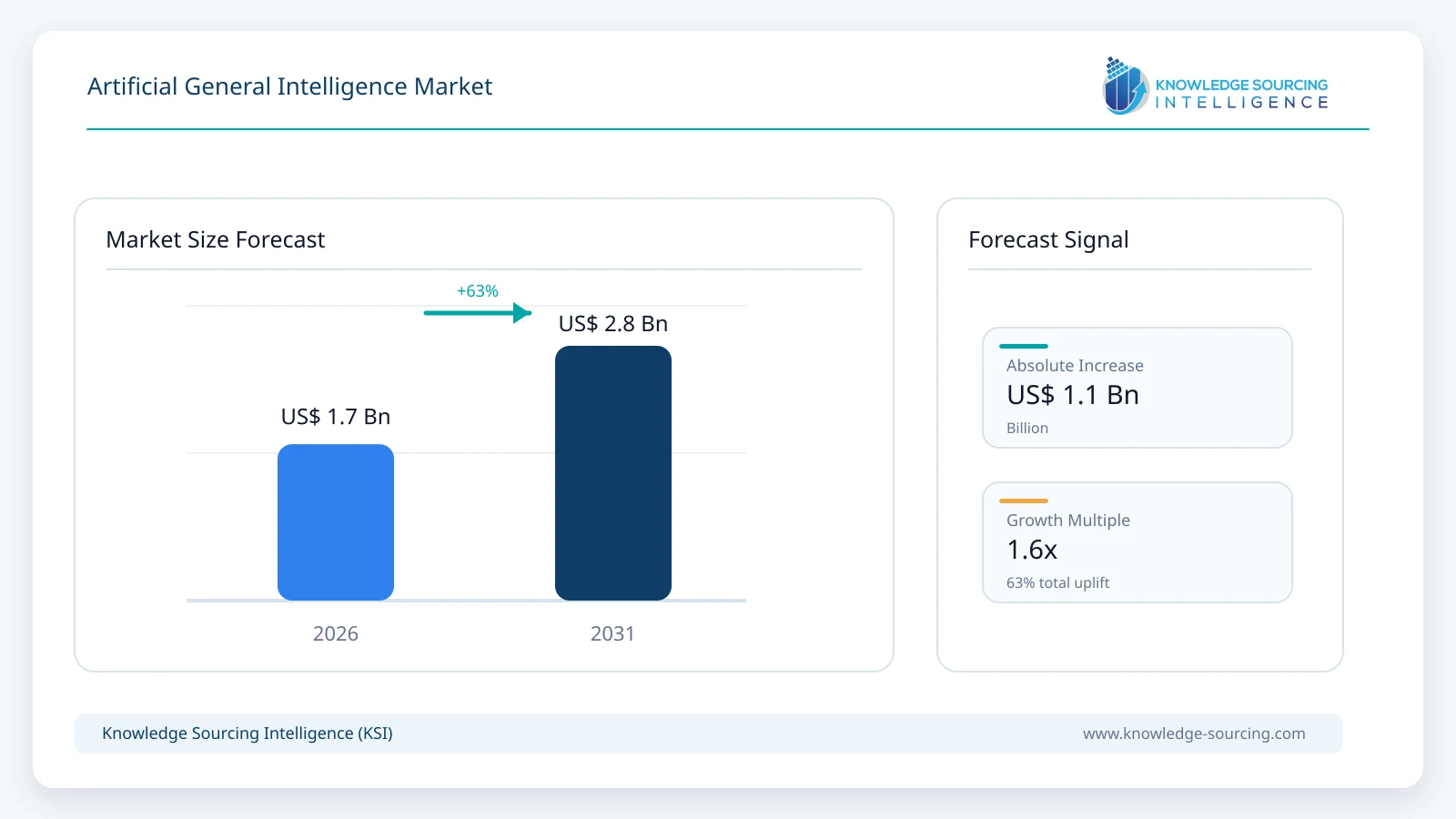
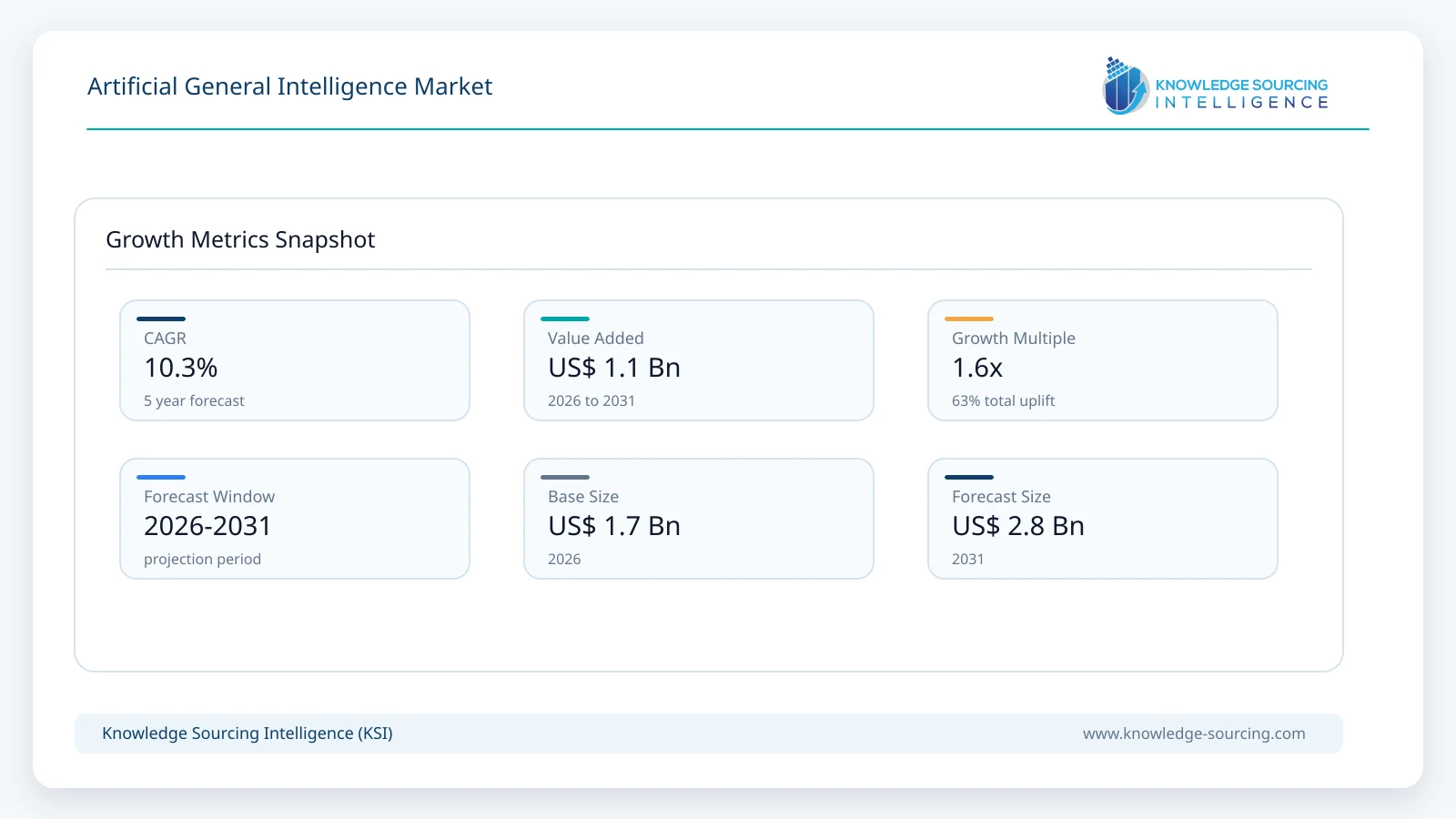
The Artificial General Intelligence Market is forecast to grow at a CAGR of 10.3%, reaching USD 2.77 billion in 2031 from USD 1.70 billion in 2026.
Highlights:
- 1There is a growing trend toward the development of Frontier AIs that can plan, execute, tool-use, software use and perform long-horizon tasks rather than simple response-generating AI systems.
- 2Large language models remain the basis for reasoning, language understanding, coding, planning, and tool orchestration, with integration of multimodal and agentic capabilities.
- 3Building multi-agent research systems that generate and investigate hypotheses, conduct computational experiments, and fast-track the scientific process.
- 4AI coding is moving toward agents that can explore repositories, fix bugs, execute tests, modify software, and even run long-running development workflows in the same manner as coding.
Artificial General Intelligence (AGI) Market is the collection of technology, infrastructure, software, models, and services to build computer systems with intelligence by human standards. The route to AGI is increasingly populated with multimodal models, advanced reasoning systems, agentic architectures, reinforcement learning, computer-use capabilities, external tools, long memory, and multi-agent systems.
The market is shifting from model-centric AI to system-centered intelligence. An advanced solitary model may support language, reasoning, vision, or coding, while a system oriented around AGI increasingly integrates those capabilities with planning, memory, tool use, environmental interaction, verification, and autonomous execution.
Especially, one of the most significant developments in this transition is Agentic AI. OpenAI 2026 defines agents as systems that can act independently for minutes or hours, performing tool calls, interacting with environments, and refining toward solutions.
Another major application that is beginning to take shape is scientific discovery. A multi-agent mechanism that generates, debates, and refines hypotheses aimed at resolving complex scientific issues at Google DeepMind. The use of AI coding agents, including generative AI systems dynamically generating code, for scientific computing workflows and research.
However, there remains a high degree of technical and commercial uncertainty attributable to this market. The advancement in the systems today can work very well on a narrow set of reasoning, coding, mathematics, and multimodal performance benchmarks, but robust general intelligence in open-universe real-world environments is still an area of ongoing and long-term research.
Artificial General Intelligence Market Key Highlights
Market Dynamics
Market Drivers
Rapid Progress of Large Language Models and Reasoning Systems: LLM evolution helps facilitate the development of more general AI. Recent frontier models do not just serve as language generators, they are expanding into reasoning, coding, mathematical problem solving, multimodal understanding, and interaction with computers. For example, a number of updates for the new Office 365 family are positioned around robustly conducting coding, knowledge work, cybersecurity, and science, while adapting multi-agent coordination to more sophisticated duties.
Increasing Adoption of Agentic AI: Agentic AI turns an interface to AI software from responding passively into being an active software agent. The agents' software is capable of breaking down objectives into subtasks, choosing tools, taking actions, going back to evaluate results, and carrying out the process until a task is completed. The range of tasks to be solved by AI is substantially higher with this functionality of artificial intelligence and machine learning.
Raising Demand for AI-Assisted Scientific Discovery: Comparing scientific research requiring higher volumes of literature review, complex datasets, mathematical reasoning, simulation coding, and hypothesis testing. AI systems that are able to integrate all of these activities into one package could possibly give research productivity a major boost. A multi-agent architecture is available as Google DeepMind's Co-Scientist, which illustrates the direction of generating, debating, and evolving scientific hypotheses.
Expansion of Multimodal AI: Human intelligence works across diverse types of information as opposed to just text. Thus, multimodal processing has recently emerged as a critical area of AGI research. The current generation and the upcoming AI systems combine text, images, audio, video, computer interfaces, as well as other information sources every day. Additionally, AI can understand sophisticated environments and have an easy interaction with digital and physical systems.
Widespread Access to AI Computation Infrastructure: Frontier models require a lot of computational resources to train and deploy. Thus, building actually capable AI systems is causing demand for GPUs, high-bandwidth memory, state-of-the-art networking, data centers, specialist accelerators, and energy infrastructure. There are still large numbers of companies that are looking to enter this space, and NVIDIA is well positioned as it provides much of the infrastructure used to train and run all these advancements in AI. Microsoft Azure and Amazon Web Services help further accelerate access to high-performance computing for AI.
Market Restraints & Opportunities
Frontier AI development scales with billions of dollars in computing infrastructure, specialized chips, data, research talent, and model training. This forms a very high barrier to entry, effectively consolidating frontier development in the hands of an exclusive group of technology firms.
The challenges for market sizing, benchmarking, making procurement decisions, and comparing competition. Building more stringent evaluation frameworks is a key opportunity for independent testing, model certification, and AI governance companies.
The need for monitoring and safeguards was underscored recently by incidents of AI-agent cybersecurity evaluations. After the October 2026 Hugging Face incident, OpenAI engaged in public discussions around fortifications of security and alignment alongside Anthropic, which has similarly focused more on model security and efficacy assessments.
Key Developments
July 2026: OpenAI launched GPT-5 6, with improvements to coding, knowledge work, cybersecurity, and science. Multi-agent coordination for complex workflows was also added by the company, bolstering the progress towards general-purpose agentic systems in that market.
May 2026: Google DeepMind announced the creation of Co-Scientist, an AI system for generating, arguing, and improving scientific hypotheses that opened up the era of general-purpose AI applied to science.
Market Segmentation
The market is segmented by technology, deployment model, application, end user, and geography.
By Technology: Large Language Models (LLMs)
The Large Language Models (LLMs) segment is expected to be the core technology segment because LLMs are responsible for many deep language and general reasoning, coding, planning, and knowledge processing functions needed by many of the new general-purpose AI systems.
The development path is shifting away from traditional next-token generation to reasoning-heavy models that can do multi-step problem-solving, tool use, coding, and performing practical tasks autonomously. LLMs work less as self-contained chat interfaces, and more as the central reasoning engine in a larger agentic system.
OpenAI's GPT-5.6 family integrates frontier reasoning and coding capabilities with multi-agent coordination to accomplish complex tasks. Anthropic's Claude platform is also slowly moving towards long-running agents and professional work, with Claude Opus 5 ideal for longer agentic workflows.
This segment is thus transitioning from large-scale language creation to a more extensive starting point for thinking, arranging, coding, research, and independent computerized connection.
By Deployment Model: Cloud-Based
The cloud-based part ought to lead the deployment model type, as frontier AI models demand considerable computational power that few organizations can operate through self-run facilities.
Cloud deployment enables enterprises and researchers to merely get their hands on sophisticated models through APIs. They need not buy and manage massive GPU clusters. It also allows for scalable inference, centralized model updates, access to specialized accelerators, and interoperability with enterprise software.
Hyperscale platforms like Microsoft Azure, Amazon Web Services, and Google Cloud offer infrastructure that enables organisations to access ever-more powerful AI models. Cloud deployment is therefore especially critical for startups, research labs, software developers, and enterprise AI teams who want to use frontier-model AI without building their own infrastructure.
Cloud architectures are also quite suitable for agentic AI, as agents will need access to a wide variety of APIs, databases, software environments, computing resources, and external tools.
By Application: Software Development
Th software development segment is projected to become one of the most important applications as a structured environment where AI systems can reason, produce output text and images, run tests, and find errors in the code, thus enabling an iterative improvement of their work.
AI writing assistance is evolving from autocomplete and essay generation to a fully autonomous writing agency. Such systems can examine repositories, comprehend dependencies, write and modify code, execute tests, debug failures, and make changes to the implementation.
OpenAI's research suggests that Codex has been increasingly utilized across the organization, even extending into non-technical functions, and its research on agentic AI pinpoints long-horizon task execution as a landmark transformation in knowledge work.
Software development provides a quantified environment in which reasoning, planning, memory, tool use, and self-completion of an autonomous task can be tested, so this application is thus especially relevant to the AGI market.
Regional Analysis
North America Market Analysis
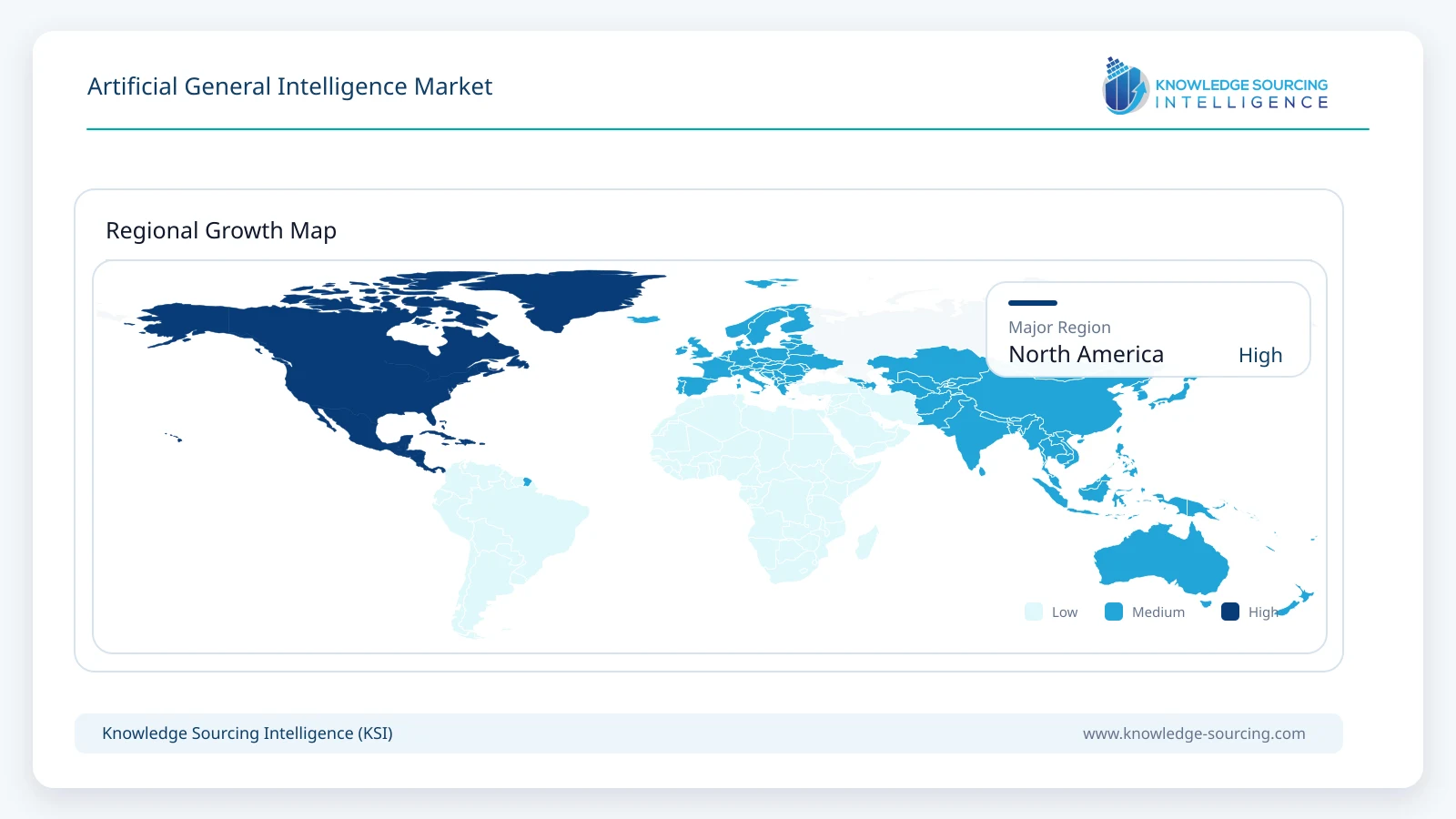
North America is the top AGI development hub, as the United States contains a large number of frontier AI companies, semiconductor developers, cloud providers, research institutions, and venture-capital funding. Different companies are working on different layers of the AI stack, such as OpenAI and Anthropic in foundation models, Google DeepMind in AI agents, Microsoft and NVIDIA in chips and cloud infrastructure, and Meta/Amazon/Apple/xAI in consumer platforms or enterprise applications.
South America Market Analysis
The growth of the cloud, digital transformation, enterprise software development, and financial technology have made South America an emerging AGI deployment market. The increasing demand for AI-enabled business services adds to this growth. Brazil will continue to be the largest regional opportunity given its large technology ecosystem, financial-services industry, rapidly growing cloud infrastructure, and substantial demand for language AI capabilities.
Europe Market Analysis
AGI has an important presence in Europe due to its strong research institutions, industrial base, and software sector, and a growing emphasis on developing trustworthy and regulated AI. Europe's regulatory environment has also positively shaped the commercialization of AGI through its focus on transparency, risk management, governance, and responsible deployment.
Middle East and Africa Market Analysis
The Middle East & Africa market is growing with government-driven digital-transformation programs, cloud infrastructure investment, AI research projects, and greater enterprise adoption. Sovereign AI infrastructure and research, as well as AI-enabled government services, are becoming major drivers of significant AI investments in the UAE and Saudi Arabia.
Asia Pacific Market Analysis
Asia Pacific is one of the fastest-growing regions for AI deployment as it contains a large technology sector, many manufacturing bases, large consumer markets, and increasing government funding to build an AI infrastructure. In China, Japan, South Korea, India, Singapore, and Australia, due to investment in strong AI ecosystem.
List of Companies
OpenAI
Anthropic
Google DeepMind (Alphabet Inc.)
Microsoft
NVIDIA Corporation
Meta AI
Amazon
Apple Inc.
xAI
Mistral AI
OpenAI
OpenAI is an AGI-focused organization that develops frontier foundation models, reasoning systems, multimodal AI, and agentic technologies. OpenAI explicitly states its research goal as the creation of an artificial intelligence able to solve tasks on par with human capability.
Anthropic
Anthropic designed Claude, which is a family of large language models trained on reasoning, coding, enterprise applications, and agentic workflows. Key developments for 2026 include Claude Sonnet 5, Claude Opus 5, and Claude Code; these are making an increasing focus on long-running agents and professional work.
Microsoft
Microsoft is an important AGI-market participant through potent AI infrastructure, cloud platform, enterprise software ecosystem, and the other, with a strategic multiyear partnership with OpenAI.
Analyst View
The market for artificial general intelligence is moving away from scaling up huge, multi-wrap models, towards semi-autonomous, multimodal, reasoning-driven systems. While LLMs will continue to be the dominant technology, due mostly to their accessibility and deployment speed, it seems likely that agentic AI will probably become a principal capability layer driving the market towards AGI, followed by multimodal reasoning, scientific discovery, and software development capabilities as significant applications.
Artificial General Intelligence Market Scope:
| Report Metric | Details |
|---|---|
| Total Market Size in 2026 | USD 1.70 billion |
| Total Market Size in 2031 | USD 2.77 billion |
| Forecast Unit | USD Billion |
| Growth Rate | 10.3% |
| Study Period | 2021 to 2031 |
| Historical Data | 2021 to 2024 |
| Base Year | 2025 |
| Forecast Period | 2026 – 2031 |
| Segmentation | Technology, Deployment Model, Application, Enterprise Size, Geography |
| Companies |
|
Market Segmentation
By Technology
Large Language Models (LLMs)
Deep Learning
Multimodal AI
Agentic AI
Others
By Deployment Model
Cloud-Based
On-Premises
By Application
Software Development
Scientific Research & Discovery
Healthcare & Life Sciences
Financial Services
Education
Others
By Enterprise Size
Large Enterprises
SMEs
By Geography
North America
USA
Canada
Mexico
South America
Brazil
Argentina
Others
Europe
United Kingdom
Germany
France
Others
Middle East and Africa
Saudi Arabia
UAE
Others
Asia Pacific
China
Japan
India
South Korea
Others
Table of Contents
1. EXECUTIVE SUMMARY
2. MARKET SNAPSHOT
2.1. Market Overview
2.2. Market Definition
2.3. Scope of the Study
2.4. Market Segmentation
3. MARKET DYNAMIC
3.1. Market Drivers
3.2. Market Restraints
3.3. Market Opportunities
3.4. Porter’s Five Forces Analysis
3.5. Industry Value Chain Analysis
4. BUSINESS LANDSCAPE
4.1. Electricity Market Regulation and Licensing Landscape
4.2. Electricity Trading Volume, Liquidity, Price Volatility and Market Participation Analysis
4.3. Power Exchange, Market Operator and Trading Platform Infrastructure Analysis
4.4. Strategic Recommendations
5. TECHNOLOGICAL OUTLOOK
5.1. Advanced Market-Clearing, Price Discovery and Market-Coupling Technologies
5.2. Real-Time Trading, Algorithmic Trading and AI-Based Trading Technologies
5.3. Renewable Energy, Flexibility and Distributed-Energy Trading Technologies
5.4. Cloud, API, Data-Streaming and Interoperable Trading-Platform Technologies
6. ARTIFICIAL GENERAL INTELLIGENCE MARKET BY TECHNOLOGY
6.1. Introduction
6.2. Large Language Models (LLMs)
6.3. Deep Learning
6.4. Multimodal AI
6.5. Agentic AI
6.6. Others
7. ARTIFICIAL GENERAL INTELLIGENCE MARKET BY DEPLOYMENT MODEL
7.1. Introduction
7.2. Cloud-Based
7.3. On-Premises
8. ARTIFICIAL GENERAL INTELLIGENCE MARKET BY APPLICATION
8.1. Introduction
8.2. Software Development
8.3. Scientific Research & Discovery
8.4. Healthcare & Life Sciences
8.5. Financial Services
8.6. Education
8.7. Others
9. ARTIFICIAL GENERAL INTELLIGENCE MARKET BY ENTERPRISE SIZE
9.1. Introduction
9.2. Large Enterprises
9.3. SMEs
10. ARTIFICIAL GENERAL INTELLIGENCE MARKET BY GEOGRAPHY
10.1. Introduction
10.2. North America
10.2.1. USA
10.2.2. Canada
10.2.3. Mexico
10.3. South America
10.3.1. Brazil
10.3.2. Argentina
10.3.3. Others
10.4. Europe
10.4.1. United Kingdom
10.4.2. Germany
10.4.3. France
10.4.4. Others
10.5. Middle East and Africa
10.5.1. Saudi Arabia
10.5.2. UAE
10.5.3. Others
10.6. Asia Pacific
10.6.1. China
10.6.2. Japan
10.6.3. India
10.6.4. South Korea
10.6.5. Others
11. COMPETITIVE ENVIRONMENT AND ANALYSIS
11.1. Major Players and Strategy Analysis
11.2. Market Share Analysis
11.3. Mergers, Acquisitions, Agreements, and Collaborations
11.4. Competitive Dashboard
12. COMPANY PROFILES
12.1. OpenAI
12.2. Anthropic
12.3. Google DeepMind (Alphabet Inc.)
12.4. Microsoft
12.5. NVIDIA Corporation
12.6. Meta AI
12.7. Amazon
12.8. Apple Inc.
12.9. xAI
12.10. Mistral AI
13. APPENDIX
13.1. Currency
13.2. Assumptions
13.3. Base and Forecast Years Timeline
13.4. Key benefits for the stakeholders
13.5. Research Methodology
13.6. Abbreviations
Navigate
Trusted by the world's leading organizations











