
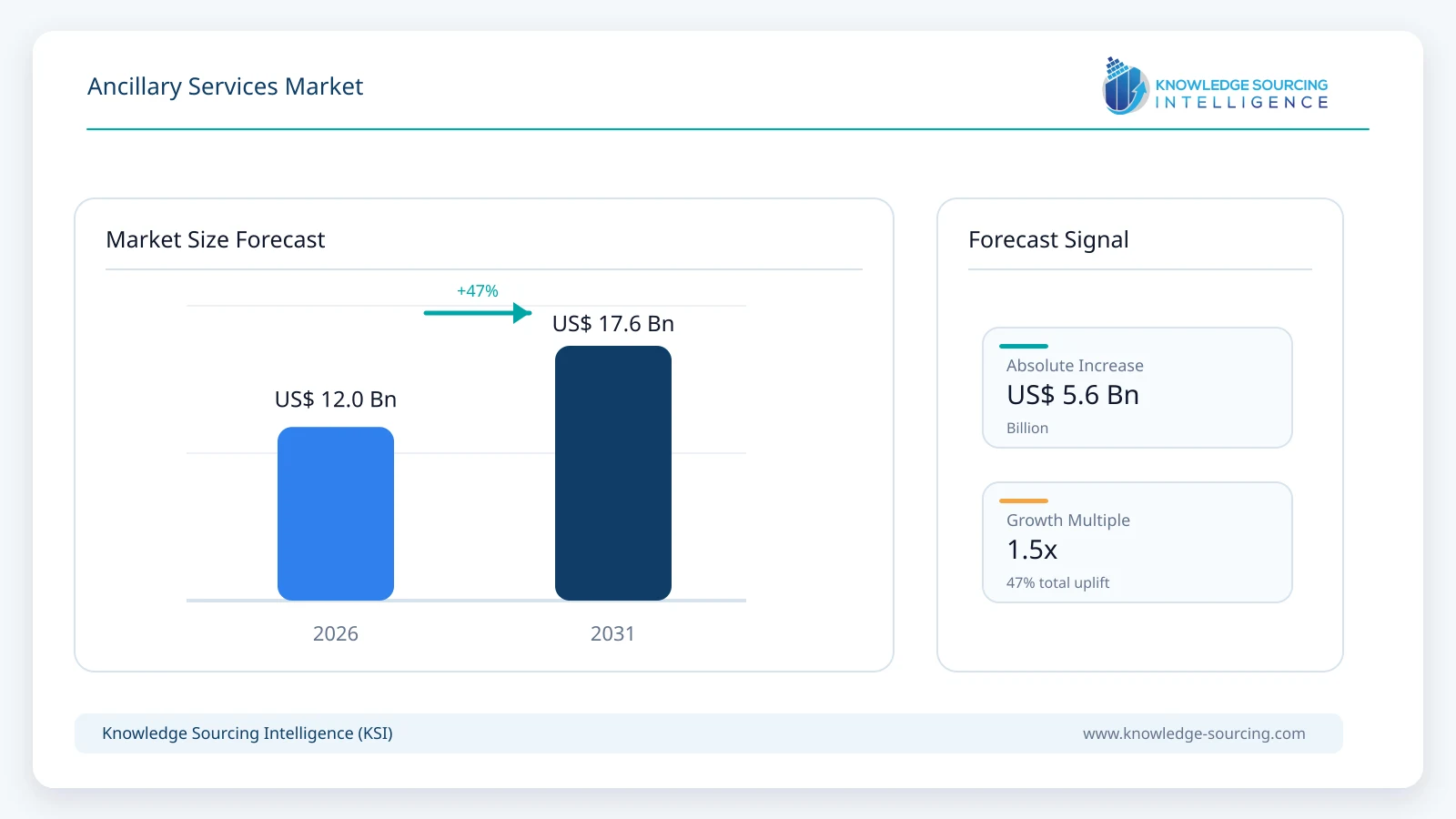
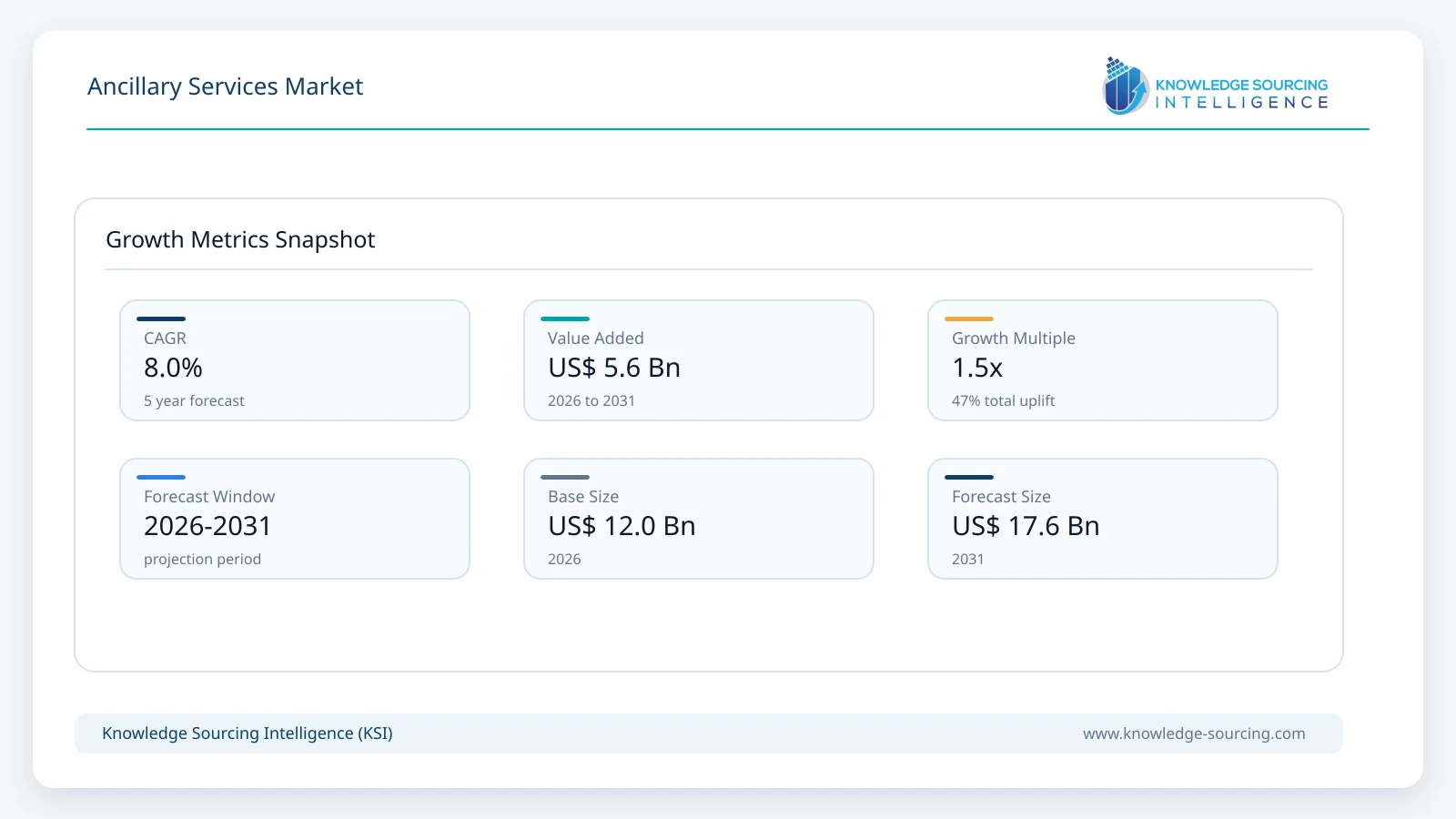
The Ancillary Services Market is forecast to grow at a CAGR of 8.0%, reaching USD 17.64 billion in 2031 from USD 12.02 billion in 2026.
Highlights:
- 1Leading segment by end userTransmission System Operators represent the largest share of the Ancillary Services Market, contributing 43.0% of total revenue in 2026, equivalent to approximately USD 5.17 billion, underscoring their central role in maintaining grid reliability and stability.
- 2Fastest-growing segment by service typeFrequency Regulation Services are set to outpace other service categories, registering a CAGR of 9.5% through 2031. The segment is projected to increase from USD 4.09 billion in 2026 to USD 6.42 billion by 2031.
- 3Dominant application areaFrequency Regulation & Grid Balancing remains the cornerstone application within the market, accounting for 37.0% of global demand in 2026 and expected to strengthen its position with a 38.0% share by 2031, reaching nearly USD 6.70 billion.
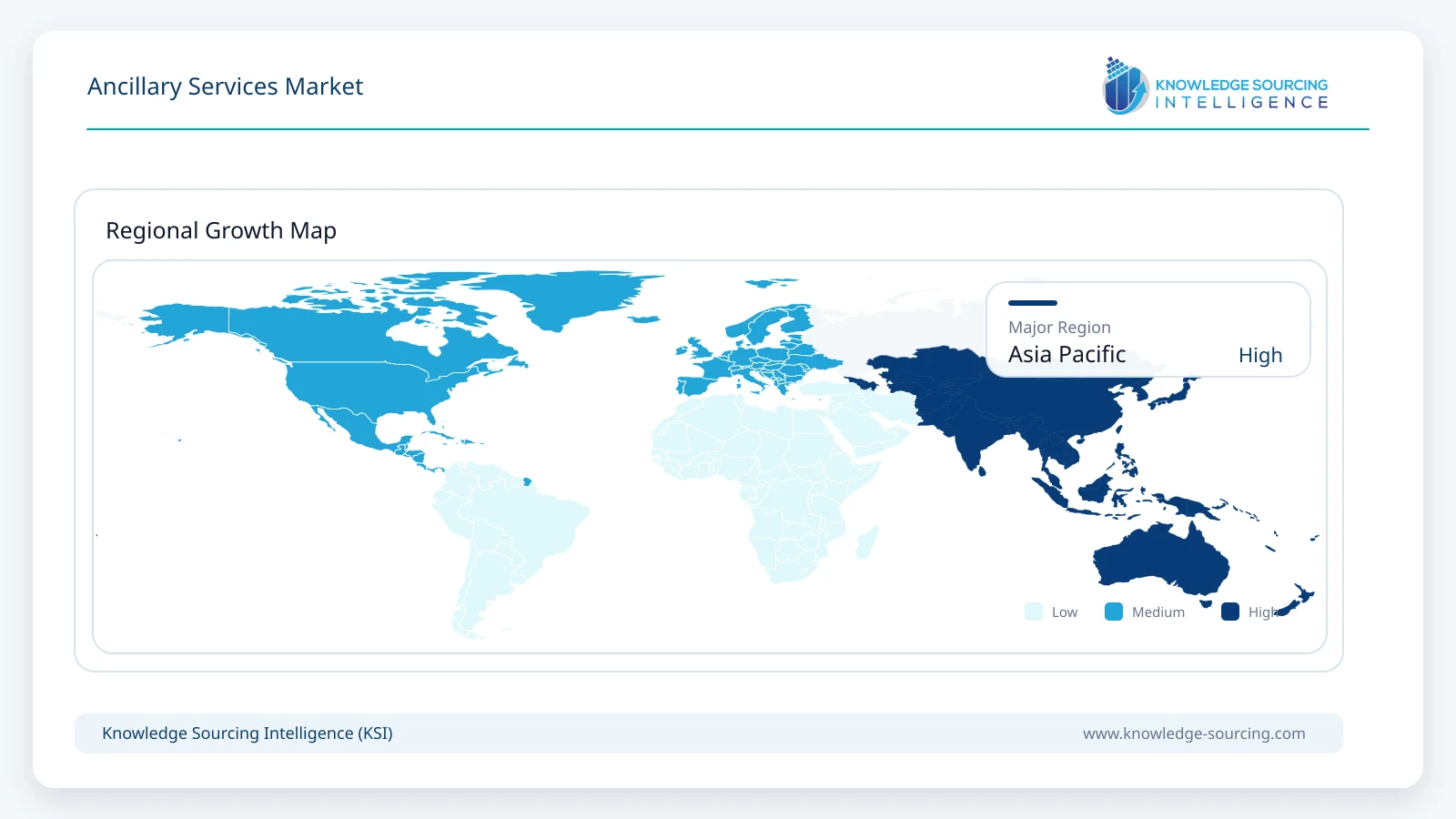
- 4Regional growth engineAsia Pacific generated USD 3.37 billion in market revenue in 2026, representing 28.0% of the global market. Supported by rapid grid modernization and renewable energy integration, the region is forecast to expand at an 8.6% CAGR through the forecast period.
- 5Grid resilience focusUtilities and system operators are actively fortifying network reliability against extreme weather, equipment failures, and aging infrastructure by procuring more ancillary services that provide reserves and support rapid recovery from disturbances.
- 6Technology-neutral shiftThe market is transitioning toward broader participation from BESS, demand response, virtual power plants, distributed generation, and advanced inverters, moving beyond traditional fossil and hydro-based providers.
Ancillary services help to provide the operational flexibility that ensures the reliability and stability of electricity networks. These services are utilized by transmission and distribution operators to manage fluctuations in electricity demand, the availability of generation resources, transmission limitations, voltage behavior, and unanticipated disturbances affecting system performance.
Electricity generation and consumption need to be instantaneously balanced at all times, but due to disruptions in energy supply such as solar power intermittency, frequency regulation is one of the critical categories. According to California ISO, regulation energy keeps system frequency close to 60 Hz and requires resources that participate in the market to automatically respond to control signals.
Reserve services are extra generation or controllable capacity that can be turned on in response to contingencies. In California, spinning and non-spinning reserves are identified within the ISO's ancillary-service products, while voltage support and black start are procured as distinct reliability services.
The market is also getting more technology-neutral. This service was traditionally only supplied by fossil, hydro, and other classical generation. The growth of BESS, demand response, distributed generation, virtual power plants, and advanced inverter technologies is expanding the range of possible service providers.
Developing nations like India are creating a separate market for this. According to GRID-INDIA, its ancillary-services mechanism is intended to keep frequency near 50 Hz, bring frequency back within the acceptable band, alleviate transmission congestion, and assure safe and secure system operation.
Market Dynamics
Market Drivers
Rise in Integration of Renewable Energy: As solar and wind generation proliferate, ancillary service needs rise commensurately since renewable output is dependent on the weather. With high renewable penetration, net load can change quickly and for multiple consecutive hours prior to an event requiring flexible resources to respond.
Fast-tracking in Battery Energy Storage Systems (BESS): BESS is becoming one of the key enabling technologies driving ancillary services. Batteries can provide rapid power adjustment upward and downward, and participate in ancillary services such as frequency regulation, spinning and non-spinning reserves, renewable firming, congestion management, among others
Increasing Demands of a Reliable and Resilient Grid: Factors such as extreme weather events, equipment failures, cyber risks, growing electricity demand, and more aging grid infrastructure are pushing utilities and system operators to fortify grid resilience. Ancillary services fulfil the role of ensuring sufficient reserves, as well as recovering electricity supply from a disturbance.
Increasing Electricity Demand: Transportation, heating, industrial processes, and digital infrastructure are being electrified as well, leading to an increasing demand for electricity and more variable load profiles. Data centers and other facilities with large loads can create significant variation in demand in a very short time. This trend is putting a premium on flexible generation, storage, demand response, and other resources that can ramp output or consumption whenever needed by the grid operators.
Expansion of Competitive Ancillary-Service Markets: Many electricity markets are implementing more structured mechanisms for procuring ancillary services. An example is ERCOT's 2026 ancillary-service methodology, which establishes minimum requirements for various reliability products, including a 1,377 MW minimum capacity requirement for Responsive Reserve Service with Primary Frequency Response.
Market Restraints & Opportunities
High capital costs continue to be a key restraint, particularly for BESS, synchronous condensers, advanced power-electronic systems, black-start facilities, and grid-automation infrastructure.
Volatility in project economics can also arise through revenue, as ancillary-service prices are market-specific and can adjust over a longer time frame as more flexible resources enter the market.
Yet another constraint is the growing difficulty of coordinating thousands of disparate resources. Distributed assets must be able to respond reliably when dispatched, and aggregators and system operators need a communications and cybersecurity infrastructure that supports it.
However, the market offers vast prospects for multi-service energy-storage systems. These applications can use a single BESS for frequency regulation, reserve services providing contingency and no-contingency reserves, renewable integration, congestion management, and energy arbitrage.
Virtual power plants also create portfolio opportunities that can be made available to the market by aggregating batteries, flexible loads, EVs, distributed solar, and other resources together. Another factor is the development of grid-forming inverters, which presents an opportunity for inverter-based resources to provide some voltage and frequency stability in grids that are increasingly losing synchronous generation.
Key Developments
July 2026: Aksa Energy commissioned the first standalone battery-energy-storage system in Türkiye and entered the ancillary-services market. In ?anl?urfa, the RASA facility featured 50 MW of operational power and 61.9 MWh of storage capacity.
August 2025: CheckWatt integrated solar self-consumption, enabling all household customers with rooftop PV to participate in ancillary services. This functionality was rolled out automatically to customers employing the Currently Optimized operating mode, and could also be turned on by those operating in Self Consumption mode simply by updating their setting.
Market Segmentation
The market is segmented by service type, application, end user, and geography.
By Service Type: Frequency Regulation Services
Frequency regulation services are expected to remain a major component of the ancillary services market, with their share increasing from 34.0% in 2026 to 36.4% by 2031. The segment is supported by the continuous requirement to maintain the balance between electricity generation and consumption, particularly as power systems integrate variable renewable generation and more distributed resources.
Frequency regulation resources automatically increase or decrease electricity output or consumption in response to system-operator control signals. This enables grid operators to correct short-term deviations in system frequency and maintain reliable power-system operation. For example, the California Independent System Operator (CAISO) defines regulation as a service provided by qualified resources that automatically respond to control signals directing them to increase or decrease their operating levels.
Battery energy storage systems (BESS) are gaining importance in frequency regulation because they can rapidly adjust both charging and discharging levels. This two-way response capability allows batteries to react quickly to changing grid conditions, making them particularly useful in power systems with high shares of solar and wind generation, where output can vary over short periods.
Market structures are also supporting participation in regulation services. In Texas, the Electric Reliability Council of Texas (ERCOT) organizes regulation services into Regulation Up and Regulation Down, allowing participating resources to provide upward or downward adjustments according to system requirements.
Battery-based resources are consequently becoming increasingly relevant across regulation-service markets. Their fast response, bidirectional power control, and ability to follow repeated dispatch signals allow them to provide frequent adjustments without the operating limitations associated with some conventional generation resources. As renewable penetration and grid flexibility requirements increase, these characteristics are expected to support continued expansion of frequency regulation services within the ancillary services market.
By Application: Frequency Regulation & Grid Balancing
Frequency Regulation & Grid Balancing, valued at approximately USD 4.45 billion in 2026, is expected to remain the largest application segment in the Ancillary Services Market, as power systems require continuous balancing between electricity generation and demand. Ancillary services enable grid operators to manage short-term variations, maintain system frequency, and preserve reliability when actual power production or consumption differs from scheduled levels.
Regulation and reserve services allow system operators to respond to deviations between scheduled and actual electricity generation or demand. For example, the California Independent System Operator (CAISO) operates market products including Regulation Up, Regulation Down, Spinning Reserve, and Non-Spinning Reserve to support grid balancing and reliability.
Similarly, ERCOT uses products such as Regulation Up, Regulation Down, Responsive Reserve Service, Non-Spinning Reserve, and Contingency Reserve Service to maintain reliability across the Texas bulk power system. At the same time, battery energy storage systems (BESS) are becoming increasingly important for rapid balancing because their fast response capabilities can help manage fluctuations associated with variable renewable generation and support the integration of wind and solar power.
By End User: Transmission System Operators
The Transmission System Operators segment is expected to dominate the Ancillary Services Market, reaching USD 7.74 billion by 2031 and accounting for 43.9% of the market. This leading position is supported by their responsibility for maintaining grid reliability, balancing generation and demand, managing transmission constraints, and ensuring adequate reserves across interconnected power systems.
Ancillary services enable transmission system operators to maintain frequency, manage balancing reserves, support voltage and reactive-power requirements, and respond to unexpected generation or transmission disturbances. In India, the ancillary-services framework is specifically designed to maintain grid frequency close to 50 Hz, restore frequency within the permissible band, and relieve congestion in the transmission network.
In California, CAISO procures ancillary services through its Integrated Forward Market and supplements procurement through real-time processes when requirements change or previously awarded resources become unavailable. Its 2026 market reports continue to track regulation up, regulation down, spinning, and non-spinning reserves across day-ahead and real-time operations. Similarly, GRID-INDIA’s ancillary-services framework supports frequency restoration and transmission-congestion relief, reinforcing the role of transmission system operators in maintaining secure and stable grid operations.
Regional Analysis
North America Market Analysis
The North America ancillary services market was valued at approximately USD 3.97 billion in 2026, representing a 33.0% share of the global market. The region has a large and well-established ancillary-services ecosystem, supported by organized wholesale electricity markets and established mechanisms for procuring and settling grid-support services. In the United States, major Regional Transmission Organizations (RTOs) and Independent System Operators (ISOs), including CAISO, ERCOT, ISO New England, NYISO, PJM, and MISO, operate structured electricity markets in which ancillary services support system stability, reliability, and real-time balancing.
The regional market encompasses services such as frequency regulation, operating reserves, voltage support, black-start capability, and reactive power. These services are becoming increasingly important as grid operators manage changes in electricity supply and demand and respond to unexpected generation or transmission disruptions. The Federal Energy Regulatory Commission notes that ancillary services provide fast-acting support for maintaining grid stability and reliability, while RTOs and ISOs determine the quantities required and procure these services through market or other established mechanisms.
The region also benefits from diversified participation across conventional generators, battery storage, distributed energy resources, demand-response providers, and renewable generation. Battery storage is particularly suited to frequency regulation because of its rapid response and operational flexibility. CAISO, for example, maintains markets for regulation up, regulation down, spinning reserve, and non-spinning reserve, while PJM operates synchronized, non-synchronized, secondary reserve, and regulation markets.
The continued expansion and evolution of organized wholesale markets, alongside increasing requirements for fast and flexible grid resources, is expected to reinforce North America's position in the global ancillary services market. The growing participation of storage and demand-side resources is also broadening the pool of assets capable of providing these services and strengthening market flexibility.
South America Market Analysis
South America is a growing new ancillary-services market supported by a growing installed capacity of renewables and the need to complement existing interconnection and transmission networks. Brazil is the largest opportunity because its electricity system features a large hydroelectric generation base and quickly growing solar and wind capacity.
Europe Market Analysis
Europe is leading in the ancillary-services market because of high penetration of renewables, interconnection between various electricity systems, and a relatively sophisticated balancing market features. Major regional markets for frequency containment, reserve, balancing, and other system services are Germany, France, the UK, Italy, and the Nordic Countries.
Middle East and Africa Market Analysis
The Middle East & Africa market is growing with new generation and transmission and distribution infrastructure modernization. Saudi Arabia and the UAE are booming regional markets because of significant solar investments and long-term plans for modernization of electricity sectors.
Asia Pacific Market Analysis
Asia Pacific is anticipated to register rapid growth over the coming years, supported by rising electricity demand, expanding renewable-energy capacity, grid modernization, and increasing investment in energy-storage and flexible grid resources. The region is projected to account for 28.8% of the global Ancillary Services Market by 2031. China is expected to remain the largest regional market, supported by its extensive power system, expanding renewable generation, and growing deployment of energy storage. China’s National Energy Administration has also strengthened the market framework for ancillary services, explicitly enabling storage companies, virtual power plants, smart microgrids, and vehicle-to-grid operators to participate in system regulation.
List of Companies
California ISO
ERCOT
ISO-New England
NYISO
Energinet
Snowy Energy
Transelectrica
NESO
GRID-INDIA
California ISO
California ISO, which operates the California electricity grid and a competitive wholesale electricity market. CAISO manages ancillary-service products such as Regulation Up, Regulation Down, Spinning Reserve, and Non-Spinning Reserve. Regulation resources track automated control signals to change their levels of operation in order to maintain system frequency.
ERCOT
The company monitors the bulk electricity system and wholesale electricity market for most of Texas. Regulation Up, Regulation Down, Responsive Reserve Service, Contingency Reserve Service, and Non-Spinning Reserve are part of its ancillary-service framework. ERCOT maintains a real-time dashboard on deployment and awards of its reliability products.
Transelectrica
Transelectrica is the operator of Romania's electricity transmission system and provides support for the country to integrate into the interconnected European electricity network. The firm also performs the transmission-system balancing and system-security tasks that require reserve capacity and other ancillary services.
Analyst View
The ancillary services market is transitioning from a generator-dominated reliability model to a dynamic flexibility ecosystem solution involving BESS, demand response, renewable generators, distributed energy resources, and digital aggregation platforms. Frequency Regulation remaining the leading service type category because constant generation-demand balancing is required for a grid to operate, while frequency regulation & grid balancing continue to remain the largest application. The most mature market structures are expected to be in North America and Europe, while Asia Pacific is poised for robust growth as China, India, Australia, and other nations continue to expand renewable generation and storage.
Ancillary Services Market Scope:
| Report Metric | Details |
|---|---|
| Total Market Size in 2026 | USD 12.02 billion |
| Total Market Size in 2031 | USD 17.64 billion |
| Forecast Unit | Billion |
| Growth Rate | 8.0% |
| Study Period | 2021 to 2031 |
| Historical Data | 2021 to 2024 |
| Base Year | 2025 |
| Forecast Period | 2026 – 2031 |
| Segmentation | Service Type, Application, End User, Geography |
| Companies |
|
Market Segmentation
BY SERVICE TYPE
Frequency Regulation Services
Voltage Support
Black Start Services
Others
BY APPLICATION
Frequency Regulation & Grid Balancing
Voltage Stability
Renewable Energy Integration
Congestion Management
Others
BY END USER
Transmission System Operators
Distribution System Operators
Power Generation Companies
Others
BY GEOGRAPHY
North America
USA
Canada
Mexico
South America
Brazil
Argentina
Others
Europe
United Kingdom
Germany
France
Others
Middle East and Africa
Saudi Arabia
UAE
Others
Asia Pacific
China
Japan
India
South Korea
Others
Table of Contents
1. EXECUTIVE SUMMARY
2. MARKET SNAPSHOT
2.1. Market Overview
2.2. Market Definition
2.3. Scope of the Study
2.4. Market Segmentation
3. MARKET DYNAMIC
3.1. Market Drivers
3.2. Market Restraints
3.3. Market Opportunities
3.4. Porter’s Five Forces Analysis
3.5. Industry Value Chain Analysis
4. BUSINESS LANDSCAPE
4.1. Regulatory and Grid Codes Landscape
4.2 Transmission System Operator & Utility Procurement Landscape
4.3. Input–Output & Service Ecosystem Landscape
4.4. Strategic Recommendations
5. TECHNOLOGICAL OUTLOOK
5.1. Automatic Generation Control & Automatic Frequency Restoration Technologies
5.2. Battery Energy Storage & Fast Frequency Response Technologies
5.3. Power Electronics, Inverter-Based Resources & Grid-Forming Technologies
5.4. Digital Grid Control, Forecasting, AI & Real-Time Frequency Monitoring Technologies
6. ANCILLARY SERVICES MARKET BY SERVICE TYPE
6.1. Introduction
6.2. Frequency Regulation Services
6.3. Voltage Support
6.4. Black Start Services
6.5. Others
7. ANCILLARY SERVICES MARKET BY APPLICATION
7.1. Introduction
7.2. Frequency Regulation & Grid Balancing
7.3. Voltage Stability
7.4. Renewable Energy Integration
7.5. Congestion Management
7.6 Others
8. ANCILLARY SERVICES MARKET BY END USER
8.1. Introduction
8.2. Transmission System Operators
8.3. Distribution System Operators
8.4. Power Generation Companies
8.5. Others
9. ANCILLARY SERVICES MARKET BY GEOGRAPHY
9.1. Introduction
9.2. North America
9.2.1. USA
9.2.2. Canada
9.2.3. Mexico
9.3. South America
9.3.1. Brazil
9.3.2. Argentina
9.3.3. Others
9.4. Europe
9.4.1. United Kingdom
9.4.2. Germany
9.4.3. France
9.4.4. Others
9.5. Middle East and Africa
9.5.1. Saudi Arabia
9.5.2. UAE
9.5.3. Others
9.6. Asia Pacific
9.6.1. China
9.6.2. Japan
9.6.3. India
9.6.4. South Korea
9.6.5. Others
10. COMPETITIVE ENVIRONMENT AND ANALYSIS
10.1. Major Players and Strategy Analysis
10.2. Market Share Analysis
10.3. Mergers, Acquisitions, Agreements, and Collaborations
10.4. Competitive Dashboard
11. COMPANY PROFILES
11.1. California ISO
11.2. ERCOT
11.3. ISO-New England
11.4. NYISO
11.5. Energinet
11.6. Snowy Energy
11.7. Transelectrica
11.8. NESO
11.9. Grid India
12. APPENDIX
12.1. Currency
1.2. Assumptions
12.3. Base and Forecast Years Timeline
12.4. Key benefits for the stakeholders
12.5. Research Methodology
12.6. Abbreviations
Navigate
Trusted by the world's leading organizations











