
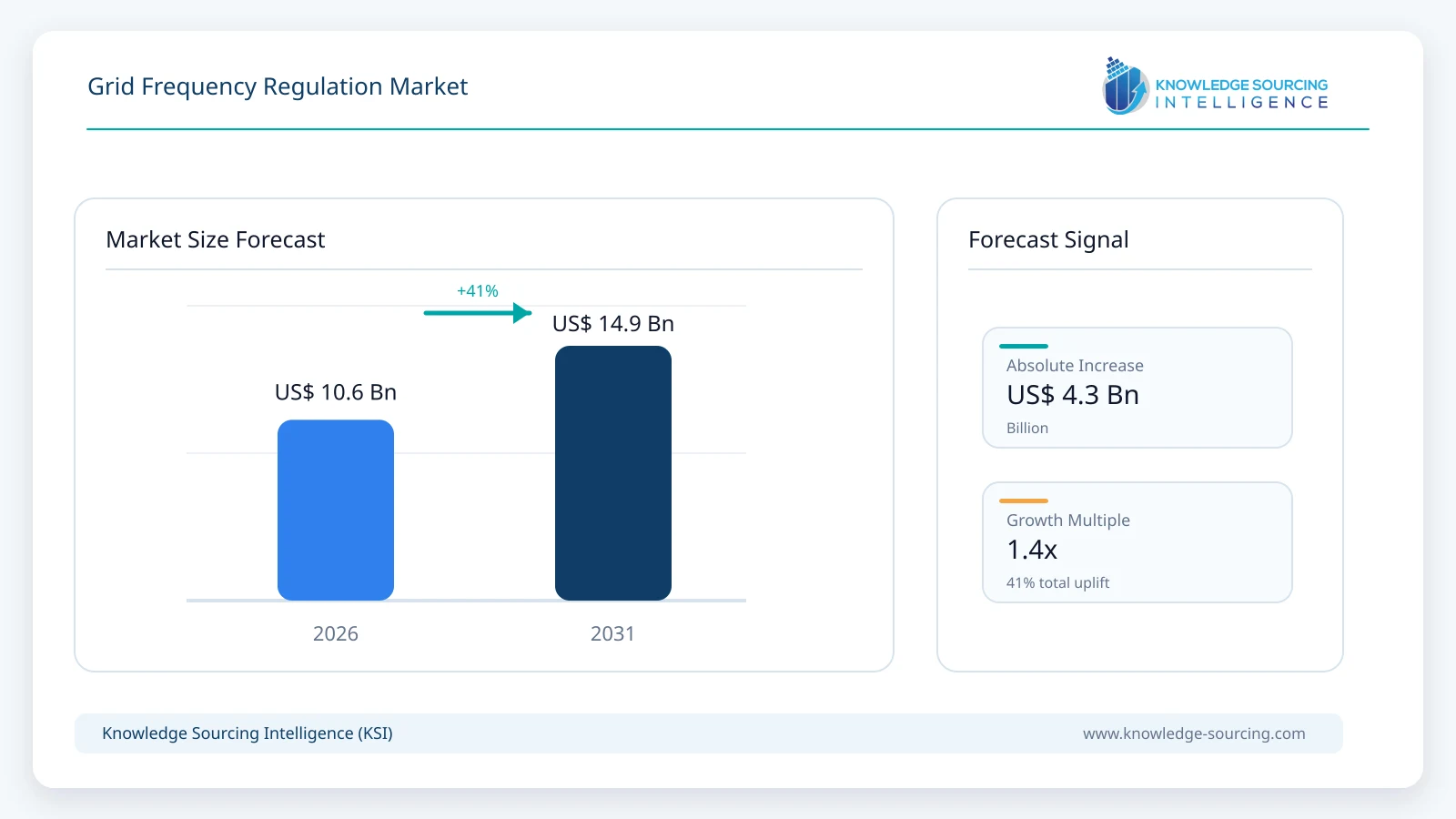
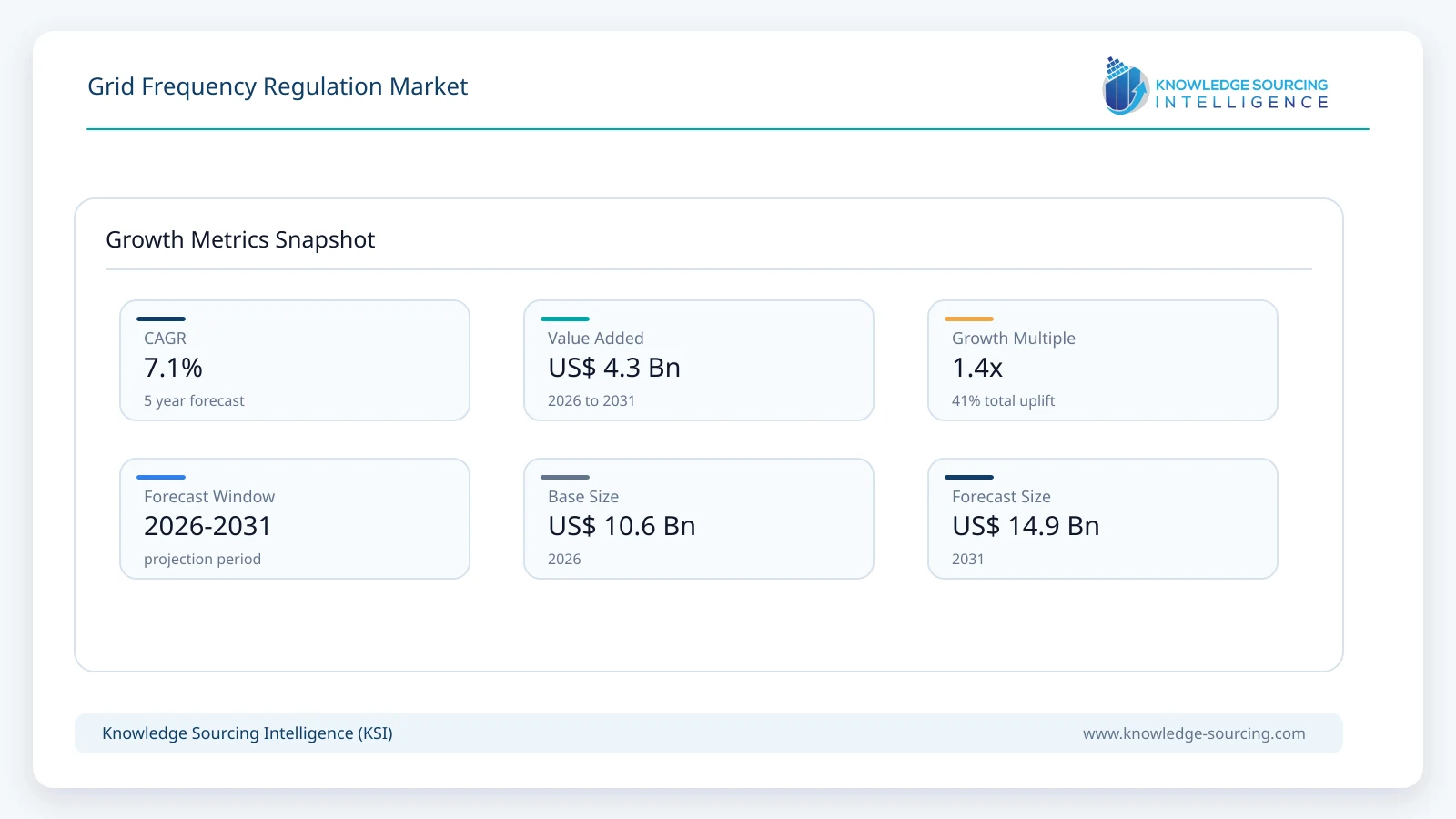
The Grid Frequency Regulation Market is forecast to grow at a CAGR of 7.1%, reaching USD 14.9 billion in 2031 from USD 10.6 billion in 2026.
Highlights:
- 1Leading segment by regulation typeSecondary Frequency Regulation represents the largest share of the Grid Frequency Regulation Market, generating USD 5.19 billion in 2026 and accounting for 49.0% of total market revenue, underscoring its critical role in maintaining grid stability and balancing power fluctuations.
- 2Fastest-growing segment by technologyBattery Energy Storage Systems (BESS) are emerging as the growth engine of the industry, projected to expand at a CAGR of 12.3% through 2031. The segment is expected to increase its market presence from 35.0% in 2026 to 44.4% by 2031.
- 3Dominant offering categoryHardware solutions command the largest portion of spending within the market, contributing approximately USD 4.66 billion in 2026. The segment continues to form the backbone of frequency regulation infrastructure, retaining a 41.6% share of global revenue in 2031.
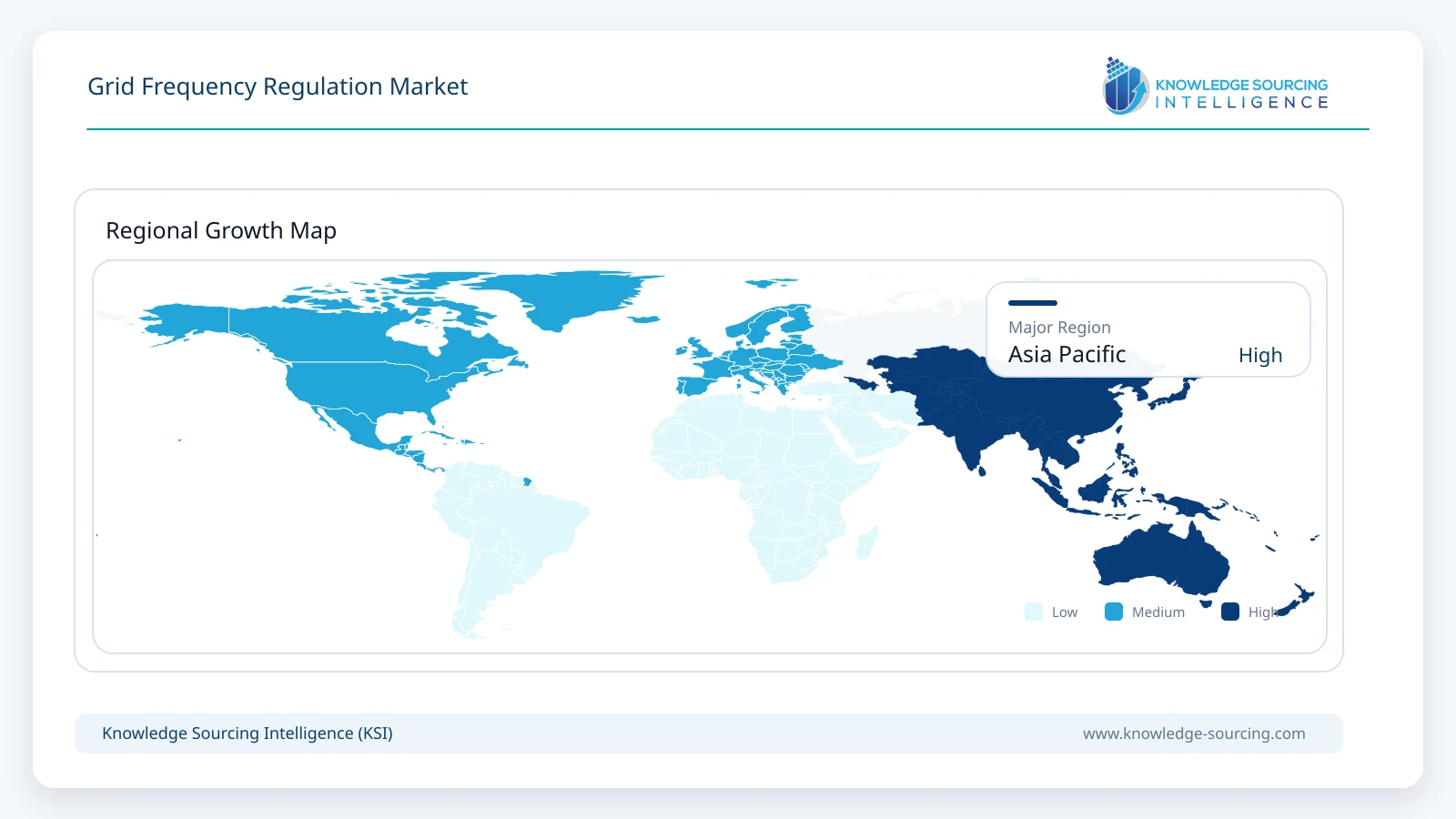
- 4Regional powerhouseAsia Pacific remains the most influential regional market, valued at USD 3.29 billion in 2026 and forecast to reach USD 4.73 billion by 2031. With a 7.6% CAGR, the region is benefiting from accelerating renewable energy integration and ongoing grid modernization initiatives.
- 5BESS expansionBattery energy storage systems are rapidly gaining share as operators deploy them for near-instantaneous frequency response, voltage support, and multi-service revenue stacking.
- 6Fast-response needsGrid operators are increasingly requiring millisecond-level frequency response capabilities to counter load volatility from electrification, data centers, and inverter-based generation.
Market Dynamics
The grid frequency regulation market is moving from conventional governor-based response toward fast, electronically controlled and digitally coordinated flexibility, driven by the changing composition of power systems. Frequency regulation remains essential because grid operators must continuously balance electricity generation and demand to keep system frequency within secure operating limits. The U.S. Federal Energy Regulatory Commission (FERC) identifies frequency regulation as an ancillary service that responds within seconds to changes in generation and demand, while grid-scale batteries are increasingly recognized for their rapid and accurate response capability.
Historically, frequency stability has relied heavily on synchronous generators, whose rotating machines provide physical inertia and governor response following sudden changes in the supply-demand balance. The increasing penetration of wind and solar generation is changing this operating model because these resources are generally connected through power electronic inverters rather than directly through synchronous machines. In July 2025, FERC approved reliability standards addressing inverter-based resources, including requirements for wind and solar resources to remain connected during voltage and frequency disturbances. This regulatory focus highlights the growing importance of advanced controls and grid-support capabilities as inverter-based generation expands.
The transition toward inverter-based generation is increasing demand for fast frequency response (FFR), synthetic inertia and other electronically delivered balancing services. A 2026 U.S. Department of Energy study notes that higher penetration of inverter-based resources can reduce traditional physical inertia when synchronous generators are displaced, while fast frequency response from energy storage, renewable resources, and flexible loads can respond more rapidly than conventional generation. These technologies can therefore help reduce the impact of sudden generation losses or load changes and support frequency stability.
Battery energy storage systems (BESS) are becoming an increasingly important source of frequency flexibility because they can rapidly switch between charging and discharging in response to grid-frequency signals. The U.S. Department of Energy states that battery systems can support frequency regulation on a millisecond-to-second timescale by absorbing or injecting power, while also providing voltage support and other grid services. In 2025, global battery-storage deployment reached 108 GW of new capacity, up around 40% from 2024, according to the International Energy Agency, strengthening the installed resource base available for flexibility and ancillary-service applications.
The market is consequently expanding beyond physical generation assets into an integrated combination of batteries, power-conversion systems, grid-forming controls, energy-management software and automated dispatch platforms. These digital systems monitor frequency conditions, receive operator or market signals, determine the required active-power response, coordinate charging and discharging, maintain appropriate state of charge, and verify performance against grid-service requirements. FERC also highlighted in 2026 that software optimization of rechargeable storage resources can improve reliability and affordability because of storage's fast response capability and rapid deployment.
The resulting market structure is increasingly centered on speed, accuracy, automation, and multi-service capability. Storage assets can participate not only in frequency regulation but also in operating reserves, voltage support, congestion management and other ancillary services. As renewable generation and battery capacity continue to expand, frequency regulation is therefore evolving into a digitally coordinated flexibility service that combines physical assets with sophisticated power electronics, control algorithms and grid-management software.
Market Drivers
Increasing Renewable Energy Penetration: This increased use of solar and wind power means greater frequency management needs. Renewable generation depends on weather conditions, and it can be significantly different from that of conventional generation. With the majority of generation now inverter-driven, grid operators need to have additional sources of active power and synthetic inertia. This demands BESS, grid-forming inverters, advanced power converters, and digital control systems.
Rapid Expansion of Battery Energy Storage: BESS is used more than ever in multiple applications, including energy arbitrage, capacity support, voltage control, renewable firming, and frequency regulation. Stacking multiple revenue streams improves the economics of storage. In Order 841, FERC established market-participation rules to make storage available for U.S. wholesale markets.
Increasing Need for Fast Frequency Response: The traditional thermal generator can provide frequency response, but mechanical and thermal system limitations make the response slow. The BESS and power-electronic systems can respond much faster, making them useful when sudden losses occur in the power output, fluctuations in load, renewable power supply, or system problems.
Electrification and Increasing Load Volatility: Electric vehicles, heat pumps, industrial electrification, data centers, and other high-power loads are altering the electricity demand patterns. These large loads can unexpectedly change the system demand, requiring fast balancing. Digital demand response systems and distributed energy sources can complement storage and generation facilities.
Development of Ancillary-Service Markets: Flexibility has emerged as a value in electricity markets. In the United States, FERC Order 841 required organized wholesale markets to establish participation models for electric storage resources in capacity, energy, and ancillary service markets. Market reforms allow batteries, aggregators, distributed resources, and other flexible assets to earn revenues from frequency regulation and related grid services.
Market Restraints & Opportunities
A major restraint with grid frequency-regulation projects is the high cost of initial capital, in particular when it comes to BESS applications, which require advanced power conversion, fire safety, thermal management, communications, and grid interconnection.
Battery deterioration also impacts the project's economics. Repetitive charging and depletion of batteries reduce usable battery life and raise replacement costs. Additionally, the price and market regulation of ancillary services vary widely between countries and electricity markets.
However, these challenges also create opportunities for BESS platforms that can mix frequency and energy arbitrage, capacity services, renewable firming, congestion management, and black start.
Another opportunity is the development of grid-forming BESS providing frequency support and synthetic inertia in low-inertia networks. For instance, the Siemens Energy Qstor platform supports grid-forming operation, synthetic inertia, black start, short-circuit current support, and active power modulation.
Key Developments
August 2026: ABB launched a data storage and smart power-orchestrating solution with an ultracapacitor energy storage in Irish data centers. It is a behind-the-meter system that employs grid-forming power conversion and digital controls working with millisecond response times to auto-respond to grid events.
Market Segmentation
The market is segmented by regulation type, technology component, application, and geography.
By Regulation Type: Primary Frequency Regulation
Primary Frequency Regulation is estimated at USD 4.03 billion in 2026, accounting for approximately 38.0% of the Grid Frequency Regulation Market. The segment is expected to remain a significant component of grid frequency regulation because it provides the rapid, automatic response required to correct frequency deviations arising from temporary imbalances between electricity generation and demand.
Primary frequency regulation responds automatically when a disturbance causes system frequency to move away from its nominal value. Conventional generators typically respond through turbine-governor controls, while inverter-based resources can provide highly responsive active-power adjustments. As power systems integrate larger shares of variable renewable generation, these fast-response capabilities are becoming increasingly important for maintaining system stability.
Battery energy storage systems (BESS) are particularly suitable for primary frequency response because power-electronic converters can rapidly switch between charging and discharging, allowing stored energy to be injected into the grid during under-frequency conditions or absorbed during over-frequency events. Siemens Energy states that its Qstor™ BESS can provide Primary Frequency Response in ERCOT, with autonomous droop-based response within seconds, while its grid-forming configuration can provide synthetic inertia and instantaneous active-power response to limit rapid frequency changes.
Similarly, GE Vernova’s energy-storage and grid-stability technologies support fast frequency response and synthetic inertia. Its FACTS FLEX GFMe solution combines energy storage with grid-forming controls to provide active and reactive power during disturbances, while its latest hybrid synchronous-condenser solutions combine BESS fast-response capabilities with physical inertia to strengthen frequency stability.
By Technology: Battery Energy Storage Systems (BESS)
Battery Energy Storage Systems (BESS) are expected to account for the largest share of the technology segment, supported by their rapid response, operational flexibility, modular deployment, and ability to deliver multiple grid-support services from a single installation. The BESS segment is estimated at USD 3.71 billion in 2026 and is projected to reach USD 6.61 billion by 2031.
BESS can respond to frequency deviations by rapidly increasing or reducing active power output. Modern systems can also support synthetic inertia, voltage regulation, black start, renewable energy firming, congestion management, and energy arbitrage, strengthening their role in maintaining grid stability as variable renewable generation increases.
Siemens Energy’s Qstor battery energy storage platform supports frequency regulation and frequency-restoration services, while also offering capabilities such as synthetic inertia, voltage control, black start, and grid-forming functionality. These functions enable BESS installations to contribute to several grid-stability requirements beyond conventional energy storage.
Similarly, Hitachi Energy’s Grid-to-Cell BESS integrates battery systems with inverters, medium- and high-voltage equipment, plant-level controls, and digital services. The solution supports frequency and voltage control through both grid-forming and grid-following operating modes, enabling flexible deployment across different grid conditions.
GE Vernova’s FLEXIQ plant-control platform provides active and reactive power control, ramp-rate management, scheduled dispatch, and frequency-response capabilities for BESS and solar-plus-storage plants. Such integrated controls allow storage assets to respond dynamically to grid requirements and coordinate their operation with renewable generation.
The increasing deployment of BESS alongside renewable power projects, transmission infrastructure, and distributed energy resources is expected to strengthen its position in grid frequency regulation. Their fast response characteristics and expanding grid-forming capabilities make BESS particularly suitable for power systems where conventional synchronous generation is declining, and the need for flexible balancing resources is increasing.
By Application: Power Transmission
Power transmission is expected to remain the largest application segment in the Grid Frequency Regulation Market, accounting for 20.0% of the market in 2026, equivalent to USD 2.12 billion, and is projected to reach USD 2.89 billion by 2031. Transmission networks contain highly interconnected systems where frequency disturbances can propagate rapidly across multiple nodes, making fast and reliable frequency regulation essential for maintaining grid stability and power quality.
Transmission system operators are increasingly integrating battery energy storage systems (BESS), synchronous technologies, grid-forming converters, and advanced control solutions at critical network interconnectors. These technologies can provide rapid frequency response, inertia support, voltage and stability services, and improved integration of variable renewable generation. The growing penetration of solar and wind power is further increasing the need for flexible frequency regulation resources across transmission networks.
Hitachi Energy provides BESS solutions for transmission and distribution applications that can support frequency control, system strength, grid restoration, and renewable energy integration. Similarly, Siemens Energy's grid-forming technology supports frequency response, synthetic inertia, and grid stability, particularly in weak and renewable-heavy transmission networks.
Regional Analysis
North America Market Analysis
North America is a mature and developed grid frequency regulation market, supported by established electricity markets, expanding renewable-power integration, and increasing deployment of grid-scale energy storage. The United States represents the largest regional market, with major organized electricity markets such as PJM, CAISO, ERCOT, MISO, and NYISO using balancing and ancillary-service mechanisms to maintain system reliability and frequency stability. PJM operates a dedicated Regulation Market, while CAISO offers regulation-up and regulation-down products that require participating resources to respond to automatic control signals.
The growing participation of battery storage, demand response, and renewable generation is further strengthening the regional requirement for fast and accurate frequency regulation. The Federal Energy Regulatory Commission identifies grid-scale batteries as well suited for frequency regulation because of their rapid response and accuracy, while distributed energy resources, demand response, wind, and solar paired with appropriate technologies can also contribute to ancillary services. PJM has also been advancing changes to its regulation-market design, including Regulation Up and Regulation Down products planned for implementation in October 2026, reflecting the evolving requirements of storage and renewable resources.
North America accounted for 31.0% of the global Grid Frequency Regulation Market in 2026, representing a market value of USD 3.29 billion. The region is expected to retain its strong position as utilities, grid operators, and market participants increase investments in flexible resources capable of responding rapidly to fluctuations in generation and electricity demand.
South America Market Analysis
South America is an emerging market for grid frequency with rising renewables and a huge area to keep stable across large interconnected power systems. The biggest opportunity lies in Brazil due to its large hydropower generation baseline, and also fast-growing solar and wind capacity.
Europe Market Analysis
Europe is one of the significant regions for frequency regulation, with high penetration of renewable energy, interconnected electricity markets, and robust ancillary-service frameworks in place. The presence of these technologies will support the frequency-response sector, mainly in Germany, the UK, France, and Nordic countries.
Middle East and Africa Market Analysis
The Middle East & Africa market is evolving as governments plan renewable-energy capacity and upgrade power infrastructure. Large-scale solar development, grid modernization, and smart-grid initiatives are leading regional markets in Saudi Arabia and the UAE. The market can also perform in remote and weak-grid environments as a microgrid-based frequency regulation site.
Asia Pacific Market Analysis
Asia Pacific is expected to remain the largest regional market for grid frequency regulation, with its share increasing from 31.0% in 2026 to 31.7% in 2031. The region’s large and rapidly evolving electricity systems, combined with accelerating renewable-energy deployment, grid expansion, and growing requirements for system flexibility, are creating substantial demand for frequency regulation solutions. China remains a major regional market, supported by extensive solar and wind additions, transmission-network expansion, and rapid growth in battery energy storage. The IEA reports that China added about 66 GW of new-type energy storage capacity in 2025, bringing cumulative capacity to approximately 145 GW by year-end. India also presents significant opportunities as solar and wind generation expand and grid operators require greater flexibility to manage variable output. India’s transmission system is being planned for integration of more than 500 GW of renewable energy capacity by 2030, alongside increased storage deployment and strengthened grid operations. Across Southeast Asia, expanding electricity demand and rising solar and wind penetration are further increasing the need for grids, storage, demand response, and other flexibility resources to maintain reliable power-system operation.
List of Companies
GE Vernova
Siemens Energy
ABB
Schneider Electric
Eaton Corporation
Hitachi Energy
Toshiba Energy Systems
Prysmian Group
Landis+Gyr
AspenTech
GE Vernova
GE Vernova has a diverse portfolio of grid frequency regulations. The company recognizes several key applications for its energy-storage solutions, which include frequency regulation, synthetic inertia, contingency reserve, firming, and renewable integration.
Siemens Energy
Siemens Energy is a leading provider of grid-forming, battery-storage, power-transmission, and grid-stability solutions. Qstor BESS platform provides a value-added service solution such as frequency regulation, frequency containment reserve, automatic and manual frequency restoration reserve (FRR), dynamic containment, dynamic moderation, dynamic regulation, and synthetic inertia.
ABB
ABB provides electrification, automation, power conversion, energy storage, and grid-control technologies. ABB BESS solutions can be used for smoothing unreliable grid supply, backup, energy arbitrage and grid flexibility.
Analyst View
The grid frequency regulation market is moving away from conventional generator-based balancing to fast, digitally coordinated flexibility resources. BESS is emerging as the dominant technology due to its quicker response time and ability to stack various grid services. Additionally, the need for primary frequency regulation to stop disturbances will continue, and higher-order secondary regulation will start as well because more operators require automatic restoration of system balance. Moreover, renewable integration is bolstering synthetic inertia and grid-forming controls demand. North America and Europe are expected to be more mature markets, while Asia Pacific is projected to experience the highest growth due to large-scale deployment of renewables, grid modernization, and swift BESS capacity expansion.
Grid Frequency Regulation Market Scope:
| Report Metric | Details |
|---|---|
| Total Market Size in 2026 | USD 10.6 billion |
| Total Market Size in 2031 | USD 14.9 billion |
| Forecast Unit | Billion |
| Growth Rate | 7.1% |
| Study Period | 2021 to 2031 |
| Historical Data | 2021 to 2024 |
| Base Year | 2025 |
| Forecast Period | 2026 – 2031 |
| Segmentation | Regulation Type, Technology, Voltage Range, Application, Geography |
| Companies |
|
Market Segmentation
BY REGULATION TYPE
Primary Frequency Regulation
Secondary Frequency Regulation
Others
BY TECHNOLOGY
Battery Energy Storage Systems (BESS)
Flywheels Energy Storage
Supercapacitors
Others
BY VOLTAGE RANGE
Hardware
Software
Services
BY APPLICATION
Power Generation
Power Transmission
Power Distribution
Renewable Energy Integration
Others
BY GEOGRAPHY
North America
USA
Canada
Mexico
South America
Brazil
Argentina
Others
Europe
United Kingdom
Germany
France
Others
Middle East and Africa
Saudi Arabia
UAE
Others
Asia Pacific
China
Japan
India
South Korea
Others
Table of Contents
1. EXECUTIVE SUMMARY
2. MARKET SNAPSHOT
2.1. Market Overview
2.2. Market Definition
2.3. Scope of the Study
2.4. Market Segmentation
3. MARKET DYNAMIC
3.1. Market Drivers
3.2. Market Restraints
3.3. Market Opportunities
3.4. Porter’s Five Forces Analysis
3.5. Industry Value Chain Analysis
4. BUSINESS LANDSCAPE
4.1. Regulatory and Grid Codes Landscape
4.2 Transmission System Operator & Utility Procurement Landscape
4.3. Input–Output & Service Ecosystem Landscape
4.4. Strategic Recommendations
5. TECHNOLOGICAL OUTLOOK
5.1. Automatic Generation Control & Automatic Frequency Restoration Technologies
5.2. Battery Energy Storage & Fast Frequency Response Technologies
5.3. Power Electronics, Inverter-Based Resources & Grid-Forming Technologies
5.4. Digital Grid Control, Forecasting, AI & Real-Time Frequency Monitoring Technologies
6. GRID FREQUENCY REGULATION MARKET BY REGULATION TYPE
6.1. Introduction
6.2. Primary Frequency Regulation
6.3. Secondary Frequency Regulation
6.4. Others
7. GRID FREQUENCY REGULATION MARKET BY TECHNOLOGY
7.1. Introduction
7.2. Battery Energy Storage Systems (BESS)
7.3. Flywheels Energy Storage
7.4. Supercapacitors
7.5. Others
8. GRID FREQUENCY REGULATION MARKET BY VOLTAGE RANGE
8.1. Introduction
8.2. Hardware
8.3. Software
8.4. Services
9. GRID FREQUENCY REGULATION MARKET BY APPLICATION
9.1. Introduction
9.2. Power Generation
9.3. Power Transmission
9.4. Power Distribution
9.5. Renewable Energy Integration
9.6. Others
10. GRID FREQUENCY REGULATION MARKET BY GEOGRAPHY
10.1. Introduction
10.2. North America
10.2.1. USA
10.2.2. Canada
10.2.3. Mexico
10.3. South America
10.3.1. Brazil
10.3.2. Argentina
10.3.3. Others
10.4. Europe
10.4.1. United Kingdom
10.4.2. Germany
10.4.3. France
10.4.4. Others
10.5. Middle East and Africa
10.5.1. Saudi Arabia
10.5.2. UAE
10.5.3. Others
10.6. Asia Pacific
10.6.1. China
10.6.2. Japan
10.6.3. India
10.6.4. South Korea
10.6.5. Others
11. COMPETITIVE ENVIRONMENT AND ANALYSIS
11.1. Major Players and Strategy Analysis
11.2. Market Share Analysis
11.3. Mergers, Acquisitions, Agreements, and Collaborations
11.4. Competitive Dashboard
12. COMPANY PROFILES
12.1. GE Vernova
12.2. Siemens Energy
12.3. ABB
12.4. Schneider Electric
12.5. Eaton Corporation
12.6. Hitachi Energy
12.7. Toshiba Energy Systems
12.8. Prysmian Group
12.9. Landis+Gyr
12.10. AspenTech
13. APPENDIX
13.1. Currency
13.2. Assumptions
13.3. Base and Forecast Years Timeline
13.4. Key benefits for the stakeholders
13.5. Research Methodology
13.6. Abbreviations
Navigate
Trusted by the world's leading organizations











