
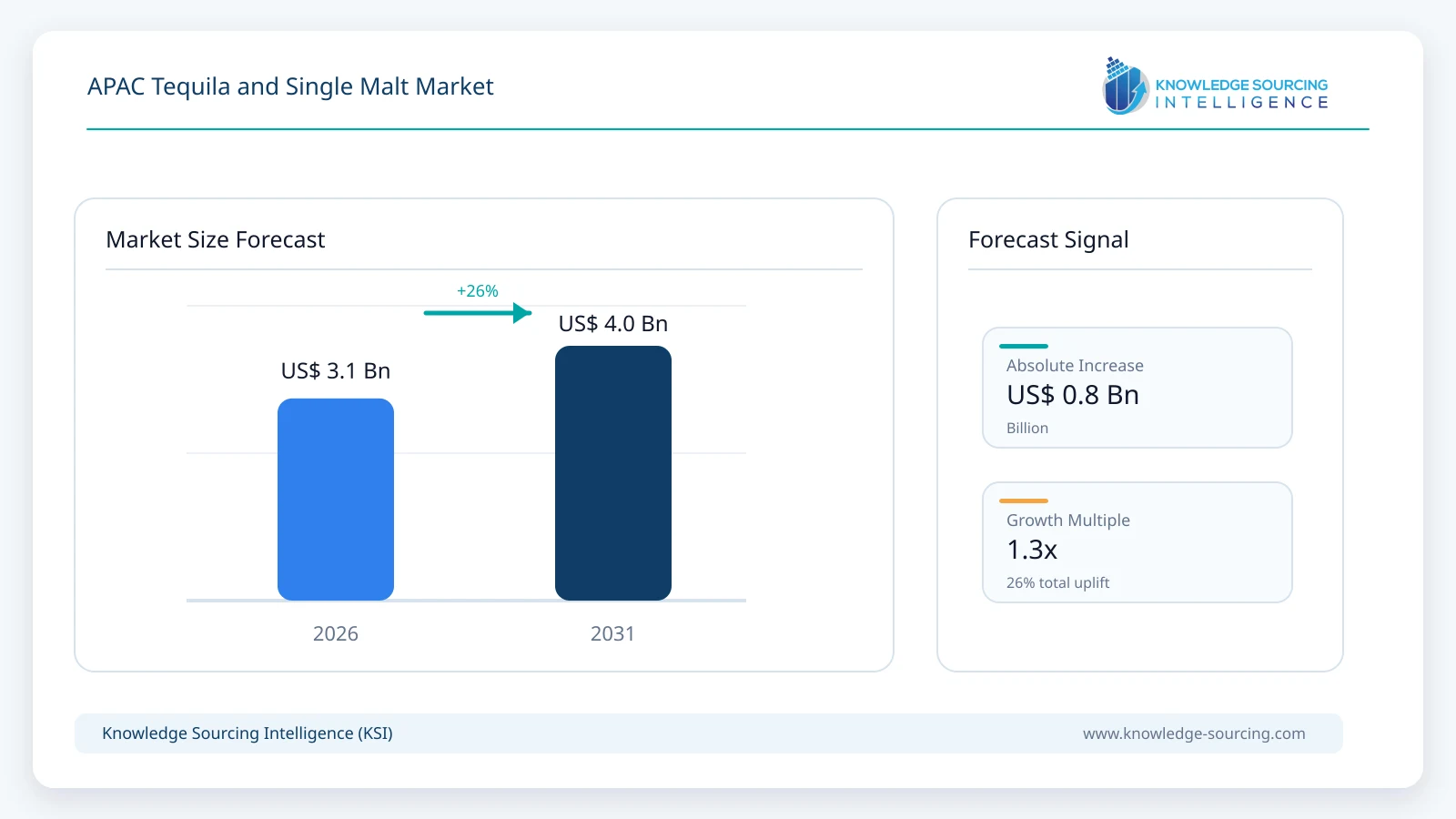
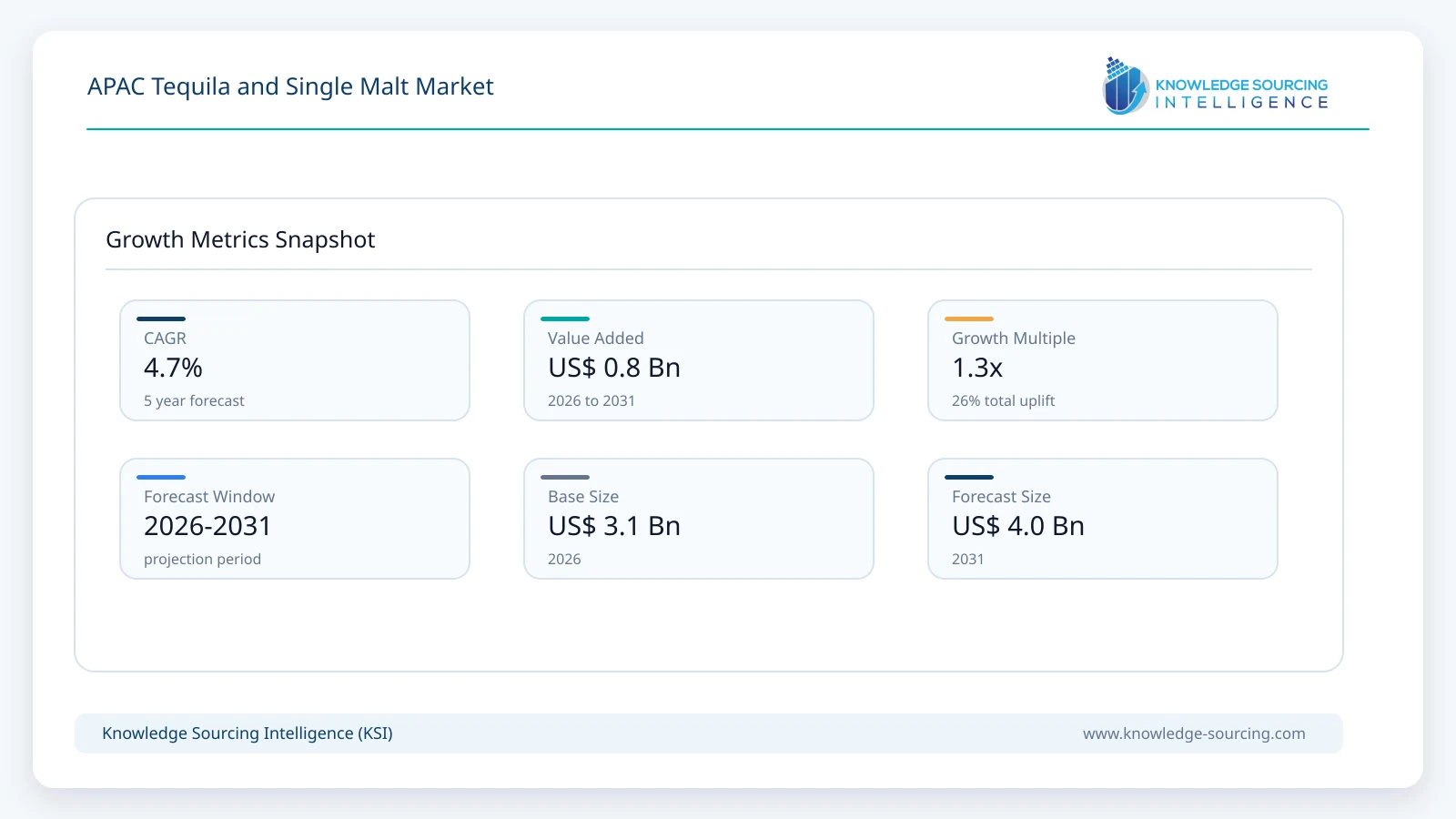
The APAC Tequila and Single Malt Market is projected to grow from USD 3.15 billion in 2026 to approximately USD 3.97 billion by 2031, at a CAGR of 4.7% during the forecast period.
Highlights:
- 1Single malt whisky represents about 78% of 2026 category value across the region.
- 2Off-trade purchasing accounts for approximately 58% of regional category sales in 2026.
- 3Premium-priced expressions contribute around 42% of 2026 revenue, ahead of mid-range products.
- 4Household purchases represent an estimated 53% of 2026 value, spanning gifting and collecting.
- 5Indian single malts compete on provenance and cask character rather than imported brand heritage alone.
- 6Authenticity rules and trade-specific taxation remain decisive for market access and pricing.
The APAC tequila and single malt market comprises consumer sales of bottled tequila manufactured under Mexico's protected designation of origin and whisky qualifying as single malt from an identified distillery. It includes locally distilled Asian single malts and legally imported Scotch or other foreign products sold through on-trade and off-trade channels. Mixed ready-to-drink beverages, blended whiskies, ordinary grain spirits, standalone distributor service fees and international re-exports that do not enter final regional consumption are excluded.
The producer base spans Suntory's Yamazaki and Hakushu malts, Pernod Ricard's The Glenlivet and Aberlour, William Grant & Sons' Glenfiddich, Indian distillers including Amrut, John Distilleries, Radico Khaitan and Piccadily, and tequila groups such as Becle, Diageo and Bacardi. Mexico remains the production location for certified tequila, whereas local single malt distillation and maturation are reshaping the product range available to Asian buyers.
The Scotch Whisky Association reported £1.6 billion in worldwide single malt Scotch export value during 2025, even as that category declined by 6% from the previous year. Japan, Taiwan, Singapore, India and China are important Asian destinations for Scotch overall, but published all-Scotch export totals cannot be read as single malt sales; substantial shipments are blends. Within this narrower report scope, single malts compete on age statements, cask maturation, provenance and availability. Buyers also distinguish a recognizable production history from luxury packaging, particularly when age-stated Scotch, Japanese and Indian expressions occupy adjacent shelves.
Tequila arrives in Asia-Pacific as an imported Mexican appellation product. The Consejo Regulador del Tequila reported 2025 shipments of roughly 4 million litres to Japan, 2.8 million litres to China and 433,000 litres to South Korea; its numbers substantiate real demand without capturing all final consumer sales or channel markups. Diageo's Don Julio, Becle's Jose Cuervo and Bacardi's Patrón are relevant brand portfolios, with premium reposado and añejo offerings alongside cocktail-oriented blanco. Bars often establish early trial through cocktails, while later home purchases depend on retail availability and confidence in brand authenticity.
Regional single malt production complicates a simple import-led account of the market. Japanese distillers supply mature domestic brands, India's Amrut, Paul John, Rampur and Indri broaden the locally made premium tier, and Taiwan's Kavalan exports across Asia. Distillers must finance maturing stocks before the highest-value bottles can be sold, whereas importers of tequila face long-distance freight, distributor margins and local excise duties. In India, the UK trade accord entered into force on 15 July 2026 and halved the applicable Scotch customs tariff from 150% to 75%, creating a defined channel for greater import competition rather than an immediate reduction in every shelf price.
Market Trends
Asian Single Malts Are Being Assessed Alongside Established Scotch
Japan's mature distillery brands continue to command collector attention, while Indian producers have scaled domestic single malts into recognized retail brands. Piccadily's Indri range and Radico Khaitan's Rampur expressions give distributors Indian-origin options in comparable premium price brackets. Scotch retains strengths in familiar age statements, global distribution and recognizable provenance; the competitive comparison now places more weight on flavour consistency and cask quality than a simple imported-versus-domestic distinction.
The availability of mature stocks varies markedly between producers. Suntory can position aged Yamazaki and Hakushu expressions at collector prices, while newer distilleries must balance releases against future inventory needs. A large number of announced new bottlings does not imply a commensurate increase in the underlying volume of well-matured single malt.
Tequila Is Developing Beyond Introductory Mixed-Drink Purchases
The Tequila Regulatory Council's shipment figures demonstrate an existing Japanese and Chinese import base; Diageo's product range in Japan extends from Don Julio Blanco to Reposado, Añejo and aged 1942 expressions. A cocktail-led introduction can therefore develop into purchases of aged or sipping variants, although the shift requires knowledgeable bartenders and consumer willingness to pay for bottle-level differences.
Becle's 2025 investor update reported stronger tequila shipments across its combined EMEA and APAC reporting region, including gains in super-premium lines. Because that reporting region is not APAC-only, its figures are evidence of brand momentum rather than a direct measure of Asian sales. High-priced inventory also remains sensitive to discretionary spending.
Travel Retail Becomes a Distinct Product-Development Channel
Piccadily launched its Indri Ilika travel-retail-only expression in June 2026, demonstrating that airport distribution can support a distinct cask recipe instead of merely duplicating domestic stock. Taiwanese producer Kavalan also introduced a Japan-specific Blender's Reserve series for Don Quijote retail in August 2026, showing how producers customize bottlings to local routes to market.
Airport availability benefits internationally mobile customers, yet duty-free purchasing is concentrated in hubs and exposed to passenger mix and regulation. Producers must carefully allocate scarce mature spirits between global travel retail, local liquor stores and hospitality accounts rather than count shipments to each channel as incremental consumption.
Price Architecture and Regulation Are Reshaping the Competitive Set
Under the UK–India trade agreement effective July 2026, the customs duty on qualifying Scotch fell from 150% to 75%, with staged reductions planned afterward. The measure changes the landed-cost equation for imported single malt even though local excise, distributor margins and differences between bottled and bulk classifications affect the final retail impact. Indian distillers may retain advantages in supply lead times and domestic distribution but face a sharper imported benchmark.
Japan's whisky labeling standards and the protected origin rules for tequila increase the value of documented production identity. Retailers and importers can build higher-priced assortments more credibly around recognized geographic products, while producers without verifiable provenance may find it harder to win shelf space in specialist channels.
APAC Tequila and Single Malt Market Segment Analysis
By Product Type
Single Malt Whisky
Single malt whisky accounts for an estimated USD 3.00 billion of Asia-Pacific sales by 2031. It remains the category's largest product group because the Japanese domestic whisky tradition, established Scotch imports and expanding Indian distillery portfolio supply a substantially wider range of consumption occasions than tequila. Scotch remains the largest origin subgroup within single malt, but Indian-origin offerings are gaining exposure through tastings, specialist retailers and travel retail.
Pernod Ricard's The Glenlivet, Suntory's Yamazaki, William Grant & Sons' Glenfiddich, John Distilleries' Paul John and Piccadily's Indri illustrate the range from global mature inventories to relatively young local brands. Distillers are differentiated by available cask stocks, distillation quality and repeatable distribution, and a new bottling is less meaningful commercially if releases are limited to a few collector lots.
By Distribution Channel
Off-Trade
Off-trade remains the principal route for full-bottle sales because home consumption, collecting and gifting require retailers able to carry multiple origins and price points. Specialist liquor stores, supermarkets where legally permitted, online merchants in authorized jurisdictions and duty-free stores make up this category. Whiskey tasting bars may establish brand credibility, but shelf visibility and reliable stock availability are important for repeat purchasing.
Off-trade sales are expected to reach approximately USD 2.22 billion by 2031. Its share eases as high-end bars and hotels take a greater role in tequila discovery and cask-led single malt experiences. Country laws limit how quickly online sales can expand; a digital discovery campaign should not be interpreted as proof that online alcohol transactions are legal in every APAC territory.
By Price Segment
Premium
Premium offerings are projected to reach approximately USD 1.71 billion in 2031, supported by recognizably branded single malts and established premium tequila labels. Mid-range bottles remain necessary for wider recruitment, while the highest-priced tier carries large per-bottle revenue but depends on limited mature inventories and economically resilient buyers. Premium pricing is a local retail classification rather than one universal currency threshold across countries with very different tax structures.
Producers can defend this price tier with cask provenance, product quality and controlled distribution; merely raising recommended retail prices without stronger consumer recognition risks losing purchases to familiar alternatives. The maturation economics of single malt make sustainable upgrading more demanding than a short-term packaging change.
By End-User Industry
Household Consumers
Household customers form the largest direct purchasing segment because bottles are bought for consumption, gifting and collecting, frequently outside the hospitality channel. The end-user allocation records the final consumer rather than the importer, preventing distributor turnover from being counted again. Single malt is especially suited to collecting and gift occasions, while tequila has room to gain households as cocktail familiarity spreads beyond on-premise venues.
Household spending is projected to reach USD 2.02 billion by 2031, with hospitality gaining a modest share as specialist bars and hotels expand premium tasting occasions. Individual household outlays can remain intermittent, so marketing reach should not be treated as equivalent to annual buying frequency; retail repeat rates and channel replenishment provide more reliable revenue indicators.
Market Drivers
A Broader Base of Established Single Malt Producers
Kavalan, Amrut, Indri, Paul John and Rampur now appear alongside Japanese and Scotch names in the premium malt assortment. Their products add origin-specific cask profiles and local sourcing alternatives, increasing the number of credible brands available to regional importers and retailers. Producers with recurring releases and established maturation plans are better positioned than brands reliant on one-off batches. Additional range breadth matters commercially because retailers can build a multi-price offer without using blended whisky as a substitute for genuine single malt.
Greater Variety in Tequila Consumption Occasions
CRT shipment data for Japan, China and Korea verify that Mexico-origin tequila is sold across multiple APAC countries. Bars recruit customers through recognizable cocktails, while reposado and añejo expressions support sipping and premium gifting. Producers can use a blanco expression to establish familiarity before asking customers to trade into more expensive aged products. Growth depends on the conversion of initial trial into repeat bottle demand, not just the number of nightlife promotions.
Duty and Import-Market Changes in India
The UK–India trade agreement's July 2026 implementation lowered the tariff on qualifying Scotch shipments at the customs border. This creates scope for greater import competition in a country where domestic single malts have established distinct consumer recognition. Importers still need licensed state distribution and must pass part of any cost benefit through multiple taxes and margins. The phased nature of the accord supports gradual purchasing and price realignment rather than an immediate forecast step-change.
Specialist Retail and Traveller-Specific Bottlings
Kavalan developed a Japanese retailer-specific malt range in 2026, while Piccadily introduced a travel-retail edition of Indri. These manufacturer-led launches reveal that distribution can influence liquid selection and packaging, creating versions tailored to buyers rather than relying only on a global standard SKU. Retail-exclusive releases can strengthen shelf commitment, provided volumes remain appropriate to the producer's mature-spirit inventory.
Provenance and Authenticity as Premium Price Supports
Tequila's Mexican geographic designation and the Japanese whisky makers' labeling standards make production history observable quality attributes. Single malt buyers also examine distillery ownership, age, maturation regime and authenticity controls. Producers capable of documenting these features may achieve better placement with knowledgeable retailers and hotel buyers. A protected origin is not a guarantee of consumer demand, but it can support pricing where purchasers recognize the distinction.
Market Restraints
High Retail Taxation and Uneven Market Access
Excise structures, customs duties and state-specific licensing can cause the same imported bottle to occupy very different price tiers across Asian countries. The India–UK agreement affects customs rates but does not remove state retail taxes, licensing limits or importer markups. Distillers must evaluate the actual tax-paid selling price, not simply the border-duty reduction. These frictions limit the ability to scale one regional promotional and price architecture without country-level adaptation.
Consumer Spending Pressure in Mature Premium Markets
The Scotch Whisky Association reported a 6% drop in worldwide single malt export value in 2025, indicating real pressure on premium demand. Its country figures also showed softer overall Scotch export values in Taiwan and Singapore. These outcomes caution against treating premiumization as uniformly positive across Asia-Pacific in every year. Retailers can reduce orders for expensive bottlings when inventories build, even while premium spirits retain long-term brand equity.
Maturation Inventory and Limited Editions
Aged single malt production requires years of working capital tied up in casks, with losses through evaporation and quality variability. Producers may release younger variants more frequently, but those releases do not replace the inventory required for established age statements. Supply constraints at prestigious distilleries can push list prices higher without increasing the number of bottles available. Capacity additions therefore take time to influence the mature product mix and the forecast revenue base.
Fragmented Alcohol Sales Regulation
Retail alcohol rules differ across India, China, Japan, Taiwan and the wider Southeast Asian market, particularly for online ordering, advertising, age verification and duty-free allowances. Brands that succeed on social media may be unable to sell directly to the same users in another jurisdiction. Importers must also manage language, packaging and health-warning compliance. The fixed cost of compliance is proportionately high for low-volume niche distillers establishing new markets.
Exposure to Counterfeiting and Origin Misclassification
Scarce Japanese malts and luxury tequila can attract substitution and unauthorized resale where price differentials are large. Labeling standards reduce ambiguity but do not eliminate parallel-trade or provenance checks. Indian single malt exporters also face the task of explaining local origin and quality to buyers accustomed to age-stated Scotch. Weak verification can undermine the willingness to pay that supports premium and ultra-premium pricing.
Geographical Outlook
Japan — Largest Market
Japan contributes an estimated 28% of APAC tequila and single malt value in 2026. Japanese single malts have an established domestic consumer base, while the market also imports Scotch and Mexican tequila; the Tequila Regulatory Council reported approximately 4 million litres of Japan-bound tequila shipments in 2025. Suntory's Yamazaki and Hakushu provide recognized locally made products, and imported single malts expand the range available through specialist stores and hospitality venues.
The country market is projected at roughly USD 1.03 billion in 2031. Growth is moderated by a mature spirits retail environment, but price mix can benefit from premium age-stated malts, origin-specific cask products and retailer-exclusive lines. Kavalan's July 2026 announcement of a Japan-targeted series provides a direct example of brands competing for a sophisticated retail customer rather than relying entirely on tourist demand.
India — Fastest-Growing Country
India's market is projected to grow at approximately 10.3% annually between 2026 and 2031, faster than the other individual countries in this forecast. Amrut, Paul John, Rampur and Indri support a domestic single malt tier with wider distribution and stronger recognition, while Scotch single malt imports face a more competitive tariff environment following the UK–India accord's July 2026 commencement. Tequila remains a smaller, primarily imported component, concentrated in major urban hospitality locations.
The national share rises from 17% in 2026 to about 22% by 2031, but the higher trajectory depends on consumer purchasing power, state excise changes and producers building sufficient mature inventory. Piccadily's product releases and the expanding number of Indian malt brands are tangible evidence of manufacturing and product investment; neither marketing awards nor capacity announcements alone demonstrate the rate at which bottles will ultimately be sold.
Competitive Landscape
Competition combines long-established multinational distillers with domestic Asian specialists and Mexico-based tequila manufacturers. Suntory is a major Japanese single malt producer; Pernod Ricard supplies Scotch malts including The Glenlivet and Aberlour; William Grant & Sons offers Glenfiddich and Balvenie; Diageo markets single malt brands and Don Julio tequila. Becle produces Jose Cuervo and other tequila expressions, while Bacardi owns Patrón. Their advantages include maturation stock, brand awareness, quality control and the capital needed to serve several import markets.
Amrut Distilleries, John Distilleries, Radico Khaitan and Piccadily Agro participate directly through Indian single malt production, while Taiwan's King Car makes Kavalan. Japanese competitors also include Nikka Whisky; ThaiBev's spirits subsidiary International Beverage manufactures Prakaan single malt in Thailand. Distribution quality matters alongside distillation: scarce bottles allocated to the wrong retail tier may produce little repeat demand. Neither the global Scotch export ranking nor a parent company's overall spirits revenue establishes a market share for this specific APAC two-category market.
Recent Developments
October 2026: Piccadily Agro Industries unveiled Indri Diwali Collector’s Edition 2026, a Ruby Port cask single malt positioned in India’s luxury gifting market.
August 2026: Pernod Ricard reported successful introductions of travel-retail-exclusive The Glenlivet and Aberlour ranges in its FY2026 results, highlighting differentiated airport assortments.
July 2026: King Car’s Kavalan announced the Blender’s Reserve single malt series tailored to Japanese consumers, with Don Quijote distribution beginning 5 August.
June 2026: Piccadily launched Indri Ilika as a travel-retail-exclusive Indian single malt, indicating dedicated channel product development.
March 2025: Diageo’s Don Julio unveiled the limited-edition Don Julio 194GOU bottle, with Asian market activations supporting the premium tequila franchise.
Market Outlook
The next five years should favor producers capable of securing stable mature whisky stocks and allocating them carefully across local retail, travel retail and hospitality. Single malt retains the largest revenue pool, while tequila has scope to grow faster from a smaller base as import availability and consumer familiarity with aged expressions improve. Japanese and Scotch suppliers remain important at high price points; Indian distillers gain influence through broader distribution, recurring product ranges and access to a large home market.
Country-level outcomes will diverge. Japanese sales are likely to advance mainly through product mix and specialized releases; India has more potential for volume recruitment but faces state-by-state taxation and strengthening Scotch competition. Imported tequila producers must build consumer education and distributor consistency without assuming that premium launches alone will increase consumption. Across both categories, sustained sell-through and repeat purchases will matter more than frequent limited-edition announcements.
APAC Tequila and Single Malt Market Scope:
| Report Metric | Details |
|---|---|
| Total Market Size in 2026 | USD 3.15 billion |
| Total Market Size in 2031 | USD 3.97 billion |
| Forecast Unit | Billion |
| Growth Rate | 4.7% |
| Study Period | 2021 to 2031 |
| Historical Data | 2021 to 2024 |
| Base Year | 2025 |
| Forecast Period | 2026 – 2031 |
| Segmentation | Product Type, Distribution Channel, Price Segment, End-User Industry, Country |
| Companies |
|
| Customization Scope | 15% Free Customization included with purchase — Request Custom Breakdown → |
| Sample & Data Access | PDF Sample, Excel Databook & Analyst Briefing — Download Free Sample → |
Market Segmentation
By Product Type
Tequila
Blanco
Reposado
Añejo (1–3 Years)
Extra Añejo (Minimum 3 Years)
Others
Single Malt
Scotch Single Malt
Indian Single Malt
Japanese Single Malt
Taiwanese Single Malt
Other Origin Single Malts
By Distribution Channel
On-Trade
Bars and Restaurants
Hotels
Clubs and Lounges
Off-Trade
Liquor Stores
Supermarkets and Hypermarkets
Online Retail
Duty-Free Shops
Specialty Retail
By Price Segment
Economy
Mid-Range
Premium
Ultra-Premium
By End-User Industry
Household Consumers
Food and Beverage Industry
Hospitality Industry
Others
By Country
Japan
China
India
South Korea
Taiwan
Thailand
Others
Table of Contents
1. EXECUTIVE SUMMARY
2. MARKET SNAPSHOT
2.1. Market Overview
2.2. Market Definition
2.3. Scope of the Study
2.4. Market Segmentation
2.5. Base and Forecast Period
3. BUSINESS LANDSCAPE
3.1. Market Drivers
3.1.1. A Broader Base of Established Single Malt Producers
3.1.2. Greater Variety in Tequila Consumption Occasions
3.1.3. Duty and Import-Market Changes in India
3.1.4. Specialist Retail and Traveller-Specific Bottlings
3.1.5. Provenance and Authenticity as Premium Price Supports
3.2. Market Restraints
3.2.1. High Retail Taxation and Uneven Market Access
3.2.2. Consumer Spending Pressure in Mature Premium Markets
3.2.3. Maturation Inventory and Limited Editions
3.2.4. Fragmented Alcohol Sales Regulation
3.2.5. Exposure to Counterfeiting and Origin Misclassification
3.3. Market Opportunities
3.4. Porter’s Five Forces Analysis
3.5. Industry Value Chain Analysis
3.6. Policies and Regulations
3.7. Strategic Recommendations
4. TECHNOLOGICAL AND PRODUCT OUTLOOK
4.1. Distillation, Cask Maturation and Product Authenticity
4.2. Tequila Appellation Standards
4.3. Japanese Whisky Labeling and Provenance
4.4. Product Innovation and Cask Finishes
5. APAC TEQUILA AND SINGLE MALT MARKET BY PRODUCT TYPE
5.1. Introduction
5.2. Tequila
5.2.1. Blanco
5.2.2. Reposado
5.2.3. Añejo (1–3 Years)
5.2.4. Extra Añejo (Minimum 3 Years)
5.2.5. Others
5.3. Single Malt
5.3.1. Scotch Single Malt
5.3.2. Indian Single Malt
5.3.3. Japanese Single Malt
5.3.4. Taiwanese Single Malt
5.3.5. Other Origin Single Malts
6. APAC TEQUILA AND SINGLE MALT MARKET BY DISTRIBUTION CHANNEL
6.1. Introduction
6.2. On-Trade
6.2.1. Bars and Restaurants
6.2.2. Hotels
6.2.3. Clubs and Lounges
6.3. Off-Trade
6.3.1. Liquor Stores
6.3.2. Supermarkets and Hypermarkets
6.3.3. Online Retail
6.3.4. Duty-Free Shops
6.3.5. Specialty Retail
7. APAC TEQUILA AND SINGLE MALT MARKET BY PRICE SEGMENT
7.1. Introduction
7.2. Economy
7.3. Mid-Range
7.4. Premium
7.5. Ultra-Premium
8. APAC TEQUILA AND SINGLE MALT MARKET BY END-USER INDUSTRY
8.1. Introduction
8.2. Household Consumers
8.3. Food and Beverage Industry
8.4. Hospitality Industry
8.5. Others
9. APAC TEQUILA AND SINGLE MALT MARKET BY COUNTRY
9.1. Introduction
9.2. Japan
9.3. China
9.4. India
9.5. South Korea
9.6. Taiwan
9.7. Thailand
9.8. Others
10. COMPETITIVE ENVIRONMENT AND ANALYSIS
10.1. Major Players and Strategy Analysis
10.2. Market Share Analysis
10.3. Mergers, Acquisitions, Agreements and Collaborations
10.4. Competitive Dashboard
11. COMPANY PROFILES
11.1. Suntory Holdings Limited
11.2. Pernod Ricard S.A.
11.3. Diageo plc
11.4. Becle, S.A.B. de C.V.
11.5. Bacardi Limited
11.6. William Grant & Sons Limited
11.7. Amrut Distilleries Private Limited
11.8. John Distilleries Private Limited
11.9. Radico Khaitan Limited
11.10. Piccadily Agro Industries Limited
11.11. King Car Group (Kavalan Distillery)
11.12. Nikka Whisky Distilling Co., Ltd.
11.13. International Beverage Holdings Limited
11.14. Brown-Forman Corporation
11.15. LVMH Moët Hennessy Louis Vuitton SE
12. APPENDIX
12.1. Currency
12.2. Assumptions
12.3. Base and Forecast Years Timeline
12.4. Key Benefits to Stakeholders
12.5. Research Methodology
12.6. Abbreviations





Frequently asked questions
What is the projected growth of the APAC Tequila and Single Malt market?
Market to reach $3.97B by 2031, growing at 4.7% CAGR.
Which product type holds the largest market share in APAC?
Single malt whisky accounts for 78% of the 2026 category value.
Which distribution channel dominates sales in the APAC market?
Off-trade accounts for approximately 58% of regional sales in 2026.
Which price segment contributes most to market revenue?
Premium-priced expressions contribute around 42% of 2026 revenue.
Who are the primary end-users in the APAC Tequila and Single Malt market?
Household purchases represent an estimated 53% of 2026 market value.
What are the key factors driving the APAC Tequila and Single Malt market?
Authenticity, provenance, cask character, and taxation are decisive factors.
Cite this report
Knowledge Sourcing Intelligence. (Oct 2026). APAC Tequila and Single Malt Market - Strategic Insights and Forecasts (2026-2031). https://www.knowledge-sourcing.com/report/apac-tequila-and-single-malt-market