
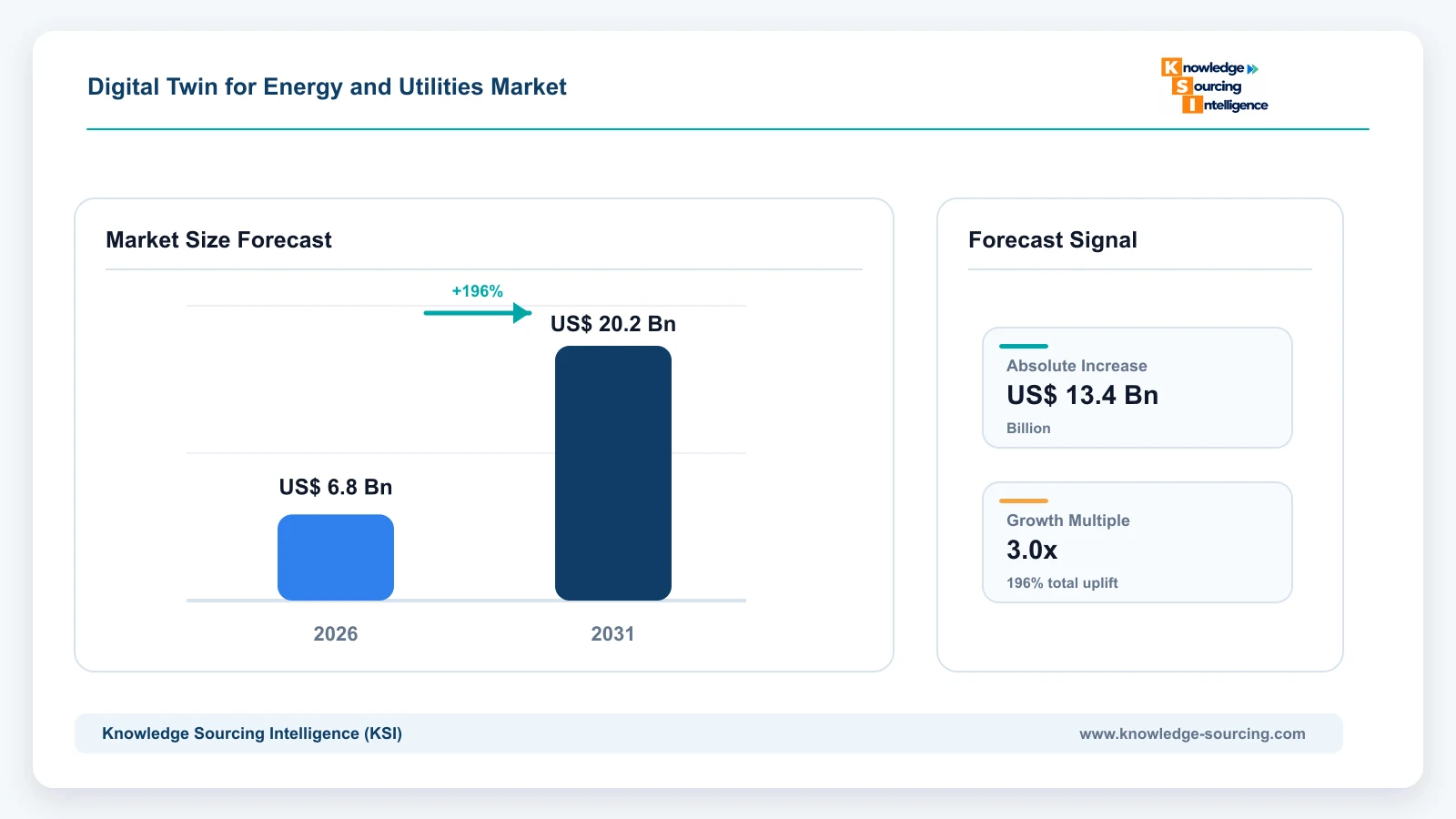
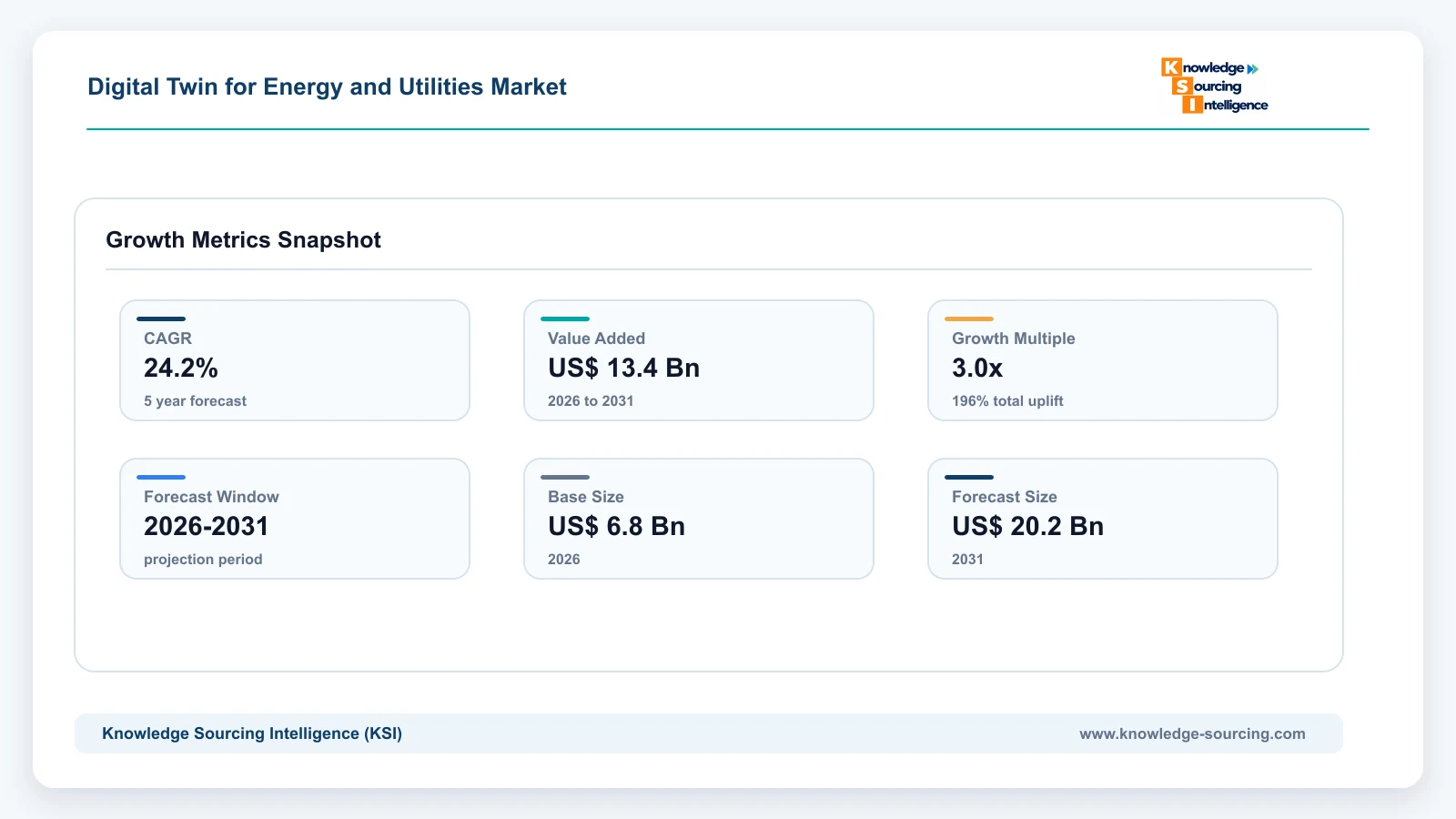
The Digital Twin for Energy and Utilities Market is forecast to grow at a CAGR of 24.2%, reaching USD 20.20 billion in 2031 from USD 6.83 billion in 2026.
Highlights:
- 1Utilities are using asset twins for turbines, transformers, substations, generators, and renewable-energy equipment to support condition monitoring, failure prediction, and maintenance optimization.
- 2The growing trend is system-level digital twins adopted by transmission and distribution operators to model network behavior, evaluate capacity, simulate contingencies, and integrate renewable and distributed energy resource potential.
- 3Digital twins are increasingly used in combination with machine learning, anomaly detection, predictive analytics, and physics-based models to detect upcoming problems in the equipment before failures happen.
- 4Digital twins are being created to be more flexible and operational, as they can combine additional data sources to provide a continuously updated view of both the industry assets and networks.
The digital twin for energy and utilities market is changing the way organizations design, operate, maintain, and upgrade energy infrastructure. Conventional utility systems are frequently based on disparate engineering drawings, GIS databases, inspection reports, SCADA data, and upkeep documents. Digital twin platforms will aggregate these data sources to form an agnostic operational picture of physical infrastructure.
The market encompasses a digital twin of individual assets, the digital twin as an interconnection of systems, and elements that operate across electricity generation, transmission, distribution, renewable energy, oil & gas extraction and refinement, water utilities, and other infrastructure operations.
Digital twins are being increasingly integrated withlive sensor data and operating systems. For instance, the GE Vernova digital twin technology includes asset twins, grid twins and process twins. Its grid digital twin capabilities integrate network models with operational knowledge to deliver near real-time visibility and facilitate grid simulation, optimization and control.
Other aspects of technology are progressing towards physics-based simulation. The company Neara uses a physics-enabled digital twin to build a spatially accurate representation of real-world utility networks, enabling operators to simulate and take advantage of wind, flood, wildfire, thermal loading, and other scenarios in design models that are physically accurate across network infrastructure. This transition is leading to an opportunity for a market in which digital twins increasingly act as operational decision-support environments, rather than rudimentary 3D visualization tools.
Market Dynamics
Market Drivers
Aging Energy Infrastructure: Energy and utility companies are streamlining aging generation, transmission, distribution, and pipeline infrastructure while fulfilling more demanding reliability expectations. This will allow operators to integrate engineering records, inspection data, operational interactions, asset condition details, and maintenance history under one digital core. GE Vernova's APM solutions use digital twins and predictive analytics to monitor the most critical equipment, allowing potential failures to be identified b4 they result in unplanned outages. This is encouraging utilities to go from calendar-based maintenance to condition- and risk-based maintenance.
Rise in Renewable & Distributed Energy on the Grid: Electricity grids are becoming more dynamic as large-scale wind and solar, utility-scaled battery storage, and distributed Generation, which in turn support electric vehicle charging, are all growing rapidly. By using digital twins, operators can experiment with renewable–energy connections and model to undestand variations in generation, demand, voltage, and network configuration alter system behavior. For example, Neara's utility digital twin lets network actors position new transmission lines and test various scenarios for the infrastructure before building. This is compelling demand for system-level twins that include spatial, engineering, operational, and environmental data.
Rise of Real-Time Monitoring and Situational Awareness: Data is time-sensitive, and utilities are now seeking real-time visibility as distributed generation, extreme weather, electric vehicles, and energy storage combined with changing load profiles layer the complexity of managing the network. Digital twins can combine operational data with geospatial and physical models to give operators detailed information on network conditions. The utility solutions of Hexagon provide digital twins for electricity, heating, gas, telecommunications, and water networks to support network planning, operations, outage management, asset maintenance, and emergency response.
Market Restraints & Opportunities
The implementation of digital twins involves a significant investment in data infrastructure, sensors, and software integration, as well as investments in cloud computing, simulation capabilities cyber security and technical expertise. In addition, utilities still function in legacy OT and IT systems that are built on entirely different architectures with different data standards.
Data quality represents another constraint. They rely on precise engineering models, asset records, sensor input, GIS data, and operational info. Digital-twin outputs can be less reliable due to incomplete or outdated asset records.
However, these challenges are opening up opportunities for managed digital-twin services, cloud-based deployment solutions, API standardization, and low-code platforms that have emerged in the past couple of years, along with AI data processing engines to automate data reconciliation and integration with secured environments.
Emerging economies are also a major opportunity where digital twins can assist utilities in upgrading and modernising infrastructure without the use of physical inspection processes or purely manual planning processes.
Key Developments
February 2026: Schneider Electric and ETAP launched a physics-based digital twin for utilities and critical-infrastructure operators. This solution coupled engineering-grade electrical models of high-voltage systems with operations data, integrating protection validation, contingency analysis, and real-time monitoring along the lifecycle of predictive maintenance.
November 2025: Schneider Electric, AVEVA, and ETAP announced as the newest members of The Alliance for OpenUSD to promote interoperability of digital twins and simulation-ready 3D models. They backed open standards for industrial simulation, collaborative design, and AI infrastructure.
Market Segmentation
The market is segmented by twin type, component, application, end user, and geography.
By Twin Type: Asset Twin
Asset Twin type will continue to be the major type of twin across industries. Energy and utility companies will continue to drive asset twin deployment based on the larger fleets of high-value assets and equipment availability and reliability driving operating costs and service continuity.
Asset twins provide digital representations of specific physical assets including gas turbines, wind turbines, transformers, generators, substations, compressors, pipelines, pumps and other key equipment.
SmartSignal by GE Vernova is an asset-twin deployment which using AI/ML driven digital-twin blueprints that monitor the operation of equipment. It can also detect anomalies and enable predictive maintenance across hundreds of types of equipment. Similarly, Akselos deploys a physics-based methodology directly centered around structural digital twins that addresses asset integrity assessment and guides life-extension decisions.
By Component: Software
The software is the major component segment because there are digital twins that need specialized platforms to integrate data, simulate, visualize, analyze, and provide AI/ML, along with modeling and scenario analysis.
Digital-twin software is increasingly incorporating engineering models along with IoT, SCADA, GIS, operational databases, and external information sources like weather data. For instance, Bentley's iTwin Platform includes APIs and services to build infrastructure digital twins, uniting engineering information with reality data, sensors, and other information.
AVEVA applied its digital-twin and asset-performance technologies throughout power and utilities. The renewable-energy portfolio consists of asset strategy optimization and predictive analytics, which provide value to asset performance, health monitoring, remaining-life estimation of assets, and maintenance optimization.
By Application: Asset Performance Management
Asset Performance Management (APM) is projected to remain the major application because utilities will be continuously monitoring and optimising expensive infrastructure.
Digital twins enhance APM by creating a virtual representation of the assets behave which is a representation that can be continuously updated with operational data. The APM portfolio from GE Vernova merges digital twins, AI/ML diagnostics, and reliability workflows with predictive analytics. Its SmartSignal solution offers digital-twin models that can identify problems likely to cause an asset to become unavailable.
GE Vernova's EnergyAPM also integrates digital-twin capabilities into a wider-generality asset-health and reliability architecture that incorporates asset diagnostics, predictive failure analysis, maintenance planning, and fleet health.
Regional Analysis
North America Market Analysis
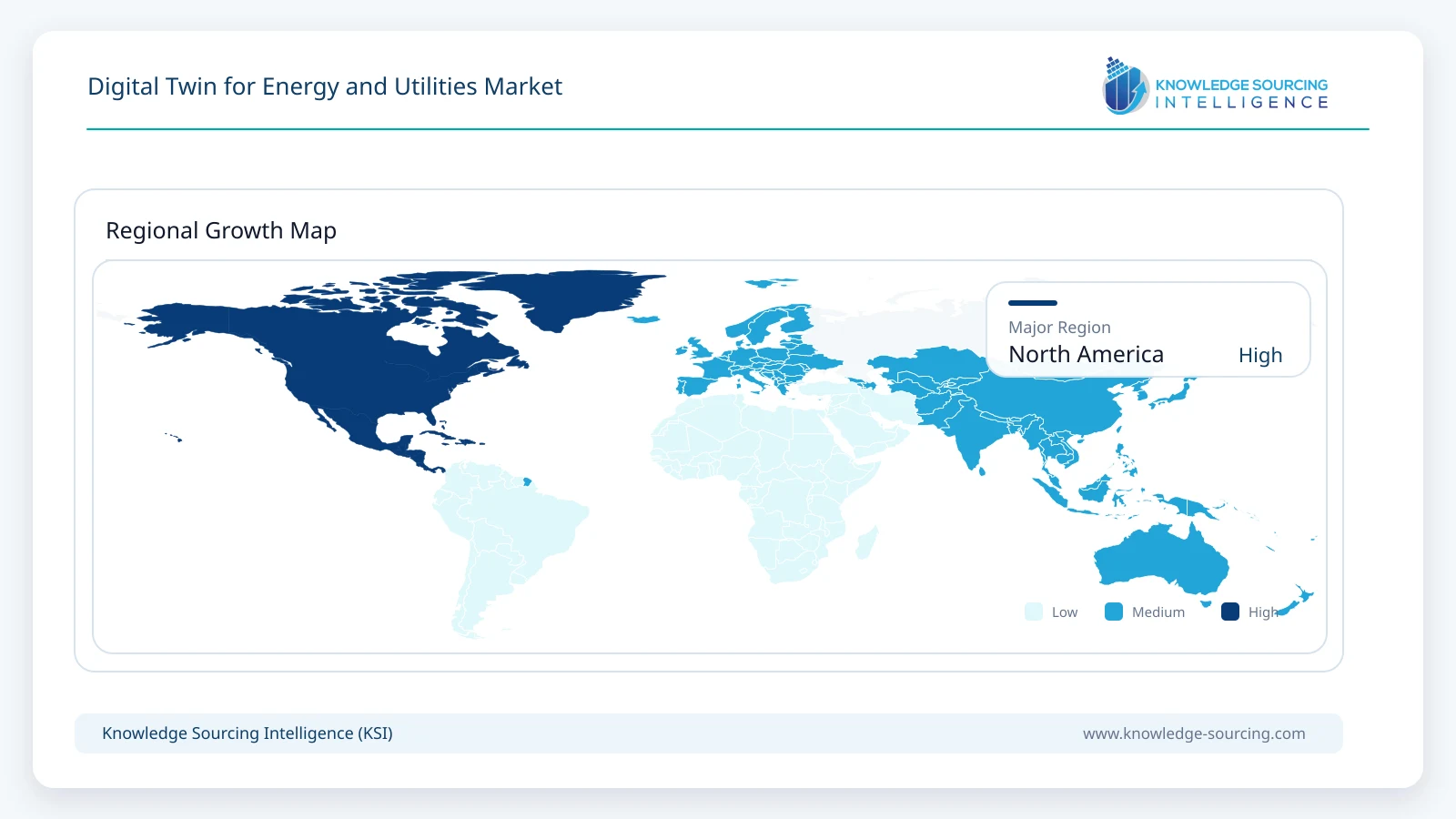
North America is a leading market due to utilities accelerating modernization of the grid as they are managing aging infrastructure for transmission and distribution. The United States is experiencing increasing demand for transmission capacity, renewable-energy integration, distributed energy resources, and grid resilience.
South America Market Analysis
South America is an emerging digital-twin market backed by renewable-energy development, transmission expansion, hydropower assets, and expanding network-modernization needs. Brazil is the biggest opportunity region with its vast electricity grid, hydropower fleet, renewable-energy expansion, and geographically diverse infrastructure.
Europe Market Analysis
Europe is one of the more mature regions in terms of energy digital twins because these utilities must manage the simultaneous pressure from renewable-energy growth, grid congestion, aging infrastructure, electrification, and decarbonization. Germany, the UK, France, the Netherlands, and the Nordic countries are sizable markets for digital infrastructure and more advanced energy-management technologies.
Middle East and Africa Market Analysis
The Middle East & Africa market is growing with utilities and energy companies establishing new generation capability, renewable strength, smart grid infrastructure, and virtual transformation. Additionally, Saudi Arabia and the UAE are both of primary importance because solar requires integrated models encompassing planning and operations of large-scale solar, hydrogen, desalination, and smart-city projects.
Asia Pacific Market Analysis
Asia Pacific is projected to show the strongest growth, driven by an accelerating mix of fast-growing demand for electricity, high levels of renewables deployment, grid modernization, and infrastructure investment. Digital twins of the energy industry in China, Japan, South Korea, India, and Australia are mature markets driven by growing renewable generation and transmission infrastructure at a larger scale.
List of Companies
Treeview Inc.
GE Vernova
Bentley Systems
AVEVA
Kongsberg
Hexagon AB
Emerson Electric
Akselos
Cesium
Neara
Treeview Inc.
Treeview Inc. is an advanced technical company that develops custom digital twins, which include real-time 3D visualization, IoT integration, cloud architecture, simulation layers, and enterprise data interfacing capabilities. Their energy portfolio features an AI-enabled digital twin for a green-hydrogen renewable-energy project in partnership with Microsoft.
GE Vernova
GE Vernova is one of the industry's longest-standing providers of digital-twin technology for the energy industry. Portfolio: Asset Digital Twins, Grid Digital Twins, and Process Digital Twins. SmartSignal provides predictive analytics for mission-critical energy equipment through AI/ML digital twins, while its Digital-twin capabilities support grid simulation and optimization through real-time representations of the network asset here.
Bentley Systems
Bentley Systems provides digital-twin technologies with its iTwin Platform, an open cloud platform tailored to infrastructure owners and developers. It turns engineering info, reality data, sensors, IoT information, and other datasets into the large world of living digital twins.
Analyst View
The global digital twin for energy and utilities market will grow with the rise in renewable integration, grid congestion, distributed generation, and extreme-weather risk within energy and utility organisations. In addition, technologies such as GE Vernova's SmartSignal, Bentley's iTwin Platform and Kongsberg's Kognitwin, and Neara's physics-enabled utility twin are indicative of a shift toward environments that are continuously updated and simulation-capable. North America and Europe continue to be the main hubs for innovation and adoption, with Asia Pacific accelerating through grid offshoots and renewables rollout. Emerging opportunities in South America and the Middle East & Africa are driven by renewable-energy development, infrastructure modernization, and remote-asset management. In the longer term, the market is headed toward predictive AI-enhanced digital twins that can predict failures, simulate future scenarios, and recommend investments, eventually facilitating more autonomous utility operations.
Digital Twin for Energy and Utilities Market Scope:
| Report Metric | Details |
|---|---|
| Total Market Size in 2026 | USD 6.83 billion |
| Total Market Size in 2031 | USD 20.20 billion |
| Forecast Unit | USD Billion |
| Growth Rate | 24.2% |
| Study Period | 2021 to 2031 |
| Historical Data | 2021 to 2024 |
| Base Year | 2025 |
| Forecast Period | 2026 – 2031 |
| Segmentation | Twin Type, Component, Application, End User, Geography |
| Companies |
|
Table of Contents
1. EXECUTIVE SUMMARY
2. MARKET SNAPSHOT
2.1. Market Overview
2.2. Market Definition
2.3. Scope of the Study
2.4. Market Segmentation
3. MARKET DYNAMIC
3.1. Market Drivers
3.2. Market Restraints
3.3. Market Opportunities
3.4. Porter’s Five Forces Analysis
3.5. Industry Value Chain Analysis
4. BUSINESS LANDSCAPE
4.1. Hydrogen Mobility, Fuel Cell & Emission Regulations Landscape
4.2. Government Incentives, Hydrogen Policy & Infrastructure Investment Landscape
4.3. Fuel Cell Manufacturing Capacity & Project Pipeline Landscape
4.4. Input–Output Analysis
4.5. Strategic Recommendations
5. TECHNOLOGICAL OUTLOOK
5.1. Membrane Electrode Assembly, Catalyst & Proton Exchange Membrane Technologies
5.2. Bipolar Plate, Gas Diffusion Layer & Stack Architecture Technologies
5.3. High-Power-Density, Durability & Thermal/Water Management Technologies
5.4. Fuel Cell System Integration, Power Electronics & Digital Monitoring Technologies
6. DIGITAL TWIN FOR ENERGY AND UTILITIES MARKET BY TWIN TYPE
6.1. Introduction
6.2. Asset Twin
6.3. Process Twin
6.4. System Twin
6.5. Others
7. DIGITAL TWIN FOR ENERGY AND UTILITIES MARKET BY COMPONENT
7.1. Introduction
7.2. Hardware
7.3. Software
7.4. Services
8. DIGITAL TWIN FOR ENERGY AND UTILITIES MARKET BY APPLICATION
8.1. Introduction
8.2. Asset Performance Management
8.3. Predictive Maintenance
8.4. Real-Time Monitoring & Visualization
8.5. Fault Detection & Diagnostics
8.6. Grid Planning & Optimization
8.7. Others
9. DIGITAL TWIN FOR ENERGY AND UTILITIES MARKET BY END USER
9.1. Introduction
9.2. Power Generation
9.3. Oil & Gas
9.4. Renewable Energy
9.5. Water & Wastewater Management
9.6.Others
10. DIGITAL TWIN FOR ENERGY AND UTILITIES MARKET BY GEOGRAPHY
10.1. Introduction
10.2. North America
10.2.1. USA
10.2.2. Canada
10.2.3. Mexico
10.3. South America
10.3.1. Brazil
10.3.2. Argentina
10.3.3. Others
10.4. Europe
10.4.1. United Kingdom
10.4.2. Germany
10.4.3. France
10.4.4. Others
10.5. Middle East and Africa
10.5.1. Saudi Arabia
10.5.2. UAE
10.5.3. Others
10.6. Asia Pacific
10.6.1. China
10.6.2. Japan
10.6.3. India
10.6.4. South Korea
10.6.5. Others
11. COMPETITIVE ENVIRONMENT AND ANALYSIS
11.1. Major Players and Strategy Analysis
11.2. Market Share Analysis
11.3. Mergers, Acquisitions, Agreements, and Collaborations
11.4. Competitive Dashboard
12. COMPANY PROFILES
12.1. Treeview Inc.
12.2. GE Vernova
12.3. Bentley Systems
12.4. AVEVA (Schneider Electric)
12.5. Kongsberg
12.6. Hexagon AB
12.7. Emerson Electric
12.8. Akselos
12.9. Cesium
12.10. Neara
13. APPENDIX
13.1. Currency
13.2. Assumptions
13.3. Base and Forecast Years Timeline
13.4. Key benefits for the stakeholders
13.5. Research Methodology
13.6. Abbreviations
Navigate
Trusted by the world's leading organizations











