
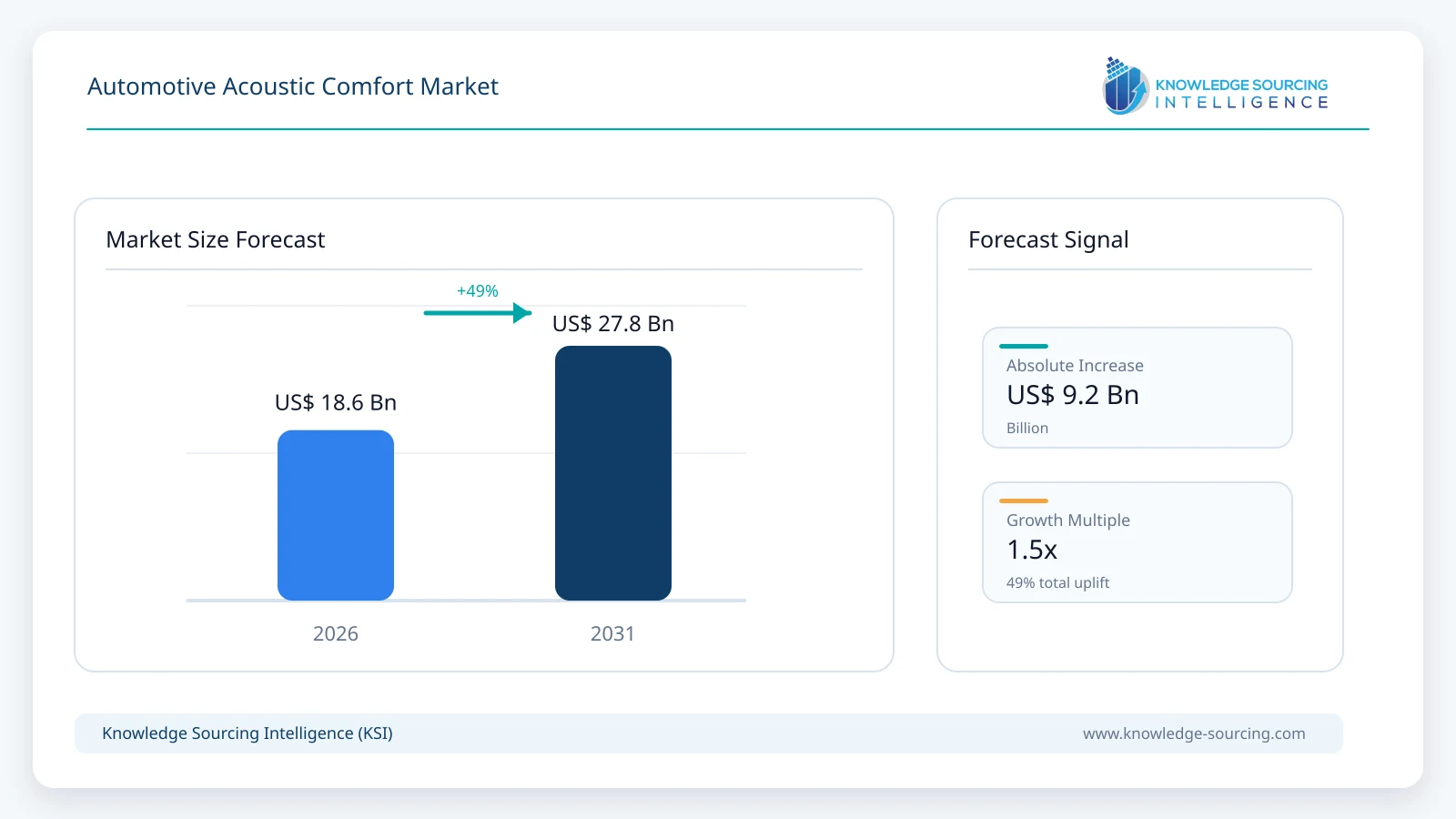
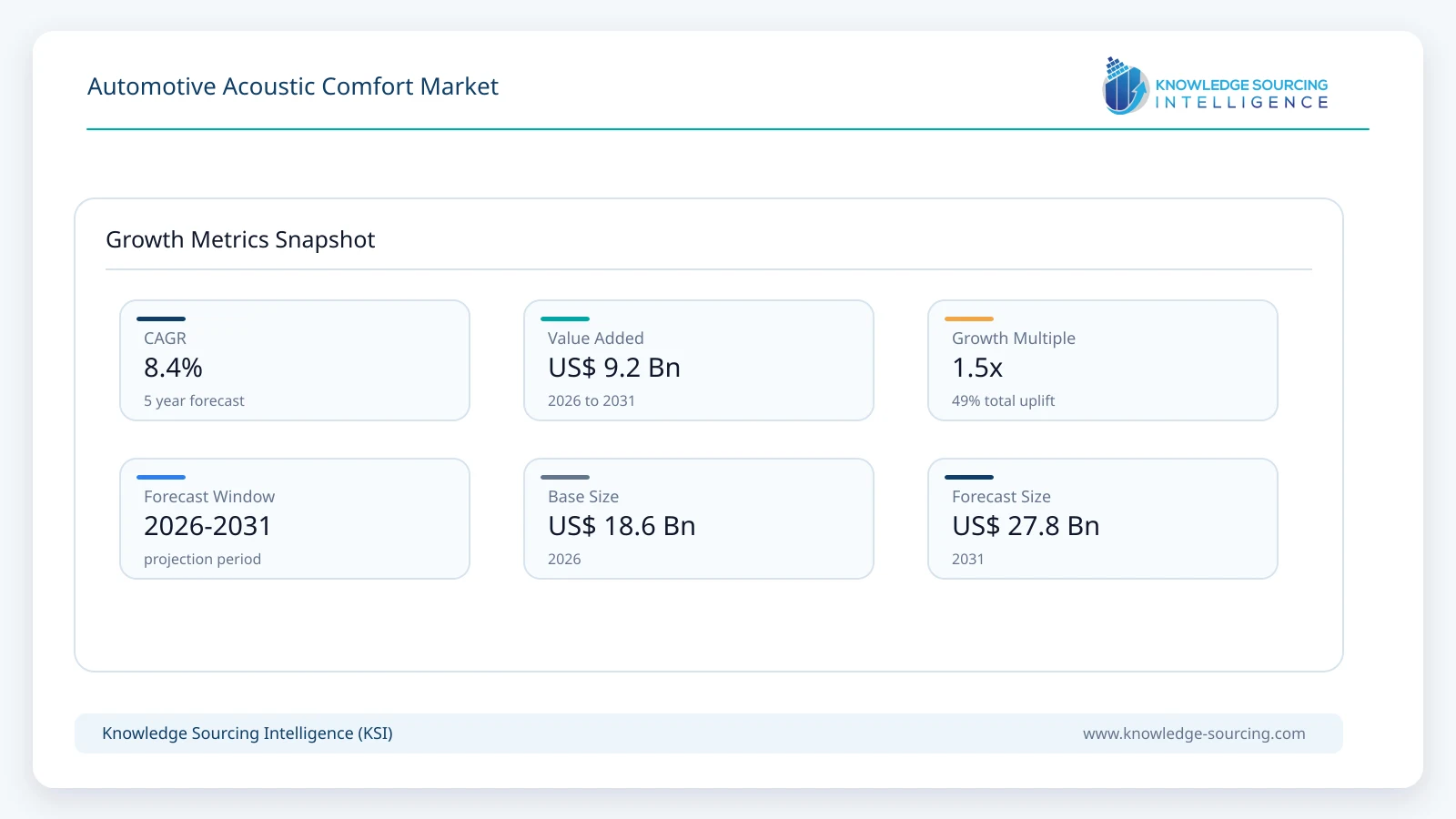
The automotive acoustic comfort market is estimated at approximately USD 18.6 billion in 2026 and is projected to reach about USD 27.8 billion by 2031, representing a CAGR of 8.4% during the forecast period.
Highlights:
- 1Passive acoustic materials and trim account for approximately 61% of global market value in 2026 because absorbers, barriers, carpets, dash insulators, headliners, wheelhouse treatments and related sound packages remain standard across high-volume vehicle production.
- 2Road and tire noise represents approximately 37% of acoustic-comfort value in 2026, reflecting stronger consumer sensitivity to structure-borne and airborne road noise in electric and premium vehicles.
- 3Passenger vehicles account for approximately 88% of global market value in 2026 because acoustic glazing, multi-layer trim packages and active noise-control systems are concentrated in cars, SUVs and MPVs.
- 4Internal-combustion vehicles remain the largest propulsion segment in 2026, but BEVs are expected to record the fastest growth in acoustic content per vehicle as previously masked road, wind, HVAC and electric-drive noise becomes more audible.
- 5Active noise control and software-defined sound management represent a smaller share of current value but are expected to grow at a mid-teens rate as OEMs reuse microphones, speakers, accelerometers and centralized audio compute.
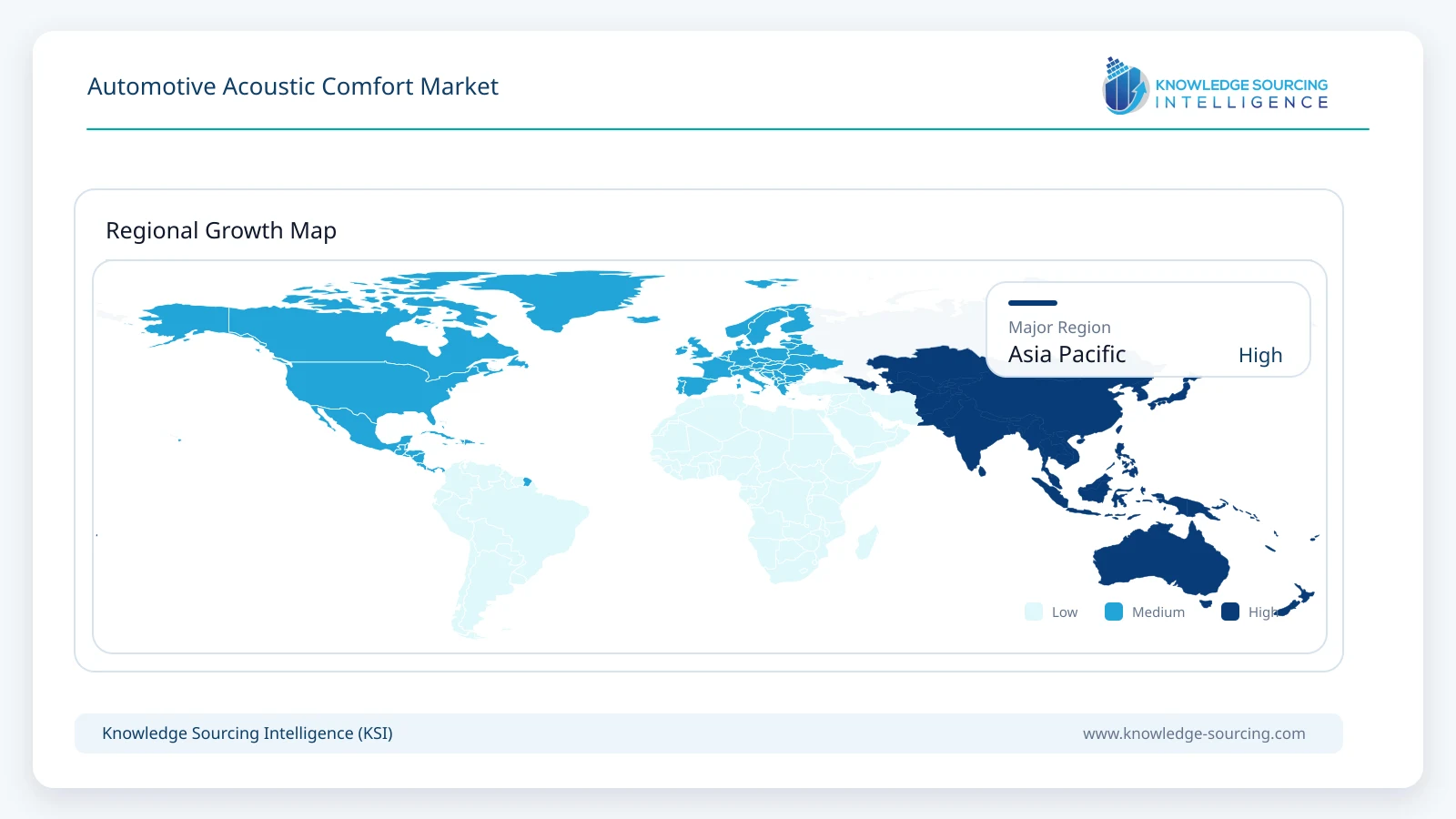
- 6Asia Pacific represents approximately 44% of global market value in 2026, supported by vehicle-production scale and rising acoustic-content levels in Chinese, Japanese, South Korean and Indian passenger vehicles.
Demand is shifting from mass-heavy sound insulation toward optimized combinations of lightweight absorbers, laminated acoustic glazing, targeted isolation and active noise cancellation.
Electrification changes the acoustic problem rather than eliminating it. Without combustion-engine masking, road and tire noise, wind turbulence, HVAC systems, electric-drive tonal noise and high-frequency inverter or motor signatures become more perceptible. OEMs are therefore treating acoustic comfort as an integrated cabin-quality attribute rather than a late-stage NVH correction.
The market includes acoustic content whose primary purpose is improving interior sound comfort. Structural chassis components, ordinary premium audio hardware, exterior pedestrian warning systems and general vibration-control products are excluded unless their value is directly attributable to cabin noise reduction or active sound management.
Market Overview
Acoustic comfort is created by controlling both the path and perception of sound. Passive systems absorb or block airborne noise and damp structural radiation, while acoustic glazing limits wind and traffic transmission through large transparent surfaces. Seals, foams and isolators close leakage paths that can otherwise undermine the performance of the broader sound package.
Active systems add a software layer. Road-noise control uses accelerometers and microphones to identify broadband disturbance and reproduce inverse sound through the vehicle audio system, while engine-order cancellation targets predictable tonal content. Newer architectures can combine several noise sources and focus cancellation on occupied seating zones.
The strongest designs increasingly combine passive and active methods. Passive materials remain necessary for broad frequency control and high-frequency attenuation, while active control is most useful where low-frequency road or powertrain noise would otherwise require heavy treatment. This hybrid architecture improves quietness while helping manage mass, cost and packaging.
Market Trends
Hybrid Passive-Active Acoustic Architectures Are Replacing Mass-Heavy Insulation
OEMs are reducing dependence on thick barriers by using lighter absorbers where they are most effective and applying active cancellation to difficult low-frequency noise. HARMAN and Bose both position active road-noise control as a way to reduce cabin noise without relying solely on added passive mass.
The commercial opportunity is therefore moving toward system optimization rather than material volume alone. Suppliers that can model complete sound paths and balance absorbers, glazing, seals and active algorithms are better positioned than component-only vendors.
Electric Vehicles Are Reprioritizing Road, Wind and Auxiliary Noise
The absence of combustion masking makes tire-road interaction, aerodynamic turbulence, HVAC compressors, pumps and electric-drive tones more noticeable. SAE research in 2026 continues to highlight HVAC and high-frequency interior-noise challenges in electric vehicles.
This raises acoustic-content requirements even when total vehicle noise is lower. BEVs increasingly need targeted wheelhouse treatment, acoustic glazing, electric-drive encapsulation and software-based cancellation rather than conventional engine-bay insulation alone.
Recycled Monomaterial Acoustic Packages Are Gaining Ground
Acoustic suppliers are redesigning insulation around recycled PET, cotton and other mono-material concepts to reduce mass and improve end-of-life recyclability. Autoneum has expanded PET-based sound-insulation products and introduced a sound-absorbing frunk solution for BEVs using up to 70% recycled material.
Sustainability is becoming a sourcing criterion alongside decibel performance and cost. The challenge is to maintain consistent absorption, durability and forming performance while reducing multi-layer constructions that are difficult to recycle.
Acoustic Glazing Is Expanding Beyond the Windshield
Laminated acoustic glass is increasingly used in front side windows, rear doors and large roof areas as cabins add more glazing and aerodynamic noise becomes more exposed. AGC and Saint-Gobain Sekurit both offer acoustic interlayer technologies designed to reduce traffic, wind and road noise.
The growth opportunity is strongest in EVs, premium SUVs and vehicles with panoramic roofs, where large transparent surfaces can become major transmission paths. Lightweight glazing also creates a need to preserve acoustic performance as glass thickness is reduced.
Zone-Based Noise Control Is Creating Personalized Quietness
Active noise systems are moving from one cabin-wide response toward seat-specific control. Nissan's advanced system can prioritize occupied seating areas, while modern audio platforms increasingly support personal sound zones and localized acoustic experiences.
Zone control improves performance without treating every seat equally and fits the broader shift toward personalized cabins. It also increases calibration complexity because microphones, speakers, seating occupancy and changing cabin conditions must be coordinated in real time.
Segment Analysis
By Acoustic Solution: Passive Acoustic Materials and Trim
Passive acoustic materials and trim are the largest solution segment because every vehicle requires physical control of airborne and structure-borne noise. Key applications include carpets, inner dashes, floor systems, headliners, wheelhouse liners, trunk trim, engine or e-drive encapsulation, absorbers and damping layers.
The segment is estimated at approximately USD 11.35 billion in 2026 and could reach about USD 15.55 billion by 2031. Its share is expected to decline gradually as acoustic glazing and active control grow faster, but lightweight sustainable materials will keep passive solutions central to full-cabin sound packages.
By Primary Noise Source: Road and Tire Noise
Road and tire noise is the largest acoustic-comfort application because excitation travels through suspension, wheelhouses, floor structures and air paths across a broad frequency range. Low-profile tires, large wheels and reduced engine masking increase the perceived importance of this noise source.
Road and tire applications account for approximately USD 6.88 billion in 2026 and are projected to exceed USD 10.5 billion by 2031. Growth will support wheelhouse absorbers, floor and carpet systems, chassis-path isolation and active road-noise cancellation.
By Propulsion: Internal-Combustion Vehicles
Internal-combustion vehicles retain the largest 2026 value pool because they still represent the majority of global light-vehicle production and require extensive control of engine, exhaust, intake, road and wind noise. Conventional sound packages remain mature but substantial in content.
The segment is estimated at approximately USD 8.56 billion in 2026. Its absolute value should remain sizeable through 2031, although share will decline as BEV and hybrid production grows and those vehicles adopt more specialized glazing, road-noise and electric-drive acoustic treatments.
By Vehicle Type: Passenger Vehicles
Passenger cars, SUVs and MPVs dominate acoustic-comfort demand because cabin quietness directly influences perceived refinement and brand quality. Premium vehicles use broader glazing and active-control packages, while mass-market platforms rely on optimized carpets, dash systems, seals and wheelhouse treatments.
Passenger vehicles account for approximately USD 16.37 billion in 2026 and are projected to exceed USD 24.0 billion by 2031. Commercial vehicles will grow from a smaller base, especially where long duty cycles increase the value of fatigue-reducing cabin quietness.
Market Drivers
Rising Consumer Expectations for Cabin Quietness and Perceived Quality
Quietness has become a visible measure of vehicle refinement, especially in premium SUVs, EVs and chauffeur-oriented vehicles. Lower interior noise improves conversation, audio clarity and perceived build quality, encouraging OEMs to invest in acoustic content even where regulation does not require it.
The effect is moving into higher-volume segments as acoustic glass, better sealing and optimized trim packages become easier to industrialize. Competitive benchmarking increasingly includes sound quality rather than only maximum interior decibel levels.
Electrification Is Exposing New Noise Sources
Electric powertrains remove much of the low-frequency engine mask but expose road, wind, HVAC, pump, motor and inverter noise. High-frequency tonal content can be particularly noticeable because it contrasts with an otherwise quiet cabin.
OEMs therefore need different materials, better source isolation and more advanced sound-quality engineering. This supports acoustic glazing, e-drive encapsulation, wheelhouse treatment and active broadband control.
Vehicle Lightweighting Favors Higher-Performance Acoustic Solutions
Heavy barriers can conflict with range, fuel economy and CO2 targets. Suppliers are responding with lightweight fiber systems, tuned multi-layer structures and active cancellation that provide greater acoustic performance per kilogram.
This creates demand for higher-value materials and engineering even when total material mass falls. Acoustic performance is increasingly optimized through placement, frequency tuning and simulation rather than simply adding thickness.
Centralized Audio Compute Enables Software-Based Noise Management
Software-defined vehicle architectures provide more processing power and access to vehicle microphones, speakers, accelerometers and network data. Active noise-control algorithms can therefore be integrated into shared audio or cockpit compute rather than requiring a completely independent electronics stack.
Reuse of existing hardware improves the business case for active control and allows calibration or sound profiles to evolve through software. Panasonic, Nissan, HARMAN and Bose illustrate the shift toward integrated sound-management platforms.
Larger Glass Areas and Premium Interior Architectures Increase Acoustic Requirements
Panoramic roofs, larger side glazing and open cabin designs increase transparent surface area and can create additional wind and transmission paths. As cabins become visually lighter, acoustic glazing and sealing need to compensate for reduced mass and more exposed interfaces.
This is particularly relevant in premium EVs and SUVs, where buyers expect both expansive glass and strong isolation. Advanced laminated glass and improved flush sealing therefore gain value alongside interior trim solutions.
Market Restraints
Cost Pressure in High-Volume Vehicle Programs
Acoustic glazing, multi-layer trim and active-control electronics can add meaningful cost to vehicles where quietness competes with safety, connectivity and powertrain features for budget. Entry-level models therefore use selective treatments rather than full-cabin packages.
Suppliers must demonstrate measurable value per kilogram and per dollar. Solutions that reuse existing audio hardware or combine thermal and acoustic functions have an advantage under tight program economics.
Vehicle-Specific Tuning and Validation Complexity
Cabin acoustics depend on body stiffness, suspension, tire choice, glass area, seals, seating, trim geometry and powertrain behavior. A solution that performs well in one vehicle cannot be transferred directly to another without renewed simulation and testing.
This increases engineering cost and lengthens validation, particularly for active systems that must remain stable across road surfaces, seating positions and audio operating states.
Broadband and High-Frequency Noise Remain Difficult to Control Actively
Active noise cancellation is strongest where noise is predictable or concentrated in lower-frequency bands. Wind rush, rapidly changing broadband content and localized high-frequency sources still require passive absorption, sealing or source treatment.
The limitation prevents active systems from fully replacing physical acoustic packages. OEMs must balance cancellation capability with passive materials rather than expecting a software-only solution.
Material Circularity Can Conflict with Acoustic and Durability Targets
Recycled and mono-material systems must still meet requirements for flammability, moisture resistance, odor, compression recovery, dimensional stability and long-term acoustic consistency. Vehicle interiors experience wide temperature and humidity cycles over many years.
Qualification can slow substitution of proven multi-material solutions. Sustainable acoustic products need to match incumbent performance without increasing thickness, scrap or process complexity.
Safety-Critical Sounds Must Remain Audible
A quieter cabin cannot suppress horns, emergency sirens, warning chimes or other information needed by occupants. Active cancellation and highly isolating glass must therefore be tuned selectively rather than maximize attenuation across all frequencies.
This creates additional requirements for system validation, fault handling and psychoacoustic design. The objective is controlled sound quality, not complete acoustic isolation from the external environment.
Regional Outlook
Asia Pacific
Asia Pacific is the largest automotive acoustic comfort market, supported by vehicle-production scale in China, Japan, South Korea and India and increasing cabin-content levels in premium and electrified vehicles. Local OEMs are using quietness, large glass areas and advanced audio as visible differentiators in highly competitive passenger-vehicle segments.
The region also has a broad supply base across acoustic trim, polymers, glass, electronics and active sound control. Autoneum is expanding its Asian footprint, while Japanese suppliers such as Panasonic Automotive and Sumitomo Riko contribute active control and sound-isolation technologies.
Growth through 2031 will be driven by higher acoustic value per vehicle rather than production volume alone. China will be especially important as BEV and smart-cabin platforms normalize premium comfort features in mainstream price bands.
Europe
Europe is a high-value acoustic comfort market because premium vehicle production, stringent efficiency targets and strong sustainability requirements encourage lightweight sound packages and high-value acoustic glazing. The region is also home to major suppliers including Autoneum, Adler Pelzer and Saint-Gobain Sekurit.
Electrification is reshaping acoustic engineering priorities toward road, wind and electric-drive noise. European OEMs are adopting recycled fiber systems, advanced simulation and thinner lightweight structures that need stronger acoustic optimization.
The region will remain important for sustainable materials and high-performance glazing through 2031. Growth is expected to be content-led as acoustic treatment becomes more integrated with thermal management, interior trim and software-based sound control.
Competitive Landscape
The market combines specialist acoustic-system suppliers, automotive glass manufacturers, material companies and active sound-management providers. Autoneum, Adler Pelzer and Auria compete through broad passive-acoustic portfolios and vehicle-level engineering, while AGC and Saint-Gobain Sekurit address glazing-based noise transmission.
3M and Sumitomo Riko contribute lightweight absorption, damping, insulation and source-control materials. HARMAN, Bose and Panasonic Automotive add software and electronics for road-noise, engine-noise and personalized sound management, creating a more direct link between cabin acoustics and the vehicle audio architecture.
Competitive advantage increasingly depends on full-system optimization. Suppliers need to reduce mass and carbon footprint while meeting frequency-specific targets, support EV-specific noise sources, validate across multiple vehicle architectures and integrate active algorithms without degrading music, alerts or external-sound awareness.
Recent Developments
18 September 2026: Panasonic Automotive Systems announced an integrated Advanced Active Noise Control system for both road and engine noise in series-hybrid vehicles, first adopted in Nissan's all-new Elgrand for Japan.
July 2026: Nissan detailed its High-Performance Active Noise Control technology, combining road- and engine-noise reduction with a Zone Control function that can prioritize specific occupied seating areas.
20 June 2026: Adler Pelzer Group researchers presented a reciprocal-holography method for spatial optimization of inner-dash acoustic performance, addressing the need to improve sound insulation under tighter mass and sustainability constraints.
4 February 2026: Autoneum introduced the Ultra-Silent Frunk, a polyester-based BEV front-trunk solution offering acoustic and thermal insulation with up to 70% recycled material; orders had already been secured for three BEV programs.
29 January 2026: Continental highlighted its latest low-noise tire technologies, including ContiSilent, which reduces interior tire noise and supports broader cabin acoustic-comfort targets.
13 January 2026: HARMAN introduced new production-ready software-driven audio and sound-personalization capabilities, expanding HALOsonic electronic sound synthesis and configurable acoustic experiences for future vehicle cabins.
Market Outlook
The automotive acoustic comfort market is expected to expand from approximately USD 18.600 billion in 2026 to about USD 27.800 billion by 2031. Passive acoustic materials will remain the largest value pool, but acoustic glazing and active sound management will gain share as OEMs pursue quieter cabins with less added mass.
The fastest change will occur in electrified vehicles. BEVs and hybrids will require stronger control of road, wind, HVAC and electric-drive noise, while centralized audio compute makes active cancellation and zone-based sound management easier to scale across vehicle platforms.
Asia Pacific will remain the largest regional market, while Europe continues to lead in high-value lightweight and sustainable acoustic packages. Supplier success will depend on acoustic performance per kilogram, recyclability, vehicle-specific simulation capability and the ability to combine passive, glazing and active technologies into one validated sound strategy.
Automotive Acoustic Comfort Market Scope
| Report Metric | Details |
|---|---|
| Total Market Size in 2026 | USD 18.6 billion |
| Total Market Size in 2031 | USD 27.8 billion |
| Forecast Unit | Billion |
| Growth Rate | 8.4% |
| Study Period | 2021 to 2031 |
| Historical Data | 2021 to 2024 |
| Base Year | 2025 |
| Forecast Period | 2026 – 2031 |
| Segmentation | Acoustic Solution, Primary Noise Source, Propulsion, Vehicle Type, Geography |
| Companies |
|
Market Segmentation
By Acoustic Solution
Passive Acoustic Materials and Trim
Acoustic Glazing
Active Noise Control and Sound Management
Acoustic Sealing and Isolation Solutions
By Primary Noise Source
Road and Tire Noise
Wind and Aerodynamic Noise
Powertrain and Electric Drive Noise
HVAC and Auxiliary-System Noise
Other Interior Noise Sources
By Propulsion
Internal-Combustion Engine Vehicles
Hybrid and Plug-In Hybrid Vehicles
Battery Electric Vehicles
By Vehicle Type
Passenger Vehicles
Light Commercial Vehicles
Medium and Heavy Commercial Vehicles and Buses
By Geography
North America
United States
Canada
Mexico
South America
Brazil
Argentina
Others
Europe
Germany
United Kingdom
France
Italy
Spain
Others
Middle East and Africa
Saudi Arabia
UAE
South Africa
Others
Asia Pacific
China
Japan
South Korea
India
Indonesia
Thailand
Others
Table of Contents
1. INTRODUCTION
1.1. Market Overview
1.2. Market Definition
1.3. Scope of the Study
1.4. Market Segmentation
1.5. Currency
1.6. Assumptions
1.7. Base and Forecast Years
1.8. Key Benefits to Stakeholders
2. RESEARCH METHODOLOGY
2.1. Research Design
2.2. Secondary Research
2.3. Primary Research
2.4. Market Estimation
2.5. Segment Modelling
2.6. Data Triangulation and Validation
3. EXECUTIVE SUMMARY
3.1. Key Findings
3.2. Automotive Acoustic Comfort Market Size, 2026-2031
3.3. Acoustic Solution Outlook
3.4. Noise Source Outlook
3.5. Propulsion Outlook
3.6. Vehicle Type Outlook
3.7. Regional Opportunity Summary
4. MARKET DYNAMICS
4.1. Market Drivers
4.1.1. Rising Consumer Expectations for Cabin Quietness and Perceived Quality
4.1.2. Electrification Is Exposing New Noise Sources
4.1.3. Vehicle Lightweighting Favors Higher-Performance Acoustic Solutions
4.1.4. Centralized Audio Compute Enables Software-Based Noise Management
4.1.5. Larger Glass Areas and Premium Interior Architectures Increase Acoustic Requirements
4.2. Market Restraints
4.2.1. Cost Pressure in High-Volume Vehicle Programs
4.2.2. Vehicle-Specific Tuning and Validation Complexity
4.2.3. Broadband and High-Frequency Noise Remain Difficult to Control Actively
4.2.4. Material Circularity Can Conflict with Acoustic and Durability Targets
4.2.5. Safety-Critical Sounds Must Remain Audible
4.3. Market Opportunities
4.4. Porter's Five Forces Analysis
4.5. Industry Value Chain Analysis
4.6. Acoustic Comfort Cost, Mass and Performance Trade-Offs
4.7. Cabin Sound Quality, Safety and Regulatory Environment
5. TECHNOLOGY OUTLOOK
5.1. Sound Absorbers, Barriers and Damping Materials
5.2. Acoustic Carpets, Floor Systems and Inner Dash Insulation
5.3. Wheelhouse, Trunk and Underbody Acoustic Treatments
5.4. Acoustic Laminated Windshield and Side Glazing
5.5. Acoustic Seals, Foams and Cavity Treatments
5.6. Electric Drive Unit and Powertrain Encapsulation
5.7. Road Noise Active Noise Control
5.8. Engine Order and Tonal Noise Cancellation
5.9. Zone-Based and Seat-Specific Noise Control
5.10. Acoustic Simulation, Transfer-Path Analysis and Digital Development
5.11. Recycled PET and Monomaterial Acoustic Systems
5.12. Software-Defined Sound Management and Cabin Sound Quality
6. AUTOMOTIVE ACOUSTIC COMFORT MARKET BY ACOUSTIC SOLUTION
6.1. Introduction
6.2. Passive Acoustic Materials and Trim
6.3. Acoustic Glazing
6.4. Active Noise Control and Sound Management
6.5. Acoustic Sealing and Isolation Solutions
7. AUTOMOTIVE ACOUSTIC COMFORT MARKET BY PRIMARY NOISE SOURCE
7.1. Introduction
7.2. Road and Tire Noise
7.3. Wind and Aerodynamic Noise
7.4. Powertrain and Electric Drive Noise
7.5. HVAC and Auxiliary-System Noise
7.6. Other Interior Noise Sources
8. AUTOMOTIVE ACOUSTIC COMFORT MARKET BY PROPULSION
8.1. Introduction
8.2. Internal-Combustion Engine Vehicles
8.3. Hybrid and Plug-In Hybrid Vehicles
8.4. Battery Electric Vehicles
9. AUTOMOTIVE ACOUSTIC COMFORT MARKET BY VEHICLE TYPE
9.1. Introduction
9.2. Passenger Vehicles
9.3. Light Commercial Vehicles
9.4. Medium and Heavy Commercial Vehicles and Buses
10. AUTOMOTIVE ACOUSTIC COMFORT MARKET BY GEOGRAPHY
10.1. North America
10.1.1. United States
10.1.2. Canada
10.1.3. Mexico
10.2. South America
10.2.1. Brazil
10.2.2. Argentina
10.2.3. Others
10.3. Europe
10.3.1. Germany
10.3.2. United Kingdom
10.3.3. France
10.3.4. Italy
10.3.5. Spain
10.3.6. Others
10.4. Middle East and Africa
10.4.1. Saudi Arabia
10.4.2. UAE
10.4.3. South Africa
10.4.4. Others
10.5. Asia Pacific
10.5.1. China
10.5.2. Japan
10.5.3. South Korea
10.5.4. India
10.5.5. Indonesia
10.5.6. Thailand
10.5.7. Others
11. COMPETITIVE ENVIRONMENT AND ANALYSIS
11.1. Major Players and Strategy Analysis
11.2. Market Share Analysis
11.3. Passive Acoustic Technology Benchmarking
11.4. Acoustic Glazing Benchmarking
11.5. Passive versus Active Noise-Control Architecture Comparison
11.6. Lightweight and Sustainable Material Benchmarking
11.7. OEM Programs and Production Readiness
11.8. Competitive Dashboard
12. COMPANY PROFILES
12.1. Autoneum Holding Ltd.
12.2. Adler Pelzer Group
12.3. Auria Solutions Ltd.
12.4. 3M Company
12.5. AGC Inc.
12.6. Saint-Gobain Sekurit
12.7. HARMAN International
12.8. Bose Corporation
12.9. Panasonic Automotive Systems Co., Ltd.
12.10. Sumitomo Riko Company Limited
13. APPENDIX
13.1. Currency
13.2. Assumptions
13.3. Base and Forecast Years Timeline
13.4. Key Benefits for Stakeholders
13.5. Research Methodology
13.6. Abbreviations
13.7. Data Sources
Navigate
Trusted by the world's leading organizations











