
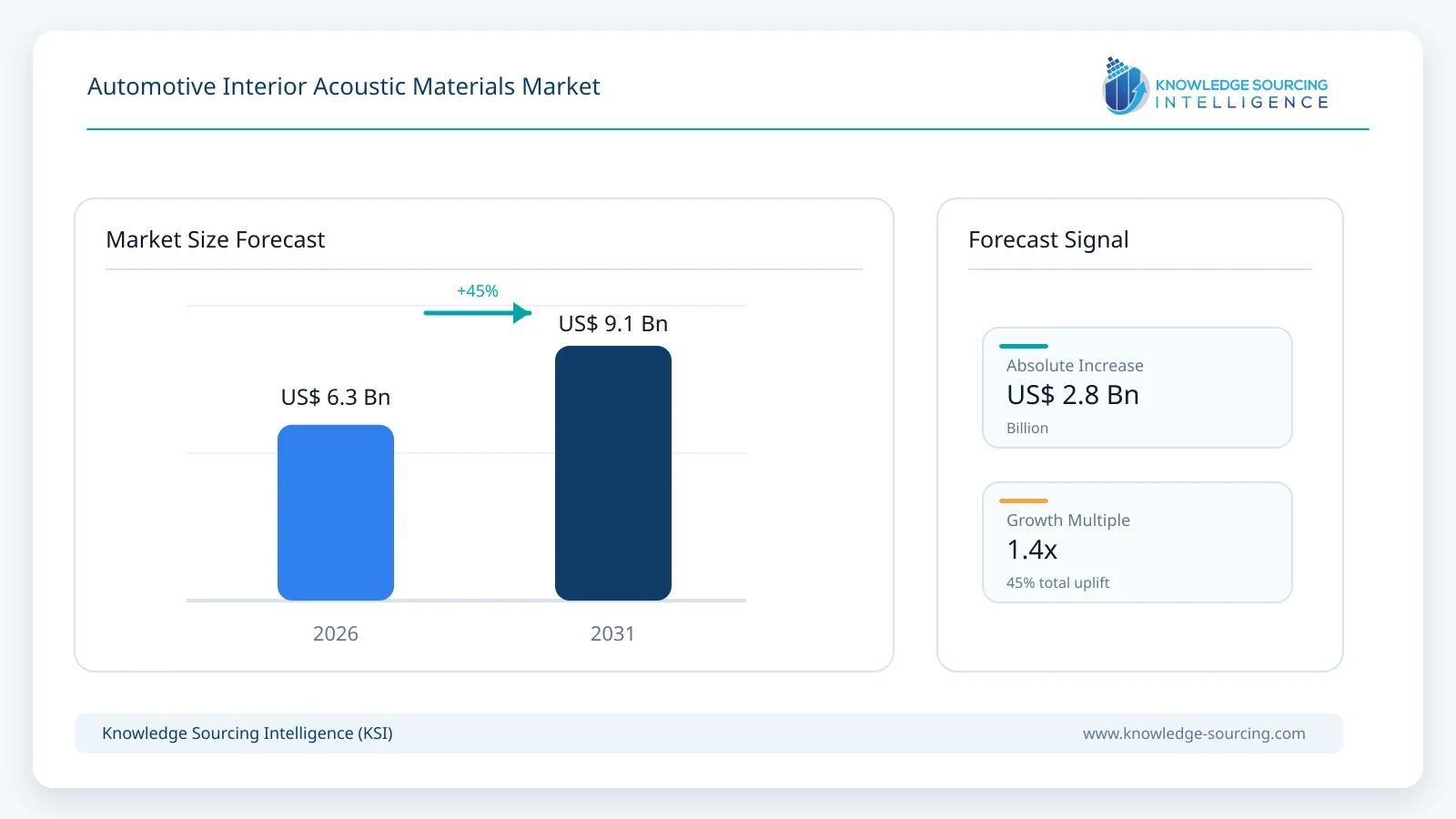
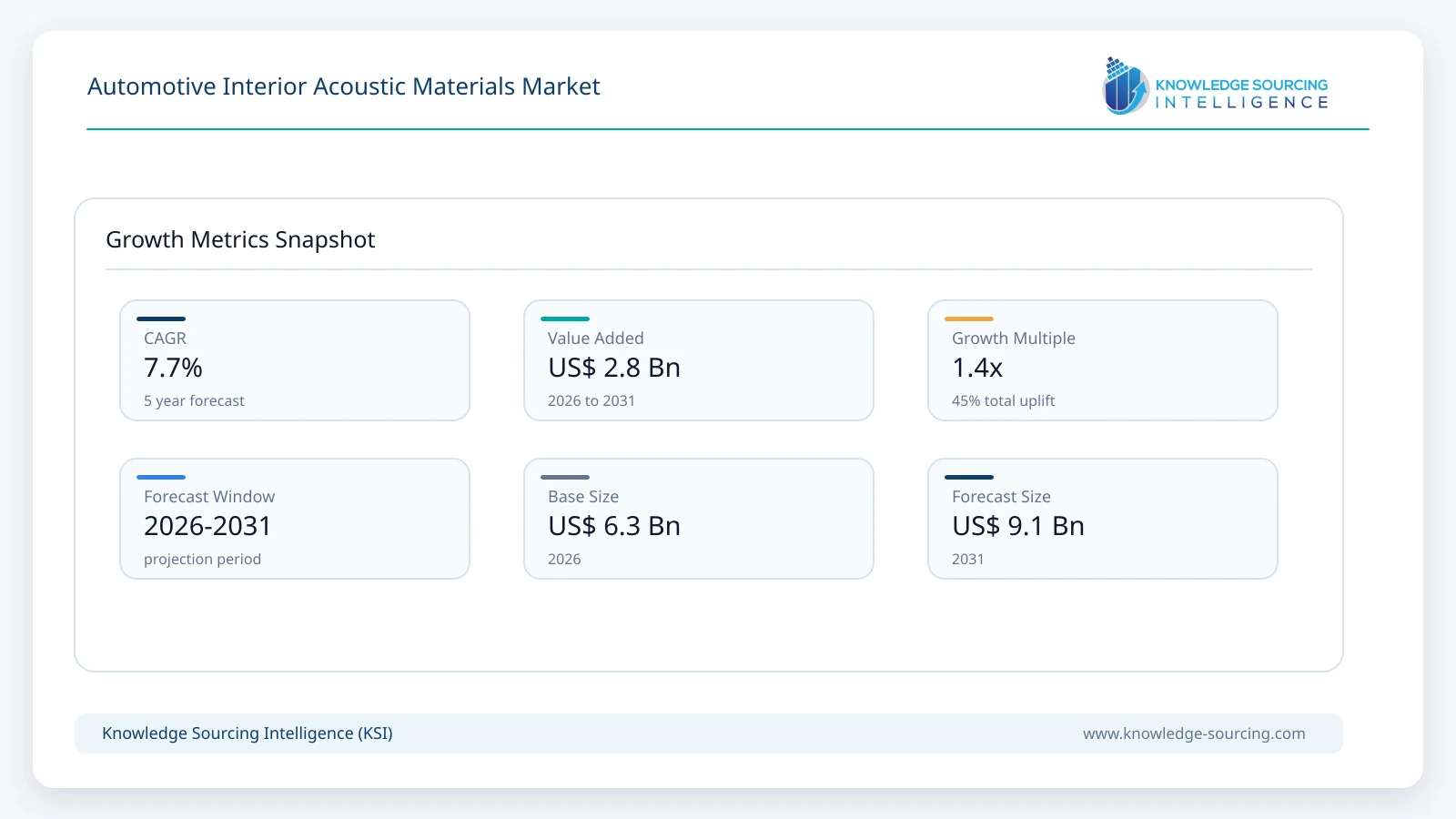
The automotive interior acoustic materials market is estimated at approximately USD 6.300 billion in 2026 and is projected to reach about USD 9.130 billion by 2031, representing a CAGR of 7.7% over the forecast period.
Highlights:
- 1Polyester/PET, felt and other nonwoven fiber systems account for approximately 37% of global market value in 2026 because they combine strong sound absorption, low mass, moldability and increasing recycled-content availability.
- 2Sound-absorption materials represent approximately 44% of 2026 market value, reflecting broad use of porous fiber and foam media in headliners, door cavities, pillars, carpets and luggage areas.
- 3Floor and carpet applications account for approximately 34% of 2026 demand because they cover the largest continuous cabin surface and sit directly above major road and structure-borne noise paths.
- 4Battery-electric vehicles represent approximately 22% of market value in 2026 but are the fastest-growing propulsion application as road, tire and high-frequency auxiliary noise becomes more perceptible in the absence of combustion masking.
- 5Passenger vehicles account for approximately 90% of global demand in 2026, supported by high production volumes and increasingly sophisticated NVH packages in SUVs, EVs and premium vehicles.
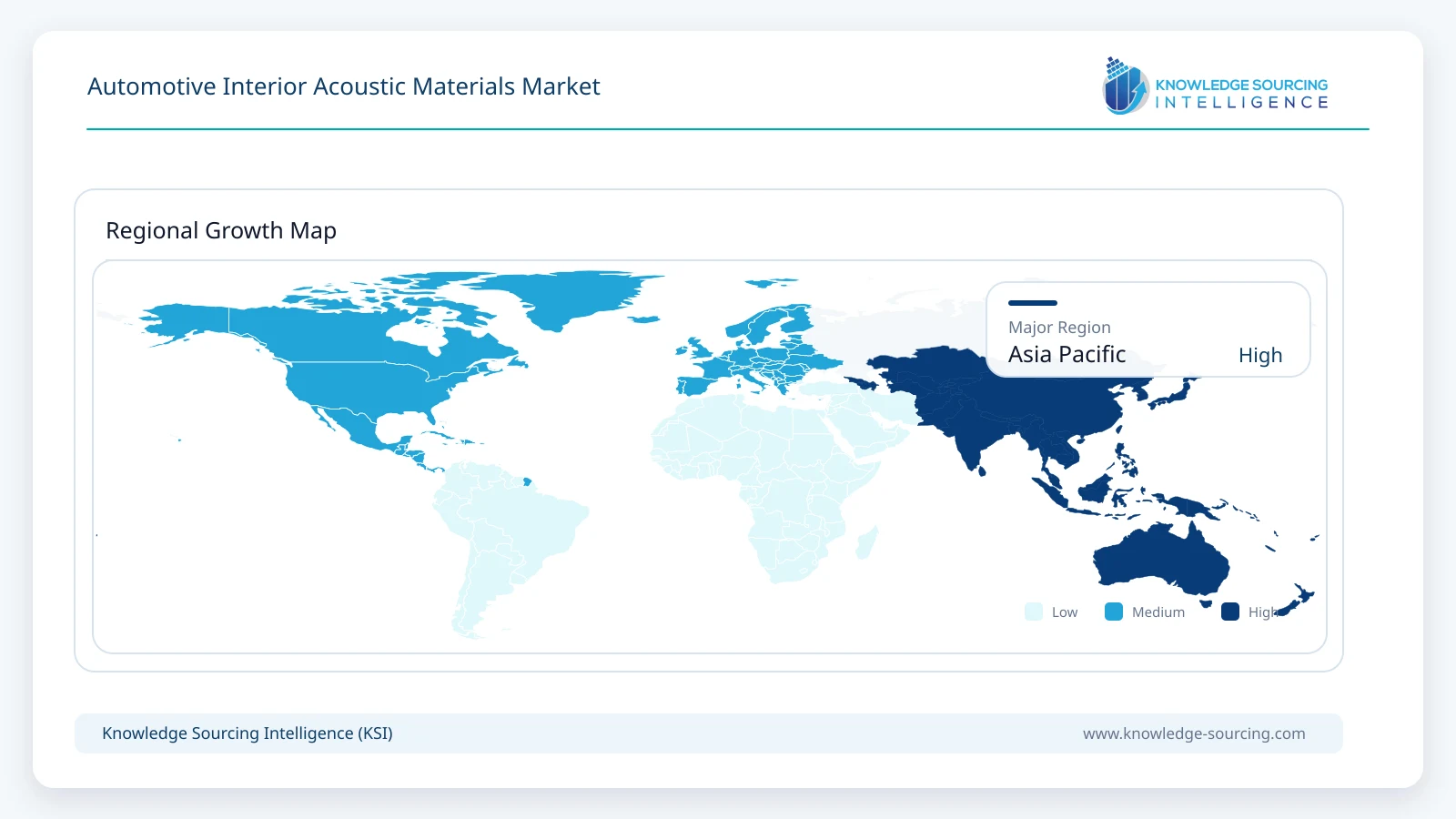
- 6Asia Pacific represents approximately 46% of market value in 2026, reflecting its vehicle-production scale and the rapid expansion of high-content interiors in China, Japan and South Korea.
Interior acoustic materials influence cabin sound through four principal mechanisms. Porous fibers and open-cell structures absorb airborne energy, mass layers reduce sound transmission, viscoelastic media damp panel vibration, and soft decoupling layers limit structural coupling between trim parts and the body-in-white. Most production acoustic packages combine several of these mechanisms rather than relying on one material type.
The materials are converted into carpets, dash insulators, roof and pillar absorbers, door-cavity treatments and luggage-area components by acoustic-system and interior suppliers. Performance is determined not only by material chemistry but also by density, thickness, airflow resistivity, fiber orientation, local geometry and the interaction between layers.
The commercial market is therefore increasingly tied to material engineering and vehicle-level simulation. Suppliers that can reduce grams per square meter while preserving absorption and transmission-loss performance can lower vehicle mass, simplify assembly and improve recyclability without forcing OEMs to compromise cabin refinement.
Market Trends
Recycled PET Is Becoming the Reference Material for Lightweight Acoustic Absorption
Polyester fiber systems are gaining share because they can deliver acoustic absorption with low density while also supporting high recycled content. Autoneum has positioned Flexi-Light PET as a recyclable alternative to polyurethane foam, while Freudenberg supplies PET-based nonwoven acoustic solutions across multiple interior applications.
The move toward PET also improves compatibility between layers. When carpet backing, decouplers and absorbers use the same polymer family, production scrap and end-of-life material can be handled more efficiently than conventional mixed-material stacks.
EVs Are Shifting Acoustic Treatment toward Road and High-Frequency Noise
Battery-electric vehicles remove a major source of low-frequency masking, making tire-road noise, wind turbulence, HVAC systems, pumps and electric-drive tones more noticeable. Interior acoustic materials must therefore control a wider and often higher-frequency spectrum with less reliance on engine-bay treatment.
This strengthens demand for floor absorbers, pillar and roof materials, door-cavity insulation and lightweight multilayer concepts that can be placed close to individual transfer paths rather than adding mass uniformly across the cabin.
Absorber and Barrier Functions Are Converging in Thinner Material Stacks
Suppliers are combining absorption and transmission-loss functions within a single material or tightly integrated laminate. 3M, for example, markets Flexile Acoustic Material as a lightweight layer designed to provide both absorber and barrier behavior in applications where package space is limited.
Functional consolidation can reduce part count and simplify conversion, but it raises the importance of precise material tuning because one structure must now perform across several frequencies and installation conditions.
Mono-Material Design Is Replacing Adhesive-Heavy Multilayer Constructions
Conventional carpets and acoustic insulators often use latex, polyurethane foam, adhesives and mixed fibers that are difficult to separate. New developments increasingly favor polyester-only or simplified fiber systems so that acoustic components can be recovered more easily at end of life.
Circularity is therefore becoming an engineering requirement alongside NVH performance. Suppliers able to provide documented recycled content and recycling pathways are gaining relevance in sourcing decisions, particularly for European and premium EV programs.
Simulation Is Increasing Acoustic Performance per Unit of Material
Vehicle-acoustic simulation and material testing are allowing engineers to identify where a gram of absorber, barrier or damping media produces the greatest cabin benefit. Autoneum operates dedicated acoustics centers and measurement systems to optimize these sound packages before production tooling is finalized.
The result is more localized treatment, variable-density structures and tailored airflow resistance rather than uniform application of thick heavy layers. This supports both cost reduction and lightweighting.
Automotive Interior Acoustic Materials Market Segment Analysis
By Material Type
Polyester/PET, Felt and Nonwoven Fiber Systems
Polyester/PET, felt and other nonwoven fiber systems are the largest material category because they can be engineered across a wide range of densities and thicknesses for carpets, inner dashes, headliners, doors and luggage areas. Their high absorption-to-weight ratio and compatibility with recycled feedstock are accelerating substitution of heavier or less recyclable alternatives.
The segment is estimated at approximately USD 2.33 billion in 2026 and could reach about USD 3.93 billion by 2031. Its share is expected to rise from roughly 37% to 43% as mono-material PET and recycled-fiber constructions gain broader OEM acceptance.
By Acoustic Function
Sound Absorption
Sound absorption is the largest function because porous acoustic media can be distributed across numerous low-mass interior surfaces without requiring the weight of a dense barrier. Headliners, pillars, door cavities, carpet systems and luggage trim all provide useful volume for absorptive treatment.
The segment represents approximately USD 2.77 billion in 2026 and is expected to approach USD 4.29 billion by 2031. Growth is supported by EV noise profiles and continued migration toward fiber-based absorbers that provide more acoustic performance per kilogram.
By Application
Floor and Carpet Systems
Floor and carpet systems lead demand because the floor spans the largest continuous cabin area and lies directly above road, tire, underbody and powertrain excitation paths. Acoustic materials within the system include felt absorbers, decouplers, barrier layers and carpet backings tuned to local body geometry.
The application is valued at approximately USD 2.14 billion in 2026 and could reach about USD 3.01 billion by 2031. Its share should remain near one-third of the market even as headliner and door applications grow more quickly.
By Propulsion
Internal-Combustion Engine Vehicles
Internal-combustion vehicles remain the largest propulsion segment in 2026 because they still represent the majority of the global installed production base and require extensive firewall, tunnel, floor and cabin insulation to manage engine and drivetrain noise.
The segment accounts for approximately USD 3.53 billion in 2026. Its value is expected to grow only modestly to around USD 3.83 billion by 2031 as global production shifts toward electrified powertrains and a larger share of new material innovation is directed to hybrid and battery-electric platforms.
By Vehicle Type
Passenger Vehicles
Passenger vehicles dominate demand because passenger comfort is a major purchase criterion and acoustic packages are applied across nearly every passenger-car and SUV program. Premium vehicles use higher-value materials, but mass-market platforms provide the largest volume base.
Passenger vehicles account for approximately USD 5.67 billion in 2026 and are projected to reach about USD 8.13 billion by 2031. Commercial-vehicle demand grows faster from a smaller base as cab comfort, long-distance driver fatigue and electric commercial platforms increase NVH requirements.
Market Drivers
Higher Cabin-Refinement Targets across Mainstream Vehicles
Acoustic comfort is no longer confined to luxury vehicles. Large infotainment systems, premium audio, quieter powertrains and greater time spent in vehicles have raised consumer expectations for low background noise across mainstream sedans, SUVs and crossovers.
OEMs are responding with more systematic treatment of floors, pillars, doors and roofs, increasing the amount of engineered acoustic media even where visible trim content changes little.
Electrification Is Changing the Frequency Mix of Cabin Noise
Electric propulsion removes combustion masking and makes road, tire, wind and auxiliary-system noise more prominent. This changes acoustic specifications and increases the need for lightweight absorbers and localized insulation close to transmission paths.
Hybrid vehicles also create difficult transient conditions as engines switch on and off, supporting material packages that perform across both combustion and electric operating modes.
Lightweighting Raises the Value of Engineered Fiber Systems
Heavy barriers can deliver strong acoustic isolation but penalize fuel economy and EV range. OEMs increasingly seek materials that achieve comparable cabin performance with lower basis weight through optimized fibers, multilayer structures and local placement.
This creates growth for higher-value PET felts, microfilament absorbers and multifunctional materials even when total kilograms of acoustic treatment per vehicle are reduced.
Circularity Targets Are Accelerating Material Substitution
Interior acoustic stacks are being redesigned around recycled content, mono-material architectures and easier separation. Polyester is particularly well positioned because it can support both acoustic performance and closed-loop material strategies across carpets and absorbers.
European end-of-life policy direction and OEM carbon targets are reinforcing this shift, while global EV brands increasingly use recyclable interior materials as part of product sustainability claims.
Global Vehicle Production Sustains a Large Volume Base
OICA reported global vehicle production of 96.4 million units in 2025, up from 92.7 million in 2024. Even modest growth in vehicle output therefore creates a large absolute demand base for acoustic materials because every vehicle requires some combination of absorbers, insulators and damping media.
The fastest value growth will come from higher acoustic content per vehicle rather than unit production alone, particularly in EVs and premium smart-cabin platforms.
Market Restraints
Severe Cost Pressure on Hidden Interior Materials
Most acoustic materials are invisible to the customer, making them frequent targets for cost reduction during vehicle development. Suppliers must justify incremental material through measurable NVH improvement rather than styling or feature differentiation.
This limits pricing power and favors technologies that reduce mass, part count or assembly steps at the same time they improve acoustic performance.
Vehicle-Specific Acoustic Tuning Limits Standardization
Cabin acoustics depend on body stiffness, glass area, tire selection, suspension, trim geometry and powertrain behavior. A material stack that performs well in one vehicle may deliver a different result in another platform.
Suppliers therefore need repeated simulation, prototyping and validation, which raises engineering cost and prevents full standardization across OEM programs.
Recyclability Can Conflict with Established Acoustic Performance
Legacy polyurethane foams, heavy layers and mixed-fiber structures remain effective and well understood. Replacing them with recyclable mono-material systems can require trade-offs in compression behavior, thermal resistance, forming or low-frequency transmission loss.
OEM qualification cycles can therefore slow material substitution even when the lifecycle case for a new material is strong.
Volatility in Polymer and Recycled-Fiber Feedstock
PET, polypropylene, polyurethane precursors and recycled textile feedstocks are exposed to changes in resin pricing, collection quality and regional availability. Recycled feedstock can also vary in color, contamination and mechanical properties.
Maintaining consistent acoustic performance across high-volume automotive programs requires tight control of fiber blend, density and processing conditions, adding complexity to global sourcing.
Package-Space Constraints Limit Material Thickness
Modern cabins allocate increasing space to wiring, displays, HVAC ducts, batteries and safety systems, leaving less room for thick acoustic stacks. Door cavities, pillars and dash areas are especially constrained.
Materials must therefore deliver higher absorption or transmission loss at lower thickness, increasing development demands and favoring advanced microfibers and engineered laminates over low-cost bulk fillers.
Regional Outlook
Asia Pacific
Asia Pacific is the largest regional market, accounting for approximately 46% of global value in 2026. China, Japan, South Korea and India combine high vehicle-production volumes with rapid electrification and growing demand for quieter, more premium cabins.
Regional growth will be supported by Chinese EV platforms, Japanese acoustic-engineering expertise and continued localization of global suppliers. Autoneum expanded its Chinese footprint through acquisitions in 2025, while local OEM sourcing increasingly emphasizes recyclable materials and lightweight acoustic packages.
Europe
Europe represents approximately 24% of global market value in 2026 and remains an important technology market for low-mass, recycled and circular acoustic materials. Premium vehicle production and stringent OEM sustainability targets support higher material value per vehicle despite slower regional production growth.
The strongest opportunity lies in PET mono-material systems, recyclable carpets and low-mass absorbers that can meet both NVH and lifecycle targets. Suppliers with robust LCA documentation and proven recycling routes are likely to gain sourcing advantages.
Competitive Landscape
The automotive interior acoustic materials market combines vertically integrated acoustic-system suppliers with specialist textile, polymer and adhesive companies. Autoneum and Adler Pelzer operate broad vehicle-acoustic portfolios and convert materials into production components, while Freudenberg Performance Materials and 3M provide specialized nonwovens, absorbers, barriers and damping technologies to OEM and Tier suppliers.
Auria Solutions, Toyota Boshoku and Hayashi Telempu add strong interior-system integration and regional manufacturing capabilities. Competitive differentiation increasingly comes from acoustic performance per unit mass, recycled-content capability, formability and the ability to support both raw-material selection and vehicle-level NVH validation.
Scale remains important because acoustic materials must be produced consistently across regions over long vehicle programs. Suppliers with global converting networks, OEM-qualified material libraries and simulation expertise are better positioned to transfer new PET and fiber technologies from premium launches into mass-market platforms.
Recent Developments
February 2026: Freudenberg Performance Materials announced that its Techtextil 2026 automotive showcase would include Finsol lightweight acoustic nonwovens for door panels, trunk liners, headliners and other vehicle applications.
December 2025: Autoneum announced a suite of 100% polyester interior and exterior components for the Polestar 5, reinforcing OEM adoption of fully recyclable acoustic material systems in premium battery-electric vehicles.
September 2025: Autoneum used IAA Mobility 2025 to highlight Flexi-Light PET, Di-Light and N-Join1, emphasizing recycled-content and fully recyclable acoustic materials for next-generation vehicles.
July 2025: Autoneum introduced Flexi-Light PET, a polyester felt-based acoustic insulation material using up to 90% recycled content and designed as a recyclable alternative to polyurethane foam in carpets and inner dashes.
July 2025: Autoneum launched N-Join1, an adhesive-free carpet architecture that can use 100% polyester substrates and supports waste-free production and end-of-life recycling.
February 2025: Autoneum completed the acquisition of a majority stake in Jiangsu Huanyu Group, expanding its Chinese production footprint across carpets, dashes, headliners, trunk trim and other acoustic-interior products.
Market Outlook
The automotive interior acoustic materials market is expected to expand from approximately USD 6.300 billion in 2026 to about USD 9.130 billion by 2031. Polyester/PET and other engineered fiber systems will capture a growing share as OEMs seek lower mass, higher recycled content and easier end-of-life recovery.
Material value will increasingly shift from commodity foam and heavy layers toward designed acoustic media with controlled airflow resistance, variable density and combined absorber-barrier functions. Battery-electric vehicles will be the fastest-growing propulsion application and should account for roughly one-third of market value by 2031.
Asia Pacific will remain the largest regional market, while Europe continues to influence circular-material standards and lightweight technology adoption. Competitive advantage will depend on acoustic performance per kilogram, global manufacturing consistency, recycling pathways and the ability to validate material behavior within complete vehicle sound packages.
Automotive Interior Acoustic Materials Market Scope:
| Report Metric | Details |
|---|---|
| Total Market Size in 2026 | USD 6.300 billion |
| Total Market Size in 2031 | USD 9.130 billion |
| Forecast Unit | USD Billion |
| Growth Rate | 7.7% |
| Study Period | 2021 to 2031 |
| Historical Data | 2021 to 2024 |
| Base Year | 2025 |
| Forecast Period | 2026 – 2031 |
| Segmentation | Material Type, Acoustic Function, Application, Propulsion, Vehicle Type, Geography |
| Companies |
|
Market Segmentation
By Material Type
Polyester/PET, Felt and Nonwoven Fiber Systems
Polyurethane Foam
Heavy and Flexible Barrier Materials
Recycled Cotton and Natural-Fiber Materials
Specialty Composites and Others
By Acoustic Function
Sound Absorption
Sound Insulation and Barrier
Vibration Damping
Decoupling and Sealing
By Application
Floor and Carpet Systems
Dash, Firewall and Tunnel
Headliner and Roof
Door, Pillar and Side Trim
Luggage Compartment and Rear Deck
Others
By Propulsion
Internal-Combustion Engine Vehicles
Hybrid and Plug-In Hybrid Vehicles
Battery Electric Vehicles
By Vehicle Type
Passenger Vehicles
Light Commercial Vehicles
Medium and Heavy Commercial Vehicles and Buses
By Geography
North America
United States
Canada
Mexico
South America
Brazil
Argentina
Others
Europe
Germany
United Kingdom
France
Italy
Spain
Others
Middle East and Africa
Saudi Arabia
UAE
South Africa
Others
Asia Pacific
China
Japan
South Korea
India
Indonesia
Thailand
Others
Table of Contents
1. INTRODUCTION
1.1. Market Overview
1.2. Market Definition
1.3. Scope of the Study
1.4. Market Segmentation
1.5. Currency
1.6. Assumptions
1.7. Base and Forecast Years
1.8. Key Benefits to Stakeholders
2. RESEARCH METHODOLOGY
2.1. Research Design
2.2. Secondary Research
2.3. Primary Research
2.4. Market Estimation
2.5. Segment Modelling
2.6. Data Triangulation and Validation
3. EXECUTIVE SUMMARY
3.1. Key Findings
3.2. Automotive Interior Acoustic Materials Market Size, 2026-2031
3.3. Material Type Outlook
3.4. Acoustic Function Outlook
3.5. Application Outlook
3.6. Propulsion Outlook
3.7. Vehicle Type Outlook
3.8. Regional Opportunity Summary
4. MARKET DYNAMICS
4.1. Market Drivers
4.1.1. Higher Cabin-Refinement Targets across Mainstream Vehicles
4.1.2. Electrification Is Changing the Frequency Mix of Cabin Noise
4.1.3. Lightweighting Raises the Value of Engineered Fiber Systems
4.1.4. Circularity Targets Are Accelerating Material Substitution
4.1.5. Global Vehicle Production Sustains a Large Volume Base
4.2. Market Restraints
4.2.1. Severe Cost Pressure on Hidden Interior Materials
4.2.2. Vehicle-Specific Acoustic Tuning Limits Standardization
4.2.3. Recyclability Can Conflict with Established Acoustic Performance
4.2.4. Volatility in Polymer and Recycled-Fiber Feedstock
4.2.5. Package-Space Constraints Limit Material Thickness
4.3. Market Opportunities
4.4. Porter's Five Forces Analysis
4.5. Industry Value Chain Analysis
4.6. Acoustic Performance, Weight and Cost Trade-Offs
4.7. Recycled Content, VOC and End-of-Life Requirements
5. TECHNOLOGY OUTLOOK
5.1. Polyester/PET Acoustic Felts and Nonwovens
5.2. Microfiber and Microfilament Absorbers
5.3. Polyurethane Acoustic Foams
5.4. Heavy Layers and Flexible Barrier Materials
5.5. Viscoelastic and Constrained-Layer Damping Media
5.6. Recycled Cotton and Mixed-Fiber Absorbers
5.7. Natural-Fiber Acoustic Materials
5.8. Decoupling and Spacer Layers
5.9. Mono-Material PET Acoustic Stacks
5.10. Absorber-Barrier Hybrid Materials
5.11. Acoustic Material Testing and Airflow-Resistance Optimization
5.12. Vehicle-Level Simulation and Material Placement Optimization
6. AUTOMOTIVE INTERIOR ACOUSTIC MATERIALS MARKET BY MATERIAL TYPE
6.1. Introduction
6.2. Polyester/PET, Felt and Nonwoven Fiber Systems
6.3. Polyurethane Foam
6.4. Heavy and Flexible Barrier Materials
6.5. Recycled Cotton and Natural-Fiber Materials
6.6. Specialty Composites and Others
7. AUTOMOTIVE INTERIOR ACOUSTIC MATERIALS MARKET BY ACOUSTIC FUNCTION
7.1. Introduction
7.2. Sound Absorption
7.3. Sound Insulation and Barrier
7.4. Vibration Damping
7.5. Decoupling and Sealing
8. AUTOMOTIVE INTERIOR ACOUSTIC MATERIALS MARKET BY APPLICATION
8.1. Introduction
8.2. Floor and Carpet Systems
8.3. Dash, Firewall and Tunnel
8.4. Headliner and Roof
8.5. Door, Pillar and Side Trim
8.6. Luggage Compartment and Rear Deck
8.7. Others
9. AUTOMOTIVE INTERIOR ACOUSTIC MATERIALS MARKET BY PROPULSION
9.1. Introduction
9.2. Internal-Combustion Engine Vehicles
9.3. Hybrid and Plug-In Hybrid Vehicles
9.4. Battery Electric Vehicles
10. AUTOMOTIVE INTERIOR ACOUSTIC MATERIALS MARKET BY VEHICLE TYPE
10.1. Introduction
10.2. Passenger Vehicles
10.3. Light Commercial Vehicles
10.4. Medium and Heavy Commercial Vehicles and Buses
11. AUTOMOTIVE INTERIOR ACOUSTIC MATERIALS MARKET BY GEOGRAPHY
11.1. North America
11.1.1. United States
11.1.2. Canada
11.1.3. Mexico
11.2. South America
11.2.1. Brazil
11.2.2. Argentina
11.2.3. Others
11.3. Europe
11.3.1. Germany
11.3.2. United Kingdom
11.3.3. France
11.3.4. Italy
11.3.5. Spain
11.3.6. Others
11.4. Middle East and Africa
11.4.1. Saudi Arabia
11.4.2. UAE
11.4.3. South Africa
11.4.4. Others
11.5. Asia Pacific
11.5.1. China
11.5.2. Japan
11.5.3. South Korea
11.5.4. India
11.5.5. Indonesia
11.5.6. Thailand
11.5.7. Others
12. COMPETITIVE ENVIRONMENT AND ANALYSIS
12.1. Major Players and Strategy Analysis
12.2. Market Share Analysis
12.3. PET versus PU versus Heavy-Layer Material Benchmarking
12.4. Absorption, Barrier and Damping Performance Comparison
12.5. Recycled Content and Circularity Benchmarking
12.6. Weight and Cost Benchmarking
12.7. OEM Qualification and Production Readiness
12.8. Competitive Dashboard
13. COMPANY PROFILES
13.1. Autoneum Holding Ltd.
13.2. Adler Pelzer Group
13.3. Auria Solutions Ltd.
13.4. Freudenberg Performance Materials
13.5. 3M Company
13.6. Toyota Boshoku Corporation
13.7. Hayashi Telempu Corporation
13.8. Sumitomo Riko Company Limited
14. APPENDIX
14.1. Currency
14.2. Assumptions
14.3. Base and Forecast Years Timeline
14.4. Key Benefits for Stakeholders
14.5. Research Methodology
14.6. Abbreviations
14.7. Data Sources
Navigate
Trusted by the world's leading organizations











