
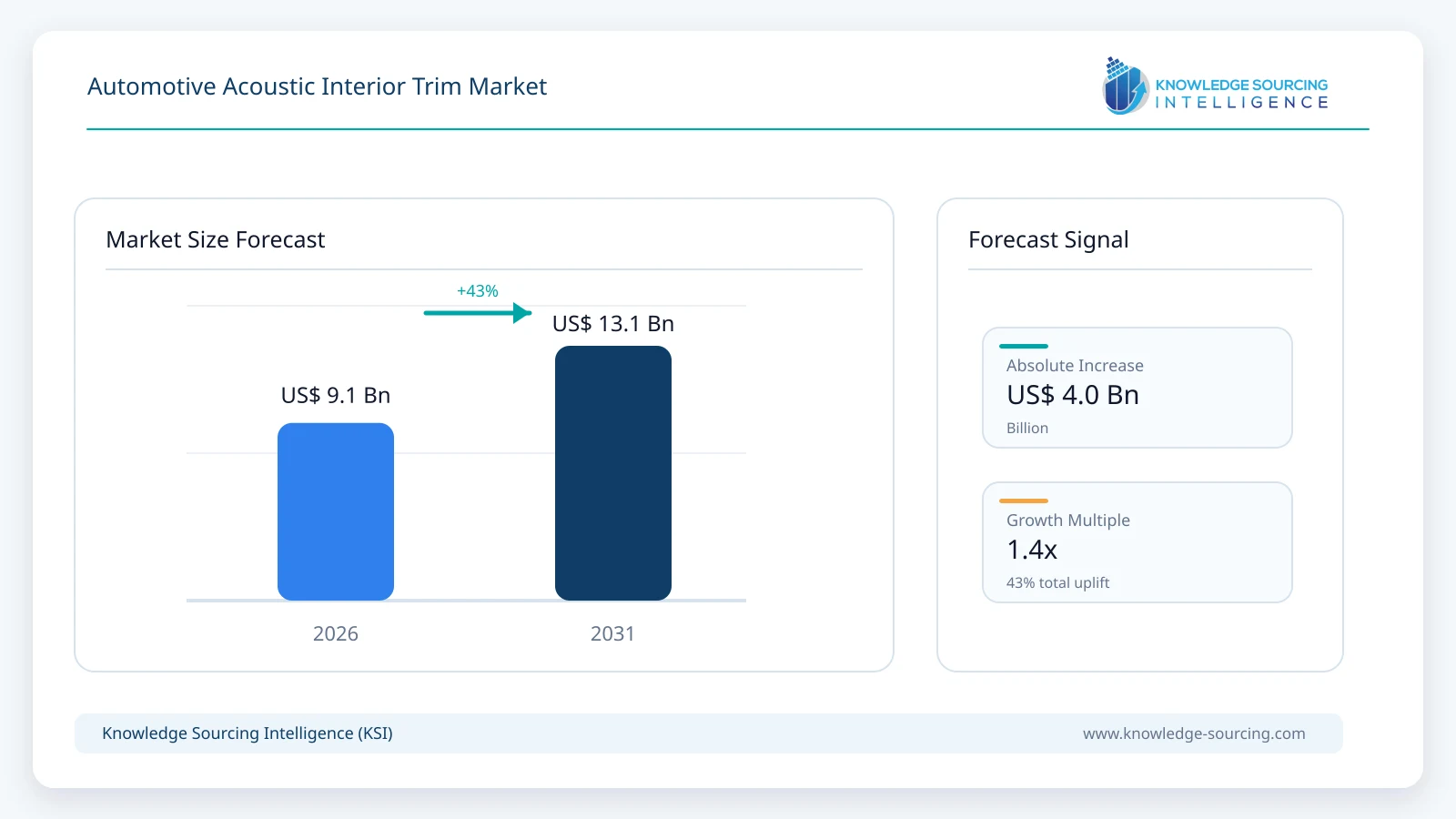
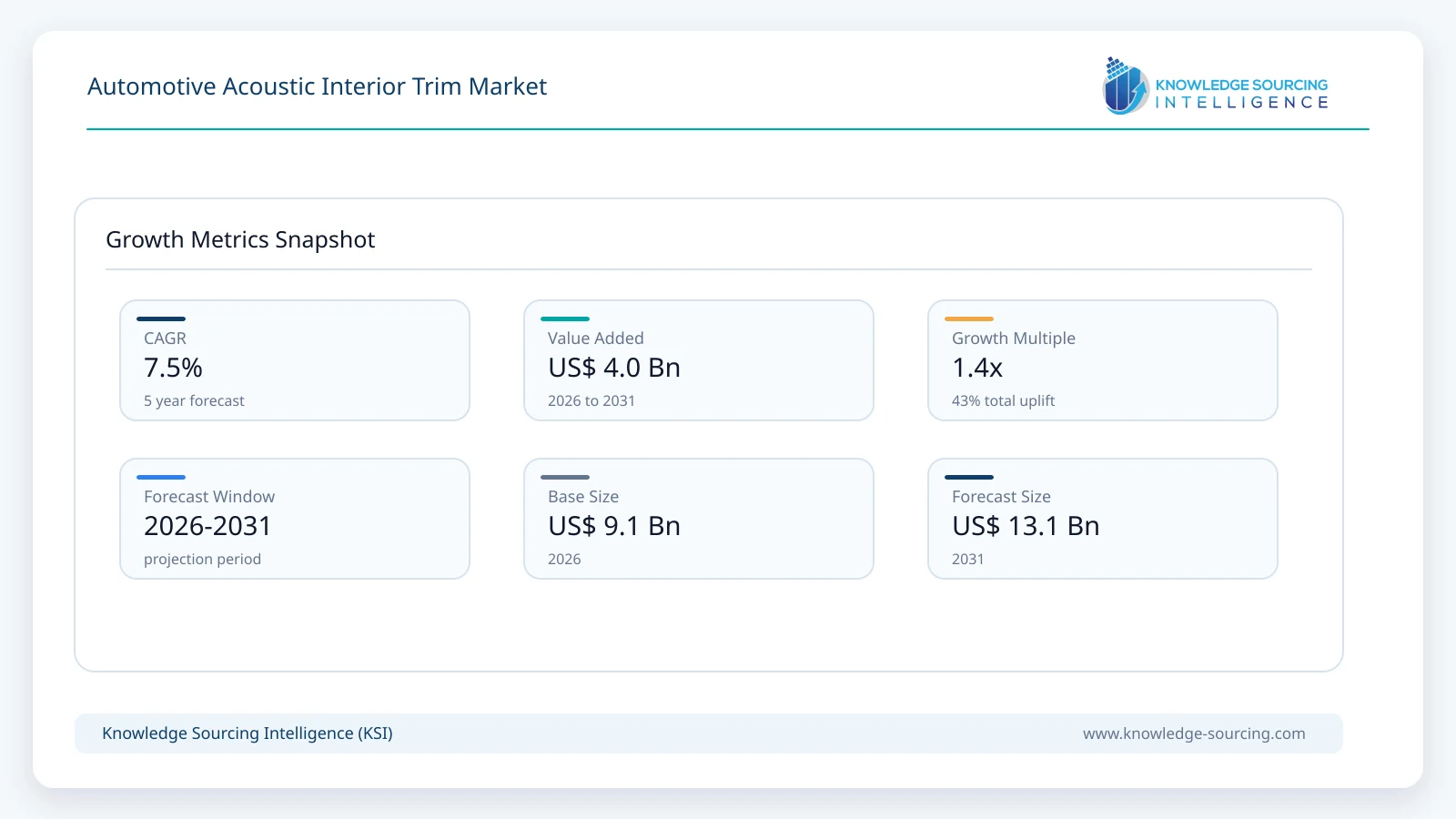
The automotive acoustic interior trim market is estimated at approximately USD 9.10 billion in 2026 and is projected to reach about USD 13.05 billion by 2031, representing a CAGR of 7.5% during the forecast period.
Highlights:
- 1Floor and carpet systems account for approximately 36% of global market value in 2026 because virtually every light vehicle uses an integrated combination of visible carpet, backing, absorbers and floor insulation to control road and structure-borne noise.
- 2Polyester/PET and nonwoven fiber systems represent approximately 36% of material value in 2026 and are gaining share as suppliers replace latex, polyurethane and mixed-material structures with lighter recyclable constructions.
- 3Internal-combustion vehicles remain the largest propulsion segment in 2026, but battery-electric vehicles are the fastest-growing application as OEMs increase treatment of floor, dash, roof and luggage areas to manage newly exposed noise sources.
- 4Passenger vehicles account for approximately 89% of market value in 2026, supported by higher acoustic-content levels in SUVs, premium cars and EVs and by the broad use of carpet, headliner and luggage-compartment trim.
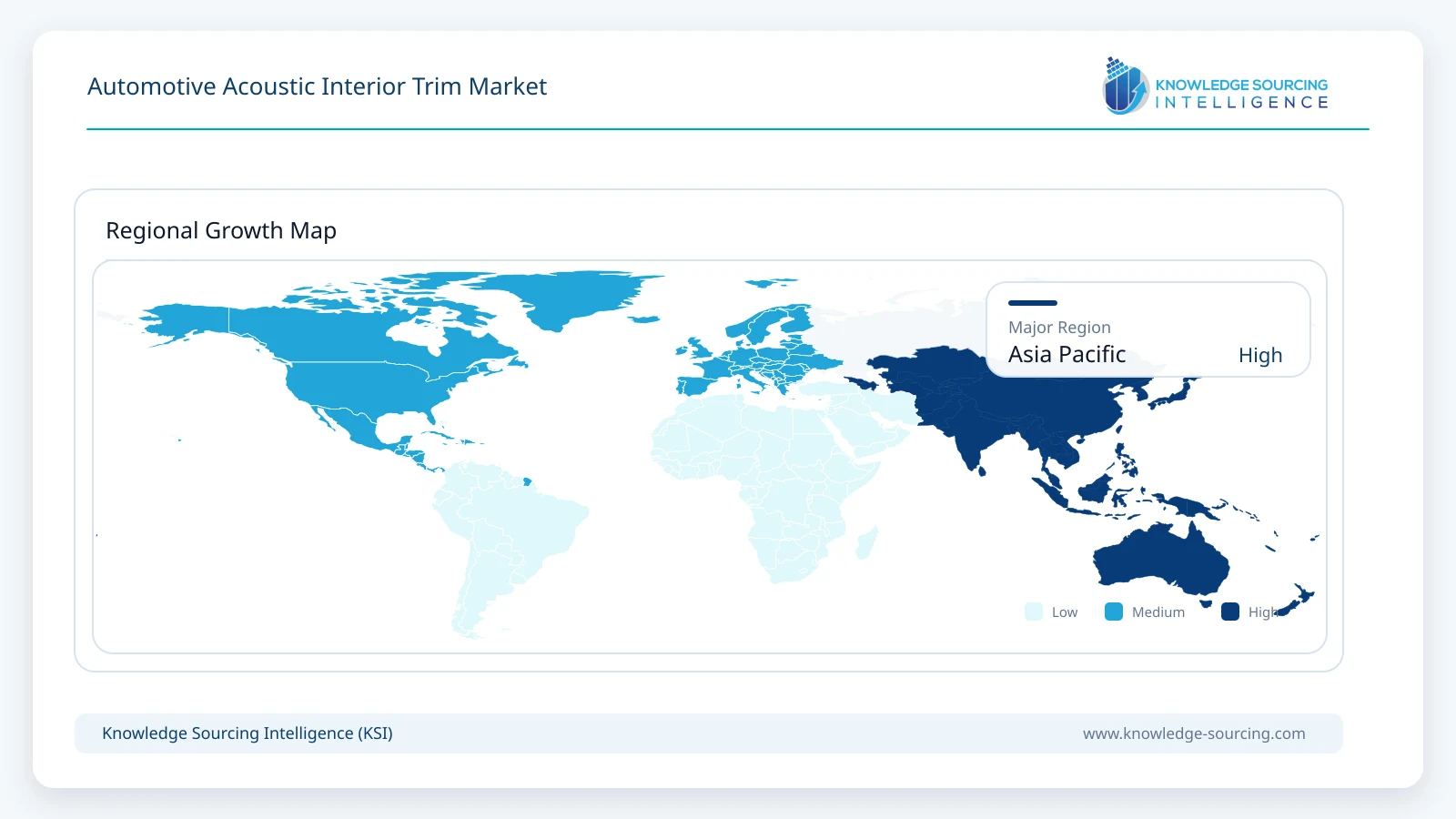
- 5Asia Pacific represents approximately 45% of global market value in 2026, reflecting the region's vehicle-production scale and rapid increase in cabin-comfort content among Chinese, Japanese and South Korean OEMs.
- 6The market is shifting from material-heavy multilayer packages toward simulation-optimized, mono-material and multifunctional trim that combines acoustics, appearance, thermal performance and recyclability in one component.
The market covers cabin trim components engineered to deliver both interior finish and measurable acoustic performance, with floor systems and inner-dash insulation forming the largest value pools.
Electrification is changing where acoustic trim is required. Battery-electric vehicles remove engine masking and increase the importance of road, tire, wind, HVAC and electric-drive noise, while flatter floors and new cabin layouts create different paths for sound transmission. OEMs are therefore redesigning carpet backings, dash insulation, roof absorbers and luggage trim for lower mass and more targeted frequency control.
The market excludes acoustic glazing, active noise cancellation, exterior wheelhouse and underbody treatments, engine-bay encapsulation, standalone seals and general decorative trim without an acoustic function. Components are included where acoustic absorption, transmission loss or damping is an explicit part of the engineering specification.
Market Overview
Acoustic interior trim manages noise after it enters or begins radiating within the passenger compartment. Porous fibers absorb airborne energy, heavy or tuned layers improve transmission loss, decouplers reduce structural coupling and molded trim closes paths around the floor, dash, pillars, roof and luggage area. Because these parts also define cabin appearance and touch quality, acoustic performance must be integrated with styling, durability and assembly requirements.
Floor systems are the largest acoustic trim architecture because they span a large surface area and sit close to road, tire and powertrain excitation paths. Inner-dash and tunnel insulators provide another critical barrier between the cabin and front structure, while headliners, door trim and luggage components manage reflected sound and local transmission through thinner body panels.
Modern systems are increasingly engineered as complete sound packages rather than isolated parts. Material density, fiber orientation, thickness and local placement are optimized through simulation and vehicle testing so that acoustic targets can be met with less mass. This favors suppliers able to combine material science, trim manufacturing and vehicle-level NVH engineering.
Market Trends
Mono-Material PET Systems Are Moving into Mainstream Interior Trim
Recyclable polyester architectures are expanding across carpets, floor insulation and complex molded acoustic parts. Autoneum's N-Join1 carpet removes latex and adhesive-heavy joining, while Flexi-Light PET uses recycled polyester felt as a shapeable acoustic decoupler for carpets and inner dashes.
The shift is commercially important because OEM sustainability targets increasingly extend beyond recycled content to end-of-life separation. Mono-material systems reduce disassembly complexity while preserving the acoustic and mechanical performance required for high-volume interiors.
EV Acoustic Packages Are Becoming More Floor- and Cabin-Focused
Battery-electric vehicles reduce combustion noise but expose tire-road excitation, aerodynamic noise and electric-drive tones. Acoustic trim therefore moves away from engine-focused treatment toward floor, wheelhouse-adjacent cabin surfaces, dash areas and luggage compartments.
This changes both material placement and value per vehicle. Lightweight absorbers and tuned carpet backings can be added selectively around the dominant transfer paths instead of relying on conventional heavy barriers developed for combustion platforms.
Decorative and Acoustic Functions Are Converging in One Part
Headliners, door panels, parcel shelves and luggage trim increasingly combine surface finish with acoustic absorption, structural stiffness and local thermal functions. The component is therefore judged simultaneously on craftsmanship, sound performance, mass and recyclability.
Integration reduces part count but raises engineering complexity because visible trim must maintain color, texture and dimensional quality while its backing layers are tuned for specific frequency ranges and cabin geometries.
Simulation Is Reducing Material Mass per Decibel of Performance
Vehicle-level acoustic simulation allows suppliers to identify the locations where added material produces the greatest reduction in cabin noise. Autoneum and Adler Pelzer both position predictive modelling and acoustic testing as core tools for optimizing sound packages.
This favors tailored density and thickness rather than uniform material addition. The result is a gradual move toward thinner, lighter components with more precisely engineered fiber structures and local absorbers.
Circularity Is Becoming a Design Constraint, Not a Secondary Attribute
Carpets, foams and multilayer insulators have historically been difficult to recycle because they combine dissimilar polymers, adhesives and coatings. New product development is increasingly centered on recyclable PET, natural fibers and processes that eliminate latex or simplify layer separation.
European circular-economy policy and OEM carbon targets reinforce the trend, while Chinese EV manufacturers are also pushing lower-mass and lower-carbon interior systems. Suppliers that can document lifecycle benefits without sacrificing NVH performance gain a stronger sourcing position.
Segment Analysis
By Component: Floor and Carpet Systems
Floor and carpet systems lead the market because they cover the cabin's largest continuous interior surface and sit directly above major road and structure-borne noise paths. The system can combine decorative carpet, molded backing, absorbers, decouplers and local insulation in one assembly.
The segment is estimated at approximately USD 3.28 billion in 2026 and could reach about USD 4.44 billion by 2031. Share will ease slightly as roof, door and luggage acoustic content grows, but recyclable carpet systems and lighter backings will sustain strong value creation.
By Material: Polyester/PET and Nonwoven Fiber Systems
Polyester and nonwoven fiber systems hold the largest material share because they can be engineered for absorption, molding, surface appearance and low mass across carpets, insulators, headliners and luggage trim. Recycled PET also aligns well with OEM circularity programs.
The segment represents approximately USD 3.28 billion in 2026 and is expected to exceed USD 5.5 billion by 2031. Growth will come from replacement of polyurethane foam, latex-backed carpet and mixed-material constructions with recyclable felt and mono-material PET solutions.
By Propulsion: Internal-Combustion Engine Vehicles
Internal-combustion vehicles remain the largest 2026 propulsion segment because they still account for most global production and use mature acoustic packages around the floor, dash, tunnel and luggage area. These systems control both powertrain and road-noise transmission.
The segment is estimated at approximately USD 6.19 billion in 2026. Its absolute value is expected to decline only gradually, but share will fall materially by 2031 as BEV and hybrid platforms take a larger portion of production and adopt higher-value lightweight interior sound packages.
By Vehicle Type: Passenger Vehicles
Passenger cars, SUVs and MPVs dominate demand because cabin refinement directly affects perceived quality and because these vehicles use the widest range of visible and concealed acoustic trim. SUVs in particular carry large floor, roof and luggage surfaces that increase trim content per vehicle.
Passenger vehicles account for approximately USD 8.10 billion in 2026 and are projected to approach USD 11.6 billion by 2031. Commercial vehicles remain smaller but benefit from growing emphasis on driver comfort and recyclable flooring in long-duty applications.
Market Drivers
Higher Cabin-Refinement Targets across Mainstream Vehicles
Acoustic comfort is no longer limited to luxury models. Better interior quietness improves speech intelligibility, audio performance and perceived build quality, encouraging OEMs to upgrade carpet backings, dash insulation and headliner absorption in higher-volume segments.
As large displays and quieter powertrains reduce other sources of cabin distraction, unwanted road and wind noise becomes more noticeable. Acoustic trim is therefore increasingly treated as part of the customer-experience package rather than a hidden engineering cost.
Electrification Is Rewriting Interior Noise Paths
BEVs remove engine masking and expose road, tire, HVAC and electric-drive sounds that are transmitted through the floor, dash and body structure. This creates demand for acoustic trim tuned to different frequencies and source locations than conventional combustion platforms.
Flat floors and battery structures also change packaging space and structural behavior. Suppliers that can redesign carpet, floor insulation and dash systems specifically for EV architectures gain incremental content opportunities.
Lightweighting Raises the Value of Engineered Fiber Systems
Heavy mass barriers conflict with range and efficiency targets, particularly in EVs. OEMs increasingly seek lower-density absorbers, tuned multilayers and fiber-based systems that deliver more acoustic performance per kilogram.
The value proposition shifts from raw material quantity toward material engineering. Higher-performance PET felts, optimized nonwovens and integrated structures can command more value even as total component mass declines.
OEM Circularity Targets Are Accelerating Recyclable Trim Adoption
Interior carpet and insulation are significant mixed-material waste streams at vehicle end of life. Mono-material polyester systems, recycled fibers and adhesive-free constructions provide a clearer path to closed-loop recycling and lower lifecycle emissions.
This is pushing suppliers to redesign the complete stack rather than add recycled content to conventional parts. Technologies that retain acoustic performance while simplifying material separation are moving closer to production-scale adoption.
Global Vehicle Production Remains a Large Installed Demand Base
OICA reported global vehicle production of approximately 96.4 million units in 2025, providing a broad production base for acoustic interior trim. Even modest growth in units creates substantial demand because floor, dash and cabin trim are fitted across almost every light vehicle.
The stronger growth is in content per vehicle. Asia is gaining production share while Chinese OEMs raise cabin-comfort specifications, supporting both higher volume and higher average acoustic-trim value in the region.
Market Restraints
Severe Cost Pressure on Hidden Interior Components
Much of acoustic trim is concealed below carpet, behind panels or inside the dash, making it difficult for consumers to value directly. OEM purchasing teams therefore apply strong cost pressure even when the component has a meaningful effect on refinement.
Suppliers must prove acoustic benefit with minimal material and process cost. Multifunctional parts and manufacturing steps that reduce adhesives, scrap or assembly complexity have an advantage.
Vehicle-Specific Acoustic Tuning Limits Standardization
Trim performance depends on body stiffness, tire selection, floor geometry, battery packaging and cabin volume. A carpet or dash package cannot be transferred unchanged across unrelated vehicle platforms.
Repeated simulation, tooling and validation increase engineering cost and can slow product reuse. Platform-based material families help, but local thickness and density still require vehicle-specific calibration.
Recyclability Can Conflict with Established Performance Targets
Mono-material structures must match incumbent solutions for sound absorption, transmission loss, dimensional stability, moisture resistance and long-term durability. Some legacy multilayer combinations remain difficult to replace at equal thickness and cost.
The transition can therefore require new forming processes and qualification cycles. Suppliers face a temporary cost and development burden before circular materials achieve full scale.
Large Trim Parts Create Logistics and Tooling Constraints
Molded carpets, headliners and luggage trim occupy substantial volume in transport and often require large dedicated tooling. Production is therefore closely tied to OEM assembly locations and model-specific launch schedules.
Low utilization after a vehicle program ends can reduce returns on tooling and equipment. Local manufacturing footprint and strong launch execution remain important barriers to entry.
Material Price and Quality Variability Affect Recycled Fiber Systems
Greater use of recycled PET and recovered fibers exposes suppliers to variation in feedstock purity, color, mechanical behavior and pricing. Automotive trim requires tighter consistency than many commodity recycling applications.
Suppliers need controlled sourcing and robust material specifications to prevent variation from affecting molding, surface quality or acoustic performance. This can limit the speed at which very high recycled content is adopted.
Regional Outlook
Asia Pacific
Asia Pacific is the largest regional market, supported by vehicle production in China, Japan, South Korea and India and by rapid improvement in cabin refinement across local brands. China is particularly important because EV and premium-smart-cabin competition is increasing acoustic content in mainstream vehicles.
The supplier base is also expanding. Autoneum strengthened its Chinese interior business through acquisitions, while Toyota Boshoku, Hayashi Telempu and regional carpet and trim specialists provide local development and manufacturing capacity.
Growth through 2031 will combine production scale with higher value per vehicle. Recyclable carpets, lightweight PET insulation and integrated decorative-acoustic trim should gain faster adoption as Asian OEMs target export markets and more premium cabin experiences.
Europe
Europe remains a high-value market because premium vehicle production, stringent mass and CO2 targets and circular-economy priorities favor lightweight acoustic trim with high recycled content. The region is also home to major suppliers including Autoneum and Adler Pelzer.
European OEMs are pushing mono-material carpets, recycled fiber insulators and lower-carbon manufacturing while still requiring strong NVH performance. BEV platforms increase the importance of floor and dash acoustic tuning as road and auxiliary noise becomes more exposed.
Regional growth will be content-led rather than volume-led. Suppliers able to combine acoustic performance, recyclability and premium surface quality will capture more value as conventional multilayer systems are redesigned.
Competitive Landscape
The automotive acoustic interior trim market is concentrated around suppliers that combine material development, acoustic engineering and large-part manufacturing. Autoneum, Adler Pelzer and Auria hold broad portfolios across carpets, dash insulation, headliners, trunk trim and molded acoustic systems, while Toyota Boshoku and Hayashi Telempu add strong Asian OEM relationships and interior-integration capability.
Antolin competes through headliners and complete interior systems, while 3M and Sumitomo Riko contribute specialty absorbers, damping and insulation materials. The competitive boundary is increasingly defined by the ability to offer recyclable material stacks rather than by access to conventional foam or carpet processing alone.
Production footprint remains a major differentiator because floor carpets, headliners and luggage trim are bulky, model-specific and frequently supplied close to final assembly plants. Suppliers with global engineering standards and regional manufacturing can scale new PET-based technologies more quickly across OEM platforms.
Recent Developments
27 July 2026: Autoneum's Flexi-Light PET recycled-polyester acoustic felt was named a finalist for the 2026 Automotive News PACE Pilot Award, highlighting growing industry interest in recyclable alternatives to polyurethane foam for interior insulation.
28 July 2026: Toyota Boshoku detailed the development of illuminated door trim for the 2026 Lexus ES, reinforcing the broader shift toward multifunctional interior panels that combine surface design with cabin-comfort functions.
29 January 2026: FORVIA announced new interior business with a major European automaker that includes instrument and door panels using natural-fiber materials, supporting lighter and more sustainable trim architectures.
16 December 2025: Autoneum disclosed a suite of 100% polyester components developed with Polestar for the Polestar 5, including interior cockpit hush panels and other lightweight acoustic parts designed for recyclability and passenger comfort.
8 July 2025: Autoneum introduced Flexi-Light PET, a recycled-polyester felt system designed as a recyclable acoustic decoupler for carpets and inner dashes and positioned as an alternative to polyurethane foam.
1 July 2025: Autoneum launched N-Join1, an adhesive-free carpet system that can use 100% polyester substrates, enabling waste-free production and full end-of-life recyclability while maintaining NVH performance.
Market Outlook
The automotive acoustic interior trim market is expected to grow from approximately USD 9.100 billion in 2026 to about USD 13.050 billion by 2031. Floor and carpet systems will remain the largest component group, while headliner, door and luggage acoustic trim gain value as OEMs pursue broader cabin refinement with less material mass.
The most important technology shift will be toward recycled and mono-material polyester systems. PET-based carpets, felts and molded insulators are positioned to take share from polyurethane foam, latex-backed constructions and difficult-to-recycle multilayer parts as OEMs tighten circularity requirements.
Asia Pacific will remain the largest regional market, while Europe continues to lead adoption of lightweight and circular trim concepts. Competitive advantage will depend on acoustic performance per kilogram, global launch capability, recyclable material design and the ability to integrate visible trim quality with hidden NVH functionality.
Automotive Acoustic Interior Trim Market Scope
| Report Metric | Details |
|---|---|
| Total Market Size in 2026 | USD 9.10 billion |
| Total Market Size in 2031 | USD 13.05 billion |
| Forecast Unit | Billion |
| Growth Rate | 7.5% |
| Study Period | 2021 to 2031 |
| Historical Data | 2021 to 2024 |
| Base Year | 2025 |
| Forecast Period | 2026 – 2031 |
| Segmentation | Component, Material, Propulsion, Vehicle Type, Geography |
| Companies |
|
Market Segmentation
By Component
Floor and Carpet Systems
Inner Dash and Tunnel Insulation
Headliners and Roof Acoustic Trim
Door, Pillar and Side Trim
Luggage-Compartment and Parcel-Shelf Trim
Others
By Material
Polyester/PET and Nonwoven Fiber Systems
Polyurethane Foam
Recycled Cotton and Mixed Fibers
Polypropylene and Natural-Fiber Composites
Others
By Propulsion
Internal-Combustion Engine Vehicles
Hybrid and Plug-In Hybrid Vehicles
Battery Electric Vehicles
By Vehicle Type
Passenger Vehicles
Light Commercial Vehicles
Medium and Heavy Commercial Vehicles and Buses
By Geography
North America
United States
Canada
Mexico
South America
Brazil
Argentina
Others
Europe
Germany
United Kingdom
France
Italy
Spain
Others
Middle East and Africa
Saudi Arabia
UAE
South Africa
Others
Asia Pacific
China
Japan
South Korea
India
Indonesia
Thailand
Others
Table of Contents
1. INTRODUCTION
1.1. Market Overview
1.2. Market Definition
1.3. Scope of the Study
1.4. Market Segmentation
1.5. Currency
1.6. Assumptions
1.7. Base and Forecast Years
1.8. Key Benefits to Stakeholders
2. RESEARCH METHODOLOGY
2.1. Research Design
2.2. Secondary Research
2.3. Primary Research
2.4. Market Estimation
2.5. Segment Modelling
2.6. Data Triangulation and Validation
3. EXECUTIVE SUMMARY
3.1. Key Findings
3.2. Automotive Acoustic Interior Trim Market Size, 2026-2031
3.3. Component Outlook
3.4. Material Outlook
3.5. Propulsion Outlook
3.6. Vehicle Type Outlook
3.7. Regional Opportunity Summary
4. MARKET DYNAMICS
4.1. Market Drivers
4.1.1. Higher Cabin-Refinement Targets across Mainstream Vehicles
4.1.2. Electrification Is Rewriting Interior Noise Paths
4.1.3. Lightweighting Raises the Value of Engineered Fiber Systems
4.1.4. OEM Circularity Targets Are Accelerating Recyclable Trim Adoption
4.1.5. Global Vehicle Production Remains a Large Installed Demand Base
4.2. Market Restraints
4.2.1. Severe Cost Pressure on Hidden Interior Components
4.2.2. Vehicle-Specific Acoustic Tuning Limits Standardization
4.2.3. Recyclability Can Conflict with Established Performance Targets
4.2.4. Large Trim Parts Create Logistics and Tooling Constraints
4.2.5. Material Price and Quality Variability Affect Recycled Fiber Systems
4.3. Market Opportunities
4.4. Porter's Five Forces Analysis
4.5. Industry Value Chain Analysis
4.6. Acoustic Interior Trim Cost, Mass and Performance Trade-Offs
4.7. Circularity, Material and Interior-Safety Requirements
5. TECHNOLOGY OUTLOOK
5.1. Tufted and Needlepunch Carpet Systems
5.2. Molded Floor Insulators and Acoustic Backings
5.3. Inner Dash and Tunnel Insulation
5.4. Headliners and Roof Acoustic Trim
5.5. Door, Pillar and Side-Panel Absorbers
5.6. Parcel Shelves and Luggage-Compartment Acoustic Trim
5.7. Polyester/PET Felt and Nonwoven Technologies
5.8. Polyurethane Foam and Heavy-Layer Systems
5.9. Recycled Cotton and Natural-Fiber Acoustic Materials
5.10. Mono-Material and Adhesive-Free Carpet Architectures
5.11. Acoustic Simulation and Sound-Package Optimization
5.12. Integrated Decorative and Acoustic Trim Structures
6. AUTOMOTIVE ACOUSTIC INTERIOR TRIM MARKET BY COMPONENT
6.1. Introduction
6.2. Floor and Carpet Systems
6.3. Inner Dash and Tunnel Insulation
6.4. Headliners and Roof Acoustic Trim
6.5. Door, Pillar and Side Trim
6.6. Luggage-Compartment and Parcel-Shelf Trim
6.7. Others
7. AUTOMOTIVE ACOUSTIC INTERIOR TRIM MARKET BY MATERIAL
7.1. Introduction
7.2. Polyester/PET and Nonwoven Fiber Systems
7.3. Polyurethane Foam
7.4. Recycled Cotton and Mixed Fibers
7.5. Polypropylene and Natural-Fiber Composites
7.6. Others
8. AUTOMOTIVE ACOUSTIC INTERIOR TRIM MARKET BY PROPULSION
8.1. Introduction
8.2. Internal-Combustion Engine Vehicles
8.3. Hybrid and Plug-In Hybrid Vehicles
8.4. Battery Electric Vehicles
9. AUTOMOTIVE ACOUSTIC INTERIOR TRIM MARKET BY VEHICLE TYPE
9.1. Introduction
9.2. Passenger Vehicles
9.3. Light Commercial Vehicles
9.4. Medium and Heavy Commercial Vehicles and Buses
10. AUTOMOTIVE ACOUSTIC INTERIOR TRIM MARKET BY GEOGRAPHY
10.1. North America
10.1.1. United States
10.1.2. Canada
10.1.3. Mexico
10.2. South America
10.2.1. Brazil
10.2.2. Argentina
10.2.3. Others
10.3. Europe
10.3.1. Germany
10.3.2. United Kingdom
10.3.3. France
10.3.4. Italy
10.3.5. Spain
10.3.6. Others
10.4. Middle East and Africa
10.4.1. Saudi Arabia
10.4.2. UAE
10.4.3. South Africa
10.4.4. Others
10.5. Asia Pacific
10.5.1. China
10.5.2. Japan
10.5.3. South Korea
10.5.4. India
10.5.5. Indonesia
10.5.6. Thailand
10.5.7. Others
11. COMPETITIVE ENVIRONMENT AND ANALYSIS
11.1. Major Players and Strategy Analysis
11.2. Market Share Analysis
11.3. Carpet and Floor-System Technology Benchmarking
11.4. Dash, Headliner and Luggage Trim Benchmarking
11.5. PET versus PU versus Recycled-Fiber Material Comparison
11.6. Lightweight and Circularity Benchmarking
11.7. OEM Programs and Production Readiness
11.8. Competitive Dashboard
12. COMPANY PROFILES
12.1. Autoneum Holding Ltd.
12.2. Adler Pelzer Group
12.3. Auria Solutions Ltd.
12.4. Toyota Boshoku Corporation
12.5. Hayashi Telempu Corporation
12.6. Antolin
12.7. 3M Company
12.8. Sumitomo Riko Company Limited
13. APPENDIX
13.1. Currency
13.2. Assumptions
13.3. Base and Forecast Years Timeline
13.4. Key Benefits for Stakeholders
13.5. Research Methodology
13.6. Abbreviations
13.7. Data Sources
Navigate
Trusted by the world's leading organizations











