
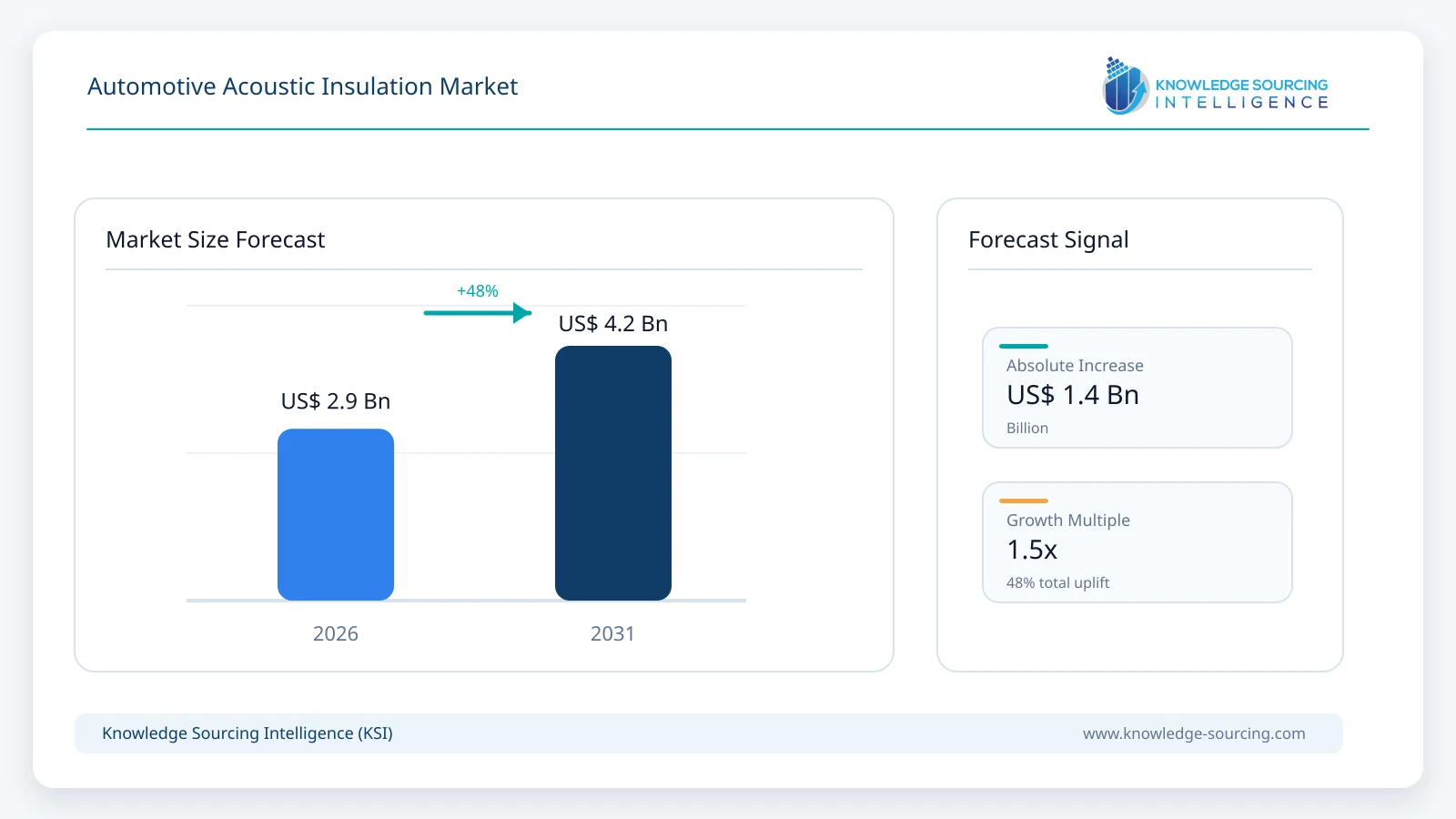
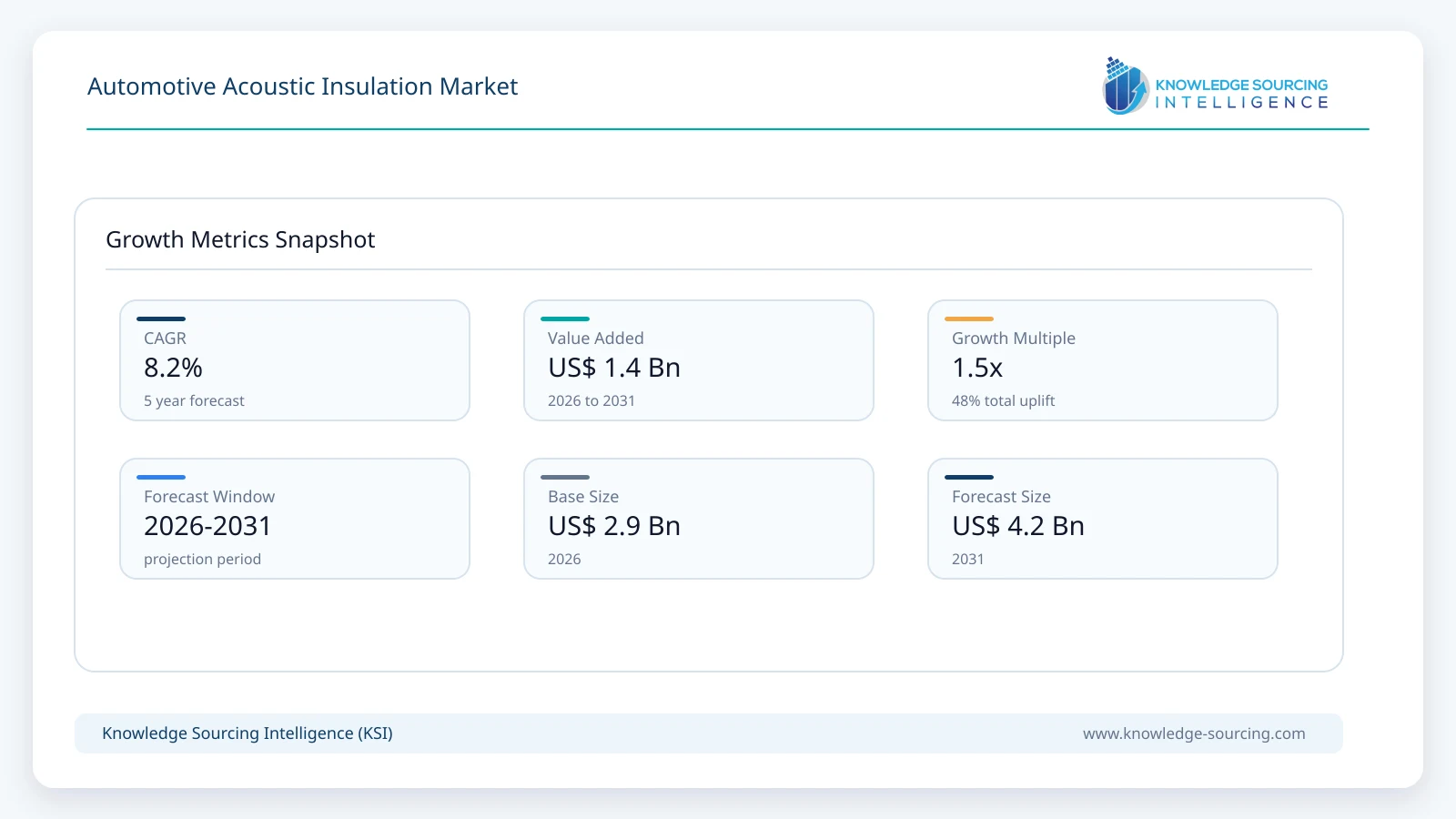
The automotive acoustic insulation market is estimated at approximately USD 2.850 billion in 2026 and is projected to reach about USD 4.227 billion by 2031, representing a CAGR of 8.2% across the forecast period.
Highlights:
- 1Decoupled mass-barrier systems account for approximately 46% of global market value in 2026 because floor, dash and firewall applications still require strong transmission-loss performance at low and mid frequencies.
- 2Heavy polymer and mineral-filled flexible barrier materials represent approximately 41% of 2026 demand, although PET/felt decouplers and lightweight hybrid layers are gaining share as OEMs reduce acoustic mass.
- 3Floor and carpet insulation accounts for approximately 31% of 2026 market value, followed closely by dash, firewall and tunnel systems at about 29%.
- 4Battery-electric vehicles represent approximately 20% of 2026 demand but are the fastest-growing propulsion segment and are projected to approach 34% by 2031.
- 5Passenger vehicles account for approximately 89% of global market value in 2026, supported by higher acoustic-content requirements in SUVs, premium vehicles and electrified platforms.
- 6Asia Pacific represents approximately 45% of global market value in 2026, reflecting vehicle-production scale and rising NVH content in China, Japan, South Korea and India.
Acoustic insulation limits the amount of sound energy transmitted through the vehicle body into the occupant space. Dense flexible barriers provide transmission loss through mass, while soft decoupling layers mechanically separate the barrier from the underlying sheet metal and prevent the complete system from behaving as one vibrating surface. Well-designed mass-spring systems can therefore outperform a heavy barrier used alone.
The principal applications sit close to dominant airborne-noise transfer paths. Dash and firewall insulators manage powertrain and front-axle noise; floor and tunnel systems control tire, road and driveline inputs; door and cavity insulation reduces airborne leakage; and luggage or rear-wheelhouse systems isolate rear-axle and tire excitation. Material choice varies according to frequency, temperature, moisture exposure and available thickness.
The commercial direction is toward lower surface density and greater function integration. Lightweight PET decouplers, molded fiber structures and hybrid absorber-barrier materials are allowing suppliers to reduce heavy-layer content without abandoning transmission-loss targets. Acoustic simulation is increasingly used to place insulation only where it produces measurable cabin benefit.
Market Trends
Lightweight Decoupled Barriers Are Replacing Uniform Heavy Layers
Traditional acoustic packages relied heavily on dense EVA, TPO or mineral-filled barrier sheets. Newer systems use a thinner barrier supported by a tuned foam or fiber decoupler, allowing the barrier to remain mechanically isolated from the body panel.
The approach reduces mass while preserving transmission loss, particularly across floor, tunnel and dash applications where low-frequency road and powertrain noise remains difficult to control.
Polyester Decouplers Are Gaining Share in Recyclable Acoustic Stacks
PET felts are increasingly used beneath barriers and carpets because their density, compression stiffness and thickness can be tuned while maintaining low mass. Autoneum has positioned Flexi-Light PET as a shapeable polyester sound-insulation system suitable for carpets and inner dashes.
Using a common polyester family across carpet backing, decoupling and adjacent acoustic layers also supports simpler scrap recovery and end-of-life recycling than highly mixed constructions.
Hybrid Absorber-Barrier Materials Are Reducing Package Thickness
Space constraints are encouraging materials that deliver both dissipation and transmission control. 3M Flexile Acoustic Material, for example, combines absorber and barrier behavior within a thin layer and can be paired with a fibrous decoupler for broader-frequency performance.
Hybrid structures are especially relevant behind instrument panels, in doors and around wheelhouses where conventional mass-spring systems may not fit without compromising cabin or component packaging.
Electrification Is Moving Insulation Priorities toward Road and Tire Paths
Battery-electric vehicles reduce combustion noise but make tire-road excitation, wind noise, pumps and electric-drive tones more apparent. Acoustic insulation must therefore address several distributed transfer paths rather than concentrate mainly on the firewall.
Floor, rear-wheelhouse, door and body-cavity insulation gain importance, while engine-side insulation becomes a smaller share of the package. This changes both material placement and frequency tuning.
Simulation Is Shifting Insulation from Area Coverage to Targeted Treatment
Vehicle-level transfer-path analysis can identify the panels and openings that contribute most strongly to cabin noise. Suppliers increasingly use this information to vary barrier mass, decoupler stiffness and local thickness rather than applying one uniform construction.
Targeted treatment lowers cost and weight, but increases the value of acoustic engineering because the insulation package becomes more dependent on vehicle-specific geometry and structural behavior.
Automotive Acoustic Insulation Market Segment Analysis
By Insulation Architecture
Decoupled Mass-Barrier Systems
Decoupled mass-barrier systems are the largest architecture because they remain highly effective where strong sound transmission loss is required across broad floor, dash and firewall areas. The heavy layer blocks airborne energy while the compliant backing separates it from the vibrating body panel.
The segment is estimated at approximately USD 1.31 billion in 2026 and could reach about USD 1.69 billion by 2031. Its share is expected to decline from roughly 46% to 40% as lightweight hybrid insulation grows faster, but absolute demand remains substantial in ICE, hybrid and premium passenger vehicles.
By Material Platform
Heavy Polymer and Mineral-Filled Barrier Layers
Heavy polymer and mineral-filled barrier layers lead material value because low-frequency transmission loss still depends strongly on surface density. EVA, TPO, EPDM and other flexible compounds can be molded or thermoformed to follow complex floor and dash geometries.
The material group accounts for approximately USD 1.17 billion in 2026 and is projected to reach about USD 1.48 billion by 2031. Share will ease as OEMs remove unnecessary mass and adopt thinner hybrid layers supported by engineered PET or foam decouplers.
By Application
Floor and Carpet Insulation
Floor and carpet insulation is the largest application because the floor is a broad transfer surface for tire, road, suspension and driveline noise. Production systems commonly combine carpet, decoupler and barrier layers with locally varied thickness around footwells, tunnels and wheelhouse interfaces.
The application is valued at approximately USD 0.88 billion in 2026 and could reach about USD 1.27 billion by 2031. Growth will be supported by EV platforms where road and tire noise becomes a larger share of the perceived cabin sound field.
By Propulsion
Internal-Combustion Engine Vehicles
Internal-combustion vehicles remain the largest propulsion segment in 2026 because firewall, tunnel and floor insulation must control engine, exhaust and driveline noise in addition to road inputs. Their broad installed production base supports high absolute consumption of barrier-heavy acoustic packages.
ICE vehicles account for approximately USD 1.77 billion in 2026, but their share is expected to fall from about 62% to 46% by 2031. Battery-electric vehicles will grow much faster as OEMs add targeted insulation for road, tire and auxiliary-system noise while minimizing package mass.
By Vehicle Type
Passenger Vehicles
Passenger vehicles dominate acoustic-insulation demand because cabin refinement is a major purchase attribute and because SUVs, crossovers and premium cars use large floor areas and extensive trim systems. Electrification and panoramic cabin designs further increase the need for carefully tuned passive insulation.
Passenger vehicles represent approximately USD 2.54 billion in 2026 and are expected to reach about USD 3.72 billion by 2031. Light commercial vehicles will grow faster from a smaller base as electric vans and premium fleet applications adopt more sophisticated cabin NVH packages.
Market Drivers
Higher Cabin-Refinement Expectations across Mainstream Vehicles
Quietness is no longer limited to premium vehicles. Better sealing, powertrain refinement and improved audio systems make residual road and body-transmitted noise more noticeable, pushing OEMs to improve passive acoustic isolation across high-volume models.
This sustains demand for dash, floor and body-cavity insulation even as engineering teams work to reduce material mass and cost.
Battery-Electric Vehicles Increase Sensitivity to Road and Tire Noise
Without continuous combustion masking, occupants perceive road texture, tire cavity noise and suspension impacts more clearly. BEVs therefore require acoustic insulation around the floor, wheelhouse interfaces, doors and rear body even when the engine-side package is reduced.
The strongest growth will come from lightweight systems that improve isolation without materially reducing driving range or increasing vehicle mass.
Lightweighting Creates Demand for Higher-Performance Insulation per Kilogram
Conventional heavy barriers deliver strong transmission loss but can add several kilograms to a vehicle. OEMs increasingly challenge suppliers to maintain cabin targets with lower surface density through tuned decouplers, hybrid materials and localized barrier placement.
This raises the value of engineered materials and simulation even when the total kilograms of acoustic insulation per vehicle decline.
Circularity Targets Favor PET-Based Decouplers and Simplified Material Stacks
Mixed foam, barrier, adhesive and textile constructions are difficult to recycle. Polyester-based decouplers and mono-material-compatible carpet structures create a clearer route to production-scrap recovery and eventual end-of-life processing.
European circularity requirements and OEM carbon targets are therefore influencing insulation architecture alongside traditional NVH, cost and durability criteria.
Global Vehicle Production Sustains a Large Base of Passive NVH Content
Nearly every light vehicle requires some passive sound-isolation treatment even when active noise-control functions are installed. The underlying volume base therefore remains tied to global vehicle production and to acoustic content per vehicle.
Value growth is expected to come primarily from higher engineered content in EVs, premium vehicles and large SUVs rather than from unit production alone.
Market Restraints
Strong Cost Pressure on Hidden Insulation Components
Most acoustic insulation sits behind carpet, dashboards and trim and has little direct consumer visibility. OEM purchasing teams therefore apply severe cost pressure even when the materials have a measurable impact on perceived vehicle quality.
Suppliers must demonstrate weight, assembly or recyclability benefits in addition to acoustic performance to defend higher-value material systems.
Barrier Mass Conflicts Directly with Vehicle Lightweighting
Transmission-loss performance traditionally improves with greater surface density, creating a direct conflict with fuel-economy and EV-range objectives. Removing too much mass can expose low-frequency boom and road noise that absorbers alone cannot control.
This forces costly optimization of local barrier thickness, decoupler stiffness and leakage paths rather than simple material substitution.
Vehicle-Specific Geometry Limits Standardization
Acoustic insulation is strongly influenced by body-panel shape, floor stampings, tunnel geometry, seat mounts and trim clearances. A system tuned for one platform may not provide the same performance when transferred to another vehicle.
Program-specific molding, cut patterns and validation reduce economies of scale and can lengthen launch engineering cycles.
Moisture, Heat and Compression Affect Long-Term Performance
Floor, firewall and body-cavity insulation can be exposed to water, heat, contamination and sustained compression. Decouplers that collapse or absorb moisture may lose their mechanical separation and acoustic effectiveness over time.
Materials therefore require durability validation beyond laboratory transmission-loss testing, particularly in commercial vehicles and harsh-climate markets.
Recyclability Can Conflict with Proven Multilayer Performance
High-performing insulation often combines polymers, foams, heavy fillers, adhesives and scrims selected for different functions. Simplifying these stacks can improve end-of-life recovery but may reduce formability, barrier performance or durability.
OEMs and suppliers must balance circularity targets with mature acoustic constructions that have already been validated across long vehicle lifecycles.
Regional Outlook
Asia Pacific
Asia Pacific is the largest automotive acoustic-insulation market in 2026, supported by vehicle-production scale in China, Japan, South Korea and India. China is particularly important as EV and premium domestic brands compete aggressively on cabin quietness while using large wheels and low-profile tires that increase road-noise challenges.
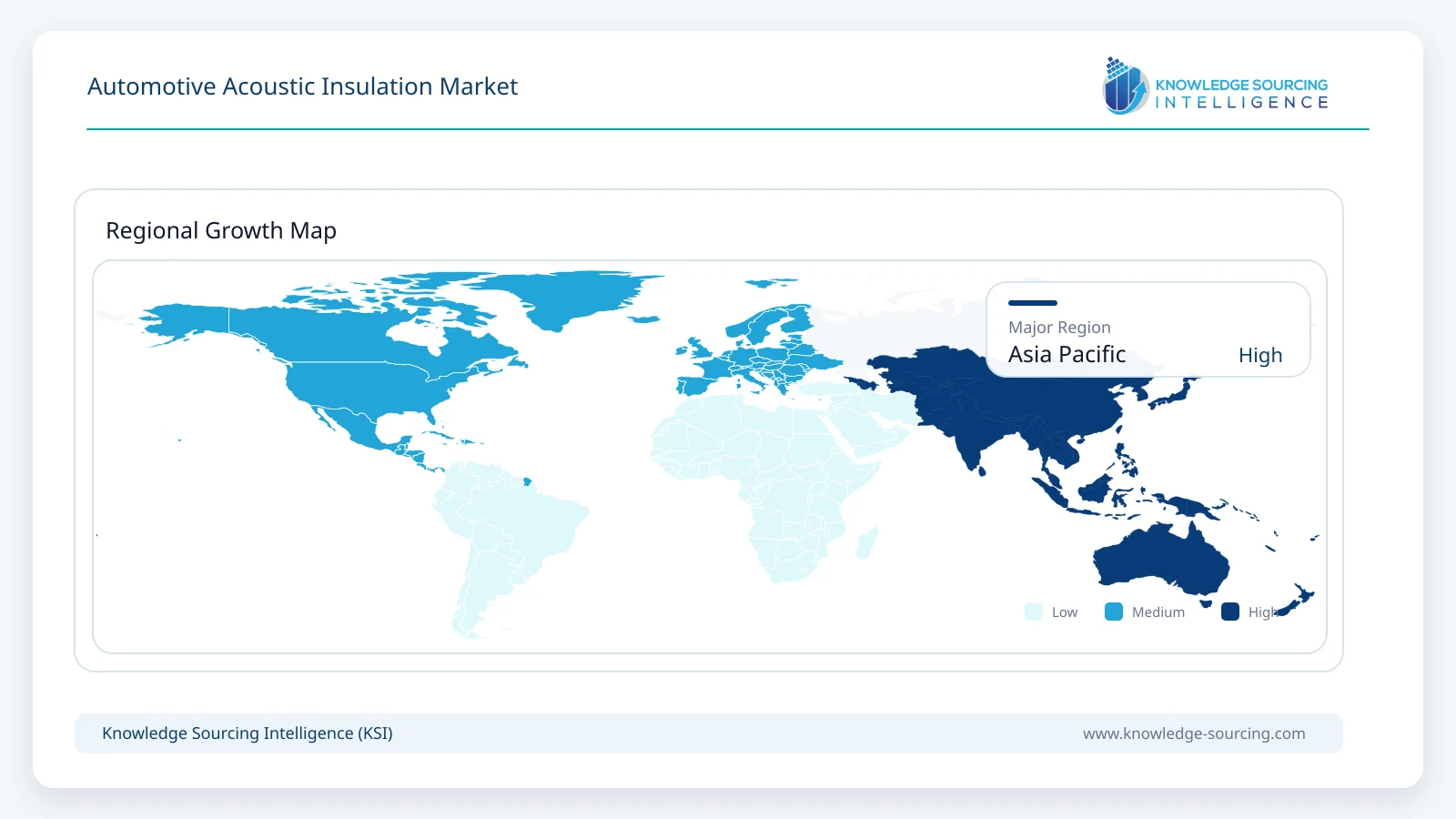
Regional suppliers and global NVH companies are expanding local engineering and production capability. Growth through 2031 will be supported by higher acoustic content per vehicle, local EV production and broader use of recyclable fiber decouplers and lightweight barriers.
Europe
Europe remains a high-value market because premium vehicle production, strict mass and CO2 targets, and strong circularity requirements create demand for lightweight, highly engineered insulation. The region is also an important development base for recyclable PET systems and optimized mass-spring constructions.
Growth will be driven more by technology substitution than by vehicle volume. Lower-mass hybrid barriers, mono-material-compatible decouplers and targeted insulation are expected to gain share as OEMs reduce overall material mass without relaxing cabin-refinement targets.
Competitive Landscape
The automotive acoustic insulation market combines large NVH system suppliers with specialist material companies. Autoneum, Adler Pelzer and Auria Solutions integrate barrier, decoupler and trim engineering into complete acoustic packages, while 3M supplies thin hybrid acoustic materials and fibrous insulation technologies. Sumitomo Riko, Toyota Boshoku and Hayashi Telempu add strong regional engineering and conversion capabilities.
Competitive differentiation increasingly depends on transmission loss per unit mass, decoupler compression behavior, formability, recycled content and the ability to integrate insulation with carpets and dash systems. Suppliers able to replace heavy conventional barriers without increasing leakage or low-frequency noise can capture disproportionate value.
Global production consistency remains a major barrier to entry. OEMs require stable acoustic behavior across material batches, plants and climates, favoring suppliers with validated material libraries, local converting capacity and vehicle-level NVH simulation and testing resources.
Recent Developments
June 2026: Sumitomo Riko announced a new automotive R&D base in India to strengthen local design, evaluation and technical-service capability, supporting regional development of polymer-based automotive products including sound-control and insulation systems.
February 2026: Freudenberg Performance Materials announced its Techtextil 2026 automotive portfolio, including lightweight acoustic nonwovens and material solutions for vehicle interiors and engine-compartment applications.
December 2025: Autoneum detailed a suite of recyclable polyester acoustic and thermal components for the Polestar 5, reinforcing the move toward lower-mass mono-material sound packages in premium BEVs.
July 2025: Autoneum introduced Flexi-Light PET, a shapeable polyester felt sound-insulation system using up to 90% recycled content and designed for carpets and inner dashes as an alternative to polyurethane foam.
July 2025: Autoneum launched the N-Join1 adhesive-free carpet system, enabling polyester-based substrates and improved end-of-life recyclability for floor systems that integrate acoustic decoupling and insulation functions.
Market Outlook
The automotive acoustic insulation market is expected to expand from approximately USD 2.850 billion in 2026 to about USD 4.227 billion by 2031. Decoupled mass-barrier systems will remain the largest architecture, but their share will decline as lightweight hybrid absorber-barrier systems and engineered fiber decouplers grow faster.
The largest structural shift will be away from heavy uniform coverage toward localized, simulation-led treatment. PET decouplers, thin dissipative layers and molded lightweight insulation will allow OEMs to reduce surface density while preserving transmission loss across floor, dash, door and wheelhouse transfer paths.
Asia Pacific will remain the largest regional market, while Europe continues to influence circularity and lightweight acoustic design. Competitive advantage will depend on acoustic isolation per kilogram, package thickness, recycling compatibility, global manufacturing consistency and the ability to validate insulation within complete vehicle NVH systems.
Automotive Acoustic Insulation Market Scope:
| Report Metric | Details |
|---|---|
| Total Market Size in 2026 | USD 2.850 billion |
| Total Market Size in 2031 | USD 4.227 billion |
| Forecast Unit | USD Billion |
| Growth Rate | 8.2%. |
| Study Period | 2021 to 2031 |
| Historical Data | 2021 to 2024 |
| Base Year | 2025 |
| Forecast Period | 2026 – 2031 |
| Segmentation | Insulation Architecture, Material Platform, Application, Propulsion, Vehicle Type, Geography |
| Companies |
|
Market Segmentation
By Insulation Architecture
Decoupled Mass-Barrier Systems
Lightweight Hybrid Absorber-Barrier Insulation
Molded Foam and Fiber Insulation
Other Specialty Insulation Systems
By Material Platform
Heavy Polymer and Mineral-Filled Barrier Layers
PET, Felt and Fiber Decouplers
Polyurethane and Specialty Foams
Elastomeric and Specialty Composite Materials
By Application
Floor and Carpet
Dash, Firewall and Tunnel
Door and Body Cavities
Luggage Compartment and Rear Deck
Roof and Pillars
Engine and E-Drive Enclosures
By Propulsion
Internal-Combustion Engine Vehicles
Hybrid and Plug-In Hybrid Vehicles
Battery Electric Vehicles
By Vehicle Type
Passenger Vehicles
Light Commercial Vehicles
Medium and Heavy Commercial Vehicles and Buses
By Geography
North America
United States
Canada
Mexico
South America
Brazil
Argentina
Others
Europe
Germany
United Kingdom
France
Italy
Spain
Others
Middle East and Africa
Saudi Arabia
UAE
South Africa
Others
Asia Pacific
China
Japan
South Korea
India
Indonesia
Thailand
Others
Table of Contents
1. INTRODUCTION
1.1. Market Overview
1.2. Market Definition
1.3. Scope of the Study
1.4. Market Segmentation
1.5. Currency
1.6. Assumptions
1.7. Base and Forecast Years
1.8. Key Benefits to Stakeholders
2. RESEARCH METHODOLOGY
2.1. Research Design
2.2. Secondary Research
2.3. Primary Research
2.4. Market Estimation
2.5. Segment Modelling
2.6. Data Triangulation and Validation
3. EXECUTIVE SUMMARY
3.1. Key Findings
3.2. Automotive Acoustic Insulation Market Size, 2026-2031
3.3. Insulation Architecture Outlook
3.4. Material Platform Outlook
3.5. Application Outlook
3.6. Propulsion Outlook
3.7. Vehicle Type Outlook
3.8. Regional Opportunity Summary
4. MARKET DYNAMICS
4.1. Market Drivers
4.1.1. Higher Cabin-Refinement Expectations across Mainstream Vehicles
4.1.2. Battery-Electric Vehicles Increase Sensitivity to Road and Tire Noise
4.1.3. Lightweighting Creates Demand for Higher-Performance Insulation per Kilogram
4.1.4. Circularity Targets Favor PET-Based Decouplers and Simplified Material Stacks
4.1.5. Global Vehicle Production Sustains a Large Base of Passive NVH Content
4.2. Market Restraints
4.2.1. Strong Cost Pressure on Hidden Insulation Components
4.2.2. Barrier Mass Conflicts Directly with Vehicle Lightweighting
4.2.3. Vehicle-Specific Geometry Limits Standardization
4.2.4. Moisture, Heat and Compression Affect Long-Term Performance
4.2.5. Recyclability Can Conflict with Proven Multilayer Performance
4.3. Market Opportunities
4.4. Porter's Five Forces Analysis
4.5. Industry Value Chain Analysis
4.6. Transmission Loss, Weight and Cost Trade-Offs
4.7. Recycled Content, VOC and End-of-Life Requirements
5. TECHNOLOGY OUTLOOK
5.1. Flexible Heavy-Layer Barrier Materials
5.2. Decoupled Mass-Spring Insulation Systems
5.3. Polyester/PET Felt Decouplers
5.4. Polyurethane and Specialty Foam Decouplers
5.5. Lightweight Absorber-Barrier Hybrid Materials
5.6. Molded Dash and Firewall Insulators
5.7. Floor and Carpet Acoustic Insulation
5.8. Door and Body-Cavity Insulation
5.9. High-Temperature Powertrain Acoustic Insulation
5.10. Mono-Material and Recyclable Insulation Stacks
5.11. Transmission-Loss and Insertion-Loss Testing
5.12. Transfer-Path Simulation and Localized Material Optimization
6. AUTOMOTIVE ACOUSTIC INSULATION MARKET BY INSULATION ARCHITECTURE
6.1. Introduction
6.2. Decoupled Mass-Barrier Systems
6.3. Lightweight Hybrid Absorber-Barrier Insulation
6.4. Molded Foam and Fiber Insulation
6.5. Other Specialty Insulation Systems
7. AUTOMOTIVE ACOUSTIC INSULATION MARKET BY MATERIAL PLATFORM
7.1. Introduction
7.2. Heavy Polymer and Mineral-Filled Barrier Layers
7.3. PET, Felt and Fiber Decouplers
7.4. Polyurethane and Specialty Foams
7.5. Elastomeric and Specialty Composite Materials
8. AUTOMOTIVE ACOUSTIC INSULATION MARKET BY APPLICATION
8.1. Introduction
8.2. Floor and Carpet
8.3. Dash, Firewall and Tunnel
8.4. Door and Body Cavities
8.5. Luggage Compartment and Rear Deck
8.6. Roof and Pillars
8.7. Engine and E-Drive Enclosures
9. AUTOMOTIVE ACOUSTIC INSULATION MARKET BY PROPULSION
9.1. Introduction
9.2. Internal-Combustion Engine Vehicles
9.3. Hybrid and Plug-In Hybrid Vehicles
9.4. Battery Electric Vehicles
10. AUTOMOTIVE ACOUSTIC INSULATION MARKET BY VEHICLE TYPE
10.1. Introduction
10.2. Passenger Vehicles
10.3. Light Commercial Vehicles
10.4. Medium and Heavy Commercial Vehicles and Buses
11. AUTOMOTIVE ACOUSTIC INSULATION MARKET BY GEOGRAPHY
11.1. North America
11.1.1. United States
11.1.2. Canada
11.1.3. Mexico
11.2. South America
11.2.1. Brazil
11.2.2. Argentina
11.2.3. Others
11.3. Europe
11.3.1. Germany
11.3.2. United Kingdom
11.3.3. France
11.3.4. Italy
11.3.5. Spain
11.3.6. Others
11.4. Middle East and Africa
11.4.1. Saudi Arabia
11.4.2. UAE
11.4.3. South Africa
11.4.4. Others
11.5. Asia Pacific
11.5.1. China
11.5.2. Japan
11.5.3. South Korea
11.5.4. India
11.5.5. Indonesia
11.5.6. Thailand
11.5.7. Others
12. COMPETITIVE ENVIRONMENT AND ANALYSIS
12.1. Major Players and Strategy Analysis
12.2. Market Share Analysis
12.3. Heavy Barrier versus Lightweight Hybrid Insulation Benchmarking
12.4. Transmission Loss and Surface-Density Comparison
12.5. Decoupler Compression and Durability Benchmarking
12.6. Recycled Content and Circularity Benchmarking
12.7. OEM Qualification and Production Readiness
12.8. Competitive Dashboard
13. COMPANY PROFILES
13.1. Autoneum Holding Ltd.
13.2. Adler Pelzer Group
13.3. Auria Solutions Ltd.
13.4. 3M Company
13.5. Sumitomo Riko Company Limited
13.6. Toyota Boshoku Corporation
13.7. Hayashi Telempu Corporation
13.8. Freudenberg Performance Materials
14. APPENDIX
14.1. Currency
14.2. Assumptions
14.3. Base and Forecast Years Timeline
14.4. Key Benefits for Stakeholders
14.5. Research Methodology
14.6. Abbreviations
14.7. Data Sources
Navigate
Trusted by the world's leading organizations











