
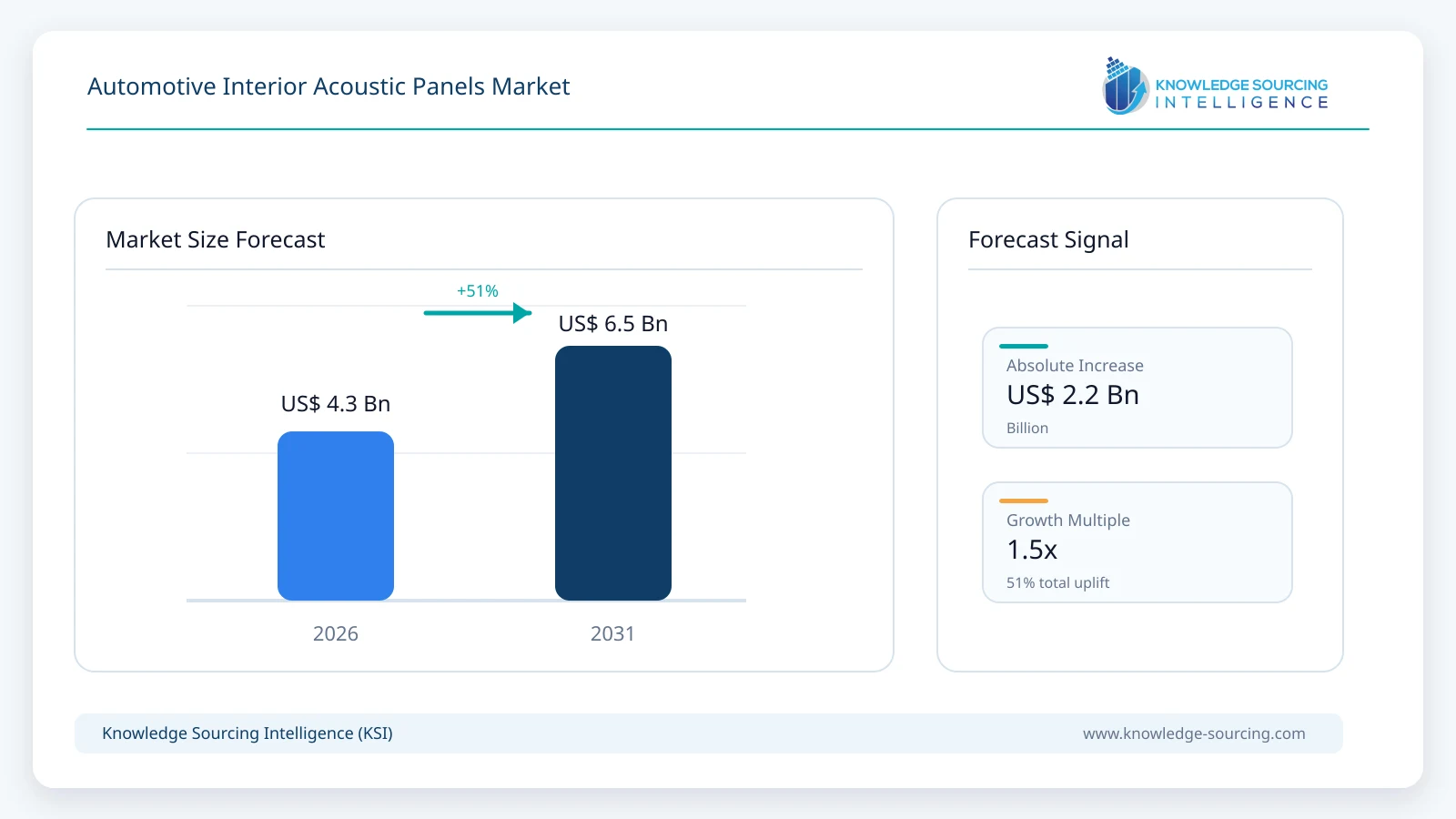
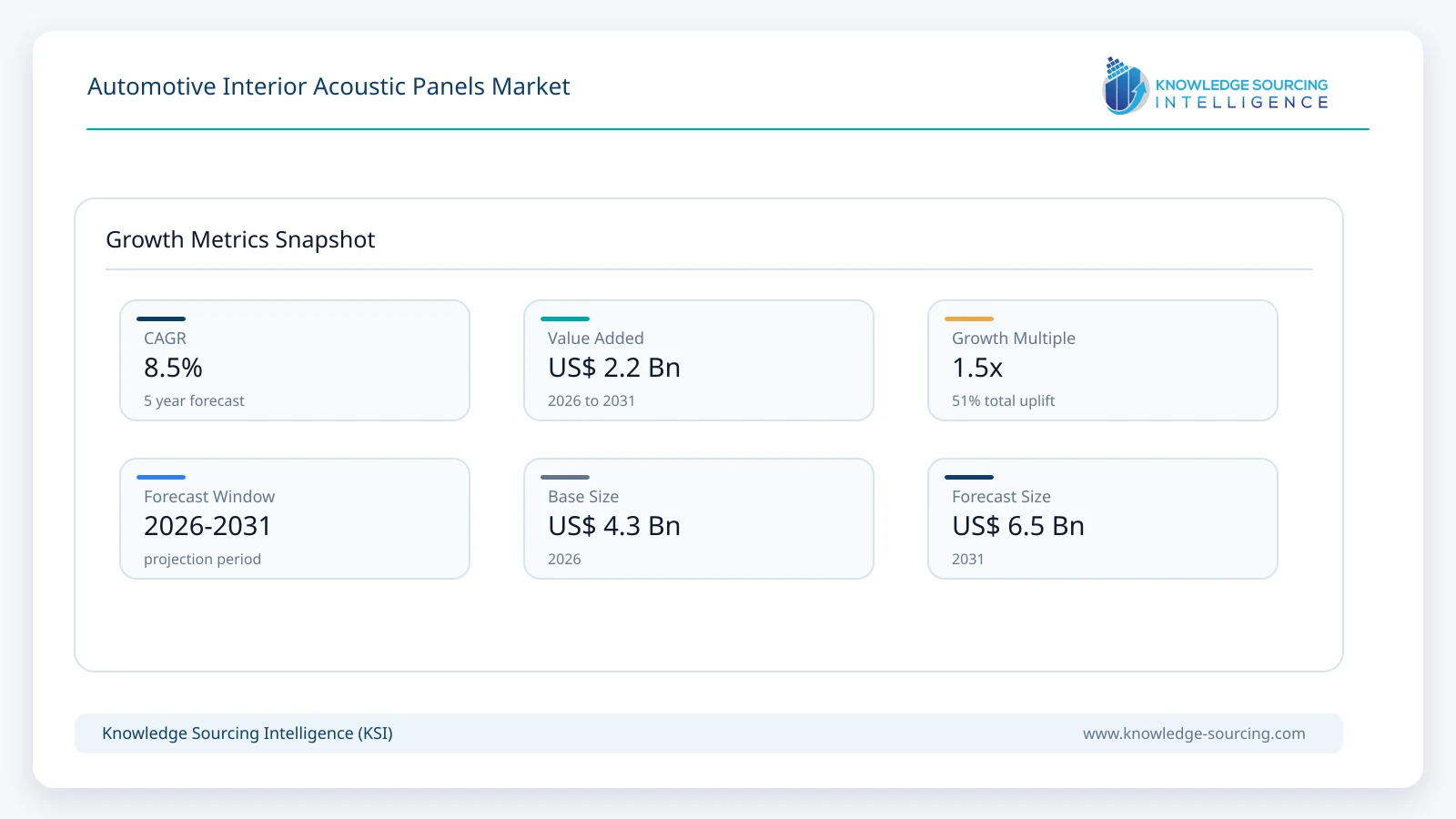
The automotive interior acoustic panels market is estimated at approximately USD 4.350 billion in 2026 and is projected to reach about USD 6.550 billion by 2031, representing a CAGR of 8.5% over the forecast period.
Highlights:
- 1Inner-dash and firewall acoustic panels account for approximately 27% of global market value in 2026 because the dash remains one of the most important cabin boundaries for controlling powertrain, road and front-structure noise transmission.
- 2PET and nonwoven fiber systems represent approximately 39% of material value in 2026 and are gaining share as suppliers replace heavier polyurethane and mixed-material stacks with lighter recyclable structures.
- 3Absorptive panel architectures account for approximately 44% of 2026 market value, supported by broad use in roof, door, side and luggage areas where porous structures can reduce reflected cabin noise without large mass additions.
- 4Internal-combustion vehicles remain the largest propulsion segment in 2026, but battery-electric vehicles are the fastest-growing application as acoustic treatment shifts toward road, tire, wind and auxiliary-system noise.
- 5Passenger vehicles represent approximately 90% of global market value in 2026, reflecting higher acoustic-content levels in SUVs, premium cars and increasingly refined mass-market passenger vehicles.
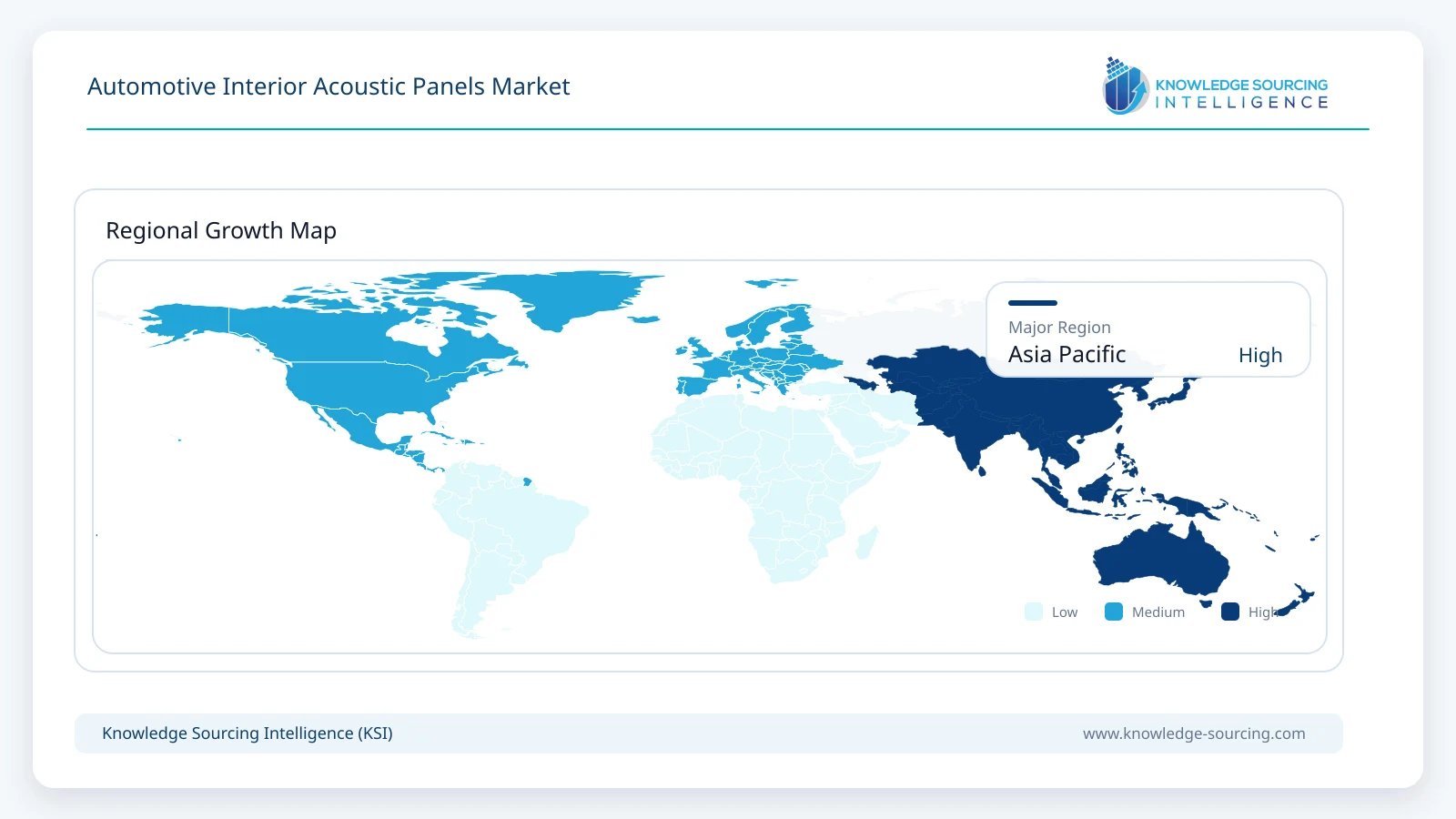
- 6Asia Pacific represents approximately 45% of global market value in 2026, supported by regional vehicle-production scale and rising acoustic-content levels among Chinese, Japanese and South Korean OEMs.
Interior acoustic panels control cabin noise through three basic mechanisms: absorption of airborne sound, transmission loss across body openings and decoupling of vibrating structures. A panel may use porous PET or cotton fibers, polyurethane foam, heavy layers, polypropylene or natural-fiber carriers, or multilayer combinations depending on the frequency range and installation location.
The principal installation zones are the inner dash, doors and side walls, roof and headliner, floor and tunnel, and rear-deck or luggage compartment. Each location faces a different noise path, so panel density, stiffness, thickness and surface geometry are increasingly tuned at the vehicle level instead of using a uniform material package.
Panelization creates manufacturing and assembly advantages because acoustic layers can be molded or laminated into a component that is installed as one part. It also creates stronger requirements for dimensional accuracy, crash and flammability compliance, recyclability and integration with wiring, airbags, speakers, lighting and other cabin systems.
Market Trends
Recycled PET Is Becoming the Preferred Lightweight Acoustic Substrate
Polyester felt is gaining share because fiber density and orientation can be tuned for acoustic performance while keeping mass low. Autoneum has expanded PET-based solutions such as Flexi-Light PET for shapeable interior insulation and broader recyclable sound packages.
For panel suppliers, the advantage is not only recycled content. A common PET chemistry can simplify scrap reuse and end-of-life recycling compared with foam-heavy or adhesive-intensive multilayer structures.
Panel Geometry Is Being Tuned More Precisely to Local Noise Paths
Acoustic simulation is allowing engineers to vary thickness, density and decoupling behavior across a single molded panel rather than applying the same treatment everywhere. Inner-dash and floor structures benefit particularly from this approach because local transmission paths can differ sharply across the component.
The result is higher acoustic performance per kilogram. Suppliers with in-house NVH testing and simulation can reduce material where it contributes little while reinforcing the zones that drive cabin sound pressure.
Door and Roof Panels Are Taking on More Multifunctional Content
Door and headliner structures increasingly combine acoustic absorption with illumination, electronics packaging, thermal management and visible interior design. This raises the value of a panel but also makes acoustic material selection more dependent on the complete cabin architecture.
The engineering challenge is to preserve sound absorption while adding stiffness, surface quality and embedded functions. Integrated panel design therefore favors suppliers with both interior-trim and acoustics capability.
BEV Programs Are Shifting Panel Demand toward Road and Wind Noise Control
Battery-electric vehicles remove engine masking and make road, tire and aerodynamic noise more noticeable. Dash and floor panels remain important, but roof, door, pillar-adjacent and rear-cabin acoustic structures gain relative importance because the dominant sound field changes.
This does not always mean more material. BEV platforms increasingly use targeted porous panels and lighter decouplers to control specific frequency bands while protecting driving range from unnecessary mass.
Circularity Is Reshaping Carrier and Lamination Choices
Traditional acoustic panels often combine fibers, foam, heavy layers, adhesives and plastic carriers that are difficult to separate. OEM circularity programs are pushing mono-material and easier-to-disassemble structures, especially in Europe.
Natural-fiber door panels, recycled PET absorbers and adhesive-reduced laminates are therefore gaining attention. The commercial winners will be solutions that improve recyclability without creating new cost, odor, moisture or durability problems.
Automotive Interior Acoustic Panels Market Segment Analysis
By Panel Type
Inner-Dash and Firewall Acoustic Panels
Inner-dash and firewall panels are the largest panel-type segment because they sit between the passenger compartment and one of the strongest structural and powertrain noise paths. They typically combine absorption with transmission loss and must fit tightly around steering, HVAC and electrical interfaces.
The segment is estimated at approximately USD 1.17 billion in 2026 and could approach USD 1.69 billion by 2031. Share is expected to ease modestly as roof, door and rear-cabin panels grow faster, particularly on electric vehicles.
By Material
PET and Nonwoven Fiber Systems
PET and nonwoven fiber systems lead the material mix because they can deliver absorption, formability, low mass and high recycled content across dash, roof, door and luggage panels. Fiber architecture can also be tuned without relying on a heavy barrier layer in every application.
The segment represents approximately USD 1.70 billion in 2026 and is expected to exceed USD 3.0 billion by 2031. Its share should rise as recyclable polyester replaces portions of polyurethane foam, mixed-fiber felt and difficult-to-separate multilayer constructions.
By Acoustic Architecture
Absorptive Panels
Absorptive panels account for the largest value pool because porous structures are widely used to control reflected and radiated noise in roof, door, side and rear-cabin locations. They are particularly attractive where added mass must remain low.
The segment is estimated at approximately USD 1.91 billion in 2026 and could reach about USD 2.88 billion by 2031. Hybrid panels combining absorption with local barrier or decoupling functions will grow slightly faster, but absorptive architectures remain the broadest installed base.
By Propulsion
Internal-Combustion Engine Vehicles
Internal-combustion vehicles remain the largest propulsion segment because they still represent the majority of global production and require substantial dash, tunnel and floor treatment to manage powertrain and exhaust-related noise. Mature panel architectures are deeply integrated into existing vehicle platforms.
The segment accounts for approximately USD 2.39 billion in 2026. Its absolute value should remain positive through 2031, but share will decline as hybrid and battery-electric vehicle production expands and acoustics spending shifts toward new noise paths.
By Vehicle Type
Passenger Vehicles
Passenger cars, SUVs and MPVs dominate demand because cabin refinement is a visible purchase criterion and because these vehicles use the broadest range of molded dash, door, roof, floor and luggage acoustic panels. Premium and large SUVs carry particularly high content per vehicle.
Passenger vehicles represent approximately USD 3.92 billion in 2026 and are expected to approach USD 5.80 billion by 2031. Commercial vehicles will grow faster from a smaller base as cab comfort receives more attention, but passenger vehicles remain the principal value pool.
Market Drivers
Higher Cabin-Refinement Targets across Mainstream Vehicle Segments
Acoustic comfort is no longer limited to premium vehicles. OEMs increasingly benchmark speech intelligibility, highway noise and perceived quietness across mainstream cars and SUVs, increasing the use of tuned panel systems in doors, roofs, dashes and rear cabins.
This broadens addressable volume while also raising engineering expectations. Suppliers must deliver measurable noise reduction without compromising cost, mass or interior packaging.
Electrification Changes the Cabin Noise Spectrum
Electric propulsion removes much of the low-frequency combustion masking that previously dominated the cabin. Tire-road input, wind noise, HVAC, pumps and high-frequency electric-drive tones become more perceptible to occupants.
OEMs therefore re-balance acoustic content rather than simply remove it. More targeted panel treatment is required around floors, doors, roof structures and rear compartments, supporting higher-value engineered interiors.
Lightweighting Favors Engineered Fiber and Composite Panels
Vehicle mass remains a major design constraint for both combustion and electric platforms. Replacing dense barrier-heavy systems with lower-density fiber or composite panels can protect acoustic performance while reducing weight.
The opportunity is strongest for suppliers that can tune geometry and material locally. A lighter panel with engineered density can outperform a uniform heavy layer in the relevant frequency range.
Circularity and Recycled-Content Targets Are Accelerating Material Change
OEM sustainability programs increasingly specify recycled content, lower product carbon footprint and improved end-of-life recovery for interior components. Acoustic panels are directly affected because conventional laminates often combine several difficult-to-separate materials.
Recycled PET, natural fibers and adhesive-reduced constructions therefore gain sourcing relevance. The change creates replacement demand even where total acoustic content per vehicle is stable.
A Large Global Vehicle-Production Base Supports Structural Demand
OICA reported global motor-vehicle production of 96.4 million units in 2025, up from 92.7 million in 2024. Each newly produced vehicle requires multiple interior structures that must meet acoustic, thermal, safety and craftsmanship targets.
Volume alone does not determine market value, but the production base provides a large recurring platform for acoustic panels. Growth in Asia also supports local capacity expansion and regionalized supply chains.
Market Restraints
Hidden Acoustic Content Faces Continuous Cost Compression
Many acoustic panels are largely invisible to the final customer, making them recurring targets for cost reduction during vehicle development. OEM purchasing teams frequently challenge thickness, material grade and part count even when cabin-noise targets remain unchanged.
Suppliers must therefore prove value through measurable NVH performance, lower mass or assembly simplification. Material innovation that raises piece price without reducing total system cost can face slow adoption.
Vehicle-Specific Geometry Limits Standardization
Dash, door, roof and floor panels must conform closely to unique body structures, wiring paths, airbags and trim interfaces. A solution validated on one platform cannot simply be transferred to another without new tooling and acoustic tuning.
This limits scale economies and increases program-engineering costs. Large molded panels also require vehicle-specific dies and launch validation.
Recyclable Materials Must Still Meet Automotive Durability Requirements
High recycled content can introduce variability in fiber quality, moisture behavior, odor, dimensional stability or surface consistency. Interior panels must maintain performance across years of heat cycles, humidity and vibration.
Qualification can therefore slow material substitution. Suppliers need controlled feedstock, robust process windows and clear evidence that circular materials meet the same life-cycle targets as incumbent systems.
Panel Integration Can Create Conflicting Performance Requirements
A door or headliner panel may simultaneously need acoustic absorption, stiffness, impact resistance, thermal stability, flame resistance and premium surface quality. Improving one property can reduce another or add mass and cost.
Multifunctional design raises the burden on material and process engineering. It can also lengthen validation when embedded lighting, electronics or airbag interfaces are introduced into the same panel.
Bulky Parts Increase Logistics and Local-Manufacturing Dependence
Large headliner, floor and side panels occupy significant freight volume relative to their value. They are therefore commonly produced close to vehicle assembly plants, which raises the importance of local capacity and synchronized launch timing.
New entrants face high tooling and plant-footprint requirements. Program cancellations or lower-than-planned vehicle volumes can also leave suppliers with underutilized dedicated assets.
Regional Outlook
Asia Pacific
Asia Pacific is the largest regional market, supported by China, Japan, South Korea and India and by rapidly improving cabin-refinement standards among local OEMs. China is particularly important as EV competition increases attention to quietness, interior quality and low-mass cabin systems.
The region also has a deep supplier base. Toyota Boshoku, Hayashi Telempu, Autoneum, Adler Pelzer and numerous local material and trim producers support development and manufacturing close to major OEM plants.
Growth through 2031 will combine vehicle-production scale with higher acoustic content per vehicle. Recycled PET and natural-fiber panel systems should expand as Asian OEMs target premium domestic buyers and export markets.
Europe
Europe remains a high-value market because premium vehicle production, strong EV penetration and circular-economy priorities favor lightweight acoustic panels with high recycled content. The region is also a major engineering base for Autoneum, Adler Pelzer, FORVIA and Antolin.
European programs increasingly require lower product carbon footprint and improved recyclability alongside strict NVH targets. This supports PET absorbers, natural-fiber door structures and material stacks designed for easier end-of-life recovery.
Regional growth will be more content-led than volume-led. Suppliers that can combine acoustic performance, low mass and circularity with premium visible surfaces will be best positioned.
Competitive Landscape
The automotive interior acoustic panels market is led by suppliers that combine vehicle-level NVH engineering with molding, lamination and large-part manufacturing. Autoneum, Adler Pelzer Group and Auria Solutions hold broad acoustic portfolios, while Toyota Boshoku and Hayashi Telempu add strong interior-integration capability and close Asian OEM relationships.
Antolin and FORVIA are important where acoustic performance must be integrated into door, overhead and cockpit structures. Material specialists such as 3M and Sumitomo Riko support damping, insulation and engineered polymer layers that can be incorporated into panel assemblies.
Competitive advantage is shifting toward low-mass recyclable panels that can be tuned for a specific vehicle without excessive tooling or development time. Global manufacturing footprint remains critical because large interior panels are bulky, model-specific and commonly supplied near OEM assembly plants.
Recent Developments
July 2026: Autoneum announced that Flexi-Light PET had been selected as a finalist for the 2026 Automotive News PACE Pilot Award, highlighting industry interest in shapeable recycled-polyester acoustic insulation for interior applications.
June 2026: Toyota Boshoku announced adoption of a newly structured door trim on the 2026 Lexus ES, developed with Hayashi Telempu and Kojima Press Industry, reinforcing the move toward multifunctional interior panel architectures.
March 2026: Antolin disclosed a SEPIDES-supported project to optimize interior components for improved electric-vehicle range, aligning interior panel development with lightweighting and efficiency targets.
February 2026: Hayashi Telempu announced the start of operations at NDR Hayashi Automotive India, which will supply NVH and interior products to major automakers in India, expanding regional acoustic-interior capacity.
January 2026: FORVIA secured more than USD 1 billion in new and extended business with a major European automaker, including instrument and door panels using natural-fiber materials for North American production.
December 2025: Autoneum announced a suite of 100% polyester components developed with Polestar for the Polestar 5, including lightweight interior acoustic parts designed to improve circularity and passenger comfort.
Market Outlook
The automotive interior acoustic panels market is expected to grow from approximately USD 4.350 billion in 2026 to about USD 6.550 billion by 2031. Inner-dash and firewall panels will remain the largest product group, while door, roof and rear-cabin panels gain value as OEMs distribute acoustic treatment more broadly across the interior.
Material mix will shift toward recycled PET, natural fibers and mono-material or easier-to-recycle composite structures. Growth in battery-electric vehicles will reinforce this transition because OEMs need targeted noise control without compromising vehicle mass and driving range.
Asia Pacific will remain the largest regional market, while Europe continues to lead circularity and lightweight-panel adoption. Supplier success will depend on acoustic performance per kilogram, vehicle-specific simulation capability, recyclable design and local production close to OEM assembly plants.
Automotive Interior Acoustic Panels Market Scope:
| Report Metric | Details |
|---|---|
| Total Market Size in 2026 | USD 4.350 billion |
| Total Market Size in 2031 | USD 6.550 billion |
| Forecast Unit | USD Billion |
| Growth Rate | 8.5% |
| Study Period | 2021 to 2031 |
| Historical Data | 2021 to 2024 |
| Base Year | 2025 |
| Forecast Period | 2026 – 2031 |
| Segmentation | Panel Type, Material, Acoustic Architecture, Propulsion, Vehicle Type, Geography |
| Companies |
|
Market Segmentation
By Panel Type
Inner-Dash and Firewall Acoustic Panels
Door and Side Acoustic Panels
Roof and Headliner Acoustic Panels
Floor and Tunnel Acoustic Panels
Rear-Deck and Luggage Acoustic Panels
By Material
PET and Nonwoven Fiber Systems
Polyurethane Foam and Foam Composites
Polypropylene and Natural-Fiber Composites
Recycled Cotton and Mixed Fibers
Others
By Acoustic Architecture
Absorptive Panels
Barrier-Decoupler Panels
Hybrid and Multilayer Panels
By Propulsion
Internal-Combustion Engine Vehicles
Hybrid and Plug-In Hybrid Vehicles
Battery Electric Vehicles
By Vehicle Type
Passenger Vehicles
Light Commercial Vehicles
Medium and Heavy Commercial Vehicles and Buses
By Geography
North America
United States
Canada
Mexico
South America
Brazil
Argentina
Others
Europe
Germany
United Kingdom
France
Italy
Spain
Others
Middle East and Africa
Saudi Arabia
UAE
South Africa
Others
Asia Pacific
China
Japan
South Korea
India
Indonesia
Thailand
Others
Table of Contents
1. INTRODUCTION
1.1. Market Overview
1.2. Market Definition
1.3. Scope of the Study
1.4. Market Segmentation
1.5. Currency
1.6. Assumptions
1.7. Base and Forecast Years
1.8. Key Benefits to Stakeholders
2. RESEARCH METHODOLOGY
2.1. Research Design
2.2. Secondary Research
2.3. Primary Research
2.4. Market Estimation
2.5. Segment Modelling
2.6. Data Triangulation and Validation
3. EXECUTIVE SUMMARY
3.1. Key Findings
3.2. Automotive Interior Acoustic Panels Market Size, 2026-2031
3.3. Panel Type Outlook
3.4. Material Outlook
3.5. Acoustic Architecture Outlook
3.6. Propulsion Outlook
3.7. Vehicle Type Outlook
3.8. Regional Opportunity Summary
4. MARKET DYNAMICS
4.1. Market Drivers
4.1.1. Higher Cabin-Refinement Targets across Mainstream Vehicle Segments
4.1.2. Electrification Changes the Cabin Noise Spectrum
4.1.3. Lightweighting Favors Engineered Fiber and Composite Panels
4.1.4. Circularity and Recycled-Content Targets Are Accelerating Material Change
4.1.5. A Large Global Vehicle-Production Base Supports Structural Demand
4.2. Market Restraints
4.2.1. Hidden Acoustic Content Faces Continuous Cost Compression
4.2.2. Vehicle-Specific Geometry Limits Standardization
4.2.3. Recyclable Materials Must Still Meet Automotive Durability Requirements
4.2.4. Panel Integration Can Create Conflicting Performance Requirements
4.2.5. Bulky Parts Increase Logistics and Local-Manufacturing Dependence
4.3. Market Opportunities
4.4. Porter's Five Forces Analysis
4.5. Industry Value Chain Analysis
4.6. Acoustic Panel Cost, Mass and Performance Trade-Offs
4.7. Interior Material, Circularity and Safety Requirements
5. TECHNOLOGY OUTLOOK
5.1. Inner-Dash and Firewall Barrier-Absorber Panels
5.2. Door and Side Acoustic Panels
5.3. Roof and Headliner Acoustic Structures
5.4. Molded Floor and Tunnel Acoustic Panels
5.5. Rear-Deck, Parcel-Shelf and Luggage Panels
5.6. PET Felt and Nonwoven Panel Technologies
5.7. Polyurethane Foam and Barrier-Layer Composites
5.8. Polypropylene and Natural-Fiber Carriers
5.9. Recycled Cotton and Mixed-Fiber Panels
5.10. Mono-Material and Adhesive-Reduced Panel Architectures
5.11. Acoustic Simulation and Local Density Optimization
5.12. Multifunctional Decorative-Acoustic Panel Integration
6. AUTOMOTIVE INTERIOR ACOUSTIC PANELS MARKET BY PANEL TYPE
6.1. Introduction
6.2. Inner-Dash and Firewall Acoustic Panels
6.3. Door and Side Acoustic Panels
6.4. Roof and Headliner Acoustic Panels
6.5. Floor and Tunnel Acoustic Panels
6.6. Rear-Deck and Luggage Acoustic Panels
7. AUTOMOTIVE INTERIOR ACOUSTIC PANELS MARKET BY MATERIAL
7.1. Introduction
7.2. PET and Nonwoven Fiber Systems
7.3. Polyurethane Foam and Foam Composites
7.4. Polypropylene and Natural-Fiber Composites
7.5. Recycled Cotton and Mixed Fibers
7.6. Others
8. AUTOMOTIVE INTERIOR ACOUSTIC PANELS MARKET BY ACOUSTIC ARCHITECTURE
8.1. Introduction
8.2. Absorptive Panels
8.3. Barrier-Decoupler Panels
8.4. Hybrid and Multilayer Panels
9. AUTOMOTIVE INTERIOR ACOUSTIC PANELS MARKET BY PROPULSION
9.1. Introduction
9.2. Internal-Combustion Engine Vehicles
9.3. Hybrid and Plug-In Hybrid Vehicles
9.4. Battery Electric Vehicles
10. AUTOMOTIVE INTERIOR ACOUSTIC PANELS MARKET BY VEHICLE TYPE
10.1. Introduction
10.2. Passenger Vehicles
10.3. Light Commercial Vehicles
10.4. Medium and Heavy Commercial Vehicles and Buses
11. AUTOMOTIVE INTERIOR ACOUSTIC PANELS MARKET BY GEOGRAPHY
11.1. North America
11.1.1. United States
11.1.2. Canada
11.1.3. Mexico
11.2. South America
11.2.1. Brazil
11.2.2. Argentina
11.2.3. Others
11.3. Europe
11.3.1. Germany
11.3.2. United Kingdom
11.3.3. France
11.3.4. Italy
11.3.5. Spain
11.3.6. Others
11.4. Middle East and Africa
11.4.1. Saudi Arabia
11.4.2. UAE
11.4.3. South Africa
11.4.4. Others
11.5. Asia Pacific
11.5.1. China
11.5.2. Japan
11.5.3. South Korea
11.5.4. India
11.5.5. Indonesia
11.5.6. Thailand
11.5.7. Others
12. COMPETITIVE ENVIRONMENT AND ANALYSIS
12.1. Major Players and Strategy Analysis
12.2. Market Share Analysis
12.3. Dash and Firewall Panel Technology Benchmarking
12.4. Door, Roof and Rear-Cabin Panel Benchmarking
12.5. PET versus PU versus Natural-Fiber Material Comparison
12.6. Absorptive versus Barrier-Decoupler Architecture Benchmarking
12.7. Lightweight and Circularity Benchmarking
12.8. OEM Programs and Production Readiness
12.9. Competitive Dashboard
13. COMPANY PROFILES
13.1. Autoneum Holding Ltd.
13.2. Adler Pelzer Group
13.3. Auria Solutions Ltd.
13.4. Toyota Boshoku Corporation
13.5. Hayashi Telempu Corporation
13.6. Antolin
13.7. FORVIA
13.8. 3M Company
13.9. Sumitomo Riko Company Limited
14. APPENDIX
14.1. Currency
14.2. Assumptions
14.3. Base and Forecast Years Timeline
14.4. Key Benefits for Stakeholders
14.5. Research Methodology
14.6. Abbreviations
14.7. Data Sources
Navigate
Trusted by the world's leading organizations











