
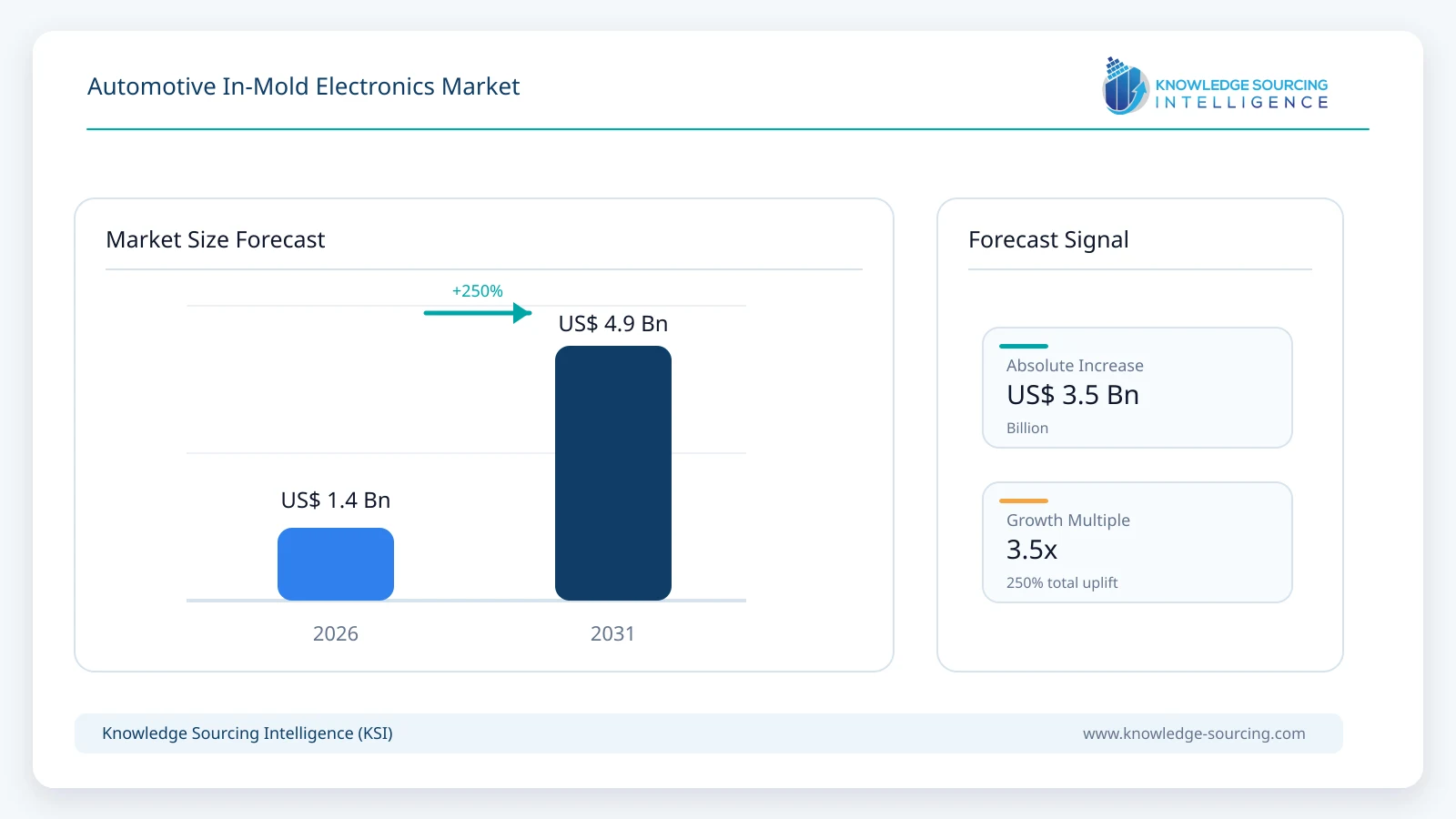
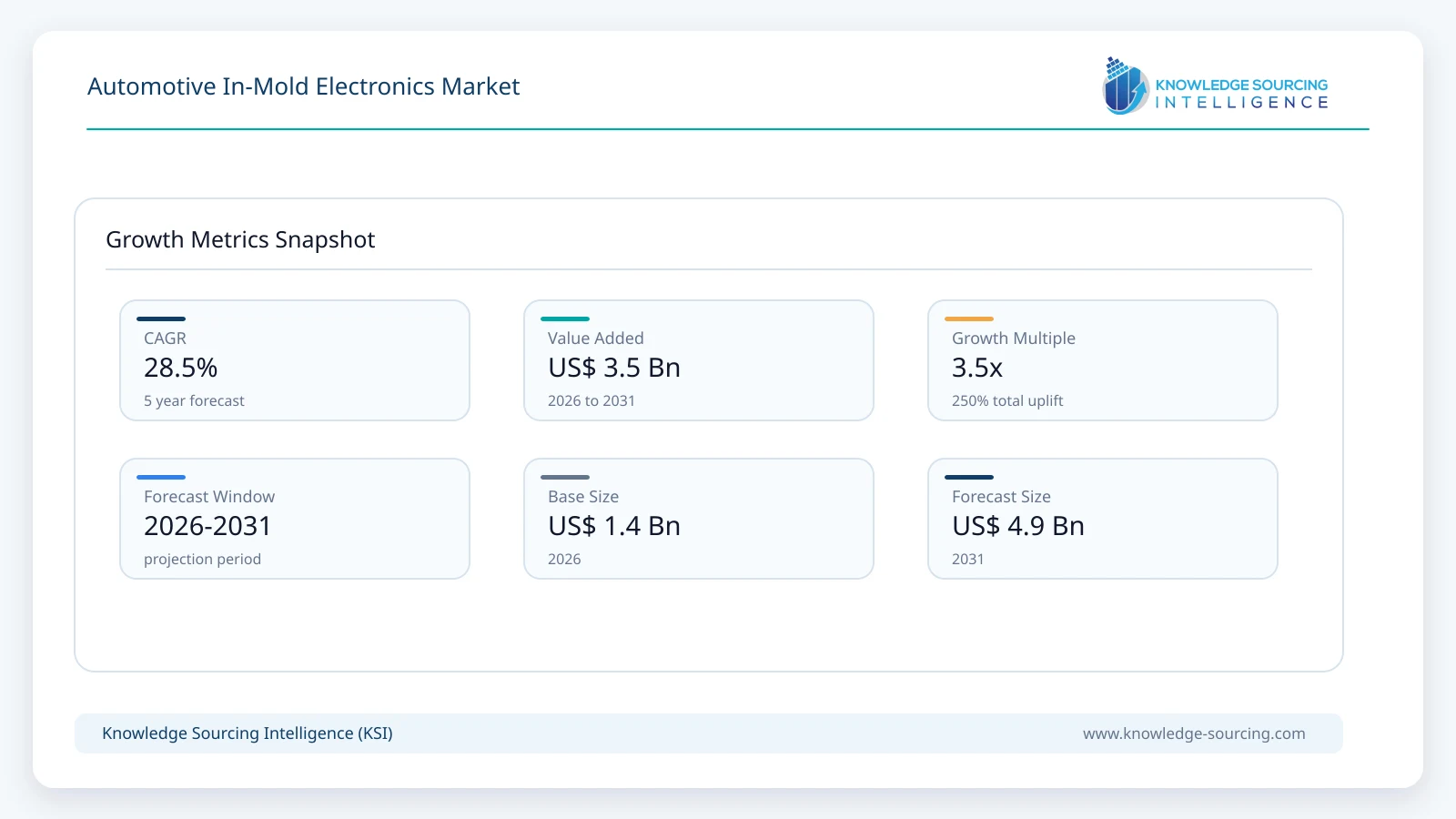
The automotive in-mold electronics market is anticipated to grow at a CAGR of 28.5%, from USD 1.40 billion in 2026 to USD 4.90 billion by 2031.
Highlights:
- 1Interior in-mold electronics account for USD 1.173 billion of 2026 modeled global value, with exterior applications contributing USD 0.227 billion.
- 2Interior IMSE revenue is projected to reach USD 4.1125 billion in 2031, retaining its dominant contribution to the automotive-wide market.
- 3The Valeo January 2026 award supplies an automotive interior commercialization reference, while NBHX adds an exterior award in June 2026.
- 4The manufacturing process combines printing, component mounting, thermoforming and injection molding to produce integrated functional surfaces.
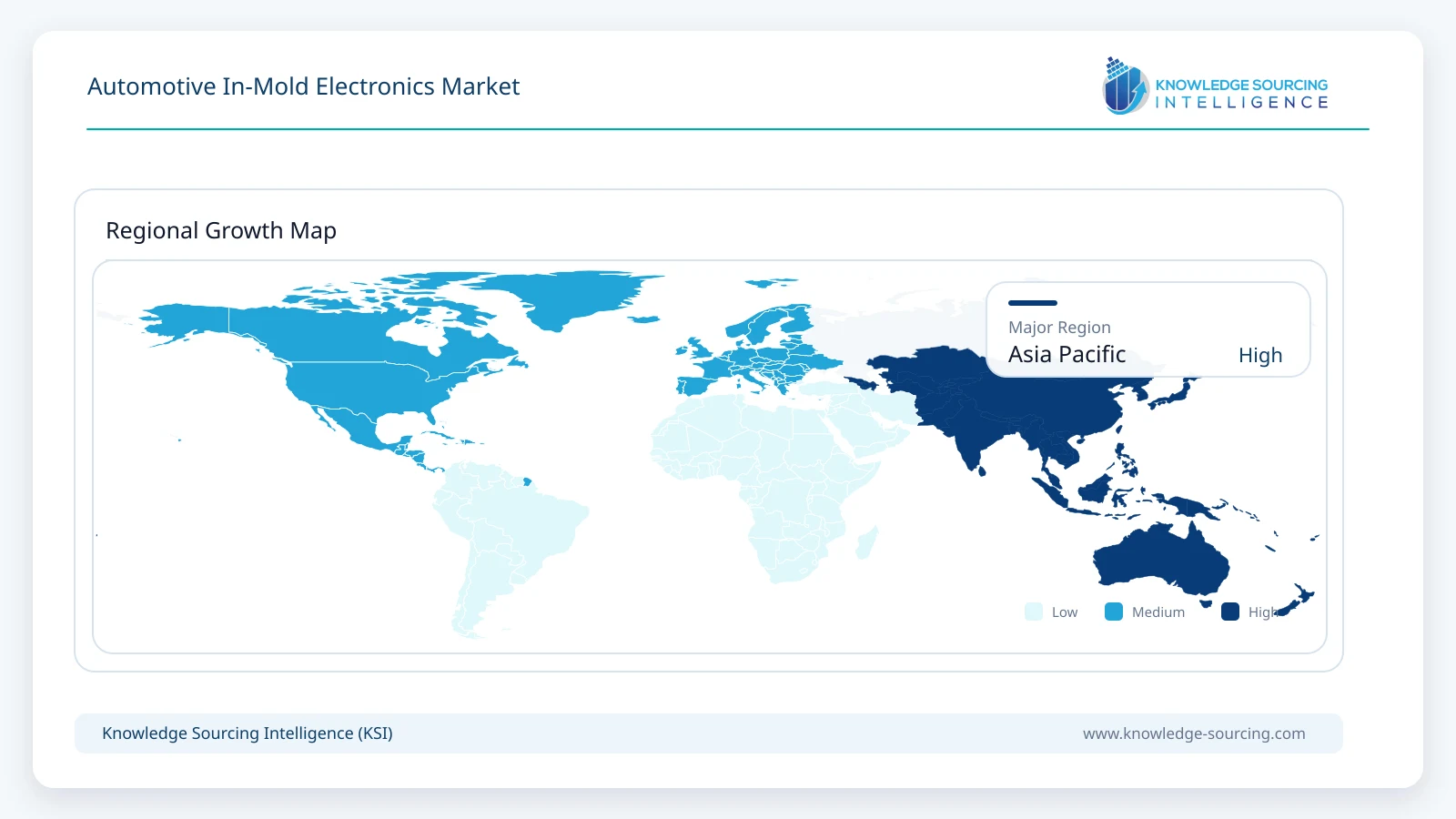
- 5Asia Pacific is the largest modeled regional market in both years, supported by vehicle production and functional-electronics supply chains.
- 6Manufacturing licenses are indicators of industrial capability, not direct evidence of installed parts or annual supplier sales.
Automotive in-mold electronics combine printing, component placement, film forming and polymer injection molding to manufacture functional structures without assembling every electronic layer as a separate module. Door trim, center consoles and instrument-panel surfaces form the largest established demand centers, with exterior lighting and branding surfaces providing an additional route into high-volume programs.
Valeo announced a major premium-vehicle IMSE interior-lighting award in January 2026, while NBHX disclosed a nominated exterior illuminated-surface program in China in June. Nissha offers film-insert molded electronic modules, and TactoTek licenses structural-electronics technology to a growing manufacturing network. These developments indicate a shift from stand-alone design demonstrations toward nominated production programs, although annual revenue remains dependent on start-of-production timing and yields.
Market Overview
In-mold electronic components are produced by placing conductive patterns and, in some constructions, surface-mounted chips or LEDs onto a plastic film before thermoforming and overmolding it. Electrical connections, environmental protection and decorative appearance become part of the molded body. The process serves applications that need a shallow installation depth, curved styling, concealed controls or integrated lighting and would otherwise use multiple mechanical brackets, circuit boards and surface covers.
TactoTek identifies printing, surface mounting, forming and molding as the principal IMSE production stages. Nissha describes insert molding of touch sensors and other functional films within curved plastic panels, with combinations of decorative films and real materials. The suppliers differ in how they monetize technology: a process licensor earns engineering and licensed manufacturing income, while a molding supplier or Tier 1 integrator delivers functional parts to automotive programs.
Vehicle platforms require stable electrical continuity after forming, injection pressure, heat cycling and repeated user contact. Assembly consolidation reduces connectors and styling compromises only when the molded circuit and electronics survive those stages at automotive production yields. For interior controls, ergonomics and repairability are material approval conditions; exterior smart lighting additionally demands weathering, sealing and long-term optical uniformity.
Market Trends
Automotive IMSE Is Moving from Prototype Validation to Awarded Programs
Valeo announced in January 2026 that a premium global automaker awarded an interior-lighting solution using TactoTek IMSE technology. The planned automated manufacturing route embeds lighting and electronics within a ready-to-use molded structure, creating a practical reference for Tier 1 commercialization. A nomination establishes contractual manufacturing intent, while revenue accumulation still depends on the production launch and vehicle volumes.
NBHX announced an exterior smart-surface mass-production program in China in June 2026, expanding the integration platform beyond cabins. Exterior adoption adds optical styling and brand-lighting applications but also introduces ultraviolet, water-ingress and stone-impact requirements. Suppliers that can meet both interior and exterior validation regimes may spread engineering costs across more vehicle zones.
Supplier Licensing Is Enlarging the Manufacturing Network
Motherson licensed TactoTek IMSE technology in May 2026, bringing a global Tier 1 manufacturer into the industrial ecosystem. Symbiose joined as a manufacturing partner in February and Global Technology Ventures obtained a North American license during the same month. This distributed approach allows OEMs to select regional capacity without requiring the technology owner to own every molding facility.
Industrial growth depends on more than signing agreements. Each facility must validate substrate stacks, tooling, circuit deformation limits, electronic attachment and automated inspection to its customers’ standards. Licenses and partner announcements indicate greater sourcing optionality but do not establish the number of vehicles carrying IMSE parts in any year.
Multifunctional Surfaces Are Increasing Content per Molded Part
Curved center-console and door panels increasingly combine lighting, capacitive control, status indication and surface decoration. TactoTek describes printed conductors and embedded components operating in a single lightweight structure, while Nissha offers film-insert sensors that follow three-dimensional plastic geometry. The additional electrical functions can raise the economic content of a molded panel even when the vehicle manufacturer uses fewer separate modules.
Integrated functionality changes qualification responsibility. A visual defect, conductor crack or failed LED may require replacement of a larger module instead of a removable component. Pricing therefore reflects warranty expectations, electrical test coverage, tooling amortization and the value of reduced final-assembly operations, rather than merely the cost of plastic or printed conductive ink.
Exterior Illuminated Applications Are Broadening the Platform
NBHX’s June 2026 China nomination is a concrete indicator of exterior demand for slim illuminated smart surfaces, alongside traditional interior use cases. In-mold integration allows molded exterior structures to carry lighting and conductors with fewer visibly separate components, supporting new brand signatures and packaging options for grilles and exterior trim.
Exterior programs involve harsher chemical, vibration, water-ingress and temperature environments than many interior applications. Manufacturers must control optical output after polymer aging and maintain connector integrity through repeated thermal expansion. Commercial deployment is most likely to progress through clearly defined high-value surfaces before extending to broad exterior body-panel functions.
Segment Analysis
By Application: Interior and Exterior Molded-Electronics Assemblies
Interior IMSE applications account for USD 1.173 billion in 2026, approximately 83.8% of the automotive-wide market. Door panels, consoles, instrument-panel trim and related cabin zones use integrated sensors and lighting where functional integration can reduce assembly complexity. The interior segment is projected to reach USD 4.1125 billion by 2031, supported by expanded adoption and higher electronic functionality per part.
Exterior smart-surface assemblies represent the remaining USD 0.227 billion in 2026 and are projected to reach USD 0.7875 billion by 2031. NBHX’s awarded exterior program demonstrates a manufacturing pathway, but exterior adoption still depends on stringent weathering and optical criteria. The values describe molded electronic content, not the full price of automotive exterior lamps or front-end assemblies.
By Primary Function: Integrated Lighting and Interactive Controls
Embedded lighting and visual indication represent the largest functional category, supported by decorative light lines, illuminated icons and exterior brand signatures. Valeo’s premium-OEM award establishes a practical interior application in which LEDs and associated circuitry are encapsulated in the molded structure. Lighting-led parts are projected to gain market weight as dynamic illumination becomes more sophisticated.
Touch and sensing functions form another substantial category in console, dashboard and door-control applications. Nissha’s IME process illustrates integration of film-based electrodes into curved plastic components. Combined lighting, sensing and control systems command higher value when functions cannot be separated economically, but they require coordinated electronics, polymer and software qualification.
By Integration Architecture: Embedded Components and Functional Films
Printed circuitry with mounted LEDs or semiconductor components creates a more integrated part than a molded insert carrying only a passive conductor pattern. The added assembly content supports premium surfaces and reduces individual part interfaces, but it increases sensitivity to component packaging and thermoforming stress. TactoTek’s four-stage manufacturing process illustrates the engineering work needed to preserve functional components through molding.
Film-insert electronic constructions remain relevant where a touch electrode, conductor trace or localized heater must conform to a curved plastic cover. Nissha identifies molded film sensors as a production-oriented application and notes that some additional functions remain under development. Device manufacturers and molders consequently offer different commercialization pathways, ranging from a functional insert sold upstream to a complete encapsulated electronic surface.
Market Drivers
Vehicle Manufacturers Are Reducing Conventional Surface Assemblies
Molded center-console and door-control modules can combine an appearance layer, circuitry, connection points and functional lighting within one part. Replacing several discrete pieces reduces the need for brackets, secondary adhesives and manual assembly operations, particularly in limited packaging spaces. The commercial gain is strongest when tooling costs can be spread across an established vehicle platform.
TactoTek positions its structural-electronics platform around reduced thickness and integrated construction, while Nissha describes fewer secondary manufacturing steps for functional molded panels. OEM sourcing teams evaluate these potential savings against molding yield and replacement-part costs, so adoption tends to focus first on high-value trim rather than inexpensive conventional switches.
Demand for Seamless Lighting and Controls Is Raising Electronic Content
Premium and technology-led cabins increasingly use concealed icons, continuous decorative surfaces and context-responsive lighting. Embedded electronics allow the surface material to remain visually uninterrupted while retaining local vehicle controls. Valeo’s 2026 interior-lighting program award links this design direction with a recognized Tier 1 manufacturing route.
The same platform can support additional sensors or lighting zones without recreating the entire visible panel architecture. Per-vehicle value rises when several functions are consolidated, although software and electronics qualification expands correspondingly. Suppliers with coordinated optics, film and injection-molding capabilities are positioned to capture a larger share of the functional component bill.
Expanded Industrial Partnerships Are Improving Sourcing Confidence
Motherson’s May 2026 IMSE license and manufacturing agreements with Symbiose and Global Technology Ventures give OEMs more potential production and engineering partners. Automotive purchasing decisions depend heavily on geographic supply, financial stability and reliable escalation during launch, making a broader industrial network commercially important.
Additional licensed manufacturers can help reduce dependence on a single specialty supplier while supporting regional tooling and validation work. Nevertheless, manufacturing capability must be demonstrated through actual approved process windows and customer nominations, not inferred solely from signed licenses. The forecast reflects gradual capacity conversion rather than immediate universal penetration.
Exterior Lighting Programs Are Increasing Automotive Addressability
NBHX’s June 2026 Chinese OEM award introduces a documented exterior application for IMSE-based illuminated surfaces. Exterior styling has long combined plastic trim with separate lamp electronics, and embedding selected circuits into molded structures can give designers thinner profiles and more continuous lighting signatures.
The opportunity becomes commercially relevant as electric and premium vehicles differentiate through exterior illumination and branding. Additional value is limited to the electronics-integrated molded structure; complete headlamps, conventional lamp modules and unrelated exterior trim remain separate markets. Exterior weathering and sealing standards determine how broadly the process can scale.
Vehicle Electronics Architectures Are Supporting Local Functional Modules
Zonal electronic architectures and configurable body-control software allow interior surfaces to act as coordinated local input or illumination devices. Embedded controls can link vehicle settings to physical decorative parts without requiring a unique mechanical switch assembly for every function. Integrators can reuse control electronics concepts across several trim designs.
Hardware reuse does not eliminate program-specific validation. Electrical interfaces, diagnostic behavior, electromagnetic compatibility and failure states must be matched to each OEM architecture. Suppliers that deliver a tested combination of molded circuitry, connectivity and control behavior may protect value better than manufacturers selling only patterned film.
Market Restraints
Thermoforming and Molding Yields Can Limit Industrial Economics
Printed conductors and solderless or adhesively mounted components experience deformation during film forming and mechanical pressure during overmolding. Track cracking, component movement, delamination or optical blemishes can result in expensive part rejection after multiple manufacturing steps have already added value.
TactoTek’s manufacturing documentation emphasizes material and component verification for those process stages. Stable yields require closely controlled curvature, resin temperatures, substrate compatibility and testing, raising the qualification cost of new designs. Short production runs are particularly exposed to tooling and scrap costs relative to conventional modular assemblies.
Embedded Electronics Complicate Repair and Warranty Decisions
Encapsulated sensors and LEDs are protected from direct handling, but a failed embedded device may not be removable independently. A minor electronic fault can require replacement of a complete decorative console or door part, increasing warranty costs and inventory complexity compared with a serviceable switch module.
Automakers assess replacement cost, diagnostics and workshop procedures before approving functional trim construction. Damage from surface abrasion or liquid exposure can also affect electronics even when basic decorative appearance remains acceptable. Repairability concerns can slow IMSE use in high-contact or low-cost vehicle zones.
Automotive Functional-Safety and Usability Requirements Restrict Controls
Flat control zones must remain identifiable and usable under driving conditions, particularly where occupants need immediate access to important functions. A seamless molded surface can offer premium appearance without providing a tactile location cue. Designers consequently face a tradeoff between hidden interfaces and direct access to essential switches.
Human-machine-interface testing, electromagnetic compatibility and control diagnostics add engineering work beyond the molding operation. Electronic surface controls are commercially more straightforward for ambient lighting, comfort and secondary convenience functions than for safety-critical primary controls, where physical switchgear may remain preferable.
Tooling Investment and Long Launch Cycles Delay Revenue Conversion
Automotive molds, forming dies, automated inspection and electrical validation equipment require investment before serial orders are realized. A single design change may affect film patterning, connector placement and mold geometry, so production release involves more coordinated requalification than a conventional cosmetic trim update.
Valeo and NBHX announced program awards in 2026, whereas other reported ecosystem developments were technology licenses and engineering partnerships. These milestones do not all create revenue in the announcement year. OEM launch timing, plant utilization and acceptance tests can shift the realization of supplier sales materially.
Material Aging and Environmental Exposure Increase Reliability Risk
Interior plastics must tolerate long-term temperature cycling, cleaning chemicals, humidity and repeated contact without visible or electrical degradation. Exterior IMSE applications add direct ultraviolet exposure, water and road contaminants, all of which can affect optical clarity, printed paths and bonding interfaces.
NBHX’s exterior award illustrates commercial interest but also highlights the durability requirements associated with exterior illumination. Material selection and accelerated aging trials are essential for each part geometry and resin stack. Failure to pass testing can force a redesign that removes the expected time or cost advantage of integrated electronics.
Regional Outlook
Asia Pacific
Asia Pacific is estimated to account for 44% of automotive in-mold electronics revenue in 2026 and 48% by 2031. China’s large vehicle manufacturing base and advanced electronics supply chain support new integrated lighting and exterior styling programs, while Japan and South Korea contribute materials, films and mold-electronics expertise. OICA reported strong Asia-Oceania vehicle-production growth during 2025.
NBHX’s Chinese exterior program and Nissha’s Japanese molded-electronics capabilities illustrate regional demand and supply routes. Vehicle-platform content decisions, high-volume tooling and access to local production facilities determine market capture. Regional allocations are KSI forecasts based on industry structure, not publicly reported IMSE sales totals.
Europe
Europe represents an estimated 29% of 2026 automotive IMSE market value, supported by premium-vehicle interiors and the local ecosystem around TactoTek, Valeo and specialist mold-electronics partners. OEM requirements for differentiated cabin lighting, compact components and low assembly complexity encourage evaluation of integrated electronic surfaces.
Valeo’s 2026 premium-OEM award and TactoTek’s European manufacturing partnerships strengthen commercialization infrastructure. Europe’s modeled share moderates to 25% by 2031 as Asia Pacific expands faster. High supplier qualification costs and the need to validate safety and reliability remain significant influences on the speed of regional adoption.
Competitive Landscape
TactoTek is a technology-platform developer and licensor, while Valeo, NBHX and Motherson bring program manufacturing and automotive-system integration capabilities. Nissha supplies integrated molded electronic inserts and functional films, and manufacturing partners such as Symbiose and Global Technology Ventures contribute specific industrial process capacity. Those roles differ in margins, capital investment and revenue recognition.
Competition is concentrated on the ability to produce reliable parts at scale with consistent decorative appearance and functional yield. Important differentiators include approved material stacks, tightly controlled component placement, flexible molding capacity, tooling expertise, and the capacity to support OEM platforms in multiple regions.
An awarded production program carries different commercial weight from a demonstration, a technology license or an engineering agreement. Numerical market-share rankings remain difficult without disclosed IMSE-specific supplier sales. Program awards, manufacturing partnerships and validated product capability therefore provide more credible comparisons than assigning unsupported company revenue shares.
Recent Developments
15 September 2026: EDAG entered TactoTek’s IMSE engineering ecosystem to support design and industrialization of automotive interior and exterior smart surfaces; it is an engineering agreement, not a vehicle award.
29 June 2026: NBHX announced a nominated exterior illuminated-surface production program in China using TactoTek IMSE; program award expands the technology’s exterior commercialization pathway.
21 May 2026: Motherson signed an IMSE technology license with TactoTek to broaden Tier 1 supply routes for molded electronic surfaces across automotive interior and exterior applications.
25 February 2026: Symbiose and TactoTek agreed to expand manufacturing capability for IMSE automotive parts using printed electronics and functional-foil expertise.
2 February 2026: Global Technology Ventures signed a North American manufacturing technology license with TactoTek to support design, tooling, prototyping and manufacturing of IMSE parts.
20 January 2026: Valeo announced a premium-automaker interior lighting program using TactoTek IMSE and an automated high-volume manufacturing solution, providing an awarded interior application.
Market Outlook
Automotive in-mold electronics market value is projected to rise from USD 1.40 billion in 2026 to USD 4.90 billion by 2031 as interior molded trim incorporates more illumination, sensing and control functions. The interior IMSE component remains the largest revenue pool, with exterior smart surfaces supplying additional growth beyond the cabin.
Valeo’s interior and NBHX’s exterior nominations demonstrate an industrial pathway, while TactoTek’s licensing network and Nissha’s molded-sensor portfolio broaden the available technical approaches. Scaling production depends on part-specific yields, validated material stacks and OEM model launches rather than on the number of announced partnerships alone.
Integrated parts should win strongest adoption where they demonstrably remove assembly steps or create design functions that conventional modules cannot deliver economically. Long qualification cycles, embedded-component serviceability and electronics durability will restrain faster penetration, particularly in lower-cost vehicles and safety-critical controls.
Automotive In-Mold Electronics Market Scope
| Report Metric | Details |
|---|---|
| Total Market Size in 2026 | USD 1.40 billion |
| Total Market Size in 2031 | USD 4.90 billion |
| Forecast Unit | Billion |
| Growth Rate | 28.5% |
| Study Period | 2021 to 2031 |
| Historical Data | 2021 to 2024 |
| Base Year | 2025 |
| Forecast Period | 2026 – 2031 |
| Segmentation | Application, Primary Function, Electronic Integration, Conductor and Circuit Process, Surface Material, Vehicle Type, Propulsion, Geography |
| Companies |
|
Market Segmentation
By Application
Door Panels and Armrest Trim
Center Console and Center Stack
Instrument Panel and Dashboard
Overhead, Rear and Other Interior Parts
Exterior Illuminated Smart Surfaces
By Primary Function
Integrated Lighting and Visual Indication
Touch and Sensor Control
Multifunctional Lighting and Control
Heating, Antennas and Other Functions
By Electronic Integration
Printed Circuits with Embedded Components
Functional Conductive Film Inserts
Localized Printed Heaters and Antennas
Other Integrated Electronic Constructions
By Conductor and Circuit Process
Screen-Printed Conductive Patterns
Metallized and Etched Film Circuits
Hybrid Multi-Layer Circuit Processes
Other Patterning Methods
By Surface Material
Molded Polycarbonate and Blends
Polypropylene and Other Polymer Systems
Decorated Films and Multilayer Overlays
Other Composite or Specialty Materials
By Vehicle Type
Passenger Vehicles
Light Commercial Vehicles
Medium and Heavy Commercial Vehicles and Buses
By Propulsion
Internal Combustion and Mild Hybrid
Hybrid and Plug-In Hybrid
Battery Electric
By Geography
North America
United States
Canada
Mexico
South America
Brazil
Argentina
Others
Europe
Germany
United Kingdom
France
Italy
Spain
Others
Middle East and Africa
Saudi Arabia
United Arab Emirates
South Africa
Others
Asia Pacific
China
Japan
South Korea
India
Indonesia
Thailand
Others
Table of Contents
1. EXECUTIVE SUMMARY
1.1. Market Opportunity and Key Findings
1.2. Market Size and Growth, 2026–2031
1.3. Automotive IMSE Commercialization
1.4. Regional Opportunity Summary
2. MARKET SNAPSHOT
2.1. Market Overview
2.2. Market Definition
2.3. Scope of the Study
2.4. Market Segmentation
3. BUSINESS LANDSCAPE
3.1. Market Drivers
3.1.1. Vehicle Manufacturers Are Reducing Conventional Surface Assemblies
3.1.2. Demand for Seamless Lighting and Controls Is Raising Electronic Content
3.1.3. Expanded Industrial Partnerships Are Improving Sourcing Confidence
3.1.4. Exterior Lighting Programs Are Increasing Automotive Addressability
3.1.5. Vehicle Electronics Architectures Are Supporting Local Functional Modules
3.2. Market Restraints
3.2.1. Thermoforming and Molding Yields Can Limit Industrial Economics
3.2.2. Embedded Electronics Complicate Repair and Warranty Decisions
3.2.3. Automotive Functional-Safety and Usability Requirements Restrict Controls
3.2.4. Tooling Investment and Long Launch Cycles Delay Revenue Conversion
3.2.5. Material Aging and Environmental Exposure Increase Reliability Risk
3.3. Market Opportunities
3.4. Porter’s Five Forces Analysis
3.5. Industry Value Chain Analysis
3.6. Policies and Regulations
3.7. Strategic Recommendations
4. TECHNOLOGICAL OUTLOOK
4.1. Printed Circuit Patterns and Conductive Inks
4.2. Surface-Mount Electronic Components and Packaging
4.3. Thermoforming and Controlled Circuit Deformation
4.4. Injection Molding and Film Encapsulation
4.5. In-Mold Structural Electronics and Hybrid Architectures
4.6. Integrated Touch, Sensing and Lighting Functions
4.7. Interior and Exterior Material-Stack Reliability
4.8. Inline Electrical, Optical and Environmental Testing
5. AUTOMOTIVE IN-MOLD ELECTRONICS MARKET BY APPLICATION
5.1. Introduction
5.2. Door Panels and Armrest Trim
5.3. Center Console and Center Stack
5.4. Instrument Panel and Dashboard
5.5. Overhead, Rear and Other Interior Parts
5.6. Exterior Illuminated Smart Surfaces
6. AUTOMOTIVE IN-MOLD ELECTRONICS MARKET BY PRIMARY FUNCTION
6.1. Introduction
6.2. Integrated Lighting and Visual Indication
6.3. Touch and Sensor Control
6.4. Multifunctional Lighting and Control
6.5. Heating, Antennas and Other Functions
7. AUTOMOTIVE IN-MOLD ELECTRONICS MARKET BY ELECTRONIC INTEGRATION
7.1. Introduction
7.2. Printed Circuits with Embedded Components
7.3. Functional Conductive Film Inserts
7.4. Localized Printed Heaters and Antennas
7.5. Other Integrated Electronic Constructions
8. AUTOMOTIVE IN-MOLD ELECTRONICS MARKET BY CONDUCTOR AND CIRCUIT PROCESS
8.1. Introduction
8.2. Screen-Printed Conductive Patterns
8.3. Metallized and Etched Film Circuits
8.4. Hybrid Multi-Layer Circuit Processes
8.5. Other Patterning Methods
9. AUTOMOTIVE IN-MOLD ELECTRONICS MARKET BY SURFACE MATERIAL
9.1. Introduction
9.2. Molded Polycarbonate and Blends
9.3. Polypropylene and Other Polymer Systems
9.4. Decorated Films and Multilayer Overlays
9.5. Other Composite or Specialty Materials
10. AUTOMOTIVE IN-MOLD ELECTRONICS MARKET BY VEHICLE TYPE
10.1. Introduction
10.2. Passenger Vehicles
10.3. Light Commercial Vehicles
10.4. Medium and Heavy Commercial Vehicles and Buses
11. AUTOMOTIVE IN-MOLD ELECTRONICS MARKET BY PROPULSION
11.1. Introduction
11.2. Internal Combustion and Mild Hybrid
11.3. Hybrid and Plug-In Hybrid
11.4. Battery Electric
12. AUTOMOTIVE IN-MOLD ELECTRONICS MARKET BY GEOGRAPHY
12.1. Introduction
12.2. North America
12.3. South America
12.4. Europe
12.5. Middle East and Africa
12.6. Asia Pacific
12.2.1. United States
12.2.2. Canada
12.2.3. Mexico
12.3.1. Brazil
12.3.2. Argentina
12.3.3. Others
12.4.1. Germany
12.4.2. United Kingdom
12.4.3. France
12.4.4. Italy
12.4.5. Spain
12.4.6. Others
12.5.1. Saudi Arabia
12.5.2. United Arab Emirates
12.5.3. South Africa
12.5.4. Others
12.6.1. China
12.6.2. Japan
12.6.3. South Korea
12.6.4. India
12.6.5. Indonesia
12.6.6. Thailand
12.6.7. Others
13. COMPETITIVE ENVIRONMENT AND ANALYSIS
13.1. Major Players and Strategy Analysis
13.2. Market Share Analysis
13.3. Mergers, Acquisitions, Agreements and Collaborations
13.4. Automotive IMSE Production Readiness
13.5. Supplier Technology and Manufacturing Benchmark
13.6. Competitive Dashboard
14. COMPANY PROFILES
14.1. TactoTek Oy
14.2. Valeo
14.3. NBHX
14.4. Motherson Group
14.5. Nissha Co., Ltd.
14.6. Symbiose
14.7. Global Technology Ventures Inc.
14.8. ARRK SPG
14.9. PolyIC GmbH
14.10. DuPont
14.11. Henkel AG & Co. KGaA
15. APPENDIX
15.1. Currency
15.2. Assumptions
15.3. Base and Forecast Years Timeline
15.4. Key Benefits for Stakeholders
15.5. Research Methodology
15.6. Abbreviations
15.7. Data Sources
Navigate
Trusted by the world's leading organizations











