
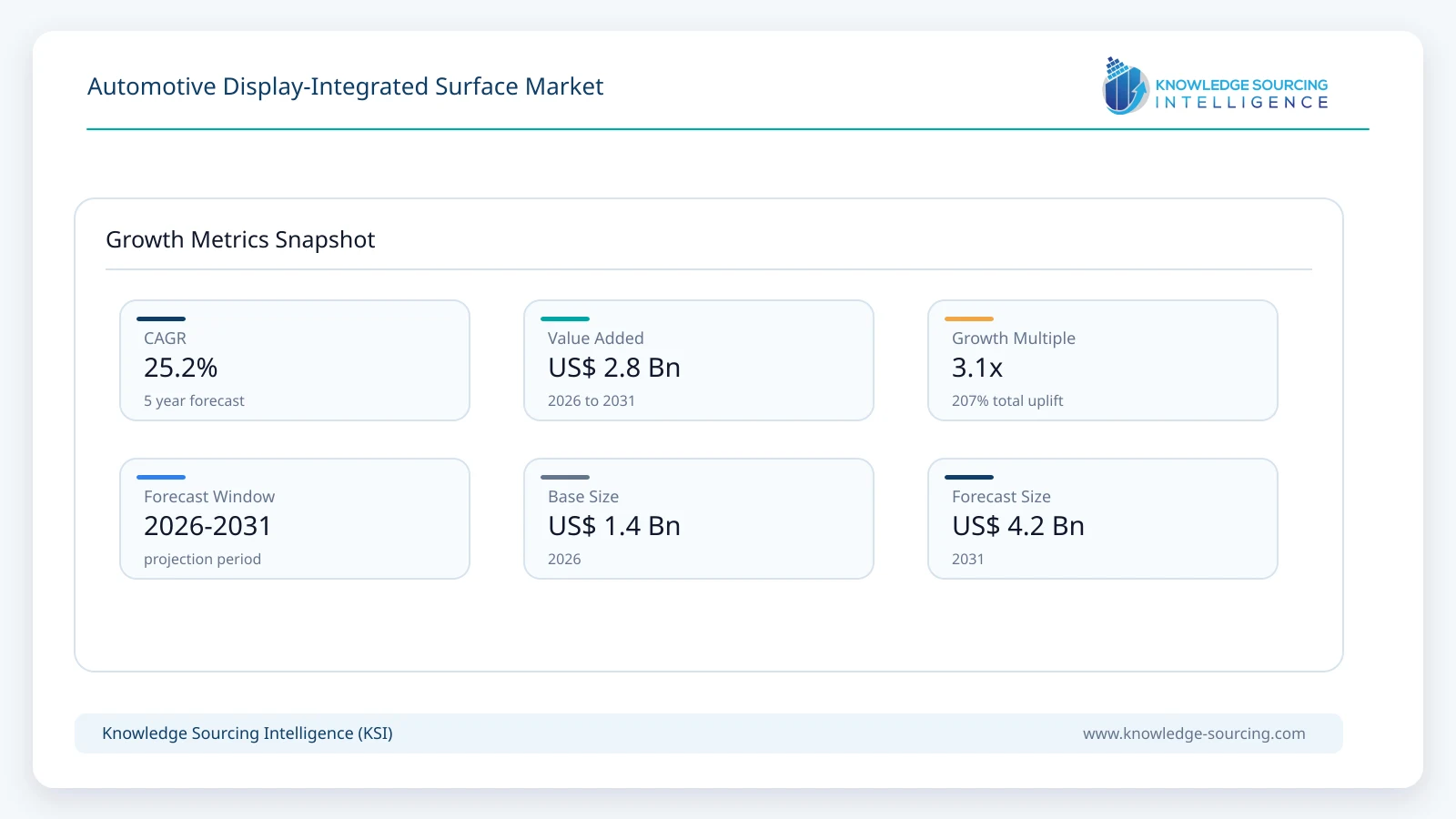
The Automotive Display-Integrated Surface Market is projected to expand at a CAGR of 25.2%, increasing from USD 1.35 billion in 2026 to USD 4.15 billion by 2031.
Highlights:
- 1Instrument-panel and dashboard applications account for an estimated 61% of 2026 market value because front-cabin integration has the strongest early design and visibility advantages.
- 2Concealed and hidden-until-needed displays are modeled at 34% of 2026 revenue, with expansion as decorative optical stacks become easier to manufacture.
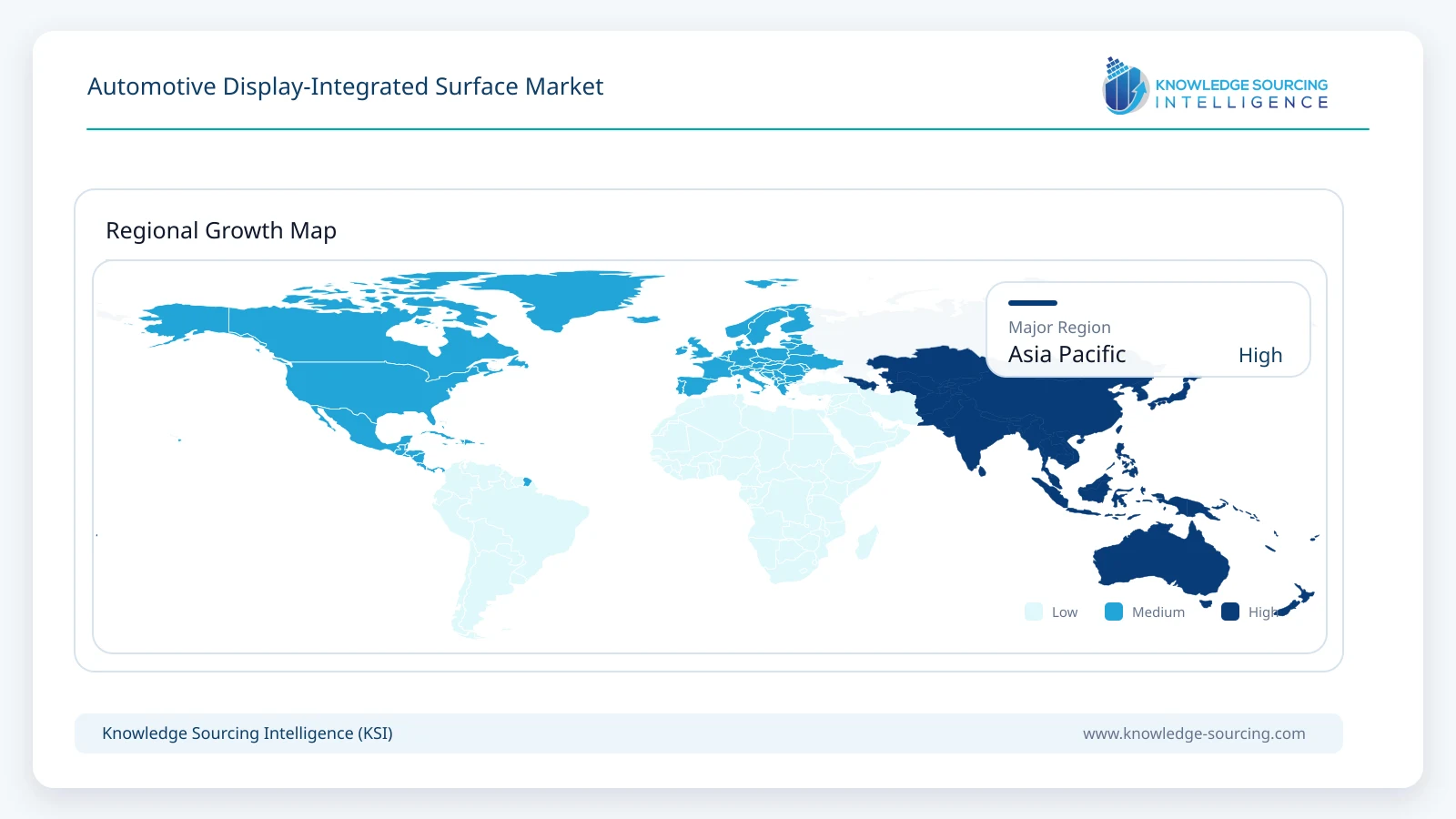
- 3Asia Pacific accounts for an estimated 44% of 2026 market value, led by Chinese automotive display and interior-integration programs.
- 4OLED and flexible OLED technologies gain share through 2031 where thinness, curvature and black-state appearance justify higher component costs.
- 5Advanced optical films, calibration and decorative-layer bonding are expected to capture an increasing share of supplier content as the visual interface becomes part of the trim assembly.
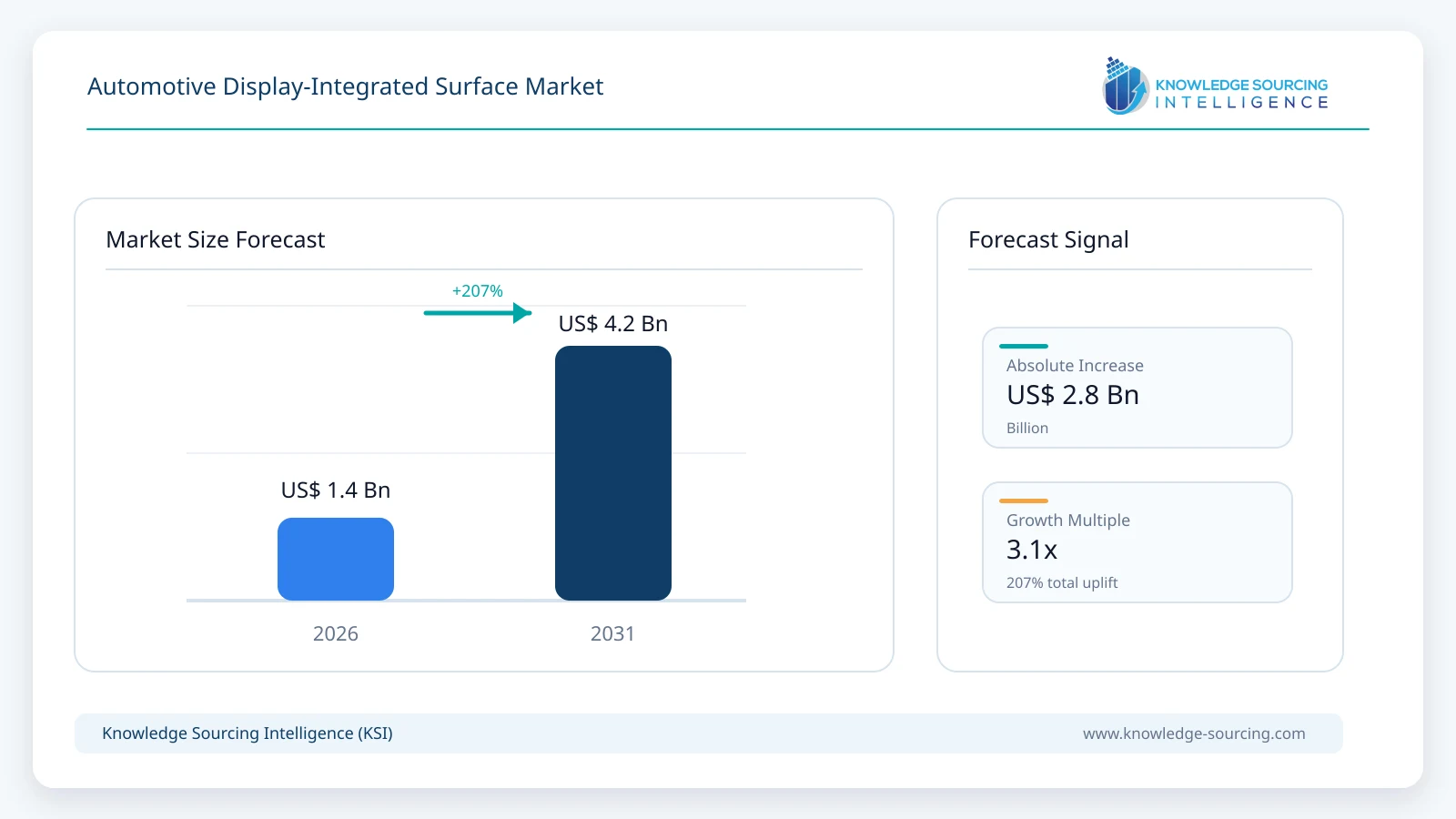
The market encompasses the attributable value of integrated surface-display assemblies, including optical overlays, concealed display stacks, projection structures, and dedicated electronic integration used to present information through a cabin surface. Standalone infotainment displays, conventional switches and non-informational decorative lighting are not independently included.
Instrument panels remain the primary integration location because manufacturers can combine driver information, climate status and context-sensitive controls within a wide, visually continuous surface. Yanfeng illustrates the interior-supplier approach through smart surfaces that conceal displays until activated, while FORVIA has demonstrated a hidden fabric-like display and AirVision projection on a translucent instrument-panel surface. Visteon and the former Continental Automotive business, now AUMOVIO, bring related display optics and integration capabilities to the supplier landscape.
Market Overview
Display-integrated surfaces replace the traditional separation between a visible display bezel and the decorative material surrounding it. The technology combines an information-producing display or optical projection with a physical trim component, translucent skin, patterned overlay, or molded housing. A manufacturer must maintain readable brightness, predictable viewing angles, low reflectance and consistent surface color despite the need for a display to disappear visually when inactive.
Yanfeng markets smart surfaces in which interaction controls, information displays, lighting and heating are coordinated across instrument-panel, console and door zones. AUMOVIO inherits Continental’s ShyTech display work, which demonstrated how optical transmission through textured decorative media can conceal a large display until required. FORVIA’s 2025 Auto Shanghai materials describe a hidden display behind a fabric-like finish and an AirVision image projected using an instrument-panel-integrated translucent surface, providing two distinct engineering routes for reducing screen prominence.
Optical-stack design is becoming more important for Tier 1 sourcing decisions because a trim supplier and a display supplier must qualify the surface as a single product. Decorative films affect transmittance and color, while display heat can change polymer stability, adhesives and perceived craftsmanship. Emerging systems therefore increase the value of joint supplier engineering and production inspection, even where display panel prices continue to decline.
Market Trends
Concealed Information Displays Are Moving into Decorative Surfaces
Yanfeng and AUMOVIO have developed hidden-display architectures that minimize black-glass areas in the unpowered cockpit. By matching the visible trim surface to nearby materials and activating information only when needed, suppliers can meet design requirements without removing digital functionality. Concealed surfaces are particularly relevant to passenger-side dashboards, center consoles and non-critical status displays where uninterrupted decoration has greater value than permanently visible graphics.
FORVIA has demonstrated a screen located behind a fabric-like surface, using image processing to compensate for brightness and color shifts introduced by the finish. This approach requires separate qualification of the optical layer, backlighting and thermal package because an apparently conventional decorative surface must function as a readable display under sunlight, nighttime dimming and vehicle vibration. Wider adoption will depend on repeatable optical yield and the cost of replacing a damaged integrated panel.
Projection and Surface Optics Are Extending Display Design Freedom
FORVIA’s AirVision technology uses a flat translucent instrument-panel surface to reflect a projected virtual image rather than relying entirely on a permanently exposed flat display module. Projection can change the perceived location of information and give stylists more flexibility over the appearance of the cockpit. The same optical path requires close control of vibration, stray light, focal geometry and line of sight, making it more demanding than ordinary backlighting.
Integrating projected information and hidden-display controls into dashboard surfaces also changes how drivers find and interpret essential vehicle functions. Euro NCAP’s 2026 assessment changes place more emphasis on the clarity and ease of use of essential controls, including the availability of physical buttons for frequently used functions. Suppliers seeking cleaner surfaces must therefore retain predictable, quickly accessible interfaces instead of interpreting design minimalism as permission to hide every driving control.
Integrated Optical Stacks Are Combining Functions
Visteon and Smart Eye announced an LCD cluster integrating a driver-monitoring camera behind the display in May 2026, with optical-stack engineering intended to preserve both image quality and near-infrared sensing. Although that program is not itself a decorative hidden-display sale, it demonstrates a wider move toward multifunction optical stacks in which display surfaces, sensors and structural elements must be engineered together. The architecture can reduce visible cutouts and consolidate components where optical performance remains acceptable.
The June 2026 Lexus ES production application of Visteon’s narrow-border driver display provides a separate indication of OEM demand for optically bonded, visually continuous cockpit assemblies. Its production status should not be confused with the commercialization of fully concealed displays. Nevertheless, slim borders, bonded covers and tight cockpit packaging create the supplier capabilities required for more extensive surface integration.
Interior Electronics Production Is Becoming More Industrialized
Motherson licensed TactoTek’s in-mold structural electronics in May 2026 to expand access to integrated smart-surface components across instrument panels, door panels, decorative trim and center consoles. IMSE-based lighting and functional electronics are adjacent to high-resolution displays rather than replacements for them, but the manufacturing platform shows how circuits and functions can move into shaped parts. Display-surface suppliers may benefit from similar molding, bonding and material-qualification techniques.
Antolin and UltraSense announced a smart-surface HMI development initiative in September 2026 involving touch and force sensing with visual and haptic feedback. The initiative remains a development program rather than a disclosed high-volume display production award. It nevertheless illustrates the growing need to combine information presentation, sensing, software calibration and tactile confirmation in one robust interior component.
Segment Analysis
By Surface Architecture: Concealed and Hidden-Until-Needed Displays
Concealed displays combine a selectively transmissive surface with an image-producing panel so that information becomes visible only in the active state. They account for an estimated 34% of market value in 2026 as premium cabins seek fewer visually exposed screens and switches. Optical transparency, surface grain and daylight brightness constrain the design, particularly when the outer trim must retain a convincing material appearance.
Concealed display surfaces are projected to approach 41% of market value by 2031, supported by better decorative films, higher-brightness displays and suppliers able to coordinate optical calibration with trim manufacturing. Yanfeng’s smart-surface portfolio and the ShyTech architecture developed by Continental Automotive illustrate the technical approach. Growth will be strongest where the surface adds both a premium material effect and a clearly useful information function.
By Display Technology: TFT-LCD and OLED
TFT-LCD remains the largest technology group in 2026 because mature manufacturing processes, high-brightness backlighting, and well-understood panel sourcing support applications behind decorative overlays. The segment represents approximately 55% of modeled revenue, although thick optical stacks and black-state appearance can limit some premium hidden-screen designs. LCD integration continues to require careful thermal and optical management where the display sits beneath fabric, film, or textured trim.
OLED and flexible OLED increase from an estimated 18% in 2026 to 27% in 2031 as conformal packaging and thin display stacks become more commercially attractive. Their material and lifetime characteristics still require automotive qualification, and the cost premium will restrict early adoption to applications where geometry or appearance delivers measurable design value. Display makers and interior integrators will compete through the finished optical module rather than panel specifications alone.
By Cabin Application: Instrument Panel and Dashboard
Instrument-panel applications account for approximately 61% of 2026 market value because the dashboard provides a large, highly visible surface surrounding the driver and front passenger. Display integration can simplify the apparent cabin architecture while retaining navigation prompts, climate status and context-dependent controls. The installation must also accommodate airbags, service access, wiring, heat and crash-related structural constraints.
Center consoles and door-trim interfaces are expected to gain share toward 2031 as OEMs move selected comfort, lighting and passenger controls away from conventional exposed buttons. The most commercially valuable installations will replace multiple separate components or create a meaningful new user function. Surfaces that merely add an illuminated logo without information-display capability remain outside this segment.
By Integration Platform: Optically Bonded Modules
Optically bonded decorative display modules are estimated to account for 45% of 2026 market value, reflecting the maturity of rigid display assemblies with specialized cover layers and controlled adhesive interfaces. Optical bonding can improve reflections and mechanical stability, but production tolerances become more demanding as surface curvature and decorative texture increase. Suppliers must qualify appearance in both powered and unpowered states.
Behind-surface translucent stacks are projected to gain share through 2031 as advanced coatings, texture processing and brightness compensation improve the hidden-display effect. Projection-based systems remain important for selected premium applications, while molded and conformal electronics create opportunities for more complex three-dimensional surfaces. Suppliers will prioritize repeatable optical quality as integration shifts from custom displays toward scalable surface modules.
By Propulsion: Battery Electric Vehicles
Battery electric vehicles are expected to represent a rising share of display-integrated surface demand because several EV platforms use digital interfaces and minimalist interiors as a product differentiator. The modeled BEV share increases from 20% in 2026 to 38% in 2031, reflecting both growth in EV production and the greater early probability of adopting new cabin architectures. Battery-powered platforms offer flexible front-cabin packaging, although the same display-surface architectures can be deployed on combustion and hybrid models.
Internal-combustion and conventional hybrid vehicles retain the larger aggregate value in 2026 due to their substantial production base. Broader deployment across these powertrains will depend on the cost of optical stacks and the ability to carry one display-surface design through multiple trim variants. Vehicle platform standardization will therefore matter as much as drivetrain technology in determining supplier revenue.
Market Drivers
Premium and Electric-Vehicle Cabin Differentiation
Premium vehicle brands and newer electric-vehicle platforms increasingly use cabin interface design to distinguish otherwise similar technical specifications. A hidden display or integrated projection can deliver information without leaving an inactive black screen visible across the passenger compartment. Yanfeng’s smart surfaces and FORVIA’s hidden-display work demonstrate how trim and optics can be combined to reinforce visual differentiation. The supplier opportunity depends on the system solving a real packaging or functional need rather than adding decoration alone.
Growing Integration of Display and Interior Trim Engineering
Instrument panels and consoles are being engineered around electronic functions much earlier in vehicle development, allowing bonding, materials and displays to be validated as one assembly. Specialized optical layers can improve perceived quality but also place more value on Tier 1 integration and production quality controls. Visteon’s bonded narrow-border display and the established ShyTech design approach illustrate these engineering directions. The shift supports demand for higher-value subassemblies rather than individual display panels alone.
Expansion of Contextual Driver and Passenger Interfaces
Passenger information, climate settings and driver-assistance status increasingly require distinct display zones across the interior rather than a single center screen. Embedding selected information into the trim can reduce travel between controls and allow occupants to access content at the relevant location. Implementation must preserve control discoverability and avoid creating new distraction risks. Manufacturers with integrated display, sensing and HMI capabilities are better positioned to meet these demands.
Improved Materials and Flexible Display Architectures
Better light-transmitting decorative skins, flexible emissive displays and optical adhesives expand the range of surfaces capable of presenting readable information. Each materials improvement creates potential for reduced assembly depth and more varied installation geometry, especially around curved instrument panels and trim. Automotive qualification continues to require thermal cycling, vibration, scratch, and color consistency testing. Commercial adoption will be strongest where these advances improve production yield or reduce separate trim and display parts.
Industrialization of Multifunction Smart Surfaces
Motherson’s 2026 licensing agreement with TactoTek and Antolin’s collaboration with UltraSense illustrate growing supplier investment in multifunction interior surfaces and industrial integration. These technologies do not by themselves establish high-volume concealed-display sales, but they expand manufacturing knowledge in embedded circuitry, surface sensing and optical feedback. Once optical and electronics processes can be combined on repeatable automotive lines, OEMs gain a more credible sourcing route for integrated display-surface designs.
Market Restraints
Readability through Decorative Layers
Decorative surfaces reduce the optical transmission available to an underlying display, making legibility more difficult under bright daylight and at oblique viewing angles. Grain, printed patterns, and color pigments can alter images across the field of view. Increasing panel brightness raises thermal and electrical demands, while aggressive color correction can introduce visible inconsistency between display and trim. A successful application must therefore balance concealment and optical performance.
Driver Distraction and Essential-Control Accessibility
Integrated interfaces can hide information until requested, but concealed functions also introduce discoverability and usability questions. Euro NCAP’s 2026 approach examines the placement and clarity of essential controls and considers physical-button access for common functions. Automakers must evaluate glove use, false activation, and whether visual feedback can be interpreted without excessive glances. Safety-critical functions are less suitable for decorative concealment than optional comfort and passenger functions.
Qualification and Replacement Complexity
A damaged integrated display surface may require replacement of a decorated structural panel rather than a small removable screen or switch. The assembly can also combine scratch-sensitive coatings, optical adhesives, electrical interconnects and temperature-sensitive materials. Qualification across thermal cycling, humidity, cleaning chemicals and vibration increases validation cost and program risk. Repairability and supply continuity consequently influence OEM purchasing decisions.
High Initial Integration Cost
Premium optical films, display brightness, bonding and tight trim tolerances raise per-vehicle cost compared with conventional visible displays and mechanical controls. Low volumes can compound tooling and yield expense when each vehicle program requires unique curvature or decorative finishes. Some integrated systems also duplicate rather than replace existing screens, weakening the initial cost case. Standardized optical platforms and consolidated parts will be necessary for wider mid-market penetration.
Fragmented Supply and Software Interfaces
Surface display programs often require coordination among display-panel makers, trim molders, electronics integrators, HMI software teams, and vehicle OEMs. Differences in vehicle network architectures, color calibration, and software update responsibility complicate reuse across platforms. Suppliers can face extended design validation when display information and the surrounding surface are specified by different organizations. Interface standards and early co-development agreements are therefore important to schedule certainty.
Regional Outlook
Asia Pacific
Asia Pacific is estimated to account for 44% of the global display-integrated surface market in 2026, supported by high vehicle production volumes and a strong supplier ecosystem in China, Japan and South Korea. OICA reported that Asia-Pacific vehicle production exceeded 59 million units in 2025, establishing the region as the principal manufacturing base for automotive cabin modules. Chinese manufacturers are particularly active in display-heavy interior designs, while regional suppliers provide optical films, panel fabrication and integrated trim assemblies.
The Asia Pacific market is projected to represent approximately 50% of global value by 2031 as lower-cost optical components and broader adoption across electric and mid-market vehicles support volume growth. Yanfeng’s XiM27 concept showcases an integrated-cabin direction, although the drivable concept must not be equated with a disclosed vehicle production contract. Manufacturing concentration provides supply-chain advantages, but qualification for global platforms will continue to require consistent optics, durability and user-interface standards.
Europe
Europe represents approximately 29% of modeled market value in 2026, with premium vehicle engineering and specialized interior suppliers supporting higher content per equipped vehicle. FORVIA’s AirVision and hidden-display concepts indicate the importance of instrument-panel design, projection optics and functional trim in European product development. AUMOVIO retains the former Continental Automotive display technology heritage, including the ShyTech approach to selectively visible information.
European demand is expected to expand through 2031 as display-integrated systems move into additional passenger and comfort zones. Premium content and engineering intensity should remain important commercial strengths, while Euro NCAP control-usability assessment may encourage more selective deployment rather than wholesale removal of physical controls. Suppliers that preserve tactile clarity while integrating display information into durable surfaces will be best placed to expand beyond high-end vehicles.
Competitive Landscape
Display-integrated surface supply combines interior system manufacturers, cockpit electronics Tier 1s and display-panel specialists. Yanfeng, FORVIA, Antolin and Motherson contribute trim manufacturing and complex interior integration, while Visteon and AUMOVIO contribute display optics, electronics and cockpit architecture. BOE, LG Display and Tianma participate through automotive display-panel technologies that may be adapted to integrated surface applications. Finished system competition depends on successfully combining these capabilities in an automotive-qualified assembly.
Established automotive display suppliers are positioned to compete on brightness, viewing-angle control, optical bonding and panel cost, while interior specialists compete on surface appearance, large-part durability and integration with airbags, HVAC and cabin packaging. Program awards and series-production content will provide stronger commercial evidence than exhibition concepts. For example, Visteon’s Lexus ES driver display is a disclosed production installation, while Yanfeng XiM27 and FORVIA AirVision remain technology demonstrations whose deployment scale cannot be inferred from public materials.
Motherson’s licensing of TactoTek IMSE technology expands the industrial route for embedding electronics into decorative automotive trim. Antolin’s work with UltraSense connects force sensing and visual feedback to thin cabin controls. These adjacent smart-surface programs can lower the technical barriers for integrated displays by improving embedded-electronics manufacturing and validation.
Recent Developments
September 2026: Antolin and UltraSense announced an initiative for integrated Smart Surface HMI with touch, force sensing, visual and haptic feedback, demonstrating a development-stage route for thin interior controls rather than a confirmed concealed-display production rollout.
June 2026: Yanfeng unveiled the drivable XiM27 smart-cabin concept, combining integrated displays and tactile interior materials. The vehicle demonstrates system-integration capability but is not evidence of a disclosed series-production OEM program.
June 2026: Visteon announced its 12.3-inch narrow-border display in the newly launched Lexus ES, providing a confirmed production example of optically bonded, tightly packaged cockpit display hardware.
May 2026: Visteon and Smart Eye presented an LCD instrument cluster with a camera positioned behind the display, illustrating optical-stack integration of display and sensing functions; the announcement relates to a demonstrated system.
May 2026: Motherson and TactoTek signed an IMSE technology licensing agreement for scalable smart-surface manufacturing, expanding industrial capability for decorative parts with embedded electronics.
April 2025: FORVIA demonstrated AirVision and a concealed driver display in its Auto Shanghai showcase, showing projection and behind-fabric approaches to integrating digital information into instrument-panel surfaces.
Market Outlook
The automotive display-integrated surface market is forecast to expand as display and decorative-trim components become more closely engineered across passenger vehicles. Instrument-panel assemblies will retain the largest revenue share through much of the forecast period, while center consoles and door panels gain relevance for comfort, interaction and passenger information. Concealed information displays should expand faster than conventional bonded modules as material transmission and optical calibration improve.
Display-integrated surface systems are expected to move beyond premium styling when the architecture reduces visible cutouts, eliminates redundant parts or improves how occupants access information. Suppliers will increasingly compete on complete optical-stack performance, thermal management, repairability and durability across varied cabin materials. Production-ready designs that offer the same visual result across multiple model variants are more likely to support profitable scaling than bespoke demonstration surfaces.
Asia Pacific will remain the largest regional value pool, with Europe maintaining a strong position in high-value interior engineering and premium applications. The transition will be gradual because visual cleanliness does not supersede safe control usability, nor does an attractive concept automatically translate into a high-volume award. The most successful programs will pair discreet visual integration with clearly accessible functions and proven automotive manufacturing processes.
Automotive Display-Integrated Surface Market Scope:
| Report Metric | Details |
|---|---|
| Total Market Size in 2026 | USD 1.35 billion |
| Total Market Size in 2031 | USD 4.15 billion |
| Forecast Unit | USD Billion |
| Growth Rate | 25.2% |
| Study Period | 2021 to 2031 |
| Historical Data | 2021 to 2024 |
| Base Year | 2025 |
| Forecast Period | 2026 – 2031 |
| Segmentation | Surface Architecture, Display Technology -, Cabin Application -, Primary Display Function - |
| Companies |
|
Market Segmentation
By Surface Architecture
Concealed And Hidden-until-needed Displays
Seamlessly Bonded Display And Decorative Panels
Integrated Surface-projection Assemblies
Conformal And Flexible Display Surfaces
By Display Technology
TFT-LCD And Oxide LCD
OLED And Flexible OLED
Projection And Virtual-image Systems
MicroLED And Other Emissive Technologies
By Cabin Application
Instrument Panel And Dashboard
Center Console And Center Stack
Door And Side Trim
Other Cabin Surfaces
By Primary Display Function
Driver Information And Status
Cabin And Comfort Control
Passenger And Entertainment Interface
Safety And Contextual Communication
By Integration Platform
Optically Bonded Decorative Display Modules
Behind-surface Translucent Display Stacks
Projection And Reflective Optical Systems
In-mold And Conformal Electronics
By Vehicle Type
Passenger Cars And SUVs
Light Commercial Vehicles
Medium/Heavy Commercial Vehicles And Buses
By Propulsion
ICE And Non-plug-in Hybrid Vehicles
Battery Electric Vehicles
Plug-in Hybrid Vehicles
By Geography
North America
United States
Canada
Mexico
South America
Brazil
Argentina
Others
Europe
Germany
United Kingdom
France
Italy
Spain
Others
Middle East And Africa
Saudi Arabia
United Arab Emirates
South Africa
Others
Asia Pacific
China
Japan
South Korea
India
Indonesia
Thailand
Others
Table of Contents
1. EXECUTIVE SUMMARY
1.1. Key Findings
1.2. Automotive Display-Integrated Surface Market Size, 2026–2031
1.3. Surface Architecture Outlook
1.4. Display Technology Outlook
1.5. Cabin Application Outlook
1.6. Regional Opportunity Summary
2. MARKET SNAPSHOT
2.1. Market Overview
2.2. Market Definition
2.3. Scope of the Study
2.4. Market Segmentation
3. BUSINESS LANDSCAPE
3.1. Market Drivers
3.1.1. Premium and Electric-Vehicle Cabin Differentiation
3.1.2. Growing Integration of Display and Interior Trim Engineering
3.1.3. Expansion of Contextual Driver and Passenger Interfaces
3.1.4. Improved Materials and Flexible Display Architectures
3.1.5. Industrialization of Multifunction Smart Surfaces
3.2. Market Restraints
3.2.1. Readability through Decorative Layers
3.2.2. Driver Distraction and Essential-Control Accessibility
3.2.3. Qualification and Replacement Complexity
3.2.4. High Initial Integration Cost
3.2.5. Fragmented Supply and Software Interfaces
3.3. Market Opportunities
3.4. Porter’s Five Forces Analysis
3.5. Industry Value Chain Analysis
3.6. Policies and Regulations
3.7. Strategic Recommendations
4. TECHNOLOGICAL OUTLOOK
4.1. Hidden-Until-Needed Display and Decorative Optical Layers
4.2. TFT-LCD, OLED and Conformal Display Technologies
4.3. Translucent Surface Materials and Optical Bonding
4.4. Projection and Virtual-Image Display Integration
4.5. Embedded Electronics, HMI Feedback and Sensor Integration
4.6. Brightness Management, Thermal Design and Optical Calibration
5. AUTOMOTIVE DISPLAY-INTEGRATED SURFACE MARKET BY SURFACE ARCHITECTURE
5.1. Introduction
5.2. Concealed and hidden-until-needed displays
5.3. Seamlessly bonded display and decorative panels
5.4. Integrated surface-projection assemblies
5.5. Conformal and flexible display surfaces
6. AUTOMOTIVE DISPLAY-INTEGRATED SURFACE MARKET BY DISPLAY TECHNOLOGY
6.1. Introduction
6.2. TFT-LCD and oxide LCD
6.3. OLED and flexible OLED
6.4. Projection and virtual-image systems
6.5. MicroLED and other emissive technologies
7. AUTOMOTIVE DISPLAY-INTEGRATED SURFACE MARKET BY CABIN APPLICATION
7.1. Introduction
7.2. Instrument panel and dashboard
7.3. Center console and center stack
7.4. Door and side trim
7.5. Other cabin surfaces
8. AUTOMOTIVE DISPLAY-INTEGRATED SURFACE MARKET BY PRIMARY DISPLAY FUNCTION
8.1. Introduction
8.2. Driver information and status
8.3. Cabin and comfort control
8.4. Passenger and entertainment interface
8.5. Safety and contextual communication
9. AUTOMOTIVE DISPLAY-INTEGRATED SURFACE MARKET BY INTEGRATION PLATFORM
9.1. Introduction
9.2. Optically bonded decorative display modules
9.3. Behind-surface translucent display stacks
9.4. Projection and reflective optical systems
9.5. In-mold and conformal electronics
10. AUTOMOTIVE DISPLAY-INTEGRATED SURFACE MARKET BY VEHICLE TYPE
10.1. Introduction
10.2. Passenger cars and SUVs
10.3. Light commercial vehicles
10.4. Medium/heavy commercial vehicles and buses
11. AUTOMOTIVE DISPLAY-INTEGRATED SURFACE MARKET BY PROPULSION
11.1. Introduction
11.2. ICE and non-plug-in hybrid vehicles
11.3. Battery electric vehicles
11.4. Plug-in hybrid vehicles
12. AUTOMOTIVE DISPLAY-INTEGRATED SURFACE MARKET BY GEOGRAPHY
12.1. North America
12.1.1. United States
12.1.2. Canada
12.1.3. Mexico
12.2. South America
12.2.1. Brazil
12.2.2. Argentina
12.2.3. Others
12.3. Europe
12.3.1. Germany
12.3.2. United Kingdom
12.3.3. France
12.3.4. Italy
12.3.5. Spain
12.3.6. Others
12.4. Middle East and Africa
12.4.1. Saudi Arabia
12.4.2. United Arab Emirates
12.4.3. South Africa
12.4.4. Others
12.5. Asia Pacific
12.5.1. China
12.5.2. Japan
12.5.3. South Korea
12.5.4. India
12.5.5. Indonesia
12.5.6. Thailand
12.5.7. Others
13. COMPETITIVE ENVIRONMENT AND ANALYSIS
13.1. Major Players and Strategy Analysis
13.2. Market Share Analysis
13.3. Mergers, Acquisitions, Agreements and Collaborations
13.4. Competitive Dashboard
14. COMPANY PROFILES
14.1. Yanfeng Automotive Interiors
14.2. FORVIA SE
14.3. AUMOVIO SE
14.4. Visteon Corporation
14.5. Antolin
14.6. Samvardhana Motherson International Limited
14.7. Marelli Holdings Co., Ltd.
14.8. LG Display Co., Ltd.
14.9. BOE Technology Group Co., Ltd.
14.10. Tianma Microelectronics Co., Ltd.
14.11. TactoTek Oy
15. APPENDIX
15.1. Currency
15.2. Assumptions
15.3. Base and Forecast Years Timeline
15.4. Key Benefits for Stakeholders
15.5. Research Methodology
15.6. Abbreviations
Navigate
Trusted by the world's leading organizations











