
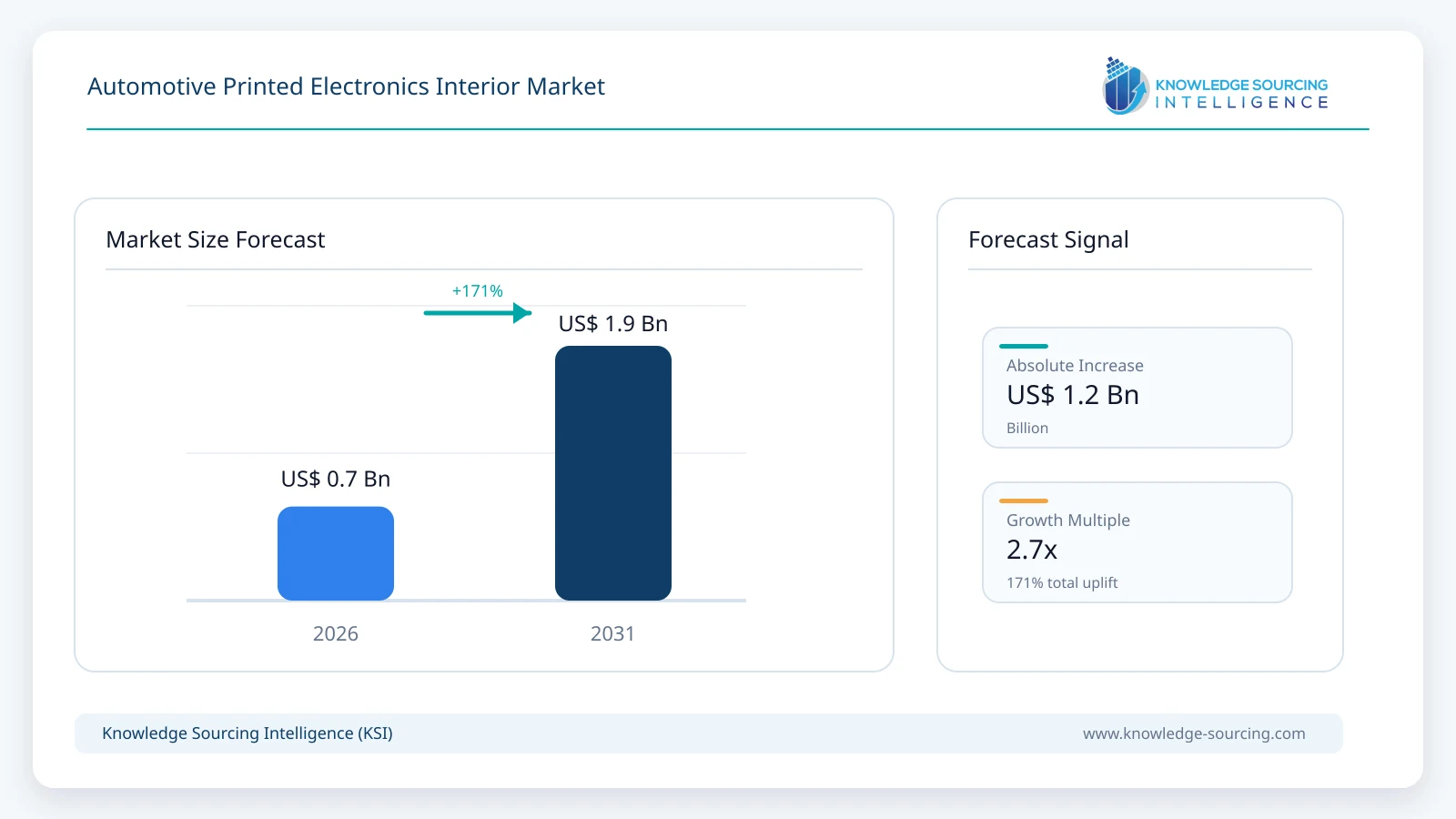
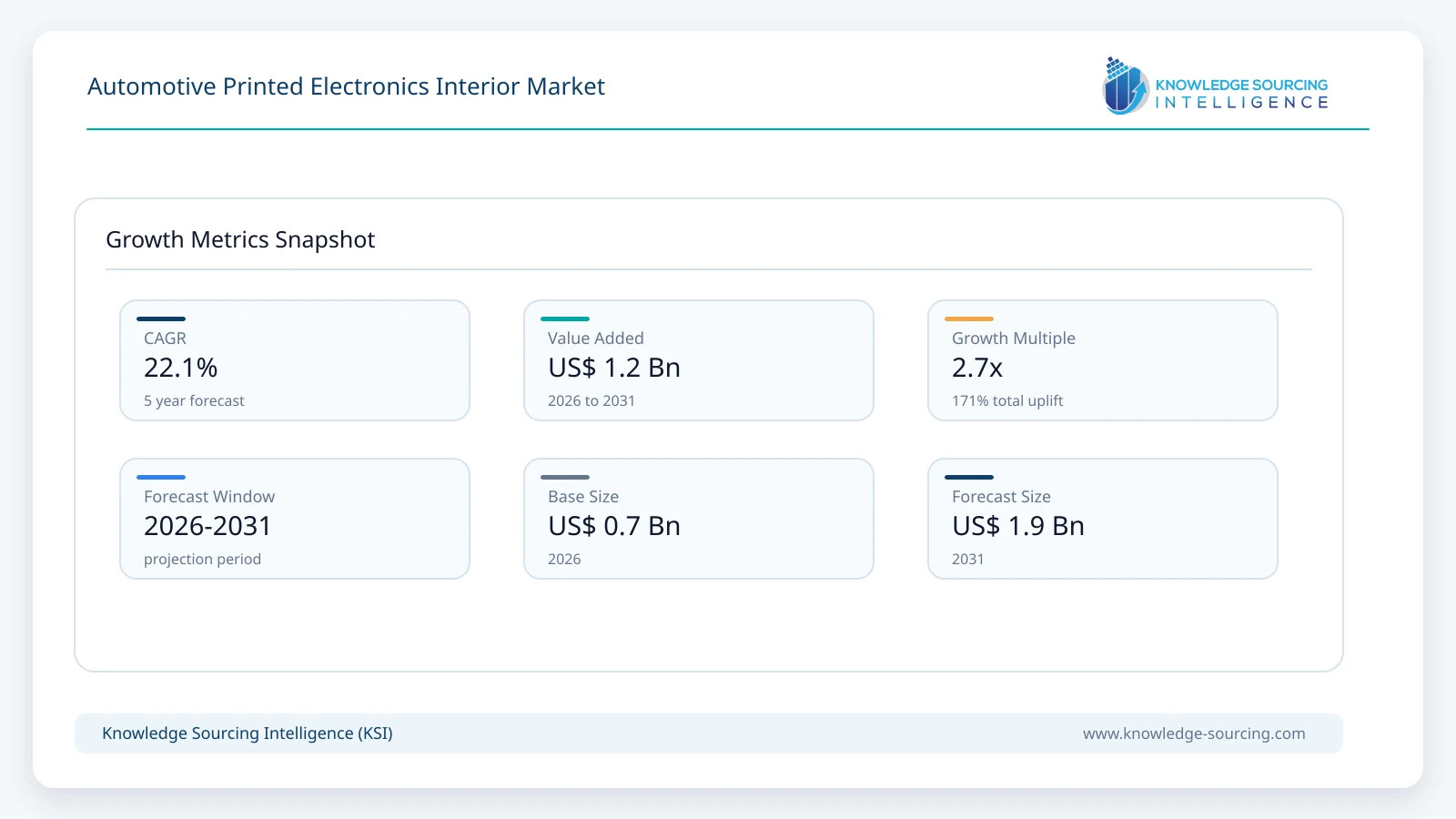
The automotive printed electronics interior market is growing at a CAGR of 22.1%, from USD 0.72 billion in 2026 to USD 1.95 billion by 2031.
Highlights:
- 1Printed electronics interior revenue is estimated at USD 0.720 billion in 2026 and forecast to reach USD 1.950 billion by 2031.
- 2Touch and force-sensing circuits represent approximately 44% of 2026 value as controls migrate into decorative cabin surfaces.
- 3Screen- and stencil-printed conductors retain the largest technology position, with digital patterning gaining share through 2031.
- 4Printed functional films and circuit sheets represent about 41% of 2026 revenue, while more converted and in-mold supply formats expand.
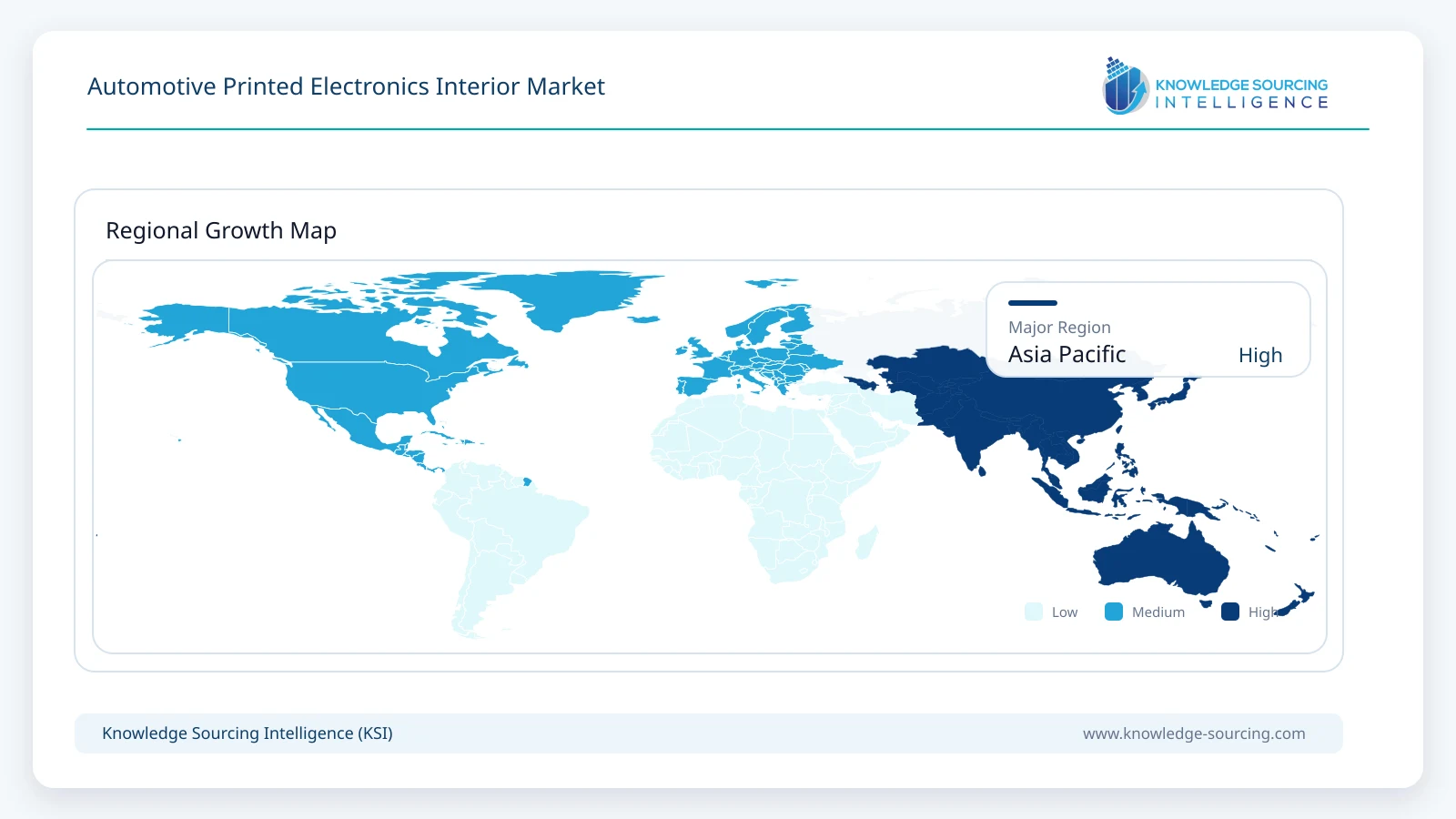
- 5Asia Pacific represents an estimated 48% of 2026 demand and is forecast to account for 52% by 2031.
- 6Valeo’s production award and additional IMSE manufacturing licenses point to industrialization, with launch maturity differing by program.
The market comprises electrically functional printed layers, patterned circuits, sensors and independently supplied conversion content used in passenger-compartment components. Finished instrument panels, complete lighting systems, display modules and ordinary decorative printing are not included at their full assembly value.
Screen, inkjet and other additive deposition processes allow conductive and dielectric patterns to be placed on polymer films that can subsequently be formed and molded. Automotive applications include capacitive touch electrodes, printed lighting connections, patterned heater circuits and interfaces in door panels, consoles and dashboard trim. Nissha describes in-mold electronics that integrate touch sensing with formed plastic structures, while PolyIC supplies automotive metal-mesh touch-sensor foils.
Market Overview
Printed circuit patterns inside cabin surfaces allow electrical functions to follow the geometry of a component instead of requiring every control zone to have its own conventional switch housing. Conductive silver, carbon or metal-mesh systems are deposited on flexible substrates, paired with dielectric or protective layers, then connected to components and controllers. The resulting architecture is attractive where OEMs want concealed controls, consistent lighting graphics and reduced visible hardware without sacrificing local interaction.
Nissha's mobility portfolio combines film decoration, sensing and molding, while Henkel's LOCTITE conductive ink materials can support stretchable circuitry in smart automotive surfaces. DuPont supplies conductive and transparent material platforms, including silver-nanowire products developed for in-mold and mobility applications. PolyIC focuses on transparent sensor foils using patterned metal mesh on polymer carriers, creating a materials and process ecosystem with more than one competing conductor technology.
Market Trends
In-Mold Structural Electronics Is Moving toward Industrial Production
Valeo announced a premium-automaker interior lighting and electronics program in January 2026 using automated manufacturing built around TactoTek's IMSE technology. The integrated construction combines surface appearance, electronic circuits and illumination within one molded structure. Printed traces and component attachment must withstand forming and overmolding, making the manufacturing sequence and finished-part yield central to component economics rather than a secondary engineering consideration.
Motherson's May 2026 IMSE license adds a multinational interior supplier to TactoTek's manufacturing ecosystem, while the 2025 TK Group agreement established an electrically functional film supply route in China. New Albea and Phillips Medisize have also entered the licensed ecosystem. Greater manufacturing choice can help global OEMs qualify regional production, but each new line still faces program-specific tooling, endurance testing and vehicle-platform approvals.
Concealed Controls Are Increasing Demand for Printed Sensor Layers
PolyIC markets highly transparent automotive touch-sensor films with conductive metal-mesh structures carried on PET. A decorative surface fitted with such a sensor can remain visually continuous until backlit icons or status graphics become active. The requirement is particularly relevant to door panels and center consoles, where users repeatedly interact with visible surfaces and where scattered switch bezels can disrupt material continuity.
Printed capacitive controls behind decorated cabin surfaces require careful coordination of electrode geometry, shielding, controller calibration and moisture tolerance to avoid false inputs and inconsistent response, while tactile confirmation often still requires a separate haptic device. Consequently, printed sensing layers have the strongest advantage in applications that combine styling flexibility with a clear functional benefit, rather than indiscriminately replacing every mechanical button.
Material Suppliers Are Expanding the Choice of Printable Conductors
Henkel offers printable conductive ink platforms for stretchable surfaces, and DuPont has presented silver-nanowire products aimed at transparent conductors and in-mold electronics. Material selection influences sheet resistance, mechanical stretch, print resolution, light transmission and the number of process steps required after printing. Each performance trade-off becomes more pronounced when film geometry changes from flat registration to three-dimensional trim.
Silver-rich traces generally provide strong conductivity but increase sensitivity to precious-metal prices, whereas carbon and alternative metal structures can change resistance, optical clarity and application suitability. Automotive programs therefore balance conductor cost with the number of qualified process steps, inspection yield and the durability required for a multi-year vehicle life. Supplier differentiation increasingly occurs in complete process compatibility rather than ink properties in isolation.
Segment Analysis
By Printed Electronic Function: Touch and Force-Sensing Circuits
Touch and force-sensing circuits are estimated to account for 44% of 2026 market value because cabin switches and interactive decorative panels provide recurring opportunities for printed electrodes. Console controls, door interfaces and dashboard surfaces are attractive locations for the thin patterned layers that capacitive inputs require. PolyIC and Nissha illustrate distinct routes through transparent sensor foils and integrated sensing modules.
Touch and force-sensing circuits are forecast to remain the largest application through 2031, although its share may decrease as printed lighting connections, localized heating and combined functions expand. Reliable sensing through wood-look finishes, coated polymers and textured decorative layers requires coordinated material and controller calibration. Suppliers that provide stable performance after molding are better positioned than film vendors offering only an unqualified conductive layer.
By Supply Configuration: Patterned and In-Mold Electronic Inserts
Patterned functional films and in-mold electronics inserts capture higher value than unprinted carrier substrates because conductor deposition, registration, insulation and forming add technical processing content. Nissha's in-mold electronics and TactoTek's IMSE manufacturing system demonstrate why converters must combine plastics tooling with electronics engineering. A qualified insert can replace several subassemblies while retaining the optical finish expected from an interior trim supplier.
In-mold and thermoformed integration is projected to gain share as Tier 1 manufacturing capacity expands. The 2026 Valeo program award and Motherson technology agreement make this a credible industrial direction without disclosing an industry-wide adoption rate. Yield losses, component-placement precision and rework restrictions remain significant cost variables, especially when an embedded circuit becomes inaccessible after molding.
By Cabin Application: Console and Dashboard Surfaces
Center consoles and dashboard surfaces together account for an estimated 59% of 2026 demand because the front cabin contains many driver-facing controls, illuminated indicators and branded decorative interfaces. Printed electrodes can be positioned beneath finished layers while electronic connections remain routed to local controllers. Door controls offer another growing application where multiple individual switches can be integrated into a unified panel.
Cabin-zone demand will broaden as rear-seat controls, overhead interfaces and premium door structures gain more electronic functions. Nevertheless, cabin-zone allocation depends on qualified vehicle programs rather than total decorative area. Heating or illuminated trim in a zone should only contribute to printed-electronics revenue when the component actually contains qualifying deposited electrical functionality.
Market Drivers
Vehicle Interiors Are Integrating More Local Electronic Functions
Automakers are adding localized interfaces for lighting, seating, comfort and passenger services to door panels, consoles and dashboard surfaces. Printed conductive electrodes and circuit layers allow some of those features to sit underneath finished trim instead of requiring new protruding switch assemblies. The value of this approach rises where the same decorative surface also needs status illumination or localized sensing.
Tier 1 suppliers that coordinate printed films with tooling can standardize functional surfaces across several trim levels. Printed patterns permit different icons and interface layouts without redesigning every mechanical subassembly, although software, controller and connector interfaces must remain consistent. Higher electronic function density should therefore support supplier content growth faster than production volume alone.
In-Mold Manufacturing Is Reducing Surface Assembly Complexity
IMSE processes integrate selected circuits, illumination and molded substrate layers into one finished surface, transferring work from final assembly into film conversion and molding. Valeo's January 2026 interior program is an important example of investment in automated production rather than a purely experimental form factor. Motherson's licensing step expands the availability of large Tier 1 manufacturing support.
In-mold circuit integration can eliminate mechanical parts, reduce wiring and limit secondary assembly, although they are offset by upfront tool development and process validation. Programs with large production runs and repeatable variants have the clearest economic case because engineering and tooling costs can be amortized across many vehicles.
Premium and Electric-Vehicle Platforms Favor Seamless Surface HMI
Premium automotive interiors increasingly use wide decorated panels, concealed icons and coordinated lighting to distinguish the occupant experience. Flexible printed electronics can be fitted into surfaces that would otherwise require separate switch islands or visible control housings. The geometry and display-treatment requirements are particularly demanding in EV and premium cockpit programs with strongly integrated visual designs.
Higher-value OEM platforms can absorb additional materials and qualification cost when a feature contributes to perceived quality or interface consistency. The technology is not exclusive to electric vehicles, however; as converters reduce defect rates and manufacturing cost, selected controls can migrate into high-volume internal-combustion and hybrid models.
Regional Printed-Electronics Manufacturing Capacity Is Expanding
TactoTek's agreements with TK Group, Suzhou Rixiang, Global Technology Ventures and other manufacturers have added print-to-mold capability across several automotive supply regions. Access to qualified regional partners is valuable because surface components require engineering collaboration with the OEM, toolmaker and final interior supplier. Cross-border sourcing can complicate such coordination when a program changes the decorative finish or circuit layout.
Regional capability expansion may reduce validation lead times and shipping complexity for functional films, particularly in China and established European automotive supply clusters. Nevertheless, licensing alone does not guarantee repeat series production; local providers must meet process capability and traceability expectations before volume commitments translate into recognized revenue.
Conductive Material Innovation Is Improving Design Options
Developments in metal mesh, silver nanowire and stretchable conductive inks widen the range of substrates on which circuits can be patterned. PolyIC's metal-mesh platform and DuPont's transparent conductor materials address different optical and forming requirements, while Henkel's stretchable inks support circuit designs where strain is difficult to avoid. Each material brings new possibilities for integrating electronic function into curved surfaces.
Material improvement can open applications that earlier printed traces could not serve reliably, but the cost advantage must be proven for each use case. Resistance after forming, protective-layer compatibility and surface aesthetics have to meet vehicle quality standards simultaneously, making supplier test data and component-level validation more valuable than laboratory conductivity figures alone.
Market Restraints
Automotive Qualification and Long Platform Cycles Delay Revenue
Printed circuits embedded in cabin trim face thermal cycling, humidity, chemical exposure, abrasion and vibration over extended service lives. An electrical failure after molding can require replacement of the entire decorated panel instead of a small conventional switch. OEMs therefore demand endurance, insulation, connection and environmental validation before launch approval.
TactoTek's September 2026 reliability program explicitly discusses thermal shock, damp heat and high-temperature aging for IMSE structures. Extensive qualification lengthens commercialization and can separate a successful technology demonstration from a production nomination by several vehicle-program cycles.
Forming and Molding Can Reduce Circuit Yield
Patterned conductive films may crack, shift or change resistance during thermoforming or injection molding, particularly around tight radii and electronic component attachment points. Ink adhesion, substrate strain and thermal expansion must be compatible throughout the full stack. Rework options become limited once the printed layers are encapsulated in the finished part.
Electrical failures caused by forming strain and poorly controlled printed-layer adhesion raise rejected-part costs, eroding the savings from eliminating separate switch assemblies. Suppliers need inspection at printing, forming and electrical test stages, and component designs may need to sacrifice some geometric freedom to maintain reliable process windows.
Material Cost and Metal-Price Exposure Constrain Volume
Silver-containing inks and specialist polymer films can cost more than conventional wired controls or established flexible circuits, depending on circuit geometry and production scale. Precious-metal prices, deposition waste and protective-layer specifications affect material economics. Premium designs can sometimes justify these inputs, but mass-market programs commonly impose narrow total component cost targets.
Alternative carbon or mesh systems may reduce exposure to one input but can change electrical resistance or optical appearance. Procurement teams therefore assess total cost after conversion yield, not merely ink price per kilogram. Printed electronics must compete with mature switch and PCB supply chains already optimized for high-volume production.
Human-Factors Requirements Preserve Physical Controls
Touch-sensitive surfaces do not automatically provide the tactile confirmation that users obtain from a mechanical switch. Cabin controls used while driving can become less intuitive when functions rely on invisible icons or multi-step touch interactions. False activation and distraction risks vary by interface position, lighting conditions and the specific driving task.
Printed sensing is consequently most suitable where the HMI design includes discoverable controls, confirmation feedback or a clear visual hierarchy. Vehicle programs may preserve physical controls for high-frequency functions while using printed layers for secondary or configurable interfaces, limiting universal replacement assumptions.
Repairability and Sustainability Challenges Affect Integrated Structures
Encapsulated printed circuits combine polymers, inks, adhesives and discrete components in a structure that can be difficult to separate after damage. A minor electrical fault may require replacing a relatively large panel, while mixed-material laminates can complicate recycling. These constraints are particularly relevant as automakers seek more repairable interiors and lower material waste.
Manufacturers must balance the lighter, more integrated construction against end-of-life recovery and warranty service. Standardized connectors, reduced layer complexity and robust process control can improve outcomes, but those improvements often require design investment before a series program can deliver the expected cost savings.
Regional Outlook
Asia Pacific
Asia Pacific is estimated to represent 48% of global printed-electronics interior revenue in 2026, supported by vehicle manufacturing scale and the presence of printed-film, molding and electronics supply chains in China, Japan and South Korea. Nissha's Japanese engineering base and the TK Group and Suzhou Rixiang IMSE agreements strengthen regional capability in functional films and integration. China is especially important for cost and feature competition across electronics-rich passenger-car platforms.
Asia Pacific's revenue share is forecast to increase to 52% by 2031 as printed interfaces extend into a broader vehicle mix. China and India provide different adoption paths: China benefits from rapid digitization and local electronics integration, whereas India is expected to expand from a lower per-vehicle electronics base. Regional suppliers must still qualify conductor and molding processes for OEM programs before localized manufacturing produces repeat shipment revenue.
Europe
Europe is estimated at 26% of 2026 global market revenue and retains a major role in the engineering of printed electronics and premium interior finishes. Henkel and PolyIC provide materials and sensor film capabilities, while TactoTek's Finnish technology platform and Valeo's European automotive engineering operations connect printed structures to Tier 1 production. The regional ecosystem also includes tooling, surface decoration and specialized component-validation suppliers.
European growth through 2031 is supported by premium vehicle demand and the industrialization of seamless HMI structures, although high engineering costs and careful production qualification may restrain near-term volume. The model places Europe's 2031 share at 23% as Asia Pacific expands faster. European suppliers are likely to remain important as technology licensors, specialist material producers and global platform-development partners even when final assembly takes place elsewhere.
Competitive Landscape
The automotive printed electronics interior supply chain combines conductive-material producers, film patterning specialists, in-mold electronics developers and finished-component integrators. PolyIC manufactures automotive sensor foils, Henkel and DuPont supply printable or transparent conductive materials, and Nissha combines functional film with sensing and molding capabilities. TactoTek contributes IMSE intellectual property, process design and a licensed production ecosystem rather than supplying every finished vehicle part itself.
Valeo's 2026 program award and Motherson's technology license place large Tier 1 companies on the route to series deployment, while TK Group and New Albea provide additional conversion and manufacturing capabilities. The firms compete at different levels of the manufacturing value chain, so total corporate revenue is not an appropriate proxy for printed-electronics-interior market share. OEM sourcing decisions depend on technical qualification, cost per accepted part and the ability to maintain electrical reliability after cosmetic and forming processes.
Recent Developments
15 September 2026: TactoTek and EDAG. EDAG obtained a license to apply IMSE in engineering and industrialization services for mobility applications, extending development support rather than confirming new production volumes.
21 May 2026: TactoTek and Motherson. Motherson signed an IMSE manufacturing license agreement that can support wider global production of electronically functional automotive smart surfaces.
28 April 2026: TactoTek and Suzhou Rixiang. The Chinese automotive-lighting prototype provider joined the IMSE license ecosystem to accelerate local functional smart-surface prototypes and validation.
2 February 2026: TactoTek and Global Technology Ventures. A North American licensing partnership added design, tooling and low-volume production capacity for programs using in-mold printed electronics.
20 January 2026: Valeo and TactoTek. Valeo announced a premium-automaker interior electronics and lighting program award with planned automated high-volume IMSE manufacturing.
19 December 2025: TactoTek and ARRK SPG. The companies announced a European IMSE technology-license agreement supporting pre-series tooling and prototyping capacity for smart surfaces.
Market Outlook
Automotive printed electronics interior revenue is projected to grow from USD 0.720 billion in 2026 to USD 1.950 billion in 2031 as printed sensing, embedded lighting connections and functional film inserts enter more vehicle programs. Touch-sensing circuitry remains the largest revenue function, while in-mold integration gains weight as established Tier 1 suppliers expand process capability. The transition is expected to be progressive because platform approvals and tooling cycles restrict rapid substitution of conventional switch hardware.
Qualified printed circuit manufacturing should capture increasing supplier value where multiple functions can be integrated into a single decorated part without sacrificing visual quality or electrical durability. Material choice, forming yield and application-specific testing will continue to separate robust production solutions from concepts. Companies offering consistent performance across printing, thermoforming and molding should be better positioned to win multi-platform contracts.
Asia Pacific is expected to account for a growing share of demand as electronics-rich vehicles are manufactured at scale, while Europe remains important for surface materials, licensing and premium HMI engineering. The strongest commercial gains will come from independently verified series programs, not from the number of technology licenses or demonstrator announcements.
Automotive Printed Electronics Interior Market Scope
| Report Metric | Details |
|---|---|
| Total Market Size in 2026 | USD 0.72 billion |
| Total Market Size in 2031 | USD 1.95 billion |
| Forecast Unit | Billion |
| Growth Rate | 22.1% |
| Study Period | 2021 to 2031 |
| Historical Data | 2021 to 2024 |
| Base Year | 2025 |
| Forecast Period | 2026 – 2031 |
| Segmentation | Electronic Function, Printing and Patterning Technology, Supply Configuration, Cabin Application, Vehicle Type, Propulsion, Geography |
| Companies |
|
Market Segmentation
By Electronic Function
Touch and Force-Sensing Circuits
Printed Lighting and Control Circuits
Localized Heating Circuits
Antennas and EMI Structures
Other Printed Electronics
By Printing and Patterning Technology
Screen and Stencil Printing
Inkjet and Digital Printing
Metal-Mesh and Fine-Line Patterning
Other Additive and Hybrid Processes
By Supply Configuration
Printed Functional Films and Circuit Sheets
Patterned and Converted Inserts
In-Mold Electronic Functional Subassemblies
By Cabin Application
Center Console
Dashboard and Instrument Panel
Door Panels
Overhead and Pillar
Seat and Other Interior Areas
By Vehicle Type
Passenger Vehicles
Light Commercial Vehicles
Heavy Commercial and Buses
By Propulsion
Internal Combustion Vehicles
Hybrid Vehicles
Plug-In Hybrid Vehicles
Battery Electric Vehicles
By Geography
North America
United States
Canada
Mexico
South America
Brazil
Argentina
Others
Europe
Germany
United Kingdom
France
Italy
Spain
Others
Middle East and Africa
Saudi Arabia
UAE
South Africa
Others
Asia Pacific
China
India
Japan
South Korea
Indonesia
Thailand
Others
Table of Contents
1. EXECUTIVE SUMMARY
1.1. Key Findings
1.2. Market Size and Forecast, 2026–2031
1.3. Printed Electronics Technology Outlook
1.4. Segmentation and Regional Summary
2. MARKET SNAPSHOT
2.1. Market Overview
2.2. Market Definition
2.3. Scope of the Study
2.4. Market Segmentation
3. BUSINESS LANDSCAPE
3.1. Market Drivers
3.1.1. Vehicle Interiors Are Integrating More Local Electronic Functions
3.1.2. In-Mold Manufacturing Is Reducing Surface Assembly Complexity
3.1.3. Premium and Electric-Vehicle Platforms Favor Seamless Surface HMI
3.1.4. Regional Printed-Electronics Manufacturing Capacity Is Expanding
3.1.5. Conductive Material Innovation Is Improving Design Options
3.2. Market Restraints
3.2.1. Automotive Qualification and Long Platform Cycles Delay Revenue
3.2.2. Forming and Molding Can Reduce Circuit Yield
3.2.3. Material Cost and Metal-Price Exposure Constrain Volume
3.2.4. Human-Factors Requirements Preserve Physical Controls
3.2.5. Repairability and Sustainability Challenges Affect Integrated Structures
3.3. Market Opportunities
3.4. Porter’s Five Forces Analysis
3.5. Industry Value Chain Analysis
3.6. Policies and Regulations
3.7. Strategic Recommendations
4. TECHNOLOGICAL OUTLOOK
4.1. Screen-Printed Conductors and Dielectric Layers
4.2. Digital and Inkjet Patterning
4.3. Transparent Metal-Mesh Electrodes
4.4. Silver-Nanowire and Stretchable Conductive Inks
4.5. In-Mold Structural Electronics
4.6. Thermoforming, Encapsulation and Component Attachment
4.7. Circuit Inspection and Reliability Testing
5. AUTOMOTIVE PRINTED ELECTRONICS INTERIOR MARKET BY ELECTRONIC FUNCTION
5.1. Introduction
5.2. Touch and Force-Sensing Circuits
5.3. Printed Lighting and Control Circuits
5.4. Localized Heating Circuits
5.5. Antennas and EMI Structures
5.6. Other Printed Electronics
6. AUTOMOTIVE PRINTED ELECTRONICS INTERIOR MARKET BY PRINTING AND PATTERNING TECHNOLOGY
6.1. Introduction
6.2. Screen and Stencil Printing
6.3. Inkjet and Digital Printing
6.4. Metal-Mesh and Fine-Line Patterning
6.5. Other Additive and Hybrid Processes
7. AUTOMOTIVE PRINTED ELECTRONICS INTERIOR MARKET BY SUPPLY CONFIGURATION
7.1. Introduction
7.2. Printed Functional Films and Circuit Sheets
7.3. Patterned and Converted Inserts
7.4. In-Mold Electronic Functional Subassemblies
8. AUTOMOTIVE PRINTED ELECTRONICS INTERIOR MARKET BY CABIN APPLICATION
8.1. Introduction
8.2. Center Console
8.3. Dashboard and Instrument Panel
8.4. Door Panels
8.5. Overhead and Pillar
8.6. Seat and Other Interior Areas
9. AUTOMOTIVE PRINTED ELECTRONICS INTERIOR MARKET BY VEHICLE TYPE
9.1. Introduction
9.2. Passenger Vehicles
9.3. Light Commercial Vehicles
9.4. Heavy Commercial and Buses
10. AUTOMOTIVE PRINTED ELECTRONICS INTERIOR MARKET BY PROPULSION
10.1. Introduction
10.2. Internal Combustion Vehicles
10.3. Hybrid Vehicles
10.4. Plug-In Hybrid Vehicles
10.5. Battery Electric Vehicles
11. AUTOMOTIVE PRINTED ELECTRONICS INTERIOR MARKET BY GEOGRAPHY
11.1. North America
11.1.1. United States
11.1.2. Canada
11.1.3. Mexico
11.2. South America
11.2.1. Brazil
11.2.2. Argentina
11.2.3. Others
11.3. Europe
11.3.1. Germany
11.3.2. United Kingdom
11.3.3. France
11.3.4. Italy
11.3.5. Spain
11.3.6. Others
11.4. Middle East and Africa
11.4.1. Saudi Arabia
11.4.2. UAE
11.4.3. South Africa
11.4.4. Others
11.5. Asia Pacific
11.5.1. China
11.5.2. India
11.5.3. Japan
11.5.4. South Korea
11.5.5. Indonesia
11.5.6. Thailand
11.5.7. Others
12. COMPETITIVE ENVIRONMENT AND ANALYSIS
12.1. Major Players and Strategy Analysis
12.2. Market Share Analysis
12.3. Mergers, Acquisitions, Agreements and Collaborations
12.4. Competitive Dashboard
13. COMPANY PROFILES
13.1. PolyIC GmbH & Co. KG
13.2. Nissha Co., Ltd.
13.3. Henkel AG & Co. KGaA
13.4. DuPont de Nemours, Inc.
13.5. TactoTek Oy
13.6. Valeo SE
13.7. Samvardhana Motherson International Limited
13.8. TK Group (Holdings) Limited
13.9. New Albea Kunststofftechnik GmbH
13.10. NBHX Trim Group
13.11. Phillips Medisize
14. APPENDIX
14.1. Currency
14.2. Assumptions
14.3. Base and Forecast Years
14.4. Key Benefits for Stakeholders
14.5. Research Methodology
14.6. Abbreviations
Navigate
Trusted by the world's leading organizations











