
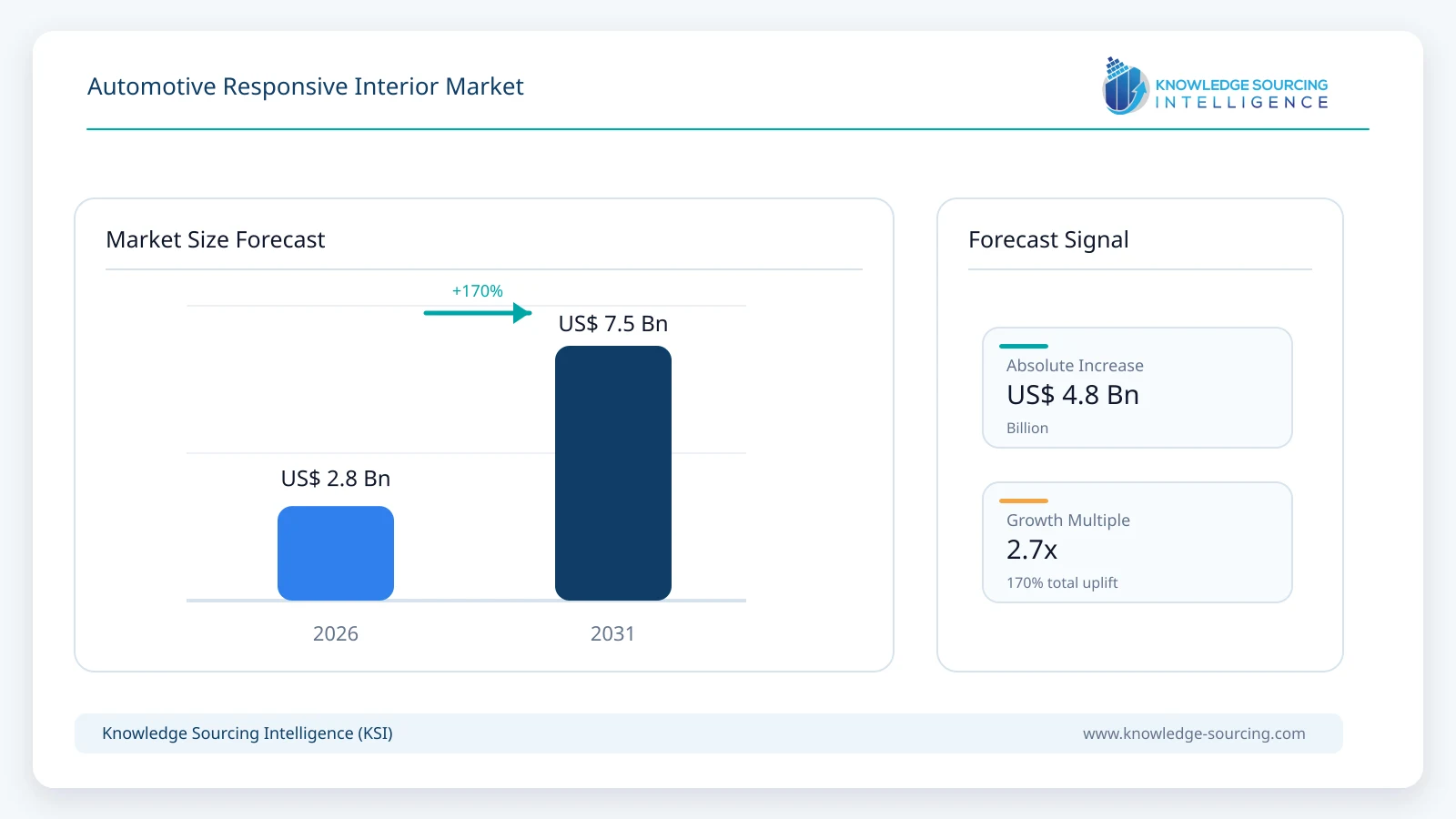
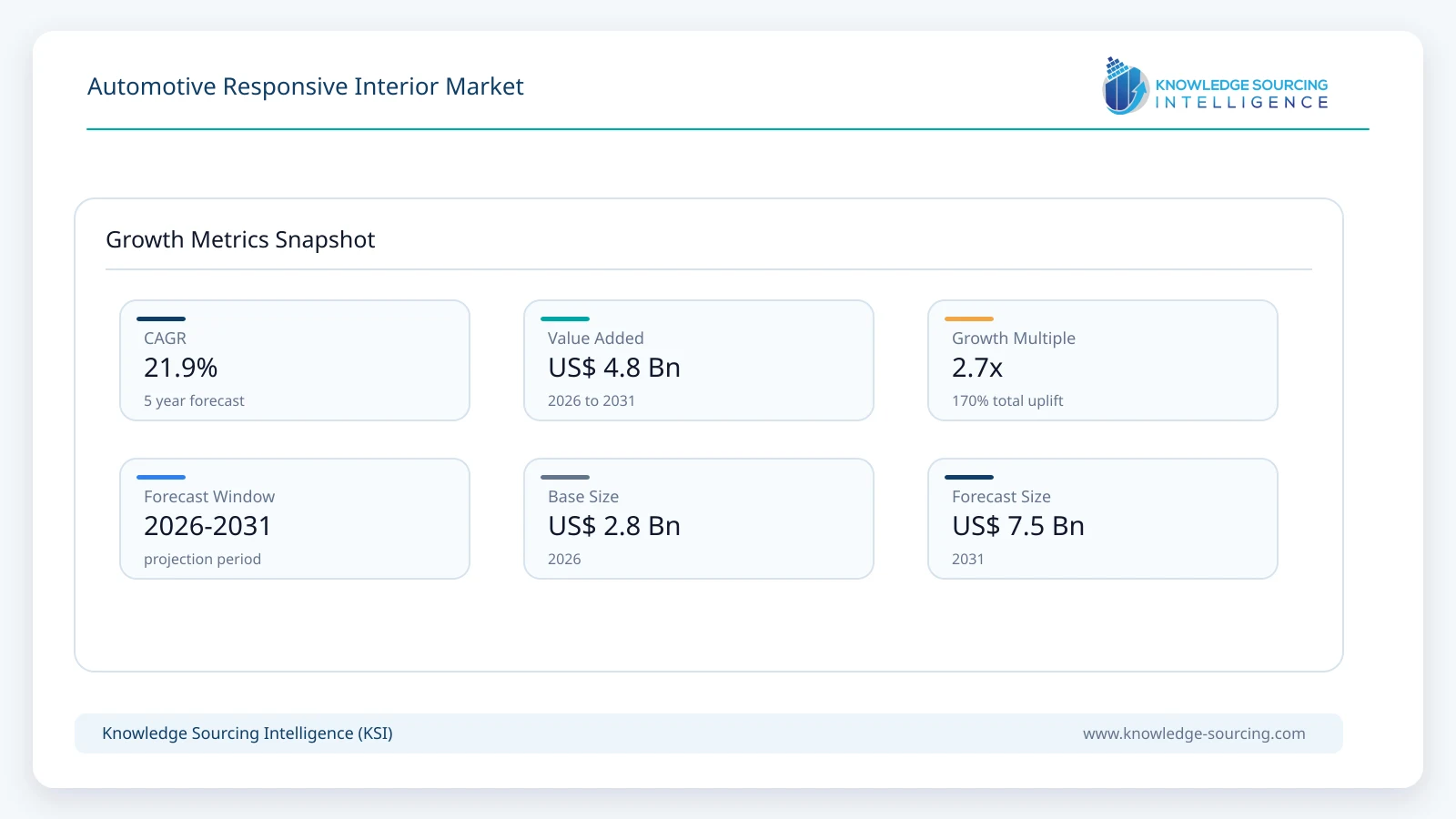
The Automotive Responsive Interior Market is valued at USD 2.80 billion in 2026 and is projected to reach USD 7.55 billion by 2031, growing at a CAGR of 21.94% during forecast period.
Highlights:
- 1Interactive smart-surface touch and haptics represent approximately 37% of 2026 value, supported by console, instrument-panel and door interfaces.
- 2Dynamic lighting and visual feedback account for around 28% of the market in 2026, reflecting established applications in cabin-state communication and control confirmation.
- 3Occupant-responsive comfort actuation is expected to gain the strongest share of incremental value through 2031 as locally controlled airflow and seating functions expand.
- 4Distributed responsive modules remain important in 2026, although surface-embedded electronics gain share as controls, illumination and sensing move into trim structures.
- 5Passenger vehicles account for approximately 94% of global revenue in 2026; commercial-vehicle applications remain smaller and more specialized.
- 6Asia Pacific represents approximately 47% of 2026 market value, supported by Chinese smart-cabin programs and regional electronics manufacturing capabilities.
Responsive interior architectures integrate capacitive and force sensors, local electronics, illuminated symbols and haptic actuators directly beneath decorated cabin surfaces. Controls can operate through selected plastic or textile structures, reducing the need for separate visible switch assemblies. Yanfeng's smart-surface portfolio combines touch interaction, lighting and information displays across cabin zones, while Antolin and UltraSense are developing a solid-state control architecture for integrated trim modules.
Valeo's 2026 automotive customer program using TactoTek IMSE technology illustrates how thin embedded electronics are moving from demonstration parts into OEM engineering and industrialization. Lighting and circuitry are incorporated in a molded structure rather than assembled as separate control elements. Toyoda Gosei's production programs for networked illumination and electronically controlled air outlets further demonstrate responsive functions beyond display-based interfaces.
Occupant recognition and position sensing create demand for cabin controls that coordinate surface interaction with individual seating and temperature preferences. Bosch develops automatic seat-position and temperature personalization, while Gentherm offers localized thermal effectors and comfort-control capabilities. Commercial expansion depends on qualification, predictable tactile response, compatible software interfaces and hardware designs that can be reused across vehicle models.
Market Trends
Smart Surfaces Are Integrating Touch, Force and Haptic Confirmation
Conventional dashboard switch assemblies use mechanical actuators, mounting hardware and fixed labels, whereas responsive smart surfaces place detection and feedback beneath decorated trim. The resulting controls can remain visually unobtrusive until an occupant approaches or operates a function. Yanfeng's surface architecture brings touch interaction, lighting, heating and display elements into dashboards, doors and consoles, although consistent sensing through different trim materials remains essential to qualification.
Antolin and UltraSense announced a September 2026 development project for an automotive platform using solid-state touch and force sensing with haptic and visual feedback. UltraSense supplies sensing electronics and software while Antolin leads complete-surface industrialization. Automotive-grade surface controls require mechanical durability, unintended-touch rejection and consistent operation under vibration and temperature variation before a vehicle nomination becomes recurring revenue.
Lighting Is Increasingly Used for Real-Time Cabin Communication
Responsive RGB lighting is moving beyond user-selected color themes to acknowledge inputs, communicate vehicle status and draw attention to relevant events. FORVIA HELLA presented an adaptive commercial-vehicle lighting architecture in September 2026 that combines atmosphere, alerts and status indication in surface-integrated modules. Reusing one lighting network for multiple functions can improve the value of installed electronics without multiplying standalone lamp assemblies.
Toyoda Gosei supplies LIN-supported full-color interior illumination for the Mazda CX-5 and dynamic pattern projection for the Lexus RZ. The Mazda product indicates series-use of networked cabin illumination, whereas Antolin’s LUXIA emotional-lighting work remains an R&D program. R&D demonstrations do not establish the same near-term volume or pricing as OEM-qualified production parts.
Occupant Context Is Informing Local Comfort Responses
Cabin cameras and radar can identify seating position, driver identity and other conditions that help tailor comfort settings. Bosch describes systems that automatically position seats and select preferred temperature after occupant identification. Qualifying interior response value arises from the associated controls and actuators, while safety-oriented camera and radar hardware remains in its principal sensing category.
Toyoda Gosei’s electronically controlled hidden air register, installed in the Toyota bZ7 in China, demonstrates a production application where airflow adjustment is transferred from manual fins to electronic control. More comprehensive systems may combine seat thermal functions, airflow and surface illumination, although energy use, calibration and individual preference differences make coordinated comfort harder than single-function control.
Automotive Responsive Interior Market Segment Analysis
By Technology System
Interactive Smart-Surface Touch and Haptics
Interactive smart-surface touch and haptic technologies represent an estimated USD 1.04 billion in 2026, making programmable occupant controls the largest responsive-interior technology category. Revenue includes qualified surface electronics, touch and force sensing, local processing, haptic actuators and related integration. Antolin and UltraSense illustrate the technical division between specialized sensing platforms and complete automotive trim industrialization.
Instrument-panel, door and console designs increasingly employ programmable responsive surfaces in place of fixed mechanical switches, raising the value of integrated sensing and haptics. Automotive qualification remains demanding because controls must respond consistently to moisture, gloved hands and vehicle vibration. The category continues to expand in value through 2031 even as occupant-responsive comfort gains a larger share of the overall market.
By Interaction Trigger
Touch, Force and Proximity Input
Direct user actions account for approximately 43% of responsive-interior value in 2026 because touch and proximity remain the most common reasons for immediate feedback. Buttons hidden behind trim, proximity-activated icons and force-sensitive console controls fall within the category when the response is part of the supplied interior interface. Yanfeng’s smart-surface portfolio illustrates multiple such interaction methods.
Occupant identification and environmental-response functions gain market share as automakers connect cabin sensors to common interior software and control networks. Direct touch and force interfaces nevertheless remain important for safety and usability because drivers require predictable confirmation and a clear manual fallback when automated response is unsuitable.
By Integration Architecture
Surface-Embedded Electronics and Controls
Surface-embedded electronics account for approximately 34% of modeled 2026 revenue and are forecast to reach 44% by 2031 as automotive trim incorporates more integrated functions. TactoTek's IMSE process places lighting and circuit elements within thin molded structures, and Valeo's premium-OEM program provides stronger commercialization evidence than a stand-alone design demonstration. Integrated architectures reduce the need for visibly separate control modules but increase qualification demands on the complete decorated part.
Surface-embedded electronics require suppliers to manage molding yields, decorative tooling, repairability and qualification of the complete electrical and mechanical subassembly. Sealed modules can be harder to service than conventional controls, encouraging joint development between electronics suppliers and interior-trim manufacturers. Platform reuse is therefore critical to the economics of embedded responsive structures.
By Application Location
Instrument Panel and Dashboard
Instrument panels represent approximately 30% of market value in 2026 because dashboards combine information access, HVAC control and surfaces visible to both drivers and passengers. Hidden controls, illumination and touch feedback have particular value where the vehicle design minimizes conventional switches. Consoles and doors offer related applications with different packaging and human-interface requirements.
The dashboard share is expected to remain high through 2031, although seats and rear cabin zones expand faster as responsive comfort and passenger personalization become more widely specified. Shared electronics can serve multiple surface zones, making modular control and robust communication especially important.
By Vehicle Type
Passenger Cars, SUVs and MPVs
Passenger vehicles account for approximately 94% of 2026 revenue because automotive smart surfaces, responsive lighting and comfort technologies are chiefly installed in car, SUV and MPV programs. High-content electric vehicles and premium model lines supply a substantial proportion of demand, but standardized electronics make selected functions available in broader vehicle classes.
Commercial-vehicle responsive interfaces represent a smaller market than passenger-car installations, with the strongest near-term applications in driver-focused lighting and warning feedback. FORVIA HELLA's 2026 adaptive commercial-vehicle lighting concept demonstrates supplier development activity, although concepts and customer engineering programs should not be treated as evidence of broad serial-production fitment.
By Geography
Asia Pacific
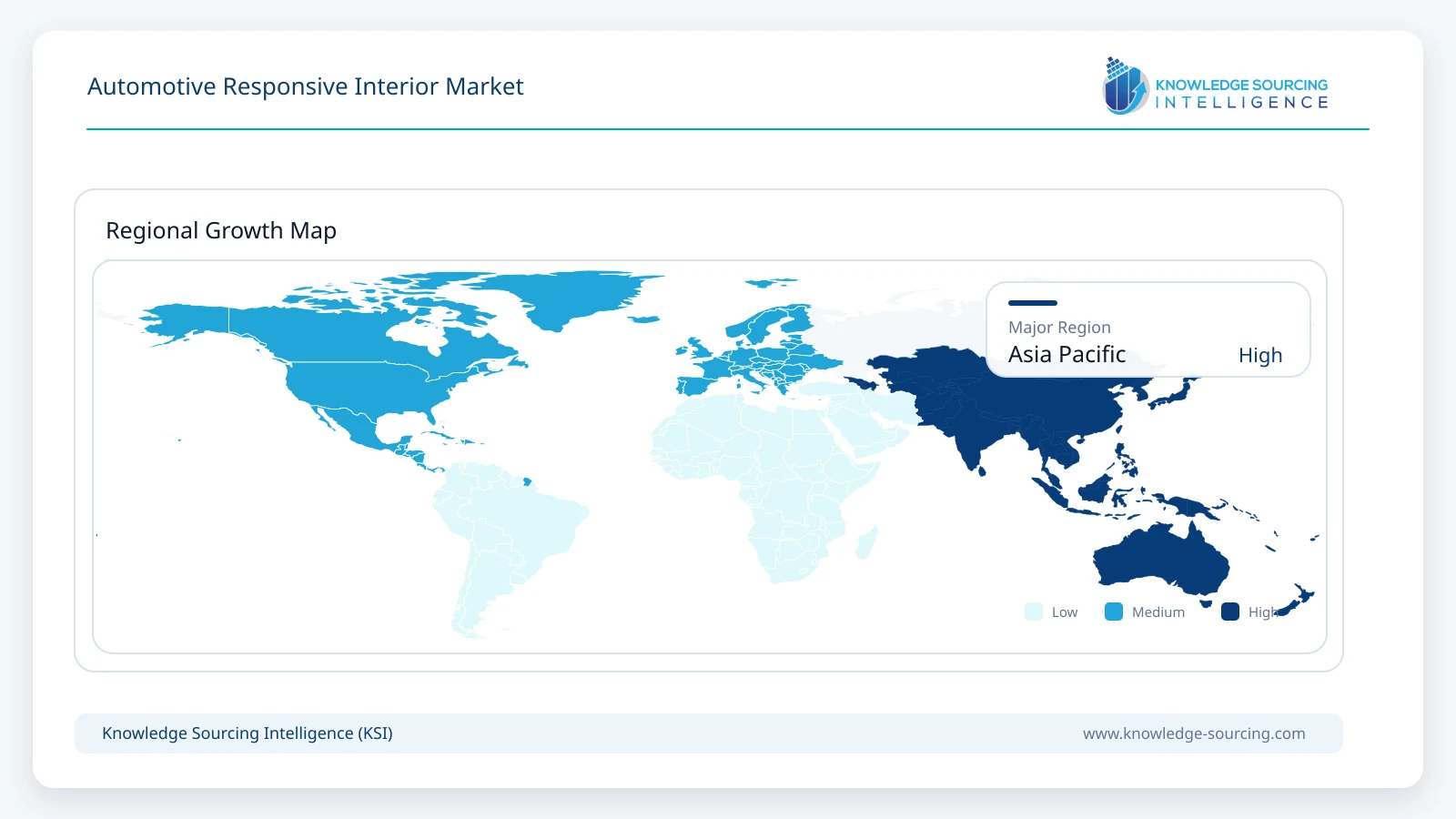
Asia Pacific represents approximately 47% of estimated global revenue in 2026, reflecting China's smart-cabin development activity and the region's lighting and electronics supply chains. Japanese and South Korean suppliers contribute interior modules, vehicle lighting and occupant interfaces, while Chinese model-refresh cycles support frequent technology updates. Toyoda Gosei's applications for the Mazda CX-5 and Toyota bZ7 demonstrate responsive-component integration across different vehicle programs.
As responsive control electronics move into higher-volume cars, manufacturing scale and surface-module costs become central to competitive differentiation. Asia Pacific is projected to reach approximately USD 3.70 billion in 2031 and retain the largest regional position.
Market Drivers
Software-Defined Interior and Zonal Electronics
Shared vehicle electronic architectures allow lighting, tactile interfaces and localized comfort functions to respond to common user settings and vehicle-state signals. Consolidating these functions reduces the need for a separate physical control and processing path for every feature. Automakers can consequently offer software updates and model-specific differentiation while reusing a greater proportion of cabin electronics across vehicle platforms.
Yanfeng's smart-surface technology and Valeo's TactoTek-based embedded-electronics program show how interior suppliers increasingly combine decorative manufacturing with functional electronics. Commercially attractive designs reduce packaging complexity but still support diagnostics, replacement and predictable response across operating conditions. A conventional trim panel with added software does not necessarily deliver the same integrated system performance.
Demand for Intuitive Hidden-Until-Needed Interfaces
Dashboard and door designs increasingly prioritize uninterrupted trim surfaces, creating demand for controls that appear only when relevant. Touch, proximity and haptic response allow operating feedback to be provided without permanent switch assemblies. Antolin and UltraSense are developing a consolidated smart-surface interface for multiple cabin applications, including center consoles and overhead controls.
Touch-sensitive cabin controls must provide clear confirmation for functions such as climate and audio adjustment that drivers may operate without continuously watching the surface. Interior suppliers therefore need to balance seamless decoration with tactile predictability, false-activation control and intuitive placement. These human-factors requirements can be as important to OEM purchasing decisions as the quality of illuminated trim.
Expansion of Dynamic Interior Lighting and Visual Feedback
Programmable interior lighting provides immediate confirmation of touch inputs, vehicle operating modes and selected warning conditions through controlled intensity and color. FORVIA HELLA's September 2026 commercial-vehicle RGB development demonstrates how such responses can be embedded within interior surfaces rather than supplied as separate signal devices. The benefit is strongest when one lighting network supports multiple useful cabin functions.
Toyoda Gosei's LIN-compatible interior lighting demonstrates how standardized vehicle communication can support distributed illumination without requiring separate control hardware for every light source. Networked modules allow automakers to specify richer lighting functions within a common electrical architecture. However, warning priority and human-factors qualification constrain animated patterns that could distract vehicle occupants.
Occupant-Responsive Personalization and Local Comfort
Bosch's occupant-recognition systems link driver identity and seating information to automatic seat positioning and preferred cabin temperature, illustrating the value of contextual comfort response. Position and preference information can also guide electronically controlled ventilation and localized thermal settings. Revenue attributable to responsive actuation and integration is distinguished from camera or radar hardware primarily installed for safety functions.
Electronically controlled ventilation and localized seat-comfort functions allow vehicle designers to provide individual adjustment while keeping visible cabin surfaces relatively uncluttered. Toyoda Gosei's production air-register application on the Toyota bZ7 demonstrates an automotive-qualified component rather than a conceptual interior feature. Wider adoption will depend on actuation reliability, controllability and per-vehicle cost.
Growing Integration across Interior Supplier Categories
Valeo's premium-OEM work with TactoTek and Antolin's collaboration with UltraSense illustrate the cross-disciplinary supplier partnerships required for multifunctional interior surfaces. Decoration, molding, electronics, haptic response and software must be validated as one vehicle-ready assembly rather than unrelated technology demonstrations. Such collaboration can expand the content supplied per module when manufacturing responsibilities are clearly allocated.
Integrated responsive modules offer interior suppliers additional electronics and software-integration revenue when the complete assembly can be validated and delivered at automotive scale. Platform volumes, warranty responsibility, qualification cost and tooling reuse determine whether that additional content is commercially attractive. A broad portfolio of interface functions does not, by itself, establish profitable series production.
Market Restraints
Higher Component and Validation Costs
Replacing a mechanical switch with a seamless smart surface can introduce sensors, force detection, haptic actuators, specialized lighting and processing electronics. Those costs are difficult to recover on models where conventional controls remain acceptable to customers. Higher specification content is therefore concentrated in premium and technology-oriented trims.
Embedded responsive surfaces require qualification of sensors, haptics, lighting, electrical connections and the decorative structure as one automotive subassembly. The combined validation and tooling expenditure raises development cost relative to conventional switches. Suppliers often need multiple vehicle programs or reusable modules to recover this investment.
Reliability under Real-World Cabin Conditions
Touch and force-sensitive interior controls must remain dependable during operation with gloved hands, moisture, vibration and varying contact pressure. False activation, poor touch recognition or weak haptic feedback can make frequently used functions difficult to operate without looking away from the road. Automotive testing must therefore address realistic usage as well as laboratory sensing accuracy.
Decorated smart-surface assemblies must withstand cabin temperature cycles, ultraviolet exposure, repeated cleaning and wear while maintaining the underlying electronic response. Qualification may have to be repeated when different films, coatings or plastic substrates change sensing behavior or durability. These material interactions can slow model-to-model reuse and increase engineering-change costs.
Driver-Distraction and Human-Factors Constraints
Dynamic cabin lighting and extensive touch controls can increase the driver's visual workload when animation, warnings and routine input feedback compete for attention. Automotive interface design must establish clear information priority, predictable tactile confirmation and separation between optional ambience and safety-related messages. Increasing the number of available effects does not necessarily improve operating usability.
Switch-free interior surfaces can reduce visible hardware but become difficult to operate when frequent functions lack dependable tactile cues and obvious control locations. Automakers must assess touch accuracy, accessibility and driver workload alongside the aesthetic benefits of uninterrupted trim. The preferred balance can differ between stationary passenger controls and controls used while driving.
Interoperability and Software Integration Burden
Responsive surfaces can depend on body controllers, infotainment networks, lighting electronics, cabin sensors and climate software developed by different suppliers. Integration across several operating environments introduces timing and cybersecurity dependencies that may become more difficult during software updates.
Multi-supplier responsive-interior systems need coordinated diagnostics, fault recovery and software-update responsibilities across body electronics, infotainment, lighting and climate modules. Separately replaceable controls may simplify servicing, while tightly integrated surfaces create additional challenges in maintenance and fault isolation. Interface ownership should therefore be resolved during system architecture rather than at the end of vehicle validation.
Fragmented OEM Requirements and Long Qualification Cycles
Vehicle manufacturers apply different electrical architectures, decorative materials, operating environments and validation standards to smart-surface controls across their programs. A sensing solution qualified for one center console may require additional calibration, tooling changes and durability tests on another vehicle platform. Such variation limits direct reuse of finished modules despite the potential for standardized sensing electronics.
Multi-year OEM development and qualification programs delay conversion of interior interface concepts into awarded series-production business, especially when electronics and trim suppliers share responsibilities. Manufacturers need reliable diagnostics, stable haptic performance and a clear allocation of warranty and failure-management obligations. Supplier development announcements consequently provide weaker revenue evidence than named vehicle production applications.
Regional Outlook
Asia Pacific
Asia Pacific leads the Automotive Responsive Interior Market because China combines large passenger-vehicle production with rapid smart-cabin development cycles. Japanese suppliers such as Toyoda Gosei contribute networked interior illumination and electrically controlled air outlets, while regional electronics manufacturing supports integration of sensing, haptics and lighting into trim modules. Asia Pacific is modeled at USD 1.32 billion in 2026 and approximately USD 3.70 billion in 2031.
Premium Chinese EVs and higher-content family vehicles remain important early adopters, whereas price-sensitive models increasingly benefit from modular electronics platforms. Production-readiness differs by technology; electronically actuated vents and networked lighting already have named vehicle applications, while advanced multimodal surfaces still require platform-by-platform industrialization.
Europe
Europe represents approximately 27% of global value in 2026, supported by strong interior, electronics and lighting suppliers and premium-vehicle engineering programs. Antolin, Valeo and FORVIA HELLA are developing smart-surface, embedded-electronics and adaptive-lighting technologies that combine interaction with conventional interior modules. Supplier collaborations make it easier to integrate electronics within decorated surfaces at automotive scale.
European growth is influenced by stringent functional and human-factors qualification as well as the cost of complex vehicle programs. The region is estimated at approximately USD 1.89 billion by 2031, with suppliers competing on reliable touch and haptic confirmation, modular lighting integration and validated production processes rather than feature demonstrations alone.
Competitive Landscape
The competitive landscape combines automotive interior-trim integrators, sensing and haptic developers, lighting specialists and suppliers of electronically controlled cabin comfort. Antolin and Yanfeng integrate smart surfaces within doors and instrument panels; Valeo and TactoTek develop embedded electronics; and UltraSense supplies touch, force and haptic technologies. Toyoda Gosei and FORVIA HELLA contribute networked illumination and local interior functions, while Bosch and HARMAN supply sensing and contextual-response capabilities.
Competition is based on qualification, manufacturing integration, reliable human interaction and the ability to reuse a core electronic architecture across vehicle variants. OEM program awards and named series applications carry more commercial weight than concept vehicles or laboratory R&D. A supplier cannot be assigned a credible market share by treating all corporate interior or electronics revenue as responsive-interior revenue.
Recent Developments
September 2026: Antolin and UltraSense announced a global-platform smart-surface HMI development initiative combining touch and force sensing, haptics, firmware and complete trim integration.
September 2026: FORVIA HELLA presented adaptive RGB interior lighting for commercial vehicles and confirmed customer development work using its RGB module technology.
May 2026: Toyoda Gosei confirmed its LIN-supported full-color interior illumination unit on the new Mazda CX-5, demonstrating networked lighting at vehicle-program level.
April 2026: Toyoda Gosei introduced an electronically controlled hidden HVAC register already fitted to the Toyota bZ7 in China.
January 2026: Antolin detailed the LUXIA R&D initiative exploring user-state-responsive interior lighting and nonvisual wellness effects.
January 2026: Valeo reported a premium-OEM award for an integrated interior lighting and electronics structure using TactoTek IMSE manufacturing technology.
Market Outlook
The Automotive Responsive Interior Market is projected to expand as smart surfaces, dynamic feedback and occupant-controlled comfort become standard features on a wider range of vehicle platforms. Embedded interaction and visual feedback remain substantial revenue contributors, while sensor-informed comfort functions and surface-integrated electronics gain share through 2031. Growth depends more on increased responsive content per equipped vehicle and broader fitment than on global vehicle production alone.
Asia Pacific is expected to retain the largest revenue share through 2031 as Chinese smart-cabin vehicle programs and regional electronics supply chains expand responsive-function installation. European suppliers contribute advanced surface integration and demanding vehicle-grade qualification capabilities. Companies able to combine dependable haptic feedback, contextual control software and scalable trim structures will have the strongest position as more responsive functions reach mainstream vehicles.
Automotive Responsive Interior Market Scope:
| Report Metric | Details |
|---|---|
| Total Market Size in 2026 | USD 2.80 billion |
| Total Market Size in 2031 | USD 7.55 billion |
| Forecast Unit | USD Billion |
| Growth Rate | 21.94% |
| Study Period | 2021 to 2031 |
| Historical Data | 2021 to 2024 |
| Base Year | 2025 |
| Forecast Period | 2026 – 2031 |
| Segmentation | Technology System, Interaction Trigger, Integration Architecture, Application Location, Propulsion, Geography |
| Companies |
|
Market Segmentation
By Technology System
Interactive Smart-Surface Touch and Haptics
Dynamic Lighting and Visual Feedback
Occupant-Responsive Comfort Actuation
Contextual Response Software and Integration
Other Responsive Interior Systems
By Interaction Trigger
Touch, Force and Proximity Input
Occupant Identity, Position and Preferences
Vehicle State and ADAS Events
Cabin and Environmental Conditions
By Integration Architecture
Distributed Responsive Modules
Surface-Embedded Electronics and Controls
Centralized and Zonal Software Integration
By Application Location
Instrument Panel and Dashboard
Door and Side Trim
Center Console and Storage
Roof and Headliner
Seats and Rear Cabin Zones
By Vehicle Type
Passenger Cars, SUVs and MPVs
Light Commercial Vehicles
Medium/Heavy Commercial Vehicles and Buses
By Propulsion
Internal Combustion Engine Vehicles
Battery Electric Vehicles
Hybrid and Plug-in Hybrid Vehicles
By Geography
North America
United States
Canada
Mexico
South America
Brazil
Argentina
Others
Europe
Germany
United Kingdom
France
Italy
Spain
Others
Middle East and Africa
Saudi Arabia
UAE
South Africa
Others
Asia Pacific
China
Japan
South Korea
India
Indonesia
Thailand
Others
Table of Contents
1. EXECUTIVE SUMMARY
2. MARKET SNAPSHOT
2.1. Market Overview
2.2. Market Definition
2.3. Scope of the Study
2.4. Market Segmentation
3. BUSINESS LANDSCAPE
3.1. Market Drivers
3.1.1. Software-Defined Interior and Zonal Electronics
3.1.2. Demand for Intuitive Hidden-Until-Needed Interfaces
3.1.3. Expansion of Dynamic Interior Lighting and Visual Feedback
3.1.4. Occupant-Responsive Personalization and Local Comfort
3.1.5. Growing Integration across Interior Supplier Categories
3.2. Market Restraints
3.2.1. Higher Component and Validation Costs
3.2.2. Reliability under Real-World Cabin Conditions
3.2.3. Driver-Distraction and Human-Factors Constraints
3.2.4. Interoperability and Software Integration Burden
3.2.5. Fragmented OEM Requirements and Long Qualification Cycles
3.3. Market Opportunities
3.4. Porter’s Five Forces Analysis
3.5. Industry Value Chain Analysis
3.6. Policies and Regulations
3.7. Strategic Recommendations
4. TECHNOLOGICAL OUTLOOK
4.1. Solid-State Touch and Force Sensing
4.2. Embedded Haptic Feedback
4.3. In-Mold Structural Electronics
4.4. Hidden-Until-Lit Interfaces
4.5. LIN and Zonal Lighting Control
4.6. Cabin Sensor Fusion and Response Logic
4.7. Electronic Airflow and Comfort Actuation
4.8. Software Validation and Safe Fallback
5. AUTOMOTIVE RESPONSIVE INTERIOR MARKET BY TECHNOLOGY SYSTEM
5.1. Introduction
5.2. Interactive Smart-Surface Touch and Haptics
5.3. Dynamic Lighting and Visual Feedback
5.4. Occupant-Responsive Comfort Actuation
5.5. Contextual Response Software and Integration
5.6. Other Responsive Interior Systems
6. AUTOMOTIVE RESPONSIVE INTERIOR MARKET BY INTERACTION TRIGGER
6.1. Introduction
6.2. Touch, Force and Proximity Input
6.3. Occupant Identity, Position and Preferences
6.4. Vehicle State and ADAS Events
6.5. Cabin and Environmental Conditions
7. AUTOMOTIVE RESPONSIVE INTERIOR MARKET BY INTEGRATION ARCHITECTURE
7.1. Introduction
7.2. Distributed Responsive Modules
7.3. Surface-Embedded Electronics and Controls
7.4. Centralized and Zonal Software Integration
8. AUTOMOTIVE RESPONSIVE INTERIOR MARKET BY APPLICATION LOCATION
8.1. Introduction
8.2. Instrument Panel and Dashboard
8.3. Door and Side Trim
8.4. Center Console and Storage
8.5. Roof and Headliner
8.6. Seats and Rear Cabin Zones
9. AUTOMOTIVE RESPONSIVE INTERIOR MARKET BY VEHICLE TYPE
9.1. Introduction
9.2. Passenger Cars, SUVs and MPVs
9.3. Light Commercial Vehicles
9.4. Medium/Heavy Commercial Vehicles and Buses
10. AUTOMOTIVE RESPONSIVE INTERIOR MARKET BY PROPULSION
10.1. Introduction
10.2. Internal Combustion Engine Vehicles
10.3. Battery Electric Vehicles
10.4. Hybrid and Plug-in Hybrid Vehicles
11. AUTOMOTIVE RESPONSIVE INTERIOR MARKET BY GEOGRAPHY
11.1. North America
11.1.1. United States
11.1.2. Canada
11.1.3. Mexico
11.2. South America
11.2.1. Brazil
11.2.2. Argentina
11.2.3. Others
11.3. Europe
11.3.1. Germany
11.3.2. United Kingdom
11.3.3. France
11.3.4. Italy
11.3.5. Spain
11.3.6. Others
11.4. Middle East and Africa
11.4.1. Saudi Arabia
11.4.2. UAE
11.4.3. South Africa
11.4.4. Others
11.5. Asia Pacific
11.5.1. China
11.5.2. Japan
11.5.3. South Korea
11.5.4. India
11.5.5. Indonesia
11.5.6. Thailand
11.5.7. Others
12. COMPETITIVE ENVIRONMENT AND ANALYSIS
12.1. Major Players and Strategy Analysis
12.2. Market Share Analysis
12.3. Mergers, Acquisitions, Agreements and Collaborations
12.4. Smart-Surface and Haptic Technology Benchmarking
12.5. OEM Programs and Manufacturing Readiness
12.6. Competitive Dashboard
13. COMPANY PROFILES
13.1. Antolin
13.2. UltraSense Systems, Inc.
13.3. Valeo SA
13.4. TactoTek Oy
13.5. Yanfeng Automotive Interiors
13.6. Toyoda Gosei Co., Ltd.
13.7. FORVIA HELLA
13.8. Robert Bosch GmbH
13.9. HARMAN International
13.10. Gentherm Incorporated
14. APPENDIX
14.1. Currency
14.2. Assumptions
14.3. Base and Forecast Years Timeline
14.4. Key Benefits for Stakeholders
14.5. Research Methodology
14.6. Abbreviations
14.7. Data Sources
Navigate
Trusted by the world's leading organizations











