
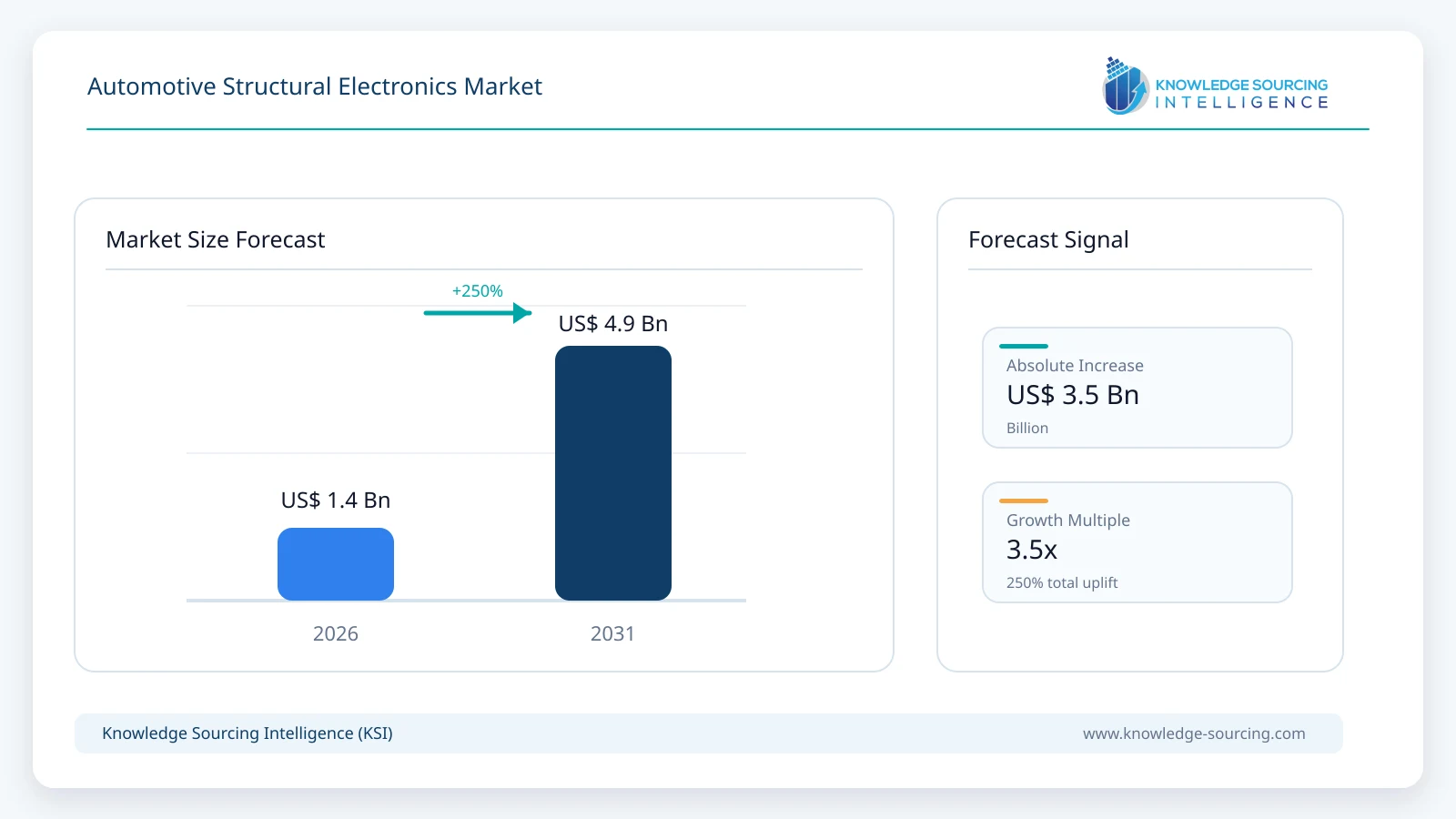
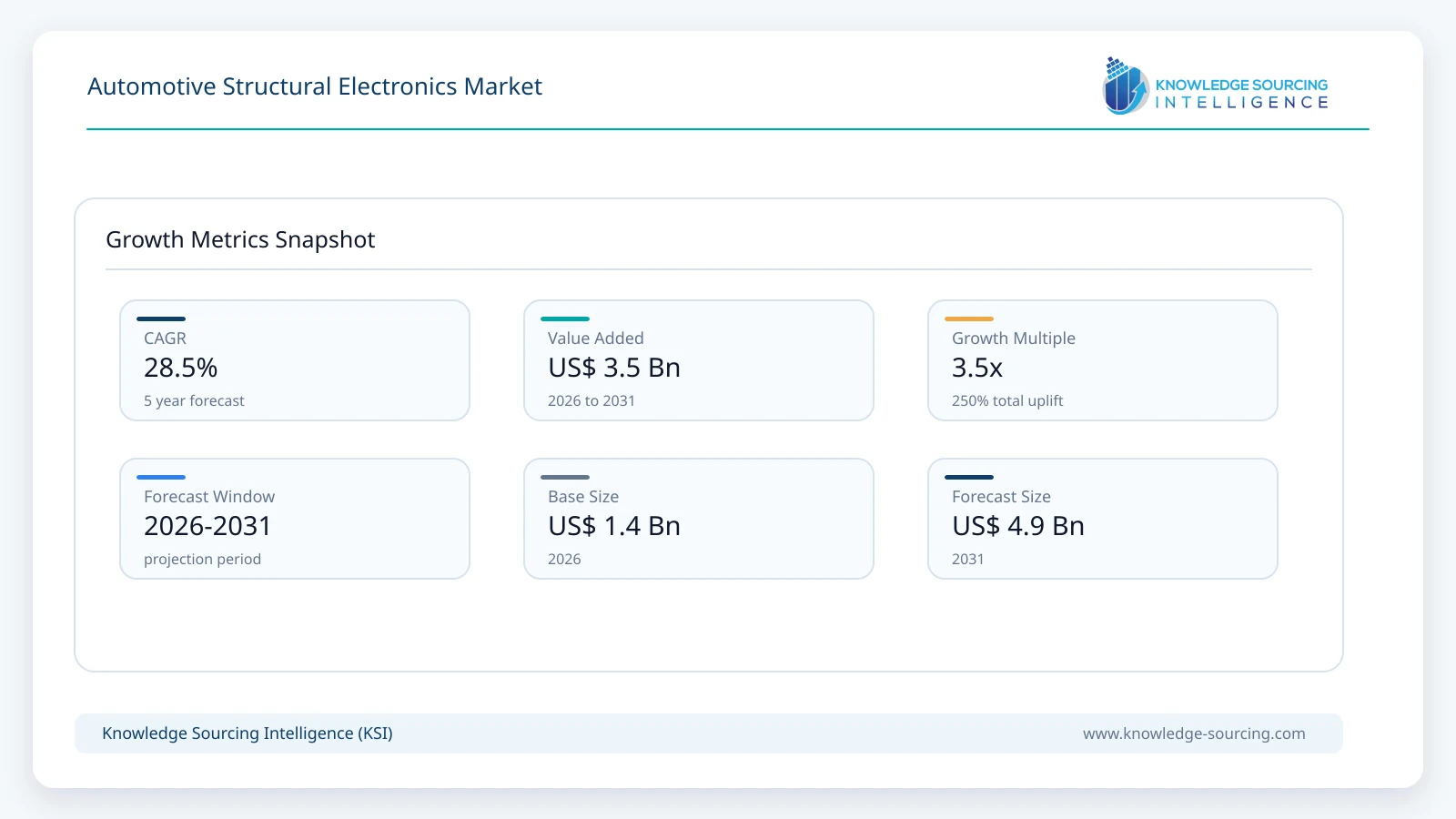
The automotive structural electronics market is projected to expand at a CAGR of 28.5%, increasing from USD 1.40 billion in 2026 to USD 4.90 billion by 2031.
Highlights:
- 1Interior functional structural-electronics assemblies account for the largest share of the market, with molded door, console and instrument-panel parts leading demand.
- 2Integrated lighting and visual indication represent approximately 37% of global value in 2026, supported by thin illuminated panels and hidden interface functions.
- 3Printed circuits with embedded electronic components account for approximately 56% of 2026 market value and gain importance as production readiness improves.
- 4Asia Pacific represents approximately 44% of 2026 demand, supported by vehicle production and regional investment in electronics-enabled surface manufacturing.
- 5Valeo’s January 2026 program award and NBHX’s June 2026 exterior production nomination demonstrate applications on both sides of the vehicle body.
- 6Tier 1 licensing and engineering partnerships are expanding access to industrial capabilities, while process yield and repair economics continue to shape adoption.
Automotive structural electronics integrate electrically active functions within a molded component rather than mounting every switch, indicator or conductive circuit as a separate module. Films carrying printed conductors and electronic components are shaped and incorporated into polymer parts for doors, dashboards, consoles and exterior illuminated surfaces. The technology combines a familiar vehicle component with a redesigned electrical and manufacturing architecture.
In January 2026, Valeo announced a premium-automaker interior award using TactoTek’s In-Mold Structural Electronics technology. NBHX subsequently disclosed an exterior illuminated-surface production nomination in China in June 2026. These awards indicate growing OEM interest in thin multifunctional parts, although production readiness still depends on program launch timing, reliable forming processes and validated durability.
Market Overview
Structural-electronics manufacturing begins with conductive patterns, functional films or component placements on a substrate designed to survive forming and molding. Thermoformed films are incorporated into the injection-molded component, allowing lighting, touch sensing or other electronic functions to follow curved surfaces. The resulting assemblies can consolidate decoration, structure and electronics while reducing the depth of conventional control or lighting installations.
TactoTek describes an industrial sequence of printing, component placement, forming and injection molding, with licensed producers adapting the process to selected automotive programs. Nissha supplies molded electronics that incorporate functions such as touch sensing into shaped decorative panels, while Henkel develops conductive inks suitable for formed electronic surfaces. Polymer selection, circuit layout and encapsulation must be engineered jointly because each process step can affect the electrical path.
Automakers increasingly evaluate structural-electronics parts for their contribution to packaging efficiency, appearance and functional density rather than for novelty alone. Integration can remove separate housings and assembly steps, but also moves reliability and replacement responsibility into a larger finished component. Commercial adoption consequently favors applications where surface geometry and multiple functions justify the production and validation burden.
Market Trends
Awarded Automotive Programs Are Replacing Isolated Demonstrators
Valeo’s January 2026 interior IMSE award and NBHX’s June 2026 exterior nomination are notable because they connect structural electronics to named supplier responsibilities and planned manufacturing operations. Valeo described a dedicated high-volume manufacturing solution for a premium automaker, while NBHX identified a new production facility in China. Both developments strengthen the industrial basis for integrated electronic structures.
Production awards do not make yield control or launch validation automatic. Manufacturers must transfer formed-circuit designs into repeatable tools, qualify electronic components after molding and control optical appearance across vehicle programs. Progress is therefore measured by the maturity of production processes and customer validation as much as by the number of announcements.
Manufacturing Licenses Are Increasing Tier 1 Participation
Motherson’s May 2026 license agreement with TactoTek gives a large automotive-supply organization access to an established IMSE process platform. The relationship brings engineering depth, global sourcing and program management into a field where specialized technology developers historically played a central role. Additional partners can improve the practical availability of structural-electronics manufacturing in major automotive regions.
AFRY and EDAG joined the technology ecosystem as engineering partners in September 2026, providing support for application design and industrial preparation. Engineering partnerships broaden development capacity but should not be confused with direct vehicle-production shipments. Their value lies in shortening learning cycles and helping components pass automotive requirements before tooling and capital decisions are finalized.
Functional Density Is Increasing inside Molded Surfaces
Automotive door and console assemblies increasingly combine visual indication, capacitive controls and illuminated decoration in the same visible area. Printed conductors allow light sources and input zones to follow the shape of a panel without separate rigid circuit boards behind every feature. Thin surfaces are especially relevant where package space must be shared with airbags, structural supports, storage volumes and conventional door mechanisms.
Improved functional density changes supplier responsibility because a finished panel must meet electrical, optical, mechanical and aesthetic specifications at the same time. Assembly consolidation offers a route to reducing interfaces, but a material or conductor defect can affect several functions simultaneously. This combination of value and risk encourages early cooperation between electronics developers, molders and vehicle interior-system suppliers.
Exterior Lighting Is Creating a Second Application Path
NBHX’s exterior structural-electronics program demonstrates that the technology can extend beyond passenger-facing interfaces. Exterior smart panels can carry illumination, identification or status signals in thin molded constructions and may fit distinctive electric-vehicle front-end designs. These applications add a different material and styling requirement to the more established interior controls and decorative lighting base.
Exposure to weathering, cleaning agents and debris creates more demanding qualification conditions than for many interior parts. Exterior manufacturing therefore requires rigorous encapsulation, optical consistency and environmental testing. Vehicle makers will prioritize applications where the integrated surface produces a visible design or packaging benefit that outweighs added validation costs.
Segment Analysis
By Application: Interior Panels and Exterior Functional Surfaces
Interior doors, center consoles and instrument panels account for most structural-electronics installations because they provide large shaped surfaces near the occupant and can incorporate lighting or controls. Door panels and armrest trim represent approximately 25% of 2026 value, while center consoles and center stacks contribute about 23%. The space and aesthetic advantages are strongest where several functions would otherwise require individual housings.
Exterior illuminated smart surfaces represent a smaller but growing field following production nominations in China. A shaped exterior element must satisfy automotive weathering and impact requirements while maintaining electrical functionality. Demand is likely to expand through selective high-content vehicle platforms before standardization reaches lower-cost models.
By Primary Function: Lighting and Multifunctional Control
Integrated lighting and visual indication account for approximately 37% of 2026 structural-electronics value. Illuminated icons, decorative light patterns and status communication are suitable early uses because the components benefit from thin packaging and can be distributed across shaped surfaces. Touch and sensor controls represent another substantial application group, especially in consoles and door-side interfaces.
Multifunctional combinations of lighting and control should gain share as suppliers validate electronic integration under molding loads. A single panel may integrate illuminated symbols, local touch detection and feedback coordinated with other vehicle systems. Such parts can replace more independent components, but program decisions still depend on repair economics and reliable user interaction.
By Electronics Integration: Embedded Circuits and Film Inserts
Printed circuits with embedded electronic components represent 56% of 2026 market value and are expected to increase their share by 2031 as production processes mature. Components mounted on formed films require careful mechanical design to avoid solder and conductor stress, but allow functions that cannot be achieved through a passive printed pattern alone. The growing contribution of this architecture is closely linked to lighting and high-content control applications.
Functional conductive film inserts remain an important route for touch sensing and simpler electrical functions. Nissha’s molded-panel technology and related film-based suppliers demonstrate the practical relevance of shaped functional inserts. Hybrid constructions will continue where film processes provide part of the functionality and separately mounted electronics remain preferable for serviceability or thermal reasons.
Market Drivers
Vehicle Manufacturers Are Consolidating Electronics within Trim Structures
Automotive designers are combining switches, indicator lighting and sensing into molded parts instead of fastening separate assemblies behind a finished panel. The consolidation is particularly relevant to door and console structures, where available depth is constrained by mechanical systems, occupant packaging and styling requirements. Embedded conductors and light sources can reduce intermediate housings and individual electrical interfaces when the complete panel is engineered as one validated part.
Valeo’s January 2026 premium-vehicle award for a high-volume interior solution using IMSE technology reflects this move toward ready-to-install structures. The value proposition depends on repeatable manufacturing and acceptable replacement cost rather than appearance alone. Suppliers that can control films, printing, component placement and molding together are better positioned to win complex component programs.
Thin Integrated Lighting and Control Surfaces Are Increasing Vehicle Content
Premium doors, dashboard surfaces and center consoles increasingly use illuminated icons and touch-responsive areas that disappear into decorative panels when inactive. Printing circuits and mounting electronics into thin polymer constructions allows functions to occupy surfaces where conventional switch packs or deep optical modules would be difficult to package. Multi-functionality also allows automakers to vary graphics and lighting signatures without redesigning every mechanical interface.
TactoTek’s IMSE architecture demonstrates how printed circuitry, LEDs and selected controls can be integrated into a shaped component. Higher functional density generally raises part-level electronic content, but it also makes optical calibration, thermal management and surface durability more important. Growth is consequently strongest in applications where integrated functions replace multiple separate items rather than simply adding another decorative feature.
Supplier Licensing Is Widening Industrial Manufacturing Capacity
Motherson’s May 2026 licensing agreement with TactoTek expanded industrial access to structural-electronics manufacturing technology through a global automotive Tier 1. The agreement adds manufacturing and program-engineering capability to a technology ecosystem previously dominated by specialist development partners. OEM purchasing teams require more than a successful concept; supplier capacity, process documentation and long-term delivery support must be available in the regions where vehicles are assembled.
EDAG and AFRY entered the IMSE engineering ecosystem in September 2026, strengthening engineering services for design and production preparation. These are capability-building developments rather than proof of new shipped vehicle content. Nevertheless, access to engineering resources and licensed manufacturing processes can improve the probability that prototype architectures meet automotive sourcing and qualification requirements.
Exterior Smart Panels Are Extending Structural Electronics Beyond Cabins
NBHX announced a nominated Chinese production program in June 2026 for an exterior illuminated smart surface based on IMSE technology. The application integrates lighting and electrical functionality into a thin molded structure, creating a manufacturing reference beyond conventional cabin controls. Exterior components can combine brand identity, status communication and differentiated vehicle front-end or rear-end styling within a common surface platform.
Exterior production introduces environmental constraints that interior demonstrations cannot establish on their own, including water exposure, road chemicals, weathering and mechanical impact. NBHX’s dedicated Chinese factory is relevant because localized process control and direct customer-program engineering support industrial adoption. Exterior value remains smaller than interior value, but contributes additional applications through 2031.
Platform Electronics Are Supporting Distributed Functional Modules
Automotive electrical architectures are becoming more software-configurable, allowing many localized cabin features to be controlled through vehicle networks rather than independent mechanical switches. A molded panel incorporating lights or touch electrodes can interface with a zone controller while retaining compact local drive electronics. The arrangement can simplify physical assembly if the communication, power and fault-detection architecture is carefully designed.
Electronic functionality embedded in structural surfaces is most attractive when the vehicle maker standardizes interface hardware across trims and product generations. Suppliers must still support diagnostics, functional-state visibility and service procedures. Architectural integration makes manufacturing and electronics-system competence important alongside surface appearance, reinforcing the advantage of multidisciplinary suppliers.
Market Restraints
Molding and Forming Yields Can Limit Manufacturing Economics
Printed conductors and mounted components experience stretching, thermal stress and pressure as plastic films are formed and molded. A fine circuit can pass initial electrical inspection but fail after a thermoforming operation or extended temperature cycling, leading to rejection late in a high-value manufacturing sequence. Multilayer designs and tight bend radii increase the amount of validation required before a surface can meet production yield targets.
Scrap costs rise when the decoration, circuitry and structural polymer are already combined in a nearly finished part. Manufacturers require stable printing registration, component retention and protected connection points across high-volume tooling. Yield improvement is therefore central to the economics of replacing separate conventional modules.
Integrated Modules Can Increase Repair and Warranty Costs
Embedding LEDs, printed circuits and controls inside one molded structure reduces the number of separately installed pieces, but can make individual faults more expensive to remedy. A defective light source or conductor may require replacing an entire console or door-panel assembly rather than a removable switch pack. This raises concerns for vehicle makers responsible for field service, warranty expense and long-term parts availability.
Electrical diagnostic capability and modular boundary design can reduce the burden, but some structural-electronics parts remain difficult to repair nondestructively. Suppliers must demonstrate reliable lifetime performance and define sensible replacement units. Warranty economics can delay adoption in vehicle classes where the packaging advantage is less valuable than serviceability.
Driver-Interface Requirements Restrict Some Touch-Only Designs
Instrument-panel and center-console surfaces must provide controls that remain usable during vibration, low-light driving and temporary visual distraction. Smooth touch controls may be less suitable for frequently accessed safety-related functions without tactile confirmation or suitable physical alternatives. Surface designs also need reliable performance when occupants wear gloves or encounter moisture and contamination.
Automakers therefore combine embedded touch areas with haptics, clear illumination, physical switches or redundant input paths according to the function involved. Additional validation and control hardware can erode the cost advantage of an otherwise thin structural-electronics part. Design freedom remains subject to usability and system-level safety requirements.
Automotive Tooling and Validation Cycles Delay Commercial Revenue
Integrating circuitry into a molded structure changes tooling, material qualification, component-supplier interfaces and final electrical test methods simultaneously. A supplier must verify resin selection, film adhesion, electrical continuity, optical performance and end-of-line yields before a vehicle program can authorize production. Program timing is therefore tied to vehicle development and purchasing decisions rather than the pace of demonstration announcements.
Licensing agreements and engineering partnerships improve technology availability but do not by themselves establish production revenue. A qualified design may also be redesigned if the automaker changes trim materials or cost targets late in development. Extended validation periods make near-term growth dependent on the conversion of nominated programs into stable series output.
Material Aging and Environmental Exposure Challenge Reliability
Electronic films encapsulated in plastic can be sensitive to changes in thermal expansion, humidity, ultraviolet exposure and repeated surface loading. Stress concentrations near conductive traces or component solder joints create risks that differ from those of conventional printed circuit boards. Exterior panels add road debris, aggressive cleaning chemistry and water ingress to the material demands already present inside the vehicle.
Long-term reliability requires compatible films, inks, adhesives and polymers, plus accelerated cycling and process inspection. Greater multifunctionality can concentrate more failure modes in one part, increasing the importance of designing the full material stack as an integrated system. These qualifications are a barrier for suppliers lacking automotive-grade process controls.
Regional Outlook
Asia Pacific
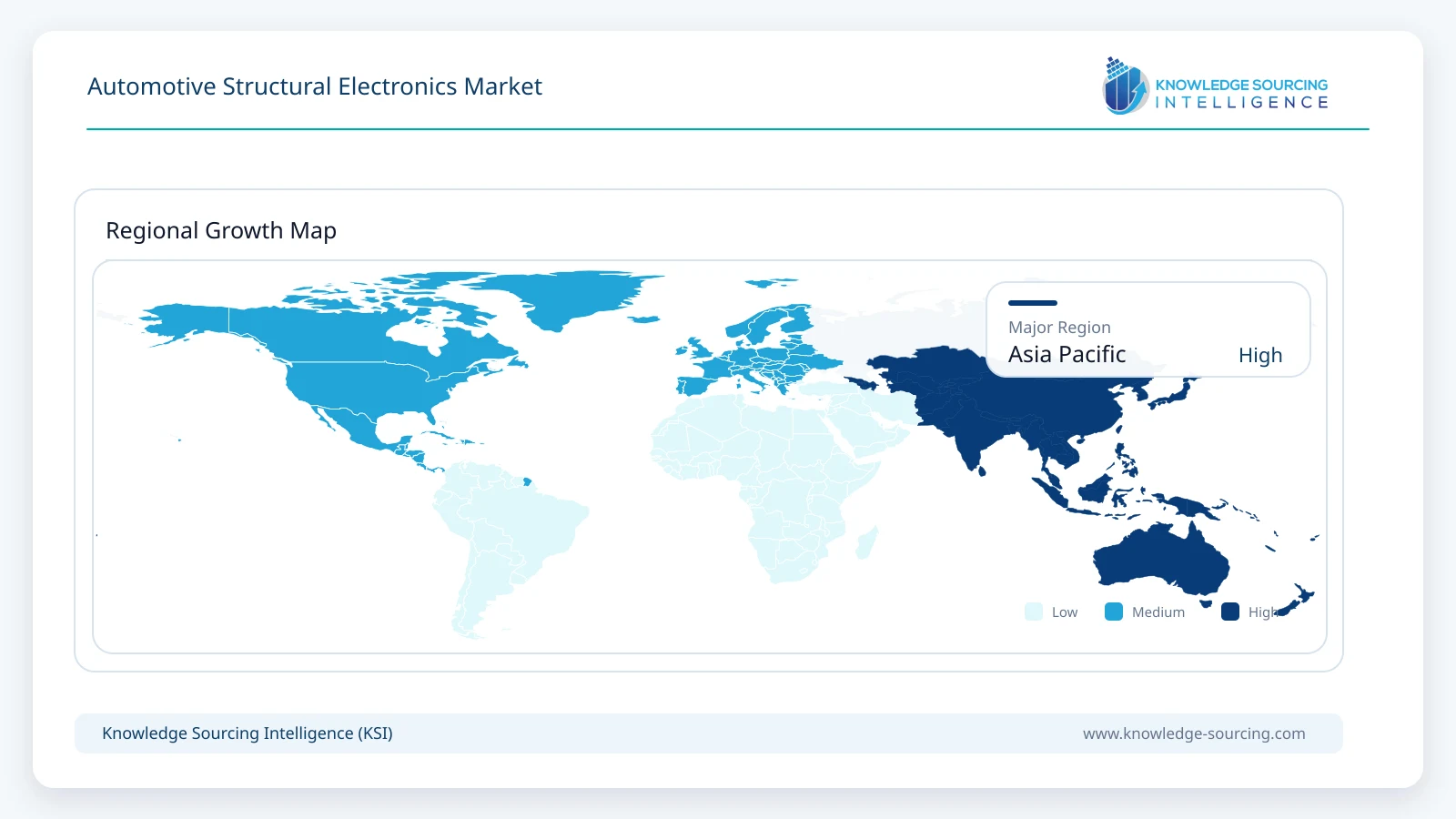
Asia Pacific represents approximately 44% of structural-electronics market value in 2026, supported by concentrated vehicle production, electronics suppliers and manufacturing scale in China, Japan and South Korea. Chinese manufacturers are also developing new interior and exterior design features across premium and mass-market electric vehicles. NBHX’s June 2026 exterior nomination highlights the relevance of localized smart-surface production for this regional demand.
China is expected to account for the largest national contribution within Asia Pacific, while Japanese and Korean suppliers maintain important expertise in film processing, molded decoration and electrical integration. Regional demand will increasingly depend on local manufacturing readiness and qualification capability, not simply high vehicle output. Rapid iteration among Chinese OEMs can favor suppliers that shorten tooling cycles without compromising process stability.
Europe
Europe remains a major center of structural-electronics engineering because premium vehicle interiors place high value on thin integrated controls, lighting and decorative quality. Valeo’s premium-automaker award, TactoTek’s Finnish technology base and participation by European engineering groups underline the region’s role in translating molded electronics into industrial parts. European automakers also place strong emphasis on consistent material appearance and reliable vehicle-interface behavior.
Growth will be shaped more by content per vehicle and high-value supplier programs than by underlying vehicle-production expansion. Materials engineering, validation services and licensing networks allow European companies to participate in projects manufactured elsewhere. Competition will favor integration capabilities that meet tight surface and electronic tolerances while satisfying cost and repair requirements.
Competitive Landscape
Automotive structural electronics involve an interconnected group of functional-film specialists, smart-surface technology licensors, Tier 1 vehicle-system suppliers and manufacturers of printed electronic materials. TactoTek licenses integrated molded-electronics technology, while Valeo, NBHX and Motherson bring automotive program execution, production capacity and established OEM relationships. Nissha contributes decorative-film and molded-electronics expertise, and Henkel and PolyIC supply materials and circuits used in related functional surfaces.
Competition increasingly depends on the ability to industrialize a full material stack rather than to supply a single printed conductor or decorative film. Mature producers must manage electrical continuity after forming, acceptable optical appearance, component packaging and repeatable molding yields. Engineering partners such as EDAG and AFRY also influence platform readiness through design and manufacturing validation without necessarily competing as direct suppliers of finished parts.
The supplier base is likely to remain fragmented by manufacturing responsibility because specialized intellectual property, materials, molding and system integration are often controlled by different companies. Program nominations, verified quality systems and sustainable manufacturing economics offer more meaningful competitive distinctions than a count of patents or concept demonstrators. Manufacturers able to combine multiple functions at reliable cost are expected to be favored for the next generation of complex vehicle surfaces.
Recent Developments
15 September 2026: EDAG joined TactoTek’s IMSE engineering ecosystem to support development and industrialization of vehicle smart-surface applications. The partnership builds application engineering capability ahead of potential production programs.
29 June 2026: NBHX announced an OEM-awarded exterior illuminated smart-surface production program in China using TactoTek IMSE technology. The nomination introduces a localized Chinese manufacturing route for exterior structural-electronics parts.
21 May 2026: Motherson signed an IMSE technology license with TactoTek to expand automotive smart-surface manufacturing capability. The license extends access to industrial manufacturing and global automotive program execution.
25 February 2026: TactoTek and Symbiose announced a partnership supporting industrial production of IMSE technology. The agreement adds film production and printed-electronics capacity for future automotive applications.
20 January 2026: Valeo announced an awarded premium-vehicle interior lighting program using TactoTek IMSE technology with an automated manufacturing solution. The award provides an industrial route for combining lighting and circuitry within a finished vehicle surface.
Market Outlook
Vehicle manufacturers bringing thin controls, integrated lighting and multifunctional molded surfaces into new model programs are expanding the use of structural electronics. Interior applications remain the largest demand center, led by door panels, console surfaces and instrument-panel structures. Exterior illuminated components provide an additional growth avenue where styling and electronics can be combined without large conventional lamp housings.
Electronics embedded in plastic components are likely to advance through improved conductive materials, more reliable component placement, tighter molding controls and better end-of-line inspection. The move toward multifunctional structures will increase the value of complete assemblies, particularly when local control and lighting functions are integrated with vehicle networks. Suppliers will need to preserve maintainability and material durability while reducing manufacturing scrap.
Asia Pacific is expected to lead in absolute demand, supported by extensive vehicle manufacturing and Chinese adoption of new exterior and interior design features. Europe will remain important for premium vehicle integration, engineering and manufacturing-technology development. The speed at which licensing and awarded programs translate into stable production will influence the market’s growth profile through 2031.
Automotive Structural Electronics Market Scope
| Report Metric | Details |
|---|---|
| Total Market Size in 2026 | USD 1.40 billion |
| Total Market Size in 2031 | USD 4.90 billion |
| Forecast Unit | Billion |
| Growth Rate | 28.5% |
| Study Period | 2021 to 2031 |
| Historical Data | 2021 to 2024 |
| Base Year | 2025 |
| Forecast Period | 2026 – 2031 |
| Segmentation | Application, Primary Function, Electronic Integration, Conductor and Circuit Process, Surface Material, Vehicle Type, Propulsion, Geography |
| Companies |
|
Market Segmentation
By Application
Door Panels and Armrest Trim
Center Console and Center Stack
Instrument Panel and Dashboard
Overhead, Rear and Other Interior Parts
Exterior Illuminated Smart Surfaces
By Primary Function
Integrated Lighting and Visual Indication
Touch and Sensor Control
Multifunctional Lighting and Control
Heating, Antennas and Other Functions
By Electronic Integration
Printed Circuits with Embedded Components
Functional Conductive Film Inserts
Localized Printed Heaters and Antennas
Other Integrated Electronic Constructions
By Conductor and Circuit Process
Screen-Printed Conductive Patterns
Metallized and Etched Film Circuits
Hybrid Multi-Layer Circuit Processes
Other Patterning Methods
By Surface Material
Molded Polycarbonate and Blends
Polypropylene and Other Polymer Systems
Decorated Films and Multilayer Overlays
Other Composite or Specialty Materials
By Vehicle Type
Passenger Vehicles
Light Commercial Vehicles
Medium and Heavy Commercial Vehicles and Buses
By Propulsion
Internal Combustion and Mild Hybrid
Hybrid and Plug-In Hybrid
Battery Electric
By Geography
North America
United States
Canada
Mexico
South America
Brazil
Argentina
Others
Europe
Germany
United Kingdom
France
Italy
Spain
Others
Middle East and Africa
Saudi Arabia
United Arab Emirates
South Africa
Others
Asia Pacific
China
Japan
South Korea
India
Indonesia
Thailand
Others
Table of Contents
1. EXECUTIVE SUMMARY
1.1. Market Opportunity and Key Findings
1.2. Market Size and Growth, 2026–2031
1.3. Technology and Production Commercialization
1.4. Regional Opportunity Summary
2. MARKET SNAPSHOT
2.1. Market Overview
2.2. Market Definition
2.3. Scope of the Study
2.4. Market Segmentation
3. BUSINESS LANDSCAPE
3.1. Market Drivers
3.1.1. Vehicle Manufacturers Are Consolidating Electronics within Trim Structures
3.1.2. Thin Integrated Lighting and Control Surfaces Are Increasing Vehicle Content
3.1.3. Supplier Licensing Is Widening Industrial Manufacturing Capacity
3.1.4. Exterior Smart Panels Are Extending Structural Electronics Beyond Cabins
3.1.5. Platform Electronics Are Supporting Distributed Functional Modules
3.2. Market Restraints
3.2.1. Molding and Forming Yields Can Limit Manufacturing Economics
3.2.2. Integrated Modules Can Increase Repair and Warranty Costs
3.2.3. Driver-Interface Requirements Restrict Some Touch-Only Designs
3.2.4. Automotive Tooling and Validation Cycles Delay Commercial Revenue
3.2.5. Material Aging and Environmental Exposure Challenge Reliability
3.3. Market Opportunities
3.4. Porter’s Five Forces Analysis
3.5. Industry Value Chain Analysis
3.6. Policies and Regulations
3.7. Strategic Recommendations
4. TECHNOLOGICAL OUTLOOK
4.1. Printed and Stretchable Conductive Patterns
4.2. Thermoforming and Circuit-Strain Management
4.3. Surface-Mounted Devices and Encapsulation
4.4. Injection Molding and Film Insert Processing
4.5. Structural Integration of Touch and Sensing
4.6. Integrated LED and Optical Surface Architectures
4.7. Hybrid Polymer and Composite Material Stacks
4.8. In-Line Electrical and Environmental Validation
5. AUTOMOTIVE STRUCTURAL ELECTRONICS MARKET BY APPLICATION
5.1. Introduction
5.2. Door Panels and Armrest Trim
5.3. Center Console and Center Stack
5.4. Instrument Panel and Dashboard
5.5. Overhead, Rear and Other Interior Parts
5.6. Exterior Illuminated Smart Surfaces
6. AUTOMOTIVE STRUCTURAL ELECTRONICS MARKET BY PRIMARY FUNCTION
6.1. Introduction
6.2. Integrated Lighting and Visual Indication
6.3. Touch and Sensor Control
6.4. Multifunctional Lighting and Control
6.5. Heating, Antennas and Other Functions
7. AUTOMOTIVE STRUCTURAL ELECTRONICS MARKET BY ELECTRONIC INTEGRATION
7.1. Introduction
7.2. Printed Circuits with Embedded Components
7.3. Functional Conductive Film Inserts
7.4. Localized Printed Heaters and Antennas
7.5. Other Integrated Electronic Constructions
8. AUTOMOTIVE STRUCTURAL ELECTRONICS MARKET BY CONDUCTOR AND CIRCUIT PROCESS
8.1. Introduction
8.2. Screen-Printed Conductive Patterns
8.3. Metallized and Etched Film Circuits
8.4. Hybrid Multi-Layer Circuit Processes
8.5. Other Patterning Methods
9. AUTOMOTIVE STRUCTURAL ELECTRONICS MARKET BY SURFACE MATERIAL
9.1. Introduction
9.2. Molded Polycarbonate and Blends
9.3. Polypropylene and Other Polymer Systems
9.4. Decorated Films and Multilayer Overlays
9.5. Other Composite or Specialty Materials
10. AUTOMOTIVE STRUCTURAL ELECTRONICS MARKET BY VEHICLE TYPE
10.1. Introduction
10.2. Passenger Vehicles
10.3. Light Commercial Vehicles
10.4. Medium and Heavy Commercial Vehicles and Buses
11. AUTOMOTIVE STRUCTURAL ELECTRONICS MARKET BY PROPULSION
11.1. Introduction
11.2. Internal Combustion and Mild Hybrid
11.3. Hybrid and Plug-In Hybrid
11.4. Battery Electric
12. AUTOMOTIVE STRUCTURAL ELECTRONICS MARKET BY GEOGRAPHY
12.1. Introduction
12.2. North America
12.2.1. United States
12.2.2. Canada
12.2.3. Mexico
12.3. South America
12.3.1. Brazil
12.3.2. Argentina
12.3.3. Others
12.4. Europe
12.4.1. Germany
12.4.2. United Kingdom
12.4.3. France
12.4.4. Italy
12.4.5. Spain
12.4.6. Others
12.5. Middle East and Africa
12.5.1. Saudi Arabia
12.5.2. United Arab Emirates
12.5.3. South Africa
12.5.4. Others
12.6. Asia Pacific
12.6.1. China
12.6.2. Japan
12.6.3. South Korea
12.6.4. India
12.6.5. Indonesia
12.6.6. Thailand
12.6.7. Others
13. COMPETITIVE ENVIRONMENT AND ANALYSIS
13.1. Major Players and Strategy Analysis
13.2. Market Share Analysis
13.3. Mergers, Acquisitions, Agreements and Collaborations
13.4. Industrial Production Readiness
13.5. Supplier Technology and Manufacturing Benchmark
13.6. Competitive Dashboard
14. COMPANY PROFILES
14.1. TactoTek Oy
14.2. Valeo
14.3. NBHX
14.4. Motherson Group
14.5. Nissha Co., Ltd.
14.6. Symbiose
14.7. Global Technology Ventures Inc.
14.8. ARRK SPG
14.9. PolyIC GmbH
14.10. Henkel AG & Co. KGaA
14.11. DuPont
14.12. EDAG Group
15. APPENDIX
15.1. Currency
15.2. Assumptions
15.3. Base and Forecast Years Timeline
15.4. Key Benefits for Stakeholders
15.5. Research Methodology
15.6. Abbreviations
15.7. Data Sources
Navigate
Trusted by the world's leading organizations











