
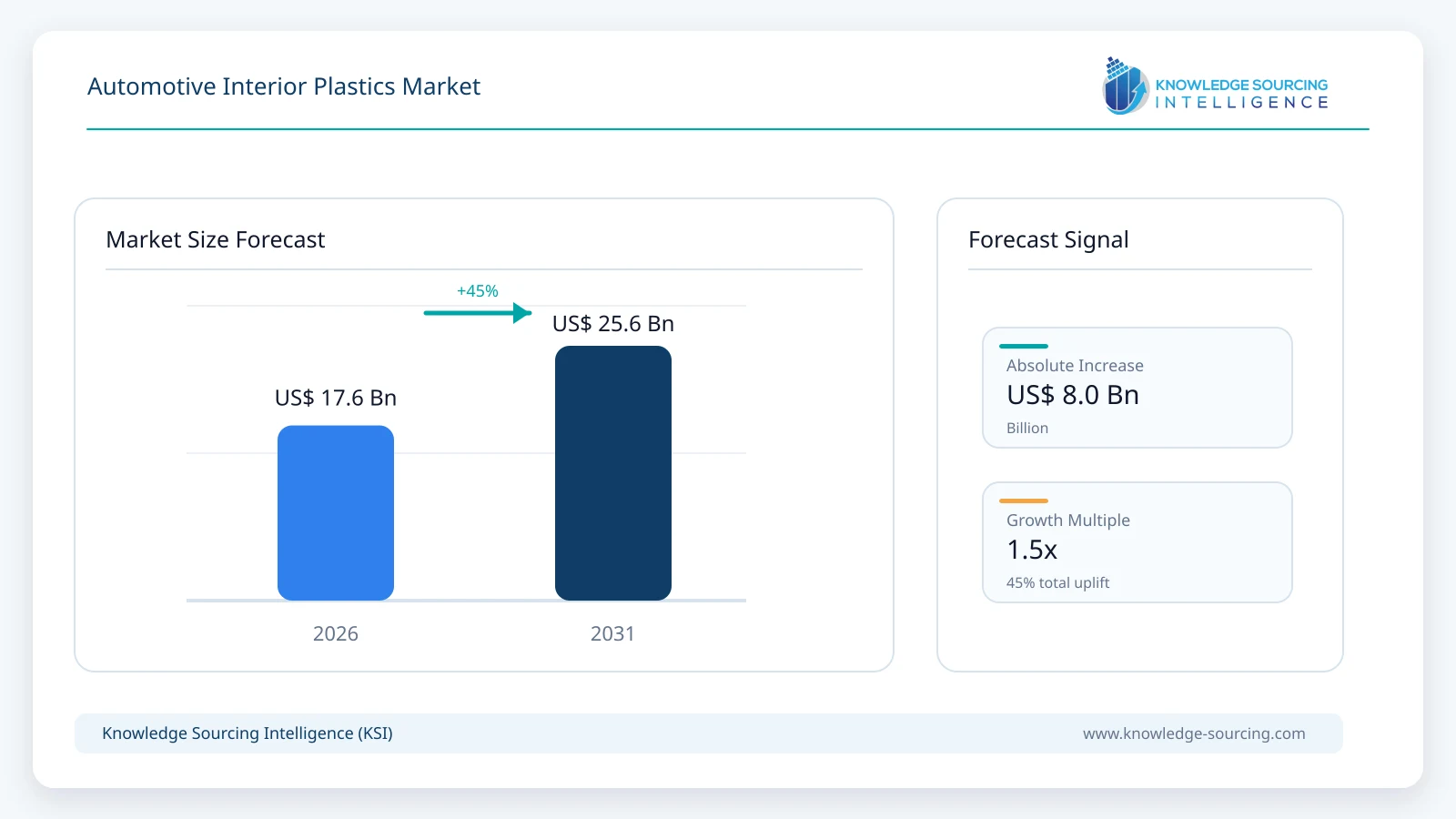
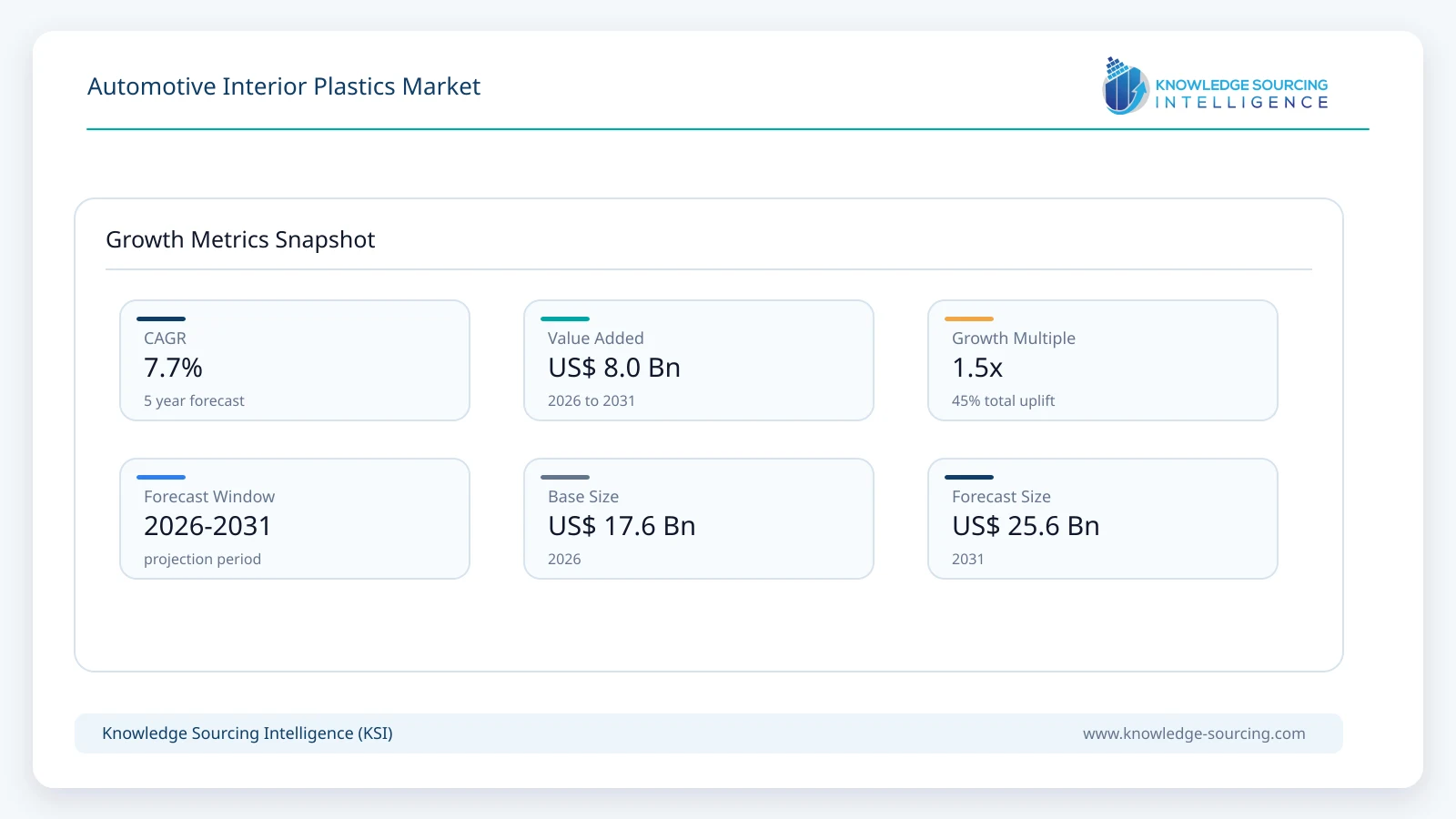
The automotive interior plastics market is forecast to grow at a CAGR of 7.7%, increasing from USD 17.6 billion in 2026 to USD 25.6 billion by 2031.
Highlights:
- 1Polypropylene and TPO compounds represent approximately 38% of modeled 2026 revenue and remain the largest polymer group.
- 2Polyurethane foam and systems contribute about 25% of 2026 market value, led by seats and soft interior parts.
- 3ABS, PC and PC/ABS blends are modeled to rise from 16% in 2026 to 18% in 2031 as decorative and functional demands expand.
- 4Seating materials account for about 29% of 2026 revenue, followed by instrument-panel and dashboard components at 23%.
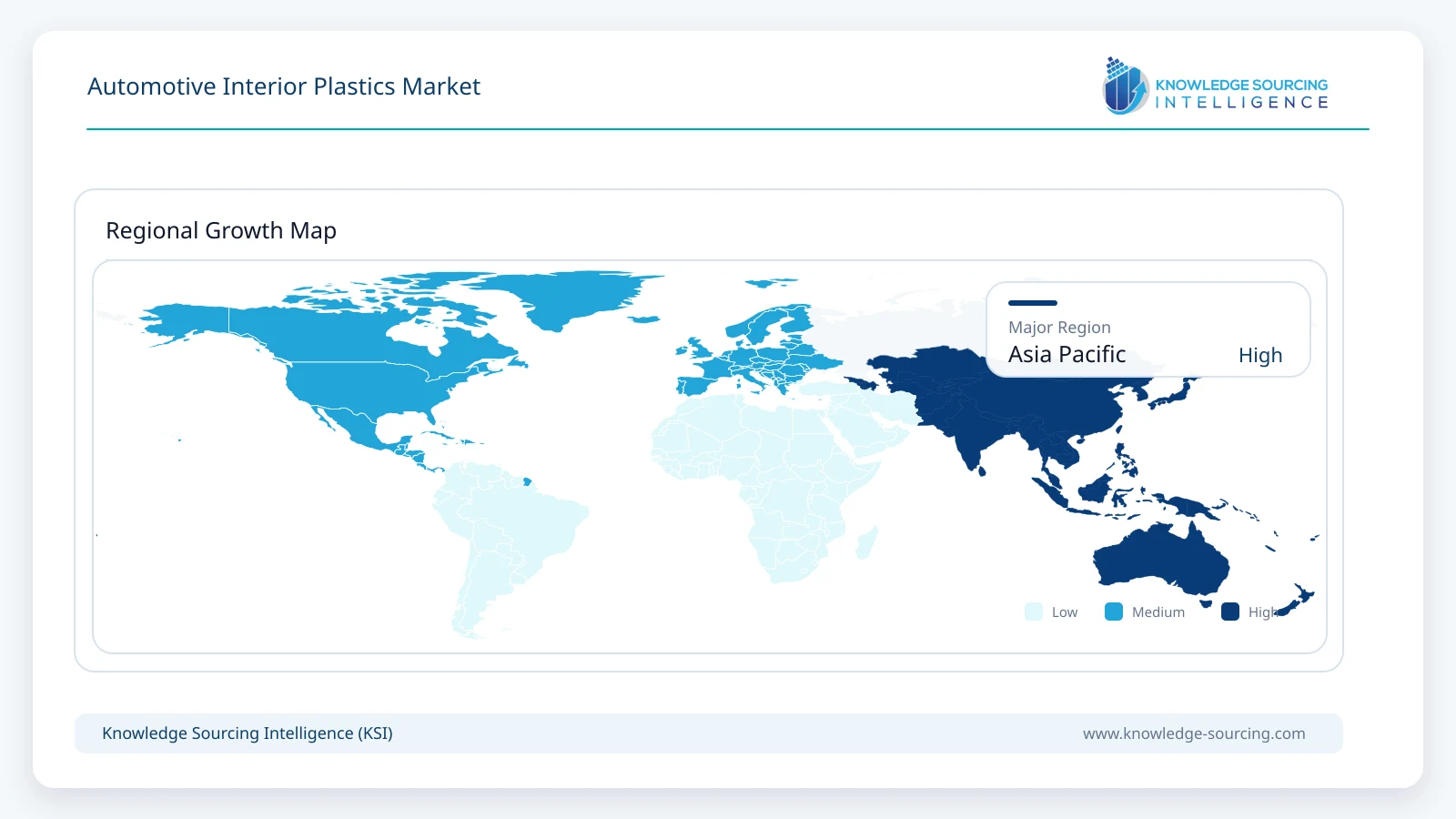
- 5Asia Pacific represents approximately 48% of 2026 material demand and is expected to reach 50% by 2031.
- 6Recycled-content PP and PC/ABS are advancing beyond trials into selected serial interior programs, although qualification varies by part.
Demand covers qualified thermoplastic compounds, polyurethane interior foams, films, skins and processed polymer substrates used in vehicle cabins. Interior plastic material value is captured at a consistent material or first-conversion transaction rather than the full selling price of finished cockpits, seats, doors, infotainment equipment or assembled trim modules.
Polypropylene and thermoplastic polyolefins anchor high-volume molded applications, whereas polyurethane occupies an important position in seat cushions, armrests and soft-touch structures. ABS, polycarbonate blends and other engineered polymers are selected where surface quality, tight tolerances and functional integration carry greater value. SABIC, BASF, Covestro, Dow and LyondellBasell supply differentiated plastic systems, while FORVIA, Antolin and other component specialists integrate polymer materials into automaker programs. Growth increasingly depends on the content and specification of qualified materials within each vehicle.
Market Overview
The largest interior plastic applications combine a molded load-bearing substrate with visible finishes, soft backing or local reinforcement. Polypropylene compounds are common in door carriers, glove boxes, lower instrument panels and console structures because talc or glass-fiber reinforcement can balance stiffness, mass, processability and cost. SABIC specifies low-emission, scratch-resistant and thin-wall interior grades, while LyondellBasell supplies modified polypropylene compounds for automotive haptics and reduced component mass.
Flexible polyurethane remains a major polymer family because seat cushions, seat backs, head restraints and armrests depend on controlled foam response and durability. Dow estimates that a typical car contains around 28 kilograms of polyurethane, with 10–15 kilograms incorporated in seating. Automotive seating uses only part of the total polyurethane mass; other foam applications include padding, energy absorption and acoustic treatments. Material suppliers are working on recoverable polyols and compatible foam chemistries because chemically crosslinked foams are more difficult to recycle than many thermoplastic trim components.
Engineering plastics are increasingly visible in upper cabin applications that require stable surfaces and integration of optical, lighting or human-machine interface features. BASF markets low-emission Ultramid grades for interior aesthetic and functional components, while Covestro supplies polycarbonate systems, polymer films and polyurethane technologies for decorated cockpit materials. Mitsubishi Chemical’s DURABIO offers high optical clarity for illuminated features.
Automakers are also increasing use of recycled-content compounds in structural and visible interior components. FORVIA reports that the instrument panel and center console of the Renault Clio 6 incorporate 40% recycled plastics, while Covestro supplies Bayblend T85X R35 CQ with 35% post-consumer recycled content for selected Lexus ES interior parts. Recycled polymers require careful feedstock control to maintain surface appearance and odor requirements, so recycled-content adoption is progressing through specific vehicle programs rather than a universal substitution across all interior grades.
Market Trends
Greater Functional Integration in Molded Surfaces
Vehicle cockpits combine larger screens, lighting, concealed controls and sensor interfaces, concentrating more functionality around molded instrument panels and consoles. Engineering plastics must deliver appearance control, dimensional stability and stable interfaces for electronics without adding unnecessary wall thickness. SABIC’s interior portfolio specifically addresses instrument-panel and console structures, antisqueak performance and thin-wall molding. Better integration can raise the value of selected polymers even where total plastic weight per vehicle remains broadly stable.
Recycled-Content Compounds Enter Visible and Structural Parts
Recycled polypropylene is moving into demanding support structures, while qualified PC/ABS blends are entering selected premium visible components. Borealis developed Borcycle GD3600SY with 65% post-consumer recycled polymer for Peugeot 3008 console carriers, and Borouge International introduced GE2331SY for dashboard and console carriers in 2026. Covestro’s Lexus ES program establishes a separate example of recycled PC/ABS used in a premium application. Surface consistency, automotive odor limits and repeatable mechanical performance remain important barriers to wider adoption.
Polyurethane Systems Move Toward More Recoverable Designs
Polyurethane suppliers are evaluating both recoverable feedstocks and product architectures that are easier to separate at vehicle end of life. Dow and Gruppo Fiori announced a 2025 process to recover polyurethane from end-of-life vehicles without complete disassembly, while Covestro is developing polyurethane-focused interior trim and load-floor concepts. New circular designs can reduce the dependence on virgin chemical inputs, but scale-up depends on economical waste separation and reliable performance after material recovery.
Low-Emission and Lightweight Processing
Low-VOC compounds, foamed thermoplastics and molded-in-color finishes reduce the need for additional interior materials and processing steps. Hyundai Transys and BASF presented a 2025 concept seat using foamed Elastollan TPU in headrest and armrest components, demonstrating material-level alternatives to conventional assemblies. The concept is not equivalent to confirmed large-volume production, but the design illustrates the direction of future lightweight soft-touch parts. Cabin-air testing and flammability compliance continue to shape the qualification of new materials.
Segment Analysis
By Polymer Type: Polypropylene and Thermoplastic Polyolefins
Polypropylene and TPO compounds are estimated to generate approximately 38% of 2026 material revenue because low-cost moldability, reinforcement flexibility and established automotive tooling support broad cabin use. Door carriers, lower instrument panels, consoles, ducts and hidden structural components remain important applications. High-flow compounds permit large molded surfaces, while recycled grades are increasingly suitable for carriers with defined stiffness and dimensional requirements. Polypropylene retains the leading share through 2031, although engineering polymer blends and some specialty foams grow faster in value.
By Application: Seating Foams, Supports and Plastic Components
Seating-related plastics are estimated to account for 29% of 2026 market value, reflecting the large quantity of polyurethane foam used in cushions, backs and head restraints alongside molded plastic shells and adjuster covers. Passenger-vehicle seating combines standardized high-volume formulations with higher-density and comfort-oriented systems used in premium trims. Better foam process control and recycled-feedstock technologies support future value, but material-lightweighting moderates volume growth for mature seat architectures. The share is modeled to ease modestly by 2031 as electronic and functional cockpit plastics expand.
By Processing Technology: Injection Molding and Overmolding
Injection molding and overmolding account for an estimated 54% of market revenue in 2026, supported by large production runs and the ability to integrate fasteners, ribs, graining and functional features into polymer components. Cabin converters use process variations to manage fiber-filled PP, ABS, PC/ABS and selected TPE grades with different flow and surface requirements. Injection processing remains the largest category because large molded trim and carrier parts dominate polymer conversion, while foaming and film processes remain necessary for tactile surfaces and cushioning.
By Vehicle Type: Passenger Vehicles
Passenger vehicles represent approximately 90% of 2026 automotive interior plastics revenue due to production scale and more extensive cockpit, seating and decorative content than most commercial-vehicle formats. Passenger cars and SUVs offer a broad mix of hard trim, engineering plastics and foam-based comfort parts across entry-level and premium configurations. Continued growth in Asian passenger-vehicle output and vehicle-content upgrades should keep the passenger segment dominant through 2031.
Market Drivers
Vehicle Production and Rising Plastic Content in Cabins
OICA reported global vehicle production of 96.4 million units in 2025, providing a large installation base for interior polymer materials. New vehicle programs incorporate molded carriers, foams, ducts, consoles and soft-touch elements, even where a specific material is substituted or reduced in mass. The main demand increase arises from vehicle volume and content changes rather than a uniform increase in plastic intensity across all models. Asian manufacturing capacity supports the strongest regional material-volume expansion.
Complex Cockpit Functions and Surface Specifications
Instrument panels and consoles are accommodating more electronic functions, ambient lighting, touchscreen supports and concealed controls. Material choice therefore extends beyond basic stiffness into scratch resistance, surface gloss, thermal aging, antisqueak behavior and compatibility with sensors or decorative films. Engineering polymer grades from SABIC, BASF and Covestro address many of these constraints. Higher-performance cockpit plastics increase material value per qualified application and strengthen the role of supplier-assisted design.
Lightweight Conversion and Production Economics
Thermoplastics permit thin-wall sections, part consolidation and molding of complex geometries that would require more assembly steps with metal-based designs. PP compounds and engineered blends can reduce weight without removing the mechanical properties required for cabin carriers, pillars and consoles. Material substitution is economically attractive when plastic processing eliminates painting, fasteners or secondary wrapping. The market benefit comes from lower installed component cost and improved manufacturing consistency as much as from lower material mass.
Recycled-Content Procurement and Traceability
European vehicle-circularity requirements are increasing the commercial value of verified recycled polymer grades. Regulation (EU) 2026/1738 establishes a 15% post-consumer recycled-plastic content requirement for relevant newly type-approved vehicles from September 2032, followed by 25% from September 2036. Neither target applies across the whole market during 2026–2031, but procurement and qualification work is already under way. Recycled PP and PC/ABS are benefiting from earlier specification decisions by vehicle manufacturers.
Demand for Consistent Low-Emission Interior Materials
Automotive plastics are tested for volatile emissions, odor and the potential for fogging on glass and display surfaces. ISO 12219-1:2021 provides a whole-vehicle methodology for measuring volatile organic compounds in cabin air, while manufacturers impose additional component-specific specifications. Low-emission additives, stable recycled feedstock and controlled polyurethane chemistry can raise supplier qualification costs but also differentiate approved materials. As visible cabin surfaces become more integrated, consistent material behavior can influence long-term sourcing decisions.
Market Restraints
Polymer and Additive Cost Volatility
Automotive compounds contain polymers, fillers, stabilizers, pigments and other additives exposed to different raw-material cost cycles. Premium grades for transparent, low-emission or flame-resistant applications also command higher processing and qualification expense than basic PP compounds. Vehicle manufacturers usually impose cost-down requirements across platform lifecycles, constraining the ability of suppliers to recover sustained material inflation. Margin pressure is particularly acute in price-sensitive high-volume cabin parts.
Recycled-Feedstock Variability and Odor Risk
Automotive PCR compounds require stable contamination levels, controlled color and repeatable rheology across multiple manufacturing batches. Mixed post-consumer streams can contain residues or incompatible materials that affect smell, appearance or long-term mechanical properties. Sorting, washing and compounded stabilization add cost before recycled grades can meet vehicle-specific requirements. Higher recycled-content specifications therefore increase technical demands rather than allowing automatic material substitution.
Qualification, Flammability and VOC Requirements
New cabin plastic formulations must pass vehicle-specific material approval processes and applicable performance rules. FMVSS 302 addresses burn resistance for specified interior materials in the United States, while OEM standards assess abrasion, heat aging, odor and emissions. Approval can require new tooling trials, accelerated durability testing and coordinated supplier changes. Qualification cycles delay full commercialization of new polymer technologies even when laboratory results are favorable.
Circularity Challenges in Mixed-Material Components
A complete interior component may combine PP carriers, polyurethane foam, metal brackets, textile wraps and adhesive layers. Mixed-material assemblies are difficult to separate mechanically, reducing the quality of recovered plastic streams and increasing treatment cost. Single-polymer and removable-surface designs can improve recyclability but are not always compatible with appearance or acoustic requirements.
Material Substitution and Weight-Reduction Pressure
Natural fibers, engineered textiles, lightweight metals and bio-derived compounds compete with some conventional interior plastic applications. Lower-density foaming and thin-wall molding also reduce kilograms of polymer used per part, even when total component value rises. Growth based only on material tonnage can therefore overstate future plastic demand. Suppliers need to improve functionality, surface quality or processing cost to protect revenue per vehicle as lightweighting develops.
Regional Outlook
Asia Pacific
Asia Pacific accounts for an estimated 48% of global automotive interior plastics value in 2026, supported by vehicle production in China, Japan, South Korea, India and Southeast Asia. China combines extensive supply of PP and engineered resins with large vehicle assembly and trim manufacturing capacity, while Japanese and Korean manufacturers retain strong positions in specialized polymer systems. India is becoming more relevant as domestic vehicle production and localization of higher-value molded components increase. Asia Pacific is forecast to reach approximately half of global demand by 2031, reflecting both production volume and expanding plastic content in smart cabins.
Europe
Europe represents an estimated 22% of 2026 market value, supported by premium-vehicle specifications, engineering plastics suppliers and established interior systems manufacturers. Germany, France, Italy, Spain and the United Kingdom contribute through automaker design programs, resin and compound production, and regional component conversion. European regulation gives more weight to material provenance and eventual recovery, encouraging qualification of recycled-content PP, PC/ABS and polyurethane technologies. Slower underlying vehicle-production growth is expected to be partly offset by higher material specifications and circularity-related product development.
Competitive Landscape
The market combines global polymer groups with specialist compounders and interior component converters. SABIC, BASF, LyondellBasell and Borouge International compete in PP and engineering thermoplastics; Covestro and Dow are particularly important in polycarbonate and polyurethane systems; Avient and Mitsubishi Chemical contribute higher-specialty compounds. FORVIA and Antolin integrate qualified materials into cabin systems, influencing the material specifications and approvals that upstream suppliers must satisfy. Competition is strongest around OEM qualification, consistent delivery, technical application support, cost and emerging requirements for recycled content.
The transition toward circular interior plastics is broadening the supplier qualification process to include traceability of recycled inputs and repeatability of material properties. Automotive grade suppliers maintain advantages where OEM programs require joint engineering across polymer choice, component geometry and processing. Premium material features, such as low odor and integrated decoration, allow some grades to achieve higher realized value even when overall plastic mass is reduced. Competitive differentiation is therefore increasingly linked to material functionality and qualification history rather than resin price alone.
Recent Developments
June 2026: Covestro confirmed that Bayblend T85X R35 CQ, containing 35% post-consumer recycled content, was adopted for selected Lexus ES interior components. The qualification demonstrates recycled PC/ABS use where visible surface quality and dimensional stability are critical.
May 2026: Borouge International launched Borcycle GE2331SY recycled polypropylene compound for demanding console and dashboard carriers. The launch expands the material options for high-stiffness interior structural parts.
January 2026: Mitsubishi Chemical announced adoption of DURABIO bio-based engineering plastic in an illuminated AI-speaker assembly on the Dongfeng Nissan Teana dashboard. The application demonstrates new decorative and optical roles for specialized cabin polymers.
November 2025: FORVIA reported that the instrument panel and center console of Renault Clio 6 incorporate 40% recycled plastics. The production application gives a verified example of circular materials in a volume vehicle program.
November 2025: Hyundai Transys and BASF unveiled a modular concept seat using foamed Elastollan TPU for headrest and armrest components. The demonstration points to alternative lightweight soft-touch architectures, without establishing serial production volume.
September 2025: Dow and Gruppo Fiori announced a polyurethane recovery process for end-of-life vehicles that avoids full disassembly. The development addresses a major recycling barrier for seating and other cabin foams.
September 2025: BASF and Porsche reported completion of a pilot gasification route that converted automotive waste and biomass into feedstock for a new polyurethane steering-wheel foam formulation. The technical pilot does not yet establish commercial-scale revenue.
Market Outlook
Automotive interior plastics demand is expected to increase through 2031 as automakers introduce more sophisticated cockpit surfaces, comfort materials and qualified recycled-content compounds. PP and TPO remain the dominant volume and value platform, while PC/ABS, specialty polyamides and engineered TPEs gain share in high-function interior applications. Polyurethane foams retain an important role in seating and soft-touch components, although circularity and alternative processing methods will influence future specifications.
Asia Pacific is likely to provide the largest absolute increase in revenue, while European development programs continue to push material verification and circular design. Recycled plastics and bio-derived formulations will be more important to future procurement but are not independently additive to the overall plastics market. The forecast assumes moderate growth in vehicle production, higher material specification and gradually increasing realized material value per vehicle. Performance and recyclability requirements support growth, although resin cost volatility and material-efficient design remain limitations.
Automotive Interior Plastics Market Scope
| Report Metric | Details |
|---|---|
| Total Market Size in 2026 | USD 17.6 billion |
| Total Market Size in 2031 | USD 25.6 billion |
| Forecast Unit | Billion |
| Growth Rate | 7.7% |
| Study Period | 2021 to 2031 |
| Historical Data | 2021 to 2024 |
| Base Year | 2025 |
| Forecast Period | 2026 – 2031 |
| Segmentation | Polymer Type, Application, Processing Technology, Vehicle Type, Geography |
| Companies |
|
Market Segmentation
By Polymer Type
Polypropylene and Thermoplastic Polyolefins (PP/TPO)
Polyurethane (PUR) Foams and Systems
ABS, Polycarbonate and PC/ABS Blends
PVC and Thermoplastic Elastomers (TPE/TPU)
Other Engineering Thermoplastics
By Application
Seating Foams, Supports and Plastic Components
Instrument Panels and Dashboard Components
Door, Pillar and Side-Trim Components
Consoles, Controls and Functional Surfaces
Headliner, Luggage and Other Cabin Uses
By Processing Technology
Injection Molding and Overmolding
Foam Molding and Reaction Processing
Extrusion, Film and Thermoforming
Compression and Other Conversion Processes
By Vehicle Type
Passenger Vehicles
Light Commercial Vehicles
Medium/Heavy Commercial Vehicles and Buses
By Geography
North America
United States
Canada
Mexico
South America
Brazil
Argentina
Others
Europe
Germany
United Kingdom
France
Italy
Spain
Others
Middle East and Africa
Saudi Arabia
UAE
South Africa
Others
Asia Pacific
China
India
Japan
South Korea
Indonesia
Thailand
Others
Table of Contents
1. EXECUTIVE SUMMARY
2. MARKET SNAPSHOT
2.1. Market Overview
2.2. Market Definition
2.3. Scope of the Study
2.4. Market Segmentation
3. BUSINESS LANDSCAPE
3.1. Market Drivers
3.1.1. Vehicle Production and Rising Plastic Content in Cabins
3.1.2. Complex Cockpit Functions and Surface Specifications
3.1.3. Lightweight Conversion and Production Economics
3.1.4. Recycled-Content Procurement and Traceability
3.1.5. Demand for Consistent Low-Emission Interior Materials
3.2. Market Restraints
3.2.1. Polymer and Additive Cost Volatility
3.2.2. Recycled-Feedstock Variability and Odor Risk
3.2.3. Qualification, Flammability and VOC Requirements
3.2.4. Circularity Challenges in Mixed-Material Components
3.2.5. Material Substitution and Weight-Reduction Pressure
3.3. Market Opportunities
3.4. Porter’s Five Forces Analysis
3.5. Industry Value Chain Analysis
3.6. Policies and Regulations
3.7. Strategic Recommendations
4. TECHNOLOGICAL OUTLOOK
4.1. Low-VOC Polypropylene and TPO Compounds
4.2. Polyurethane Foam Chemistry and Recycling
4.3. ABS, PC/ABS and Specialty Engineering Polymers
4.4. Thermoplastic Elastomers and Decorative Films
4.5. Recycled-Content and Bio-Attributed Compounds
4.6. Thin-Wall Molding, Foaming and Functional Integration
5. AUTOMOTIVE INTERIOR PLASTICS MARKET BY POLYMER TYPE
5.1. Introduction
5.2. Polypropylene and Thermoplastic Polyolefins (PP/TPO)
5.3. Polyurethane (PUR) Foams and Systems
5.4. ABS, Polycarbonate and PC/ABS Blends
5.5. PVC and Thermoplastic Elastomers (TPE/TPU)
5.6. Other Engineering Thermoplastics
6. AUTOMOTIVE INTERIOR PLASTICS MARKET BY APPLICATION
6.1. Introduction
6.2. Seating Foams, Supports and Plastic Components
6.3. Instrument Panels and Dashboard Components
6.4. Door, Pillar and Side-Trim Components
6.5. Consoles, Controls and Functional Surfaces
6.6. Headliner, Luggage and Other Cabin Uses
7. AUTOMOTIVE INTERIOR PLASTICS MARKET BY PROCESSING TECHNOLOGY
7.1. Introduction
7.2. Injection Molding and Overmolding
7.3. Foam Molding and Reaction Processing
7.4. Extrusion, Film and Thermoforming
7.5. Compression and Other Conversion Processes
8. AUTOMOTIVE INTERIOR PLASTICS MARKET BY VEHICLE TYPE
8.1. Introduction
8.2. Passenger Vehicles
8.3. Light Commercial Vehicles
8.4. Medium/Heavy Commercial Vehicles and Buses
9. AUTOMOTIVE INTERIOR PLASTICS MARKET BY GEOGRAPHY
9.1. Introduction
9.2. North America
9.2.1. By Polymer Type
9.2.2. By Application
9.2.3. By Processing Technology
9.2.4. By Vehicle Type
9.2.5. By Country
9.2.5.1. United States
9.2.5.2. Canada
9.2.5.3. Mexico
9.3. South America
9.3.1. By Polymer Type
9.3.2. By Application
9.3.3. By Processing Technology
9.3.4. By Vehicle Type
9.3.5. By Country
9.3.5.1. Brazil
9.3.5.2. Argentina
9.3.5.3. Others
9.4. Europe
9.4.1. By Polymer Type
9.4.2. By Application
9.4.3. By Processing Technology
9.4.4. By Vehicle Type
9.4.5. By Country
9.4.5.1. Germany
9.4.5.2. United Kingdom
9.4.5.3. France
9.4.5.4. Italy
9.4.5.5. Spain
9.4.5.6. Others
9.5. Middle East and Africa
9.5.1. By Polymer Type
9.5.2. By Application
9.5.3. By Processing Technology
9.5.4. By Vehicle Type
9.5.5. By Country
9.5.5.1. Saudi Arabia
9.5.5.2. UAE
9.5.5.3. South Africa
9.5.5.4. Others
9.6. Asia Pacific
9.6.1. By Polymer Type
9.6.2. By Application
9.6.3. By Processing Technology
9.6.4. By Vehicle Type
9.6.5. By Country
9.6.5.1. China
9.6.5.2. India
9.6.5.3. Japan
9.6.5.4. South Korea
9.6.5.5. Indonesia
9.6.5.6. Thailand
9.6.5.7. Others
10. COMPETITIVE ENVIRONMENT AND ANALYSIS
10.1. Major Players and Strategy Analysis
10.2. Market Share Analysis
10.3. Mergers, Acquisitions, Agreements and Collaborations
10.4. Competitive Dashboard
11. COMPANY PROFILES
11.1. SABIC
11.2. BASF SE
11.3. Covestro AG
11.4. Dow Inc.
11.5. Borouge International
11.6. LyondellBasell Industries N.V.
11.7. Avient Corporation
11.8. Mitsubishi Chemical Corporation
11.9. LG Chem, Ltd.
11.10. Trinseo PLC
11.11. FORVIA SE
11.12. Antolin
12. APPENDIX
12.1. Currency
12.2. Assumptions
12.3. Base and Forecast Years Timeline
12.4. Key Benefits for Stakeholders
12.5. Research Methodology
12.6. Abbreviations
Navigate
Trusted by the world's leading organizations











