
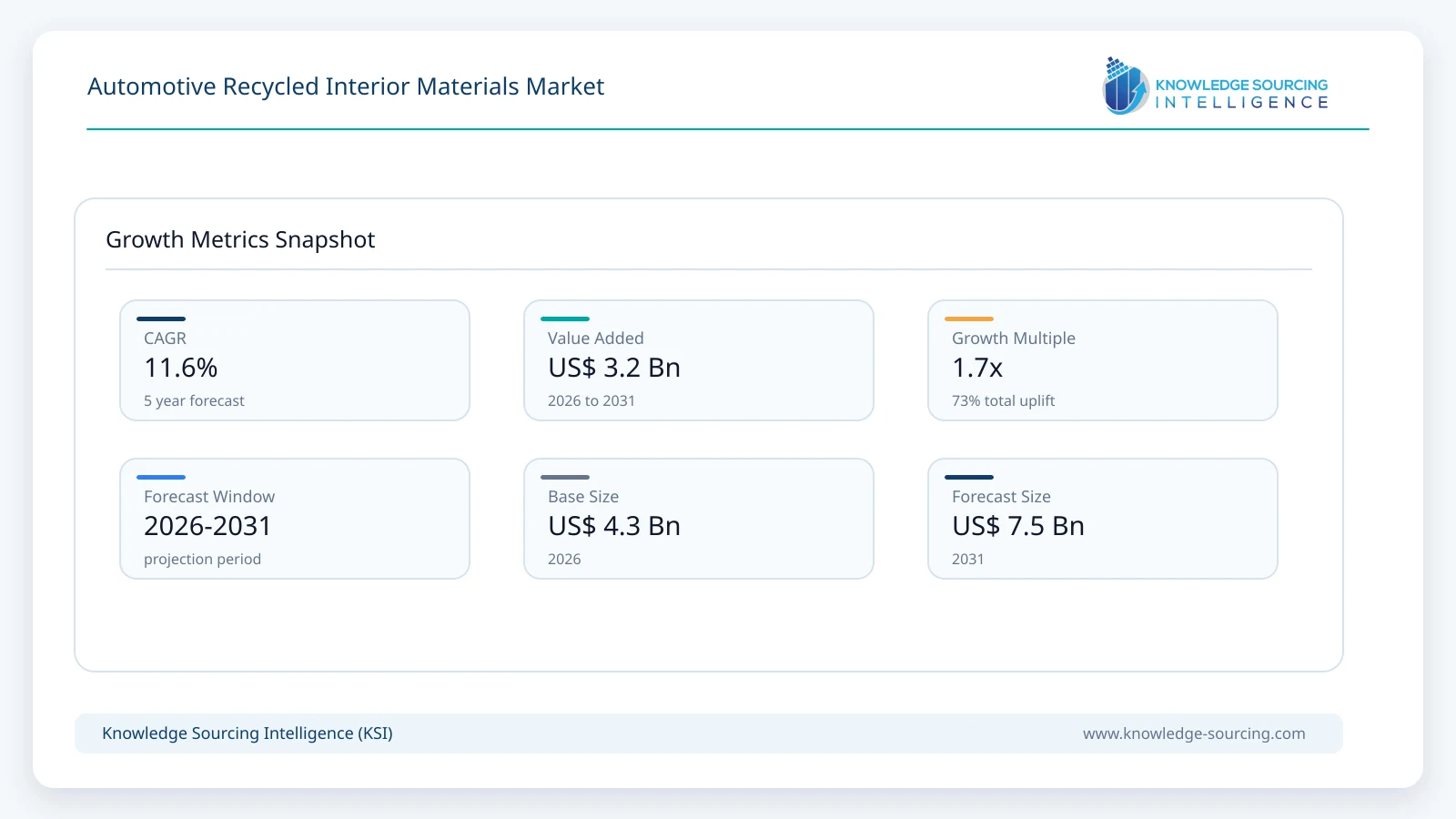
The automotive recycled interior materials market is estimated at approximately USD 4.30 billion in 2026 and is projected to reach USD 7.45 billion by 2031, representing annual growth of 11.62% during the forecast period.
Highlights:
- 1Recycled PET and polyester textiles/nonwovens account for approximately 45% of 2026 market value, reflecting their established use in automotive carpets, seat surfaces and acoustic layers.
- 2Recycled polypropylene and other polyolefins represent around 32% of 2026 value and gain share through molded interior carriers and decorative substrates.
- 3Floor coverings, carpets and acoustic layers constitute approximately 36% of the market in 2026, supported by large material areas and repeatable nonwoven production.
- 4Post-consumer material represents an estimated 56% of 2026 market value and becomes increasingly important as recycled-content provenance is formalized.
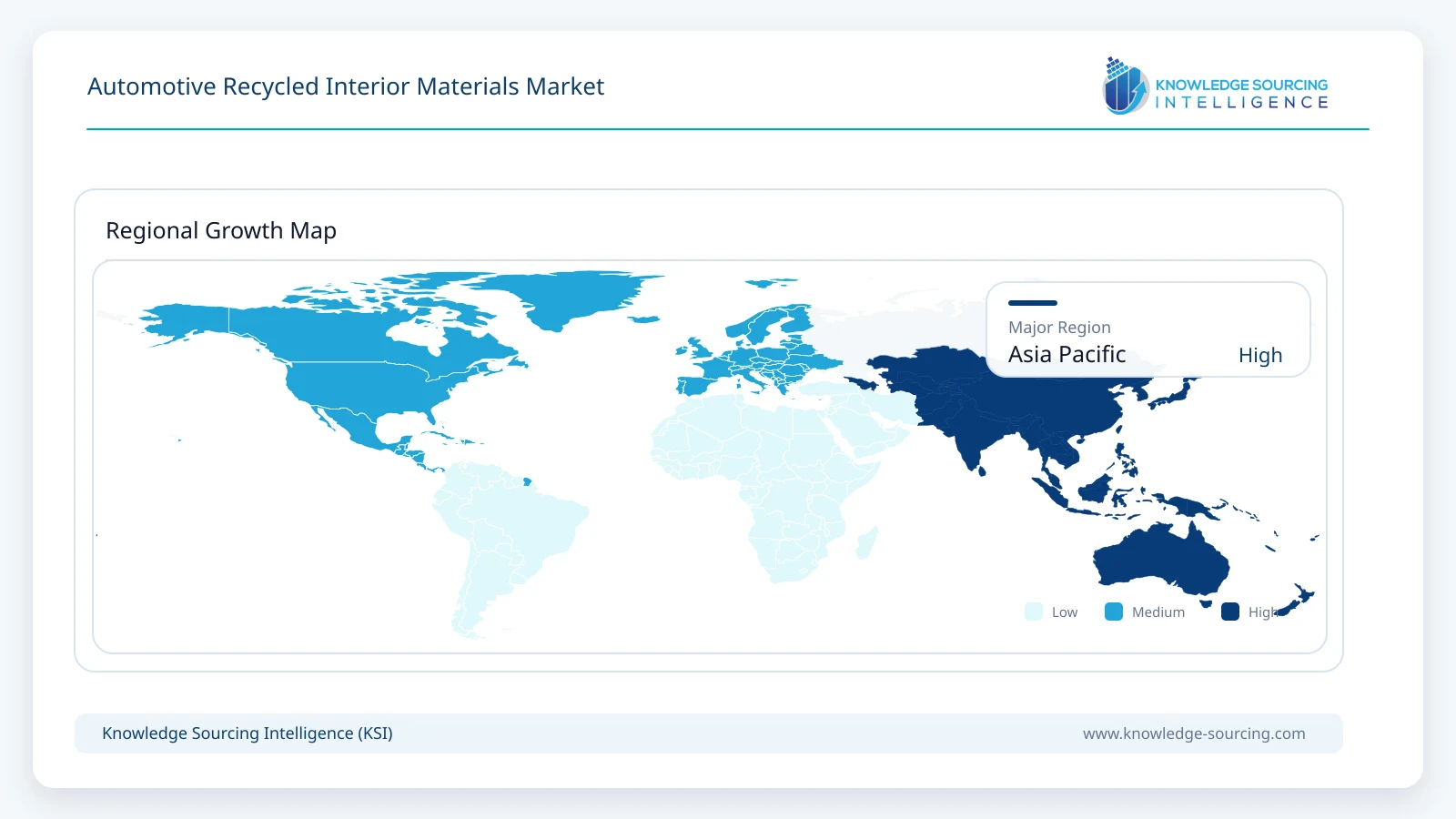
- 5Asia Pacific accounts for about 42% of 2026 demand by value; Europe remains a major center for specification, traceability and premium recycled-content interiors.
- 6The EU’s 2026 vehicle-circularity regulation enters broad application in September 2028, with new vehicle recycled-plastic minimums starting in 2032; it is not a 2026 compliance mandate.
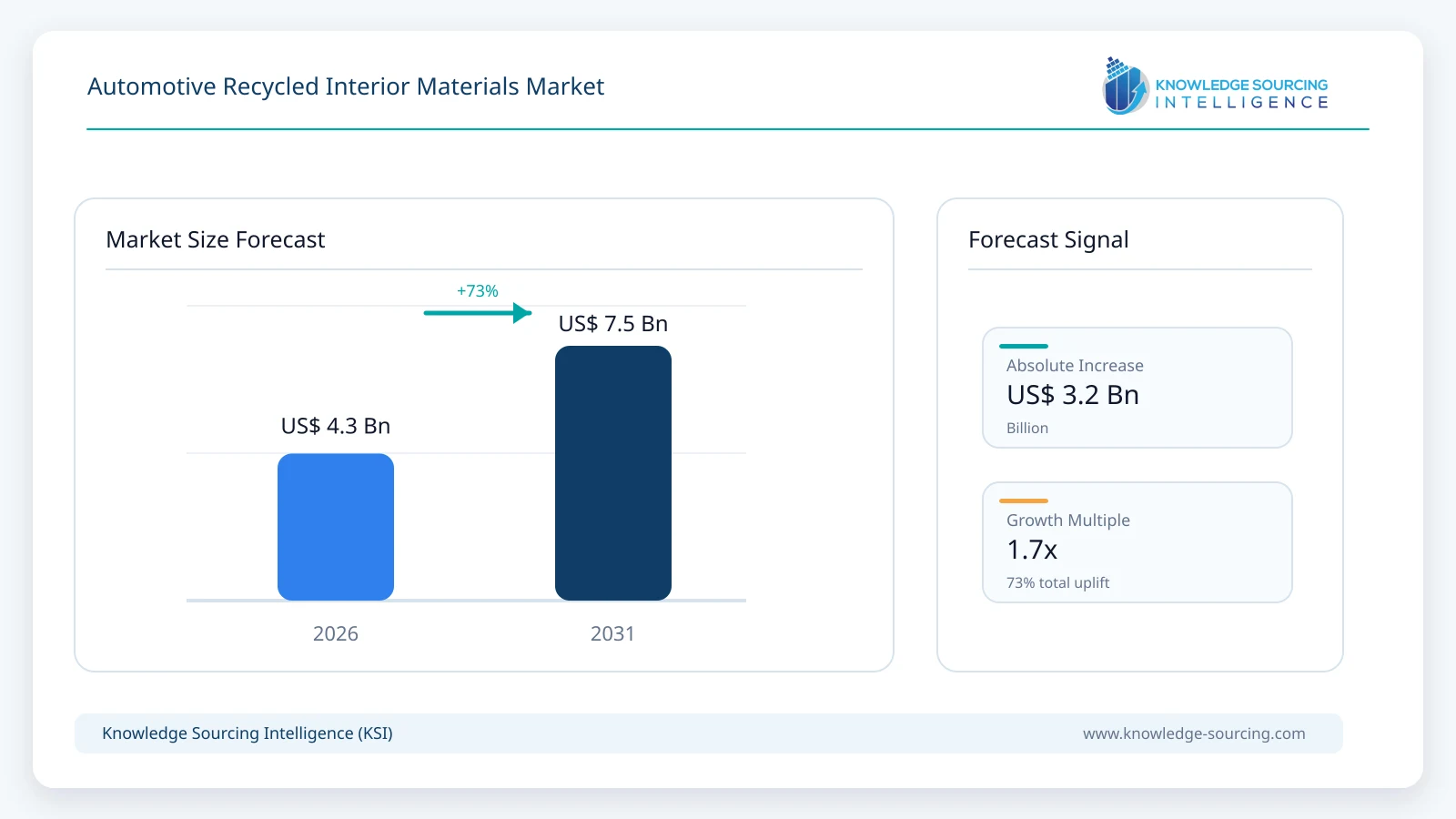
The market includes processed materials containing recycled feedstock and sold for vehicle-cabin applications, including textile surfaces, polymer compounds, molded substrates, acoustic nonwovens and selected cushioning materials. Revenue is measured at the converted-material supply stage rather than at the value of complete seats or interior modules.
The expansion is occurring alongside a geographically uneven automotive production base. OICA reported 96.4 million motor vehicles manufactured globally in 2025, including approximately 59.2 million in Asia-Oceania. European automakers generally face stronger policy pressure and recycled-material documentation, whereas the scale of vehicle manufacturing in China and India gives Asia Pacific substantial incremental volume potential. Recycled material penetration per vehicle, rather than aggregate vehicle production alone, will determine how quickly market value increases.
Market Overview
Material selection for vehicle interiors is determined by appearance, tactile performance, emissions, wear, acoustics and processing stability. Recycled polyester is commercially established in yarns, carpets, headliners and cushioning felts because the feedstock can be spun or formed using familiar textile equipment. Recycled polypropylene is attractive in injection-molded trim carriers because it can replace part of the virgin resin while retaining established tooling and processing routes. The material grade, the recycled percentage and the quality of the incoming waste stream remain decisive for program approval.
Autoneum disclosed at IAA Mobility 2025 that it processes more than 30,000 tonnes of recycled PET annually. Its Flexi-Light PET insulation, introduced in July 2025, is made entirely from polyester with recycled content reaching 90% in suitable configurations. This provides a measurable indication of industrial material throughput, although the figure covers one supplier rather than a published total for global recycled interior materials.
Visible cabin surfaces are also using secondary feedstock. FORVIA reported that instrument-panel and center-console components for the Renault Clio 6 incorporate 40% recycled plastic. BMW identified fully recycled PET yarn in selected iX3 seat textiles, headlining and floor mats, while Volvo offers recycled-polyester seating surfaces on the EX30. These programs show that recycled content is increasingly specified in exposed, design-sensitive areas rather than being confined to concealed sound insulation.
The distinction between recycled and merely recyclable materials is important. A mono-material carpet or door trim may improve end-of-life processing without containing any recycled feedstock at sale. The market therefore focuses on materials with incorporated secondary inputs, while treating recyclable design as a technology pathway that can facilitate higher recycled-content procurement in subsequent programs.
Market Trends
Recycled Polyester Is Moving Across Multiple Cabin Surfaces
Automotive polyester recycling is extending beyond basic carpeting into higher-value surface applications. Lear’s ReNewKnit uses yarn derived from recycled plastic bottles and a recycled fleece backing, with applications covering seating, visors, headliners and package trays. Sage Automotive Interiors offers both post-consumer and post-industrial recycled yarn routes, including suede-like and mono-material fabric constructions. Premium textures and controlled color consistency are helping recycled feedstock compete in more visible positions where aesthetic quality previously limited adoption.
Rigid Interior Components Are Absorbing More Recycled Polyolefins
Molded polypropylene and related polyolefin compounds represent a growing route for secondary-material use in dashboards, consoles and door-trim carriers. FORVIA’s Clio 6 program demonstrates that significant recycled resin content can be qualified within an integrated production interior. Continental’s DecoJect approach supports 10–30% recycled polymers in compatible interior surface constructions. Material performance still depends on melt-flow consistency, odor, volatile emissions and pigment control, particularly for visible components.
Recyclable Material Architectures Are Influencing Purchasing Decisions
Conventional cabin assemblies often combine foams, adhesives, fabric, coatings and rigid carriers that are difficult to separate after vehicle dismantling. Autoneum’s N-Join1 uses an adhesive-free polyester carpet construction, and Toyota Boshoku has presented seat-cover concepts designed to simplify material recovery. These designs can reduce future recycling losses and improve the quality of recovered feedstock, although a fully recyclable construction does not itself establish the proportion of recycled material used in the current product.
Post-Consumer Traceability Is Becoming a Procurement Requirement
The EU’s Regulation 2026/1738 entered into force in August 2026 and will generally apply from September 2028. For new vehicle types, a minimum 15% recycled plastic content is required from September 2032, rising to 25% from September 2036. The law specifies post-consumer recycled inputs and a closed-loop contribution, differentiating regulatory compliance from the wider market for post-industrial recyclates. Automotive material suppliers will consequently need better evidence of waste origin, chain of custody and recycled-content calculation before those future deadlines.
Segment Analysis
By Material Type: Recycled PET and Polyester Textiles / Nonwovens
Recycled PET and other polyester fiber systems provide the largest revenue group because large textile and felt areas are present across floors, headliners, door coverings and luggage compartments. The segment accounts for approximately USD 1.94 billion in 2026, supported by established automotive suppliers and relatively mature bottle-to-yarn recycling chains. Its absolute demand is expected to increase through 2031, although its proportion declines as recycled polyolefin compounds are adopted in a wider set of hard interior parts.
Autoneum’s Di-Light, Flexi-Light PET and recycled-content carpet technologies illustrate the range of acoustic and floor products available to automakers. Lear’s ReNewKnit and Sage’s recycled-yarn offerings expand the selection of customer-facing fabrics. Consistent dyeability, abrasion resistance and cabin-air performance remain important in determining which recycled grades can replace virgin material without additional finishing costs.
By Application: Floor Coverings, Carpets and Acoustic Layers
Floor coverings and acoustic layers represent about 36% of market value in 2026. These components consume relatively substantial quantities of fiber and nonwoven material, while acoustic applications can tolerate a wider range of internal surface textures than premium seat upholstery. Recycled polyester, reclaimed cotton blends and compatible thermoplastic backings are well established in the value chain, particularly for floor insulators, carpet systems and inner-dash sound absorbers.
By Recycled Feedstock Source: Post-Consumer Recyclates
Post-consumer feedstock accounts for an estimated 56% of 2026 market value. Beverage bottles, recovered textiles and qualifying end-of-life plastics support this category, with PET offering the most mature sorting and processing infrastructure. Automotive-grade post-industrial scrap remains valuable because its polymer composition can be more consistent, but it is not interchangeable with post-consumer input for future EU recycled-plastic obligations. The growing separation of these two feedstock markets will influence pricing, procurement contracts and material declarations.
By Vehicle Type: Passenger Vehicles
Passenger cars, SUVs, crossovers and MPVs account for approximately 88% of recycled interior material value in 2026. Their scale and greater variety of seats, decorative surfaces and acoustic treatments make them the primary platform for recycled-content qualification. Commercial vans and heavy vehicles offer additional demand in flooring, seat coverings and cab liners, but generally have fewer premium trim variants and lower material value per vehicle.
Market Drivers
OEM Requirements for Lower Material-Related Emissions
Automakers are extending product carbon-footprint management to interior materials rather than focusing solely on operating emissions. BMW’s iX3 integrates recycled-PET yarn in selected cabin textiles as part of its wider secondary-material strategy. The resulting sourcing pressure encourages Tier 1 suppliers to replace virgin inputs where life-cycle analysis shows an advantage and the material continues to meet interior qualification requirements.
Regulated Recycled-Content Targets in Europe
The EU’s newly enacted vehicle-circularity regime establishes prospective recycled-plastic obligations for new vehicle types beginning in 2032. Although the binding content thresholds fall beyond this forecast, engineering and supplier qualification typically begin well before production programs are launched. European purchasing teams therefore have a clearer incentive to approve post-consumer polymer grades and auditable content documentation during 2026–2031.
Mature PET Collection and Conversion Infrastructure
Established PET recycling and fiber-conversion operations make recycled polyester available in several automotive formats, including yarn, nonwovens, felts and molded carpet layers. Autoneum’s disclosed recycled-PET processing scale and Lear’s ReNewKnit technology illustrate practical automotive use. Broader availability gives automakers more routes to reduce virgin input without replacing established textile processing equipment.
Expansion into Rigid and Visible Interior Parts
Recycled plastics are increasingly used in hard surfaces whose appearance and mechanical requirements are tightly controlled. FORVIA’s recycled-content Clio instrument panel and center console provide a series-production example. This broadens demand beyond concealed insulation and allows suppliers to address higher-value parts, provided odor, thermal aging, scratch resistance and dimensional stability remain consistent.
Increasing Use of Circular Material Architectures
Carpet, trim and upholstery suppliers are reducing incompatible layers so that materials can be more readily separated or processed together after use. Autoneum’s adhesive-free polyester carpet and Antolin’s mono-material trim concepts indicate an industry response to recovery challenges. Better end-of-life design can support future recycled feedstock availability, although recovered-material quality and collection economics will still determine the outcome.
Market Restraints
Inconsistent Recyclate Quality and Limited Grade Availability
Recycled polymer properties can vary with the mix of source waste, prior processing and contamination. Automotive interiors require repeatable viscosity, color, strength and aging performance. Suppliers may need blending, sorting, additives and additional testing before a grade is suitable for serial programs, restricting the volume of acceptable feedstock.
Interior Air-Quality and Appearance Requirements
Odor, volatile organic compounds, fogging, texture and color matching are closely controlled in passenger compartments. Impurities in recycled feedstocks can lead to additional purification or qualification cost. Visible high-gloss or light-colored parts are especially sensitive because minor variations can generate scrap or rejection during surface finishing.
Complex Multi-Layer Components and Weak Collection Economics
Adhesives, foam-backed fabrics, coatings and mixed-material carpets are difficult to recover into high-quality secondary materials. Dismantling and sorting add cost, while contaminated residue is frequently downcycled. Improved mono-material design helps, but end-of-life recovery systems and economic incentives vary widely between countries.
Competition with Low-Cost Virgin Polymers
Recycled-content procurement does not always deliver a price advantage over virgin resin or conventional textiles. High-purity sorting, washing, decontamination and traceability can increase costs, particularly for post-consumer grades. Price sensitivity remains important in entry-level vehicle platforms where material substitution must preserve manufacturing yield.
Lengthy Automotive Qualification and Traceability Audits
OEM approvals can require heat-aging, flammability, mechanical, emissions and appearance testing across several production locations. Changes in recycled feedstock source can require requalification even when nominal polymer chemistry is unchanged. Documentation requirements will intensify as Europe phases in new post-consumer recycled-content rules.
Regional Outlook
Asia Pacific
Asia Pacific is the largest regional market, accounting for approximately 42% of global recycled interior material value in 2026. China, Japan, India and South Korea combine large vehicle-manufacturing bases with established polymer processing, textiles and integrated interior supply networks. China’s production scale and expanding domestic passenger-vehicle programs support the largest absolute consumption, while Japan and South Korea retain important roles in automotive material qualification and specialty interior systems.
Regional growth through 2031 is expected to outpace that of mature markets as recycled material content rises from a lower average value per vehicle. Production in China and India provides volume leverage, although local availability of consistent post-consumer grades and OEM specifications will determine actual substitution rates. Export-oriented suppliers serving European vehicle platforms also face growing documentation requirements.
Europe
Europe represents approximately 31% of 2026 market value despite accounting for a smaller share of global vehicle production. Its position reflects premium cabin material intensity, established recycling networks and strong engagement by automakers and Tier 1 interior suppliers. Germany remains central to engineering and specification activity, while production facilities in Central and Eastern Europe, France, Spain and the United Kingdom contribute a broad textile and molded-component base.
The EU vehicle-circularity framework will increasingly shape material selection during the forecast period, although mandatory recycled-plastic content for new vehicle types starts in 2032. Suppliers with verified post-consumer input, stable formulation quality and compatible mono-material designs should be better positioned for forthcoming OEM tenders. Europe is likely to retain higher material value per vehicle even as Asia Pacific adds more absolute volume.
Competitive Landscape
Competitive activity spans integrated interior suppliers, automotive textile specialists, acoustic-material producers and compound developers. Autoneum competes in floor, acoustic and luggage-compartment materials, while FORVIA and Antolin integrate recycled polymers into visible cockpit and door systems. Lear and Sage Automotive Interiors offer recycled-yarn-based surface materials, and Continental supplies recycled-content decorative surface technologies. These participants compete through material qualification, process reliability and OEM platform access rather than through recycled-feedstock sourcing alone.
Other relevant participants include Adient in seating materials, Auria and Adler Pelzer in flooring and acoustic systems, Freudenberg Performance Materials in technical nonwovens, and Toyota Boshoku in interior material development. Public disclosures do not isolate recycled-interior-material revenue consistently, so a numerical supplier ranking cannot be established reliably. Programs also vary from validated production to prototypes, making shipment maturity an essential distinction when comparing suppliers.
Recent Developments
August 2026: Regulation (EU) 2026/1738 entered into force, establishing the future EU framework for circular vehicle design and recycled plastics. The first mandatory recycled-plastic content threshold for new vehicle types applies in September 2032, encouraging earlier material qualification.
March 2026: BMW outlined the recycled-PET Econeer seat covers for the new BMW i3, extending recyclable textile constructions into another Neue Klasse model. Production application strengthens the demand outlook for visible recycled polyester surfaces.
December 2025: Autoneum disclosed its work on fully polyester-based interior and acoustic components for the Polestar 5. The program demonstrates integration of recyclable material architecture within a commercial premium-vehicle platform.
November 2025: FORVIA reported that the Renault Clio 6 instrument panel and center console incorporate 40% recycled plastics. The disclosed content provides a concrete specification benchmark for rigid interior parts.
September 2025: Autoneum stated that it processes more than 30,000 tonnes of recycled PET annually and highlighted recycled-content carpets and acoustic systems at IAA Mobility. The throughput offers a useful supplier-scale cross-check.
July 2025: Autoneum introduced Flexi-Light PET, a thermoformable automotive insulation technology composed entirely of polyester with recycled content reaching 90%. The product targets carpet and inner-dash applications.
Market Outlook
Automotive recycled interior materials are expected to expand through a combination of higher recycled content within existing components and adoption in additional cabin surfaces. Polyester-based textiles and nonwovens will remain important because their supply chain is relatively mature, while recycled polypropylene compounds should gain share as more door, dashboard and console programs qualify secondary feedstock. Material engineering and consistent production economics will determine whether these substitutions extend beyond premium and sustainability-led vehicle programs.
Asia Pacific is expected to supply the largest incremental demand as regional vehicle production and material penetration increase. Europe will retain a disproportionate role in developing traceable recycled-content specifications and future closed-loop procurement systems. Suppliers offering documented feedstock origin, repeatable physical properties and simplified recycling architectures are likely to capture a larger share of new interior-platform awards.
Automotive Recycled Interior Materials Market Scope
| Report Metric | Details |
|---|---|
| Total Market Size in 2026 | USD 4.30 billion |
| Total Market Size in 2031 | USD 7.45 billion |
| Forecast Unit | Billion |
| Growth Rate | 11.62% |
| Study Period | 2021 to 2031 |
| Historical Data | 2021 to 2024 |
| Base Year | 2025 |
| Forecast Period | 2026 – 2031 |
| Segmentation | Material Type, Application, Recycled Feedstock Source, Vehicle Type, Geography |
| Companies |
|
Market Segmentation
By Material Type
Recycled PET and Polyester Textiles / Nonwovens
Recycled Polypropylene and Other Polyolefins
Recycled Polyurethane Foam Materials
Other Recycled Polymers and Recovered Fibers
By Application
Floor Coverings, Carpets and Acoustic Layers
Seat Upholstery and Cushioning Materials
Door, Dashboard and Console Materials
Headliners, Pillars and Luggage-Area Trim
By Recycled Feedstock Source
Post-Consumer Recyclates
Post-Industrial Recyclates
By Vehicle Type
Passenger Vehicles
Light Commercial Vehicles
Medium and Heavy Commercial Vehicles and Buses
By Geography
North America
United States
Canada
Mexico
South America
Brazil
Argentina
Others
Europe
Germany
United Kingdom
France
Italy
Spain
Czechia
Others
Middle East and Africa
South Africa
Morocco
Saudi Arabia
UAE
Others
Asia Pacific
China
Japan
India
South Korea
Thailand
Indonesia
Others
Table of Contents
1. EXECUTIVE SUMMARY
1.1. Key Findings
1.2. Automotive Recycled Interior Materials Market Size and Forecast, 2026–2031
1.3. Material Type, Application, Feedstock and Vehicle Type Outlook
1.4. Regional Opportunity Summary
2. MARKET SNAPSHOT
2.1. Market Overview
2.2. Market Definition
2.3. Scope of the Study
2.4. Market Segmentation
3. BUSINESS LANDSCAPE
3.1. Market Drivers
3.1.1. OEM Requirements for Lower Material-Related Emissions
3.1.2. Regulated Recycled-Content Targets in Europe
3.1.3. Mature PET Collection and Conversion Infrastructure
3.1.4. Expansion into Rigid and Visible Interior Parts
3.1.5. Increasing Use of Circular Material Architectures
3.2. Market Restraints
3.2.1. Inconsistent Recyclate Quality and Limited Grade Availability
3.2.2. Interior Air-Quality and Appearance Requirements
3.2.3. Complex Multi-Layer Components and Weak Collection Economics
3.2.4. Competition with Low-Cost Virgin Polymers
3.2.5. Lengthy Automotive Qualification and Traceability Audits
3.3. Market Opportunities
3.4. Porter’s Five Forces Analysis
3.5. Industry Value Chain Analysis
3.6. Policies and Regulations
3.7. Strategic Recommendations
4. TECHNOLOGICAL OUTLOOK
4.1. Mechanical Recycling and Automotive Compounding
4.2. Post-Consumer PET Yarn and Nonwoven Technologies
4.3. Recycled Polypropylene and Molded Interior Substrates
4.4. Recycled Polyurethane Foam and Cushioning Technologies
4.5. Mono-Material Carpet and Interior Surface Constructions
4.6. Chemical Recycling and Automotive-Grade Feedstock Recovery
4.7. Recycled-Content Verification and Traceability
5. AUTOMOTIVE RECYCLED INTERIOR MATERIALS MARKET BY MATERIAL TYPE
5.1. Introduction
5.2. Recycled PET and Polyester Textiles / Nonwovens
5.3. Recycled Polypropylene and Other Polyolefins
5.4. Recycled Polyurethane Foam Materials
5.5. Other Recycled Polymers and Recovered Fibers
6. AUTOMOTIVE RECYCLED INTERIOR MATERIALS MARKET BY APPLICATION
6.1. Introduction
6.2. Floor Coverings, Carpets and Acoustic Layers
6.3. Seat Upholstery and Cushioning Materials
6.4. Door, Dashboard and Console Materials
6.5. Headliners, Pillars and Luggage-Area Trim
7. AUTOMOTIVE RECYCLED INTERIOR MATERIALS MARKET BY RECYCLED FEEDSTOCK SOURCE
7.1. Introduction
7.2. Post-Consumer Recyclates
7.3. Post-Industrial Recyclates
8. AUTOMOTIVE RECYCLED INTERIOR MATERIALS MARKET BY VEHICLE TYPE
8.1. Introduction
8.2. Passenger Vehicles
8.3. Light Commercial Vehicles
8.4. Medium and Heavy Commercial Vehicles and Buses
9. AUTOMOTIVE RECYCLED INTERIOR MATERIALS MARKET BY GEOGRAPHY
9.1. North America
9.1.1. United States
9.1.2. Canada
9.1.3. Mexico
9.2. South America
9.2.1. Brazil
9.2.2. Argentina
9.2.3. Others
9.3. Europe
9.3.1. Germany
9.3.2. United Kingdom
9.3.3. France
9.3.4. Italy
9.3.5. Spain
9.3.6. Czechia
9.3.7. Others
9.4. Middle East and Africa
9.4.1. South Africa
9.4.2. Morocco
9.4.3. Saudi Arabia
9.4.4. UAE
9.4.5. Others
9.5. Asia Pacific
9.5.1. China
9.5.2. Japan
9.5.3. India
9.5.4. South Korea
9.5.5. Thailand
9.5.6. Indonesia
9.5.7. Others
10. COMPETITIVE ENVIRONMENT AND ANALYSIS
10.1. Major Players and Strategy Analysis
10.2. Market Share Analysis
10.3. Mergers, Acquisitions, Agreements and Collaborations
10.4. Competitive Dashboard
11. COMPANY PROFILES
11.1. Autoneum Holding AG
11.2. FORVIA SE
11.3. Lear Corporation
11.4. Sage Automotive Interiors, Inc.
11.5. Grupo Antolin-Irausa, S.A.
11.6. Adient plc
11.7. Continental AG
11.8. Auria Solutions Ltd.
11.9. Freudenberg Performance Materials
11.10. Toyota Boshoku Corporation
11.11. Adler Pelzer Group
12. APPENDIX
12.1. Currency
12.2. Assumptions
12.3. Base and Forecast Years Timeline
12.4. Key Benefits for Stakeholders
12.5. Research Methodology
12.6. Abbreviations
Navigate
Trusted by the world's leading organizations











