
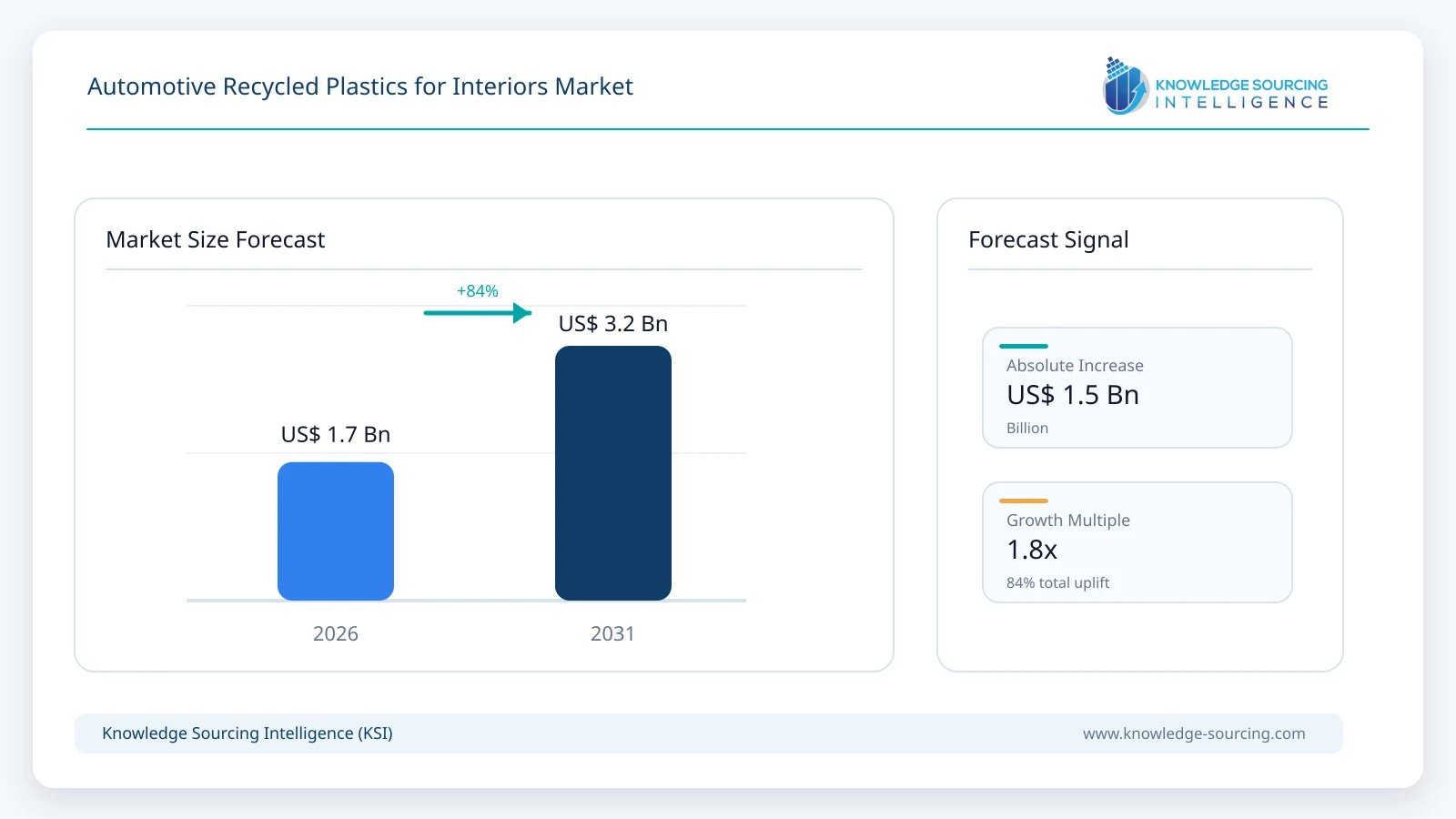
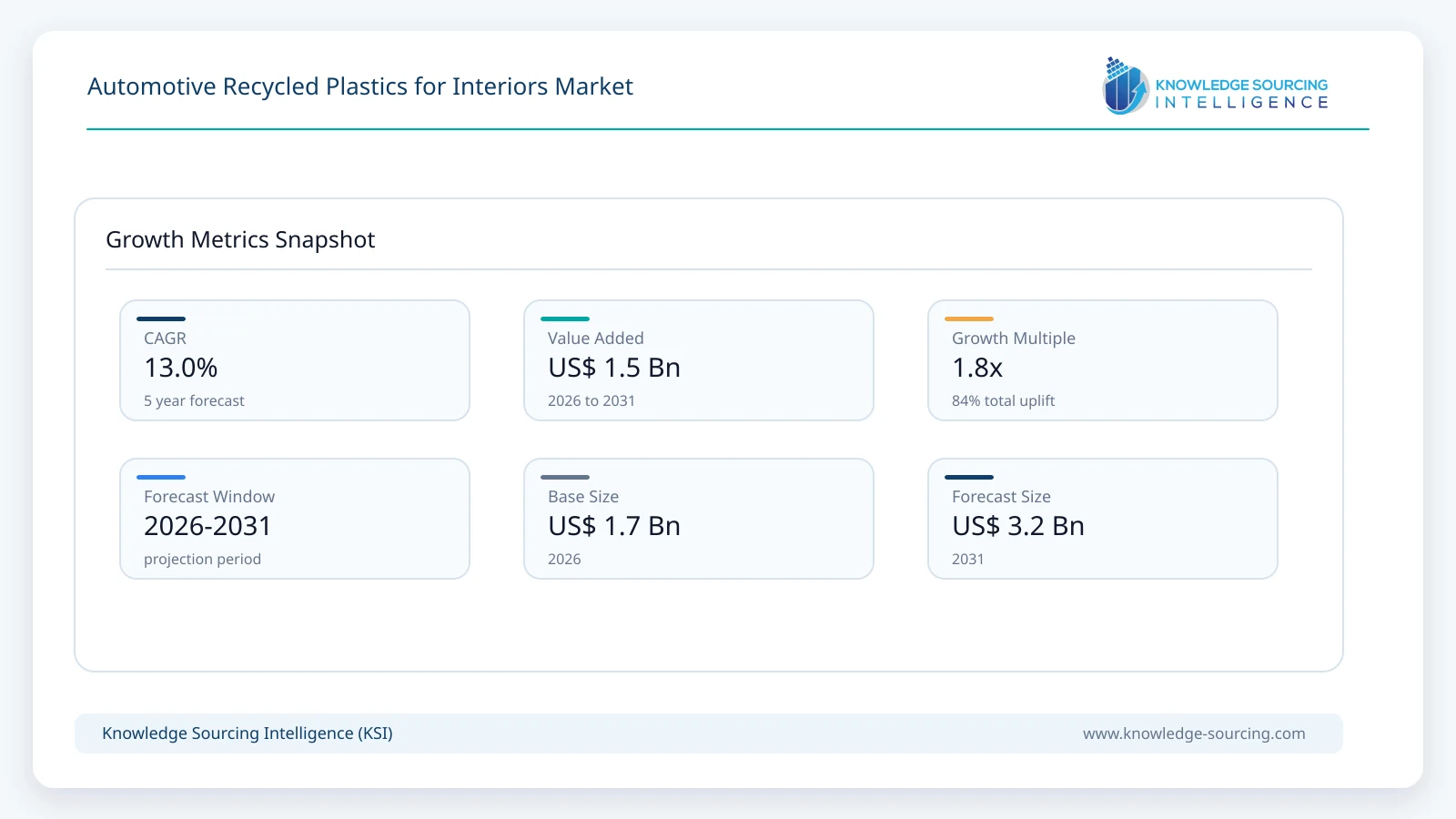
The automotive recycled plastics for interiors market is projected to expand at a CAGR of 12.96%, increasing from USD 1.74 billion in 2026 to USD 3.20 billion by 2031.
Highlights:
- 1Recycled polypropylene and related polyolefin compounds represent approximately 79% of market value in 2026, reflecting their extensive use in rigid door, console and dashboard structures.
- 2Door, pillar and side-trim substrates account for an estimated 31% of 2026 demand, while console and storage parts gain share through wider use of reinforced recycled grades.
- 3Post-consumer recycled feedstock represents approximately 58% of 2026 revenue, with traceability and consistent compound performance supporting a rising share through 2031.
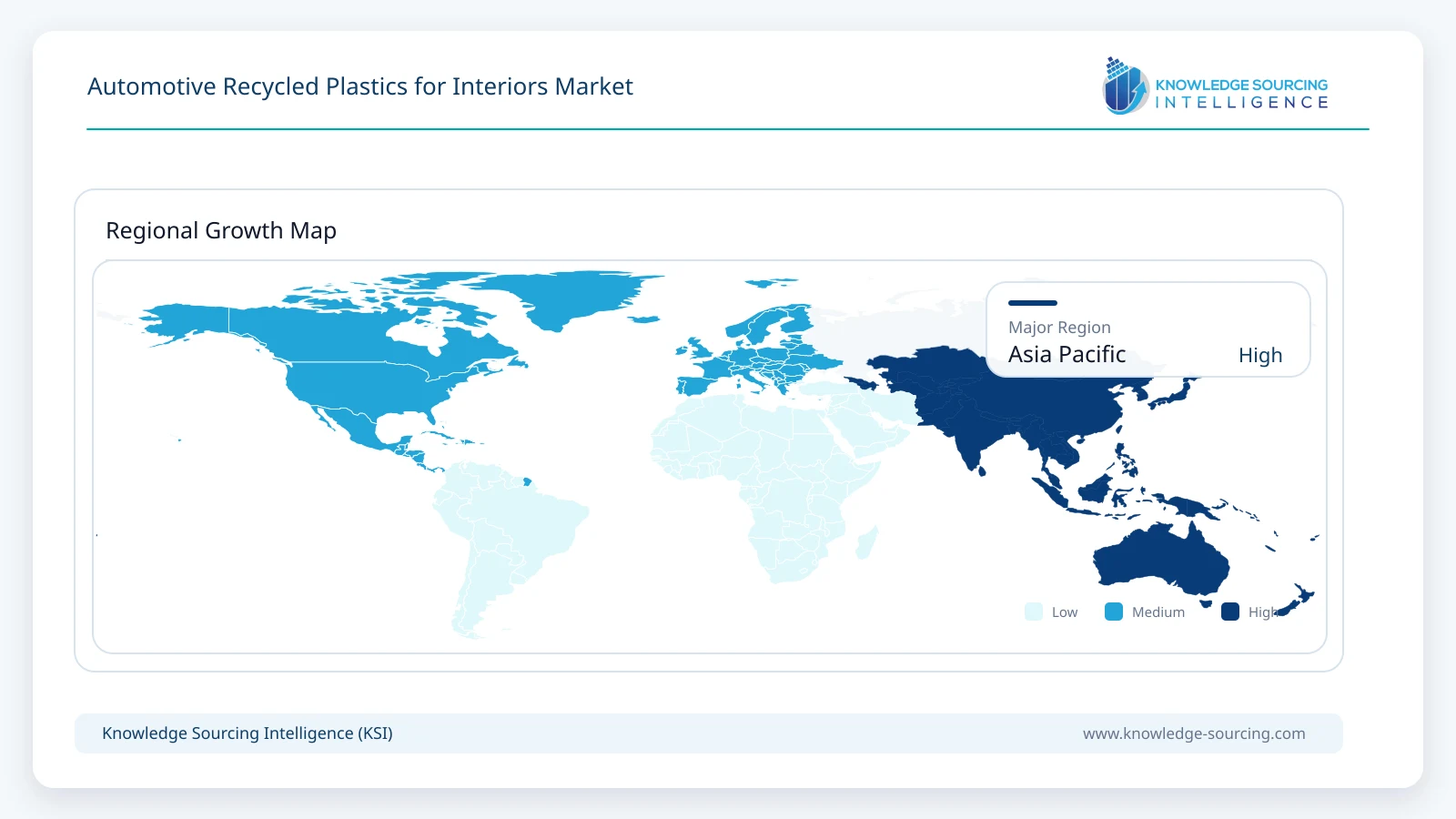
- 4Asia Pacific is the largest regional market at approximately 40% of 2026 value; Europe retains an important role in qualification standards and recycled-content procurement.
- 5Borouge International reported in May 2026 that its 40%-PCR Borcycle GE2331SY compound is already used by several OEMs for console and dashboard carriers.
- 6The EU recycled-plastic requirement for newly approved vehicle types begins at 15% in September 2032, outside the forecast period but relevant to 2026–2031 sourcing and qualification decisions.
It covers automotive-qualified recycled-content thermoplastic compounds used in instrument panels, door carriers, consoles, pillar trim, seat structures and other rigid or semi-rigid cabin components. Market value reflects the supply of converted plastic materials rather than the complete selling price of assembled interior modules.
Polypropylene and other polyolefin compounds form the commercial base of recycled interior plastics because vehicle manufacturers already use these materials extensively in molded carriers and trim structures. FORVIA identifies 40% recycled plastic content in instrument-panel and center-console components for the Renault Clio 6, while Covestro's recycled PC/ABS grade containing 35% post-consumer material has been adopted for selected Lexus ES interior parts. Together, these applications show how recycled content can be incorporated into both volume-production carriers and more demanding visible components.
Market Overview
Polypropylene is widely specified for interior carriers because it combines low weight, moldability and dimensional control at high production volumes. ABS, PC/ABS and polyester engineering compounds serve cabin components that require greater toughness, surface quality or dimensional stability. When recycled feedstock is introduced, compounders must preserve the established performance requirements for attachment points, part tolerances, impact behavior and low cabin emissions across variable material batches.
Automotive recycled-content compounds typically combine sorted and reprocessed polymers with virgin resin, reinforcing fillers, compatibilizers and stabilizers as required by the part specification. Material declarations distinguish recycled content in the total compound from recycled content in the polymer fraction, particularly where glass fiber or mineral fillers account for a substantial share of the finished material. This distinction matters when manufacturers compare recycled-content grades, assess procurement targets or qualify replacements for existing interior parts.
Recycled polypropylene compounds are gaining acceptance in interior carriers where stiffness, impact resistance and dimensional stability limit the use of unmodified recyclate. Borealis' Borcycle GD3600SY, initially qualified for Peugeot 3008 center-console carriers, combines 65% post-consumer recycled polymer with 30% glass fiber. Borouge International also offers Borcycle GE2331SY, containing 40% post-consumer recycled material and 20% glass fiber, for dashboard and console carriers. SABIC's automotive portfolio includes recycled-content polypropylene and PC/PET compounds, extending the range of materials available for interior applications with demanding mechanical and emissions requirements.
Cabin applications for recycled plastic compounds range from structural door and dashboard carriers to console shells, trim supports and selected visible surfaces. These components are manufactured alongside upholstery, acoustic textiles and cushioning materials, but their material qualification depends primarily on thermoplastic processing and part-level performance. The contribution of plastic compounds is concentrated in the molded material itself, while decorative layers, electronic systems and final module assembly add separate value downstream.
Market Trends
Recycled PP Is Moving into Higher-Performance Interior Carriers
Automotive-grade recycled PP is increasingly used in structural interior carriers that require controlled stiffness, impact resistance and dimensional stability. Borouge International's Borcycle GE2331SY contains 40% post-consumer recycled polymer and 20% glass fiber and is used for dashboard and center-console carriers. The grade follows Borealis' earlier Borcycle GD3600SY qualification for Peugeot 3008 console carriers, showing that reinforced recycled PP can meet established part specifications without a change in the fundamental injection-molding process.
Premium Visible Surfaces Require More Sophisticated Engineering Blends
Visible cabin components impose tighter requirements on gloss, surface uniformity, scratch behavior and dimensional stability than most concealed carriers. Covestro's Bayblend T85X R35 CQ contains 35% post-consumer recycled material and was adopted for selected Lexus ES interior components in 2026. The application illustrates the qualification work needed to introduce recycled PC/ABS into premium surfaces while maintaining the appearance and performance expected from engineering thermoplastics.
Post-Consumer Material Quality and Traceability Are Becoming Buying Criteria
Post-consumer polymer supply must be traceable and consistent enough to meet automotive material specifications across successive manufacturing batches. Borealis reported an upgrade of its Integra facility in Bulgaria in 2025 to increase the production of premium recycled polypropylene using Borcycle M technology. Investments in more controlled reprocessing and sorting help reduce variability in recovered feedstock, which remains an important constraint on higher-volume automotive procurement.
Regulation (EU) 2026/1738 establishes future minimum recycled-plastic requirements for newly approved vehicle types, with the first threshold applying in 2032. Although these requirements take effect after the 2026–2031 forecast window, vehicle programs are qualified and sourced well before they enter production. European OEMs and material suppliers therefore have an incentive to validate recycled content, documentation and repeatable compound performance during the current forecast period.
Design for Recycling Is Influencing Compound Formulation
Door panels, console assemblies and instrument panels frequently combine molded polymers with coatings, adhesives, inserts and decorative films. Multi-material construction can make end-of-life separation more difficult and reduce the quality of recovered resin even when the original part contains recycled content. Suppliers are working with interior manufacturers on compatible material combinations and more removable attachments while maintaining established cabin performance requirements.
Segment Analysis
By Polymer Type: Recycled Polypropylene and Other Polyolefins
Recycled polypropylene and other polyolefin compounds represent an estimated USD 1.38 billion, or 79% of market value, in 2026. Their leading position reflects the amount of PP already used in door carriers, dashboard supports, consoles and other injection-molded structures. Reinforced, filled and modified grades allow recycled polymers to be introduced while maintaining the stiffness, dimensional control and surface characteristics required by automotive specifications.
By 2031, recycled polyolefin compounds are projected to reach approximately USD 2.61 billion as more interior programs qualify secondary feedstock and increase its proportion in established parts. Borouge International, LyondellBasell and Celanese provide relevant compounding capabilities, supported by a wider network of polymer recyclers and processors. The segment's expansion primarily reflects material substitution in existing component designs rather than an assumption of rising total plastic use per vehicle.
By Application: Door, Pillar and Side-Trim Materials
Door, pillar and side-trim materials account for approximately 31% of market value in 2026 because they combine large molded surface areas with repeatable component specifications across vehicle platforms. Inner supports, door pockets, pillar substrates and trim carriers can incorporate modified or mineral-filled recycled PP where dimensional control and mechanical performance are verified. Concealed and textured parts remain practical early applications because they allow the material to be qualified before it is introduced into more appearance-sensitive surfaces.
Door and side-trim materials are expected to retain a substantial revenue base through 2031, although faster adoption in dashboards and reinforced consoles is likely to moderate their share. Qualification remains dependent on low fogging, color stability, clip retention and impact performance across successive material batches. Suppliers with consistent compound formulations and access to controlled recycled feedstock are better positioned to secure repeat nominations across multiple vehicle programs.
By Recycled Feedstock: Post-Consumer Recyclates
Post-consumer feedstock represents an estimated 58% of recycled interior plastic material value in 2026, drawing mainly on sorted end-of-life polymer streams and recovered packaging material. The composition of these streams varies by collection system, polymer type, pigments and prior additives, which can affect the performance of the final compound. Automotive processors therefore rely on additional sorting, cleaning, blending and material testing before qualifying post-consumer polymers for cabin components.
Post-consumer recyclates are projected to account for approximately 72% of market value by 2031 as suppliers expand reprocessing capability and automotive purchasers place greater emphasis on verifiable end-of-life feedstock. Post-industrial material continues to offer valuable consistency and manufacturing yield, especially where a stable regrind stream is available. The expected mix shift depends on improvements in recovered-polymer quality rather than collection volumes alone.
By Vehicle Type: Passenger Vehicles
Passenger vehicles account for an estimated 88% of recycled interior plastic material demand in 2026 because cars, SUVs and crossovers contain large volumes of molded door, dashboard, console and decorative structures. Model differentiation creates multiple opportunities to introduce recycled grades, while higher trim content in larger vehicles can increase qualified material consumption per unit. Continued material substitution across high-volume platforms is expected to remain the main source of demand through 2031.
Commercial vehicles use recycled-content plastics primarily in durable dashboard housings, door structures and cabin storage components. Material selection is strongly influenced by cost, service life and production consistency, with fewer requirements for premium visible finishes than in passenger cars. The smaller segment can nevertheless expand as refreshed truck and light-commercial-vehicle platforms incorporate more secondary-feedstock compounds into repeat production.
Market Drivers
OEM Material-Decarbonization and Circularity Targets
Vehicle manufacturers are placing greater emphasis on recycled materials as they seek to reduce the lifecycle emissions associated with component production. Volvo has disclosed recycled plastic applications in the EX30, while FORVIA and Renault identify substantial recycled content in production interior parts. Procurement specifications increasingly require compound suppliers to document recycled content and material consistency alongside conventional mechanical and processing characteristics.
Expansion of Automotive-Qualified Recycled PP Grades
Glass-reinforced recycled PP compounds make it possible to substitute secondary polymers in interior structures that require higher stiffness and stable dimensions. Borouge International's Borcycle GE2331SY and the Borcycle GD3600SY grade originally qualified for Peugeot 3008 console carriers provide commercial examples of this approach. Because both use polypropylene-based compounds compatible with established molding processes, suppliers can focus qualification on material performance rather than redesigning every manufacturing step.
Future EU Recycled-Content Requirements
Regulation (EU) 2026/1738 sets a 15% post-consumer recycled-plastic minimum for newly approved vehicle types from September 2032 and a 25% threshold from September 2036. These obligations fall outside the 2026–2031 forecast, but automotive component qualification and supplier nominations typically occur years ahead of production. Material manufacturers consequently have a defined incentive to develop traceable compounds and secure repeatable recycled feedstock during the forecast period.
Commercialization of Recycled Engineering Resins
Premium visible interior components often require more demanding surface finish, impact behavior and dimensional stability than the concealed carriers served by recycled PP. Covestro's adoption of recycled-content PC/ABS for selected Lexus ES parts provides a production example for higher-value engineering blends. Suppliers able to combine verified recycled content with low emissions and acceptable appearance can extend recycled polymer use beyond the largest polyolefin applications.
Investment in Higher-Quality Secondary Polymer Supply
Sorting and compounding investments directly influence the amount of secondary polymer that can meet automotive interior requirements. Borealis' Integra facility upgrade and Rialti's recycled PP grades illustrate efforts to provide more consistent feedstock and qualified compounds. Reliable input quality reduces batch-to-batch variability and helps suppliers commit to longer vehicle programs without repeated formulation changes.
Market Restraints
Odor, Fogging and Interior Air-Quality Limits
Interior plastics must satisfy strict requirements for volatile emissions and fogging because materials are used in an enclosed passenger compartment. Recovered polymers can retain residues from earlier applications, making effective cleaning and compound formulation especially important. A recycled grade cannot replace its virgin equivalent in a cabin part until the finished formulation meets the automaker's relevant emissions and performance tests.
Feedstock Variability and Polymer Contamination
Post-consumer plastic streams contain varying levels of mixed polymers, pigments and additives that can affect melt flow, impact resistance and appearance after reprocessing. Such variation creates particular difficulties in thin-walled or visible interior components where tight processing tolerances are required. Automotive suppliers therefore need controlled input streams and repeatable compound specifications before increasing recycled-content penetration on high-volume platforms.
Material Qualification and Tooling Constraints
Introducing a recycled compound into an established interior component can change shrinkage, warpage, weld-line strength or retention of clips and fasteners. Manufacturers must validate the material on production tooling and repeat the relevant durability, impact and environmental tests. The qualification process can extend across a vehicle development cycle, delaying commercial adoption even when a recycled grade has satisfactory laboratory properties.
Competition from Cost-Optimized Virgin Resin
Automotive-qualified recycled compounds bear the additional costs of collection, sorting, purification, formulation control and traceability. Their economics are sensitive to virgin resin prices, the quality of incoming feedstock and the processing needed to meet cabin specifications. Recycled content is therefore more likely to be sustained in production where suppliers can meet both component performance requirements and acceptable total material costs.
Limited Automotive-to-Automotive Closed-Loop Recovery
Recovery of interior plastics from end-of-life vehicles remains difficult because dismantled parts often contain mixed polymers, coatings, adhesives and metal attachments. Existing component designs do not always support economical separation into resin-specific streams suitable for new interior compounds. Greater automotive-to-automotive recycling will depend on improved sorting infrastructure and component designs that limit contamination and incompatible material combinations.
Regional Outlook
Asia Pacific
Asia Pacific accounts for an estimated 40% of market value in 2026, reflecting its extensive vehicle production, resin-conversion capacity and automotive interior manufacturing base. China contributes the largest manufacturing volume, while Japan and South Korea combine advanced compound development with major OEM supply programs. India and Southeast Asia provide additional capacity for high-volume parts, although access to traceable recycled feedstock and automotive-grade material varies across these markets.
Asia Pacific is expected to increase its market share through 2031 as qualified recycled grades enter a wider range of mainstream vehicle platforms. Regional compounders also supply manufacturers serving European and North American OEM programs, so material specifications increasingly reflect international customer requirements. Growth remains dependent on consistent post-consumer inputs, scalable quality control and cost-effective manufacturing.
Europe
Europe represents approximately 34% of market value in 2026 and remains an important center for qualification of recycled-content automotive compounds. Renault, Stellantis, FORVIA, Covestro and Borouge International are associated with applications ranging from large molded carriers to selected premium visible surfaces. Germany and France provide major vehicle development and procurement centers, supported by compounding and component manufacturing networks across the rest of Europe.
European demand is expected to grow mainly through greater recycled content per qualifying component rather than substantial increases in total vehicle production. Preparation for the EU vehicle-circularity framework encourages manufacturers to qualify documented post-consumer material in programs that will remain active after the initial compliance dates. Europe should therefore retain a strong influence on recycled-plastic specifications even as Asia Pacific accounts for a larger share of additional market volume.
Competitive Landscape
The competitive market includes producers of recycled polyolefin compounds, suppliers of engineering thermoplastics, plastics recyclers and interior-component manufacturers that qualify materials for series production. Borouge International, LyondellBasell, SABIC, Celanese and Avient provide relevant compounding or polymer technologies, while Covestro and INEOS Styrolution participate in higher-performance engineering materials. FORVIA and Plastivaloire contribute component-level qualification and manufacturing capability, linking recycled polymer formulations with OEM requirements.
Borouge International brings together the former Borealis, Borouge and NOVA Chemicals businesses following its formation in March 2026, and these activities are assessed as one supplier group. Renault Group's The Future is NEUTRAL and Gaia are relevant to recovered-automotive-plastics supply, although the market positions of captive recovery activities differ from those of independent compounders. Company-wide revenue does not provide a reliable proxy for recycled automotive interior plastics because manufacturers generally do not disclose this application separately.
Recent Developments
August 2026: The European Union introduced Regulation (EU) 2026/1738, setting future post-consumer recycled-plastic minimums for new vehicle types. The 2032 implementation milestone gives automotive compounders a clear forward qualification timeline.
June 2026: Covestro reported adoption of its Bayblend T85X R35 CQ PC/ABS with 35% post-consumer recycled content for selected Lexus ES interior parts, confirming progress in premium visible components.
May 2026: Borouge International launched Borcycle GE2331SY, a glass-reinforced PP compound with 40% post-consumer recycled polymer used for dashboard and console carriers by several OEMs.
November 2025: FORVIA disclosed 40% recycled plastic content in Renault Clio 6 instrument-panel and center-console components, providing a high-volume molded-interior benchmark.
October 2025: Borealis reported the conversion of its Integra facility in Bulgaria to premium recycled PP production using Borcycle M technology, expanding input capacity for compounders.
March 2025: Borealis subsidiary Rialti introduced PP compound grades containing post-consumer and post-industrial recycled content for demanding structural uses, including mobility applications.
Market Outlook
Market growth through 2031 is expected to be driven by greater use of recycled compounds in existing interior components and higher secondary-polymer content within qualified formulations. Post-consumer feedstock should increase its share as sorting, cleaning and compound-control capabilities improve, although odor, contamination and qualification remain material constraints. The pace of adoption will depend more on repeatable automotive-grade supply than on a wholesale shift in vehicle interior design.
Asia Pacific is projected to remain the largest regional market through 2031, supported by vehicle production and interior-component manufacturing, while European sourcing requirements influence material qualification internationally. Suppliers with controlled recycled feedstock, traceable content and reliable part performance are better positioned to secure multi-year OEM programs. The forecast remains sensitive to recycled polymer availability, virgin resin pricing and the cost of upgrading recovered material to cabin specifications.
Automotive Recycled Plastics for Interiors Market Scope
| Report Metric | Details |
|---|---|
| Total Market Size in 2026 | USD 1.74 billion |
| Total Market Size in 2031 | USD 3.20 billion |
| Forecast Unit | Billion |
| Growth Rate | 12.96% |
| Study Period | 2021 to 2031 |
| Historical Data | 2021 to 2024 |
| Base Year | 2025 |
| Forecast Period | 2026 – 2031 |
| Segmentation | Polymer Type, Application, Feedstock Source, Vehicle Type, Geography |
| Companies |
|
Market Segmentation
By Polymer Type
Recycled Polypropylene and Other Polyolefins
Recycled ABS and PC/ABS Compounds
Recycled Rigid PET/PBT Engineering Compounds
Other Recycled Plastic Compounds
By Application
Door, Pillar and Side-Trim Materials
Instrument Panels and Dashboard Carriers
Center Consoles and Storage Components
Seat Carriers and Other Molded Interior Components
By Feedstock Source
Post-Consumer Recyclates
Post-Industrial Recyclates
By Vehicle Type
Passenger Vehicles
Commercial Vehicles
By Geography
North America
United States
Canada
Mexico
South America
Brazil
Argentina
Others
Europe
Germany
United Kingdom
France
Italy
Spain
Others
Middle East and Africa
Saudi Arabia
UAE
South Africa
Others
Asia Pacific
China
Japan
South Korea
India
Indonesia
Thailand
Others
Table of Contents
1. EXECUTIVE SUMMARY
1.1. Key Findings
1.2. Market Size and Forecast, 2026–2031
1.3. Polymer Type, Application and Feedstock Outlook
1.4. Regional Opportunity Summary
2. MARKET SNAPSHOT
2.1. Market Overview
2.2. Market Definition
2.3. Scope of the Study
2.4. Market Segmentation
3. BUSINESS LANDSCAPE
3.1. Market Drivers
3.1.1. OEM Material-Decarbonization and Circularity Targets
3.1.2. Expansion of Automotive-Qualified Recycled PP Grades
3.1.3. Future EU Recycled-Content Requirements
3.1.4. Commercialization of Recycled Engineering Resins
3.1.5. Investment in Higher-Quality Secondary Polymer Supply
3.2. Market Restraints
3.2.1. Odor, Fogging and Interior Air-Quality Limits
3.2.2. Feedstock Variability and Polymer Contamination
3.2.3. Material Qualification and Tooling Constraints
3.2.4. Competition from Cost-Optimized Virgin Resin
3.2.5. Limited Automotive-to-Automotive Closed-Loop Recovery
3.3. Market Opportunities
3.4. Porter’s Five Forces Analysis
3.5. Industry Value Chain Analysis
3.6. Policies and Regulations
3.7. Strategic Recommendations
4. TECHNOLOGICAL OUTLOOK
4.1. Mechanical Recycling, Sorting and Decontamination
4.2. Recycled Polypropylene Compounding and Reinforcement
4.3. Recycled PC/ABS and Engineering Polymer Blends
4.4. Compatibilization, Low-VOC and Odor Control
4.5. Physical Recyclate Traceability and Mass-Balance Claims
4.6. Design for Disassembly and Closed-Loop Recovery
5. AUTOMOTIVE RECYCLED PLASTICS FOR INTERIORS MARKET BY POLYMER TYPE
5.1. Introduction
5.2. Recycled Polypropylene and Other Polyolefins
5.3. Recycled ABS and PC/ABS Compounds
5.4. Recycled Rigid PET/PBT Engineering Compounds
5.5. Other Recycled Plastic Compounds
6. AUTOMOTIVE RECYCLED PLASTICS FOR INTERIORS MARKET BY APPLICATION
6.1. Introduction
6.2. Door, Pillar and Side-Trim Materials
6.3. Instrument Panels and Dashboard Carriers
6.4. Center Consoles and Storage Components
6.5. Seat Carriers and Other Molded Interior Components
7. AUTOMOTIVE RECYCLED PLASTICS FOR INTERIORS MARKET BY FEEDSTOCK SOURCE
7.1. Introduction
7.2. Post-Consumer Recyclates
7.3. Post-Industrial Recyclates
8. AUTOMOTIVE RECYCLED PLASTICS FOR INTERIORS MARKET BY VEHICLE TYPE
8.1. Introduction
8.2. Passenger Vehicles
8.3. Commercial Vehicles
9. AUTOMOTIVE RECYCLED PLASTICS FOR INTERIORS MARKET BY GEOGRAPHY
9.1. North America
9.1.1. United States
9.1.2. Canada
9.1.3. Mexico
9.2. South America
9.2.1. Brazil
9.2.2. Argentina
9.2.3. Others
9.3. Europe
9.3.1. Germany
9.3.2. United Kingdom
9.3.3. France
9.3.4. Italy
9.3.5. Spain
9.3.6. Others
9.4. Middle East and Africa
9.4.1. Saudi Arabia
9.4.2. UAE
9.4.3. South Africa
9.4.4. Others
9.5. Asia Pacific
9.5.1. China
9.5.2. Japan
9.5.3. South Korea
9.5.4. India
9.5.5. Indonesia
9.5.6. Thailand
9.5.7. Others
10. COMPETITIVE ENVIRONMENT AND ANALYSIS
10.1. Major Players and Strategy Analysis
10.2. Market Share Analysis
10.3. Mergers, Acquisitions, Agreements and Collaborations
10.4. Competitive Dashboard
11. COMPANY PROFILES
11.1. Borouge Group International AG
11.2. LyondellBasell Industries N.V.
11.3. SABIC
11.4. Covestro AG
11.5. Avient Corporation
11.6. Celanese Corporation
11.7. INEOS Styrolution Group GmbH
11.8. FORVIA SE
11.9. Plastivaloire
11.10. The Future is NEUTRAL (Renault Group)
12. APPENDIX
12.1. Currency
12.2. Assumptions
12.3. Base and Forecast Years Timeline
12.4. Key Benefits for Stakeholders
12.5. Research Methodology
12.6. Abbreviations
Navigate
Trusted by the world's leading organizations











