
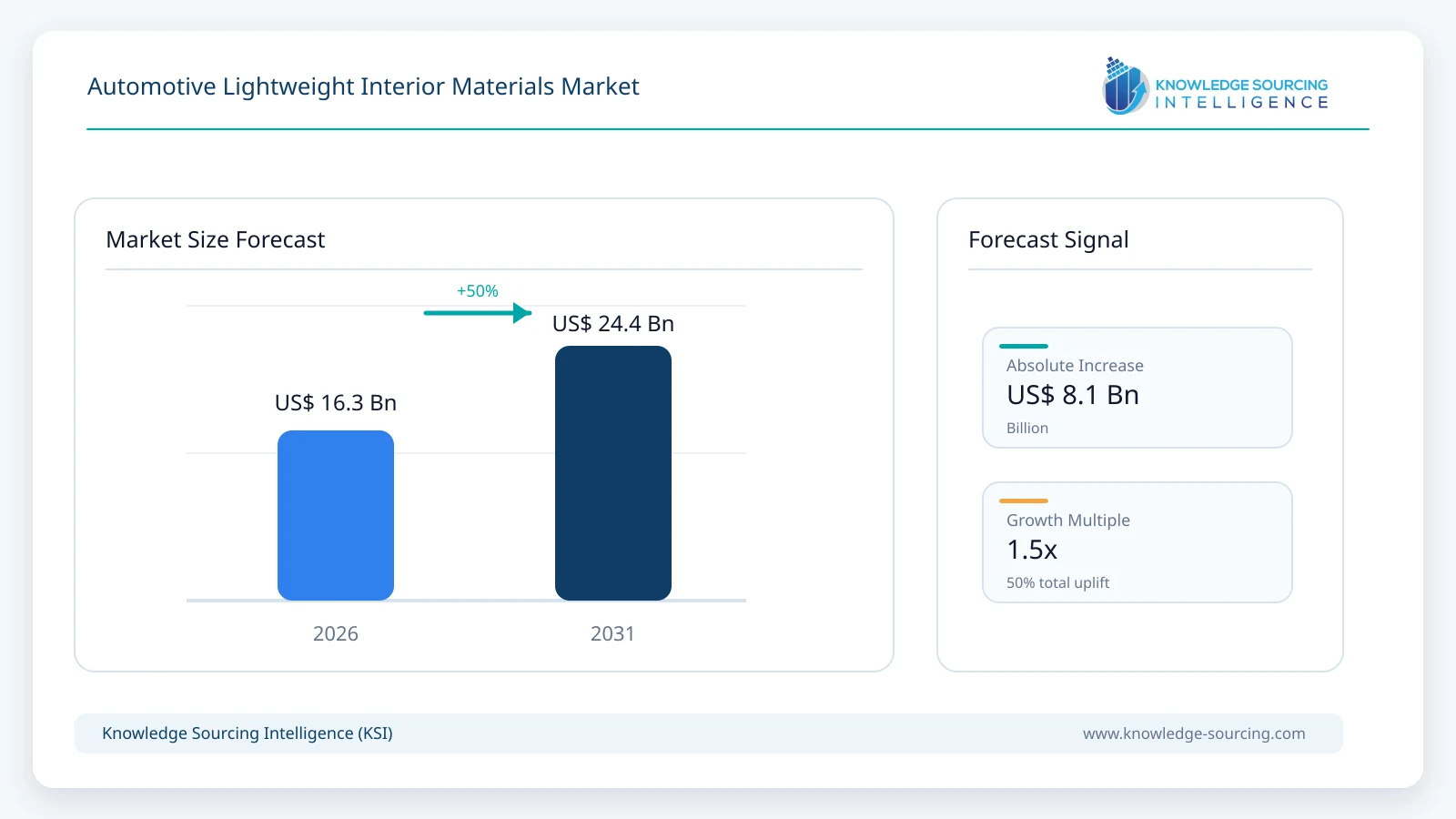
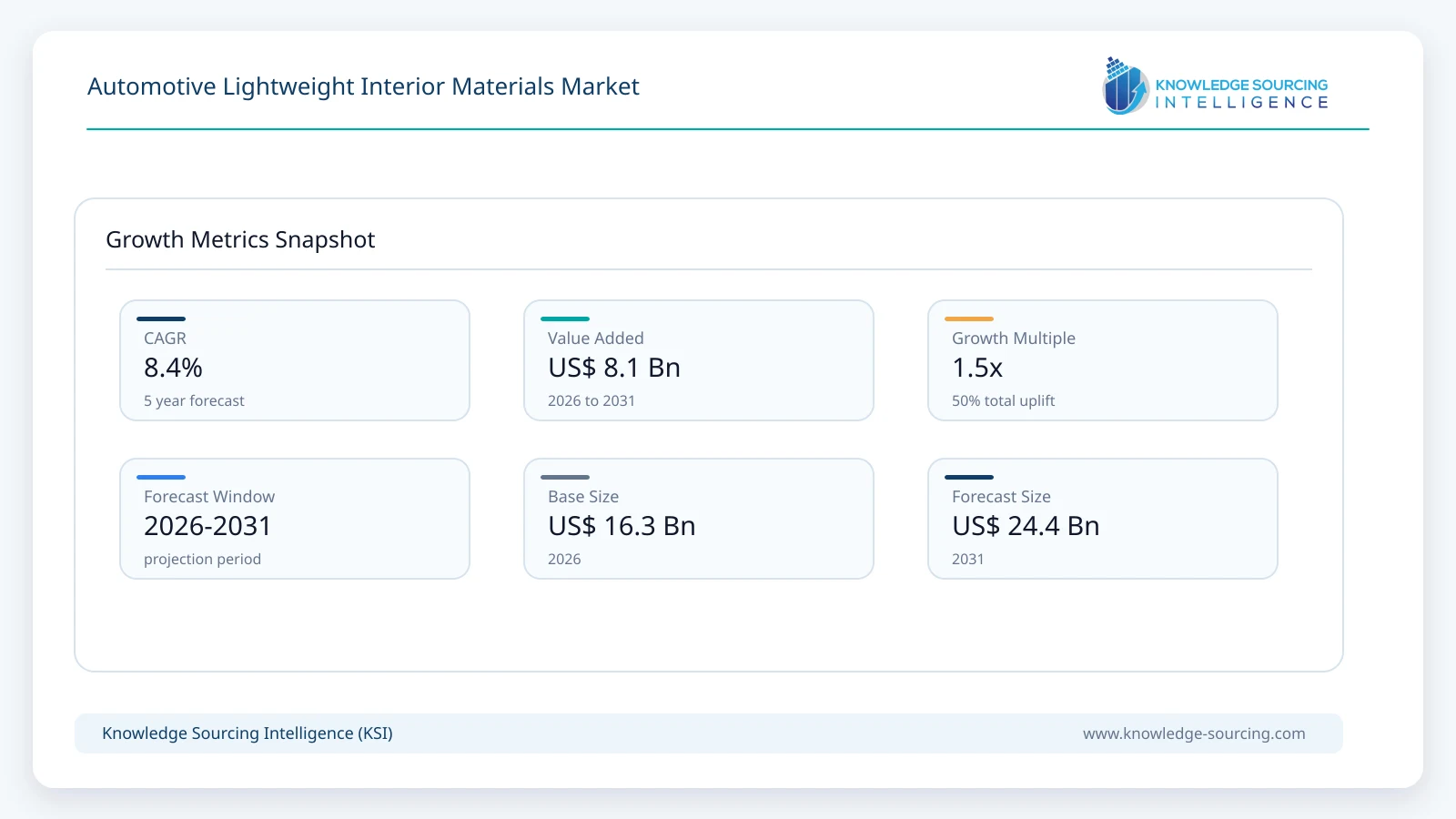
The automotive lightweight interior materials market is projected to expand at a CAGR of 8.4%, increasing from USD 16.3 billion in 2026 to USD 24.4 billion by 2031.
Highlights:
- 1Engineered thermoplastics and low-density polyolefin platforms account for approximately 38% of estimated 2026 material value, reflecting extensive use in cabin trim and molded support substrates.
- 2Fiber-reinforced and natural-fiber composites account for approximately 21% of 2026 value and expand faster as multi-material parts replace heavier conventional constructions.
- 3Door, pillar and side-trim materials represent about 30% of 2026 demand, supported by large surface area and opportunities for thin-wall and foamed substrates.
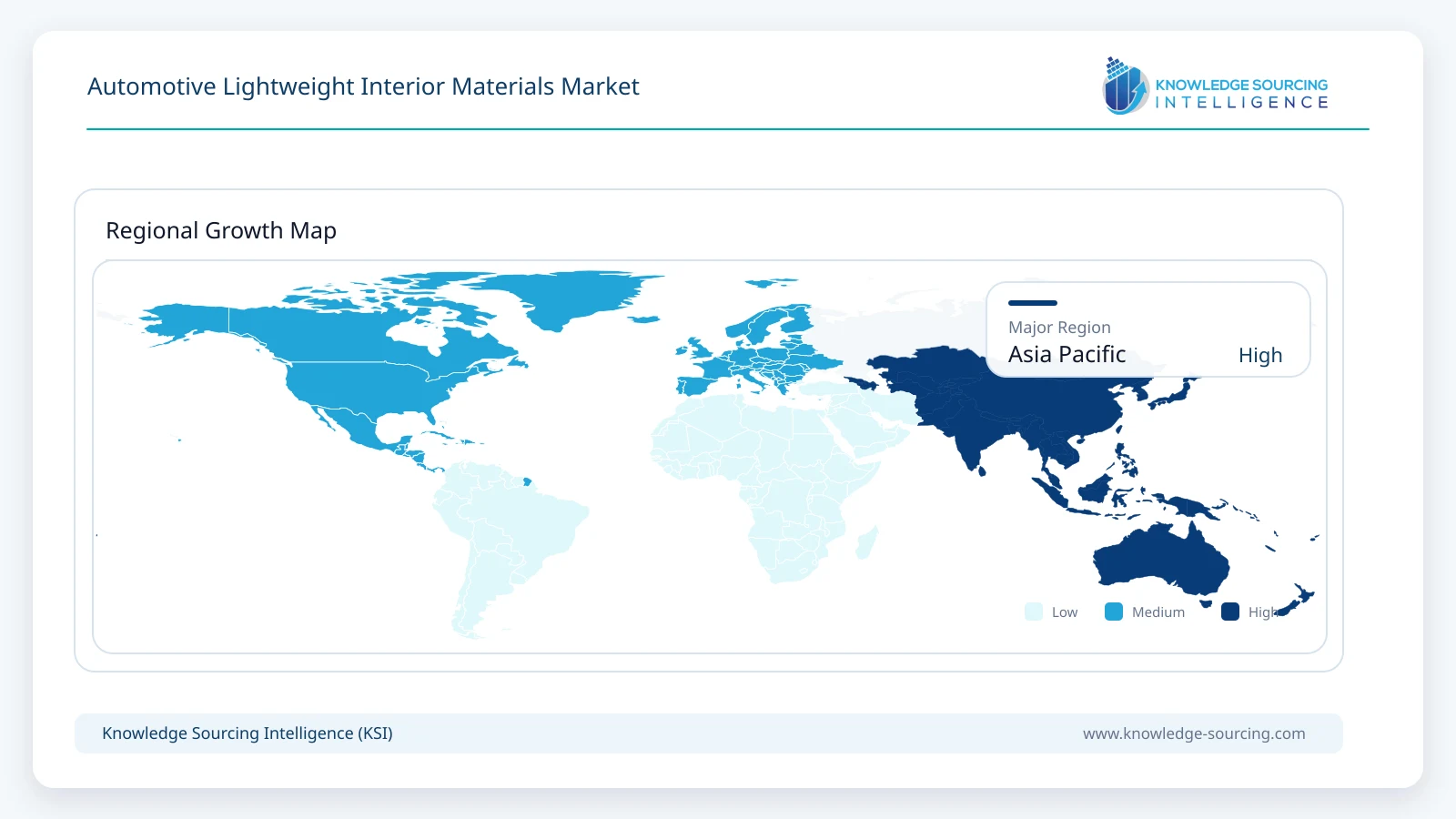
- 4Asia Pacific represents approximately 51% of 2026 value, owing to high vehicle production in China, Japan, India and South Korea.
- 5Battery-electric vehicles account for an estimated 22% of market value in 2026 and gain share through 2031 as interior mass reduction and range-related efficiency remain procurement priorities.
- 6Progress in polyester-based insulation, visible bio-composites and recyclable monomaterial structures is expanding material choice without removing the need for flame, odor, crash and acoustic qualification.
Demand spans weight-optimized polymer compounds, fiber-reinforced and bio-composite substrates, cellular foams, lightweight acoustic nonwovens and selected engineered metal or multi-material substrates used inside the cabin. The estimate reflects the value of qualifying material platforms at their first automotive-ready conversion stage rather than the full selling price of assembled seats, doors, dashboards or roof modules.
Demand is anchored in large-area interior components where material density, structural design and part consolidation influence finished vehicle mass. Toyota Boshoku has commercialized an impact-resistant foamed door-trim substrate that reduces basis weight from approximately 1.8 to 1.5 kilograms per square metre, while Autoneum offers moldable polyester-based acoustic media that can substitute for conventional foam. Such developments illustrate a wider shift from using material weight alone as a purchasing criterion to evaluating stiffness, energy absorption, acoustic performance and manufacturability per kilogram.
Market Overview
Most vehicle interiors combine rigid carriers, cushioning, decorative surfaces, acoustic layers and metal supports. A lighter material has commercial value only when its lower mass survives tests for impact, vibration, long-term creep, heat aging and appearance. Manufacturers therefore use several approaches rather than a single universal lightweight material: thinner structural thermoplastics, foamed injection-molded panels, reinforced composite sheets, lower-density polyurethane systems and textile media that perform the same function with less mass.
BASF markets reinforced Ultramid and Ultradur compounds for automotive cabin components, including parts where stiffness, heat resistance and emissions must be controlled. Toyota Boshoku jointly developed a highly impact-resistant foamed door-trim material with Mitsui Chemicals, demonstrating how polymer design and cell structure can reduce part weight without discarding impact requirements. These technologies are attractive for high-volume vehicles because they can be adapted to existing injection-molding and interior production processes.
Material optimization also affects textile-heavy applications. Autoneum supplies polyester-based sound-absorption and carpet insulation technologies, while Freudenberg Performance Materials provides Finsol lightweight acoustic nonwovens for headliners, pillars and door panels. Antolin develops headliners with thermoplastic, polyurethane and other substrate architectures, including natural-fiber and lower-impact inputs. Material selection increasingly reflects acoustic output and recyclability as well as cost per square metre.
Market Trends
Foamed Polymer Substrates Are Reducing Mass in Large Trim Panels
Foam injection technology provides material savings where a panel requires surface coverage and impact resistance but does not need a fully solid polymer cross-section. Toyota Boshoku reports approximately 20% weight reduction in its high-impact foamed door-trim substrate compared with its earlier 1.8 kg/m² reference. The engineering challenge is maintaining consistent cell structure, mounting-point strength and visible-surface quality across high-speed molding cycles.
Acoustic Materials Are Shifting toward Functional Fiber Structures
Lower-density polyester nonwovens increasingly replace thicker or heavier acoustic layers in carpets, inner dashes, headliners and luggage compartments. Autoneum’s Flexi-Light PET uses shaped polyester fibers and is marketed for carpet insulation, while Freudenberg’s Finsol products tune fiber composition and air-flow resistance to achieve absorption at lower weight. Electric vehicles reinforce this trend because road and tire noise become more perceptible without engine noise masking. Material suppliers must therefore defend acoustic effectiveness at the installed thickness and weight, rather than merely quote the nominal density of a sample.
Multi-Material Composites Combine Reinforcement and Lower-Impact Inputs
Composite substrates use reinforcement to preserve stiffness as overall panel mass is reduced. FORVIA’s MATERI’ACT business offers NAFILean polymer bio-composites, and Antolin develops headliner substrates using natural fibers and alternative foam inputs. Such systems may also contain recycled feedstock, but recycled content does not itself demonstrate a weight advantage. Their commercial adoption depends on equivalent dimensional stability, moisture behavior, process yield and recyclability in the intended interior part.
Segment Analysis
By Material Type: Engineered Thermoplastics and Low-Density Polyolefins
Engineered thermoplastics and low-density polyolefins represent approximately 38% of 2026 market value, the largest material group. They serve door carriers, console supports, cockpit substrates and smaller trim components where thin walls, molded ribs and controlled filling can reduce mass without undermining rigidity. Polypropylene remains widely used on cost-sensitive platforms, while polyamides, polyesters and specialty blends address applications with tighter mechanical or thermal specifications. The category remains dominant through 2031, although advanced composite and textile formats gain share in selected assemblies.
By Material Type: Fiber-Reinforced and Natural-Fiber Composites
Fiber-reinforced and bio-composite substrates are estimated to account for approximately 21% of 2026 value and reach about USD 5.84 billion in 2031. Glass-fiber, natural-fiber and hybrid systems provide reinforcement in panels whose stiffness and thickness can be redesigned around the composite rather than conventional solid plastic. MATERI’ACT’s NAFILean range demonstrates a qualifying bio-composite platform for automotive interiors, while BASF’s CONTOURA technology combines resin with natural, recycled or synthetic reinforcement for molded components. Qualification requirements around moisture uptake, odor and repeatable fiber distribution remain significant for large-scale substitution.
By Application: Door, Pillar and Side-Trim Substrates
Door, pillar and side-trim substrates account for approximately 30% of estimated 2026 market value, reflecting several large-area panels on each passenger vehicle. These components offer scope for foamed structures, reduced wall thickness, recyclable composite backers and integrated mounting features that eliminate secondary material. The weight benefit must be measured at the installed part level, including clips, reinforcement and adhesives, because some lightweight formulations require additional support. Higher penetration of engineered foams and composite substrates is expected to sustain demand despite lower material mass per individual part.
By Vehicle Type: Passenger Vehicles
Passenger vehicles account for an estimated 89% of 2026 value because cars, crossovers and SUVs drive the greatest volumes of molded cabin materials. Premium and electric vehicles provide more opportunities for sophisticated acoustic and composite structures, while cost-focused models rely heavily on high-volume thermoplastics. Commercial-vehicle cabs increasingly use lightweight acoustic and thermal systems, although passenger applications remain dominant through 2031.
By Propulsion: Battery-Electric Vehicles
Battery-electric vehicles are estimated to generate approximately 22% of market value in 2026 and are projected to approach 34% by 2031. Lower cabin mass can contribute to vehicle efficiency, but the benefit is evaluated alongside cost, battery size, acoustic performance and safety. Battery-electric architectures may eliminate some conventional powertrain noise while placing greater importance on floor and wheel-path absorbers, favoring lighter functional nonwovens. This mix supports above-market growth in engineered acoustic media and high-value interior substrates, rather than a uniform increase in all material categories.
Market Drivers
Vehicle-Efficiency Targets and Electrification
Weight optimization remains part of vehicle-efficiency engineering across internal-combustion, hybrid and electric platforms. In electric vehicles, material selection is considered alongside battery packaging, thermal control and body mass because small savings spread across several interior systems can support a lower vehicle weight. The largest commercial opportunity is often not replacing one material with another, but redesigning panel geometry and removing unnecessary reinforcements. Suppliers that demonstrate validated part-level weight savings at competitive cost are more likely to enter new OEM platforms.
Demand for Lightweight Acoustic and Thermal Comfort Materials
Cabins require acoustic attenuation even as vehicle makers reduce the mass of barriers, foams and absorbers. Autoneum’s moldable Flexi-Light PET and Freudenberg’s lightweight nonwovens show how fiber architecture and flow resistance can deliver acoustic function without relying solely on heavy material layers. Battery-electric platforms bring tire, wind and electric-drive sound profiles that differ from combustion vehicles, requiring more targeted treatment. This encourages material value growth in sophisticated nonwovens and layered structures despite pressure to reduce kilograms per car.
Higher-Strength Polymers and Improved Processing
Advances in melt flow, reinforcement dispersion and foaming allow manufacturers to produce thinner and lighter parts while retaining acceptable performance. Toyota Boshoku’s high-impact foamed door-trim platform demonstrates a measurable reduction in substrate basis weight, while BASF supplies low-emission reinforced compounds for functional visible components. Suppliers also benefit when fewer molding or painting operations are required. The purchasing decision therefore reflects cycle time, yield, tooling compatibility and finished-part quality as well as resin price.
Material Circularity and OEM Sustainability Requirements
Recycled polymer inputs, renewable fibers and mono-material architectures increasingly feature in cabin-material purchasing specifications. FORVIA’s NAFILean Vision and Autoneum’s PET-based acoustic systems expand the available material technologies, while the EU’s 2026 vehicle-circularity regulation increases attention to disassembly, material identification and future recycled-content compliance. Lightweighting and recyclability are separate criteria, but a material that satisfies both can reduce qualification and sourcing complexity. Manufacturers must substantiate the claimed benefits through appropriate testing and life-cycle information.
Interior Architecture and Component Integration
Electric and premium vehicle platforms increasingly combine large displays, reconfigurable seating, acoustic treatments and complex surface finishes within limited cabin packaging space. Lower-profile seat frames and lighter instrument-panel substrates can create usable space while reducing mass, provided the design still supports occupant loads and mounted electronics. Toyota Boshoku’s next-generation frame roadmap illustrates the relevance of thinner components, while Antolin’s modular headliner portfolio combines weight management with lighting and acoustic integration. Demand grows for materials engineered around several simultaneous functions.
Market Restraints
Cost Premiums and Uncertain Vehicle-Level Savings
Lightweight compounds and reinforced substrates frequently cost more than standard polymers or conventional steel on a direct purchasing basis. A part that is lighter but more expensive may not be approved on a high-volume model when the resulting efficiency gain is small or cannot be monetized. Savings must also include reduced fasteners, fewer forming steps or shorter assembly time where applicable. Without demonstrable system-level economics, lightweight solutions are more likely to remain concentrated in selected premium or high-complexity applications.
Mechanical, Fire, Odor and Aging Qualification
Passenger-compartment materials must satisfy requirements for flammability, volatile emissions, odor, abrasion, dimensional stability and long-term exposure to heat and humidity. A foam or composite can show favorable laboratory density while failing an impact, durability or fastener-retention requirement at production geometry. Reinforced and bio-based formulations introduce additional variability in fiber dispersion and moisture response. Testing and platform qualification extend project lead times and limit rapid substitution late in a vehicle program.
Manufacturing Yield and Process Integration
Thin-wall polymer molding, foam injection and natural-fiber composite forming depend on controlled tooling, thermal history and material preparation. Higher scrap rates, inconsistent cellular structures or unstable visible surfaces can erase nominal savings in material use. Large Tier 1 suppliers therefore require process windows that remain reliable across several factories and production shifts. Existing injection-molding and laminating assets also constrain how quickly a fundamentally different material can be adopted.
Recycling Challenges in Mixed-Material Structures
Low weight does not guarantee an easy end-of-life recycling pathway. Bonded foam, textile facings, composite reinforcement and permanently joined metal inserts can be difficult to separate into reusable material streams. Automotive-grade recycled feedstock also requires consistent mechanical properties and control of odor, color and contamination. Suppliers face an increasingly complex design trade-off between minimum mass, durability and economically recoverable material content.
Regional Cost and Supply-Chain Variability
Automotive interior materials are sourced through geographically dispersed compounders, converters and Tier 1 manufacturing plants. Different regional availability of high-specification resins, composite reinforcements and recycled PET can affect cost and qualification choices for a global model. Import duties, local-content requirements and shifting raw-material prices may encourage multiple material specifications for the same cabin design. This complicates global standardization and can slow substitution in lower-volume markets.
Regional Outlook
Asia Pacific
Asia Pacific accounts for an estimated 51% of 2026 market value and remains the largest regional demand center through 2031. China’s large vehicle-production base and extensive EV manufacturing network support lightweight interior compounds and functional acoustic materials, while Japan and South Korea contribute established polymer, textile and seat-engineering expertise. India is gaining importance as local vehicle production and supplier localization expand. Toyota Boshoku’s work on foamed trim substrates and thinner seating demonstrates how regional suppliers translate weight targets into repeatable vehicle components.
The region is projected to approach USD 12.91 billion by 2031, with its share moving toward 53%. Advanced thermoplastic molding remains important because high-volume vehicle production requires predictable cost and short cycle times, but composite and fiber-based technologies should take a larger role in selected roof, door and acoustic applications. Growth is not expected to be uniform across countries, as the premium mix, electric-vehicle penetration and supplier capabilities vary substantially.
Europe
Europe represents approximately 22% of global market value in 2026, supported by established suppliers of cabin foams, composite substrates, headliners and acoustic nonwovens. Antolin, Autoneum and Freudenberg maintain relevant European product development capabilities, while FORVIA is commercializing alternative reinforced polymer formulations. Regulatory scrutiny of circularity and material reporting encourages suppliers to document the performance of lightweight materials beyond immediate production cost. Vehicle-program economics nonetheless remain central as European assembly volumes fluctuate.
Europe is projected to reach about USD 5.11 billion by 2031. Its share eases moderately as Asian production and material conversion expand, but European engineering capabilities remain important in material qualification and development. Suppliers that combine mass savings, reliable low-emission behavior and material recovery pathways are likely to retain a competitive advantage in premium and export-oriented platforms.
Competitive Landscape
The competitive environment spans compounders, specialty polymer producers, reinforcing-material suppliers, acoustic converters and global interior-system manufacturers. BASF, SABIC, Celanese and other engineered-material suppliers compete through mechanical performance, density and process stability, while Autoneum and Freudenberg focus on shaped fiber and acoustic media. Antolin, FORVIA and Toyota Boshoku influence material specifications through complete cabin-system engineering and their own substrate technologies. Participants compete at different stages of the value chain, so group-wide company revenue cannot be interpreted as a market-share measure for qualifying lightweight material sales.
Competitive differentiation is increasingly linked to part-level validation. A successful compound must maintain stiffness and appearance in its final molded geometry, while an acoustic nonwoven must deliver measured performance at the intended installed mass. Global production support, repeatable emissions testing and scrap-recycling arrangements also influence sourcing decisions. Manufacturers with qualified multi-region supply chains can scale a new material architecture faster than firms offering only isolated laboratory formulations.
Recent Developments
July 2026: The EU adopted Regulation (EU) 2026/1738 on vehicle circularity and end-of-life management. For interior materials, the development increases attention to recyclability, dismantling information and documented content; it should not be misread as an immediate lightweight-material mandate.
June 2026: Toyota Boshoku reported adoption of its TBlocks seat architecture in the new Lexus ES. The design distributes occupant support through resin components as well as cushioning and reduces use of urethane pads, illustrating how interior architecture can lower material demand.
February 2026: Freudenberg Performance Materials presented Finsol lightweight acoustic nonwovens and related automotive materials for headliners, door panels and cargo applications at its Techtextil 2026 showcase.
July 2025: Autoneum introduced Flexi-Light PET, a moldable acoustic-insulation material containing up to 90% recycled polyester, for automotive carpet insulation and other suitably qualified applications.
June 2025: FORVIA’s MATERI’ACT subsidiary introduced NAFILean Vision, extending the NAFILean bio-composite family toward visible interior surfaces and greater design flexibility. A portfolio launch does not establish volume production across all advertised applications.
Market Outlook
The automotive lightweight interior materials market is projected to reach USD 24.35 billion by 2031 as more cabin applications adopt engineered low-density polymers, fiber-based acoustic systems and reinforced substrates. Growth is expected to derive from material engineering value and broader use per vehicle, as well as underlying production volume, rather than a simple increase in kilograms of material consumed. Door and cockpit applications will remain major sources of demand, with textile acoustics and composite panels gaining relevance in redesigned electric and premium cabins.
Manufacturers will continue to balance material mass, durability, price and recovery. Engineered fiber systems offer opportunities where acoustic or structural function is preserved at lower density, while metal remains necessary in many validated load paths. Asia Pacific should retain its lead, with Europe shaping qualification and circularity requirements.
Automotive Lightweight Interior Materials Market Scope
| Report Metric | Details |
|---|---|
| Total Market Size in 2026 | USD 16.3 billion |
| Total Market Size in 2031 | USD 24.4 billion |
| Forecast Unit | Billion |
| Growth Rate | 8.4% |
| Study Period | 2021 to 2031 |
| Historical Data | 2021 to 2024 |
| Base Year | 2025 |
| Forecast Period | 2026 – 2031 |
| Segmentation | Material Type, Application, Vehicle Type, Propulsion, Geography |
| Companies |
|
Market Segmentation
By Material Type
Engineered Thermoplastics and Low-Density Polyolefins
Fiber-Reinforced and Natural-Fiber Composites
Lightweight Nonwovens and Textile Substrates
Cellular Foams and Microcellular Cores
Lightweight Metals and Multi-Material Substrates
By Application
Door, Pillar and Side Trim
Instrument Panel and Center Console
Seating and Seat Structures
Headliners and Roof Substrates
Floor and Acoustic Insulation
Luggage and Other Interior Components
By Vehicle Type
Passenger Vehicles
Light Commercial Vehicles
Medium and Heavy Commercial Vehicles and Buses
By Propulsion
Internal-Combustion Engine Vehicles
Hybrid and Plug-In Hybrid Vehicles
Battery-Electric Vehicles
By Geography
North America
United States
Canada
Mexico
South America
Brazil
Argentina
Others
Europe
Germany
United Kingdom
France
Italy
Spain
Others
Middle East and Africa
Saudi Arabia
UAE
South Africa
Others
Asia Pacific
China
Japan
South Korea
India
Indonesia
Thailand
Others
Table of Contents
1. EXECUTIVE SUMMARY
1.1. Key Findings
1.2. Automotive Lightweight Interior Materials Market Size and Forecast, 2026–2031
1.3. Material Technology and Application Outlook
1.4. Regional Opportunity Summary
2. MARKET SNAPSHOT
2.1. Market Overview
2.2. Market Definition
2.3. Scope of the Study
2.4. Market Segmentation
3. BUSINESS LANDSCAPE
3.1. Market Drivers
3.1.1. Vehicle-Efficiency Targets and Electrification
3.1.2. Demand for Lightweight Acoustic and Thermal Comfort Materials
3.1.3. Higher-Strength Polymers and Improved Processing
3.1.4. Material Circularity and OEM Sustainability Requirements
3.1.5. Interior Architecture and Component Integration
3.2. Market Restraints
3.2.1. Cost Premiums and Uncertain Vehicle-Level Savings
3.2.2. Mechanical, Fire, Odor and Aging Qualification
3.2.3. Manufacturing Yield and Process Integration
3.2.4. Recycling Challenges in Mixed-Material Structures
3.2.5. Regional Cost and Supply-Chain Variability
3.3. Market Opportunities
3.4. Porter’s Five Forces Analysis
3.5. Industry Value Chain Analysis
3.6. Policies and Regulations
3.7. Strategic Recommendations
4. TECHNOLOGICAL OUTLOOK
4.1. Thin-Wall and Foamed Injection-Molded Thermoplastics
4.2. Reinforced Thermoplastic and Natural-Fiber Composite Substrates
4.3. Lightweight Polyester Nonwovens and Acoustic Structures
4.4. Microcellular Foams and Hybrid Seating Materials
4.5. Lightweight Metallic and Mixed-Material Interior Supports
4.6. Material Circularity and Low-Emission Qualification
5. AUTOMOTIVE LIGHTWEIGHT INTERIOR MATERIALS MARKET BY MATERIAL TYPE
5.1. Introduction
5.2. Engineered Thermoplastics and Low-Density Polyolefins
5.3. Fiber-Reinforced and Natural-Fiber Composites
5.4. Lightweight Nonwovens and Textile Substrates
5.5. Cellular Foams and Microcellular Cores
5.6. Lightweight Metals and Multi-Material Substrates
6. AUTOMOTIVE LIGHTWEIGHT INTERIOR MATERIALS MARKET BY APPLICATION
6.1. Introduction
6.2. Door, Pillar and Side Trim
6.3. Instrument Panel and Center Console
6.4. Seating and Seat Structures
6.5. Headliners and Roof Substrates
6.6. Floor and Acoustic Insulation
6.7. Luggage and Other Interior Components
7. AUTOMOTIVE LIGHTWEIGHT INTERIOR MATERIALS MARKET BY VEHICLE TYPE
7.1. Introduction
7.2. Passenger Vehicles
7.3. Light Commercial Vehicles
7.4. Medium and Heavy Commercial Vehicles and Buses
8. AUTOMOTIVE LIGHTWEIGHT INTERIOR MATERIALS MARKET BY PROPULSION
8.1. Introduction
8.2. Internal-Combustion Engine Vehicles
8.3. Hybrid and Plug-In Hybrid Vehicles
8.4. Battery-Electric Vehicles
9. AUTOMOTIVE LIGHTWEIGHT INTERIOR MATERIALS MARKET BY GEOGRAPHY
9.1. North America
9.1.1. United States
9.1.2. Canada
9.1.3. Mexico
9.2. South America
9.2.1. Brazil
9.2.2. Argentina
9.2.3. Others
9.3. Europe
9.3.1. Germany
9.3.2. United Kingdom
9.3.3. France
9.3.4. Italy
9.3.5. Spain
9.3.6. Others
9.4. Middle East and Africa
9.4.1. Saudi Arabia
9.4.2. UAE
9.4.3. South Africa
9.4.4. Others
9.5. Asia Pacific
9.5.1. China
9.5.2. Japan
9.5.3. South Korea
9.5.4. India
9.5.5. Indonesia
9.5.6. Thailand
9.5.7. Others
10. COMPETITIVE ENVIRONMENT AND ANALYSIS
10.1. Major Players and Strategy Analysis
10.2. Market Share Analysis
10.3. Mergers, Acquisitions, Agreements and Collaborations
10.4. Competitive Dashboard
11. COMPANY PROFILES
11.1. BASF SE
11.2. SABIC
11.3. Celanese Corporation
11.4. Borealis AG
11.5. Covestro AG
11.6. Autoneum Holding AG
11.7. Freudenberg Performance Materials
11.8. Antolin
11.9. FORVIA SE
11.10. Toyota Boshoku Corporation
11.11. Adler Pelzer Group
11.12. Bcomp Ltd.
12. APPENDIX
12.1. Currency
12.2. Assumptions
12.3. Base and Forecast Years Timeline
12.4. Key Benefits for Stakeholders
12.5. Research Methodology
12.6. Abbreviations
Navigate
Trusted by the world's leading organizations











