
The Automotive Interior Composites Market is forecast to grow at a CAGR of 9.53%, reaching USD 5.96 billion in 2031 from USD 3.78 billion in 2026.
Highlights:
- 1Glass- and mineral-fiber reinforced thermoplastics represent an estimated 38% of 2026 market value, led by load-bearing and dimensionally stable interior carriers.
- 2Door, side and pillar substrates represent approximately 31% of 2026 global interior composite value, followed by instrument-panel and console carriers at 25%.
- 3Thermoplastic-matrix systems account for approximately 58% of 2026 value as injection processing and material recovery favor melt-processable formulations.
- 4Asia Pacific accounts for an estimated 47% of 2026 market value, supported by vehicle assembly scale and regional interior-supplier capacity.
- 5Natural-fiber reinforced composites are forecast to gain share through 2031, particularly in door substrates, seat backs and selected visible surfaces.
- 6Engineering of low-emission, recyclable and multilayer substrates remains critical as cabin safety, climate-aging and end-of-life requirements converge.
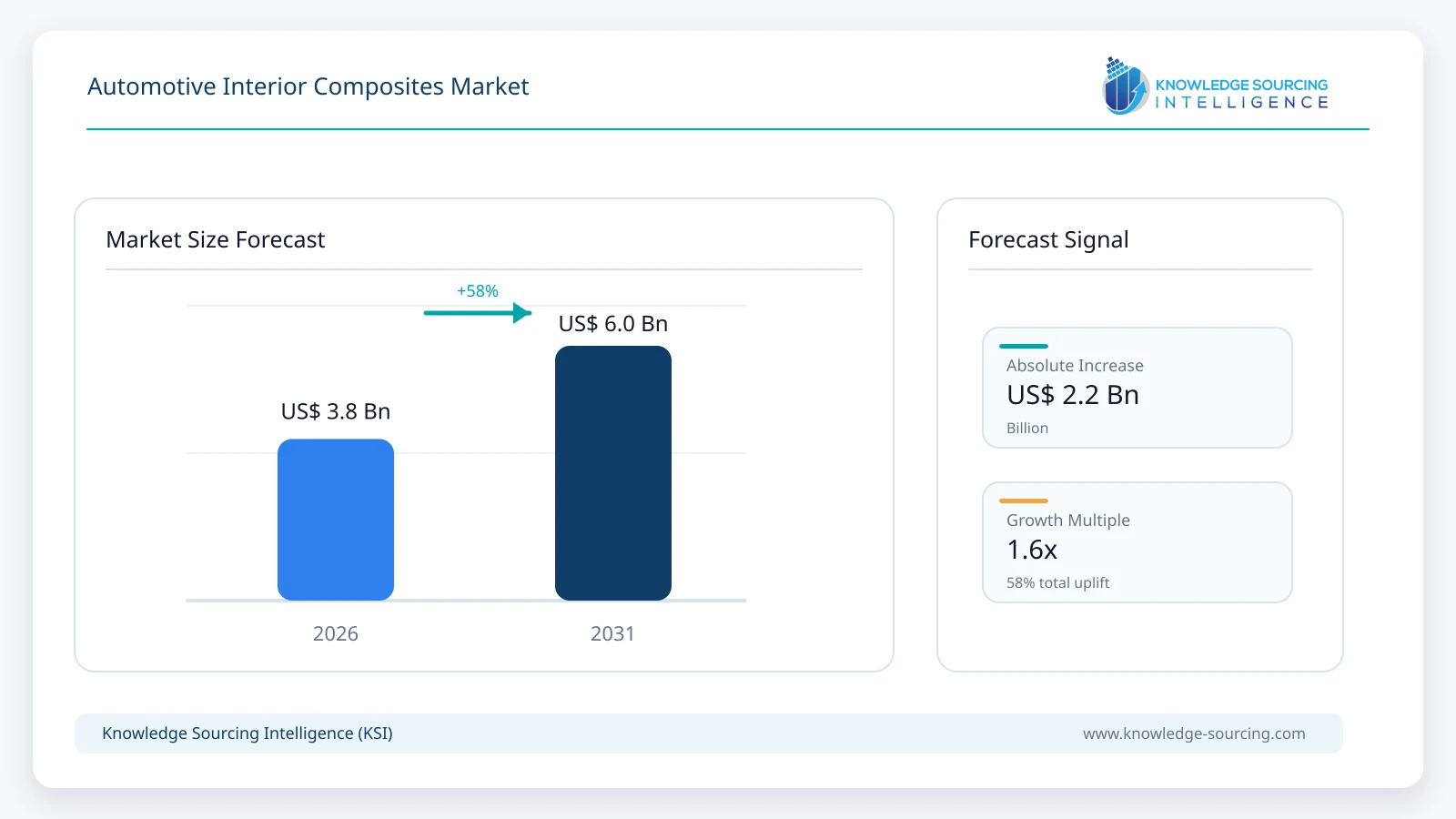
Automotive interior composites include reinforced thermoplastic carriers, bonded fiber panels, natural-fiber composites and engineered foam-fiber laminates incorporated into passenger-compartment structures. Suppliers use these materials to meet requirements for stiffness, dimensional stability, impact behavior, acoustic comfort, low weight, and complex component geometry.
Glass-fiber-reinforced thermoplastics remain important in load-bearing instrument-panel and console structures, while natural-fiber substrates are established in selected door and seat-back applications. SABIC offers STAMAX long-glass-fiber polypropylene for semi-structural interior applications, and Toyota Boshoku manufactures kenaf-based interior carriers. Antolin uses polyurethane, thermoplastic, and thermoset headliner processes, showing the range of composite construction methods already embedded in automotive interior supply chains.
Market Overview
Interior composites are engineered combinations of a polymeric matrix, fibrous reinforcement or coordinated substrate layers that provide performance beyond an ordinary unreinforced plastic. Instrument-panel carriers may rely on long-glass-fiber polypropylene for stiffness and dimensional stability, while compression-formed bast-fiber mats provide a different balance of mass, forming pressure and impact properties. Composite selection is therefore driven by the component load case, geometry and manufacturing route rather than one preferred fiber across the cabin.
SABIC positions STAMAX long-glass-fiber polypropylene for instrument panels and door modules, with grades designed for impact resistance, thin walls and controlled emissions. Celanese supplies long-fiber reinforced thermoplastics for automotive interior trim and structural housings, while FORVIA develops hemp-reinforced polypropylene through the NAFILean family. The established commercial portfolios indicate that composite materials are selected at component-program level and qualified against specific OEM specifications.
Headliners and acoustic panels use a wider range of layered composite constructions. Antolin manufactures overhead systems using polyurethane and thermoplastic technologies and incorporates natural fibers and lower-impact foams in selected designs. Autoneum develops polyester-based acoustic solutions with engineered fiber arrangements for carpet and inner-dash applications, including recyclable PET constructions. Material qualification remains sensitive to acoustic frequency response, thermal aging, fogging, odor, and packaging thickness.
Automotive composite production combines resin compounding with injection molding, sheet consolidation, compression forming and lamination. FlexForm supplies natural-fiber and thermoplastic nonwoven mats that can be formed into door panels, headliners and rear package trays at low molding pressures. The manufacturing route determines cycle time, tooling investment and the degree to which fasteners, surface coverings and reinforcement features can be integrated during processing.
Market Trends
Long-Fiber Thermoplastics Are Supporting Integrated Cabin Carriers
Long-glass-fiber thermoplastics offer a route to combine structural rigidity, impact performance and molding efficiency in instrument-panel supports and door carriers. SABIC’s STAMAX portfolio includes injection-molding grades developed for thin-walled semi-structural applications and low-emission interior requirements. Celanese also markets high-flow Celstran long-fiber thermoplastics for thinner automotive parts and improved filling behavior. Component designers can consolidate ribs and mounting features within molded carriers, although joint design and crash validation still limit unrestricted material substitution.
Natural-Fiber Composites Are Moving beyond Concealed Trim
Kenaf, hemp and flax reinforcement is established in non-visible door and seat-back substrates because low-density natural fibers can provide useful stiffness at competitive processing weights. FORVIA presented NAFILean Vision in June 2025 to extend renewable fillers into visible injection-molded surfaces, while Toyota Boshoku continues developing kenaf-based carriers. Visible applications require tighter control of fiber dispersion, surface appearance, odor and long-term color behavior than concealed substrates. Commercial growth depends on automotive program awards and production qualification rather than material demonstrations alone.
Headliner and Acoustic Systems Are Adopting Recoverable Architectures
Composite roof and floor systems combine fiber mats, foams and skin layers to manage noise, stiffness and occupant comfort. Antolin reported that revenue from sustainable headliner solutions doubled in 2025, reflecting broader adoption of recycled and lower-impact constituents across overhead programs. Autoneum’s Flexi-Light PET uses engineered recycled-polyester fibers for molded carpet insulation, and the company supplies interior acoustic components to Polestar 5. Recyclability is becoming a design variable alongside mass and acoustic performance, especially where bonded layers previously required difficult separation.
Mono-Material Designs Are Challenging Complex Laminates
Composite performance is often achieved by joining materials that cannot be readily recovered together at end of life. At the 2025 Automotive Engineering Exposition and the 2026 Beijing motor show, Toyota Boshoku presented an olefin-based door-trim concept intended to simplify recycling compared with mixed-material trim structures. The concept remains a development example rather than evidence of market-wide replacement. Interior composite suppliers face increasing pressure to justify when differentiated reinforcement and multilayer construction offer enough benefit to offset separation costs.
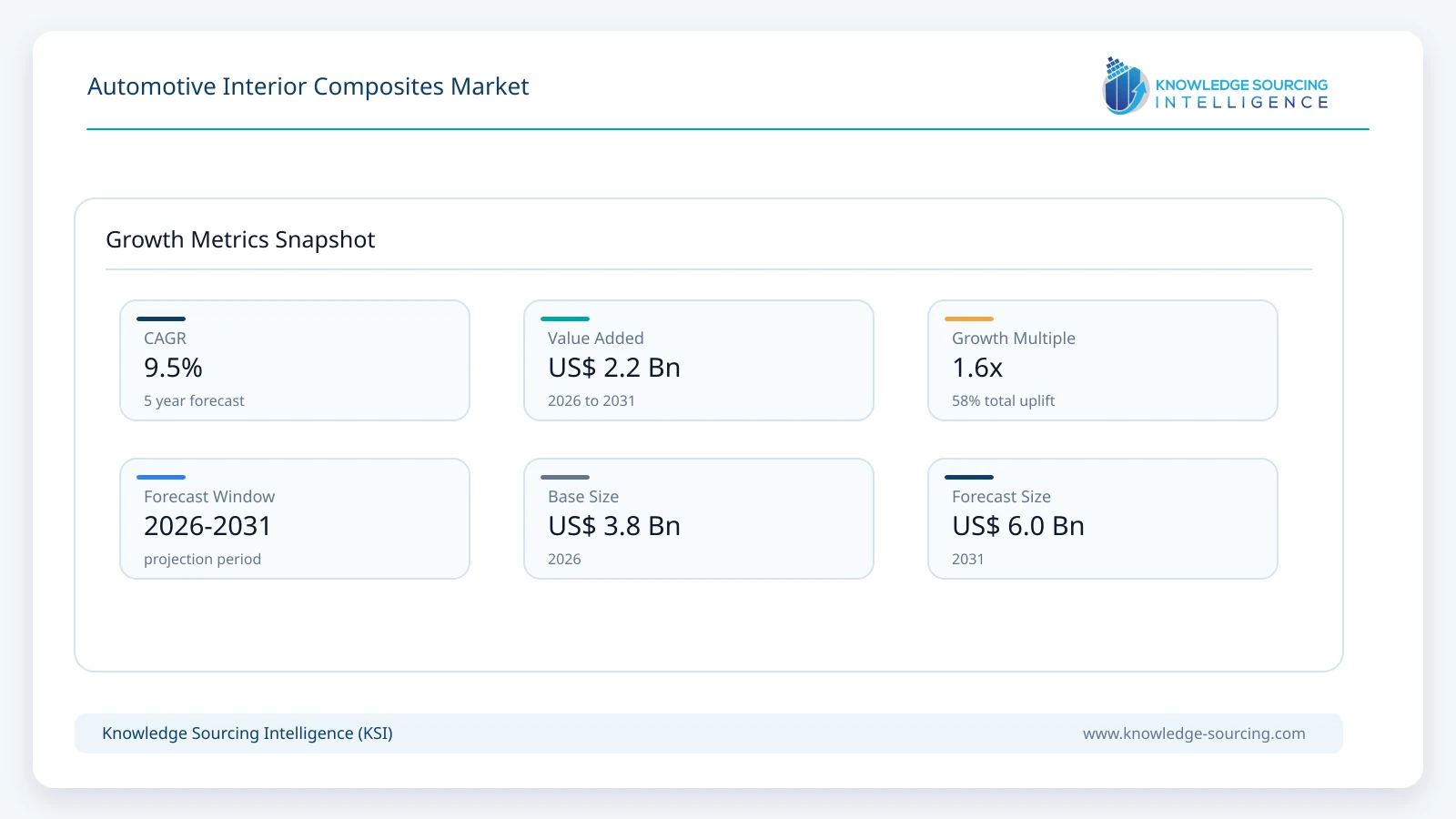
Segment Analysis
By Composite Platform: Glass- and Mineral-Fiber Reinforced Thermoplastics
Glass- and mineral-fiber reinforced thermoplastics provide stiffness, creep resistance and dimensional stability for molded carriers that must hold interfaces and attachment points under thermal cycling. High-volume polypropylene composites remain cost-competitive in instrument-panel, center-console and door-support structures, while specialized engineering polymers serve more demanding temperature or impact conditions. The platform accounts for an estimated 38% of 2026 global value.
Reinforced thermoplastic value is projected to reach approximately USD 2.09 billion in 2031. The platform retains the largest position despite some share transfer toward natural-fiber and specialty hybrids, because long-fiber reinforcement accommodates integrated mounting geometry and high-volume injection molding. SABIC and Celanese compete through fiber retention, flow characteristics, emissions performance, and application engineering rather than reinforcement weight alone.
By Matrix and Binder System: Thermoplastic-Matrix Composites
Thermoplastic-matrix composites represent approximately 58% of the global market in 2026 because polypropylene-based systems suit high-volume molding, fast cooling, and complex cabin geometries. Thermoplastic matrices also offer established compounding routes for glass, natural, and other fibers, supporting material optimization without changing entire production lines. The most suitable grade depends on resin-fiber adhesion, crash properties, odor and the requirement for surface finishing.
The thermoplastic-matrix segment is projected to approach USD 3.64 billion in 2031 as injection and thermoforming applications gain share. Growth should be reinforced by greater use of recycled polymer feedstocks where reinforced properties remain stable after processing. Polyurethane and other thermosets remain technically important in headliners and laminate systems where processing behavior and substrate performance favor reactive or cross-linked chemistries.
By Application: Door, Side and Pillar Substrates
Door and side-trim substrates provide one of the largest cabin surfaces where composite panels can reduce mass while carrying clips, armrests, speakers and surface coverings. Natural-fiber mats and reinforced polypropylene are both used, but door applications require different solutions for side-impact response, moisture exposure and finishing quality. Antolin and Toyota Boshoku maintain established capabilities in door-trim engineering and material integration.
Door, side and pillar composites account for an estimated 31% of 2026 market value and could reach approximately USD 1.85 billion by 2031. Demand reflects vehicle production as well as continued substitution of heavier panels and consolidation of attachment features. Qualification cycles and commonization across model platforms make supplier relationships important determinants of adoption.
By Manufacturing Process: Injection Molding and Overmolding
Injection molding and overmolding enable reinforced polymer carriers with integrated ribs, fastener bosses, and complex packaging features. High-flow long-fiber polypropylene formulations can reduce molding pressure and permit thin-wall design while retaining useful reinforcement length. Suppliers must balance flow behavior with glass-fiber breakage, warpage, low VOC emissions and tooling economics across high-volume part families.
Injection molding and overmolding account for around 42% of market value in 2026 and are projected to increase their contribution toward 2031. Compression molding and thermoforming retain advantages in large-area natural-fiber boards and certain headliner structures, where wide sheets can be shaped with relatively modest forming pressure. The process split therefore reflects both component size and the economics of integrating finished features during the molding cycle.
By Vehicle Type: Passenger Vehicles
Passenger cars, SUVs and crossovers carry the largest concentration of engineered interior panels, decorative carriers and acoustic composite substrates. Cabin differentiation, platform redesigns and increasingly sophisticated occupant-comfort requirements encourage adoption of reinforced and multilayer materials. Passenger vehicles represent approximately 87% of the market in 2026.
Passenger-vehicle composite value is forecast to exceed USD 5.2 billion in 2031. Commercial vehicles remain relevant for durable door structures, overhead panels and cab acoustic systems, but typically combine lower decorative content with longer platform lifecycles. Supplier investment is consequently concentrated around passenger-vehicle launch programs, with selected materials carried into light- and heavy-commercial applications where performance requirements align.
Market Drivers
Weight Reduction without Compromising Interior Performance
Automotive manufacturers continue specifying lighter interior carriers when weight reduction can be achieved without weakening crash behavior or attachment integrity. Long-fiber reinforced polypropylene can replace some heavier constructions, while natural-fiber laminates offer low density in broad panels. Engineered composites also allow local reinforcement and thickness variation, enabling targeted material use rather than uniform overdesign. The strongest demand emerges in applications where lower mass is accompanied by stable tooling cost and repeatable dimensional control.
Higher Composite Content in Integrated Interior Architectures
Cockpit and door components increasingly combine structural carriers with cable routing, attachment points, comfort features and decorated surfaces. Reinforced composite substrates accommodate complex ribs and mounting geometry, reducing the need for separate brackets in selected applications. SABIC’s STAMAX and Celanese’s Celstran platforms support semi-structural molded components, while Tier-1 interior suppliers control final packaging and production validation. Integrated carrier design raises the importance of material engineering within cabin program sourcing.
Expansion of Low-Emission and Sustainable Material Specifications
Interior material approval now places greater emphasis on odor, fogging, volatile organic emissions and documented raw-material composition alongside conventional mechanical testing. FORVIA’s hemp-reinforced compounds and Antolin’s recycled-content headliners illustrate different approaches to reducing reliance on virgin fossil-based materials. European vehicle-circularity rules strengthen attention to recoverability and recycled plastics, although compliance dates and scope vary by provision. Suppliers able to combine validated emissions performance with reliable recycled or renewable material content can access a wider range of OEM specifications.
Automotive Acoustic and Thermal Comfort Requirements
Electric vehicles expose different noise profiles, while conventional vehicles continue requiring control of road, tire, and wind noise within limited cabin packaging space. Fiber-bonded panels and foam-based laminates allow acoustic absorption and stiffness to be tuned through layer composition and fiber orientation. Autoneum’s polyester sound-insulation systems demonstrate how engineered fiber architecture can be adapted for shaped carpet and inner-dash uses. Composite acoustic substrates gain commercial relevance where weight, thickness, and recycling constraints prevent simple increases in conventional insulation mass.
Improving Industrial Economics of Thermoplastic Processing
Reinforced polypropylene and compression-formable composite mats benefit from mature automotive manufacturing equipment and established supplier qualification practices. Fast-filling grades, tailored fiber lengths and integrated fastener features can reduce secondary assembly operations on selected interior programs. FlexForm’s low-pressure forming approach demonstrates the value of combining material shaping and attachment integration in a single process. Lower total converted-part cost, rather than raw-resin price alone, supports adoption of more sophisticated composite constructions.
Market Restraints
Recycling Complexity in Mixed-Material Composite Structures
Reinforced carriers and laminated interior panels can be difficult to recycle when fibers, adhesives, foams and decorative skins require different recovery processes. Separation often adds labor and can reduce the purity of recovered polymers. Toyota Boshoku’s mono-material door-trim development reflects a practical effort to address a limitation affecting conventional mixed-material construction. Composite suppliers must either improve part-level recoverability or demonstrate sufficient technical value to justify more complex end-of-life processing.
Moisture Sensitivity and Property Variation of Natural Fibers
Kenaf, hemp and flax reinforcement require control of fiber moisture, consistency and dispersion before molding. Variations can affect surface finish, bonding, dimensional stability and durability under humid vehicle-cabin conditions. SGL Carbon’s work on flax-compatible resin and prepreg systems for the BMW Group highlights the importance of controlling moisture-related performance, particularly for visible parts. Natural-fiber composite qualification can therefore involve longer formulation and environmental testing cycles than conventional standardized glass-fiber grades.
Tooling and Qualification Costs for High-Volume Vehicle Platforms
Composite substitutions often require new tooling, joint redesign, crash evaluation and long-duration thermal and emissions testing. Changing a door carrier or instrument-panel support after vehicle architecture has been finalized can create substantial engineering cost. Materials with theoretical mass advantages may consequently remain outside production until the next platform redesign. Proven process compatibility and prior OEM approvals give established suppliers an advantage in winning incremental material conversions.
Trade-Offs between Strength, Weight and Surface Finish
Higher reinforcement loading can improve stiffness while increasing warpage, surface fiber visibility or brittleness under particular impact conditions. Natural-fiber and engineered nonwoven composites introduce additional constraints related to surface appearance, moisture and the stability of bonded layers. Interior applications also need acceptable odor, abrasion and climate-aging performance across a wide range of conditions. Compound suppliers must manage these simultaneous requirements, limiting the economic advantage of simple high-fiber formulations.
Price and Supply Volatility across Reinforcement Systems
Composite-material costs reflect polymer prices, glass fiber availability, natural-fiber quality, energy costs and conversion yields. Natural fibers depend on agricultural processing and regional supply chains, while specialty resins and surface-grade formulations command higher prices than commodity polypropylene. Automotive customers generally negotiate against established component-cost targets, restricting the ability to pass through every input-price increase. Suppliers with diversified materials sourcing and efficient scrap recovery are better placed to protect margins through volatile procurement cycles.
Regional Outlook
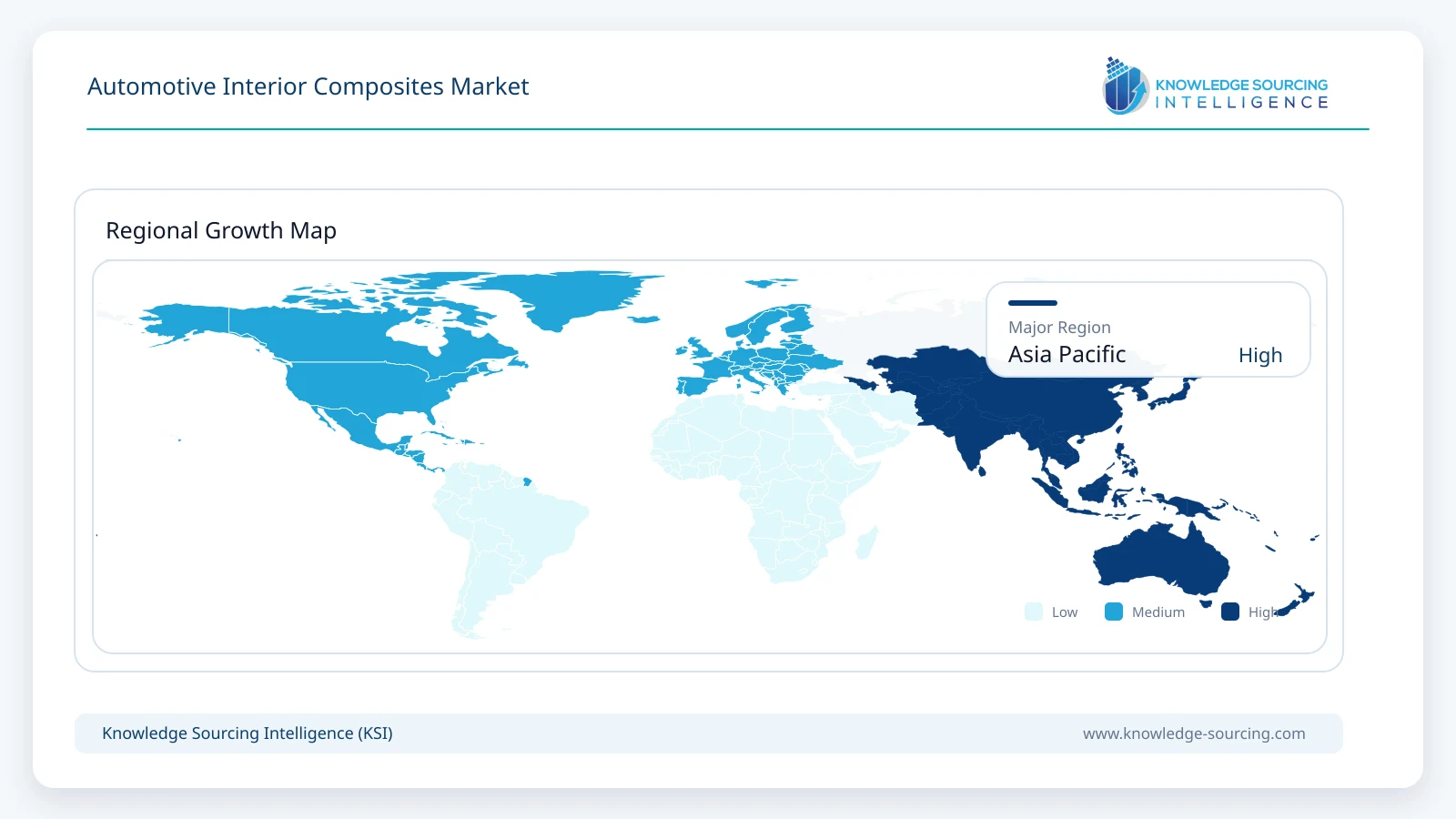
Asia Pacific
Asia Pacific is estimated to account for 47% of the automotive interior composites market in 2026. The region combines the world’s largest vehicle manufacturing base with substantial interior engineering and component conversion capacity in China, Japan, South Korea and India. OICA records stronger 2025 automotive production growth in Asia-Oceania than in Europe or the Americas, supporting the region’s importance as the primary volume center. Toyota Boshoku’s established kenaf composites and continued mono-material door-trim development also demonstrate the depth of regional expertise in reinforced and layered interior systems.
Asia Pacific market value is projected to reach approximately USD 2.92 billion in 2031. China contributes a large share of additional vehicle-platform demand, while India is expected to increase its share through manufacturing growth and broader interior content. Japanese and South Korean suppliers remain important technology and qualification centers. The region’s competitive position reflects production scale and relatively diverse vehicle architectures, from cost-sensitive compact cars to electronics-rich premium cabins.
Europe
Europe accounts for an estimated 25% of global interior composite value in 2026 and retains a strong role in premium cabin materials, headliner technology, fiber composites and vehicle sustainability engineering. Antolin operates an extensive overhead and door-system portfolio and reports increased commercial adoption of sustainable headliner solutions. FORVIA and specialist natural-fiber developers also contribute to European activity in renewable reinforcement and molded visible surfaces. European procurement standards place substantial weight on traceability, emissions performance and documented material recovery routes.
European interior composite value is projected to reach approximately USD 1.43 billion in 2031, with growth influenced more by composite content and material substitution than by rapid regional vehicle-production expansion. Regulation (EU) 2026/1738 adds pressure to improve design for recycling and recycled-plastic documentation as its provisions become applicable. The strongest opportunities are expected in recoverable headliner systems, lower-emission thermoplastics and reinforced substrates that combine stiffness with reduced material mass.
Competitive Landscape
Automotive interior composites are supplied through a layered competitive structure involving polymer compounders, fiber-material developers and automotive interior-system manufacturers. SABIC and Celanese compete in reinforced thermoplastic formulations, while FORVIA, Antolin and Toyota Boshoku integrate material systems into qualified cabin structures. FlexForm supplies composite mats and boards for downstream molding, and Autoneum develops engineered fiber technologies used in acoustic and comfort components. Supplier differentiation depends on validated performance, local production, tooling capability, customer-platform access and quality consistency.
FORVIA and Toyota Boshoku retain established natural-fiber programs, while Antolin has broad headliner and door-system manufacturing capabilities. Autoneum’s Polestar and PET-based projects show how acoustic design and end-of-life performance influence material choices. Specialty players including Bcomp and SGL Carbon develop higher-value flax reinforcement and prepreg systems, although large-scale penetration of premium visible composites remains dependent on individual OEM programs. Competitive positions should be judged through product capabilities and validated application scope rather than unavailable standalone composite revenue shares.
Recent Developments
April 2026: Toyota Boshoku exhibited an all-olefin mono-material door-trim concept at Auto China 2026. The prototype targets simplified recovery of substrates, covering layers and associated materials, highlighting recycling pressure on mixed-composite interior construction.
April–May 2026: Antolin published its 2025 operating and sustainability results, reporting that sustainable-headliner revenue doubled during 2025. The disclosure indicates commercial program adoption of recycled and lower-impact overhead constructions, without identifying the value of composite-only sales.
January 2026: SGL Carbon and the BMW Group received a JEC Innovation Award for a flax-based composite project. SGL Carbon developed the resin and prepreg platform for qualified visible interior and exterior components, supporting specialty natural-fiber processing capability.
December 2025: Autoneum confirmed polyester-based components on the Polestar 5 program, including under-cockpit Hush Panels. The announcement provides a production-program example of integrated acoustic design and recoverable polymer-fiber systems.
July 2025: Autoneum introduced Flexi-Light PET for shaped carpet and inner-dash acoustic applications. The predominantly recycled-PET fiber system demonstrates alternative lightweight insulation construction and improved material recovery potential.
June 2025: FORVIA introduced NAFILean Vision with renewable fillers for visible automotive parts. The injection-moldable composite family expands the development range beyond conventional concealed carriers, with serial program uptake still subject to qualification.
Market Outlook
The automotive interior composites market is driven by increasing composite content per vehicle, integrated reinforced carriers and broader adoption of engineered fiber and recoverable laminate systems. Glass- and mineral-fiber thermoplastics should remain the leading material platform, while natural-fiber composites gain traction in door panels, headliners and selected visible component applications.
Injection-molded reinforced substrates are expected to grow faster than the overall market as thin-wall design and integrated features broaden processing efficiency. Antolin, FORVIA, Toyota Boshoku, Autoneum and specialist material companies will continue competing on component validation, recyclability, appearance, acoustic response and cost. Asia Pacific remains the largest regional demand center, while European supplier activity is likely to focus on circularity, premium materials and better end-of-life recovery. Commercial growth will favor technologies that deliver measurable performance improvements within the cost and qualification constraints of mass vehicle production.
Automotive Interior Composites Market Scope:
| Report Metric | Details |
|---|---|
| Total Market Size in 2026 | USD 3.78 billion |
| Total Market Size in 2031 | USD 5.96 billion |
| Forecast Unit | USD Billion |
| Growth Rate | 9.53% |
| Study Period | 2021 to 2031 |
| Historical Data | 2021 to 2024 |
| Base Year | 2025 |
| Forecast Period | 2026 – 2031 |
| Segmentation | Composite Platform, Matrix and Binder System, Application, Manufacturing Process |
| Companies |
|
Market Segmentation
By Composite Platform
Glass- and Mineral-Fiber Reinforced Thermoplastics
Natural-Fiber Reinforced Composites
Engineered Fiber-Bonded Nonwoven Composites
Foam-Fiber Sandwich Laminates
Carbon-Fiber and Specialty Hybrid Laminates
By Matrix and Binder System
Thermoplastic-Matrix Composites
Polyurethane and Other Thermoset Composites
Binder-Bonded and Multilayer Hybrid Systems
By Application
Door, Side and Pillar Substrates
Instrument Panel and Console Carriers
Headliner and Roof Substrates
Floor, Inner-Dash and Acoustic Composite Panels
Seat-Back, Parcel-Shelf and Cargo Panels
By Manufacturing Process
Injection Molding and Overmolding
Compression Molding and Thermoforming
Lamination and Foam-Composite Consolidation
Other Qualified Composite Processes
By Vehicle Type
Passenger Vehicles
Light Commercial Vehicles
Medium and Heavy Commercial Vehicles and Buses
By Geography
North America
United States
Canada
Mexico
South America
Brazil
Argentina
Others
Europe
Germany
United Kingdom
France
Italy
Spain
Others
Middle East and Africa
Saudi Arabia
UAE
South Africa
Others
Asia Pacific
China
Japan
South Korea
India
Indonesia
Thailand
Others
Table of Contents
1. EXECUTIVE SUMMARY
1.1. Key Findings
1.2. Automotive Interior Composites Market Size, 2026–2031
1.3. Composite Platform Outlook
1.4. Application and Technology Outlook
1.5. Regional Opportunity Summary
2. MARKET SNAPSHOT
2.1. Market Overview
2.2. Market Definition
2.3. Scope of the Study
2.4. Market Segmentation
3. BUSINESS LANDSCAPE
3.1. Market Drivers
3.1.1. Weight Reduction without Compromising Interior Performance
3.1.2. Higher Composite Content in Integrated Interior Architectures
3.1.3. Expansion of Low-Emission and Sustainable Material Specifications
3.1.4. Automotive Acoustic and Thermal Comfort Requirements
3.1.5. Improving Industrial Economics of Thermoplastic Processing
3.2. Market Restraints
3.2.1. Recycling Complexity in Mixed-Material Composite Structures
3.2.2. Moisture Sensitivity and Property Variation of Natural Fibers
3.2.3. Tooling and Qualification Costs for High-Volume Vehicle Platforms
3.2.4. Trade-Offs between Strength, Weight and Surface Finish
3.2.5. Price and Supply Volatility across Reinforcement Systems
3.3. Market Opportunities
3.4. Porter’s Five Forces Analysis
3.5. Industry Value Chain Analysis
3.6. Policies and Regulations
3.7. Strategic Recommendations
4. TECHNOLOGICAL OUTLOOK
4.1. Long-Fiber Thermoplastic Compounds
4.2. Natural-Fiber and Hybrid Reinforcement
4.3. Engineered Nonwoven Composite Substrates
4.4. Foam-Fiber Sandwich and Headliner Construction
4.5. Compression Molding, Thermoforming and Overmolding
4.6. Composite Recyclability and Low-Emission Formulations
5. AUTOMOTIVE INTERIOR COMPOSITES MARKET BY COMPOSITE PLATFORM
5.1. Introduction
5.2. Glass- and Mineral-Fiber Reinforced Thermoplastics
5.3. Natural-Fiber Reinforced Composites
5.4. Engineered Fiber-Bonded Nonwoven Composites
5.5. Foam-Fiber Sandwich Laminates
5.6. Carbon-Fiber and Specialty Hybrid Laminates
6. AUTOMOTIVE INTERIOR COMPOSITES MARKET BY MATRIX AND BINDER SYSTEM
6.1. Introduction
6.2. Thermoplastic-Matrix Composites
6.3. Polyurethane and Other Thermoset Composites
6.4. Binder-Bonded and Multilayer Hybrid Systems
7. AUTOMOTIVE INTERIOR COMPOSITES MARKET BY APPLICATION
7.1. Introduction
7.2. Door, Side and Pillar Substrates
7.3. Instrument Panel and Console Carriers
7.4. Headliner and Roof Substrates
7.5. Floor, Inner-Dash and Acoustic Composite Panels
7.6. Seat-Back, Parcel-Shelf and Cargo Panels
8. AUTOMOTIVE INTERIOR COMPOSITES MARKET BY MANUFACTURING PROCESS
8.1. Introduction
8.2. Injection Molding and Overmolding
8.3. Compression Molding and Thermoforming
8.4. Lamination and Foam-Composite Consolidation
8.5. Other Qualified Composite Processes
9. AUTOMOTIVE INTERIOR COMPOSITES MARKET BY VEHICLE TYPE
9.1. Introduction
9.2. Passenger Vehicles
9.3. Light Commercial Vehicles
9.4. Medium and Heavy Commercial Vehicles and Buses
10. AUTOMOTIVE INTERIOR COMPOSITES MARKET BY GEOGRAPHY
10.1. North America
10.1.1. By Composite Platform
10.1.2. By Application
10.1.3. By Country
10.1.3.1. United States
10.1.3.2. Canada
10.1.3.3. Mexico
10.2. South America
10.2.1. By Composite Platform
10.2.2. By Application
10.2.3. By Country
10.2.3.1. Brazil
10.2.3.2. Argentina
10.2.3.3. Others
10.3. Europe
10.3.1. By Composite Platform
10.3.2. By Application
10.3.3. By Country
10.3.3.1. Germany
10.3.3.2. United Kingdom
10.3.3.3. France
10.3.3.4. Italy
10.3.3.5. Spain
10.3.3.6. Others
10.4. Middle East and Africa
10.4.1. By Composite Platform
10.4.2. By Application
10.4.3. By Country
10.4.3.1. Saudi Arabia
10.4.3.2. UAE
10.4.3.3. South Africa
10.4.3.4. Others
10.5. Asia Pacific
10.5.1. By Composite Platform
10.5.2. By Application
10.5.3. By Country
10.5.3.1. China
10.5.3.2. Japan
10.5.3.3. South Korea
10.5.3.4. India
10.5.3.5. Indonesia
10.5.3.6. Thailand
10.5.3.7. Others
11. COMPETITIVE ENVIRONMENT AND ANALYSIS
11.1. Major Players and Strategy Analysis
11.2. Market Share Analysis
11.3. Mergers, Acquisitions, Agreements and Collaborations
11.4. Competitive Dashboard
12. COMPANY PROFILES
12.1. FORVIA SE
12.2. Antolin
12.3. Toyota Boshoku Corporation
12.4. Autoneum Holding AG
12.5. SABIC
12.6. Celanese Corporation
12.7. FlexForm Technologies, LLC
12.8. Covestro AG
12.9. BASF SE
12.10. International Automotive Components Group
12.11. Bcomp Ltd.
12.12. SGL Carbon SE
13. APPENDIX
13.1. Currency
13.2. Assumptions
13.3. Base and Forecast Years Timeline
13.4. Key Benefits for Stakeholders
13.5. Research Methodology
13.6. Abbreviations
Navigate
Trusted by the world's leading organizations











