
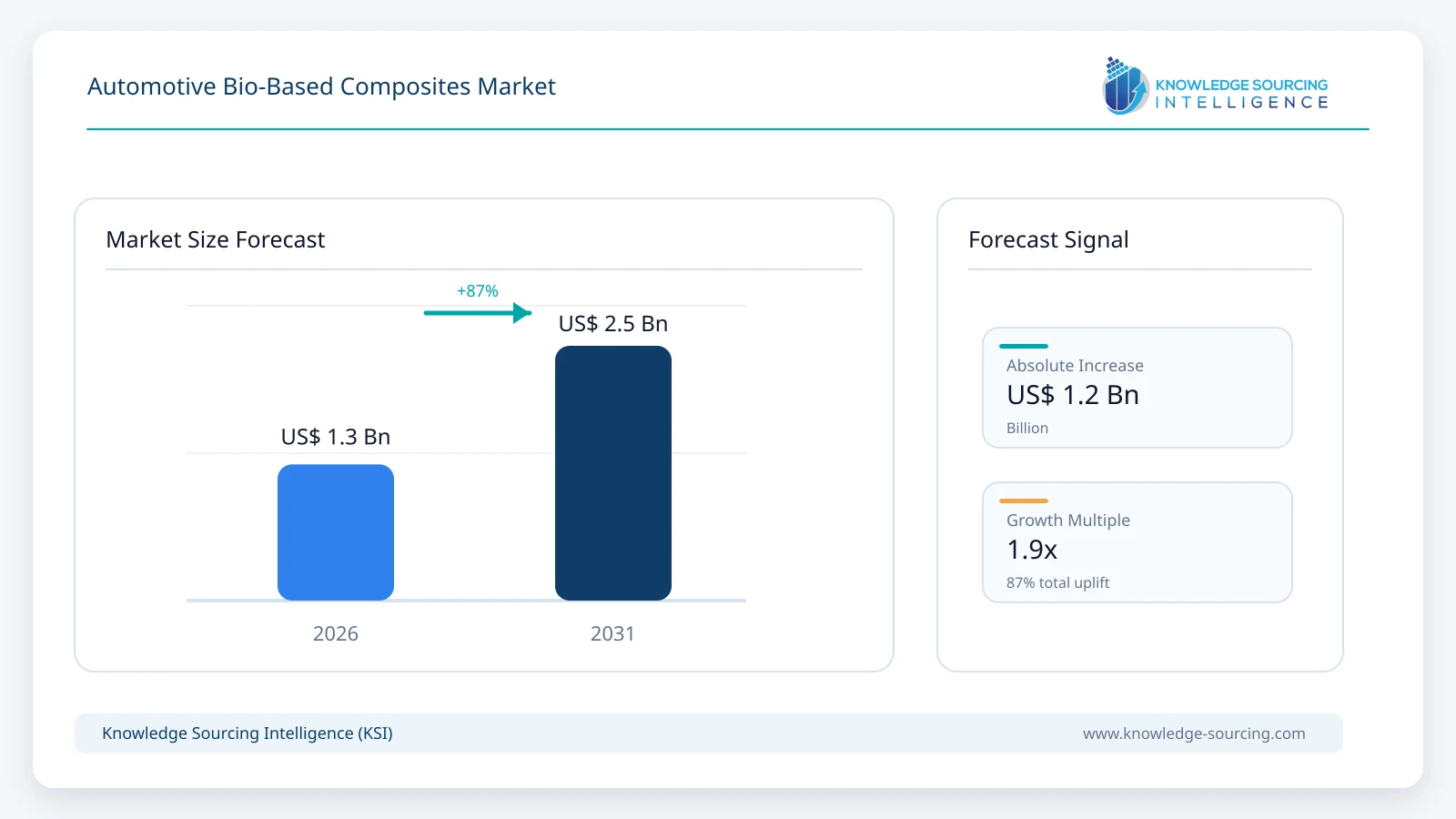
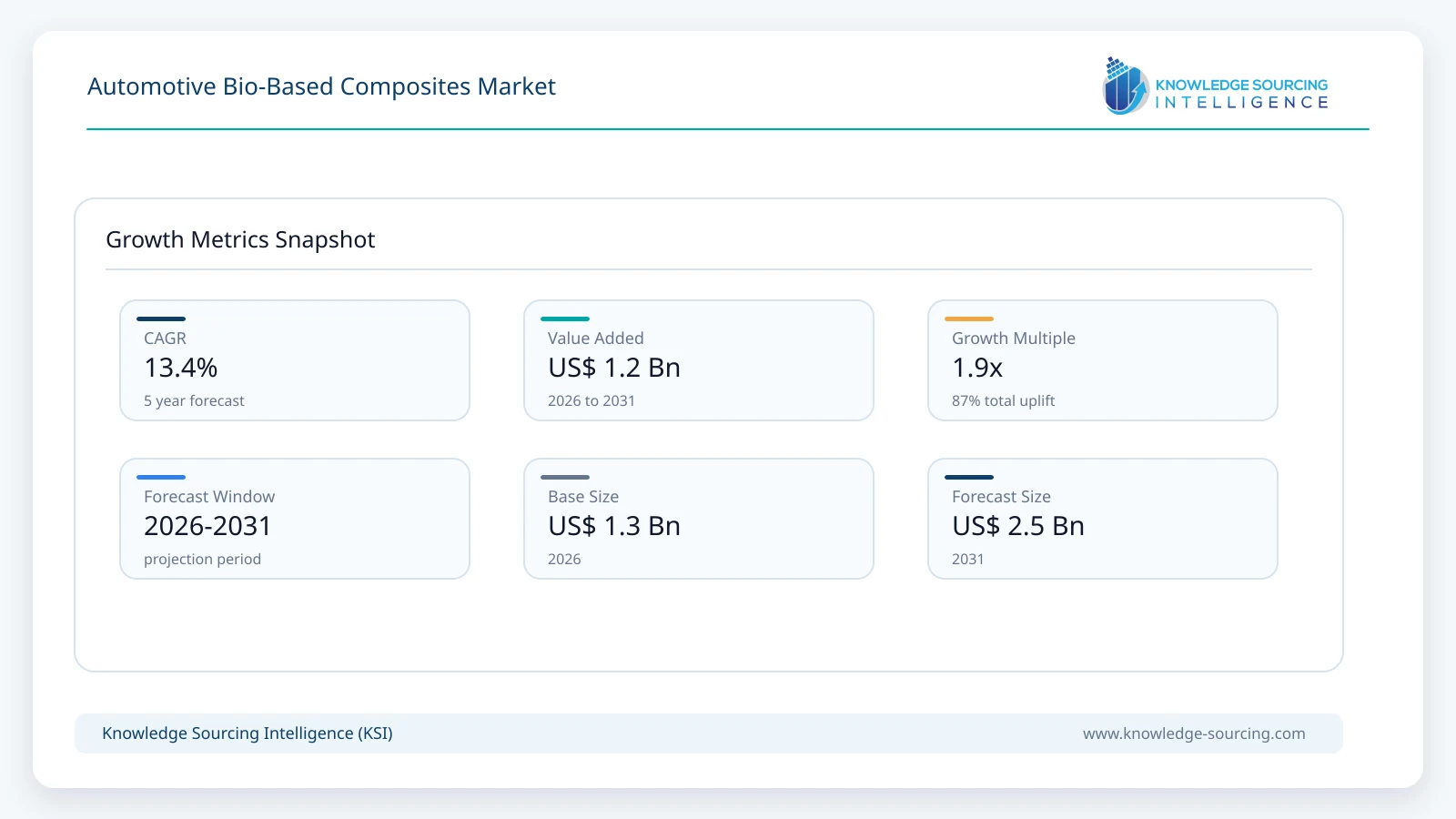
The Automotive Bio-Based Composites Market is forecast to grow at a CAGR of 13.4%, reaching USD 2.47 billion in 2031 from USD 1.32 billion in 2026.
Highlights:
- 1Natural-fiber thermoplastic compounds are estimated to account for 36% of global bio-based composite material value in 2026, reflecting high-volume injection-molded interior applications.
- 2Door, pillar and instrument-panel substrates represent approximately 44% of 2026 market value and remain the principal commercial application through 2031.
- 3Asia Pacific accounts for an estimated 38% of global value in 2026, supported by automotive production scale and established Japanese natural-fiber component technologies.
- 4Flax prepregs and other performance-oriented natural-fiber laminates gain share as qualification extends from motorsport into premium exterior and visible components.
- 5European vehicle-circularity regulation increases scrutiny of product composition and end-of-life recovery, but the 2026 regulation does not immediately mandate bio-based plastic content.
- 6Renewable content does not establish biodegradability or recyclability; full formulations and component designs determine recovery performance.
The market includes automotive-ready composites containing verified biological reinforcement, natural particulate fillers, or bio-derived polymer matrices. Product forms include injection-moldable fiber compounds, thermoplastic compression sheets, fiber-resin prepregs and qualified hybrid substrates used inside and outside vehicles. Fiber treatment, polymer compatibility and production yield strongly influence conversion costs and the price premium available to automotive composite suppliers.
Mature products provide a practical starting point for the forecast. FORVIA uses hemp-reinforced polypropylene in the Renault 5 E-Tech instrument-panel carrier, and Toyota Boshoku supplies kenaf-based door-trim substrates across established vehicle programs. BMW Group has also reached series-production maturity with flax-based composites suitable for visible exterior and interior parts. The range of programs places renewable reinforcement in several distinct automotive performance categories.
Market Overview
Automotive bio-based composites combine a continuous polymer phase with biological fibers, particles, or a renewable resin matrix. Commercial systems frequently incorporate kenaf, hemp, flax, wood fiber or cellulose with polypropylene and related polymers, while specialized programs may use bio-derived polyamides or other resins as part of reinforced structures. Composites must meet vehicle-specific requirements for impact resistance, fatigue, dimensional stability, heat aging, odor and moisture exposure.
FORVIA has developed the NAFILean family for automotive injection molding, including NAFILean-R with 20% hemp reinforcement and recycled polypropylene. The Renault 5 E-Tech uses the material in an instrument-panel carrier, and FORVIA identifies a 20% weight reduction against a conventional comparison material for that application. Toyota Boshoku uses kenaf in compression-formed door carriers and has developed compatible resin-processing technology. Production experience in both systems demonstrates the importance of fiber-polymer bonding and repeatable tooling rather than simple substitution of plant fibers for mineral reinforcement.
Composite architecture varies substantially across applications. FlexForm supplies bast-fiber thermoplastic mats and boards for door, headliner, seat-back, and luggage-area parts, while UPM Formi combines cellulose fibers with polypropylene for injection-molded products. Antolin also develops headliner systems incorporating natural fibers and lower-impact substrates. In more demanding applications, BMW and Bcomp use flax-based reinforcements with dedicated resins and coatings to achieve durability and exterior finish requirements.
Bio-derived polymer chemistry creates an adjacent route to market development. Arkema manufactures castor-oil-based PA11 and has developed reinforced composite material technologies, although not every PA11 automotive component qualifies as a composite. Reinforced bio-derived resin systems can improve heat and chemical performance, but automotive economics depend on the finished composite formulation and application.
Market Trends
Natural-Fiber Thermoplastics Are Expanding Beyond Concealed Substrates
Interior carriers historically account for much of natural-fiber composite consumption because non-visible panels can accommodate the texture and color variation of biological reinforcement. FORVIA introduced NAFILean Vision in June 2025 to extend renewable fillers into visible decorative components using injection molding. The material family incorporates up to 25% renewable biomass and offers finishes intended to reduce separate painting or film-processing stages. Commercial scale will depend on program awards and appearance consistency, but visible-grade development increases the potential value of each qualified part.
Flax Reinforcement Is Moving into High-Performance Exterior Designs
BMW Group announced series-production maturity for flax composite technology in June 2025 after multi-year work with Bcomp and other engineering partners. The development addresses demanding visible surface applications and automotive roof requirements rather than only low-load trim. SGL Carbon contributes resin and prepreg processing to the BMW program, while coating technology helps manage climate exposure and visual appearance. Such qualifications improve the prospects for premium exterior panels, although the addressable volumes remain smaller than those of mainstream injection-molded cabin substrates.
Hybrid Bio-Based and Recycled Feedstocks Are Increasingly Combined
Renewable reinforcement can coexist with mechanically recycled thermoplastics without becoming a separate additive market value. FORVIA combines hemp with recycled polypropylene in NAFILean-R, aligning lower virgin-resin consumption with light part construction. Composite recyclability nevertheless depends on the complete formulation, fiber loading, contaminants and material separation arrangements. This favors suppliers that control feedstock sorting, compounding and component qualification within the same development program.
Manufacturing Economics Are Shaping Technology Selection
Compression molding remains suitable for broad-area nonwoven composite sheets, while injection molding supports complex geometry, integrated ribs and high-volume interior carriers. Prepreg lay-up and resin-transfer processes offer stronger performance for specific high-value parts but generally require more demanding process control. FlexForm emphasizes low-pressure shaping for multi-layer natural-fiber mats, whereas the BMW collaboration addresses coating and resin-related durability for exposed flax components. The manufacturing route therefore influences achievable selling price, cycle time and adoption as much as the percentage of renewable content.
Segment Analysis
By Composite Platform: Natural-Fiber Thermoplastic Compounds
Natural-fiber thermoplastic compounds account for approximately 36% of estimated 2026 market value, reflecting application in injection-molded instrument-panel carriers, trim supports and other interior parts. Hemp and kenaf can reduce polymer usage and contribute stiffness when fiber treatment, dispersion and coupling chemistry are optimized. FORVIA has established this processing route through the NAFILean portfolio, while Toyota Boshoku uses related reinforcement principles in mature interior products. Continued growth is supported by vehicle-program repetition and improvements in visible finishes, although injection-molding performance differs materially by fiber type and loading.
By Bio-Based Feedstock: Kenaf and Hemp
Kenaf and hemp together represent an estimated 47% of composite-material value in 2026, supported by existing door-panel and cockpit applications. Toyota Boshoku has maintained kenaf automotive expertise since 2000, and FORVIA has integrated hemp-reinforced composites across multiple European programs. The combined share gradually moderates as flax-based exterior systems and other specialized feedstocks develop from smaller bases.
By Application: Door, Pillar and Instrument-Panel Substrates
Door, pillar and cockpit substrates form the largest application group because broad panel surfaces require stiffness and mounting-point strength without the severe mechanical loading of chassis parts. The segment represents approximately 44% of global bio-based composite value in 2026. FORVIA and Toyota Boshoku offer commercial evidence of fiber-reinforced carriers, while FlexForm supplies conformable natural-fiber mats for multiple interior panel designs. Exterior panels gain relative share over the forecast period, but high-volume vehicle interiors remain the principal source of material demand.
By Manufacturing Process: Injection Molding and Overmolding
Injection molding and overmolding account for an estimated 38% of 2026 sales, closely following compression molding and thermoforming. Injection processes suit complex undercuts, clips and reinforcement ribs and can reduce secondary joining operations where tools are adapted to fiber-filled compounds. FORVIA’s visible-grade bio-composites extend injection molding into decorative surfaces, while compression sheets remain competitive for broad-area interior substrates. Differentiated process growth reflects part geometry and cycle-time requirements rather than a universal shift toward a single production method.
By Vehicle Type: Passenger Vehicles
Passenger vehicles account for an estimated 88% of 2026 market demand because cars and utility vehicles provide the largest production base and the widest range of interior trim surfaces. Premium passenger programs also provide early development opportunities for costlier flax-based exterior structures. Light commercial vehicles use bio-based sheets in cabins and parcel-area trim, while medium and heavy vehicles provide more limited but technically credible applications in larger interior panels. Passenger vehicles are projected to remain dominant as additional renewable composite designs enter mainstream platforms.
Market Drivers
OEM Programs to Reduce Material-Related Lifecycle Emissions
Automakers increasingly evaluate component-related emissions alongside direct manufacturing expenditure, especially for high-volume polymer-intensive interior parts. FORVIA reports deployment of NAFILean across more than six million Stellantis vehicles and identifies renewable feedstock use within those programs. Replacing part of the virgin polymer or traditional reinforcement creates a measurable route to lower material-related emissions when lifecycle methodology and feedstock origin are documented.
Lightweighting Requirements across Passenger and Electric Vehicles
Vehicle mass continues to influence efficiency, range and handling, even when electric propulsion replaces conventional engines. FORVIA cites a 20% material-related weight saving for the NAFILean-R instrument-panel application, and BMW identifies lightweight engineering as a principal rationale for flax-reinforced composites. Material advantages depend on a comparable part geometry and performance specification rather than fiber density in isolation. Successful programs can extend composite content into new functions, increasing eligible material value per vehicle.
Established Kenaf, Hemp and Cellulose Supply Capability
High-volume composite adoption requires stable fiber preparation and predictable mechanical performance across repeated production batches. Toyota Boshoku’s longstanding kenaf applications and FlexForm’s bast-fiber product families demonstrate that bio-based reinforcement can be processed at automotive manufacturing scale. Agricultural residues and cultivated fibers offer multiple sourcing options, although specification control remains necessary.
Progress in Surface Finish and Exposure Resistance
Visible interior trim and exterior panels demand appearance stability that concealed composite substrates have not historically needed to provide. FORVIA’s NAFILean Vision addresses color and texture through renewable-filled injection molding, while the BMW–Bcomp program combines flax reinforcement with resin and coating solutions for exposed parts. Each advance expands the range of parts for which OEM designers can consider a bio-based composite. Program-specific exposure testing remains essential before such developments translate into sustained production orders.
Automotive Material Circularity and Design Requirements
Vehicle makers face greater scrutiny of material composition, dismantling practices and end-of-life handling in major automotive markets. Regulation (EU) 2026/1738 entered into force in August 2026, with broad application from September 2028, and places additional attention on circular vehicle design. The legislation does not establish an immediate bio-based composite quota, but improved material records and disassembly strategies can favor suppliers with transparent feedstock and recycling practices. Renewability and recyclability must be assessed independently in sourcing decisions.
Market Restraints
Moisture Sensitivity and Long-Term Material Stability
Natural fibers absorb moisture and can swell or lose interfacial performance when exposed to repeated humidity and temperature cycling. Exposed components are especially sensitive because surface appearance, dimensional stability and coating adhesion must remain consistent through vehicle service. The BMW flax-composite program required coordinated resin, coating and testing development to address demanding automotive conditions. Additional qualification expense can delay adoption compared with established glass-fiber or mineral-filled polymers.
Variable Agricultural Feedstock Quality
Fiber length, cleanliness, moisture content and chemical composition vary with crop origin, harvesting and preparation methods. Such variation affects molding behavior and can alter mechanical properties across production lots. Suppliers must introduce grading, drying, treatment and traceability procedures to achieve automotive repeatability. Higher preparation costs narrow the economic advantage of bio-based fillers where conventional polymers are inexpensive.
Limited Suitability for High-Temperature and Safety-Critical Parts
Plant-fiber composites are not direct replacements for every glass-fiber, carbon-fiber or metal vehicle component. High-temperature engine-area service, severe crash loading and prolonged chemical exposure may require polymer and reinforcement combinations that provide greater margins. Bio-derived resins can extend performance in selected applications, but the material must be assessed as a complete composite.
Qualification Cost and Manufacturing Complexity
New automotive materials require evidence for odor, flammability, emissions, aging, impact performance and process repeatability before an OEM can approve serial use. Natural-fiber feeding, compound drying and tooling conditions may differ from those used for standard mineral-filled polymers. Small specialty programs often cannot amortize these development costs as efficiently as established high-volume trim applications. Supplier scale and multi-program qualification therefore influence the pace of market conversion.
End-of-Life Recycling and Mixed-Material Separation
Composite structures can complicate end-of-life recycling when biological reinforcement, polymer additives and bonded layers are difficult to separate. Bio-based content does not automatically make a finished automotive composite biodegradable or compatible with all mechanical recycling streams. Vehicle makers must consider material identification, disassembly and recyclate quality at the design stage. Recycling uncertainty can reduce purchasing interest despite potential benefits in feedstock origin and component weight.
Regional Outlook
Asia Pacific
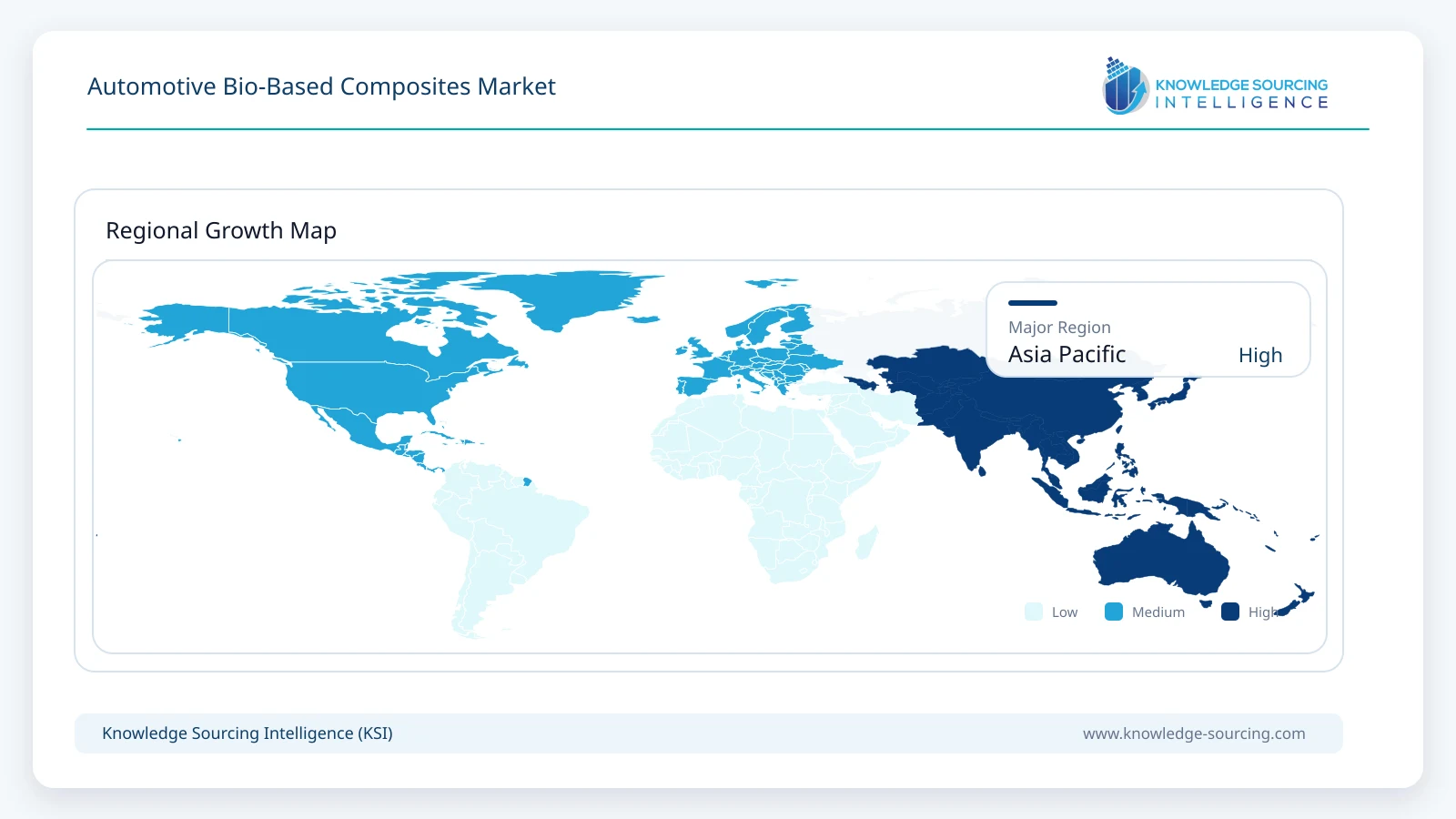
Asia Pacific is estimated to represent 38% of global automotive bio-based composite revenue in 2026, supported by vehicle production in China, Japan, India, South Korea and Southeast Asia. Toyota Boshoku’s kenaf door-trim technology provides evidence of long-term Japanese production capability, while Asian component converters serve vehicle programs requiring complex injection-molded and compression-formed structures. Material qualification is increasingly relevant as global platforms specify similar performance across manufacturing regions. Growth depends on both regional production volumes and uptake of higher-value renewable composite formulations.
The Asia Pacific market is projected to reach approximately USD 1.01 billion by 2031 as qualifying material content increases and suppliers introduce renewable reinforcement into additional automotive programs. China and India contribute to volume growth, while Japanese material engineering remains influential in long-established interior applications. Price-sensitive vehicle platforms will continue to favor thermoplastic and compression-molded systems over costlier exposed-surface laminates.
Europe
Europe accounts for approximately 36% of global value in 2026 and has a strong position in flax-reinforcement development, hemp compounds and advanced composite processing. FORVIA and its MATERI’ACT business provide established bio-composite materials, while Bcomp and SGL Carbon participate in the BMW flax-composite program. European material qualification combines weight and surface requirements with increasing attention to traceability and end-of-life treatment. The presence of specialized resin, reinforcement and converter expertise supports higher-value development applications.
Europe is projected to approach USD 0.84 billion by 2031, with growth in both visible-grade interior compounds and selected exterior fiber laminates. Regulation (EU) 2026/1738 should encourage more transparent material and recyclability assessments as implementation proceeds, although recycled-plastic obligations must not be confused with a requirement for renewable reinforcement. European suppliers are likely to remain important in high-performance composite engineering even as regional revenue share eases slightly.
Competitive Landscape
Competition spans plant-fiber processors, polymer compounders, preform manufacturers, composite converters and tier-one interior suppliers. FORVIA and Toyota Boshoku possess established vehicle-program expertise; FlexForm, UPM and Autoneum supply fibrous or compounded material platforms; and Bcomp, SGL Carbon and Cobra Advanced Composites participate in advanced flax-composite systems. Antolin contributes headliner and instrument-panel material conversion capabilities, while NPSP develops specialty natural-fiber composite components. Direct material sales are less visible than the broader automotive-systems revenues of multinational suppliers.
Qualification depth is becoming a stronger differentiator than biological content alone. Material developers must demonstrate repeatable impact performance, odor control, aging resistance, appearance and tool stability at the relevant production cycle. Experienced converters can reduce introduction risk by aligning composite formulations with part design and existing manufacturing equipment.
Recent Developments
August 2026: EU Regulation 2026/1738 entered into force, revising requirements for circular vehicle design and end-of-life management. The measure will influence composite documentation and recovery practices as application dates arrive; the regulation does not create an immediate mandatory bio-based polymer share.
June 2026: NPSP reported manufacturing bamboo-fiber EV components with partly and fully bio-based resin options, claiming mass savings against an aluminum comparator. The demonstration extends bio-composite evaluation into EV component designs, although volume production has not been confirmed.
January 2026: SGL Carbon confirmed its role in the award-winning BMW M natural-fiber composites program, including resin and prepreg materials for flax reinforcement. SGL Carbon’s prepreg work addresses production readiness for demanding exposed-surface parts.
October 2025: FORVIA reported that its NAFILean hemp-based composite had been integrated across ten Stellantis programs since 2013, with more than six million vehicles on the road. The cumulative program history confirms established automotive adoption without indicating current annual market sales.
June 2025: FORVIA introduced NAFILean Vision, extending the NAFILean material family into decorative injection-molded surfaces with renewable biomass fillers and reduced post-processing requirements.
June 2025: BMW Group announced that its flax-based natural-fiber composite technology had reached series-production maturity for future model applications, including qualified visible and roof-component uses.
Market Outlook
The automotive bio-based composites market is projected to reach USD 2.47 billion by 2031 as established natural-fiber thermoplastics gain content per vehicle and higher-value flax and bio-resin systems enter additional components. Door and cockpit substrates should remain the largest application because existing tooling and vehicle-program evidence support repeatable production. Exterior and semi-structural composite applications are expected to grow faster from a much smaller base, subject to temperature, aging, appearance, and cost qualification.
Material selection will remain application-specific. High-volume interior components favor low-cost reinforcement and short molding cycles, while visible premium panels justify more elaborate resin and surface systems. Competition should favor suppliers with dependable feedstock preparation, automotive testing capabilities, and regional conversion capacity. Manufacturers will also need to substantiate renewable content and assess recycling performance separately, particularly in markets introducing stronger circularity obligations.
Automotive Bio-Based Composites Market Scope:
| Report Metric | Details |
|---|---|
| Total Market Size in 2026 | USD 1.32 billion |
| Total Market Size in 2031 | USD 2.47 billion |
| Forecast Unit | USD Billion |
| Growth Rate | 13.4% |
| Study Period | 2021 to 2031 |
| Historical Data | 2021 to 2024 |
| Base Year | 2025 |
| Forecast Period | 2026 – 2031 |
| Segmentation | Composite Platform, Primary Bio-Based Feedstock, Application, Manufacturing Process |
| Companies |
|
Market Segmentation
By Composite Platform
Natural-Fiber Thermoplastic Compounds
Natural-Fiber Thermoplastic Mats and Sheets
Flax and Other Natural-Fiber Prepregs/Thermosets
Bio-Derived Resin Reinforced Composites
Other Bio-Filled and Hybrid Composites
By Primary Bio-Based Feedstock
Kenaf
Hemp
Flax
Wood Fiber and Cellulose
Other Renewable Fiber, Particulate or Matrix
By Application
Door, Pillar and Instrument-Panel Substrates
Seat Backs, Parcel Shelves and Cargo Panels
Headliners and Functional Acoustic Substrates
Exterior Decorative and Body Panels
Other Under-Hood and Semi-Structural Parts
By Manufacturing Process
Compression Molding and Thermoforming
Injection Molding and Overmolding
Prepreg Lay-Up and Resin Transfer Molding
Other Composite Conversion Processes
By Vehicle Type
Passenger Vehicles
Light Commercial Vehicles
Medium and Heavy Commercial Vehicles and Buses
By Geography
North America
United States
Canada
Mexico
South America
Brazil
Argentina
Others
Europe
Germany
United Kingdom
France
Italy
Spain
Others
Middle East and Africa
Saudi Arabia
UAE
South Africa
Others
Asia Pacific
China
Japan
South Korea
India
Indonesia
Thailand
Others
Table of Contents
1. EXECUTIVE SUMMARY
1.1. Key Findings
1.2. Automotive Bio-Based Composites Market Size and Forecast, 2026–2031
1.3. Composite Platform and Application Outlook
1.4. Regional Opportunity Summary
2. MARKET SNAPSHOT
2.1. Market Overview
2.2. Market Definition
2.3. Scope of the Study
2.4. Market Segmentation
3. BUSINESS LANDSCAPE
3.1. Market Drivers
3.1.1. OEM Programs to Reduce Material-Related Lifecycle Emissions
3.1.2. Lightweighting Requirements across Passenger and Electric Vehicles
3.1.3. Established Kenaf, Hemp and Cellulose Supply Capability
3.1.4. Progress in Surface Finish and Exposure Resistance
3.1.5. Automotive Material Circularity and Design Requirements
3.2. Market Restraints
3.2.1. Moisture Sensitivity and Long-Term Material Stability
3.2.2. Variable Agricultural Feedstock Quality
3.2.3. Limited Suitability for High-Temperature and Safety-Critical Parts
3.2.4. Qualification Cost and Manufacturing Complexity
3.2.5. End-of-Life Recycling and Mixed-Material Separation
3.3. Market Opportunities
3.4. Porter’s Five Forces Analysis
3.5. Industry Value Chain Analysis
3.6. Policies and Regulations
3.7. Strategic Recommendations
4. TECHNOLOGICAL OUTLOOK
4.1. Natural-Fiber Thermoplastic Compounding and Coupling Agents
4.2. Low-Pressure Compression Molding of Bio-Composite Sheets
4.3. Flax Prepregs and Structural Hybrid Laminates
4.4. Bio-Derived Polyamide and Resin Matrix Systems
4.5. Surface Finishing, Moisture Protection and Durability
4.6. Renewable-Content Verification and Composite Recycling
5. AUTOMOTIVE BIO-BASED COMPOSITES MARKET BY COMPOSITE PLATFORM
5.1. Introduction
5.2. Natural-Fiber Thermoplastic Compounds
5.3. Natural-Fiber Thermoplastic Mats and Sheets
5.4. Flax and Other Natural-Fiber Prepregs/Thermosets
5.5. Bio-Derived Resin Reinforced Composites
5.6. Other Bio-Filled and Hybrid Composites
6. AUTOMOTIVE BIO-BASED COMPOSITES MARKET BY PRIMARY BIO-BASED FEEDSTOCK
6.1. Introduction
6.2. Kenaf
6.3. Hemp
6.4. Flax
6.5. Wood Fiber and Cellulose
6.6. Other Renewable Fiber, Particulate or Matrix
7. AUTOMOTIVE BIO-BASED COMPOSITES MARKET BY APPLICATION
7.1. Introduction
7.2. Door, Pillar and Instrument-Panel Substrates
7.3. Seat Backs, Parcel Shelves and Cargo Panels
7.4. Headliners and Functional Acoustic Substrates
7.5. Exterior Decorative and Body Panels
7.6. Other Under-Hood and Semi-Structural Parts
8. AUTOMOTIVE BIO-BASED COMPOSITES MARKET BY MANUFACTURING PROCESS
8.1. Introduction
8.2. Compression Molding and Thermoforming
8.3. Injection Molding and Overmolding
8.4. Prepreg Lay-Up and Resin Transfer Molding
8.5. Other Composite Conversion Processes
9. AUTOMOTIVE BIO-BASED COMPOSITES MARKET BY VEHICLE TYPE
9.1. Introduction
9.2. Passenger Vehicles
9.3. Light Commercial Vehicles
9.4. Medium and Heavy Commercial Vehicles and Buses
10. AUTOMOTIVE BIO-BASED COMPOSITES MARKET BY GEOGRAPHY
10.1. North America
10.1.1. United States
10.1.2. Canada
10.1.3. Mexico
10.2. South America
10.2.1. Brazil
10.2.2. Argentina
10.2.3. Others
10.3. Europe
10.3.1. Germany
10.3.2. United Kingdom
10.3.3. France
10.3.4. Italy
10.3.5. Spain
10.3.6. Others
10.4. Middle East and Africa
10.4.1. Saudi Arabia
10.4.2. UAE
10.4.3. South Africa
10.4.4. Others
10.5. Asia Pacific
10.5.1. China
10.5.2. Japan
10.5.3. South Korea
10.5.4. India
10.5.5. Indonesia
10.5.6. Thailand
10.5.7. Others
11. COMPETITIVE ENVIRONMENT AND ANALYSIS
11.1. Major Players and Strategy Analysis
11.2. Market Share Analysis
11.3. Mergers, Acquisitions, Agreements and Collaborations
11.4. Competitive Dashboard
12. COMPANY PROFILES
12.1. FORVIA SE
12.2. Toyota Boshoku Corporation
12.3. Bcomp Ltd.
12.4. FlexForm Technologies
12.5. UPM-Kymmene Corporation
12.6. SGL Carbon SE
12.7. Cobra Advanced Composites Co., Ltd.
12.8. Antolin
12.9. Autoneum Holding AG
12.10. NPSP B.V.
12.11. Arkema S.A.
12.12. Bambooder Biobased Fibers
13. APPENDIX
13.1. Currency
13.2. Assumptions
13.3. Base and Forecast Years Timeline
13.4. Key Benefits for Stakeholders
13.5. Research Methodology
13.6. Abbreviations
Navigate
Trusted by the world's leading organizations











