
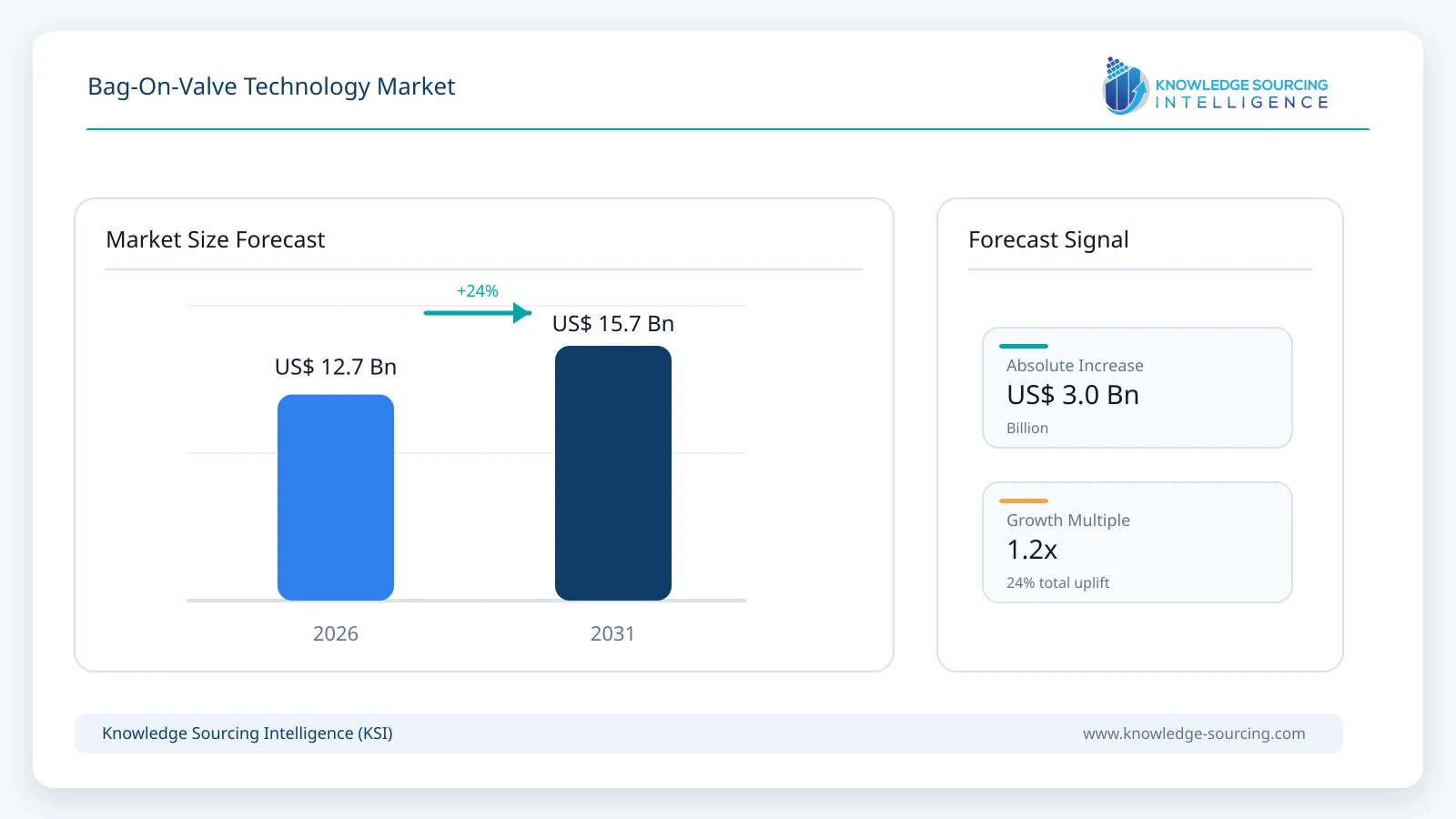
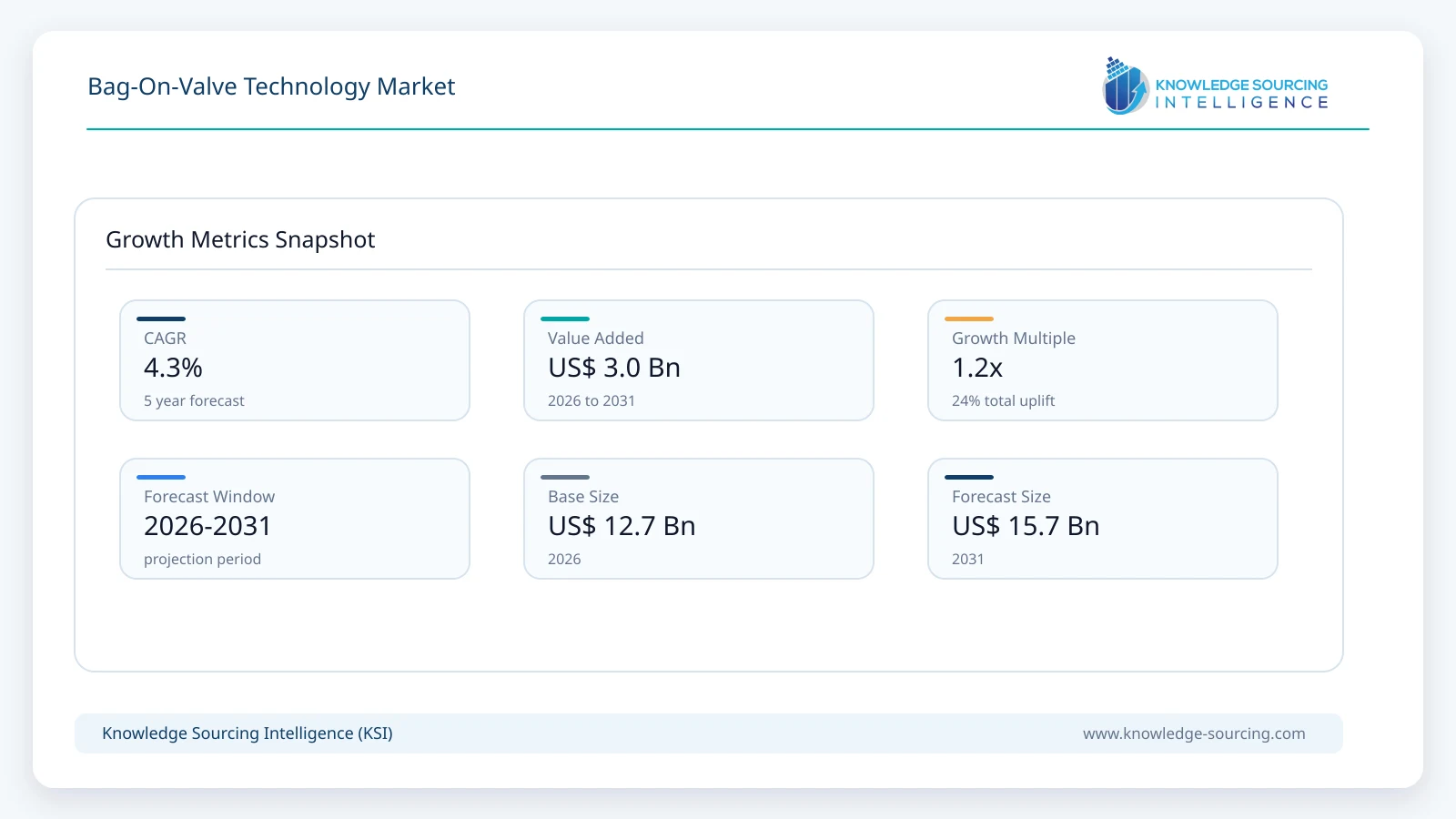
The Bag-On-Valve Technology Market is expected to expand at a CAGR of 4.33%, reaching USD 15.7 billion in 2031 from USD 12.7 billion in 2026.
Highlights:
- 1Cosmetics and personal care remain the largest end-user group, supported by premium spray formats.
- 2Pharmaceutical applications benefit from barrier protection and controlled nasal or topical delivery.
- 3Packs between 100 ml and 250 ml lead consumption across several consumer applications.
- 4Metered bag-on-valve systems expand formulation options requiring defined application quantities.
- 5Europe combines mature aerosol manufacturing with specialist valves, bags and filling expertise.
- 6Compressed-gas dispensing supports product separation but requires careful packaging-design validation.
Report Overview
Bag-on-valve technology is deployed in pressurised packs that retain the product in a sealed laminated bag while compressed gas occupies the space between the pouch and container. The architecture allows spray, jet, foam or gel dispensing across an unusually wide range of container orientations. Relevant supply activities span valves, barrier bags, compatible actuators, qualified containers and contract filling, although these activities occupy different commercial points in the value chain.
Packaging specialists compete on valve reliability, barrier performance, fill speed and compatibility with individual formulations. Pharmaceutical applications demand documented materials, controlled processing and device qualification, whereas cosmetics and household care place greater weight on cost, spray feel, appearance and retail performance. European packaging requirements also raise attention to multi-material design and recyclability. Suppliers with established assembly tooling and technical support can assist brand owners through conversion, product trials and line validation.
Market Overview
The BOV system differs from a conventional aerosol package because the product does not occupy the same chamber as the propellant. A one-inch valve attached to a multilayer pouch is inserted into a metal container; pressurised air or nitrogen then compresses the pouch as the contents are released. Barrier integrity, crimp performance, valve-stem geometry and bag-folding behaviour all affect evacuation and dispensing consistency. LINDAL specifies nearly complete product evacuation for suitable formulations, but actual performance varies with viscosity, pack geometry and operating conditions.
Pharmaceutical and medical-device uses have made BOV an established format for saline nasal sprays, wound irrigation and topical applications. Aptar Pharma markets adjustable flow rates and specialised nasal and dermal actuators, while Aurena Laboratories contract-manufactures medical products using the technology. In consumer applications, product developers evaluate whether a sealed formulation and 360-degree operation improve the practical experience enough to support a higher packaging bill of materials.
Supply is organised around specialist valve manufacturers, packaging converters, filling-equipment providers and contract packers. Coster, Aptar, LINDAL, Summit Packaging Systems and Precision Valve participate in the dispensing-component ecosystem, although their exact product portfolios differ. Qualification of a BOV pack involves cooperation across these parties: valve selection has consequences for pouch construction, container dimensions, pressure testing, fill-line settings, and the spray characteristics seen by the end user.
Market Trends
Metered Dispensing Is Moving BOV Beyond Continuous Spray
Conventional BOV packs provide continuous discharge while the actuator is depressed, a useful feature for saline, protective sprays and personal-care foams. Coster’s mBOV introduces a measured-dose mechanism in the valve through a piston chamber and three-way configuration. Available dose options include 250, 500 and 1,000 microlitres, extending the platform toward products where users require a reproducible application amount rather than an uninterrupted spray.
Product developers can adopt this capability without necessarily replacing an entire filling line, since Coster describes compatibility with standard BOV processes. The commercial significance is strongest for specialised cosmetics and healthcare products where a dosing claim must be supported by testing across the pack’s useful life. Viscosity, droplet profile and the active formulation will still determine whether the design is appropriate.
Nasal and Topical Products Are Driving Application-Specific Actuators
Aptar Pharma’s BOV platform includes soft-spray and jet configurations for nasal care, alongside dermal actuators adapted to gels and sprays. These products illustrate how packaging differentiation can migrate from the barrier bag toward the interface with the user. Actuator geometry and flow characteristics affect treatment comfort, targeting, discharge volume and the ability to apply a formulation hygienically without direct contact.
Healthcare suppliers consequently face more complex qualification requirements than conventional consumer aerosol vendors. Medical-device classification, material documentation, irradiation compatibility and process repeatability can affect purchasing decisions. Aurena’s contract-manufacturing model shows why development and filling competence may be as important as supply of the valve itself, especially for companies entering regulated product categories.
Compressed Gas Is Reshaping Formulation and Environmental Choices
Separating the product from the propellant enables manufacturers to use compressed air or nitrogen in place of hydrocarbon propellants for suitable applications. This can reduce propellant-related volatile organic compound emissions at the point of use, without making the total packaging system automatically low-carbon. The container, multilayer pouch, filling operation and transport all still contribute to environmental performance.
The European Union’s Packaging and Packaging Waste Regulation began applying in August 2026, sharpening scrutiny of packaging composition and end-of-life treatment. For BOV manufacturers, the practical response is better component traceability, design-for-recycling work and evidence that any claimed packaging benefit holds across the entire pack. The strongest commercial propositions combine formulation protection with measurable reductions in waste or handling complexity.
Manufacturing Capacity and Product Qualification Are Becoming Linked
LINDAL previously expanded dedicated BOV manufacturing lines in France and the United States, establishing regional supply points for customers seeking shorter lead times. Its January 2026 Wismar acquisition increases its wider European manufacturing footprint, although the company did not identify that facility as a dedicated BOV plant. These investments matter to brand owners because component availability and quality consistency are crucial during a product’s launch and subsequent volume scale-up.
Packaging conversion projects can involve tooling adjustments, bag welding, crimp sealing, pressure testing and repeated filling trials. Customers that can qualify multiple pack formats with the same supplier may reduce changeover complexity, while suppliers offering application laboratories can retain accounts through technical assistance. Manufacturing capacity alone does not assure commercial adoption unless the chosen pack can be produced reliably at the required line speed.
Segment Analysis
By Packaging Size: 100 ml to 250 ml
The 100 ml to 250 ml category accounts for an estimated 42% of the market in 2026, making it the leading size group in the KSI packaging-size framework. These packs suit saline sprays, sun-care preparations, skin-care products and professional-use formulations that require repeated dispensing but must remain portable. The category accommodates both continuous-discharge and application-specific actuator designs without the very small fill volumes associated with travel packs.
Aurena offers medical and first-aid products across common fills that include 100, 125, 150, 200 and 250 ml, while Summit lists BOV pouch options spanning 75 to 250 ml. That breadth allows brands to adapt a familiar dispensing system to different retail and clinical usage rates. Demand will depend on consumption frequency, container cost and whether compact formats can retain sufficient gas pressure throughout the intended shelf life.
By End-User Industry: Cosmetics and Personal Care
Personal-care manufacturers use BOV to dispense shaving preparations, sunscreens, moisturising mists and gels while protecting the packaged formulation from direct propellant contact. The technology is especially useful for formulations whose texture and consumer handling influence repeat purchases. Aptar Beauty markets BOV valves built around a robust multilayer bag and compressed-gas dispensing, while supplier actuator ranges allow brands to distinguish spray characteristics without changing the core container architecture.
The segment is modelled to reach approximately USD 5.792 billion by 2031. Its market position reflects a broad range of commercial product categories and established aerosol distribution, although healthcare is expected to gain share as application-specific sterile and metered systems become more important. Premium positioning must still translate into retail willingness to pay; a high-performing valve does not eliminate the cost of product qualification, decorated packaging and shelf merchandising.
Market Drivers
Higher Demand for Protected Topical and Nasal Formulations
Aptar Pharma’s BOV platform is used for nasal saline and dermal product formats, where a sealed reservoir helps protect product integrity during repeated use. The design supports non-contact application and can provide practical advantages where a conventional pump requires priming or where an open formulation is susceptible to exposure. Pharmaceutical customers, however, must substantiate any preservative-reduction or sterility claims for the specific product.
These applications create demand for compatible materials, specialised actuators and controlled manufacturing rather than simply larger output of standard aerosol valves. Once a formulation has been qualified, switching to another supplier can require new compatibility and performance testing, encouraging longer procurement relationships with proven system providers.
Greater Formulation Flexibility in Personal Care
Viscous gels, creams, lotions and fine mists place different demands on an aerosol’s dispensing system. BOV enables selected products to be discharged using gas pressure without direct mixing of the formulation and propellant. Coster’s metered system and LINDAL’s barrier-pack portfolio indicate the effort manufacturers are making to extend application range through valve geometry and flow control.
Brands benefit when one platform supports several product variants with familiar packaging equipment. This can improve development economics across skincare, shaving and first-aid lines, provided that bag materials and discharge performance remain compatible with the formulation. Growth is therefore more closely linked to approved application conversions than to an assumed blanket replacement of conventional aerosol formats.
Improved Product Evacuation and Consumer Convenience
The flexible pouch is compressed progressively as gas pressure acts on its outer surface, allowing the product to be dispensed in multiple orientations. Manufacturers report high evacuation rates under suitable test conditions, which can limit residual product and make spray delivery more predictable. The resulting consumer experience has particular relevance for products used in awkward positions or applied directly to skin.
Higher usable product content can support a premium packaging decision, but performance is not identical across all viscosities or fill levels. Valve suppliers must document spray quality and discharge rate from initial actuation to near-empty conditions. Purchasers typically evaluate that evidence against the additional material and filling costs associated with the barrier design.
Expansion of Specialist Filling and Contract-Manufacturing Services
Aurena Laboratories offers BOV contract manufacturing for healthcare and personal-care products, including product development, technical feasibility work and validation before full production. This service model provides a route to market for brand owners without a dedicated BOV filling operation or extensive experience with pressurised packaging. It can be particularly attractive for medical devices and niche consumer formulations.
The complexity of line qualification benefits equipment and service providers able to combine bag welding, propellant filling, pressure checks and packaging compliance. Repeat orders follow when the manufacturer can maintain batch consistency and supply continuity. The business case rests on validated production throughput rather than the mere availability of a contract-filling facility.
Packaging Sustainability and Reduced Propellant-Related Emissions
Compressed air and nitrogen allow appropriate BOV products to avoid conventional hydrocarbon propellants. For companies selling topical sprays, the separation of contents from pressurising gas can contribute to a differentiated formulation and handling proposition. European regulatory changes reinforce the need to document packaging construction, waste handling and substances of concern.
These factors encourage redesign of bags, actuators and containers, but do not automatically make a multilayer BOV package easier to recycle. Suppliers able to demonstrate lower product wastage and acceptable end-of-life performance will be better placed to justify conversion. Regulatory compliance increases the value of technical documentation and repeatable material sourcing.
Market Restraints
Higher Packaging and Filling Cost Than Standard Aerosols
BOV packs require a welded internal pouch, compatible valve components and a controlled pressurisation process. Material costs, assembly steps and pressure testing can exceed those of conventional aerosols using simpler valve systems. For products sold on price-sensitive retail shelves, the incremental cost must be offset by differentiated performance, product protection or lower residual wastage.
Brand owners may also need specialised filling machinery or contract-manufacturing capacity. The cost can be difficult to recover when order sizes are small or product turnover is uncertain. These economics favour applications in which product quality or consumer benefit can support a clear packaging premium.
Barrier-Material Compatibility and Long-Term Stability
Pouch laminates must resist the packaged product while retaining mechanical strength through the intended shelf life. Some solvents, active ingredients and high-viscosity formulations pose challenges for film selection, seam integrity and valve performance. Product developers cannot assume that a bag proven for saline will perform identically with a concentrated cosmetic or specialty chemical formulation.
Compatibility testing, accelerated ageing and transport trials add time before commercial approval. Failures can require changes to pouch construction or valve geometry, restarting parts of the qualification programme. The restraint is especially material for regulated healthcare products, where package integrity must be demonstrated through specified storage conditions.
Complexity of Recycling Multi-Material Packs
Although a metal aerosol container may enter an established recycling stream, BOV packages also contain polymer laminates, seals and valves that are not always readily separated by existing recovery processes. Claims about recyclability must therefore reflect the full pack and the infrastructure available in the country where it is sold. Compressed gas alone does not establish a superior overall environmental footprint.
The European packaging regulation increases the relevance of design-for-recycling evidence. Manufacturers may have to adjust materials or documentation while preserving pressure resistance and product protection. The need to satisfy both performance and end-of-life criteria can slow adoption in price-sensitive or sustainability-led product lines.
Technical Challenges Across Different Flow Rates and Viscosities
A liquid intended for a fine mist and a high-viscosity gel require different discharge geometries, bag behaviour and actuation forces. Inappropriate valve selection can produce uneven spray patterns, difficult evacuation or excessive residual material. Metered dispensing adds a further requirement to maintain dose accuracy as pressure falls during use.
Suppliers therefore conduct formulation-specific trials rather than treating BOV as universally interchangeable with standard aerosol valves. Product designers must balance dose precision, spray feel and acceptable filling speed. This validation effort can delay introductions when multiple formulations share a single commercial packaging launch.
Qualification, Change Control and Supply Concentration
Healthcare customers buying BOV devices or medical sprays require reliable process documentation and traceable material changes. Altering a valve supplier, pouch film or actuator may trigger compatibility, shelf-life or device-performance assessments. These controls can extend project schedules and increase inventory requirements for brands seeking secure supply.
The supplier universe is concentrated in specialist aerosol-component manufacturers and a smaller number of experienced contract packers. Multiple sourcing is therefore not straightforward for proprietary actuators or metered mechanisms. Procurement teams must weigh technical differentiation against the risks of tool ownership, replacement-parts availability and long-term manufacturing continuity.
Regional Outlook
Europe
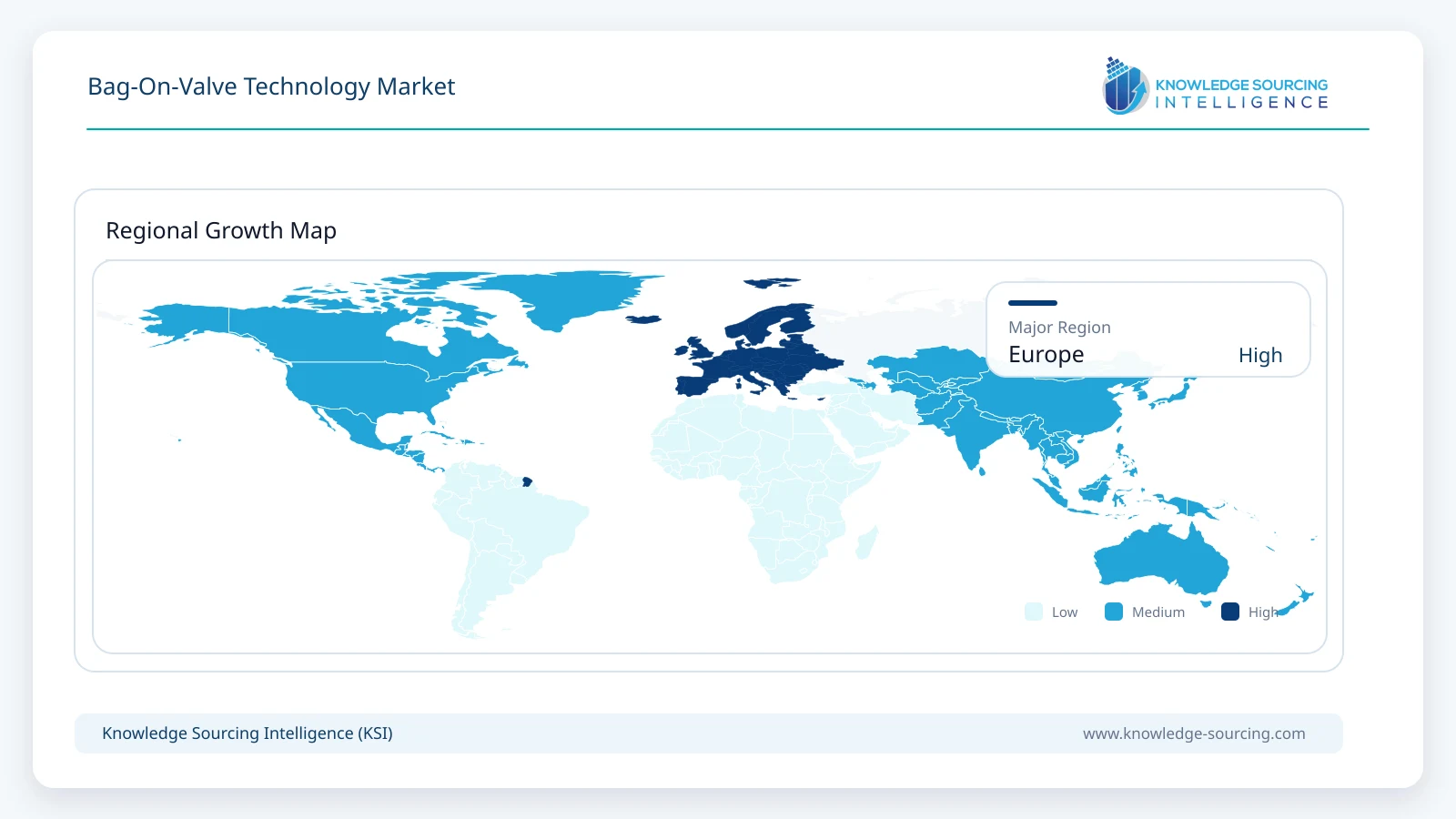
Europe accounts for an estimated 36% of market value in 2026, supported by established aerosol production and the presence of specialist dispensing-component manufacturers in Germany, Italy, France, Poland and other markets. European Aerosol Federation statistics show more than 3.4 billion aerosol units produced within the European Union in 2024, although these include many non-BOV formats. Coster’s Italian operations, LINDAL’s French production and supplier expertise across the continent support an industrial base for bags, valves and qualified filling processes.
The region’s mature personal-care and pharmaceutical sectors favour reliability, end-of-life documentation and application-specific formats. The EU Packaging and Packaging Waste Regulation has applied since August 2026, placing greater emphasis on packaging construction and recyclability without automatically endorsing any one dispensing technology. Europe is modelled at approximately USD 5.322 billion by 2031; suppliers will increasingly compete on product performance alongside verifiable packaging compliance.
Asia Pacific
Asia Pacific is expected to expand at approximately 7.0% annually from 2026 to 2031, the fastest pace in the regional model. Rising packaged personal-care consumption, wider access to aerosol production and demand for convenient healthcare sprays support adoption in China, India, Japan and Southeast Asia. Production growth should not be confused with universal BOV conversion; conventional pumps and standard aerosols remain economical in many categories.
Regional competitiveness depends on local component supply, consistent film quality and technical support during packaging conversion. Brands targeting multiple countries also face different product approvals, recycling arrangements and retail price expectations. International suppliers with regional partners may be better positioned to serve complex healthcare formulations, while local manufacturers can compete strongly in basic consumer formats once the necessary tooling and qualification skills are established.
Competitive Landscape
Aptar, Coster, LINDAL, Precision Valve, Summit Packaging Systems and KOH-I-NOOR participate at the aerosol dispensing-component level, with different degrees of direct BOV specialisation. Aptar supplies pharmaceutical and consumer BOV technology, Coster differentiates through metered-dose capability, and LINDAL provides barrier-pack solutions alongside application-laboratory services. Summit supplies one-inch BOV assemblies with a range of pouch sizes, while other manufacturers compete through valve construction, manufacturing capacity and customer qualification support.
Competition also includes the integrated product and service capabilities of contract manufacturers. Aurena Laboratories develops and fills BOV-based healthcare products, giving customers access to an established process for medical sprays rather than requiring them to assemble a supplier network individually. This is a different revenue position from the component manufacturer and should not be conflated with valve sales. Buyers select suppliers on compatibility with formulation, reliable output, regulatory documentation, supply continuity and support during scale-up.
Supplier positioning is likely to change more through product and manufacturing capabilities than through headline consolidation alone. Metered valves provide a technical route into defined-dose products, while conventional continuous systems must remain cost-effective for high-volume uses. Manufacturers able to supply verified performance data across pack sizes and formulations are better positioned to retain business once customers have qualified a particular packaging configuration.
Recent Developments
8 July 2026: Coster Group published its 2025 Sustainability Report, identifying mBOV among the dispensing technologies developed during the year and providing evidence of continued investment in specialised packaging.
12 June 2026: Coster Group reported recognition of its metered bag-on-valve solution at the ABAS and AEDA aerosol awards, highlighting controlled delivery for cosmetic and healthcare spray and gel applications.
12 January 2026: LINDAL Group announced the acquisition of a manufacturing facility in Wismar, Germany, extending its European production footprint for aerosol dispensing components.
27 April 2024: Coster Group introduced its metered-dose BOV design using a piston chamber and three-way valve, establishing a distinct controlled-quantity option within the BOV platform.
Market Outlook
The bag-on-valve market should develop through deeper penetration of products whose formula stability, controlled application or consumer convenience outweigh a higher packaging cost. The strongest applications are likely to remain pharmaceutical and personal-care categories, although food, household and technical formulations can support additional product conversions. Manufacturing growth will be uneven because formulations, bag films and valve configurations must be validated individually, and many products remain suitable for simpler packaging.
Metered-dose systems may shift differentiation toward precision and device-like functionality. Meanwhile, capacity expansion and regional partnerships should improve availability, but successful suppliers will need to show reliable pack performance and reproducible filling economics. Europe is expected to remain a major industrial and technology base, with Asia Pacific contributing faster incremental growth as application expertise broadens. Material design, pressure performance and recycling evidence will become increasingly important elements of supplier selection.
Bag-On-Valve Technology Market Scope:
| Report Metric | Details |
|---|---|
| Total Market Size in 2026 | USD 12.7 billion |
| Total Market Size in 2031 | USD 15.7 billion |
| Forecast Unit | Billion |
| Growth Rate | 4.33% |
| Study Period | 2021 to 2031 |
| Historical Data | 2021 to 2024 |
| Base Year | 2025 |
| Forecast Period | 2026 – 2031 |
| Segmentation | Packaging Size, End-user Industry, Geography |
| Companies |
|
| Customization Scope | 15% Free Customization included with purchase — Request Custom Breakdown → |
| Sample & Data Access | PDF Sample, Excel Databook & Analyst Briefing — Download Free Sample → |
Market Segmentation
By Packaging Size
30 ml to 100 ml
100 ml to 250 ml
More than 250 ml
By End-user Industry
Food & Beverage
Pharmaceutical
Cosmetics & Personal Care
Others
By Geography
Europe
Germany
France
Italy
United Kingdom
Spain
Poland
Others
North America
United States
Canada
Mexico
Asia Pacific
China
India
Japan
South Korea
Australia
Indonesia
Thailand
Others
South America
Brazil
Argentina
Others
Middle East and Africa
Saudi Arabia
United Arab Emirates
South Africa
Others
Table of Contents
1. EXECUTIVE SUMMARY
1.1. Key Findings
1.2. Bag-On-Valve Technology Market Size, 2026–2031
1.3. Segment and Regional Opportunity Summary
2. MARKET SNAPSHOT
2.1. Market Overview
2.2. Market Definition
2.3. Scope of the Study
2.4. Market Segmentation
3. BUSINESS LANDSCAPE
3.1. Market Drivers
3.1.1. Higher Demand for Protected Topical and Nasal Formulations
3.1.2. Greater Formulation Flexibility in Personal Care
3.1.3. Improved Product Evacuation and Consumer Convenience
3.1.4. Expansion of Specialist Filling and Contract-Manufacturing Services
3.1.5. Packaging Sustainability and Reduced Propellant-Related Emissions
3.2. Market Restraints
3.2.1. Higher Packaging and Filling Cost Than Standard Aerosols
3.2.2. Barrier-Material Compatibility and Long-Term Stability
3.2.3. Complexity of Recycling Multi-Material Packs
3.2.4. Technical Challenges Across Different Flow Rates and Viscosities
3.2.5. Qualification, Change Control and Supply Concentration
3.3. Market Opportunities
3.4. Porter’s Five Forces Analysis
3.5. Industry Value Chain Analysis
3.6. Policies and Regulations
3.7. Strategic Recommendations
4. TECHNOLOGICAL OUTLOOK
4.1. Bag-on-Valve Package Architecture
4.2. Metered-Dose and Continuous Valve Designs
4.3. Film Barrier and Propellant Compatibility
4.4. Filling, Crimping and Quality-Control Technology
5. BAG-ON-VALVE TECHNOLOGY MARKET BY PACKAGING SIZE
5.1. Introduction
5.2. 30 ml to 100 ml
5.3. 100 ml to 250 ml
5.4. More than 250 ml
6. BAG-ON-VALVE TECHNOLOGY MARKET BY END-USER INDUSTRY
6.1. Introduction
6.2. Food & Beverage
6.3. Pharmaceutical
6.4. Cosmetics & Personal Care
6.5. Others
7. BAG-ON-VALVE TECHNOLOGY MARKET BY GEOGRAPHY
7.1. Introduction
7.2. Europe
7.2.1. Germany
7.2.2. France
7.2.3. Italy
7.2.4. United Kingdom
7.2.5. Spain
7.2.6. Poland
7.2.7. Others
7.3. North America
7.3.1. United States
7.3.2. Canada
7.3.3. Mexico
7.4. Asia Pacific
7.4.1. China
7.4.2. India
7.4.3. Japan
7.4.4. South Korea
7.4.5. Australia
7.4.6. Indonesia
7.4.7. Thailand
7.4.8. Others
7.5. South America
7.5.1. Brazil
7.5.2. Argentina
7.5.3. Others
7.6. Middle East and Africa
7.6.1. Saudi Arabia
7.6.2. United Arab Emirates
7.6.3. South Africa
7.6.4. Others
8. COMPETITIVE ENVIRONMENT AND ANALYSIS
8.1. Major Players and Strategy Analysis
8.2. Market Share Analysis
8.3. Mergers, Acquisitions, Agreements and Collaborations
8.4. Competitive Dashboard
9. COMPANY PROFILES
9.1. AptarGroup, Inc.
9.2. Coster Tecnologie Speciali S.p.A.
9.3. LINDAL Group Holding GmbH
9.4. Precision Valve Corporation
9.5. Summit Packaging Systems, Inc.
9.6. KOH-I-NOOR Mladá Vožice a.s.
9.7. Aurena Laboratories AB
10. APPENDIX
10.1. Currency
10.2. Assumptions
10.3. Base and Forecast Years Timeline
10.4. Key Benefits for Stakeholders
10.5. Research Methodology
10.6. Abbreviations





Frequently asked questions
What is the Bag-On-Valve Technology Market's projected growth?
The Bag-On-Valve Technology Market is projected to reach USD 15.7 billion by 2031 at 4.33% CAGR.
Which industry is the largest end-user for Bag-On-Valve technology?
Cosmetics and personal care remain the largest end-user group.
How do pharmaceutical applications benefit from Bag-On-Valve technology?
They benefit from barrier protection and controlled nasal/topical delivery.
What pack size leads consumption in Bag-On-Valve applications?
Packs between 100 ml and 250 ml lead consumption.
Which region demonstrates strong expertise in Bag-On-Valve technology?
Europe combines mature manufacturing with specialist valves, bags, and filling expertise.
What is a core advantage of Bag-On-Valve technology?
The Bag-On-Valve Technology Market retains product in a sealed bag, separated from propellant gas.
Cite this report
Knowledge Sourcing Intelligence. (Oct 2026). Bag-On-Valve Technology Market - Strategic Insights and Forecasts (2026-2031). https://www.knowledge-sourcing.com/report/bag-on-valve-technology-market