
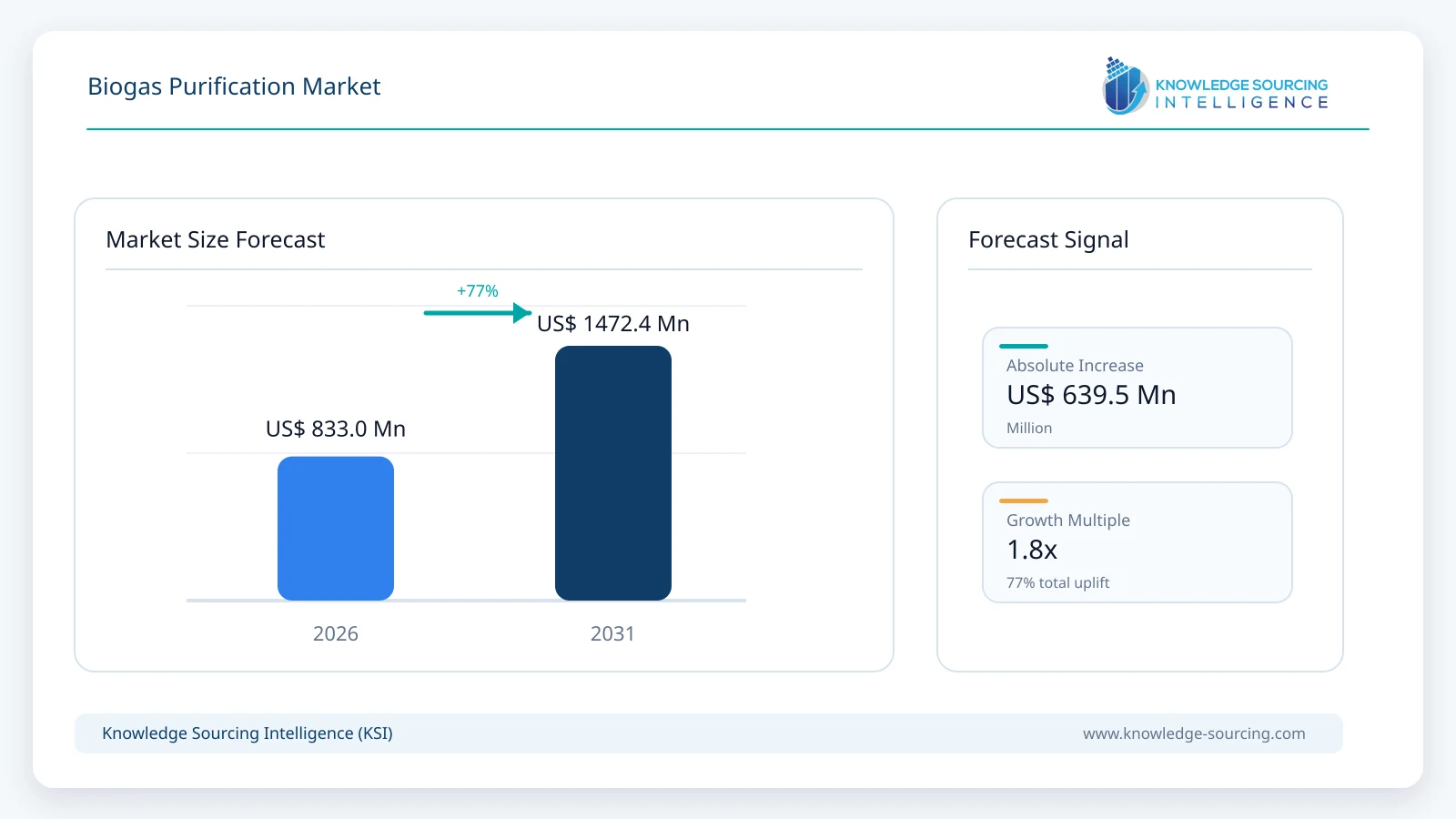
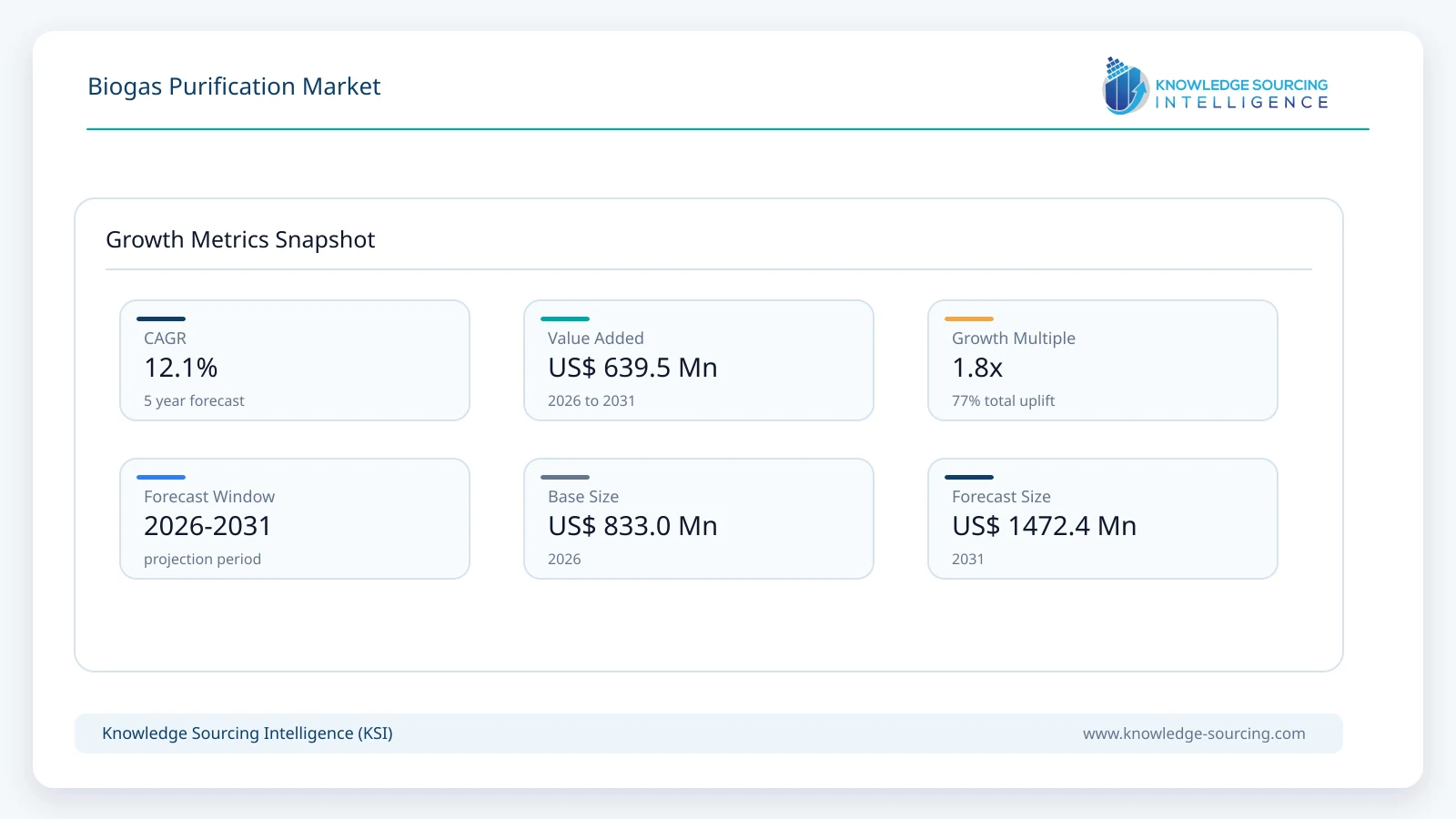
The Biogas Purification Market is projected to increase from USD 832.97 million in 2026 to USD 1,472.42 million by 2031, growing at a CAGR of 12.1% throughout the forecast period.
Highlights:
- 1Membrane separation is gaining adoption due to its energy efficiency, modular design, and suitability for biogas upgrading across different plant scales.
- 2Europe is the largest market, and Asia-Pacific is projected to experience the fastest growth due to an expansion of biomethane programs.
- 3The biogas industry is increasingly shifting toward biomethane upgrading to enable broader applications in transportation, industrial energy, and natural gas networks.
- 4Structural issues include capital cost for smaller agricultural producers and grid connection rules are different in various areas.
In terms of technology, membrane separation is gaining traction due to its modular design, energy efficiency, and suitability for biogas upgrading across different plant scales. Other widely used technologies include water scrubbing, pressure swing adsorption, and chemical scrubbing, while cryogenic separation is emerging for applications involving landfill gas treatment, liquefied biomethane, and liquid carbon dioxide production.
Demand for biogas purification solutions is driven by investments from agricultural biogas producers, waste management companies, and other end users seeking to improve gas quality and expand its applications. Regionally, market development is supported by established renewable gas infrastructure in mature markets, while emerging markets are gaining momentum through investments in clean energy, waste management, and biogas upgrading technologies.
Market Dynamics
Market Drivers
Renewable-energy requirements, methane reduction regulations, carbon reduction requirements are driving change to upgrade biogas to biomethane for grid injection and transportation fuels.
Project economics are moving towards biomethane purification and upgrading as a result of premium prices being offered for biomethane and vehicle fuel compared to electricity.
A diversion of food and agricultural waste to digesters generates feedstock that must be consistently purified to a gas-quality standard.
Membrane, adsorbent and process control advances are reducing energy consumption and methane loss and making the plants more economical.
Market Restraints & Opportunities
Adoption is limited due to high capital cost of upgrading plants, variable grid-connections requirements in different regions, methane slip and energy use, and reliance on policy support, primarily for smaller producers.
However, the emergence of modular and containerized systems, digital monitoring, carbon dioxide recovery, increasing demand for Renewable Natural Gas and Compressed Biogas are presenting significant opportunities for technology suppliers and service providers.
Key Developments
October 2026: Metacon's fully owned Greek subsidiary Metacon SA has received EU funding for its participation in the PUREHY2+ project. The project targets an integrated system solution that can enable biogas producers to add high-purity hydrogen production while capturing carbon dioxide on site.
Biogas Purification Market Segmentation
The market is segmented by technology, feedstock, end user, and geography.
By Technology
Membrane Separation
The most popular and fastest growing technology is membrane separation, which is modular, has low energy demand and is applicable to a variety of plant sizes.
SEPURAN Green membranes for biogas upgrading are supplied by Evonik Industries AG.
Air Liquide S.A. provides membrane and other biogas upgrading technology and had more than 10% market share of the biogas upgrading technology market in 2025, according to one estimate.
By Contaminant / Process Step
Hydrogen Sulfide, Moisture and Siloxane Removal
Hydrogen sulfide, moisture and siloxane removal are protective and polishing steps that are smaller in value than carbon dioxide removal but essential. Hydrogen sulfide is toxic and corrosive and is normally removed early, using media such as activated carbon or iron-based adsorbents or biological desulfurization, to protect membranes, compressors and engines. Moisture removal, through chilling and drying, prevents condensation and corrosion and brings the gas to the dew point required for pipelines and compression. Siloxanes, which arise mainly in landfill and sewage gas from consumer and industrial products, form abrasive silica deposits and are removed by adsorption or cryogenic methods, while trace contaminant polishing ensures the gas meets strict injection and fuel standards. These steps generate recurring demand for replacement media, maintenance and monitoring services, and are often bundled with upgrading equipment as integrated systems.
Greenlane Renewables Inc. and DMT International typically supply integrated systems that combine gas pretreatment with upgrading.
Linde plc and other gas-processing suppliers provide cryogenic and adsorption technology relevant to trace-contaminant and siloxane removal.
By End User
Agriculture and Waste Management Companies
Agricultural producers and waste management companies are among the most active buyers of purification systems. Agricultural biogas plants, built around manure, crop residues and food-processing waste, need compact, modular and lower-cost systems because capital cost is a structural barrier for smaller producers, and demand is strong from farm and landfill-based plants as operators move from generating power to selling biomethane. Waste management companies operate landfills and large organic-waste digesters, producing large and steady gas volumes; landfill gas in particular requires careful handling of siloxanes, volatile organic compounds and air ingress, which favors robust pretreatment and, in some cases, cryogenic upgrading.
Waga Energy SAS upgrades landfill gas to biomethane using cryogenic technology, serving landfill operators.
Regional Analysis
North America
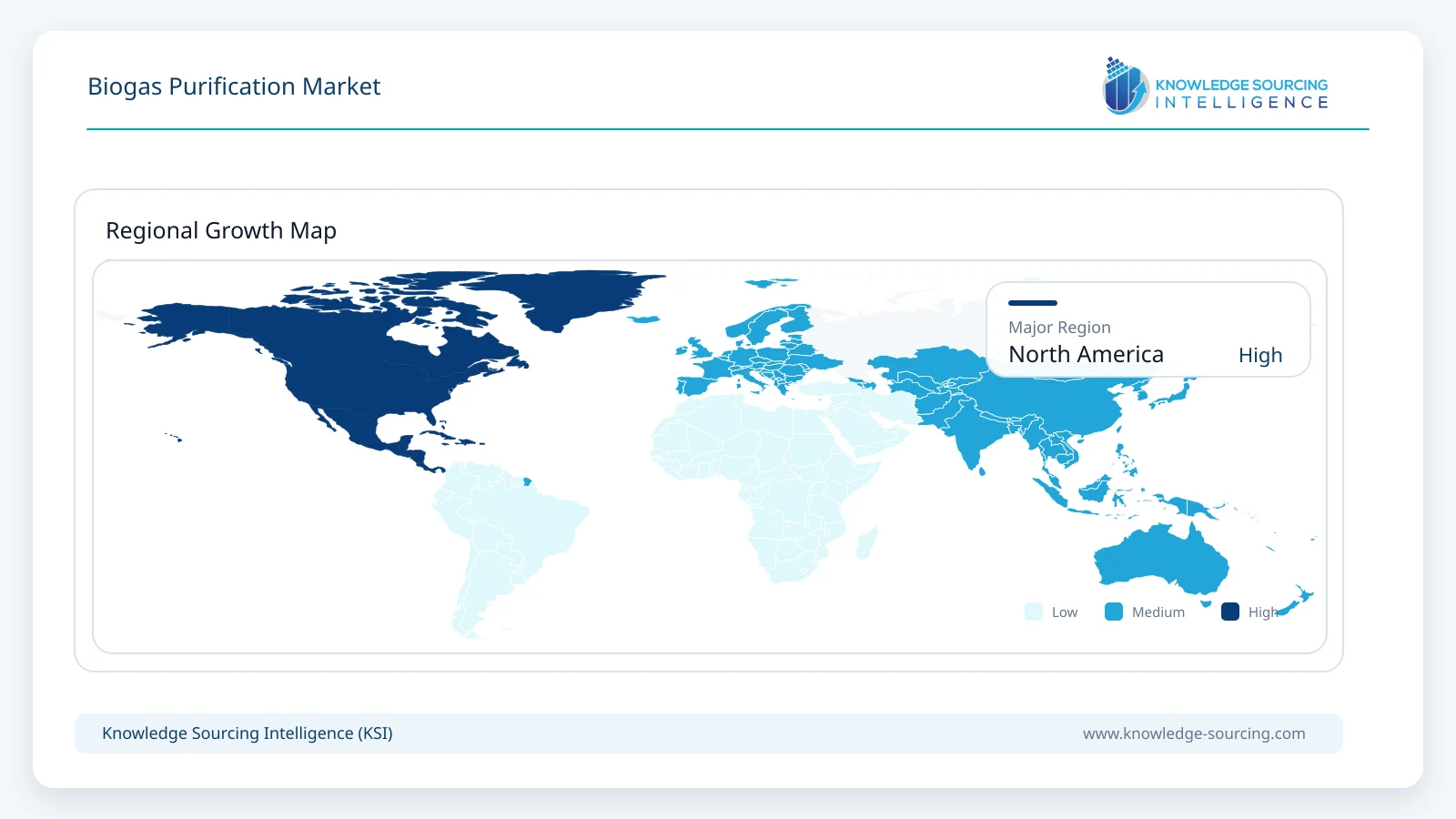
North America is one of the most commercially active regions, led by the United States and Canada, where renewable natural gas programs and low-carbon fuel credits support upgrading at landfill, dairy and wastewater plants.
Europe
Europe is the largest market, valued at about USD 1.4 billion in 2025 in BCC Research estimates, supported by mature biomethane policy in Germany, France, Italy, the Netherlands, Denmark and the United Kingdom.
Asia-Pacific
Asia-Pacific is growing fastest, with BCC Research projecting about 17.5% annual growth to 2030 as India, China and Southeast Asia expand biomethane and compressed biogas programs.
Middle East and Africa
The Middle East is approaching biogas upgrading through circular economy, landfill diversion and wastewater treatment, with early projects in the Gulf states.
South America
South America is an emerging market, with Brazil's agricultural waste volumes and renewable-fuel policy support driving growing investment in upgrading capacity.
List of Companies
Air Liquide S.A.
Evonik Industries AG
Greenlane Renewables Inc.
DMT International
EnviTec Biogas AG
Hitachi Zosen Inova AG
Pentair plc
Waga Energy SAS
Veolia Environnement S.A.
Linde plc
Competitive Landscape
Air Liquide S.A.
Air Liquide is a leading supplier of biogas purification and upgrading technology and biomethane, with strong positions in membrane systems and in biomethane supply for mobility and industry.
Evonik Industries AG
Evonik supplies SEPURAN Green polymer membranes, which are used in biogas upgrading plants, and signed a large supply agreement in Malaysia in April 2026.
Greenlane Renewables Inc.
Greenlane Renewables supplies water scrubbing, pressure swing adsorption and membrane upgrading systems, with a focus on the North American agricultural and landfill sectors.
Analyst View
The Biogas Purification market is growing quickly as operators shift from power generation to biomethane, which requires reliable removal of carbon dioxide, hydrogen sulfide, moisture and trace contaminants. Estimates differ widely depending on whether the scope covers only upgrading equipment or the wider treatment and services chain. Membrane systems are taking share thanks to modularity and low energy use, cryogenic systems are gaining in landfill and liquid biomethane niches, and digital monitoring is raising efficiency. Capital cost and inconsistent grid rules remain constraints for small producers. Suppliers that offer modular, low-methane-slip systems with service and monitoring are best positioned.
Biogas Purification Market Scope:
| Report Metric | Details |
|---|---|
| Total Market Size in 2026 | USD 832.97 million |
| Total Market Size in 2031 | USD 1,472.42 million |
| Forecast Unit | USD Million |
| Growth Rate | 12.1% |
| Study Period | 2021 to 2031 |
| Historical Data | 2021 to 2024 |
| Base Year | 2025 |
| Forecast Period | 2026 – 2031 |
| Segmentation | Technology, Contaminant / Process Step, End User, Geography |
| Companies |
|
Market Segmentation
By Technology
Membrane Separation
Pressure Swing Adsorption
Water Scrubbing
Chemical Scrubbing
Cryogenic Separation
Others
By Contaminant / Process Step
Carbon Dioxide Removal
Hydrogen Sulfide Removal
Moisture Removal
Siloxane & Trace Contaminant Removal
By End User
Utilities
Agriculture
Municipal
Industrial
Waste Management Companies
By Geography
North America
USA
Canada
Mexico
South America
Brazil
Others
Europe
Germany
France
United Kingdom
Others
Middle East and Africa
UAE
Saudi Arabia
Others
Asia Pacific
China
India
Japan
Others
Table of Contents
1. EXECUTIVE SUMMARY
2. MARKET SNAPSHOT
2.1. Market Overview
2.2. Market Definition
2.3. Scope of the Study
2.4. Market Segmentation
3. BUSINESS LANDSCAPE
3.1. Market Drivers
3.2. Market Restraints
3.3. Market Opportunities
3.4. Porter's Five Forces Analysis
3.5. Industry Value Chain Analysis
3.6. Policies and Regulations
3.7. Strategic Recommendations
4. TECHNOLOGICAL OUTLOOK
4.1. Membrane Separation Advances
4.2. Pressure Swing Adsorption & Water Scrubbing
4.3. Cryogenic Separation & CO2 Recovery
4.4. H2S, Siloxane & Moisture Removal
5. BIOGAS PURIFICATION MARKET BY TECHNOLOGY
5.1. Introduction
5.2. Membrane Separation
5.3. Pressure Swing Adsorption
5.4. Water Scrubbing
5.5. Chemical Scrubbing
5.6. Cryogenic Separation
5.7. Others
6. BIOGAS PURIFICATION MARKET BY CONTAMINANT / PROCESS STEP
6.1. Introduction
6.2. Carbon Dioxide Removal
6.3. Hydrogen Sulfide Removal
6.4. Moisture Removal
6.5. Siloxane & Trace Contaminant Removal
7. BIOGAS PURIFICATION MARKET BY END USER
7.1. Introduction
7.2. Utilities
7.3. Agriculture
7.4. Municipal
7.5. Industrial
7.6. Waste Management Companies
8. BIOGAS PURIFICATION MARKET BY GEOGRAPHY
8.1. Introduction
8.2. North America
8.2.1. USA
8.2.2. Canada
8.2.3. Mexico
8.3. South America
8.3.1. Brazil
8.3.2. Others
8.4. Europe
8.4.1. Germany
8.4.2. France
8.4.3. United Kingdom
8.4.4. Others
8.5. Middle East and Africa
8.5.1. UAE
8.5.2. Saudi Arabia
8.5.3. Others
8.6. Asia Pacific
8.6.1. China
8.6.2. India
8.6.3. Japan
8.6.4. Others
9. COMPETITIVE ENVIRONMENT AND ANALYSIS
9.1. Major Players and Strategy Analysis
9.2. Market Share Analysis
9.3. Mergers, Acquisitions, Agreements, and Collaborations
9.4. Competitive Dashboard
10. COMPANY PROFILES
10.1. Air Liquide S.A.
10.2. Evonik Industries AG
10.3. Greenlane Renewables Inc.
10.4. DMT International
10.5. EnviTec Biogas AG
10.6. Hitachi Zosen Inova AG
10.7. Pentair plc
10.8. Waga Energy SAS
10.9. Veolia Environnement S.A.
10.10. Linde plc
11. APPENDIX
11.1. Currency
11.2. Assumptions
11.3. Base and Forecast Years Timeline
11.4. Key Benefits for the Stakeholders
11.5. Research Methodology
11.6. Abbreviations
Navigate
Trusted by the world's leading organizations











