
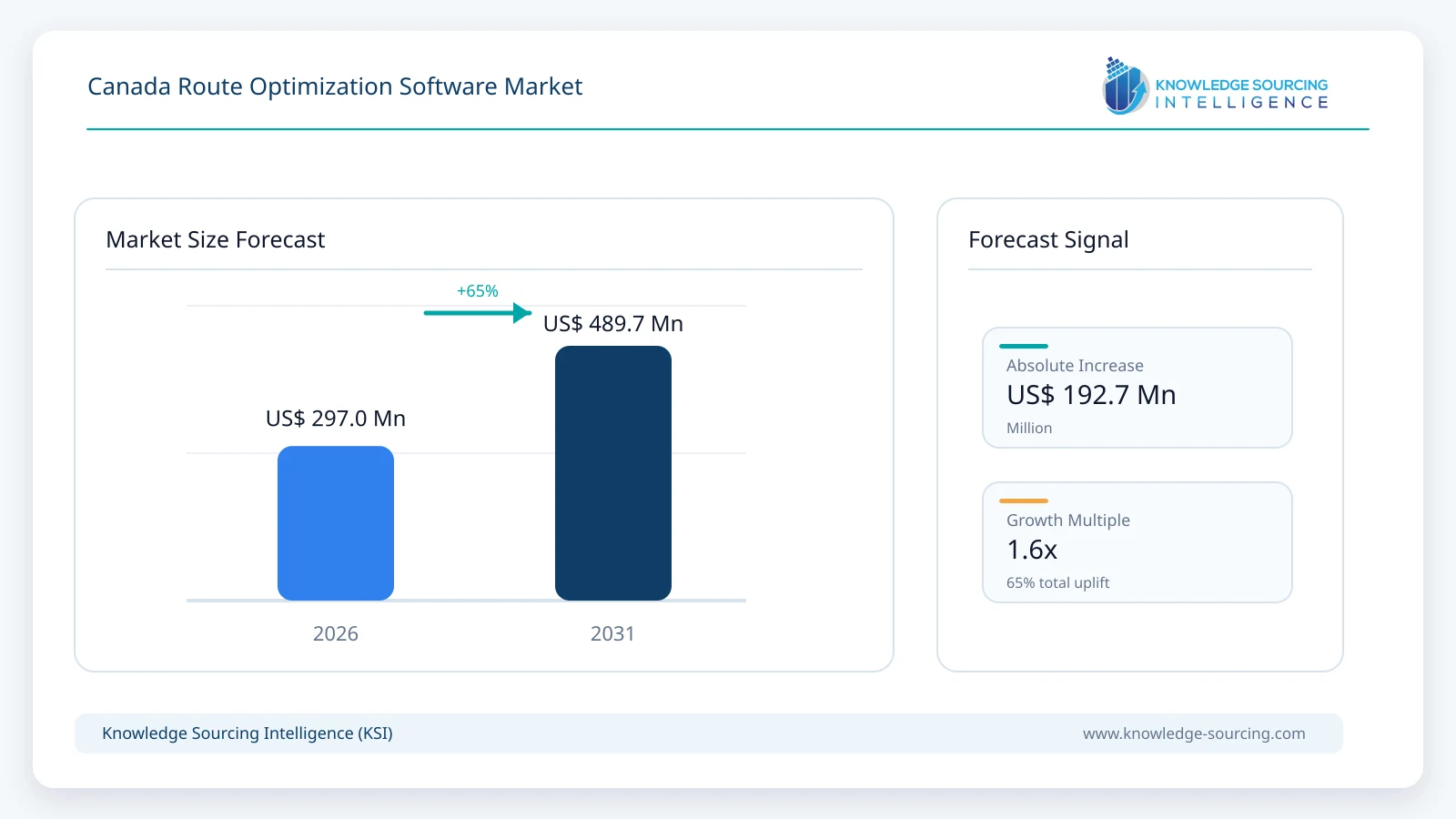
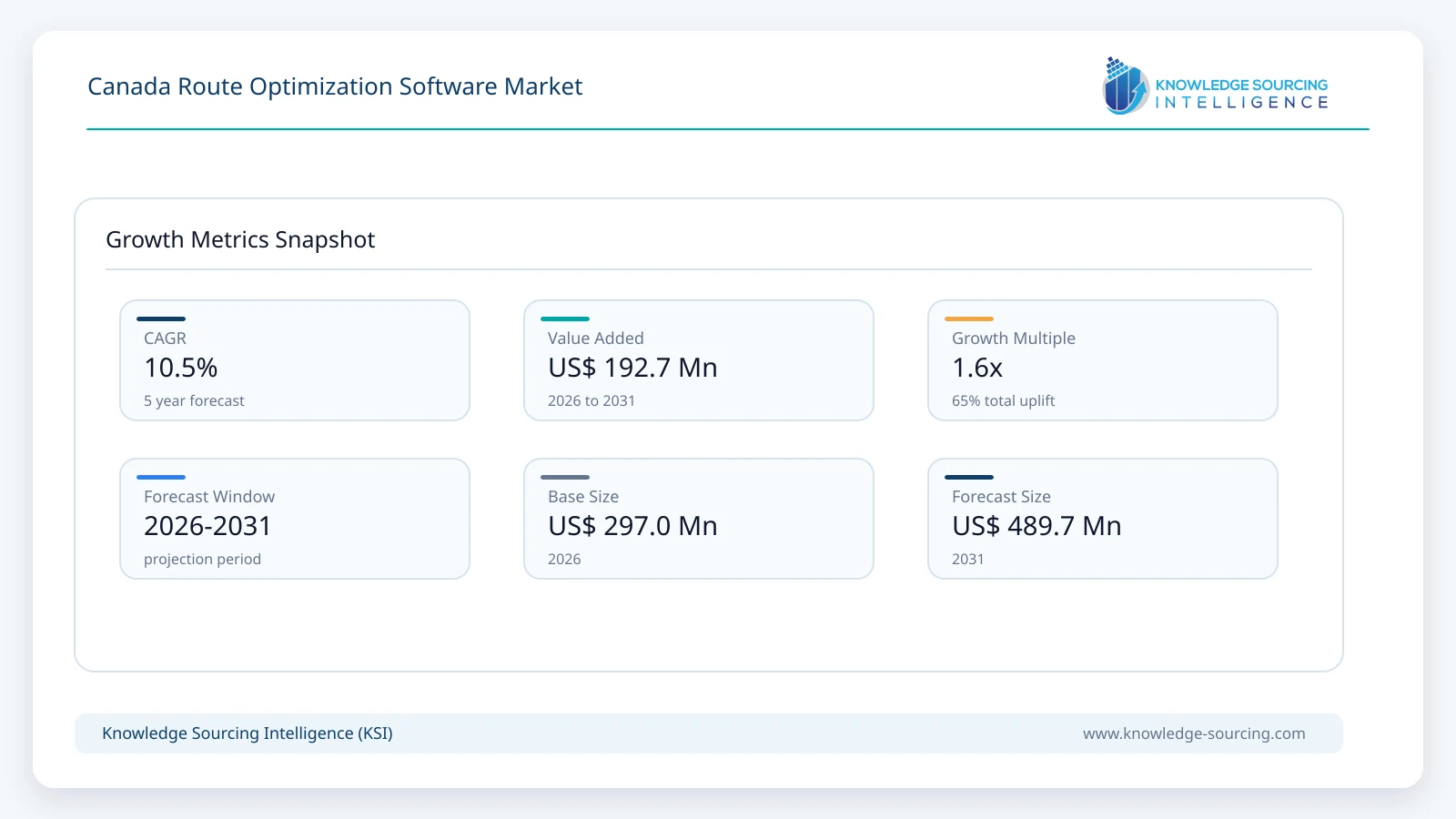
The Canadian route optimization software market is anticipated to grow at a CAGR of 10.5%, increasing to USD 489.7 million in 2031 from USD 297.0 million in 2026.
Highlights:
- 1Real-time route optimization is becoming integral to fleet productivity, cost control, and service reliability across Canada.
- 2Transportation, retail, and field service organizations are integrating route optimization with telematics and enterprise platforms.
- 3Cloud deployment is gaining preference because it enables rapid scalability, continuous updates, and distributed fleet management.
- 4Regulatory focus on transportation efficiency, emissions reduction, and electronic fleet management is strengthening software adoption.
- 5Vendor competition increasingly depends on analytics, AI-assisted dispatch, telematics integration, and recurring software services rather than standalone route planning.
Demand spans transportation and logistics providers, retailers, healthcare distributors, field service organizations, utilities, manufacturers, and mobility operators that require higher operational efficiency while managing Canada's geographically dispersed population and extensive transportation network. Commercial demand is closely linked to the increasing complexity of freight movement and last-mile delivery rather than simple fleet expansion. Transport Canada's latest assessment shows that Canada's transportation system continues to operate under changing trade patterns, climate-related disruptions, evolving supply chains, and increasing pressure on corridor efficiency. These operating conditions encourage fleet operators to invest in software capable of dynamically adjusting routes, minimizing delays, and improving asset utilization.
Buyers increasingly evaluate route optimization platforms on their ability to integrate with telematics, enterprise resource planning (ERP), warehouse management systems, customer relationship management (CRM) software, and electronic logging solutions. Purchasing decisions also depend on scalability, data security, predictive analytics, ease of deployment, and support for real-time traffic, weather, and driver availability data. Subscription-based cloud platforms continue to gain acceptance because they reduce implementation complexity while enabling continuous software enhancements.
Value creation extends well beyond route calculation. Software vendors increasingly compete by delivering measurable reductions in fuel consumption, vehicle idle time, empty mileage, and delivery exceptions while improving customer visibility through estimated arrival times and proof-of-delivery capabilities. These capabilities are becoming commercially important as Canadian organizations seek greater operational resilience amid changing freight flows and rising customer expectations for delivery accuracy.
Key Market Indicators
Indicator | Latest Evidence | Commercial Meaning |
Canadian transportation system | 2025 national assessment | Freight networks continue adapting to changing trade flows, increasing demand for intelligent route planning. |
Canadian exports to non-U.S. markets | 16% increase (2025) | Diversified freight corridors increase routing complexity across logistics networks. |
Exports to the United States | 5% decline (2025) | Fleet operators increasingly require flexible routing strategies as trade patterns evolve. |
Rail shipments to Mexico | 25% increase (2025) | Cross-border logistics requires software capable of dynamic route and capacity planning. |
Air cargo with Europe | 8% increase (2025) | Higher international freight activity supports integrated transportation management solutions. |
Source: Transport Canada, Transportation in Canada 2025 Annual Report.
Key indicator: Canadian exports to non-U.S. markets increased 16% in 2025.
Commercial meaning: Diversified trade routes increase planning complexity, strengthening demand for route optimization and fleet visibility solutions.
Market Drivers
Expanding logistics complexity created by shifting Canadian trade corridors.
Canadian freight networks are adapting to changing domestic and international trade patterns rather than operating through fixed transportation corridors. Transport Canada's 2025 assessment shows declining exports to the United States alongside higher trade volumes with Europe and Asia, requiring logistics providers to redesign transportation networks and improve routing flexibility. These changes increase demand for software capable of optimizing multi-stop deliveries, intermodal operations, and cross-regional fleet allocation. Vendors are responding by strengthening AI-assisted route planning, predictive traffic analysis, and integration with transportation management systems to help carriers reduce operating costs while maintaining service reliability.
Rapid expansion of e-commerce and time-sensitive delivery operations.
Retail, grocery distribution, parcel delivery, and food delivery businesses increasingly compete on delivery speed and service reliability instead of price alone. Higher order frequency and smaller shipment sizes have made manual route planning commercially inefficient for fleets operating in urban and suburban Canada. Route optimization software enables dispatchers to adjust schedules continuously using traffic conditions, customer availability, delivery priorities, and driver capacity. Software suppliers are expanding automated dispatch, proof-of-delivery, customer notification, and mobile workforce capabilities because buyers increasingly seek unified delivery management rather than standalone routing applications. These capabilities improve fleet utilization while reducing delivery exceptions and overtime costs.
Growing adoption of connected fleet technologies and telematics platforms.
Canadian fleet operators continue investing in GPS tracking, electronic logging devices, onboard diagnostics, and connected vehicle technologies that generate large volumes of operational data. Route optimization software converts these data streams into actionable routing decisions by combining vehicle location, driver status, fuel consumption, maintenance conditions, and traffic information within a single operational platform. Companies including Geotab, Samsara, Trimble, Verizon Connect, and Descartes continue expanding cloud-based fleet ecosystems that combine telematics with route planning, safety monitoring, compliance, and analytics, reflecting customer demand for integrated fleet management rather than isolated software products. Company product strategies and official disclosures consistently emphasize connected fleet ecosystems, software subscriptions, and operational analytics as core investment priorities.
Market Restraints and Challenges
Complex integration with legacy enterprise and fleet management systems.
Many Canadian fleet operators have invested over several years in transportation management systems (TMS), warehouse management systems (WMS), enterprise resource planning (ERP) software, telematics platforms, and customer relationship management (CRM) applications. Introducing route optimization software often requires extensive system integration, data migration, API development, and workflow redesign before organizations can realize operational benefits. Large enterprises generally possess the technical resources to complete these projects, while smaller fleet operators frequently rely on external implementation partners, increasing project costs and extending deployment timelines. Vendors such as Oracle, Trimble, Descartes Systems Group, and Samsara continue expanding integration capabilities and partner ecosystems to reduce implementation complexity, yet interoperability remains a practical barrier where legacy software lacks modern interfaces.
Data quality limitations reduce optimization accuracy.
Route optimization engines depend on reliable operational data rather than routing algorithms alone. Inaccurate customer addresses, incomplete delivery windows, outdated road network information, inconsistent fleet records, or delayed vehicle telemetry can reduce route quality and dispatch efficiency. Seasonal road restrictions, construction activity, weather-related disruptions, and temporary closures across Canada's transportation network further complicate optimization models. Software providers increasingly incorporate real-time mapping, GPS tracking, traffic intelligence, and automated data validation to improve routing decisions. Nevertheless, organizations with fragmented operational data often experience slower returns on investment because optimization performance reflects the quality of available inputs.
High implementation costs for smaller fleet operators.
Although subscription-based cloud software has lowered initial technology investment, total deployment costs frequently extend beyond software licensing. Organizations must budget for implementation services, employee training, system integration, mobile devices, data migration, workflow redesign, and ongoing technical support. These costs represent a manageable investment for national logistics providers and enterprise retailers but can delay purchasing decisions among regional carriers, local distributors, municipal service providers, and small field service businesses operating limited vehicle fleets. Many software vendors have responded by introducing modular subscription packages, usage-based pricing, and software-as-a-service (SaaS) offerings that allow customers to expand functionality gradually instead of committing to enterprise-wide implementations from the outset.
Growing cybersecurity and data governance requirements.
Modern route optimization platforms process continuous streams of operational information, including vehicle locations, customer addresses, delivery schedules, employee assignments, and business performance data. As cloud connectivity and mobile workforce applications expand, fleet operators place greater emphasis on cybersecurity, user authentication, encryption, access controls, and compliance with Canadian privacy requirements. Enterprise customers increasingly evaluate vendors on security certifications, disaster recovery capabilities, system availability, and data governance practices before awarding contracts. These requirements lengthen software evaluation cycles but also encourage vendors to strengthen cloud infrastructure, security investments, and compliance capabilities as important competitive differentiators.
Major Segment Analysis
Cloud-based Deployment
Cloud-based deployment represents one of the most commercially important segments within Canada's route optimization software market because it aligns with the operational requirements of geographically distributed fleets and multi-site enterprises. Organizations increasingly prefer subscription-based platforms that provide centralized fleet visibility, remote access, automatic software updates, scalable computing resources, and integration with telematics, mapping services, and enterprise applications. These capabilities reduce dependence on internally managed infrastructure while enabling dispatch teams to respond quickly to changing traffic conditions, weather events, and customer requests.
Transportation providers, retailers, utilities, healthcare distributors, and field service organizations are among the largest adopters because route optimization increasingly forms part of broader digital fleet management strategies rather than functioning as a standalone application. Purchasing decisions typically emphasize cybersecurity, integration flexibility, application programming interface (API) availability, system reliability, and recurring software support instead of software ownership alone. Although on-premises deployment remains relevant for organizations with strict internal security policies or specialized infrastructure requirements, cloud platforms continue receiving stronger product investment from software vendors due to their recurring revenue model, faster feature deployment, and ability to support AI-driven analytics across distributed fleet operations.
Competitive Landscape
The Canadian route optimization software market is moderately fragmented, with competition shaped by platform breadth, telematics integration, analytics capabilities, and recurring software services rather than standalone route planning functionality. Enterprise buyers increasingly seek integrated ecosystems that combine fleet visibility, dispatch management, compliance, driver monitoring, and customer communication within a single platform. As a result, vendors compete on interoperability, cloud architecture, implementation expertise, and long-term service capability as much as software functionality.
Descartes Systems Group and Geotab, both headquartered in Canada, benefit from established domestic customer relationships and extensive transportation technology portfolios. Trimble, Samsara, Verizon Connect, Oracle, Omnitracs, and Route4Me compete by expanding cloud-native platforms, AI-assisted route planning, mobile workforce applications, and telematics integration. Product development increasingly emphasizes predictive analytics, application programming interfaces (APIs), and software ecosystems that integrate with transportation management, warehouse management, and enterprise resource planning systems. Vendors are also investing in cybersecurity, customer support, and partner networks to address enterprise deployment complexity and strengthen customer retention. High switching costs associated with operational data, workflow integration, driver training, and enterprise software connectivity provide established suppliers with recurring revenue opportunities, although specialized software providers continue competing through deployment flexibility and industry-specific functionality.
Recent Developments
July 2026: Canada-based Descartes acquired Drivin, adding AI-powered last-mile delivery management with advanced route optimization, dispatch automation, and real-time execution visibility, strengthening logistics capabilities for Canadian and international distribution networks.
June 2026: Trimble introduced its cloud-native Next-Gen Shipper Transportation Management System, combining AI-powered transportation planning, route optimization, carrier collaboration, execution, and real-time visibility to improve freight operations across North America, including Canada.
April 2026: Canada-based Descartes acquired Idelic, expanding its logistics platform with AI-powered driver safety analytics, telematics integration, and fleet performance management that complement transportation planning and route optimization solutions.
June 2025: Canada-based Descartes acquired PackageRoute, strengthening its final-mile logistics portfolio with route optimization, fleet management, mobile delivery applications, and real-time shipment visibility for parcel carriers and delivery service providers.
Regulatory and Policy Environment
Canada's regulatory framework does not specifically govern route optimization software, but several transportation, privacy, safety, and environmental policies influence purchasing decisions and product development. Fleet operators increasingly require software platforms that support compliance with federal and provincial transportation regulations while improving operational efficiency.
Transport Canada's freight transportation initiatives continue encouraging greater resilience, efficiency, and digital modernization across national transportation networks. Investments in trade corridors, supply chain resilience, and multimodal transportation increase demand for software that improves route planning, fleet utilization, and operational visibility. At the same time, commercial vehicle operators must comply with electronic logging device (ELD) requirements that support hours-of-service enforcement, increasing the value of route optimization platforms integrated with compliant fleet management systems. Official regulatory guidance has accelerated adoption of connected fleet technologies that combine routing, driver compliance, and operational reporting within a unified environment.
Privacy legislation also shapes software procurement. Organizations evaluating cloud-based route optimization platforms increasingly assess compliance with the Personal Information Protection and Electronic Documents Act (PIPEDA) and relevant provincial privacy frameworks because fleet management systems routinely process customer addresses, vehicle locations, employee information, and operational data. Enterprise buyers therefore prioritize encryption, identity management, audit capabilities, and secure cloud infrastructure during vendor selection.
Environmental policy is becoming another indirect demand driver. Federal programs supporting lower transportation emissions encourage organizations to improve vehicle utilization, reduce unnecessary mileage, and lower fuel consumption. Route optimization software contributes to these objectives by reducing empty trips, minimizing idle time, and improving dispatch efficiency, making operational optimization an increasingly important component of broader fleet sustainability strategies.
Outlook and Strategic Implications
Demand for route optimization software in Canada is expected to remain supported by continued investment in logistics modernization, connected fleet technologies, and digital supply chain management between 2026 and 2031. Commercial adoption will increasingly be driven by operational efficiency rather than fleet expansion alone. Organizations are expected to prioritize software capable of integrating routing, telematics, compliance, predictive analytics, and customer communication into unified operational platforms that improve service reliability while controlling transportation costs.
Artificial intelligence is likely to reshape competitive differentiation during the forecast period. Rather than replacing traditional optimization algorithms, AI will increasingly support demand forecasting, predictive dispatching, dynamic route adjustments, driver behavior analysis, and automated exception management. Vendors capable of embedding these capabilities into scalable cloud architectures while maintaining strong cybersecurity and interoperability are expected to strengthen enterprise adoption.
Key strategic implications include:
Transportation and logistics providers will continue investing in integrated routing platforms to improve fleet utilization, reduce fuel costs, and manage increasingly complex freight networks.
Retailers, healthcare distributors, and field service organizations are expected to prioritize real-time dispatch visibility, customer communication, and mobile workforce integration to support time-sensitive service delivery.
Software vendors are likely to focus on artificial intelligence, API-based integration, recurring cloud subscriptions, and cybersecurity as primary competitive differentiators.
System integrators and implementation partners should benefit from increasing demand for enterprise deployment, data migration, workflow redesign, and software integration services.
Investors are expected to monitor recurring software revenue, customer retention, cloud adoption, and AI-enabled product development as indicators of long-term competitive positioning.
As fleet operations become increasingly data-driven, competitive advantage will depend less on basic route calculation and more on the ability to convert real-time operational data into measurable improvements in asset utilization, delivery performance, compliance, and customer service. Vendors that combine scalable cloud infrastructure with integrated fleet intelligence and strong implementation capabilities are expected to be better positioned to address the evolving requirements of Canadian commercial fleet operators during the forecast period.
Canada Route Optimization Software Market Scope:
| Report Metric | Details |
|---|---|
| Total Market Size in 2026 | USD 297.0 million |
| Total Market Size in 2031 | USD 489.7 million |
| Forecast Unit | Million |
| Growth Rate | 10.5% |
| Study Period | 2021 to 2031 |
| Historical Data | 2021 to 2024 |
| Base Year | 2025 |
| Forecast Period | 2026 – 2031 |
| Segmentation | Solution, Deployment Type, Industry Vertical |
| Companies |
|
Market Segmentation
By Solution
Software
Services
By Deployment Type
Cloud-based
On-premises
By Industry Vertical
Transportation and Logistics
Retail and E-Commerce
Food and Beverage Delivery
Field Service Management
Manufacturing
Healthcare and Pharmaceuticals
Utilities
Ride-Hailing and Mobility Services
Others
Table of Contents
1. Introduction
1.1. Market Definition
1.2. Market Segmentation
2. Research Methodology
2.1. Research Data
2.2. Assumptions
3. Executive Summary
3.1. Research Highlights
4. Market Dynamics
4.1. Market Drivers
4.2. Market Restraints
4.3. Porter’s Five Forces Analysis
4.3.1. Bargaining Power of End-Users
4.3.2. Bargaining Power of Buyers
4.3.3. Threat of New Entrants
4.3.4. Threat of Substitutes
4.3.5. Competitive Rivalry in the Industry
4.4. Industry Value Chain Analysis
5. Canada Route Optimization Software Market Analysis, by Solution
5.1. Introduction
5.2. Software
5.3. Services
6. Canada Route Optimization Software Market Analysis, by Deployment Type
6.1. Introduction
6.2. Cloud-based
6.3. On-premises
7. Canada Route Optimization Software Market Analysis, by Industry Vertical
7.1. Introduction
7.2. Transportation and Logistics
7.3. Retail and E-Commerce
7.4. Food and Beverage Delivery
7.5. Field Service Management
7.6. Manufacturing
7.7. Healthcare and Pharmaceuticals
7.8. Utilities
7.9. Ride-Hailing and Mobility Services
7.10. Others
8. Competitive Environment and Analysis
8.1. Major Players and Strategy Analysis
8.2. Emerging Players and Market Lucrativeness
8.3. Mergers, Acquisitions, Agreements, and Collaborations
8.4. Vendor Competitiveness Matrix
9. Company Profiles
9.1. Trimble Inc.
9.2. Omnitrac
9.3. Descartes Systems Group
9.4. Samsara
9.6. Verizon Connect
9.7. Geotab
9.8. Oracle
Navigate
Trusted by the world's leading organizations











