
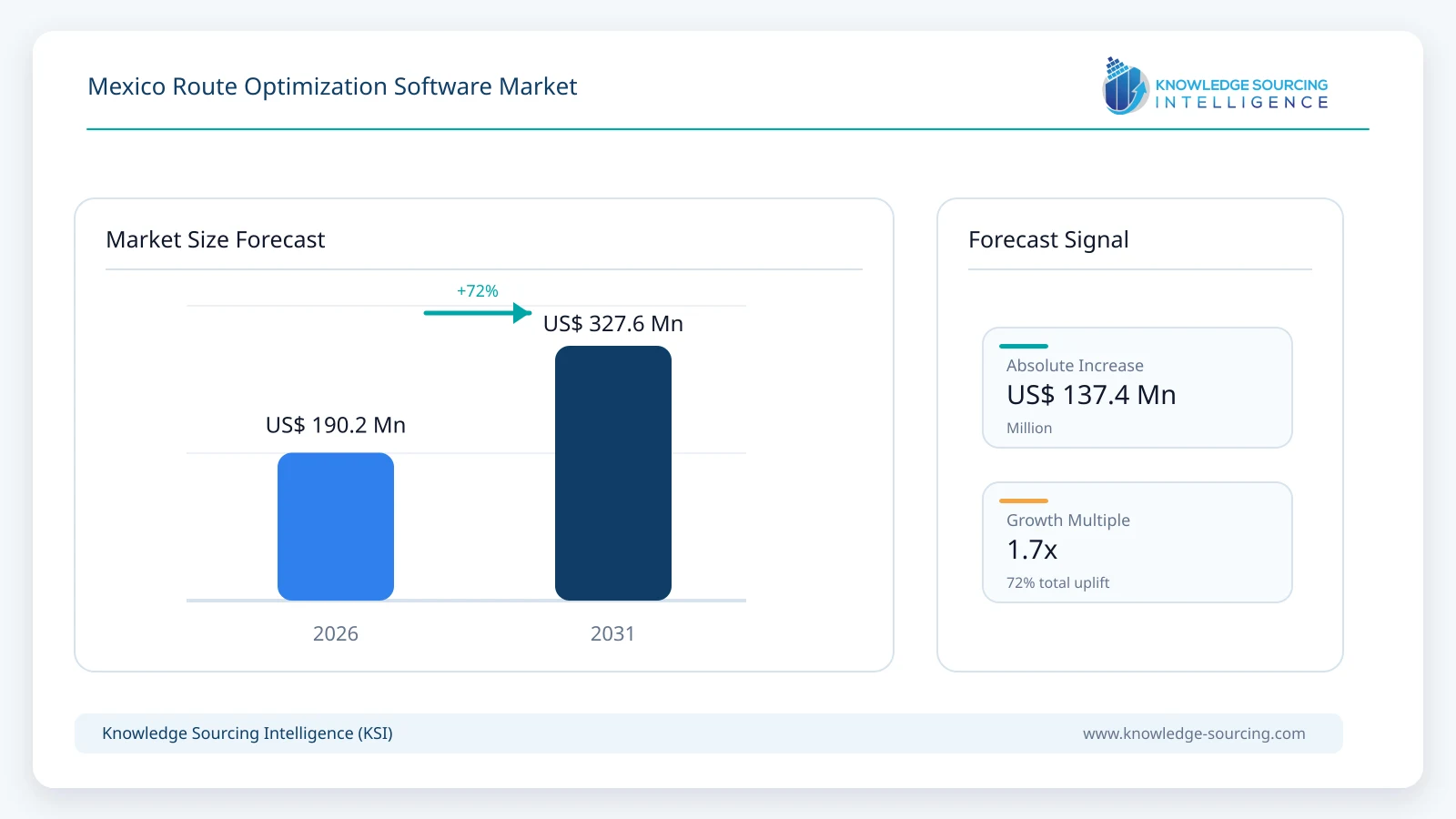
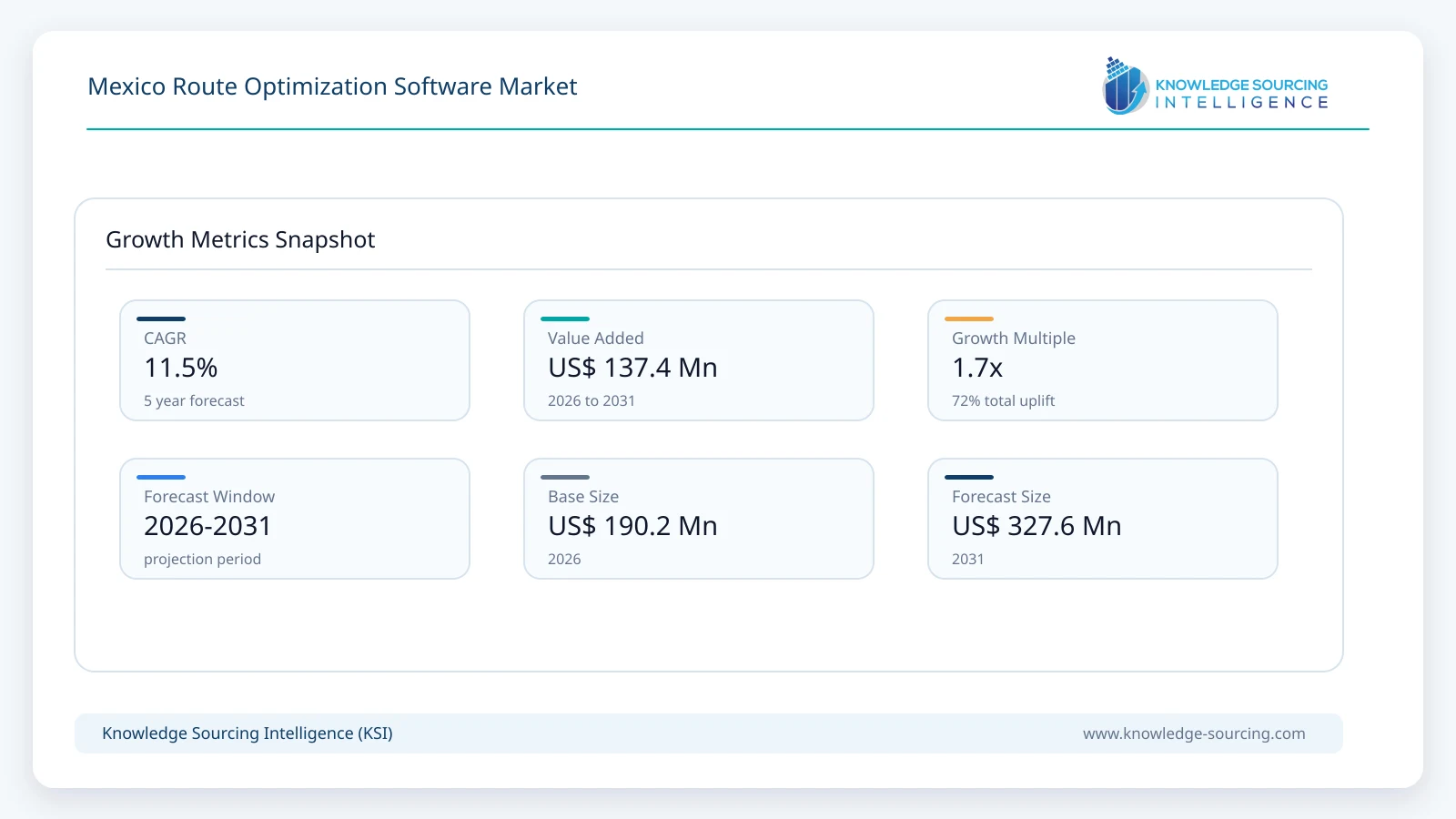
Mexico route optimization software market is anticipated to grow at a CAGR of 11.5%, increasing to USD 327.6 million in 2031 from USD 190.2 million in 2026.
Highlights:
- 1Route optimization software adoption is expanding as Mexican enterprises seek lower fleet operating costs and higher delivery reliability.
- 2Cloud deployment continues to gain preference because it reduces implementation time and supports distributed fleet management.
- 3Transportation and logistics remain the most commercially important end-user segment due to high fleet intensity and cross-border freight activity.
- 4AI-enabled route planning, telematics integration, and real-time traffic intelligence are becoming standard purchasing requirements.
- 5Enterprise buyers increasingly evaluate software vendors on integration capability, scalability, compliance support, and analytics rather than navigation functions alone.
Demand is closely linked to Mexico's expanding logistics sector, growing e-commerce activity, manufacturing exports, and nearshoring investment. Companies operating national distribution networks face rising transportation costs, congested metropolitan corridors, cargo security concerns, and increasingly demanding delivery windows. These operational pressures encourage investment in software that reduces empty mileage, improves fleet visibility, and supports more accurate delivery scheduling. Industry surveys conducted by Mexico's logistics organizations continue to identify digitalization as one of the highest operational priorities for improving competitiveness across the national supply chain.
Enterprise purchasing behaviour has also changed. Buyers increasingly evaluate platforms based on interoperability with transportation management systems (TMS), warehouse management systems (WMS), ERP software, telematics hardware, proof-of-delivery applications, and mobile workforce solutions. Cloud-native platforms have become particularly attractive because implementation cycles are shorter, software updates are continuous, and geographically dispersed fleets can be managed through centralized dashboards.
Commercial value is distributed across software licensing, implementation services, integration, consulting, analytics, maintenance, and recurring subscription revenues. Vendors therefore compete not only through routing algorithms but also through implementation capability, customer support, data quality, cybersecurity, regulatory compliance, and ecosystem partnerships that reduce deployment complexity for enterprise customers.
Key Market Indicators
Indicator | Latest Evidence | Commercial Meaning |
Logistics digitalization survey participation | 441 companies (2025) | Demonstrates broad industry engagement in digital transformation initiatives. |
FEMSA consolidated revenue | Ps. 840,954 million (2025) | Large distribution networks continue investing in operational efficiency and logistics optimization. |
AI-enabled SME logistics improvement | 18% reduction in transportation costs (case evidence) | Supports commercial adoption of AI-based route optimization in distribution operations. |
Enterprise priority | Digitalization identified as a cross-sector logistics priority (2025) | Technology investment increasingly supports operational competitiveness rather than discretionary IT spending. |
Key indicator: Logistics organizations surveyed 441 Mexican companies in the 2025 Pulsómetro Logístico study.
Commercial meaning: Fleet digitalization has become a strategic operational priority across multiple industries.
Market Drivers
Expansion of nearshoring-supported logistics operations.
Manufacturing investment associated with North American supply chain regionalization is increasing freight movements between industrial corridors, ports, border crossings, and distribution centres across Mexico. Larger transportation networks require more sophisticated route planning to maintain service levels while controlling operating costs. Fleet operators increasingly procure optimization platforms capable of balancing delivery schedules, driver availability, vehicle utilization, and cross-border transport requirements. Software vendors are responding by strengthening integration with transportation management systems, customs workflows, and enterprise resource planning platforms that support complex logistics operations.
Higher operational pressure from last-mile delivery and retail distribution.
Retail, grocery, food delivery, and e-commerce operators continue to compress delivery windows while handling larger shipment volumes across densely populated metropolitan areas. Traffic congestion, variable customer availability, and increasing expectations for real-time shipment visibility reduce the effectiveness of manual route planning. Buyers therefore prioritize software capable of dynamic route recalculation, estimated arrival prediction, proof-of-delivery functions, and driver mobile applications. Artificial intelligence and predictive traffic analytics have become procurement criteria because they reduce unnecessary mileage and improve on-time delivery performance while lowering fuel consumption.
Growing integration of telematics, cloud platforms, and enterprise software.
Route optimization increasingly functions as part of a wider fleet management ecosystem rather than as standalone software. Enterprise customers expect integration with GPS devices, vehicle diagnostics, warehouse management systems, ERP platforms, customer relationship management software, and mobile workforce applications. Vendors including Trimble, Samsara, Geotab, Oracle, and Google continue expanding connected software ecosystems to improve operational visibility and decision support across transportation networks. Cloud deployment accelerates adoption because organizations can scale fleets without substantial on-premises infrastructure investment while receiving continuous software enhancements and cybersecurity updates through subscription models.
Market Restraints and Challenges
Complex system integration and legacy IT environments.
Enterprise buyers rarely implement route optimization software as an isolated application. Large transportation companies, manufacturers, and retailers typically require integration with transportation management systems (TMS), warehouse management systems (WMS), enterprise resource planning (ERP) platforms, telematics devices, mobile applications, and customer relationship management software. Differences in data structures, legacy infrastructure, and application programming interfaces (APIs) can extend implementation timelines and increase deployment costs. Oracle, Trimble, and Descartes emphasize interoperability and integration capabilities within their enterprise logistics offerings because customers increasingly seek unified operational visibility rather than standalone routing functionality. Smaller fleet operators often lack internal IT resources to manage these integration projects, making implementation partners an important part of the value chain.
Data quality limitations reduce optimization accuracy.
Route optimization algorithms depend on accurate operational data, including vehicle availability, driver schedules, delivery priorities, customer addresses, traffic conditions, and fleet telemetry. Incomplete or inconsistent data can reduce routing accuracy and weaken the financial return from software investments. Organizations with fragmented operational processes frequently spend considerable time standardizing datasets before deployment. Several enterprise software providers identify master data governance, location intelligence, and continuous data validation as essential requirements for delivering reliable optimization results. As a result, buyers increasingly evaluate vendors on their ability to clean, integrate, and synchronize operational data instead of assessing routing algorithms alone.
Cybersecurity, data privacy, and regulatory compliance obligations.
Cloud-based fleet management platforms process large volumes of operational and location data, making cybersecurity an important procurement criterion. Enterprises handling customer delivery information, driver records, and commercial shipment data must comply with Mexico's Federal Law on the Protection of Personal Data Held by Private Parties while maintaining secure system access across distributed operations. Multinational customers also require compliance with international cybersecurity standards and internal governance policies. Software suppliers therefore continue investing in encryption, identity management, secure cloud infrastructure, and regular platform updates to address customer risk assessments. These additional compliance requirements increase development costs and may lengthen enterprise purchasing cycles, particularly for regulated industries.
Major Segment Analysis
Transportation and Logistics
Transportation and logistics represents the most commercially important industry vertical because fleet-intensive operations generate the clearest financial return from route optimization investments. Freight carriers, third-party logistics providers, parcel delivery companies, and distribution operators manage large vehicle fleets across urban centres, industrial corridors, ports, and cross-border trade routes. Even modest reductions in fuel consumption, idle time, empty mileage, or delivery delays can translate into measurable operating cost savings across high-volume transport networks.
Enterprise buyers within this segment increasingly require platforms that combine route optimization with fleet tracking, electronic proof of delivery, driver performance monitoring, predictive maintenance, and transportation management system integration. Purchasing decisions extend beyond routing performance and increasingly consider scalability, cybersecurity, application programming interface (API) availability, multilingual support, and implementation services. Suppliers therefore compete by offering integrated logistics platforms that support dispatch automation, real-time visibility, and analytics rather than standalone navigation software. Growing cross-border freight movement between Mexico, the United States, and Canada further strengthens demand for solutions capable of handling complex scheduling, regulatory documentation, and multi-stop route planning across international supply chains.
Competitive Landscape
Competition in the Mexico route optimization software market is technology-led and increasingly driven by platform integration, cloud scalability, and service capability rather than route calculation alone. Enterprise customers prefer suppliers that combine route optimization with fleet management, telematics, geospatial intelligence, analytics, and application programming interfaces (APIs), allowing software to operate within broader transportation and enterprise management environments. This preference raises switching costs once solutions are embedded into daily logistics operations.
Trimble Inc., Descartes Systems Group, Samsara, Geotab, Oracle Corporation, Google (Google Maps Platform), PTV Logistics (PTV Group), Esri, and Route4Me compete across different customer segments and deployment models. Larger enterprise vendors strengthen their position through extensive partner ecosystems, cloud infrastructure, implementation services, and integration with transportation management and enterprise resource planning systems. Companies also continue investing in artificial intelligence, predictive analytics, location intelligence, and real-time fleet visibility to improve dispatch decisions and operational efficiency. Expansion of local implementation partners, customer support capabilities, and software interoperability remains an important competitive strategy as Mexican enterprises seek solutions that reduce deployment complexity while supporting long-term digital transformation initiatives.
Recent Developments
July 2026: TomTom and Transit Technologies announced a July 2 partnership integrating Orbis Maps and Live Traffic into fleet and logistics software across the United States and Central America, strengthening real-time routing.
April 2026: Uber Direct and EnvíaTodo announced a Mexico integration on April 17, enabling local businesses to arrange deliveries in under three hours through real-time tracking and Uber’s urban delivery network.
November 2025: Trimble introduced its new, modular, cloud-native Trimble TMS for enterprise carriers, featuring embedded AI agents to automate manual tasks like order processing. This Software launch directly enhances route planning efficiency by automating the precursor steps required for optimization, driving demand for next-generation intelligence in logistics.
Regulatory and Policy Environment
Mexico's regulatory environment increasingly supports digital logistics while placing greater emphasis on cybersecurity, data protection, and efficient freight movement. The Federal Law on the Protection of Personal Data Held by Private Parties (LFPDPPP) establishes obligations for organizations processing personal information, including location and customer delivery data collected through fleet management platforms. Compliance with these requirements has become an important consideration for enterprise software procurement, particularly among retailers, healthcare providers, logistics companies, and multinational manufacturers.
Cross-border supply chains also influence software requirements. Companies serving North American trade routes must manage customs documentation, shipment traceability, and transport records while aligning operations with the United States-Mexico-Canada Agreement (USMCA). At the same time, Mexico's broader digital transformation agenda and investment in transport infrastructure continue to encourage adoption of technologies that improve logistics efficiency, fleet visibility, and operational planning. Software vendors increasingly incorporate stronger cybersecurity controls, audit capabilities, cloud security certifications, and data governance features to meet evolving customer and regulatory expectations.
Outlook and Strategic Implications
Route optimization software is expected to become a standard operational platform for medium and large fleet operators in Mexico during the 2026–2031 forecast period. Future purchasing decisions are likely to emphasize artificial intelligence, predictive analytics, automated dispatch, real-time fleet visibility, and integration with enterprise logistics systems rather than standalone routing functionality. Cloud deployment will remain the preferred implementation model because it offers scalability, continuous software updates, and lower infrastructure requirements for organizations expanding distribution networks.
Several strategic implications are likely to shape market performance:
Fleet operators are expected to prioritize measurable reductions in fuel consumption, delivery delays, vehicle utilization gaps, and administrative costs through data-driven route planning.
Software providers will continue expanding artificial intelligence capabilities, API ecosystems, and implementation services to address increasingly complex enterprise requirements.
System integrators and technology partners are likely to benefit from rising demand for software integration, data migration, cybersecurity, and cloud deployment support.
Manufacturers, retailers, and logistics service providers will increasingly evaluate route optimization software as part of broader supply chain modernization initiatives rather than as an independent fleet application.
Commercial competition is therefore expected to shift toward platform interoperability, service quality, data intelligence, and long-term customer support. Vendors capable of combining advanced routing algorithms with scalable cloud architecture, enterprise integration, and localized implementation expertise will be better positioned to address the evolving operational requirements of Mexico's logistics ecosystem.
Mexico Route Optimization Software Market Scope:
| Report Metric | Details |
|---|---|
| Total Market Size in 2026 | USD 190.2 million |
| Total Market Size in 2031 | USD 327.6 million |
| Forecast Unit | Million |
| Growth Rate | 11.5% |
| Study Period | 2021 to 2031 |
| Historical Data | 2021 to 2024 |
| Base Year | 2025 |
| Forecast Period | 2026 – 2031 |
| Segmentation | Solution, Deployment Type, Industry Vertical |
| Companies |
|
Market Segmentation
By Solution
Software
Services
By Deployment Type
Cloud-based
On-premises
By Industry Vertical
Transportation and Logistics
Retail and E-Commerce
Food and Beverage Delivery
Field Service Management
Manufacturing
Healthcare and Pharmaceuticals
Utilities
Ride-Hailing and Mobility Services
Others
Table of Contents
1. Introduction
1.1. Market Definition
1.2. Market Segmentation
2. Research Methodology
2.1. Research Data
2.2. Assumptions
3. Executive Summary
3.1. Research Highlights
4. Market Dynamics
4.1. Market Drivers
4.2. Market Restraints
4.3. Porter’s Five Forces Analysis
4.3.1. Bargaining Power of End-Users
4.3.2. Bargaining Power of Buyers
4.3.3. Threat of New Entrants
4.3.4. Threat of Substitutes
4.3.5. Competitive Rivalry in the Industry
4.4. Industry Value Chain Analysis
5. Mexico Route Optimization Software Market Analysis, by Solution
5.1. Introduction
5.2. Software
5.3. Services
6. Mexico Route Optimization Software Market Analysis, by Deployment Type
6.1. Introduction
6.2. Cloud-based
6.3. On-premises
7. Mexico Route Optimization Software Market Analysis, by Industry Vertical
7.1. Introduction
7.2. Transportation and Logistics
7.3. Retail and E-Commerce
7.4. Food and Beverage Delivery
7.5. Field Service Management
7.6. Manufacturing
7.7. Healthcare and Pharmaceuticals
7.8. Utilities
7.9. Ride-Hailing and Mobility Services
7.10. Others
8. Competitive Environment and Analysis
8.1. Major Players and Strategy Analysis
8.2. Emerging Players and Market Lucrativeness
8.3. Mergers, Acquisitions, Agreements, and Collaborations
8.4. Vendor Competitiveness Matrix
9. Company Profiles
9.1. Trimble Inc.
9.2. Descartes Systems Group
9.3. Samsara
8.4. Geotab
8.5. Esri
8.7. Oracle Corporation
8.8. Google (Google Maps Platform)
8.9. PTV Logistics (PTV Group)
Navigate
Trusted by the world's leading organizations











