
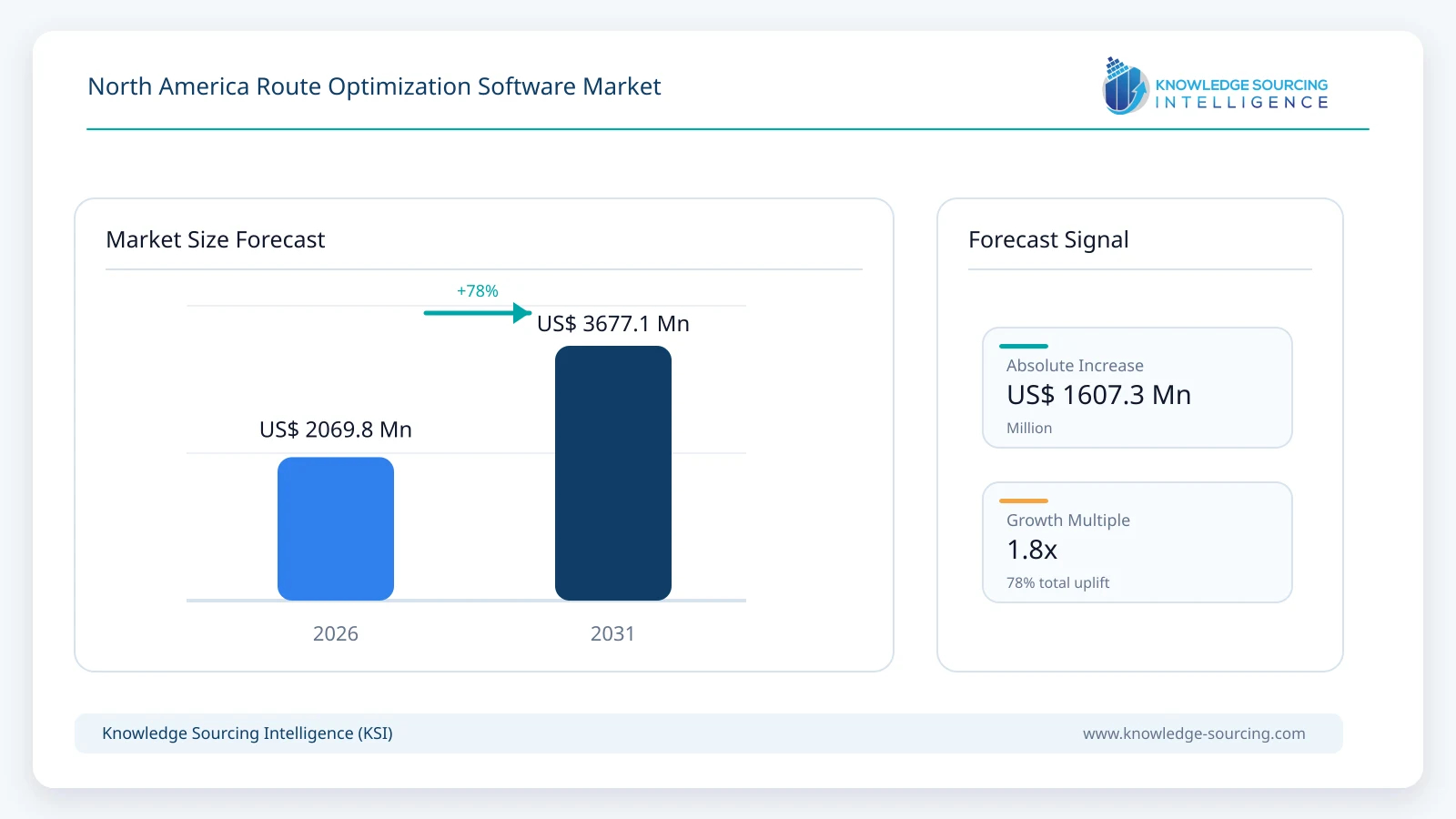
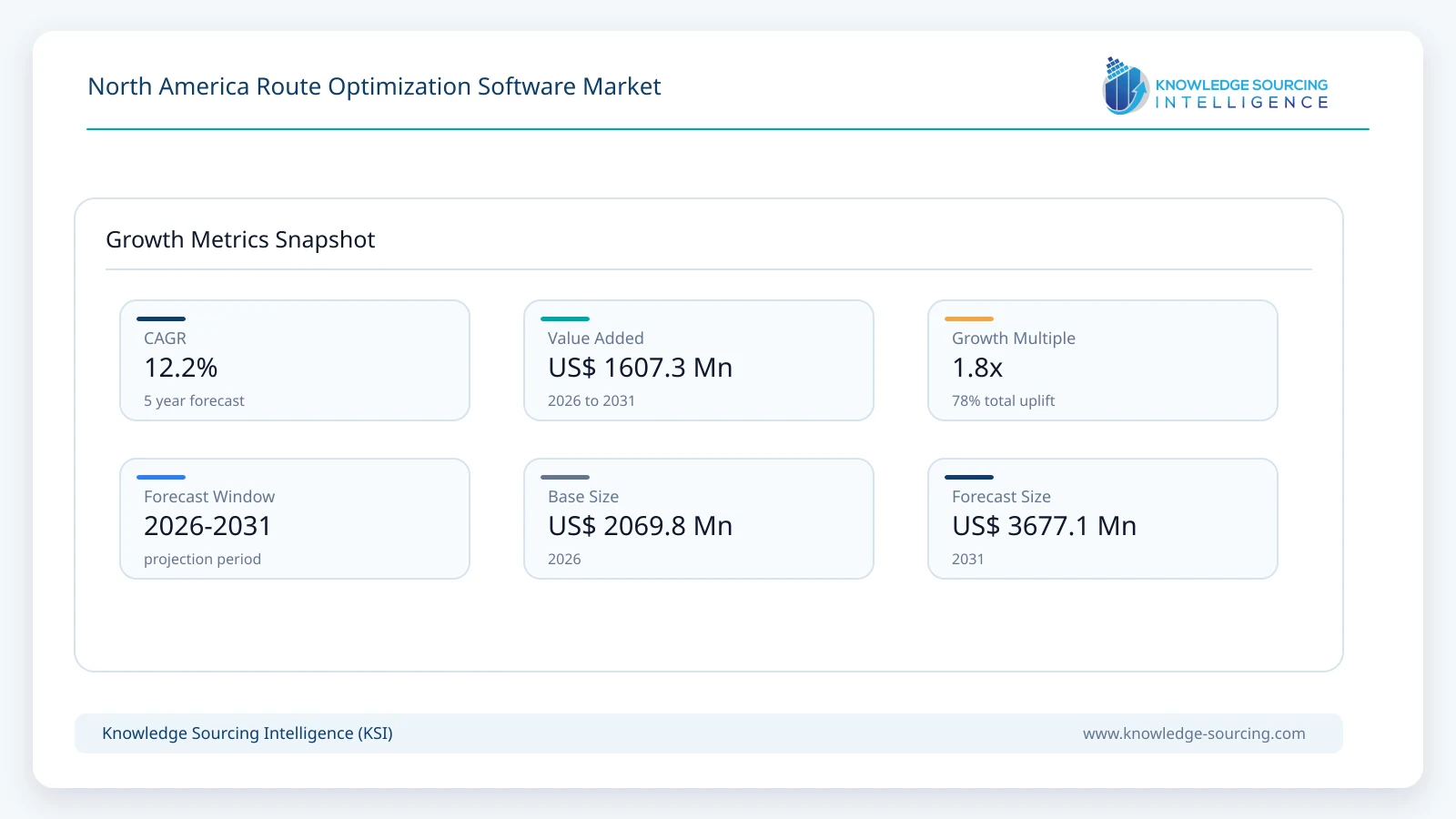
North America’s Route Optimization Software Market is forecast to grow at a CAGR of 12.2%, reaching USD 3,677.1 million in 2031 from USD 2,069.8 million in 2026.
Highlights:
- 1Route optimization software is becoming an operational planning platform rather than a standalone routing tool.
- 2Transportation, retail, and field service organizations continue replacing manual route planning with AI-assisted scheduling.
- 3Cloud deployment supports faster software adoption by reducing implementation time and simplifying system integration.
- 4Real-time fleet visibility, telematics integration, and dynamic route adjustment increasingly influence purchasing decisions.
- 5Fleet operators prioritize software capable of reducing fuel consumption, improving asset utilization, and supporting service-level commitments.
Demand spans transportation providers, retailers, healthcare distributors, utilities, manufacturers, and field service organizations seeking greater operational efficiency amid rising labor expenses, volatile fuel prices, and tighter delivery expectations. Purchasing decisions increasingly extend beyond routing capability alone. Buyers evaluate software according to its ability to integrate with transportation management systems, enterprise resource planning platforms, warehouse management systems, customer relationship management software, GPS hardware, and connected vehicle platforms. Cloud-native deployment has accelerated implementation timelines while allowing software providers to introduce continuous feature updates, artificial intelligence capabilities, predictive analytics, and application programming interface (API) integrations without disrupting customer operations.
Commercial value within the market increasingly shifts toward recurring software subscriptions, implementation services, analytics modules, and fleet intelligence capabilities rather than one-time software licensing. Organizations managing large vehicle fleets also seek configurable optimization engines capable of accommodating delivery windows, vehicle capacity limits, driver hours-of-service rules, customer priorities, and real-time traffic conditions. This broadens software usage beyond route sequencing into workforce planning, dispatch management, sustainability reporting, and customer service improvement.
Across North America, digital logistics investment, continued expansion of e-commerce fulfillment networks, increasing adoption of connected vehicles, and growing dependence on real-time operational data continue to support procurement of route optimization platforms. Competition increasingly centers on scalability, integration capability, optimization accuracy, implementation support, and the ability to deliver measurable operating cost reductions rather than navigation functionality alone.
Key Market Indicators
Indicator | Latest Evidence | Commercial Meaning |
Route optimization benefits | Up to 98% on-time arrivals and 15–30% mileage reduction (Geotab) | Demonstrates measurable operational savings supporting software procurement decisions. |
Route4Me platform scale | 3+ billion miles optimized; 750+ million destinations served | Indicates large-scale commercial deployment across logistics and field operations. |
Enterprise customer adoption | 40,000+ organizations using Route4Me platform | Reflects expanding enterprise acceptance of dedicated route optimization solutions. |
Planning efficiency | Descartes reports planning time reductions of up to 75% | Faster planning improves dispatcher productivity and fleet utilization. |
Operational savings | Descartes reports planned mileage reductions of around 10% and fuel savings of around 15% | Lower transportation costs strengthen software return on investment. |
Key indicator: Geotab states that optimized routing can improve on-time arrivals by up to 98% while reducing mileage by 15%–30%.
Commercial meaning: Buyers increasingly justify software investments through measurable operating-cost reductions rather than feature expansion alone.
Market Drivers
Expansion of last-mile delivery operations requiring dynamic route planning
Retailers, parcel carriers, grocery distributors, and third-party logistics providers continue increasing delivery density across metropolitan areas, making manual planning progressively less practical. Customer expectations for same-day and scheduled delivery windows require software capable of continuously recalculating routes based on traffic conditions, order changes, and vehicle availability. Route4Me reports enterprise deployment across thousands of organizations supporting billions of optimized travel miles, illustrating the operational scale at which automated routing now operates. Software suppliers increasingly complement optimization engines with proof-of-delivery, customer notifications, dispatch automation, and analytics to strengthen recurring software revenue while addressing broader logistics requirements.
Integration of telematics and connected fleet technologies
Fleet operators increasingly purchase route optimization platforms as part of broader connected fleet ecosystems rather than as standalone applications. GPS tracking, vehicle diagnostics, driver behavior monitoring, electronic logging, and predictive maintenance data now feed optimization algorithms that improve dispatch decisions throughout the operating day. Geotab's Routing and Optimization solution illustrates this direction by combining fleet telemetry with customer scheduling requirements, available vehicle capacity, and traffic intelligence to improve operational efficiency. Similar integration strategies adopted by Samsara, Verizon Connect, and other providers allow customers to consolidate fleet operations under unified cloud platforms instead of maintaining multiple disconnected software systems.
Increasing emphasis on transportation cost control and fleet productivity
Fleet operating costs continue to encourage investment in optimization software capable of reducing unnecessary mileage, idle time, and dispatcher workload. Rather than expanding vehicle fleets, organizations increasingly seek higher utilization of existing transportation assets through automated planning and real-time optimization. Descartes states that its route optimization platform can reduce planning time by up to 75%, lower planned mileage by around 10%, and reduce fuel consumption by approximately 15%, allowing operators to improve productivity without proportionate increases in labor or fleet size. These measurable operational improvements strengthen procurement decisions across transportation, utilities, healthcare distribution, and field service industries where route efficiency directly affects operating margins.
Growing adoption of cloud-based enterprise software across logistics operations
Cloud deployment continues reducing implementation complexity while improving scalability, cybersecurity updates, software maintenance, and integration with enterprise business systems. Buyers increasingly expect route optimization platforms to connect with warehouse management software, enterprise resource planning systems, customer relationship management applications, and mobile workforce tools through standardized APIs. Vendors have expanded cloud-native offerings to support continuous software updates, artificial intelligence enhancements, mobile applications, and subscription-based licensing models that reduce upfront capital expenditure. This deployment model also enables organizations operating across multiple North American locations to standardize routing practices while maintaining centralized operational visibility and governance.
Market Restraints and Challenges
Complex enterprise system integration extends implementation timelines
Route optimization platforms rarely operate as standalone applications. Large enterprises typically require integration with enterprise resource planning (ERP), transportation management systems (TMS), warehouse management systems (WMS), telematics platforms, customer relationship management (CRM) software, and mobile workforce applications. Differences in data architecture, legacy software, and interface standards increase implementation complexity and project costs. Descartes, Samsara, and Trimble continue expanding integration capabilities and API ecosystems to reduce deployment barriers, yet organizations with fragmented IT environments often require customized implementation services before operational benefits can be realized. This challenge primarily affects large fleet operators managing multiple business systems rather than smaller organizations adopting cloud-native solutions.
Dependence on accurate operational data limits optimization performance
Optimization algorithms depend on reliable location data, customer addresses, delivery windows, vehicle specifications, and driver availability. Incomplete or inaccurate operational data reduces route quality and weakens expected cost savings. Companies such as Samsara and Geotab continue investing in real-time telematics, GPS accuracy, automated data capture, and connected fleet technologies to improve planning accuracy. However, organizations transitioning from manual dispatch processes frequently encounter inconsistent operational datasets, extending software configuration periods and delaying measurable productivity improvements. Data quality therefore remains an operational challenge rather than a software limitation.
Long procurement and customization cycles among enterprise customers
Large transportation companies, utilities, healthcare providers, and government agencies generally conduct lengthy software evaluations before awarding enterprise contracts. Procurement frequently includes pilot deployments, cybersecurity assessments, regulatory compliance reviews, interoperability testing, and user acceptance validation. Verizon Connect, Trimble, and Esri offer configurable platforms to address diverse operational requirements, but extensive customization increases implementation time and consulting costs. While these projects typically generate long-term recurring revenue for suppliers, extended procurement cycles slow revenue recognition and delay customer-wide deployment.
Cybersecurity and data governance requirements increase compliance costs
Cloud-based route optimization platforms process operational information that includes fleet locations, driver activity, customer addresses, shipment schedules, and business-critical logistics data. Organizations operating regulated supply chains increasingly require encryption, identity management, audit trails, and compliance with industry cybersecurity frameworks before software deployment. Software vendors continue expanding cloud security capabilities and obtaining third-party certifications, but maintaining these standards increases development and operating costs. Compliance requirements are particularly demanding for government agencies, healthcare organizations, and critical infrastructure operators managing sensitive operational information.
Major Segment Analysis
Cloud-based Deployment
Cloud-based deployment represents the most commercially important deployment model because organizations increasingly prioritize implementation speed, operational flexibility, and continuous software enhancement over locally managed infrastructure. Subscription-based licensing reduces upfront capital investment while enabling providers to deliver artificial intelligence improvements, optimization updates, cybersecurity enhancements, and new integrations without interrupting customer operations. Multi-site organizations also benefit from centralized fleet visibility and standardized route planning across geographically dispersed operations.
Demand is strongest among transportation and logistics providers, retail distributors, field service organizations, and food delivery operators that require real-time routing, mobile workforce connectivity, and scalable computing resources during seasonal demand fluctuations. Purchasing decisions increasingly emphasize cybersecurity, application programming interface (API) availability, system interoperability, and integration with telematics platforms rather than routing capability alone. Although some highly regulated organizations continue maintaining on-premises deployments to satisfy internal governance requirements, cloud platforms increasingly receive supplier investment because they generate recurring subscription revenue while supporting faster feature development and broader ecosystem integration.
Regional Analysis
Country | Main Demand Signal | Principal Constraint |
United States | Large commercial fleets, mature e-commerce networks, connected vehicle adoption | Complex enterprise integration and cybersecurity requirements |
Canada | Long-distance freight operations and expanding field service digitalization | Sparse population density across remote operating regions |
Mexico | Manufacturing supply chains, cross-border logistics, and industrial expansion | Uneven digital infrastructure and technology adoption among smaller operators |
United States
The United States represents the largest commercial market within North America due to its extensive freight transportation network, mature e-commerce sector, and widespread adoption of connected fleet technologies. According to the U.S. Census Bureau, e-commerce continues to account for a growing share of total retail sales, increasing delivery density and the need for dynamic route planning across parcel, grocery, and last-mile distribution networks. Large logistics providers, utilities, healthcare distributors, and field service organizations continue investing in software that combines route optimization with fleet visibility, compliance monitoring, and predictive analytics. Buyers increasingly prioritize platforms capable of integrating with existing enterprise software while supporting artificial intelligence-driven dispatch and real-time operational decision-making.
Canada
Canada's market is shaped by geographically dispersed operations, extensive freight corridors, and the need to maintain efficient transportation across long travel distances and varying weather conditions. Route optimization software is widely adopted within transportation, utilities, municipal services, and field service management, where reducing travel time and improving workforce utilization directly affects operating costs. Cloud deployment continues gaining acceptance because centralized software management supports organizations operating across multiple provinces. Procurement decisions frequently emphasize reliability, mapping accuracy, and integration with telematics systems capable of supporting remote fleet operations.
Mexico
Mexico's demand is closely linked to manufacturing, cross-border trade, retail distribution, and expanding logistics activity supporting North American supply chains. The United States-Mexico-Canada Agreement (USMCA) continues encouraging freight movement between manufacturing centers and export markets, increasing interest in software that improves transportation planning and delivery performance. Larger logistics providers and multinational manufacturers continue investing in cloud-based optimization platforms, while adoption among smaller fleet operators remains constrained by technology investment capacity, workforce training requirements, and varying levels of digital infrastructure. Despite these challenges, continued industrial investment and expanding cross-border supply chain integration are expected to support software adoption throughout the forecast period.
Competitive Landscape
Competition within the North American route optimization software market is technology-led and service-intensive, with vendors competing through optimization accuracy, cloud architecture, telematics integration, geographic data quality, and enterprise interoperability rather than routing functionality alone. Trimble Inc., Descartes Systems Group, Samsara Inc., Verizon Connect, Geotab, Esri, Route4Me, OptimoRoute, Caliper Corporation, and Ortec address different customer groups ranging from small delivery fleets to large multinational logistics operators.
Product differentiation increasingly depends on artificial intelligence-assisted dispatch, application programming interface (API) connectivity, mobile workforce support, and integration with transportation management, warehouse management, and enterprise resource planning systems. Suppliers continue investing in cloud-native platforms, predictive analytics, and real-time fleet intelligence to strengthen recurring subscription revenue and increase customer retention. Partnerships with telematics providers, mapping companies, and enterprise software vendors have become an important competitive strategy because customers increasingly seek unified operational platforms instead of standalone routing applications. High switching costs associated with enterprise integrations, employee training, and operational workflows provide established vendors with customer retention advantages, while new entrants often compete through industry-specific functionality, implementation flexibility, and lower deployment costs.
Recent Developments
August 2026: Samsara enhanced Commercial Navigation with pre-trip fuel optimization and precise last-mile approach paths, integrating fuel prices, vehicle capacity, and fleet-negotiated discounts directly into routing.
July 2026: Onfleet released Q2 product updates introducing new route-performance charts and additional optimization parameters for API-driven routing, providing customers greater control and visibility over optimized delivery routes.
July 2026: Descartes acquired Drivin, expanding its AI-powered last-mile logistics capabilities through advanced route optimization, dispatch management, real-time execution visibility, machine learning, and agentic AI.
July 2026: project44 launched LSP44 as a separate AI-native business, providing logistics service providers with AI-agent and API infrastructure designed to support embedded logistics workflows and transportation operations.
June 2026: Trimble introduced its cloud-native Next-Gen Shipper TMS, integrating AI-driven transportation planning, route optimization, carrier collaboration, shipment execution, and real-time visibility to improve freight operations across North American supply chains.
April 2026: Descartes acquired U.S.-based Idelic, adding AI-powered driver safety analytics, telematics intelligence, and fleet performance management that complement its transportation management and route optimization solutions across North America.
June 2025: Descartes acquired PackageRoute, strengthening its final-mile delivery portfolio with route optimization, fleet management, mobile delivery applications, and real-time shipment visibility for parcel carriers throughout North America.
Regulatory and Policy Environment
Route optimization software suppliers operate within a regulatory environment shaped by transportation safety rules, commercial vehicle regulations, data privacy requirements, cybersecurity expectations, and electronic recordkeeping obligations. In the United States, the Federal Motor Carrier Safety Administration (FMCSA) continues enforcing Hours of Service regulations and Electronic Logging Device (ELD) requirements, increasing demand for routing solutions that account for driver availability and regulatory compliance during dispatch planning. Software platforms increasingly incorporate compliance monitoring alongside route optimization to reduce operational risk.
Privacy and cybersecurity rules also influence purchasing decisions, particularly among enterprises managing customer addresses, fleet locations, and operational logistics data. Organizations increasingly require software providers to demonstrate secure cloud infrastructure, identity management, encryption, audit capabilities, and compliance with recognized cybersecurity standards before contract approval. Canadian privacy legislation and Mexico's data protection framework similarly encourage suppliers to strengthen governance controls for cloud-based deployments.
Cross-border freight movement under the United States-Mexico-Canada Agreement (USMCA) also supports demand for software capable of improving shipment visibility, customs planning, and transportation efficiency across integrated North American supply chains. At the same time, buyers increasingly expect route optimization platforms to accommodate evolving sustainability reporting requirements by measuring fuel consumption, vehicle utilization, idle time, and transportation-related emissions using operational fleet data.
Outlook and Strategic Implications
Demand during the 2026–2031 forecast period is expected to shift toward integrated operational platforms capable of combining route optimization with fleet management, artificial intelligence, predictive analytics, telematics, and mobile workforce applications. Purchasing decisions are likely to focus less on routing algorithms alone and more on enterprise interoperability, cybersecurity, automation, and measurable operating cost reductions. Suppliers capable of delivering configurable cloud platforms with open integration frameworks are expected to strengthen their competitive position among large fleet operators managing increasingly complex transportation networks.
Several commercial priorities are expected to shape market development during the forecast period:
Fleet operators: Greater emphasis on reducing transportation costs through real-time optimization, predictive planning, and higher vehicle utilization rather than fleet expansion.
Software providers: Continued investment in artificial intelligence, cloud-native architectures, API ecosystems, and advanced analytics to improve recurring subscription revenue and customer retention.
System integrators and technology partners: Increasing opportunities to support enterprise deployments requiring integration with ERP, TMS, WMS, telematics, and connected vehicle platforms.
Transportation-intensive industries: Retail, logistics, manufacturing, healthcare, utilities, and field service organizations are expected to prioritize software capable of supporting compliance, operational resilience, and customer service improvements through data-driven route planning.
As operational complexity continues to increase across North American supply chains, competitive advantage will increasingly depend on the ability to deliver scalable, secure, and interoperable route optimization platforms that improve fleet productivity while supporting enterprise-wide logistics decision-making.
North America Route Optimization Software Market Scope:
| Report Metric | Details |
|---|---|
| Total Market Size in 2026 | USD 2,069.8 million |
| Total Market Size in 2031 | USD 3,677.1 million |
| Forecast Unit | Million |
| Growth Rate | 12.2% |
| Study Period | 2021 to 2031 |
| Historical Data | 2021 to 2024 |
| Base Year | 2025 |
| Forecast Period | 2026 – 2031 |
| Segmentation | Solution, Deployment Type, Industry Vertical, Country |
| Companies |
|
Market Segmentation
By Solution
Software
Services
By Deployment Type
Cloud-based
On-premises
By Industry Vertical
Transportation and Logistics
Retail and E-Commerce
Food and Beverage Delivery
Field Service Management
Manufacturing
Healthcare and Pharmaceuticals
Utilities
Ride-Hailing and Mobility Services
Others
By Country
United States
Canada
Mexico
Table of Contents
1. INTRODUCTION
1.1. Market Definition
1.2. Market Segmentation
2. RESEARCH METHODOLOGY
2.1. Research Data
2.2. Assumptions
3. EXECUTIVE SUMMARY
3.1. Research Highlights
4. MARKET DYNAMICS
4.1. Market Drivers
4.2. Market Restraints
4.3. Porter’s Five Forces Analysis
4.3.1. Bargaining Power of End-Users
4.3.2. Bargaining Power of Buyers
4.3.3. Threat of New Entrants
4.3.4. Threat of Substitutes
4.3.5. Competitive Rivalry in the Industry
4.4. Industry Value Chain Analysis
5. NORTH AMERICA ROUTE OPTIMIZATION SOFTWARE MARKET ANALYSIS, BY SOLUTION
5.1. Introduction
5.2. Software
5.3. Services
6. NORTH AMERICA ROUTE OPTIMIZATION SOFTWARE MARKET ANALYSIS, BY DEPLOYMENT TYPE
6.1. Introduction
6.2. Cloud-based
6.3. On-premises
7. NORTH AMERICA ROUTE OPTIMIZATION SOFTWARE MARKET ANALYSIS, BY INDUSTRY VERTICAL
7.1. Introduction
7.2. Transportation and Logistics
7.3. Retail and E-Commerce
7.4. Food and Beverage Delivery
7.5. Field Service Management
7.6. Manufacturing
7.7. Healthcare and Pharmaceuticals
7.8. Utilities
7.9. Ride-Hailing and Mobility Services
7.10. Others
8. NORTH AMERICA ROUTE OPTIMIZATION SOFTWARE MARKET BY COUNTRY
8.1. Introduction
8.2. United States
8.3. Canada
8.4. Mexico
9. COMPETITIVE ENVIRONMENT AND ANALYSIS
9.1. Major Players and Strategy Analysis
9.2. Emerging Players and Market Lucrativeness
9.3. Mergers, Acquisitions, Agreements, and Collaborations
9.4. Vendor Competitiveness Matrix
10. COMPANY PROFILES
10.1. Trimble Inc.
10.2. Caliper Corporation
10.3. Ortec
10.4. Descartes Systems Group
10.5. Samsara Inc.
10.6. Verizon Connect
10.7. Esri
10.9. Geotab
10.10. OptimoRoute
Navigate
Trusted by the world's leading organizations











