
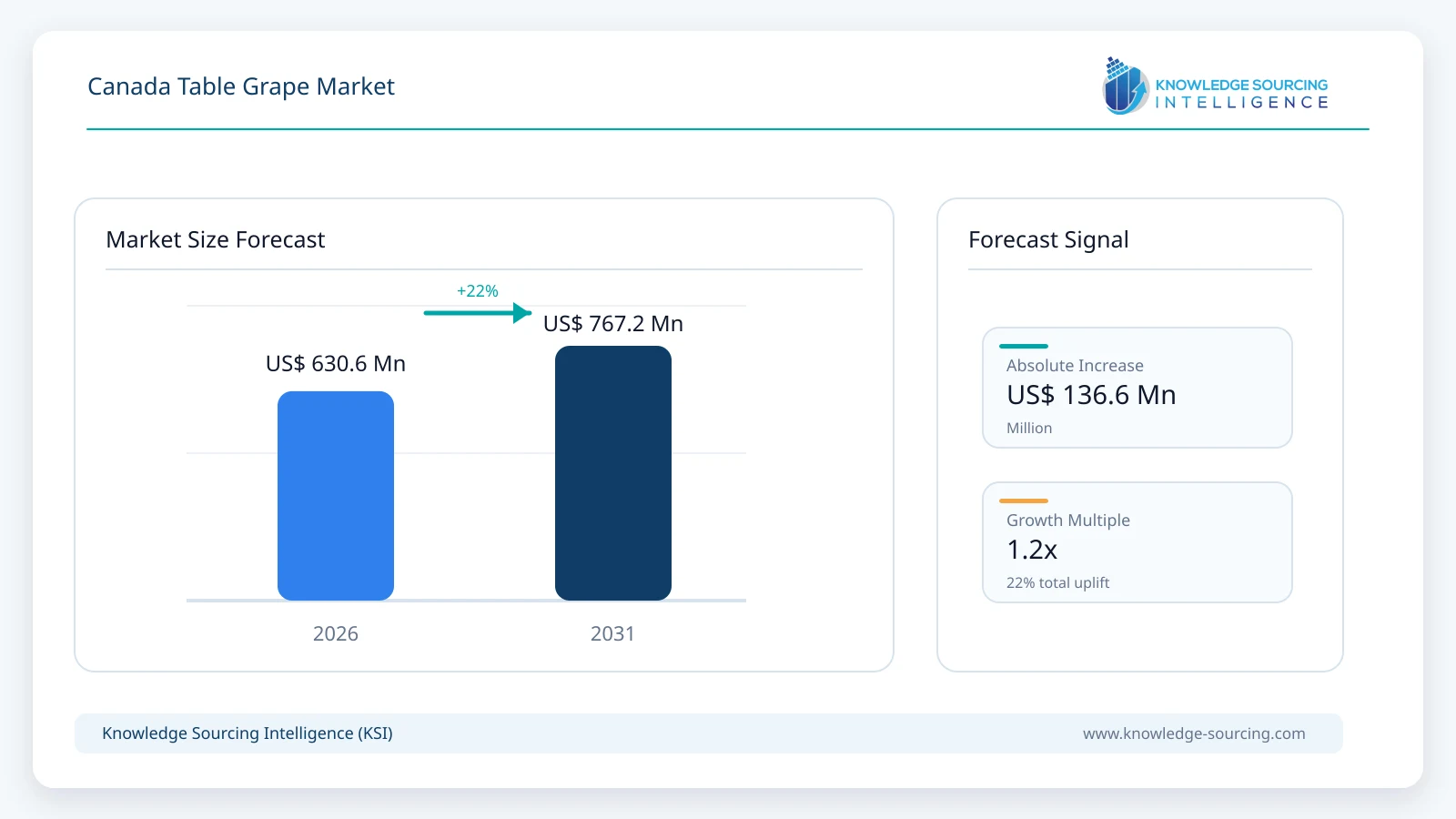
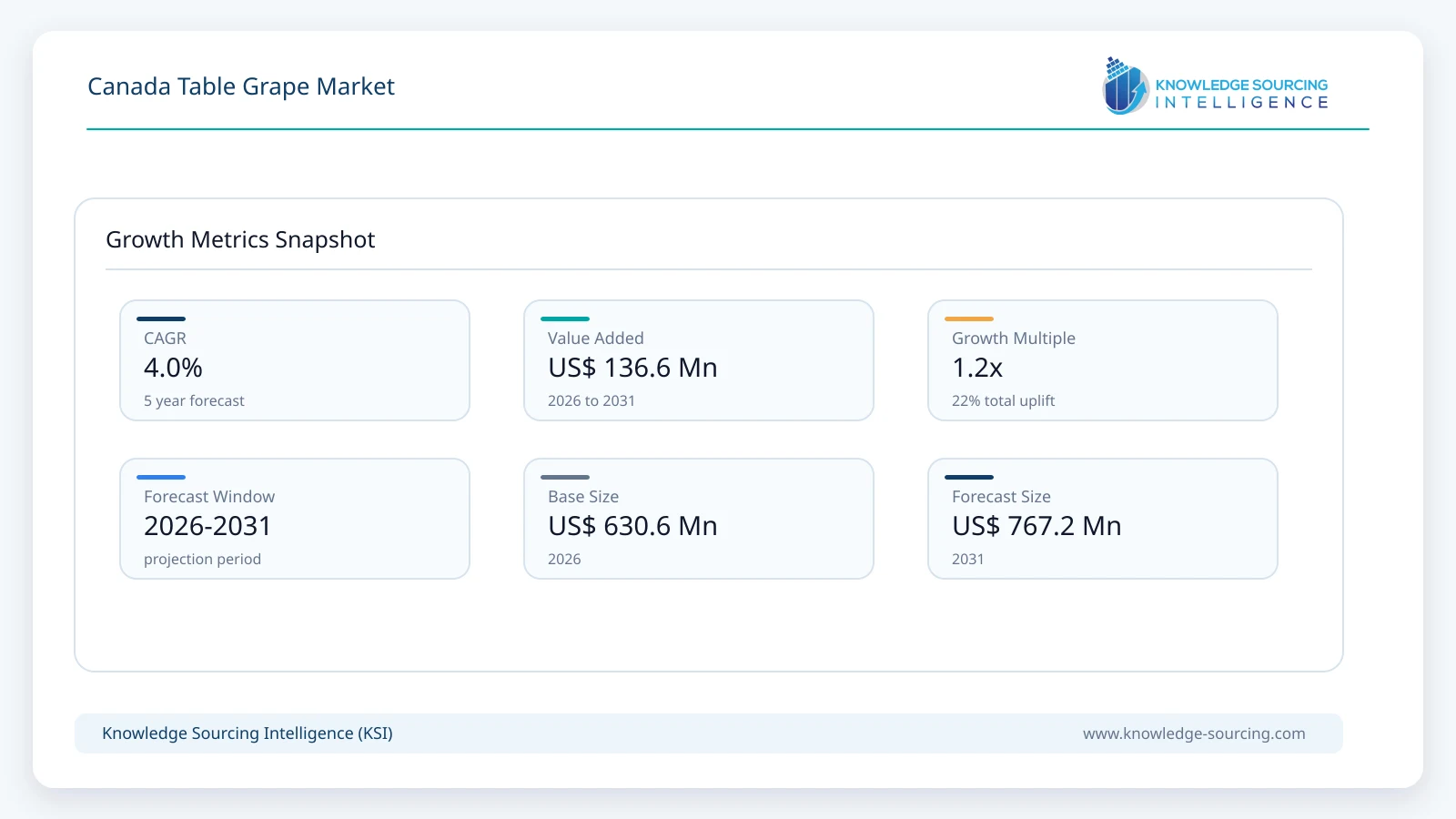
The Canadian Table Grape Market is forecast to grow at a CAGR of 4.0%, reaching USD 767.2 million in 2031 from USD 630.6 million in 2026.
Highlights:
- 1Seedless table grapes account for a substantial share of retail demand due to consumer convenience and wider supermarket availability.
- 2Imports remain essential to year-round supply, complementing Canada's limited domestic production season.
- 3Food retailers continue expanding premium fresh produce assortments, supporting demand for high-quality table grapes.
- 4Online grocery channels are improving access to fresh fruit, although offline retail remains the primary sales channel.
- 5Food safety standards, import regulations, and cold-chain efficiency remain critical purchasing considerations across the value chain.
According to Agriculture and Agri-Food Canada (AAFC) and Statistics Canada, imported fresh grapes consistently represent the largest share of total market availability, reflecting Canada's structural reliance on international suppliers.
Retail purchasing decisions increasingly prioritize consistent fruit quality, berry size, shelf life, sweetness, and appearance alongside food safety compliance. Large supermarket chains continue expanding premium fresh produce offerings while strengthening direct sourcing relationships with growers and importers capable of meeting strict quality specifications. Seasonal promotions, branded premium varieties, and improved cold-chain logistics have further increased product availability across both metropolitan and regional markets.
Commercial value within the market extends beyond primary production to post-harvest handling, refrigerated transportation, packaging, import distribution, and retail merchandising. Investments in controlled-atmosphere storage, traceability systems, and temperature-controlled logistics have become increasingly important as retailers seek to reduce food waste while maintaining product freshness throughout distribution. Importers with diversified sourcing regions are also better positioned to manage seasonal supply fluctuations and weather-related production risks.
Demand during the 2026-2031 forecast period is expected to remain supported by stable household fruit consumption, retailer emphasis on premium fresh produce, expanding availability of proprietary grape varieties, and continued investment in efficient supply-chain infrastructure. Competitive performance will depend on sourcing reliability, product differentiation, regulatory compliance, and logistics efficiency rather than production scale alone.
Key Market Indicators
Indicator | Latest Evidence | Commercial Meaning |
Fresh grape availability | Imports account for most annual Canadian supply | Demonstrates continued dependence on international sourcing to maintain year-round retail availability. |
Domestic production regions | Ontario and British Columbia (Statistics Canada) | Commercial cultivation remains geographically concentrated, limiting domestic supply expansion. |
Primary sales channel | Supermarkets and grocery retailers dominate fresh fruit sales (AAFC) | Large retail chains continue to influence procurement standards and supplier selection. |
Import diversity | United States, Peru, Chile, Mexico and South Africa remain key suppliers (AAFC; Global Affairs Canada) | Geographic diversification reduces seasonal supply disruptions and extends market availability. |
Consumer preference | Seedless varieties represent the preferred retail offering across major grocery chains | Product development increasingly focuses on premium seedless cultivars and proprietary varieties. |
Key indicator: Canada continues to rely on imported table grapes for uninterrupted annual supply.
Commercial meaning: Supply-chain resilience and diversified sourcing remain central competitive factors for importers and distributors.
Market Drivers
Expansion of premium retail fresh produce assortments.
Canadian grocery retailers have continued allocating additional shelf space to premium fresh produce categories as consumers increasingly purchase higher-quality fruits throughout the year. Major national retailers emphasize consistency in appearance, flavour, shelf life, and packaging, encouraging suppliers to introduce premium grape cultivars alongside conventional offerings. Agriculture and Agri-Food Canada identifies fresh fruit consumption as an important contributor to retail produce sales, while retailers have expanded branded produce programs that reward growers capable of maintaining uniform quality. This purchasing behaviour supports higher-value imports, encourages long-term supplier relationships, and increases demand for proprietary grape varieties offering superior eating characteristics and improved storage performance.
Year-round import sourcing strengthens market stability.
Canada's climatic conditions restrict commercial grape production to relatively short harvesting periods, making international sourcing fundamental to market continuity. Agriculture and Agri-Food Canada and Statistics Canada indicate that imported grapes consistently supply the majority of annual consumption. Importers diversify procurement across California, Peru, Chile, Mexico, and South Africa to balance seasonal harvest cycles and reduce supply interruptions caused by weather events. This diversified sourcing strategy enables retailers to maintain consistent product availability while reducing dependence on any single producing region. Import logistics, refrigerated transportation, and established distribution partnerships therefore remain critical commercial capabilities throughout the value chain.
Development of proprietary seedless grape varieties.
Breeding organizations and commercial growers continue introducing patented seedless grape cultivars designed to improve sweetness, firmness, shelf life, berry size, and transport durability. Companies such as SNFL Group have expanded licensing programs that provide growers with access to differentiated premium varieties capable of commanding stronger retail positioning. These cultivars address retailer demand for consistent quality while offering producers improved productivity and harvest scheduling flexibility. The increasing commercialization of proprietary genetics also strengthens competition beyond price, allowing suppliers to differentiate products through flavour profiles, harvest windows, and branding rather than relying solely on commodity characteristics.
Cold-chain investment improves product quality and reduces waste.
Maintaining grape quality requires uninterrupted temperature control from harvest through retail distribution. Canadian importers, logistics providers, and distribution centres continue investing in refrigerated transportation, warehouse modernization, and temperature monitoring technologies that preserve freshness during long-distance shipments. According to Agriculture and Agri-Food Canada, efficient cold-chain management remains essential for reducing spoilage in perishable food products. Better logistics support longer shelf life, improve inventory management, and reduce shrinkage for retailers, making investments in storage and transportation infrastructure commercially attractive across the supply chain.
Market Restraints and Challenges
Dependence on imported supply exposes the market to external disruptions.
Heavy reliance on imported grapes increases exposure to weather variability, transportation delays, labour shortages in exporting countries, and international logistics disruptions. Production shortfalls in major supplying regions can reduce export availability and increase procurement costs for Canadian importers. Shipping delays and port congestion may also shorten remaining shelf life upon arrival, increasing food waste and inventory losses. Suppliers increasingly mitigate these risks by diversifying sourcing regions and maintaining relationships with multiple growers, although such strategies cannot eliminate supply volatility entirely.
Strict food safety and phytosanitary compliance increase operating costs.
Imported fresh grapes must satisfy Canadian Food Inspection Agency requirements covering phytosanitary certification, pesticide residue limits, labelling, traceability, and food safety standards. Compliance requires extensive documentation, inspection procedures, and quality verification throughout the supply chain. Exporters serving multiple international markets often face varying regulatory requirements, increasing administrative complexity and operational costs. Importers with established compliance systems generally manage these obligations more efficiently, while smaller suppliers may experience higher certification costs and longer market entry timelines.
Climate variability limits domestic production expansion.
Commercial table grape cultivation in Canada remains concentrated in regions with suitable growing conditions, particularly Ontario and British Columbia. Frost events, excessive rainfall during harvest, heat stress, and other weather-related factors can reduce yields and affect fruit quality. Provincial agricultural agencies have repeatedly highlighted climate variability as an ongoing challenge for fruit producers. While improved vineyard management, irrigation, and cultivar selection can reduce production risks, climatic limitations continue restricting rapid expansion of domestic supply relative to national consumption.
Retail procurement standards raise barriers for smaller suppliers.
Large supermarket chains increasingly require suppliers to demonstrate consistent product quality, standardized packaging, traceability, food safety certification, and reliable delivery performance before securing procurement contracts. Meeting these requirements often requires investment in grading equipment, cold storage, quality assurance systems, and logistics capabilities. Smaller growers and distributors may struggle to achieve the operational scale necessary to satisfy national retail programs, limiting their participation in higher-volume supply agreements despite producing competitive fruit during the domestic harvest season.
Major Segment Analysis
Seedless Variety
Seedless table grapes represent the most commercially important variety segment within the Canadian market because they align closely with retail merchandising strategies and household purchasing preferences. Large grocery retailers increasingly allocate shelf space to premium seedless cultivars that offer consistent berry size, sweetness, texture, and longer shelf life. Proprietary varieties developed through commercial breeding programs have further strengthened this segment by providing differentiated flavour profiles and harvest windows that allow suppliers to extend seasonal availability. As a result, growers and importers continue prioritizing licensed seedless cultivars capable of meeting retailer specifications and supporting premium pricing.
Buyer expectations extend beyond appearance to include transport durability, reduced spoilage, and reliable year-round availability. Importers source seedless grapes from multiple producing countries to maintain supply continuity across seasonal production cycles, while domestic growers focus on quality rather than volume to remain competitive during the Canadian harvest season. Licensing costs for proprietary varieties and compliance with retailer quality standards raise production and distribution expenses, yet these investments improve product differentiation and strengthen long-term supplier relationships. Performance within the seedless segment therefore has a direct influence on merchandising strategies, procurement decisions, and value realization across the broader Canada table grape market.
Regional Analysis
Region | Main Demand Signal | Principal Constraint |
Ontario | Largest concentration of consumers, grocery distribution, and domestic grape production | Seasonal production limits and weather variability |
British Columbia | Established fruit-growing industry with favourable vineyard conditions | Limited production scale and climate-related risks |
Others | Dependence on imported grapes distributed through national retail networks | Minimal commercial cultivation and logistics costs |
Ontario
Ontario remains the country's most commercially important province for table grapes because it combines domestic production with Canada's largest consumer and retail markets. The Niagara Peninsula provides favourable conditions for grape cultivation, while proximity to major population centres supports efficient distribution to supermarkets and wholesale markets. Statistics Canada identifies Ontario as Canada's principal grape-producing province by cultivated area. Retail demand is reinforced by dense grocery networks and established fresh produce distribution infrastructure. Seasonal production nevertheless requires supplementation through imports to ensure uninterrupted availability during the remainder of the year.
British Columbia
British Columbia contributes an important share of Canada's domestic table grape production, particularly within the Okanagan Valley, where climatic conditions support commercial vineyard operations. Provincial investment in horticultural development and advanced vineyard management has supported improvements in fruit quality and production efficiency. Growers increasingly emphasize premium varieties capable of meeting retailer specifications for sweetness, appearance, and shelf life. Production volumes, however, remain constrained by available agricultural land, water availability, and seasonal weather conditions, limiting the province's ability to satisfy national demand independently.
Others
The remaining provinces rely predominantly on imported grapes supplied through national wholesalers, distribution centres, and supermarket networks. Limited climatic suitability restricts commercial table grape cultivation across most regions, making refrigerated logistics and efficient interprovincial distribution essential for maintaining product freshness. National retailers leverage centralized procurement systems to distribute imported fruit across these markets, ensuring year-round availability despite minimal local production. Consumer demand remains stable, although transportation costs and longer distribution distances can influence retail pricing and inventory management.
Competitive Landscape
Competition within the Canada table grape market is driven primarily by sourcing capability, product quality, variety portfolios, supply reliability, and compliance with retailer procurement standards rather than domestic production volume alone. Delano Farms Company, SNFL Group (AM Fresh Group), Giumarra Vineyard Corporation, Linden Lane Farms, and BC Tree Fruits participate across different stages of the value chain, including breeding, cultivation, distribution, and marketing. Companies with access to proprietary seedless varieties strengthen their competitive position by offering differentiated products that support premium retail placement and longer marketing seasons.
Importers and distributors increasingly diversify sourcing across multiple producing countries to reduce weather-related supply disruptions and seasonal shortages. Investments in cold-chain infrastructure, quality assurance, traceability systems, and standardized packaging have become essential for maintaining retailer confidence and reducing post-harvest losses. Domestic producers compete through freshness, regional branding, and close relationships with Canadian retailers, while international suppliers leverage production scale and extended harvest calendars to maintain year-round availability. These competitive dynamics continue raising quality expectations throughout the supply chain and encourage greater investment in varietal development and logistics efficiency.
Recent Developments
June 2026: Divine Flavor introduced Arra Honey Pop early-season table grapes. Developed with Grapa Global, the new premium white seedless variety entered Canadian import channels via Mexican harvests, targeting improved flavor, crunch, and early seasonal supply continuity.
February 2026: Vista Vineyards launched a 52-week table grape supply program. The vertically integrated platform combines California, Mexico, and South America operations, ensuring year-round Canadian retail availability through proprietary varieties, coordinated logistics, and expanded retail partnerships.
January 2026: Oppy expanded its table grape import program through Dole integration. The deal added 1.25 million boxes from Peru and Chile, increasing Canadian supply by 44 percent and strengthening year-round availability despite earlier seasonal export disruptions.
December 2025: Unifrutti acquired Safco Operations in Peru. The acquisition strengthened its Southern Hemisphere table grape supply base for exports into Canada, expanding proprietary varietal production capacity across 560 hectares and improving winter-season availability.
October 2025: AMFRESH Group acquired Terramara Fresh in Mexico. The deal expanded Pacific Rim table grape farming operations, enhancing proprietary varietal development and strengthening export flows into North America, including Canadian retail supply chains.
Regulatory and Policy Environment
Canada's table grape market operates within a regulatory framework that emphasizes food safety, plant health, import compliance, and consumer protection. The Canadian Food Inspection Agency administers the Safe Food for Canadians Regulations (SFCR), which establish licensing, preventive control, traceability, and import requirements for fresh produce businesses. Importers must ensure that table grapes comply with Canadian maximum residue limits for pesticides, phytosanitary measures, and labelling standards before entering the domestic market.
International trade agreements continue supporting diversified sourcing by facilitating access to major exporting countries while maintaining regulatory oversight. Fresh produce imports remain subject to inspection and documentation requirements intended to reduce plant pest risks and protect consumer health. Domestic growers also operate under provincial agricultural regulations covering pesticide use, labour practices, environmental management, and food safety certification.
Environmental sustainability is becoming a more important consideration across the value chain. Provincial governments continue promoting efficient water management, integrated pest management, and climate adaptation measures for horticultural producers. These initiatives encourage operational improvements while helping growers respond to changing weather conditions and evolving retailer sustainability expectations.
Outlook and Strategic Implications
Demand for table grapes in Canada is expected to remain supported during the 2026-2031 forecast period by stable fresh fruit consumption, continued expansion of premium retail produce assortments, and year-round availability through diversified international sourcing. Seedless varieties are likely to retain their commercial importance as retailers continue emphasizing convenience, consistent eating quality, and differentiated premium offerings. Domestic production will remain strategically valuable during seasonal harvest periods but is unlikely to replace imported supply because of climatic limitations and relatively limited production capacity.
Strategic priorities across the value chain are expected to include:
Growers: Invest in premium varieties, climate-resilient production practices, and quality improvement to strengthen competitiveness.
Importers and distributors: Diversify sourcing regions, strengthen cold-chain infrastructure, and improve traceability to reduce supply disruptions.
Retailers: Expand premium fresh produce assortments while maintaining strict quality and food safety standards.
Technology and logistics providers: Develop solutions that improve inventory visibility, refrigerated transport efficiency, and post-harvest quality management.
Commercial performance over the forecast period will depend less on expansion of domestic production volumes and more on supply-chain resilience, access to premium varieties, regulatory compliance, and the ability of suppliers to consistently deliver high-quality fruit throughout the year. Companies that combine diversified sourcing with efficient logistics and strong retailer relationships are expected to be better positioned to respond to changing procurement requirements and maintain competitive differentiation within the Canadian table grape market.
Canada Table Grape Market Scope:
| Report Metric | Details |
|---|---|
| Total Market Size in 2026 | USD 630.6 million |
| Total Market Size in 2031 | USD 767.2 million |
| Forecast Unit | Million |
| Growth Rate | 4.0% |
| Study Period | 2021 to 2031 |
| Historical Data | 2021 to 2024 |
| Base Year | 2025 |
| Forecast Period | 2026 – 2031 |
| Segmentation | Variety, Distribution Channel, State |
| Companies |
|
Market Segmentation
By Variety
- Seeded
- Seedless
By Distribution Channel
- Offline
- Online
By State
- Ontario
- British Columbia
- Others
Table of Contents
1. INTRODUCTION
1.1. Market Overview
1.2. Market Definition
1.3. Scope of the Study
1.4. Market Segmentation
1.5. Currency
1.6. Assumptions
1.7. Base and Forecast Years Timeline
2. RESEARCH METHODOLOGY
2.1. Research Data
2.2. Assumptions
3. EXECUTIVE SUMMARY
3.1. Research Highlights
4. MARKET DYNAMICS
4.1. Market Drivers
4.2. Market Restraints
4.3. Market Opportunities
4.4. Porter’s Five Force Analysis
4.4.1. Bargaining Power of Suppliers
4.4.2. Bargaining Power of Buyers
4.4.3. Threat of New Entrants
4.4.4. Threat of Substitutes
4.4.5. Competitive Rivalry in the Industry
4.5. Industry Value Chain Analysis
5. CANADA TABLE GRAPE MARKET ANALYSIS, BY VARIETY
5.1. Introduction
5.2. Seeded
5.3. Seedless
6. CANADA TABLE GRAPE MARKET ANALYSIS, BY DISTRIBUTION CHANNEL
6.1. Introduction
6.2. Offline
6.3. Online
7. CANADA TABLE GRAPE MARKET ANALYSIS, BY STATE
7.1. Introduction
7.2. Ontario
7.3. British Columbia
7.4. Others
8. COMPETITIVE ENVIRONMENT AND ANALYSIS
8.1. Major Players and Strategy Analysis
8.2. Emerging Players and Market Lucrativeness
8.3. Mergers, Acquisitions, Agreements, and Collaborations
8.4. Vendor Competitiveness Matrix
9. COMPANY PROFILES
9.1. Delano Farms Company
9.2. SNFL Group (AM Fresh Group)
9.3. BC Tree Fruits
9.4. Linden Lane Farms
9.5. Giumarra Vineyard Corporation
Navigate
Trusted by the world's leading organizations











