
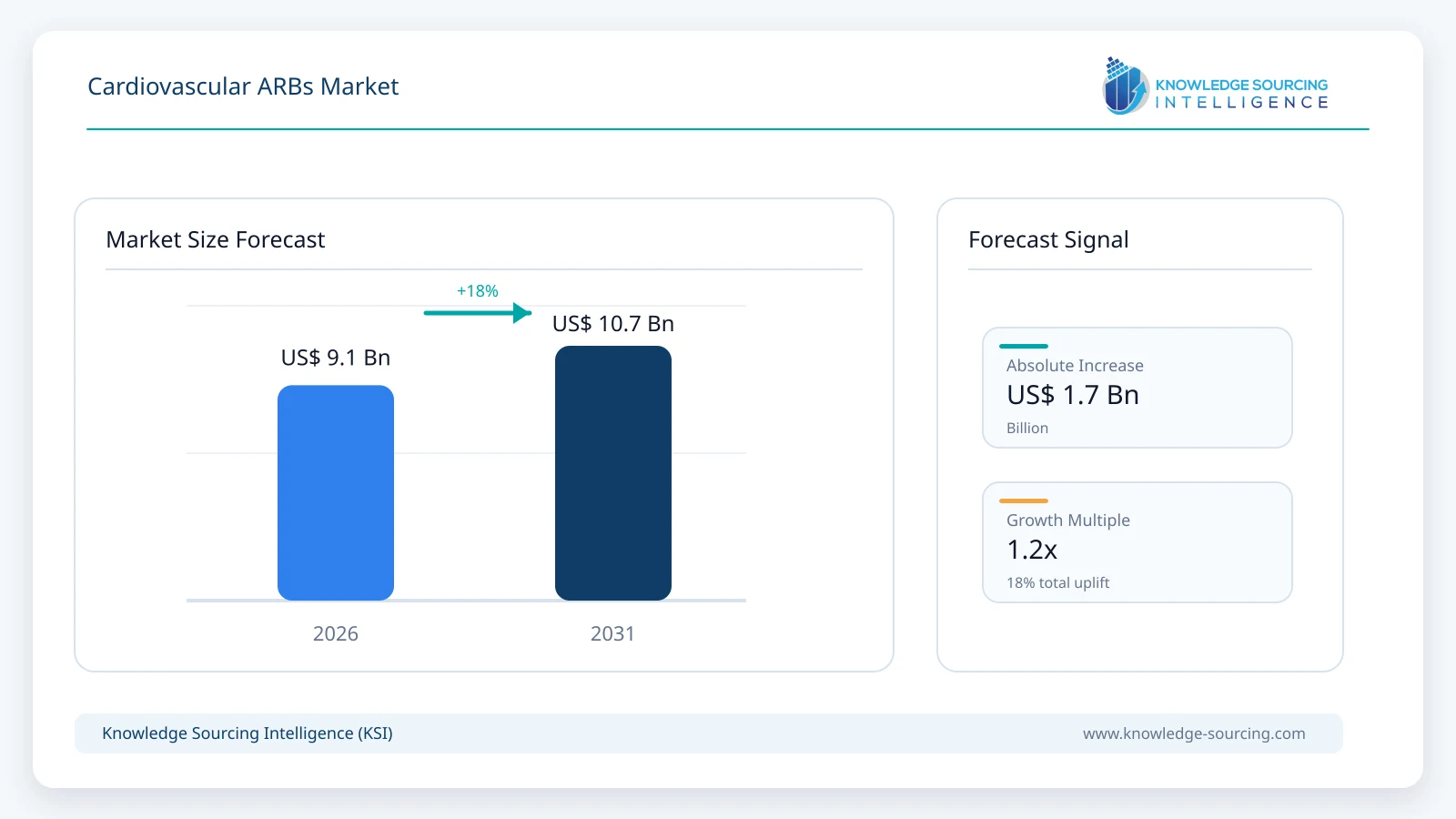
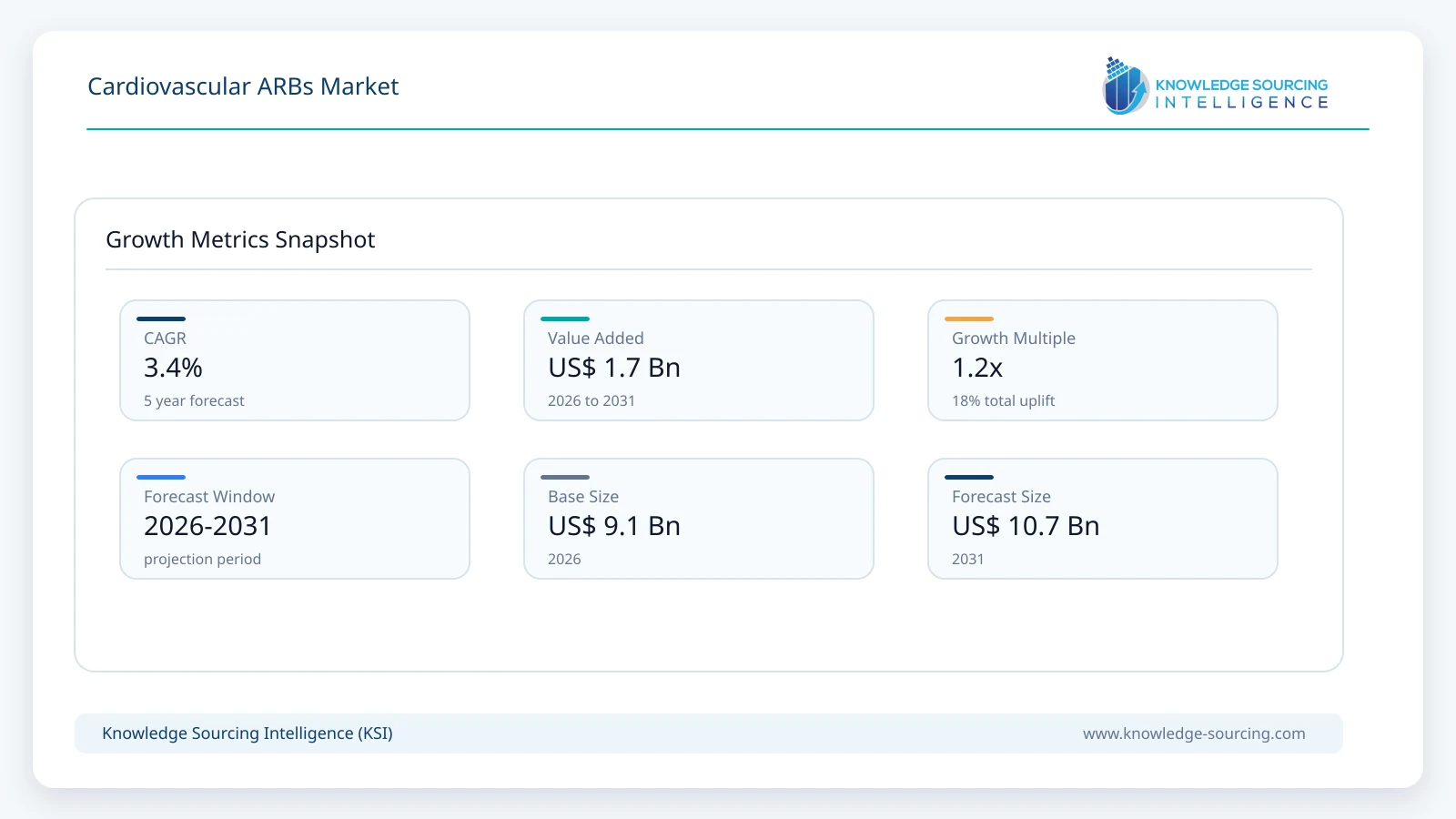
The Cardiovascular ARBs Market is set to reach USD 10.73 billion in 2031, growing at a CAGR of 3.4% from USD 9.07 billion in 2026.
Highlights:
- 1ARBs are widely prescribed for hypertension, heart failure, diabetic nephropathy, chronic kidney disease, and cardiovascular risk reduction.
- 2ARBs are often preferred in patients intolerant to ACE inhibitor-associated cough or angioedema.
- 3Losartan, valsartan, telmisartan, olmesartan, candesartan, and irbesartan represent the leading marketed molecules.
- 4Extensive generic availability supports broad access and low treatment costs globally.
- 5Rising prevalence of hypertension, diabetes, obesity, and chronic kidney disease continues to expand the addressable patient population.
Angiotensin II receptor blockers (ARBs) are a class of cardiovascular medicines that selectively block the binding of angiotensin II to AT1 receptors, thereby reducing vasoconstriction, aldosterone secretion, sympathetic activation, and sodium retention. This mechanism lowers blood pressure, decreases cardiac workload, and provides renal and cardiovascular protection in high-risk patients. ARBs are widely used because they deliver efficacy comparable to ACE inhibitors while generally demonstrating improved tolerability, particularly lower incidence of cough and angioedema.
Key molecules including Losartan, Valsartan, Telmisartan, Olmesartan, Candesartan, and Irbesartan are extensively prescribed for hypertension, heart failure, diabetic nephropathy, chronic kidney disease, and cardiovascular risk reduction. Most ARBs are available as low-cost generics and are incorporated into international treatment guidelines. Their broad clinical applicability and favorable safety profile continue to support strong global utilization.
Market Dynamics
Market Drivers
Rising Global Burden of Hypertension and Cardiovascular Disease
Hypertension remains one of the largest chronic disease burdens worldwide and is a major driver of ARB demand. Increasing prevalence of obesity, sedentary lifestyles, aging populations, and metabolic disorders is contributing to sustained growth in cardiovascular disease. ARBs are widely prescribed because they provide effective blood pressure reduction and long-term cardiovascular protection with favorable tolerability.
Strong Guideline Support and Favorable Tolerability
Organizations such as the American Heart Association and the European Society of Cardiology recommend ARBs for hypertension, heart failure, chronic kidney disease, and diabetic nephropathy. Their lower incidence of cough and angioedema compared with ACE inhibitors makes them attractive alternatives in long-term therapy.
Increasing Chronic Kidney Disease and Diabetes Prevalence
Chronic Kidney Disease and Type 2 Diabetes are major global health challenges associated with elevated cardiovascular risk. ARBs provide both renal and cardiovascular protection and are strongly recommended in diabetic nephropathy and proteinuric kidney disease, supporting growing utilization.
Broad Generic Availability
Most ARBs are available as inexpensive generics from multinational and regional manufacturers. Low-cost access supports widespread adoption in public health systems, insurance formularies, and outpatient treatment programs globally.
Market Restraints
Intense generic competition significantly limits pricing power and revenue expansion.
Adverse effects including hyperkalemia, hypotension, dizziness, and renal function changes may limit use in some patients.
Contraindication during pregnancy restricts use in women of childbearing potential without appropriate counseling.
Newer cardiometabolic therapies including SGLT2 inhibitors and ARNI combinations are reshaping treatment paradigms in heart failure and kidney disease.
Manufacturing quality issues and supply disruptions can temporarily affect product availability in global markets.
Market Opportunities
Expansion in Emerging Markets
Demand for ARBs is increasing in India, China, Brazil, and Indonesia due to improving diagnosis rates and expanding healthcare infrastructure. Generic manufacturers are increasing supply to support broader access.
Growth of Fixed-Dose Combination Therapies
ARBs are increasingly combined with diuretics and calcium channel blockers to simplify treatment regimens and improve adherence. Combination products provide lifecycle extension opportunities and strengthen long-term chronic disease management strategies.
Increasing Cardio-Renal Risk Management Focus
Growing emphasis on integrated cardiovascular and renal protection is supporting continued use of ARBs in chronic kidney disease and diabetic nephropathy. Their dual protective role broadens the addressable treatment population.
Disease & Epidemiology Analysis
Cardiovascular disease remains the leading global cause of mortality and the primary epidemiological driver of ARB demand. World Health Organization estimates that cardiovascular disease causes approximately 17.9 million deaths annually worldwide. Hypertension affects more than one billion adults and significantly increases the risk of stroke, heart failure, coronary artery disease, and chronic kidney disease.
Heart Failure and Coronary Artery Disease continue to drive substantial ARB utilization, particularly in patients intolerant to ACE inhibitors. Diabetic Nephropathy and chronic kidney disease are also increasing globally due to rising diabetes prevalence. ARBs play a central role in slowing renal disease progression while reducing cardiovascular morbidity and mortality.
Treatment Guidelines Landscape
ARB Category | Representative Molecules | Primary Clinical Applications | Guideline Significance |
Standard Oral ARBs | Losartan, Valsartan, Telmisartan | Hypertension, cardiovascular risk reduction | Strongly recommended in major international guidelines |
Heart Failure ARBs | Candesartan, Valsartan | Heart failure with reduced ejection fraction | Important alternatives for ACE inhibitor-intolerant patients |
Renal Protective ARBs | Irbesartan, Losartan, Telmisartan | Diabetic nephropathy and chronic kidney disease | Significant role in cardio-renal protection |
Fixed-Dose Combination Products | ARBs with diuretics or calcium channel blockers | Multi-drug hypertension management | Improve adherence and simplify chronic therapy |
Hospital and Specialized Formulations |
Market Segmentation
By Molecule
Losartan remains one of the leading ARB molecules globally because of its extensive clinical use, broad generic availability, and strong physician familiarity. Other major molecules including Valsartan, Telmisartan, Olmesartan, Candesartan, and Irbesartan also maintain strong prescription demand across cardiovascular and renal disease management. Growth is supported by long-term use in hypertension, diabetic nephropathy, and chronic kidney disease. Generic competition dominates the segment, encouraging high-volume utilization and broad patient access in both developed and emerging healthcare markets worldwide.
By Indication
Hypertension represents the largest indication segment within the ARBs market due to its exceptionally high global prevalence and chronic treatment requirements. ARBs are widely prescribed as first-line or combination therapies because they effectively reduce blood pressure and provide favorable tolerability. Additional demand comes from heart failure, coronary artery disease, diabetic nephropathy, and chronic kidney disease with cardiovascular risk. Increasing prevalence of obesity, diabetes, sedentary lifestyles, and aging populations continues expanding the addressable patient pool. Strong treatment guideline support and broad generic availability are sustaining stable prescription volumes and long-term market growth across global healthcare systems.
By Route of Administration
Oral administration dominates the global ARBs market because nearly all long-term cardiovascular and renal disease management is conducted through tablet-based outpatient therapy. Oral formulations provide convenient once-daily dosing, strong patient adherence, and cost-effective chronic treatment. Intravenous ARB formulations represent only a limited niche segment used in specialized hospital and acute care settings. Extensive generic availability and simplified manufacturing continue supporting high-volume oral utilization globally. Growth in fixed-dose combinations pairing ARBs with diuretics or calcium channel blockers is further strengthening the oral segment by improving treatment convenience, reducing pill burden, and supporting adherence in patients requiring multidrug antihypertensive therapy.
REGIONAL ANALYSIS
North America
North America remains one of the largest ARB markets globally due to high prevalence of hypertension, diabetes, chronic kidney disease, and cardiovascular disorders combined with strong healthcare infrastructure and reimbursement coverage. The United States accounts for the majority of regional demand through extensive prescription volumes and broad generic drug utilization. Physicians frequently prescribe ARBs because of their strong efficacy and improved tolerability compared with ACE inhibitors. Mature generic competition constrains pricing growth but ensures broad patient access. Continued aging of the population and increasing cardiometabolic disease prevalence are expected to sustain stable long-term market demand throughout the forecast period.
Europe
Europe represents a mature and highly regulated ARB market supported by universal healthcare systems, aging demographics, and extensive implementation of evidence-based cardiovascular treatment guidelines. Major markets including Germany, France, United Kingdom, Italy, and Spain maintain substantial prescription demand for low-cost generic ARBs. Cost-containment measures encourage widespread use of established molecules with strong clinical outcomes data. Increasing prevalence of chronic kidney disease, diabetes, and hypertension continues to support long-term utilization. Generic substitution policies and public reimbursement systems further strengthen patient access across the region.
Asia Pacific
Asia Pacific is expected to witness the fastest ARB market growth due to rising hypertension prevalence, expanding healthcare access, increasing urbanization, and strong domestic pharmaceutical manufacturing capabilities. India and China are major contributors because of their very large patient populations and improving chronic disease diagnosis rates. Regional manufacturers such as Sun Pharmaceutical, Dr. Reddy’s, Lupin, Aurobindo, and Zydus are expanding affordable ARB availability domestically and internationally. Government healthcare initiatives and broader insurance coverage are further increasing long-term utilization of cardiovascular and renal protective therapies throughout the region.
Rest of the World
Latin America, the Middle East, and Africa are experiencing gradual ARB market expansion as healthcare infrastructure improves and chronic disease diagnosis rates increase. Rising prevalence of hypertension, diabetes, and cardiovascular disease is supporting growing demand for affordable long-term therapies. Public procurement programs, expanding insurance access, and broader availability of low-cost generic ARBs are improving patient treatment rates. Although pricing pressures remain strong, increasing urbanization and improving awareness of cardiovascular risk management are expected to support continued market growth across developing healthcare systems during the forecast period.
Regulatory Landscape
ARBs operate within highly standardized and mature regulatory frameworks overseen by agencies such as the U.S. Food and Drug Administration, European Medicines Agency, Central Drugs Standard Control Organisation, National Medical Products Administration, and Pharmaceuticals and Medical Devices Agency. Since most ARBs are off-patent, regulatory activity primarily focuses on generic approvals, manufacturing inspections, bioequivalence studies, and post-marketing pharmacovigilance.
Manufacturers must demonstrate pharmaceutical equivalence, strong quality systems, and compliance with Good Manufacturing Practices to maintain regulatory approvals. Past concerns regarding impurities in certain ARB products increased regulatory scrutiny of manufacturing processes, active pharmaceutical ingredient sourcing, and quality control systems globally. Continued emphasis on supply reliability, product quality, and safety monitoring remains critical for companies competing in the global ARBs market.
Pipeline Analysis
The ARBs market is characterized by a mature and highly established development landscape with limited innovation in new molecular entities. Most pipeline activity is focused on generic approvals, fixed-dose combinations, lifecycle management strategies, and geographic market expansion rather than discovery of novel angiotensin II receptor blockers. Companies continue investing in differentiated formulations and combination therapies pairing ARBs with diuretics or calcium channel blockers to improve adherence and simplify long-term hypertension management.
Development efforts are also focused on strengthening cardio-renal disease management through broader utilization in diabetic nephropathy and chronic kidney disease populations. Emerging markets remain a major growth area where pharmaceutical companies are expanding manufacturing capacity and regulatory registrations to meet rising demand for affordable cardiovascular therapies. Although scientific innovation is limited compared with newer cardiovascular drug classes, ARBs remain commercially important because of their strong clinical relevance, large patient population, and durable long-term prescription demand.
Reimbursement Landscape
ARBs operate within highly standardized and mature regulatory frameworks overseen by agencies such as the U.S. Food and Drug Administration, European Medicines Agency, Central Drugs Standard Control Organisation, National Medical Products Administration, and Pharmaceuticals and Medical Devices Agency. Since most ARBs are off-patent, regulatory activity primarily focuses on generic approvals, manufacturing inspections, bioequivalence studies, and post-marketing pharmacovigilance.Manufacturers must demonstrate pharmaceutical equivalence, strong quality systems, and compliance with Good Manufacturing Practices to maintain regulatory approvals. Past concerns regarding impurities in certain ARB products increased regulatory scrutiny of manufacturing processes, active pharmaceutical ingredient sourcing, and quality control systems globally. Continued emphasis on supply reliability, product quality, and safety monitoring remains critical for companies competing in the global ARBs market.
Strategic Competitive Landscape
Novartis AG
Novartis AG is a global innovative medicines company with strong expertise in cardiovascular and renal therapeutics. The company operates across numerous international markets with advanced research, manufacturing, and commercialization capabilities. Although ARBs represent a mature segment within its broader portfolio, Novartis maintains extensive global regulatory and market access infrastructure. The company generated revenue exceeding USD 50 billion in 2025. Recent developments include continued expansion in cardiovascular innovation, radioligand therapy commercialization, and operational streamlining initiatives aimed at strengthening long-term growth and improving efficiency across key therapeutic business segments worldwide.
Pfizer Inc.
Pfizer Inc. is one of the world’s leading pharmaceutical companies with diversified operations spanning cardiovascular medicine, oncology, vaccines, inflammation, and specialty therapeutics. The company possesses extensive manufacturing scale, regulatory expertise, and international commercialization infrastructure supporting mature cardiovascular products including ARBs. Pfizer generated revenue exceeding USD 60 billion in 2025. Recent developments include strategic acquisitions, continued investment in innovative medicine development, and expansion of global commercial operations. The company’s strong international supply capabilities and broad therapeutic reach support its continued participation in large-volume cardiovascular medicine markets.
Teva Pharmaceutical Industries Ltd.
Teva Pharmaceutical Industries Ltd. is a leading global generic pharmaceutical manufacturer with extensive cardiovascular product offerings including multiple ARB formulations. The company benefits from vertically integrated manufacturing, broad international distribution networks, and strong expertise in regulatory filings and generic commercialization. Teva generated revenue exceeding USD 16 billion in 2025. Recent developments include manufacturing modernization, supply chain optimization, and strategic focus on core generic medicine categories. The company continues strengthening its position in chronic disease therapeutics through broad product availability and large-scale production capabilities across regulated and emerging pharmaceutical markets.
Sun Pharmaceutical Industries Ltd.
Sun Pharmaceutical Industries Ltd. is the largest pharmaceutical company in India and a major global supplier of chronic disease medicines including ARBs. The company operates extensive formulation and active pharmaceutical ingredient manufacturing facilities serving numerous international markets. Sun Pharma generated revenue exceeding USD 6 billion in fiscal 2025. Recent developments include expansion of chronic therapy portfolios, increasing penetration into regulated markets, and manufacturing capacity enhancement initiatives. The company’s strong global distribution capabilities and broad cardiovascular product portfolio support its continued growth in essential generic medicine categories worldwide.
Dr. Reddy's Laboratories Ltd.
Dr. Reddy's Laboratories Ltd. is a major Indian pharmaceutical manufacturer with strong formulation development, regulatory, and global commercialization capabilities. The company markets a broad range of cardiovascular medicines including ARBs across developed and emerging markets. Dr. Reddy’s generated revenue exceeding USD 3 billion in fiscal 2025. Recent developments include international product approvals, manufacturing investments, and expansion of chronic therapy offerings. The company continues strengthening its global presence through regulatory compliance initiatives, portfolio diversification, and increasing participation in regulated pharmaceutical markets with high-volume generic cardiovascular products.
Lupin Limited
Lupin Limited is a leading global pharmaceutical company with significant expertise in cardiovascular, respiratory, and chronic disease therapeutics. The company maintains extensive manufacturing operations and strong international distribution networks supporting broad ARB commercialization. Lupin generated revenue exceeding USD 2.5 billion in fiscal 2025. Recent developments include expansion of chronic disease portfolios, investments in manufacturing quality systems, and continued growth in regulated international markets. The company’s vertically integrated production capabilities and broad generic medicine expertise support its position as a major supplier of affordable cardiovascular therapies globally.
Sanofi S.A.
Sanofi S.A. is a multinational healthcare company with diversified operations across pharmaceuticals, vaccines, specialty therapeutics, and consumer healthcare. The company maintains longstanding cardiovascular medicine expertise and extensive international commercialization infrastructure. Although ARBs are not a primary growth focus, Sanofi continues participating in mature cardiovascular therapy markets through broad market access capabilities and global pharmaceutical operations. Sanofi generated revenue exceeding EUR 45 billion in 2025. Recent developments include strategic portfolio optimization, expansion of specialty medicine programs, and continued investment in innovative therapeutic platforms supporting long-term business diversification.
Viatris Inc.
Viatris Inc. is one of the world’s largest suppliers of generic and branded medicines with substantial cardiovascular manufacturing and distribution capabilities. The company markets multiple ARB formulations globally and benefits from extensive regulatory approvals and diversified production infrastructure. Viatris generated revenue exceeding USD 15 billion in 2025. Recent developments include optimization of global manufacturing operations, expansion of chronic disease medicine supply, and strengthening of international distribution networks. The company continues focusing on large-scale generic medicine production and improving access to essential long-term cardiovascular therapies across global healthcare markets.
Aurobindo Pharma Limited
Aurobindo Pharma Limited is a major Indian pharmaceutical manufacturer with strong active pharmaceutical ingredient and finished dosage capabilities supporting global generic medicine supply. The company produces multiple ARB formulations for domestic and export markets and maintains significant presence in regulated pharmaceutical regions. Aurobindo generated revenue exceeding USD 3.5 billion in fiscal 2025. Recent developments include manufacturing capacity expansion, regulatory filing growth, and strengthening of chronic disease product portfolios. The company’s vertically integrated manufacturing structure supports cost-efficient production and broad commercialization of cardiovascular medicines worldwide.
Zydus Lifesciences Limited
Zydus Lifesciences Limited is a prominent Indian pharmaceutical company with expanding global operations and a diversified generic medicine portfolio that includes ARBs and other cardiovascular therapies. The company benefits from integrated manufacturing, strong domestic market presence, and growing international commercialization capabilities. Zydus generated revenue exceeding USD 2 billion in fiscal 2025. Recent developments include international product launches, expansion of regulated market approvals, and investment in manufacturing infrastructure. The company continues strengthening its position in chronic disease therapeutics through broad product availability and increasing global market penetration.
Key Developments
March 2026 – Viatris Inc. Expanded Generic Cardiovascular Supply: Viatris strengthened international manufacturing and distribution of ARBs, including losartan and valsartan formulations, to support growing chronic disease demand across developed and emerging markets.
February 2026 – Aurobindo Pharma Limited Increased Production Capacity for ARBs: Aurobindo expanded manufacturing operations for cardiovascular generics, including multiple ARB products, to support institutional procurement and export growth.
January 2026 – Sun Pharmaceutical Industries Ltd. Expanded Chronic Disease Portfolio: Sun Pharmaceutical continued strengthening its cardiovascular portfolio through expanded registrations and international commercialization of ARB formulations.
December 2025 – Dr. Reddy's Laboratories Ltd. Advanced Global Regulatory Approvals: Dr. Reddy’s expanded international approvals and registrations for cardiovascular generics, including ARBs in regulated markets.
Strategic Insights and Future Market Outlook
The global ARBs market is expected to maintain steady long-term growth through 2031, supported by the increasing burden of hypertension, diabetes, chronic kidney disease, and cardiovascular disorders worldwide. ARBs continue to gain strong physician preference because of their proven efficacy, renal protective effects, and improved tolerability profile compared with ACE inhibitors. Broad inclusion in international treatment guidelines and essential medicine programs will sustain high prescription volumes across both developed and emerging healthcare systems.
Future market expansion will primarily be volume-driven rather than price-driven because of intense generic competition and widespread commoditization. Companies with large-scale manufacturing capabilities, strong regulatory compliance, diversified supply chains, and efficient international distribution networks are expected to maintain competitive advantages. Asia Pacific is projected to generate the strongest incremental growth due to expanding healthcare access and large patient populations in India and China.
Fixed-dose combinations, branded generics, and integrated cardio-renal disease management strategies will continue supporting market development. Although innovation in novel ARB molecules is limited, the class will remain an essential component of long-term cardiovascular and renal disease treatment globally
Cardiovascular ARBs Market Scope:
| Report Metric | Details |
|---|---|
| Total Market Size in 2026 | USD 9.07 billion |
| Total Market Size in 2031 | USD 10.73 billion |
| Forecast Unit | USD Billion |
| Growth Rate | 3.4% |
| Study Period | 2021 to 2031 |
| Historical Data | 2021 to 2024 |
| Base Year | 2025 |
| Forecast Period | 2026 – 2031 |
| Segmentation | Molecule, Indication, Route of Administration, Geography |
| Companies |
|
Market Segmentation
By Molecule
- Losartan
- Valsartan
- Telmisartan
- Olmesartan
- Candesartan
- Irbesartan
- Others
By Indication
- Hypertension
- Heart Failure
- Coronary Artery Disease and Secondary Prevention
- Chronic Kidney Disease with Cardiovascular Risk
- Diabetic Nephropathy
By Route of Administration
- Oral
- Intravenous
By Distribution Channel
- Hospital Pharmacies
- Retail Pharmacies
- Online Pharmacies
By Formulation
- Tablets
- Capsules
- Fixed-Dose Combination Products
By Geography
- North America
- Europe
- Asia-Pacific
- Latin America
- Middle East & Africa
Table of Contents
1. EXECUTIVE SUMMARY
1.1 Cardiovascular ARBs Market Scope and Objectives
1.2 Key Market Insights and Strategic Highlights
1.3 Therapeutic Utilization Snapshot Across Cardiovascular Indications
1.4 Market Growth Outlook and Revenue Forecast
1.5 Strategic Conclusions
2. CARDIOVASCULAR ARBS MARKET OVERVIEW
2.1 Definition and Scope of Global ARBs Market – Cardiovascular Applications
2.2 Cardiovascular ARBs Market Size Analysis 2018–2024
2.3 Cardiovascular ARBs Market Size Forecast 2025–2035
2.4 Market Drivers
2.4.1 Rising Prevalence of Hypertension and Heart Failure
2.4.2 Increasing Use in Cardiovascular and Renal Protection
2.4.3 Improved Tolerability Compared with ACE Inhibitors
2.4.4 Broad Generic Availability and Guideline-Based Adoption
2.5 Market Restraints
2.5.1 Competition from ARNI and Combination Therapies
2.5.2 Safety Concerns Related to Hyperkalemia and Renal Dysfunction
2.5.3 Pricing Pressure from Generic Competition
2.6 Market Opportunities
2.6.1 Expansion in Emerging Markets
2.6.2 Fixed-Dose Combination Product Development
2.6.3 Increasing Adoption in Cardio-Renal Disease Management
2.7 Cardiovascular ARBs Market Segmentation
2.7.1 By Molecule
2.7.1.1 Losartan
2.7.1.2 Valsartan
2.7.1.3 Telmisartan
2.7.1.4 Olmesartan
2.7.1.5 Candesartan
2.7.1.6 Irbesartan
2.7.1.7 Others
2.7.2 By Indication
2.7.2.1 Hypertension
2.7.2.2 Heart Failure
2.7.2.3 Coronary Artery Disease and Secondary Prevention
2.7.2.4 Chronic Kidney Disease with Cardiovascular Risk
2.7.2.5 Diabetic Nephropathy
2.7.3 By Route of Administration
2.7.3.1 Oral
2.7.3.2 Intravenous
2.7.4 By Distribution Channel
2.7.4.1 Hospital Pharmacies
2.7.4.2 Retail Pharmacies
2.7.4.3 Online Pharmacies
2.7.5 By Formulation
2.7.5.1 Tablets
2.7.5.2 Capsules
2.7.5.3 Fixed-Dose Combination Products
3. CARDIOVASCULAR DISEASE EPIDEMIOLOGY AND TREATMENT BURDEN
3.1 Global Prevalence of Cardiovascular Diseases
3.2 Hypertension Epidemiology
3.3 Heart Failure Epidemiology
3.4 Chronic Kidney Disease and Diabetic Nephropathy Burden
3.5 Coronary Artery Disease Burden
3.6 Forecast of Treatable Patient Population
4. DISEASE AND UNMET NEED ANALYSIS
4.1 Need for Long-Term Blood Pressure Control
4.2 Residual Cardiovascular and Renal Risk
4.3 Treatment Adherence Challenges
4.4 Need for Better Tolerability and Personalized Therapy
4.5 Unmet Need in Low- and Middle-Income Countries
5. MECHANISM OF ACTION AND PHARMACOLOGY LANDSCAPE
5.1 Renin-Angiotensin-Aldosterone System Biology
5.2 Angiotensin II Receptor Blockade Mechanism
5.3 Cardiovascular and Renal Protective Effects
5.4 Pharmacokinetic and Pharmacodynamic Considerations
5.5 Comparative Safety and Tolerability Profiles
5.6 Drug Interaction Considerations
6. CLINICAL AND COMMERCIAL INTELLIGENCE
6.1 Clinical Guideline Positioning
6.2 Utilization by Cardiovascular Indication
6.3 Prescription Volume Trends
6.4 Comparative Effectiveness Benchmarking
6.5 Generic Competition Analysis
6.6 Pricing Trends and Reimbursement Dynamics
6.7 Market Share Analysis by Molecule
6.8 Lifecycle Management Strategies
7. PRODUCT BENCHMARKING
7.1 Established Standard-of-Care Molecules
7.2 Guideline-Preferred Agents
7.3 Fixed-Dose Combination Products
7.4 Extended-Release and Reformulated Products
7.5 Emerging Differentiated Formulations
7.6 Competitive Differentiation Analysis
8. MARKET FORECAST AND RISK ANALYSIS
8.1 Revenue Forecast Modeling
8.2 Demand Forecast by Indication
8.3 Generic Erosion Assessment
8.4 Pricing Pressure Analysis
8.5 Key Risk Factors
8.5.1 Guideline Evolution Risks
8.5.2 Competitive Class Substitution
8.5.3 Supply Chain Disruptions
8.5.4 Reimbursement Changes
8.6 Sensitivity and Scenario Analysis
9. COMPETITIVE LANDSCAPE
9.1 Branded vs Generic Market Structure
9.2 Market Share by Manufacturer
9.3 Regional Competitive Positioning
9.4 Portfolio Breadth Analysis
9.5 Strategic Positioning of Leading Suppliers
9.6 Mergers, Acquisitions, and Licensing Activity
10. GEOGRAPHIC ANALYSIS
10.1 North America
10.2 Europe
10.3 Asia-Pacific
10.4 Latin America
10.5 Middle East and Africa
11.KEY COUNTRIES ANALYSIS
11.1 United States
11.2 Canada
11.3 Germany
11.4 United Kingdom
11.5 France
11.6 Italy
11.7 Spain
11.8 China
11.9 Japan
11.10 India
11.11 South Korea
11.12 Australia
11.13 Brazil
11.14 Mexico
11.15 Saudi Arabia
11.16 South Africa
12. COMPANY PROFILES
12.1 Novartis AG
12.1.1 Overview
12.1.2 Financials
12.1.3 Product Portfolio
12.1.4 Recent Developments
12.2 Pfizer Inc.
12.2.1 Overview
12.2.2 Financials
12.2.3 Product Portfolio
12.2.4 Recent Developments
12.3 Teva Pharmaceutical Industries Ltd.
12.3.1 Overview
12.3.2 Financials
12.3.3 Product Portfolio
12.3.4 Recent Developments
12.4 Sun Pharmaceutical Industries Ltd.
12.4.1 Overview
12.4.2 Financials
12.4.3 Product Portfolio
12.4.4 Recent Developments
12.5 Dr. Reddy's Laboratories Ltd.
12.5.1 Overview
12.5.2 Financials
12.5.3 Product Portfolio
12.5.4 Recent Developments
12.6 Lupin Limited
12.6.1 Overview
12.6.2 Financials
12.6.3 Product Portfolio
12.6.4 Recent Developments
12.7 Sanofi S.A.
12.7.1 Overview
12.7.2 Financials
12.7.3 Product Portfolio
12.7.4 Recent Developments
12.8 Viatris Inc.
12.8.1 Overview
12.8.2 Financials
12.8.3 Product Portfolio
12.8.4 Recent Developments
12.9 Aurobindo Pharma Limited
12.9.1 Overview
12.9.2 Financials
12.9.3 Product Portfolio
12.9.4 Recent Developments
12.10 Zydus Lifesciences Limited
12.10.1 Overview
12.10.2 Financials
12.10.3 Product Portfolio
12.10.4 Recent Developments
13.FUTURE OUTLOOK AND STRATEGIC INSIGHTS
13.1 Expansion in Cardio-Renal Disease Management
13.2 Growth of Fixed-Dose Combination Therapies
13.3 Intensifying Generic Competition
13.4 Opportunities in Emerging Markets and Preventive Care
13.5 Strategic Recommendations
14.METHODOLOGY AND DATA FRAMEWORK
14.1 Data Sources
14.2 Epidemiology Modeling Approach
14.3 Market Sizing and Forecasting Methodology
14.4 Competitive Benchmarking Framework
14.5 Assumptions and Limitations
Navigate
Trusted by the world's leading organizations











