
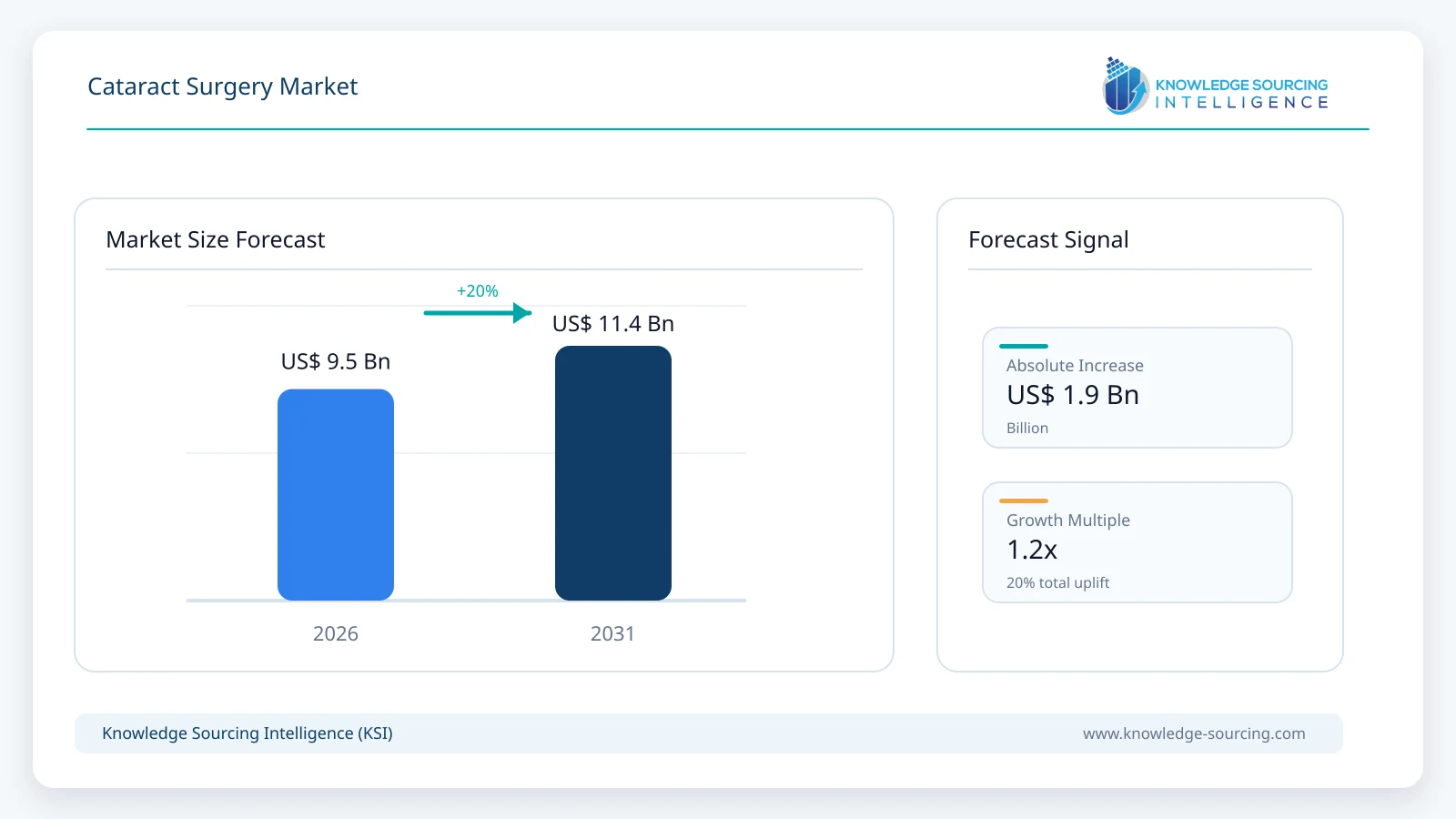
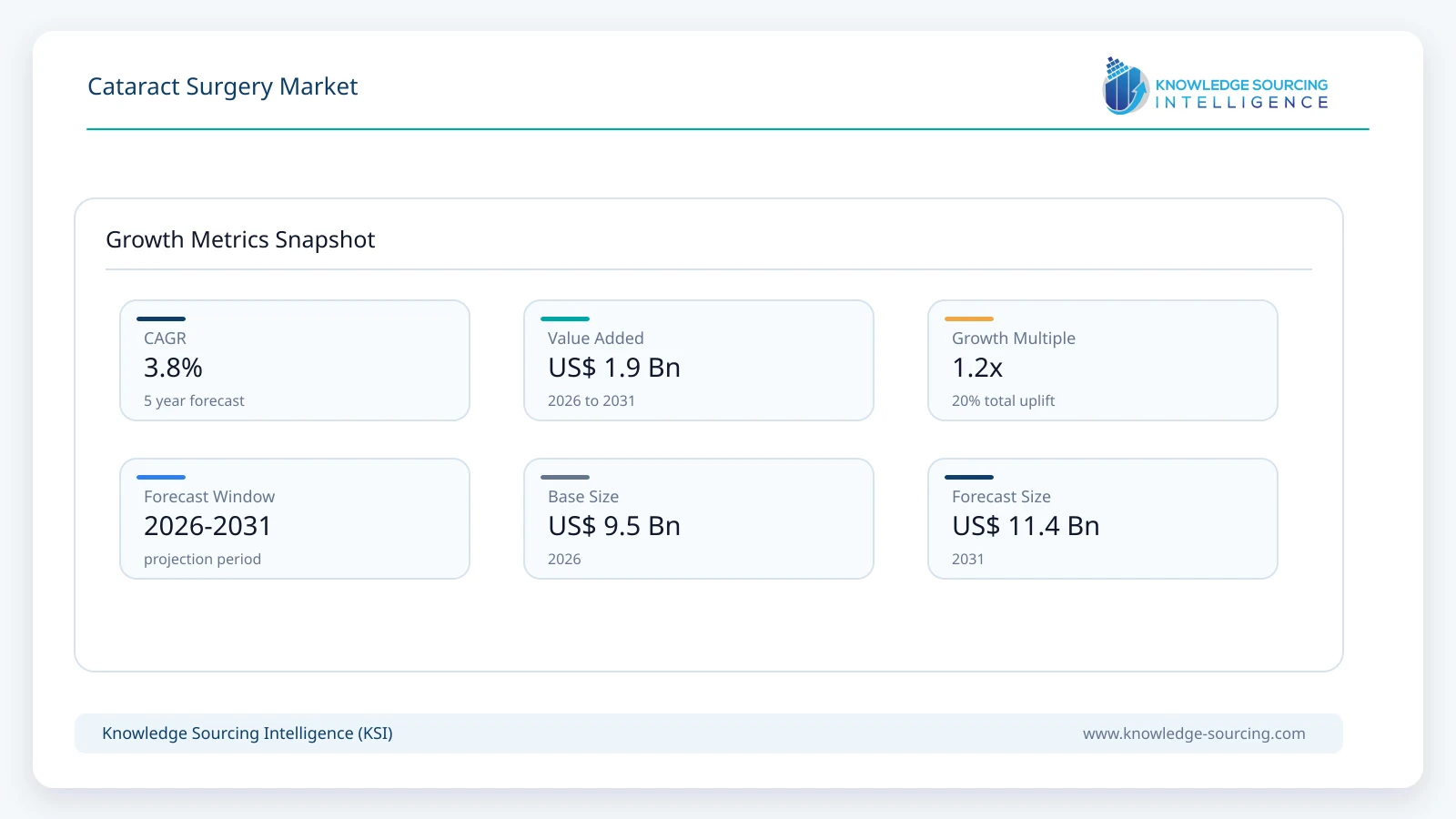
The cataract surgery market is set to reach USD 11.43 billion in 2031, growing at a CAGR of 3.8% between 2026 and 2031, from USD 9.49 billion in 2026.
Highlights:
- 1Robotic-assisted cataract surgery systems developed through UCLA research now perform precise, hands-free lens implantation in the first human procedures.
- 2Innovative 4D-phaco techniques using advanced ultrasound technology enable smoother, less traumatic lens removal with enhanced precision.
- 3AI-powered laser cataract systems mark a milestone by automatically optimizing surgical parameters for individualized treatment outcomes.
- 4Premium intraocular lens innovations usher in a golden age of cataract surgery, delivering superior visual restoration and patient satisfaction.
Market Overview
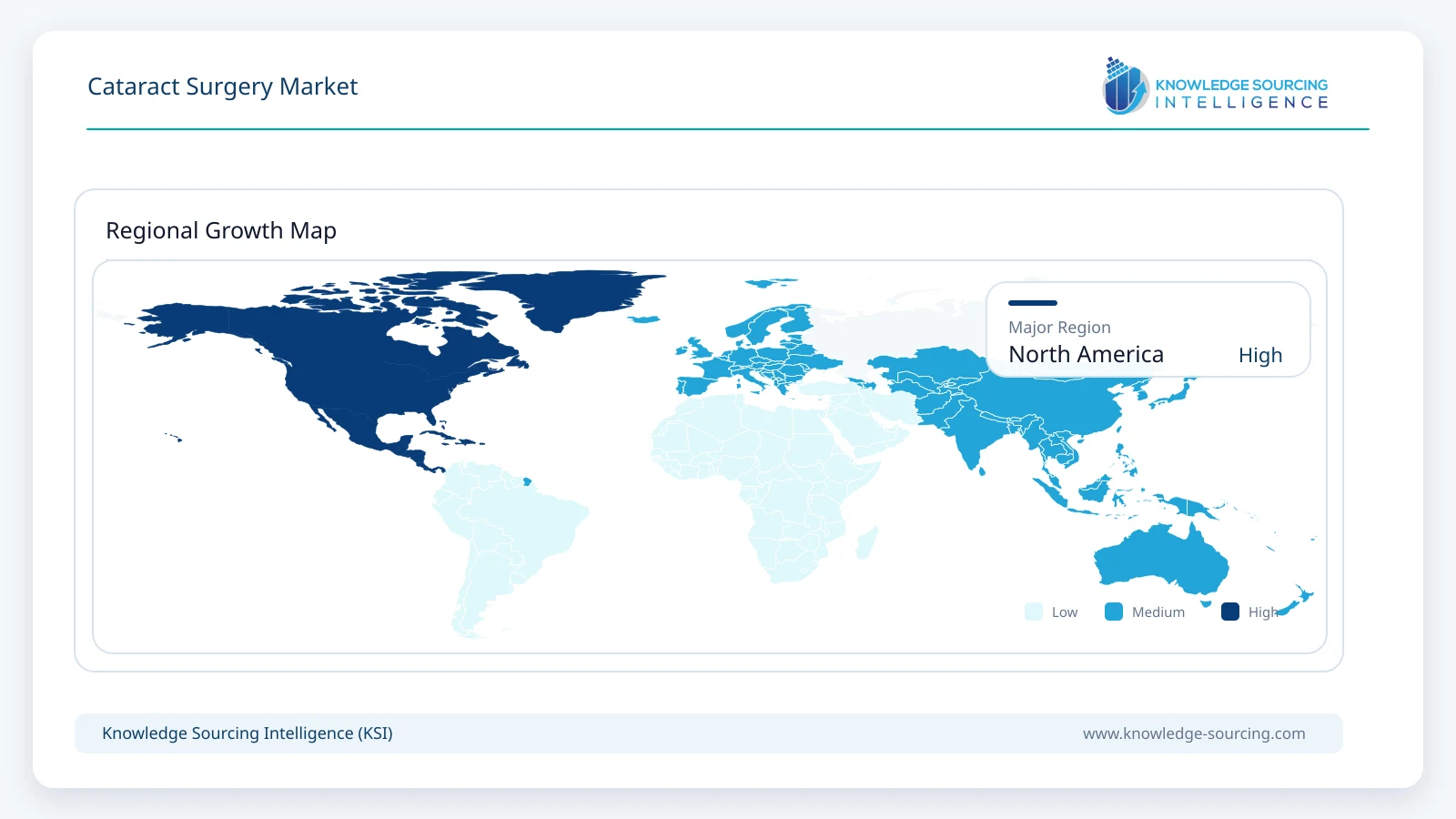
The global cataract surgery market is being influenced by a rapidly aging population worldwide, regulatory oversight from the FDA and international bodies like the CE Mark, and continued investment from leading device makers like Alcon, Johnson & Johnson Vision, Bausch + Lomb, Carl Zeiss Meditec, and NIDEK. These companies are focusing on advancements in AI-guided planning, femtosecond lasers, and premium IOLs, with the US remaining the largest and most innovative single market in this sector.
Globally, cataract remains the leading cause of blindness and moderate-to-severe vision impairment, with prevalence rising fastest in aging, higher-income populations. According to data from the National Eye Institute (NEI), the total number of people in the United States affected by cataracts is projected to double from 24.4 million in 2010 to 50 million by 2050.
Age-related lens opacification remains dominant worldwide, compounded by UV exposure, diabetes, smoking, and steroid use, patterns consistent globally but have been especially studied in US Medicare data, which shows disparities by race and sex in both prevalence and surgical access.
Access to treatment remains highly uneven globally: the World Health Organization estimates that 1 in 2 people worldwide who need cataract surgery don't have access to it, with the burden falling disproportionately on low- and middle-income countries. The US, by contrast, has near-universal surgical access, with cataract removal performed as a routine, high-volume outpatient procedure.
The absolute number of people blind or with moderate-to-severe vision impairment from cataract has risen globally over the past three decades, even as the age-standardized prevalence rate has declined, reflecting population growth and longer lifespans rather than worsening eye health. This dynamic is especially pronounced in the US, where a growing elderly population is sustaining high surgical case volumes despite improved per-capita outcomes.
The ZEISS AI IOL Calculator uses advanced artificial intelligence and paraxial ray tracing, drawing on more than 16,000 IOL parameters to fine-tune predictions for each lens model, effectively making legacy A-constants obsolete for supported lenses.
Veracity's AI-based IOL calculator generates data-driven refractive predictions alongside traditional formulas, while Eyetelligence instead uses biometric patterns to recommend which standard formula best fits a given eye, reflecting two distinct AI approaches now live in the market.
Research published in 2026 confirms that AI-based IOL formulas are outperforming traditional models specifically in complex ocular anatomies (short eyes, long eyes, post-refractive-surgery eyes), where classical formulas historically underperform.
Market Drivers
Aging Population
The market is driven by an aging population, and the surgical burden is accelerating as more Americans cross the age threshold where cataract formation becomes near-universal. This demographic shift is reshaping device demand toward higher volumes and premium, technology-enabled procedures.
According to the data tables from the National Eye Institute (NEI), cataract prevalence rises from just 2.5% at ages 40-49 to 63.8% by age 80+, showing that the condition transitions from relatively uncommon to highly prevalent across a single lifetime.
As of 2026, cataracts are responsible for almost 45% of global blindness, which affects approximately 15.2 million individuals. They also account for 39% of moderate to severe visual impairment, which means they affect about 78.8 million people. The prevalence of cataracts increases massively with age, with rates ranging from 3.9% among individuals aged 55 - 64 to a huge 92.6% in those aged 80+. This age-related trend demonstrates the growing burden of cataracts in ageing populations.
In the United States, more than 25 million Americans are affected by cataracts. Projections estimate this number will rise to 38.5 million by 2032 and 45.6 million by 2050 due to an ageing population. Despite the availability of advanced surgical options, differences in access to care remain, particularly among those in underserved communities.
The World Health Organization estimates that vision impairment, including that caused by cataracts, results in an annual global productivity loss of approximately US$411 billion.
Alcon is expanding AI-assisted surgical guidance. Its March 2026 digital cataract platform integrates advanced imaging with AI-guided workflow, building on its 2025 acquisition of Lensar's ALLY dual-pulse femtosecond laser system.
Carl Zeiss Meditec's Veracity Surgery Planner has been used to plan more than 2 million cataract cases digitally, following FDA clearance of its VisuMax 800 platform in January 2024.
Johnson & Johnson Vision received FDA approval in March 2026 for its TECNIS PureSee IOL, extending its premium depth-of-focus lens lineup to compete directly with Alcon's AcrySof IQ Vivity.
Academic research is pushing AI further upstream into IOL power calculation itself, with newer formulas like Kane and Hill-RBF improving refractive accuracy in difficult cases such as extreme axial myopia, a trend expected to broaden through 2026-2027 as more US surgical centers adopt AI-native biometry devices.
Major Segment Analysis
Phacoemulsification
By procedures, the cataract surgery market is segmented into phacoemulsification, extracapsular cataract extraction (ECCE), intracapsular cataract extraction (ICCE), femtosecond-laser assisted, and others. The phacoemulsification procedure is expected to hold a considerable market share due to its high healing advantages and surgical precision. Recent technological advancements in surgical procedures, fueled by AI-penetration and robotics-assistance, have transformed the overall landscape cataract procedures.
Being one of the earliest technological interventions for cataract, phacoemulsification provides a modern approach for such surgery types. Research studies indicate that, with nearly 25 million to 30 million cataract procedures performed annually worldwide, phacoemulsification, owing to its low-infection risk and minimal downtime, constitutes for approximately 70% of the total surgical frequency.
Data from the World Health Organization reports that cataracts affect more than 94 million people globally, and with a target set by the World Health Assembly (WHA) to increase cataract surgery coverage from the current 15% to 30% by 2030, which could further increase access to phacoemulsification procedure thereby improving the total market landscape.
Continued innovations in IOLs have provided new opportunities for phacoemulsification. For instance, Johnson & Johnson, through its “TECNIS” portfolio of IOLs, provides advanced optical lenses for cataract. In March 2026, the company received FDA approval for its “TECNIS PureSee IOL” in the United States.
Developed markets like the United States are witnessing a considerable transition towards AI and robot-assisted surgical procedures offering high efficiency with minimal error; hence, such transition stimulates the development of AI-based platforms such as Horizon Surgical System’s “Polaris” for cataract surgery, which is expected to drive new market innovations.
Geographical Outlook
North America: the US
More than four million cataract surgeries being performed annually in the United States. Studies suggest that procedure volumes are growing by approximately 3 to 4% annually. The implementation of surgical programs such as “Operation Sight” by the American Society of Cataract and Refractive Surgery (ASCRS) is providing surgical access to patients, which is expected to support market growth.
Likewise, the aging population has further added to the surgical burden, with various studies suggesting that the population aged 65 years and above has a higher prevalence rate of cataract in the United States. According to the National Eye Institute, the cataract prevalence rate was 9.1% in Americans aged 55-59 years, 15.5% in 60-64 years, and 24.7% in 65-69 years.
Continued technological advancements in medical devices have amplified the adoption scope for next-generation AI concepts for cataract surgeries in the United States, which is bolstering the market trajectory. Hence, companies like Horizon Surgical Systems are investing in AI-based cataract surgery through their “Polar” platforms. Similarly, research collaborations with major institutions like UCLA have established a framework to promote robot-assisted cataract surgery.
With a current prevalence of about 25 million people having cataracts in the country, various studies such as Prevent Blindness’s “Future of Vision: Forecasting the Prevalence and Costs of Vision Problems” indicate the overall prevalence is expected to grow to 38.5 million by 2031 and 45.6 million by 2050. The increasing predominance of cataract patients is anticipated to accelerate the demand for effective surgical measures in the United States, thereby expanding the market outlook.
The recent FDA approval of Johnno & Johnson’s “TECNIS PureSee IOL”, along with BVI’s successful implantation of its FDA-approved “FINEVISION HP” is expected to drive innovations in IOLs (Intraocular Lenses) in the United States, thereby establishing new growth prospects for cataract surgery solutions.
Key Developments
September 2026: Rayner introduced its hydrophobic Galaxy spiral IOL at ESCRS 2026, extending its full-range-of-vision platform with hydrophobic acrylic material and planned Q4 2026 European commercial availability.
August 2026: ZEISS introduced a dedicated cataract configuration of DORC EVA NEXUS, expanding its ophthalmic surgical platform with cataract-focused workflow, control and stability for operating-room requirements.
July 2026: Bausch + Lomb launched EyeGility, a preloaded IOL delivery system for enVista lenses, offering balanced push force and one-handed operation, initially supporting enVista Aspire in the U.S.
April 2026: Alcon launched Clareon TruPlus enhanced-design monofocal and toric IOLs in the U.S., designed to increase depth of focus while preserving the distance-vision performance expected from monofocal lenses.
Company Profiles
Alcon’s cataract strategy revolves around an ecosystem-led growth model, coupling advanced optical implants with high-performance surgical machinery. By utilizing a "razor-and-blade" approach, the placement of proprietary hardware systems drives continuous, high-margin revenue through single-use surgical packs and intraocular lenses (IOLs).
The company aggressively invests in R&D to expand its lead in presbyopia-correcting and premium IOLs, while simultaneously leveraging global surgeon training programs to build long-term institutional loyalty across both developed and emerging healthcare markets.
Cataract Surgery Market Scope:
| Report Metric | Details |
|---|---|
| Total Market Size in 2026 | USD 9.49 billion |
| Total Market Size in 2031 | USD 11.43 billion |
| Forecast Unit | Billion |
| Growth Rate | 3.8% |
| Study Period | 2021 to 2031 |
| Historical Data | 2021 to 2024 |
| Base Year | 2025 |
| Forecast Period | 2026 – 2031 |
| Segmentation | Procedure, Lens Type, Device Type, Cataract Type, End-User, Regions |
| Companies |
|
Market Segmentation
By Procedure
Phacoemulsification
Extracapsular Cataract Extraction (ECCE)
Intracapsular Cataract Extraction (ICCE)
Femtosecond-Laser Assisted
Others
By Lens Type
Monofocal Intraocular Lens
Multifocal Intraocular Lens
Toric Intraocular Lens
Others
By Device Type
Equipment
Consumables
By Cataract Type
Cortical Cataract
Nuclear Sclerotic Cataract
Posterior Subcapsular Cataract
Others
By End-User
Hospitals
Ophthalmology Clinics and Eye Care Centers
Ambulatory Surgical Centers
Academic and Research Institutions
Others
By Region
North America
USA
Canada
Mexico
South America
Brazil
Argentina
Others
Europe
United Kingdom
Germany
France
Spain
Italy
Others
Middle East and Africa
Saudi Arabia
UAE
Others
Asia Pacific
China
Japan
India
South Korea
Taiwan
Thailand
Indonesia
Others
Table of Contents
1. EXECUTIVE SUMMARY
2. MARKET SNAPSHOT
2.1. Market Overview
2.2. Market Definition
2.3. Scope of the Study
2.4. Market Segmentation
3. MARKET DYNAMICS
3.1. Market Drivers
3.2. Market Restraints
3.3. Market Opportunities
3.4. Porter’s Five Forces Analysis
3.5. Industry Value Chain Analysis
4. BUSINESS LANDSCAPE
4.1. Regulatory & Reimbursement Landscape
4.2. Healthcare Provider & Service Delivery Analysis
4.3. Pricing & Cost Analysis
4.4. Patient & Procedure Volume Analysis
4.5. Distribution & Procurement Landscape
5. TECHNOLOGY AND INNOVATION OUTLOOK
5.1. Surgical Technology Advancements
5.2. IOL Technology Advancements
5.3. Laser & Image-Guided Surgery
5.4. AI & Digital Technologies
5.5. Emerging Technologies & Future Trends
6. CATARACT SURGERY MARKET BY PROCEDURE (2021-2031)
6.1. Introduction
6.2. Phacoemulsification
6.3. Extracapsular Cataract Extraction (ECCE)
6.4. Intracapsular Cataract Extraction (ICCE)
6.5. Femtosecond-Laser Assisted
6.6. Others
7. CATARACT SURGERY MARKET BY LENS TYPE (2021-2031)
7.1. Introduction
7.2. Monofocal Intraocular Lens
7.3. Multifocal Intraocular Lens
7.4. Toric Intraocular Lens
7.5. Others
8. CATARACT SURGERY MARKET BY DEVICE TYPE (2021-2031)
8.1. Introduction
8.2. Equipment
8.3. Consumables
9. CATARACT SURGERY MARKET BY CATARACT TYPE (2021-2031)
9.1. Introduction
9.2. Cortical Cataract
9.3. Nuclear Sclerotic Cataract
9.4. Posterior Subcapsular Cataract
9.5. Others
10. CATARACT SURGERY MARKET BY END-USER (2021-2031)
10.1. Introduction
10.2. Hospitals
10.3. Ophthalmology Clinics and Eye Care Centers
10.4. Ambulatory Surgical Centers
10.5. Academic and Research Institutions
10.6. Others
11. CATARACT SURGERY MARKET BY REGION (2021-2031)
11.1. Introduction
11.2. North America
11.2.1. USA
11.2.2. Canada
11.2.3. Mexico
11.3. South America
11.3.1. Brazil
11.3.2. Argentina
11.3.3. Others
11.4. Europe
11.4.1. United Kingdom
11.4.2. Germany
11.4.3. France
11.4.4. Spain
11.4.5. Italy
11.4.6. Others
11.5. Middle East and Africa
11.5.1. Saudi Arabia
11.5.2. UAE
11.5.3. Others
11.6. Asia Pacific
11.6.1. China
11.6.2. Japan
11.6.3. India
11.6.4. South Korea
11.6.5. Taiwan
11.6.6. Thailand
11.6.7. Indonesia
11.6.8. Others
12. COMPETITIVE ENVIRONMENT AND ANALYSIS
12.1. Major Players and Strategy Analysis
12.2. Market Share Analysis
12.3. Mergers, Acquisitions, Agreements, and Collaborations
12.4. Competitive Dashboard
13. COMPANY PROFILES
13.1. Alcon, Inc.
13.2. Johnson & Johnson Vision
13.3. Bausch + Lomb Corporation
13.4. Carl Zeiss Meditec AG
13.5. Hoya Corporation
13.6. RxSight, Inc.
13.7. Rayner Intraocular Group Limited
13.8. Lenstec, Inc.
13.9. Oertli Instrumente AG
13.10. HumanOptics Holding AG
13.11. Topcon Corporation
13.12. Nidek Co., Ltd.
13.13. Ziemer Ophthalmic Systems AG
13.14. Santen Pharmaceutical Co., Ltd.
13.15. Aurolab Biotech Healthcare Group
14. RESEARCH METHODOLOGY
15. LIST OF FIGURES
Navigate
Trusted by the world's leading organizations











