
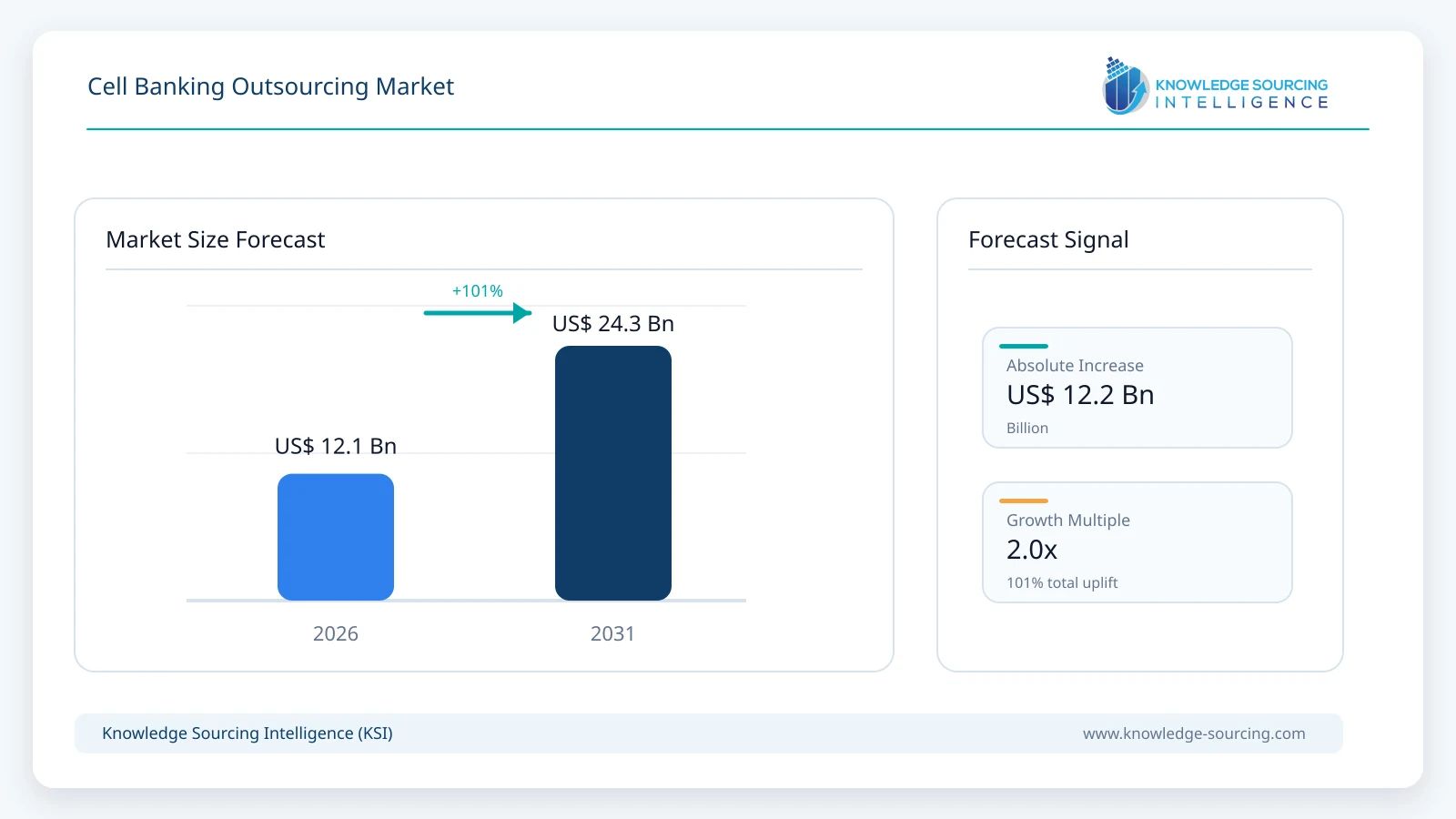
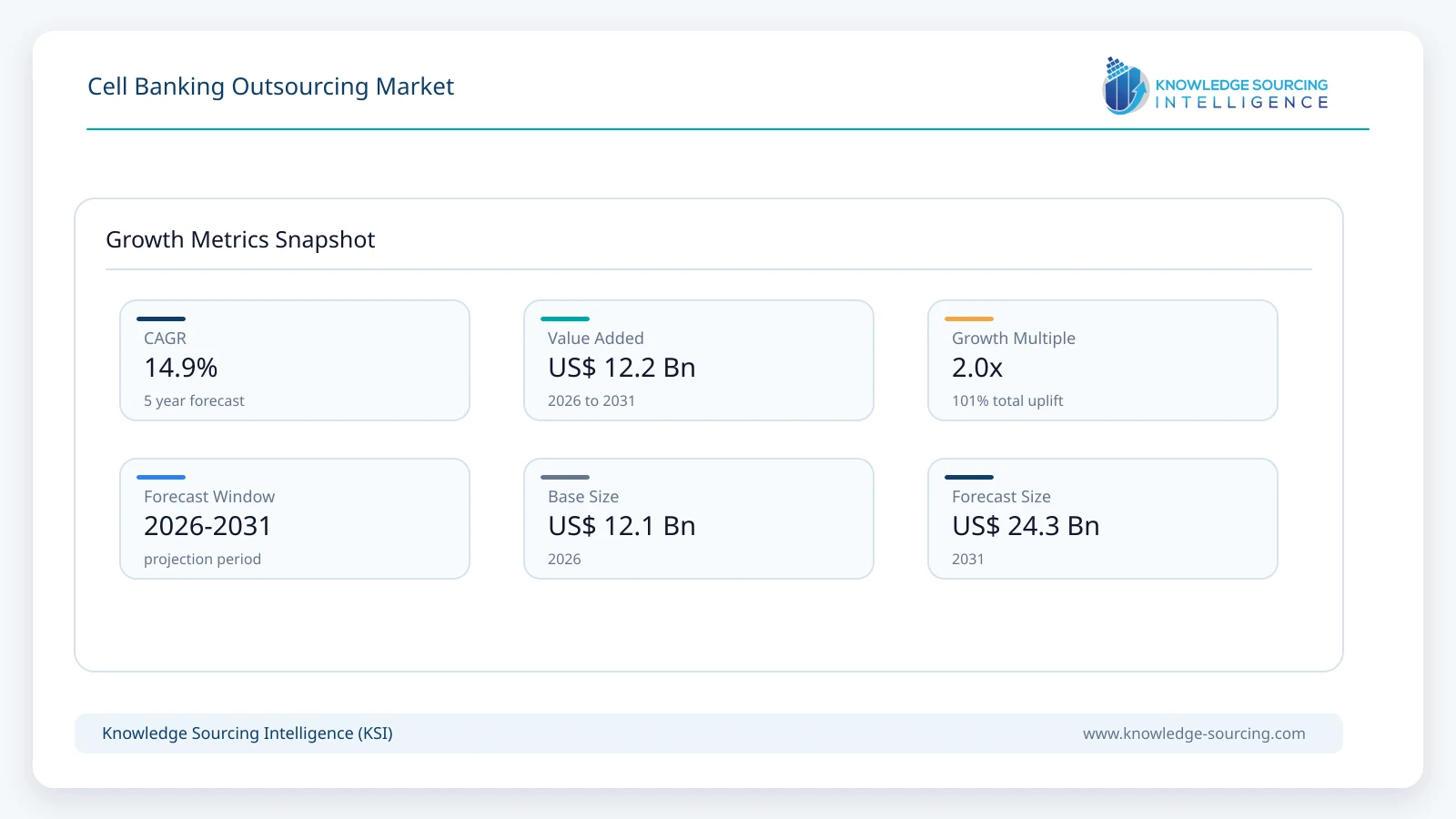
The cell banking outsourcing market is forecast to grow at a CAGR of 14.9%, reaching USD 24.3 billion in 2031 from USD 12.1 billion in 2026.
Highlights:
- 1Outsourcing economicsPharmaceutical and biotechnology companies can avoid duplicating specialized cryogenic infrastructure, analytical testing capabilities, quality systems, and trained technical teams by using qualified external providers.
- 2Master Cell Bank relevanceMCB establishment remains commercially important because it creates the controlled source from which WCBs can be generated for manufacturing programs. FDA guidance describes the MCB as the source material for the WCB and requires appropriate characterization and contamination controls.
- 3Cell therapy influenceGrowth in cell and gene therapy development is expanding the technical requirements surrounding cellular starting materials, identity, characterization, testing, and manufacturing continuity.
- 4Regulatory influenceICH Q5D and regional regulatory requirements make documentation, traceability, contamination control, characterization, storage conditions, and stability evidence central to supplier selection.
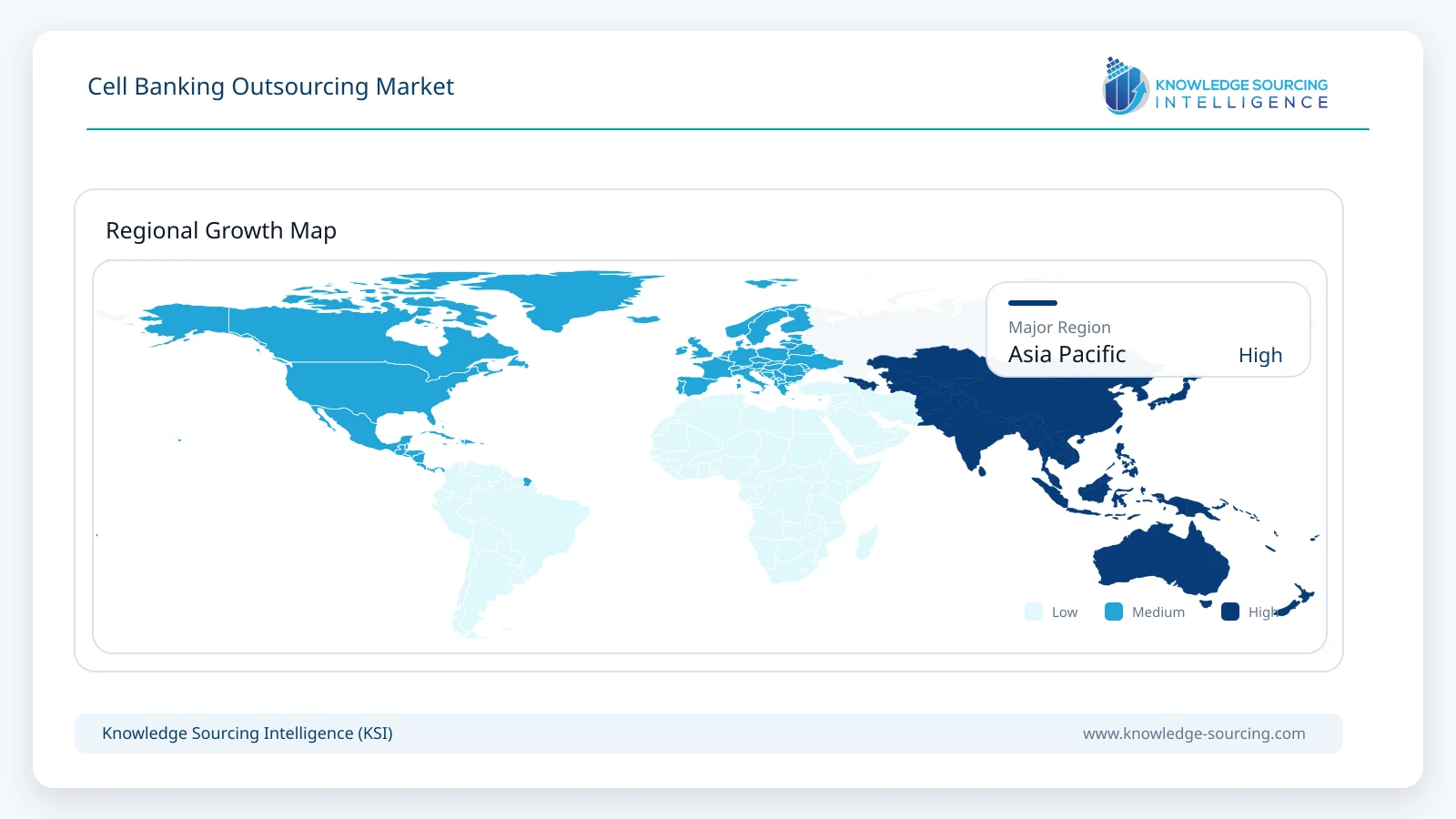
- 5Regional opportunityNorth America and Europe retain strong demand from established pharmaceutical and biotechnology ecosystems, while Asia Pacific offers expanding development and manufacturing capacity.
- 6Supplier differentiationProviders increasingly compete through integrated services, geographic redundancy, specialized analytical capabilities, regulated storage infrastructure, and the ability to connect cell banking with broader development and manufacturing workflows.
The Cell Banking Outsourcing Market covers third-party services used to establish, characterize, test, cryopreserve, store, manage, and supply cell banks for pharmaceutical, biotechnology, research, and advanced-therapy programs. The service scope can include Master Cell Bank (MCB) and Working Cell Bank (WCB) creation, cell expansion, identity testing, sterility and mycoplasma testing, adventitious-agent testing, stability assessment, cryogenic storage, inventory management, documentation, and controlled shipment. Depending on the program, outsourced providers may also support cell-line development, process development, analytical characterization, regulatory documentation, and technology transfer.
Cell banking is commercially important because the bank becomes a controlled biological starting material for downstream manufacturing or research. A well-characterized bank reduces variability between production campaigns and establishes a defined source for future manufacturing. The International Council for Harmonisation (ICH) Q5D guideline specifically addresses the derivation and characterization of cell substrates and preparation of cell banks used for biotechnology and biological products. It emphasizes identity, purity, stability, and control of biological risks associated with cell substrates.
Outsourcing demand is primarily created by pharmaceutical and biotechnology companies that need qualified cell-banking infrastructure without building every capability internally. Cell banking requires specialized cryogenic storage, controlled processing areas, qualified analytical methods, validated procedures, environmental monitoring, quality systems, trained personnel, and contingency arrangements. For smaller biotechnology companies, maintaining these capabilities internally can create substantial fixed costs before a product reaches commercial manufacturing. External providers therefore allow buyers to convert part of that expenditure into project-based or service-based costs.
Buyer priorities extend beyond the quoted price of banking services. Sponsors generally evaluate regulatory compliance, testing capability, chain of custody, storage security, documentation quality, turnaround time, geographic accessibility, technology-transfer experience, and the provider's ability to support subsequent development stages. The value proposition becomes stronger when a supplier can perform banking alongside characterization, analytical testing, process development, or manufacturing services.
The market also benefits from the expanding range of biological modalities requiring controlled cell substrates. Conventional recombinant biologics and vaccines continue to depend on established cell-bank systems, while cell and gene therapy programs introduce additional requirements around starting materials, cellular identity, potency, genetic characteristics, contamination control, and comparability. EMA guidance recognizes appropriately characterized MCB and WCB systems for established cell lines and links cell-bank characterization and testing to ICH Q5D.
Demand is consequently divided between recurring banking requirements from established manufacturers and project-driven demand from emerging biotechnology programs. Established pharmaceutical manufacturers typically emphasize continuity of supply, validated processes, long-term storage, audit readiness, and redundancy. Emerging companies tend to prioritize rapid access to qualified facilities, technical expertise, flexible capacity, and the ability to scale from development-stage banking toward clinical and commercial supply.
The market operates across a specialized outsourcing chain rather than as a single homogeneous service category. Some providers concentrate on cryogenic storage and biobanking, while larger contract development and manufacturing organizations integrate cell banking with cell-line development, analytical testing, process development, and manufacturing. This creates different procurement models, ranging from individual cell-bank projects to multi-year outsourcing arrangements covering several stages of the development lifecycle.
Market Drivers
Outsourcing of Specialized Infrastructure
Cell banking requires infrastructure that is expensive to establish and maintain relative to the utilization levels of individual development programs. Cryogenic storage systems, controlled processing environments, monitoring systems, backup power, alarm systems, validated procedures, and quality-control laboratories create a significant fixed-cost burden.
This economics encourages biotechnology companies to outsource banking rather than build complete infrastructure during early development. The buyer can obtain access to qualified facilities without carrying the full capital and operating cost of an internal platform. For pharmaceutical companies, outsourcing can also provide additional capacity when internal facilities face workload constraints or require geographic redundancy.
Providers respond by offering packaged services covering bank generation, testing, storage, inventory control, and release documentation. Commercial differentiation therefore depends on service integration and reliability rather than storage capacity alone.
Increasing Biological Product Complexity
Biological development increasingly involves cell lines and cellular starting materials that require detailed characterization. ICH Q5D identifies cell-substrate characteristics as relevant to the quality and safety of biotechnology and biological products. The guideline covers cell-bank preparation and characterization for both microbial and mammalian systems.
As development programs become more technically demanding, sponsors require laboratories capable of conducting identity, purity, genetic, microbial, viral, and stability-related assessments. External providers with established analytical platforms can reduce the need for sponsors to develop every test internally.
The commercial implication is that cell banking increasingly functions as part of a broader quality-controlled development workflow. Providers able to combine banking and analytical testing can reduce handoffs and potentially shorten project timelines.
Expansion of Cell and Gene Therapy Programs
Cell and gene therapy development adds another demand layer. These programs can involve genetically modified cells, patient-derived cells, stem-cell-derived materials, or specialized cellular starting materials. Regulatory expectations require close control of identity, quality, safety, manufacturing consistency, and traceability.
EMA's guidance for genetically modified cell-based medicinal products specifically addresses quality, non-clinical, and clinical considerations for such products. The guidance reflects the technical requirements associated with CAR-T cells, induced pluripotent stem cells, and genome-editing technologies.
This environment supports demand for specialized banking and characterization capabilities. Outsourcing becomes attractive when developers lack the specialized facilities or analytical experience needed to manage these materials under appropriate quality systems.
Need for Manufacturing Continuity and Risk Management
Cell banks represent a critical biological input, so loss or contamination of a bank can disrupt downstream manufacturing. FDA materials emphasize defined storage conditions, inventory controls, characterization, and procedures for protecting cell banks from failures in storage infrastructure. FDA guidance for vaccine manufacturing also highlights measures such as multiple freezers or different storage sites to reduce the risk of a catastrophic loss.
This creates demand for suppliers that can provide monitored storage, backup arrangements, controlled access, inventory traceability, and contingency planning. Buyers increasingly evaluate the resilience of the entire storage system rather than simply purchasing a defined number of cryogenic positions.
For commercial-stage programs, continuity can carry a higher economic value than the initial banking fee because a compromised bank can affect production schedules, regulatory commitments, and supply availability.
Integration With Broader CDMO Services
Pharmaceutical sponsors increasingly evaluate outsourcing partners based on their ability to support multiple development activities. A provider that can connect cell banking with cell-line development, analytical testing, process development, and manufacturing can reduce technology-transfer requirements and supplier-management complexity.
This favors larger CDMOs and specialized service providers with complementary capabilities. Lonza, for example, reported in its 2025 annual reporting that its Cell & Gene sites had secured manufacturing programs for approved commercial therapies, demonstrating the increasing connection between specialized cell capabilities and commercial manufacturing infrastructure.
The implication for cell banking is that suppliers can increase customer retention when banking becomes embedded within a broader development relationship.
Market Restraints and Challenges
High Regulatory and Quality-System Requirements
Cell banks cannot be treated as conventional biological inventory. Sponsors need documented cell history, defined banking procedures, characterization, contamination testing, storage controls, and traceability. FDA guidance specifically calls for documentation covering cell origin and history, freezing and recovery procedures, characterization, contamination testing, expiration dating, and post-thaw testing.
These requirements increase service costs and extend project timelines. Providers must continuously maintain qualified personnel, equipment, quality systems, documentation, and testing capabilities. Smaller suppliers can therefore face a high entry barrier.
The mitigation strategy is operational specialization. Providers that standardize validated procedures and maintain dedicated quality teams can spread infrastructure costs across multiple customers.
Cryogenic Storage and Business Continuity Risk
Long-term storage introduces operational risks involving temperature excursions, equipment failure, power interruption, inventory errors, and physical-site incidents. A bank may contain material that cannot easily be recreated, making storage failure disproportionately costly.
Suppliers must therefore invest in redundant monitoring, backup systems, emergency procedures, controlled access, and disaster-recovery arrangements. These requirements increase operating expenditure and can limit price-based competition.
Buyers increasingly assess the provider's business-continuity plan during qualification. Geographic redundancy can become an important differentiator for commercially important cell banks.
Complex Testing and Characterization Requirements
The required testing profile varies according to the cell substrate, intended application, regulatory pathway, and development stage. Some programs require extensive characterization and contamination testing, while others may involve specialized assays related to phenotype, genotype, potency, or vector characteristics.
This variability complicates service standardization. Providers need flexible analytical capabilities and must ensure that test methods remain appropriate for the intended use. Testing requirements can also increase turnaround time, particularly when specialized assays or external laboratories are required.
Technology Transfer and Chain-of-Custody Complexity
When a sponsor transfers cells to an external provider, the process requires careful control of sample identity, documentation, shipping conditions, storage, processing, and inventory records. Errors during transfer can compromise valuable biological material.
The challenge becomes more pronounced when programs move between research laboratories, cell-bank providers, CDMOs, and manufacturing facilities. Suppliers must maintain clear chain-of-custody records and compatible documentation systems.
Pricing Pressure From Integrated Procurement
Large pharmaceutical companies can use procurement scale to negotiate broader outsourcing contracts. Buyers may compare multiple suppliers or bundle cell banking with analytical, development, and manufacturing services.
This can place pressure on standalone banking providers that compete primarily on storage and basic testing. Suppliers need differentiated technical services, specialized expertise, geographical coverage, or integrated workflows to protect margins.
Major Segment Analysis:
Master Cell Bank
The Master Cell Bank segment is commercially important because the MCB forms the controlled source from which working banks can be derived for manufacturing. FDA describes the MCB as a cell seed lot stored cryogenically and used as the source for the WCB, while ICH Q5D establishes principles for cell-bank preparation and characterization.
The commercial importance of MCB outsourcing comes from the combination of technical complexity and downstream risk. A sponsor does not simply purchase storage space. It purchases a controlled process for establishing a biological reference material that may support multiple future production campaigns.
Buyer requirements therefore emphasize identity, purity, stability, contamination control, documentation, storage security, and reproducibility. FDA guidance recommends appropriate testing of MCBs for contaminating biological agents and describes the need for characterization and post-thaw assessment.
For biotechnology companies, outsourcing MCB establishment can reduce the capital requirement associated with developing an internal banking laboratory. It also provides access to specialized testing and quality personnel during the transition from research material toward regulated development.
The segment also creates follow-on revenue. Once an MCB has been qualified, sponsors may require WCB generation, long-term storage, inventory management, stability monitoring, additional characterization, and controlled distribution. Consequently, an MCB project can become the entry point for a broader outsourcing relationship.
Competition within the segment is based on regulatory experience, analytical depth, turnaround time, storage security, documentation quality, and the ability to support future manufacturing requirements. Large CDMOs can differentiate through integration with downstream manufacturing, while specialized biobanking providers can compete through dedicated storage and cell-management expertise.
The commercial relevance of the MCB segment should therefore be assessed through the entire customer lifecycle rather than through the initial banking transaction alone. A provider that successfully establishes a qualified MCB can become embedded in a program's manufacturing-control strategy.
Regional Analysis
North America
North America represents a major demand center because of its concentration of pharmaceutical companies, biotechnology firms, advanced-therapy developers, contract research organizations, and manufacturing infrastructure. The United States provides a particularly important regulatory environment through FDA oversight of biological products, cell therapies, vaccines, and related manufacturing systems.
U.S. buyers generally place strong emphasis on regulatory documentation, audit readiness, validated processes, contamination control, and storage continuity. The FDA's inspection guidance specifically addresses MCB and WCB storage, identification, characterization, handling, and traceability.
Canada contributes through its biotechnology and life-sciences ecosystem, while Mexico provides a smaller but relevant pharmaceutical manufacturing and research base. Cost considerations can influence outsourcing decisions, but regulated capability and supply continuity remain decisive for higher-value programs.
Europe
Europe has a mature pharmaceutical and biotechnology base supported by extensive regulatory frameworks for biological products and advanced therapies. EMA guidance explicitly recognizes MCB and WCB systems for established cell lines and links their characterization and testing to ICH Q5D.
Germany, France, the United Kingdom, and Switzerland-linked European supply networks provide strong technical infrastructure for biological development. Buyers typically evaluate GMP compliance, analytical capability, traceability, quality documentation, and cross-border logistics.
European demand also benefits from cell and gene therapy development. EMA maintains specific guidance covering human cell-based medicinal products, stem-cell-based products, and genetically modified cells.
Asia Pacific
Asia Pacific provides an expanding demand base supported by pharmaceutical manufacturing, biotechnology investment, clinical development, and growing CDMO capacity. China has established large-scale pharmaceutical outsourcing infrastructure, while Japan and South Korea maintain sophisticated biopharmaceutical manufacturing capabilities.
India offers a growing pharmaceutical and biotechnology ecosystem with increasing outsourcing requirements. Indonesia and Thailand contribute through expanding healthcare and life-sciences infrastructure, although the depth of specialized cell-banking capabilities varies by country.
Providers with regional facilities can reduce shipping complexity and offer customers access to local processing and storage. However, international sponsors continue to scrutinize regulatory equivalence, quality systems, data integrity, and technology-transfer capabilities when selecting Asian suppliers for globally regulated programs.
Middle East and Africa
The Middle East and Africa represent a smaller demand base but offer longer-term opportunities through pharmaceutical localization, biotechnology investment, healthcare infrastructure development, and government-supported life-sciences initiatives.
Saudi Arabia and the UAE are particularly relevant because both countries are investing in biotechnology and advanced healthcare capabilities. Demand is more likely to originate from research institutions, emerging biotechnology programs, pharmaceutical localization projects, and regional healthcare initiatives than from a deeply established cell-banking outsourcing ecosystem.
The main constraints include limited specialized infrastructure in several countries, smaller local customer pools, regulatory fragmentation, and the need for highly trained technical personnel.
South America
South America is supported primarily by pharmaceutical manufacturing, academic research, biotechnology activity, and healthcare-related research infrastructure. Brazil represents the largest commercial opportunity in the regional grouping, followed by Argentina and other markets with smaller research and manufacturing bases.
Local sourcing can be attractive when biological materials require controlled logistics and close technical coordination. However, demand can be constrained by economic volatility, currency risk, limited specialized infrastructure, and differences in regulatory maturity.
International providers can address these constraints through regional partnerships, centralized testing, controlled logistics, and multinational quality systems.
Competitive Landscape
The competitive structure includes global CDMOs, analytical service providers, specialist biobanking companies, and organizations with broader cell and gene therapy capabilities. The supplied competitive universe includes Sartorius AG, Cryosite Limited, Charles River Laboratories Inc., Cryo-Cell International, Inc., GBI Biomanufacturing, Lonza Group, SGS SA, WuXi AppTec, Eurofins Scientific, SK pharmteco, Inc., and Biofortuna Limited.
Competition is not based solely on the number of stored samples. Buyers assess the provider's ability to maintain cell identity, testing integrity, documentation, storage continuity, and regulatory readiness. The strongest commercial proposition is often an integrated service that minimizes the number of transfers between banking, analytical testing, development, and manufacturing stages.
Large CDMOs compete through breadth and customer integration. Their advantage comes from linking banking with downstream development and manufacturing. Specialized providers can compete by offering dedicated biobanking infrastructure, highly focused storage capabilities, flexible project models, and specialized analytical expertise.
Recent corporate activity illustrates the broader movement toward integrated biological service platforms. Lonza reorganized its business in April 2025 around three CDMO platforms, with Cell & Gene Technologies included within its Specialized Modalities platform.
Sartorius has also expanded its cell-technology capabilities. In 2025, the company completed the acquisition of MatTek, adding human cell-based microtissues and 3D models to its portfolio, while later expanding GMP production capacity for transfection reagents in France.
WuXi AppTec's financial disclosures show the scale at which integrated pharmaceutical outsourcing platforms are expanding. Its 2025 continuing-operations revenue increased 21.4% year over year, while its continuing-operations backlog reached RMB 58.00 billion at year-end.
These developments indicate that competition in cell-related outsourcing increasingly depends on the ability to connect specialized biological services with broader customer workflows.
Recent Developments
March 2026: Sartorius launched its Eveo Cell Therapy Platform for automated, multi-parallel production and quality control of autologous cell therapies, targeting manufacturing bottlenecks and lower production costs. The development reinforces the industry's movement toward integrated cell-processing infrastructure.
January 2026: WuXi AppTec reported expected 2025 continuing-operations revenue growth of approximately 21.4%, reflecting sustained customer demand for integrated pharmaceutical development and manufacturing services. The result supports continued investment in outsourced biological capabilities.
March 2026: WuXi AppTec reported 2025 continuing-operations revenue of RMB 43.42 billion, up 21.4%, with backlog reaching RMB 58.00 billion. The figures indicate strong contracted demand across its integrated CRDMO platform and support further capacity deployment.
Regulatory and Policy Environment
Cell banking is governed by regulatory expectations concerning biological starting materials, cell identity, purity, contamination control, characterization, storage, traceability, and manufacturing consistency. The exact requirements depend on the intended application and jurisdiction.
At the international level, ICH Q5D remains a foundational reference for cell substrates used in biotechnology and biological products. It addresses the derivation and characterization of human and animal cell lines and microbial cells, as well as preparation and characterization of cell banks.
In the United States, FDA guidance requires detailed information on cell origin and history, freezing and recovery procedures, characterization, contamination testing, storage, expiration dating, and post-thaw testing. FDA inspection materials also address storage conditions, WCB characterization, inventory handling, and traceability.
European regulation follows a comparable quality-oriented approach. EMA guidance for human cell-based medicinal products recommends appropriately characterized MCB and WCB systems for established cell lines and directs developers toward ICH Q5D principles.
For advanced therapies, the regulatory burden can become more specialized. EMA maintains guidance for genetically modified cells, stem-cell-based products, and advanced therapy medicinal products. The framework addresses quality, safety, manufacturing, and clinical considerations associated with these products.
For outsourcing buyers, regulatory compliance affects supplier qualification directly. Sponsors must evaluate whether the provider can generate sufficient documentation, maintain appropriate quality systems, protect sample integrity, demonstrate testing competence, and support inspections or regulatory submissions.
Regulatory expectations therefore act as both a market barrier and a competitive filter. Providers with established quality systems and regulatory experience can serve customers that would otherwise face substantial internal investment requirements.
Outlook and Strategic Implications
The 2026–2031 outlook for cell banking outsourcing will be shaped less by storage capacity alone and more by the increasing technical and regulatory requirements surrounding biological starting materials.
Pharmaceutical and biotechnology companies are likely to prioritize suppliers that can provide an integrated chain from cell establishment through characterization, banking, storage, testing, and downstream development. This model reduces supplier interfaces and can simplify documentation and technology transfer.
Investment priorities will center on cryogenic infrastructure, redundant storage, analytical testing, automation, digital inventory systems, quality-control laboratories, and specialized cell-processing capabilities. Providers serving commercial programs will need stronger business-continuity systems because the economic consequences of cell-bank loss increase as a therapy approaches market supply.
Technology adoption will also influence procurement. Automated cell processing, closed systems, improved monitoring, digital chain-of-custody systems, and advanced characterization methods can reduce manual handling and improve reproducibility. Sartorius's 2026 launch of an integrated cell-therapy production and QC platform illustrates how automation is being connected with cell-processing workflows.
Procurement behavior is likely to favor suppliers with multiple service capabilities. A sponsor may initially outsource MCB creation but subsequently require WCB production, long-term storage, testing, stability work, and manufacturing support. Suppliers that can retain the program across these stages can increase account value and reduce customer switching.
Geographic diversification will remain important. Sponsors with globally distributed development and manufacturing networks may seek storage and service redundancy across North America, Europe, and Asia Pacific. At the same time, cross-border movement of biological materials creates additional documentation and logistics requirements, encouraging regional service capacity.
The competitive environment will therefore separate into two broad models. Large integrated CDMOs will compete through end-to-end capabilities, manufacturing integration, geographic reach, and investment capacity. Specialist providers will compete through technical depth, dedicated storage infrastructure, flexible service models, and specialized testing.
The principal risks include regulatory changes, contamination incidents, storage failures, high infrastructure costs, skilled-labor shortages, technology-transfer delays, and pricing pressure from large pharmaceutical buyers. Providers must balance investment in capacity with actual customer utilization, particularly because cell-banking infrastructure can require substantial fixed expenditure.
For buyers, supplier qualification should extend beyond price and storage capacity. Critical evaluation criteria should include regulatory history, quality-system maturity, testing scope, storage redundancy, disaster recovery, sample traceability, turnaround times, data integrity, technical-transfer capabilities, and the provider's ability to support later manufacturing stages.
For suppliers, the strategic opportunity lies in positioning cell banking as a critical component of the biological development chain rather than as an isolated storage service. The ability to combine controlled banking with characterization, analytical testing, cell processing, and manufacturing support can improve customer retention and strengthen the economics of outsourcing.
Overall, the 2026–2031 market outlook will depend on the continued externalization of specialized biological infrastructure, expansion of advanced-therapy development, regulatory emphasis on cell-substrate control, and pharmaceutical companies' preference for qualified partners that can provide reliable, documented, and scalable services.
Cell Banking Outsourcing Market Scope:
| Report Metric | Details |
|---|---|
| Total Market Size in 2026 | USD 12.1 billion |
| Total Market Size in 2031 | USD 24.3 billion |
| Forecast Unit | Billion |
| Growth Rate | 14.9% |
| Study Period | 2021 to 2031 |
| Historical Data | 2021 to 2024 |
| Base Year | 2025 |
| Forecast Period | 2026 – 2031 |
| Segmentation | Bank Type, Cell Type, End-user, Geography |
| Companies |
|
Market Segmentation
By Bank Type
By Cell Type
By End-user
By Geography
Table of Contents
1. EXECUTIVE SUMMARY
2. MARKET SNAPSHOT
2.1. Market Overview
2.2. Market Definition
2.3. Scope of the Study
2.4. Market Segmentation
3. BUSINESS LANDSCAPE
3.1. Market Drivers
3.2. Market Restraints
3.3. Market Opportunities
3.4. Porter’s Five Forces Analysis
3.5. Industry Value Chain Analysis
3.6. Policies and Regulations
3.7. Strategic Recommendations
4. TECHNOLOGICAL OUTLOOK
5. CELL BANKING OUTSOURCING MARKET BY BANK TYPE
5.1. Introduction
5.2. Master Cell Bank
5.3. Working Cell Bank
6. CELL BANKING OUTSOURCING MARKET BY CELL TYPE
6.1. Introduction
6.2. Stem Cell
6.3. Non-Stem Cell
7. CELL BANKING OUTSOURCING MARKET BY END-USER
7.1. Introduction
7.2. Pharmaceutical & Biotech Companies
7.3. Academic & Research Institutes
7.4. Others
8. CELL BANKING OUTSOURCING MARKET BY GEOGRAPHY
8.1. Introduction
8.2. North America
8.2.1. By Bank Type
8.2.2. By Cell Type
8.2.3. By End-User
8.2.4. By Country
8.2.4.1. USA
8.2.4.2. Canada
8.2.4.3. Mexico
8.3. South America
8.3.1. By Bank Type
8.3.2. By Cell Type
8.3.3. By End-User
8.3.4. By Country
8.3.4.1. Brazil
8.3.4.2. Argentina
8.3.4.3. Others
8.4. Europe
8.4.1. By Bank Type
8.4.2. By Cell Type
8.4.3. By End-User
8.4.4. By Country
8.4.4.1. Germany
8.4.4.2. France
8.4.4.3. United Kingdom
8.4.4.4. Spain
8.4.4.5. Others
8.5. Middle East and Africa
8.5.1. By Bank Type
8.5.2. By Cell Type
8.5.3. By End-User
8.5.4. By Country
8.5.4.1. Saudi Arabia
8.5.4.2. UAE
8.5.4.3. Others
8.6. Asia Pacific
8.6.1. By Bank Type
8.6.2. By Cell Type
8.6.3. By End-User
8.6.4. By Country
8.6.4.1. China
8.6.4.2. India
8.6.4.3. Japan
8.6.4.4. South Korea
8.6.4.5. Indonesia
8.6.4.6. Thailand
8.6.4.7. Others
9. COMPETITIVE ENVIRONMENT AND ANALYSIS
9.1. Major Players and Strategy Analysis
9.2. Market Share Analysis
9.3. Mergers, Acquisitions, Agreements, and Collaborations
9.4. Competitive Dashboard
10. COMPANY PROFILES
10.1. Sartorius AG
10.2. Cryosite Limited
10.3. Charles River Laboratories Inc.
10.4. Cryo-Cell International, Inc.
10.5. GBI Biomanufacturing
10.6. Lonza Group
10.7. SGS SA
10.8. WuXi AppTec
10.9. Eurofins Scientific
10.10. SK pharmteco, Inc.
10.11. Biofortuna Limited
11. APPENDIX
11.1. Currency
11.2. Assumptions
11.3. Base and Forecast Years Timeline
11.4. Key Benefits for the Stakeholders
11.5. Research Methodology
11.6. Abbreviations
LIST OF FIGURES
LIST OF TABLES
Navigate
Trusted by the world's leading organizations











