
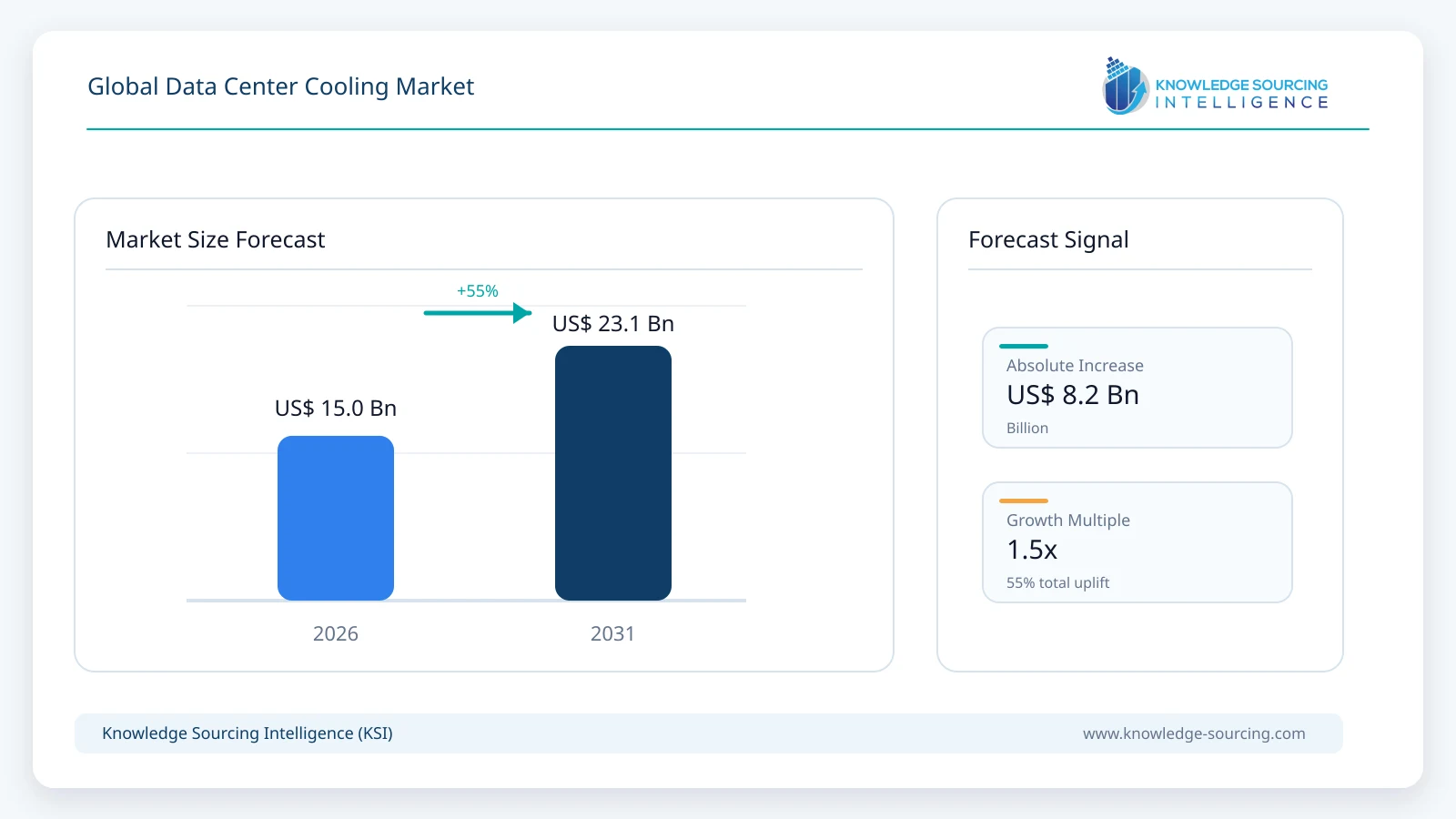
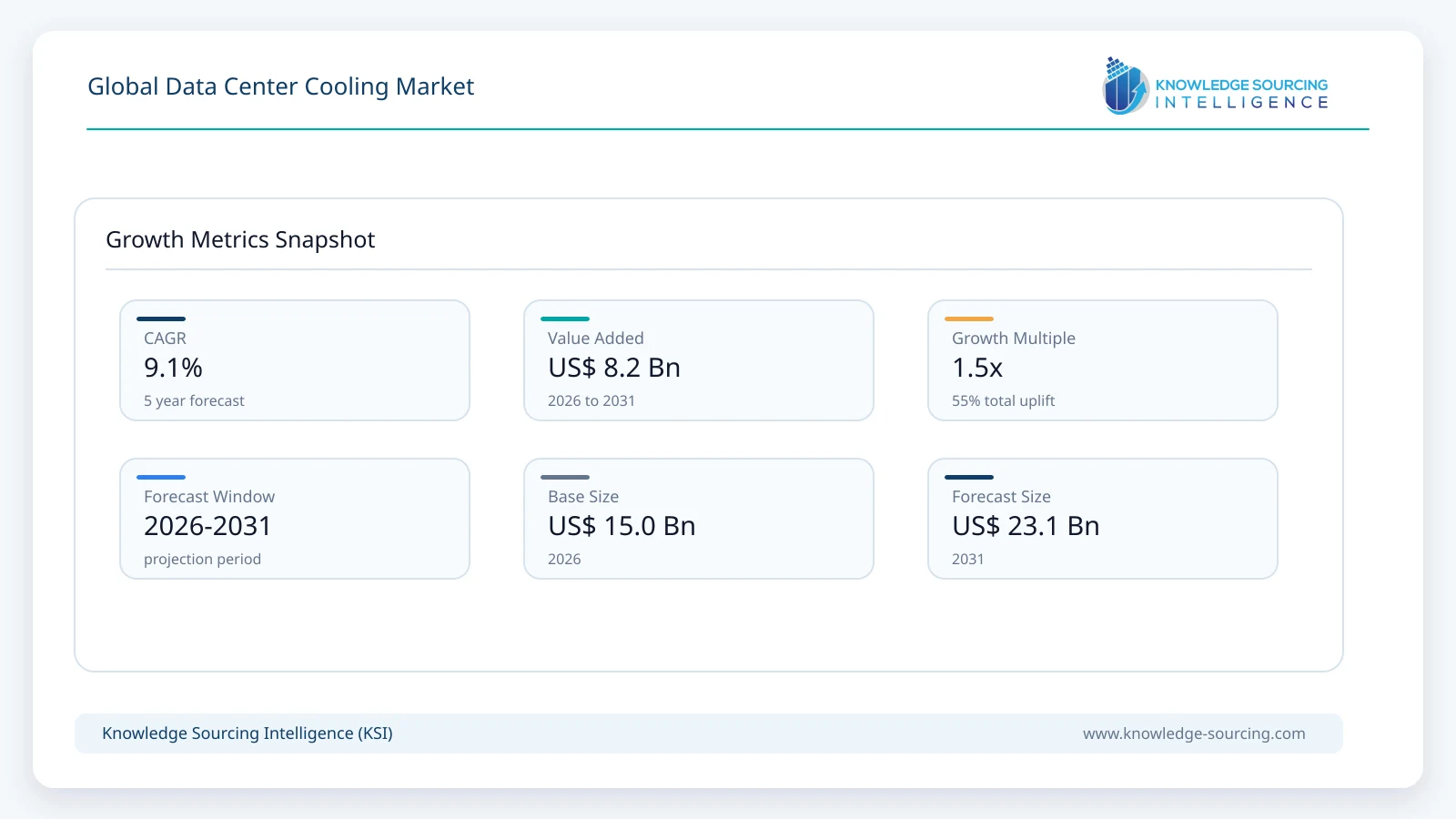
The Data Center Cooling Market is forecast to grow at a CAGR of 9.11%, reaching USD 23.13 billion in 2031 from USD 14.96 billion in 2026.
Highlights:
- 1Rising AI and high-density computing deployments are strengthening demand for advanced thermal management solutions.
- 2Liquid cooling represents one of the most commercially important technology segments for next-generation computing environments.
- 3Asia Pacific continues to attract substantial investment through new hyperscale and cloud infrastructure construction.
- 4Energy-efficient cooling architectures and intelligent thermal management software are influencing procurement decisions.
- 5Environmental regulations related to refrigerants, energy efficiency, and carbon reduction are shaping technology selection.
- 6Competition increasingly depends on integrated infrastructure capabilities, lifecycle services, and global deployment experience.
The data center cooling market comprises thermal management technologies designed to maintain optimal operating temperatures for servers, storage systems, networking equipment, and high-density computing infrastructure. The market includes air conditioning systems, chillers, economizers, liquid cooling solutions, cooling towers, and supporting thermal management technologies deployed across enterprise, colocation, and hyperscale data centers. Cooling has become a strategic infrastructure component because it directly influences equipment reliability, power utilization effectiveness (PUE), operational expenditure, and facility lifespan.
Demand is being shaped by sustained investment in cloud computing infrastructure, artificial intelligence (AI) workloads, high-performance computing (HPC), and edge data center deployments. Modern processor architectures generate substantially higher thermal loads than previous generations, requiring operators to reassess conventional air-based cooling methods. As rack power densities continue to increase, buyers are evaluating cooling technologies based not only on acquisition cost but also on energy efficiency, water consumption, operational resilience, and compatibility with future computing platforms.
Commercial purchasing decisions differ across customer groups. Cloud service providers prioritize scalable cooling systems capable of supporting continuous infrastructure expansion while maintaining low operating costs. Colocation providers seek flexible cooling architectures that accommodate customers with varying rack densities. Enterprise operators often emphasize lifecycle cost, retrofit compatibility, maintenance requirements, and regulatory compliance. Across all customer categories, energy consumption remains one of the most important procurement considerations because cooling accounts for a substantial share of total data center electricity use.
The supplier ecosystem includes manufacturers of cooling equipment, liquid cooling specialists, control system providers, engineering contractors, and infrastructure integrators. Competition extends beyond hardware specifications to encompass system design expertise, predictive monitoring capabilities, energy optimization software, lifecycle services, and global maintenance networks. As data center operators seek higher operational efficiency, integrated cooling solutions are replacing isolated equipment procurement strategies.
Growing investment in hyperscale facilities, regional cloud availability zones, and AI infrastructure is expanding opportunities across both greenfield developments and upgrades of existing facilities. At the same time, tightening environmental regulations and corporate sustainability commitments are encouraging adoption of cooling technologies that reduce electricity consumption, refrigerant emissions, and water usage.
Market Drivers
Expansion of AI and High-Density Computing Infrastructure
Artificial intelligence training clusters, graphics processing units (GPUs), and high-performance computing systems generate heat levels that frequently exceed the capabilities of traditional room-based air cooling. Operators therefore require thermal management systems capable of maintaining consistent temperatures under sustained computational loads.
Large cloud providers, research organizations, and enterprise AI adopters are investing in liquid cooling, precision air conditioning, and advanced heat rejection technologies. Equipment suppliers are responding by introducing modular cooling platforms that can support future increases in rack density without major facility redesign, strengthening long-term replacement demand.
Energy Efficiency as an Operational Cost Priority
Electricity represents one of the largest operating expenses for data center operators. Cooling efficiency directly affects facility operating costs, making thermal management a strategic investment rather than a purely technical requirement.
Procurement teams increasingly evaluate cooling technologies using metrics such as power utilization effectiveness, total cost of ownership, maintenance frequency, and expected equipment lifespan. Vendors compete by offering intelligent controls, predictive monitoring, and optimized airflow management that reduce electricity consumption while maintaining infrastructure reliability.
Growth in Colocation and Cloud Infrastructure
Enterprises continue shifting workloads toward cloud environments while outsourcing infrastructure management to colocation providers. This transition requires operators to support customers with different workload characteristics and cooling requirements.
Facility operators therefore favor modular cooling systems capable of adapting to changing customer density profiles. Suppliers offering flexible deployment models and scalable capacity expansions gain a competitive advantage in multi-tenant environments.
Sustainability and Environmental Commitments
Governments, investors, and corporate sustainability programs are placing greater emphasis on reducing carbon emissions associated with digital infrastructure. Cooling systems have become central to these initiatives because they influence both electricity consumption and refrigerant emissions.
Manufacturers are expanding portfolios that incorporate low-global-warming-potential refrigerants, economizer technologies, intelligent energy controls, and liquid cooling systems designed to reduce environmental impact while supporting operational reliability.
Market Restraints and Challenges
High Capital Investment Requirements
Advanced cooling systems require substantial upfront investment in specialized equipment, facility modifications, piping infrastructure, monitoring systems, and engineering expertise. These costs are particularly challenging for smaller enterprise operators upgrading legacy facilities.
Many organizations therefore adopt phased modernization strategies rather than complete infrastructure replacement, extending procurement timelines and influencing supplier revenue recognition.
Complexity of Retrofitting Existing Facilities
Numerous enterprise data centers were designed around conventional air-cooling architectures. Integrating liquid cooling or higher-capacity thermal systems often requires structural modifications, revised airflow management, electrical upgrades, and operational planning.
Operators must balance infrastructure modernization against service continuity requirements, making retrofit projects technically demanding and commercially complex.
Water Availability and Environmental Constraints
Certain cooling technologies depend on reliable water resources, creating operational challenges in regions experiencing water scarcity or stricter environmental regulations.
Data center developers increasingly assess local water availability during site selection while evaluating hybrid cooling solutions that balance energy efficiency with responsible resource consumption.
Skilled Workforce Limitations
Advanced thermal management systems require specialized engineering knowledge covering fluid dynamics, refrigeration systems, control software, and facility integration. Limited availability of experienced personnel can delay implementation schedules and increase maintenance costs.
Equipment manufacturers increasingly provide technical training, remote monitoring services, and lifecycle support programs to reduce operational risks for customers.
Major Segment Analysis
Liquid Cooling
Liquid cooling has become one of the most commercially significant segments because conventional air cooling faces practical limitations in supporting AI servers and high-density computing environments. Direct-to-chip cooling and immersion cooling technologies enable efficient heat transfer while allowing significantly higher rack power densities.
Demand originates primarily from hyperscale cloud providers, AI infrastructure developers, scientific computing facilities, and organizations deploying GPU-intensive workloads. Buyers prioritize thermal performance, operational reliability, compatibility with existing server platforms, maintenance requirements, and future scalability.
Competition within this segment extends beyond hardware performance. Suppliers differentiate through integration expertise, standardized deployment methodologies, coolant management systems, monitoring software, and partnerships with server manufacturers. As processor thermal design power continues to increase, liquid cooling is expected to capture a growing share of new data center investments while creating retrofit opportunities for selected existing facilities.
Regional Analysis
North America
North America remains a major demand center due to extensive hyperscale cloud investment, AI infrastructure deployment, and mature colocation markets. The United States continues to account for substantial capital expenditure in new data center construction, while regulatory attention toward energy efficiency encourages adoption of advanced cooling technologies. Buyers prioritize operational resilience, lifecycle economics, and sustainability performance.
Europe
European demand is supported by stringent environmental regulations, corporate sustainability objectives, and increasing regional cloud capacity. Operators emphasize energy-efficient cooling architectures, heat recovery opportunities, and compliance with refrigerant regulations. Higher electricity prices further strengthen demand for technologies capable of reducing long-term operating costs.
Asia Pacific
Asia Pacific represents the largest infrastructure expansion opportunity owing to digital economy growth, cloud service expansion, semiconductor manufacturing, and government-supported digital infrastructure initiatives. China, India, Japan, South Korea, Taiwan, and Southeast Asian markets continue investing in hyperscale facilities. Procurement decisions increasingly balance construction speed, operating efficiency, and local environmental requirements.
Middle East & Africa
The region presents growing opportunities as governments diversify digital economies and expand cloud infrastructure. High ambient temperatures create strong demand for reliable cooling technologies capable of maintaining efficiency under challenging climatic conditions. Investment remains concentrated in strategically important digital infrastructure hubs, although infrastructure maturity varies across countries.
South America
Demand is driven by enterprise digitalization, financial services modernization, telecommunications investment, and expanding cloud availability. Brazil represents the principal market due to its relatively mature data center ecosystem. Economic volatility and infrastructure limitations remain considerations for investment planning, although demand for efficient cooling solutions continues to improve.
Competitive Landscape
The competitive environment includes established infrastructure manufacturers alongside specialized thermal management companies. Competition is based on cooling efficiency, system reliability, lifecycle service capabilities, engineering expertise, intelligent controls, and the ability to support both conventional and high-density computing environments.
Suppliers differentiate through integrated infrastructure offerings that combine cooling equipment with power management, monitoring software, digital services, and predictive maintenance. Strategic partnerships with server manufacturers, engineering firms, and cloud infrastructure developers strengthen market positioning by enabling standardized deployments for complex facilities.
Expansion strategies include manufacturing capacity investments, regional service network development, product portfolio diversification, acquisitions of specialized cooling technology providers, and collaborative development programs addressing AI infrastructure requirements. Companies including Vertiv Group Corporation, Schneider Electric SE, STULZ GmbH, Rittal GmbH & Co. KG, Johnson Controls International plc, Carrier Global Corporation, Delta Electronics, Inc., LiquidStack Holding B.V., Asperitas, and Munters AB compete across varying customer segments through differentiated technology portfolios and international project execution capabilities.
Recent Developments
June 2026: CoolIT Systems unveiled the industry's first 15 kW single-phase direct liquid cooling coldplate, demonstrating nearly four times the cooling capacity of its previous design to support future ultra-high-density AI accelerators and GPUs.
May 2026: Vertiv introduced additional high-density liquid cooling capabilities designed to support AI computing environments. The expansion strengthens infrastructure options for hyperscale and enterprise customers deploying GPU-intensive workloads.
February 2026: Schneider Electric inaugurated its Motivair liquid cooling manufacturing facility in Bengaluru, India, its first such plant in the country, expanding localized production of high-density cooling systems for AI-driven data center infrastructure.
September 2025: Carrier Global announced expanded thermal management capabilities for mission-critical infrastructure applications through strategic product enhancements. The initiative broadens its participation in next-generation data center projects.
Regulatory and Policy Environment
Regulatory frameworks influencing the market primarily address energy efficiency, refrigerant management, environmental sustainability, building performance, and operational resilience. Standards governing refrigeration systems and energy-efficient building design encourage adoption of technologies that reduce electricity consumption and greenhouse gas emissions.
Environmental regulations targeting high-global-warming-potential refrigerants are accelerating transitions toward alternative cooling technologies. Many jurisdictions also promote improved energy performance through efficiency standards, emissions reporting, and sustainability disclosure requirements.
Government investment in digital infrastructure, national cloud programs, and semiconductor manufacturing initiatives indirectly supports cooling equipment demand by stimulating construction of new computing facilities. Compliance with international standards for electrical infrastructure, environmental performance, and operational continuity remains essential during facility design and procurement.
Outlook and Strategic Implications
The commercial outlook for the data center cooling market will be shaped by AI infrastructure expansion, rising rack power densities, sustainability requirements, and continued cloud investment. Procurement priorities are expected to shift toward modular cooling architectures capable of supporting future computing requirements without extensive facility redesign.
Investment will increasingly favor intelligent thermal management systems integrating predictive analytics, automation, digital monitoring, and energy optimization. Suppliers capable of combining cooling hardware with software-driven operational management and global service capabilities are likely to strengthen competitive positioning.
Liquid cooling adoption is expected to expand beyond specialized computing applications into broader enterprise deployments as processor thermal requirements continue to increase. At the same time, hybrid cooling architectures combining air and liquid technologies will provide flexibility for facilities managing mixed computing environments.
Strategic risks include electricity price volatility, water availability constraints, regulatory changes affecting refrigerants, supply chain disruptions for specialized components, and skilled workforce shortages. Nevertheless, sustained investment in hyperscale data centers, AI infrastructure, and cloud services provides a favorable commercial foundation for suppliers capable of delivering efficient, scalable, and environmentally compliant cooling solutions over the forecast period.
Data Center Cooling Market Scope
| Report Metric | Details |
|---|---|
| Total Market Size in 2026 | USD 14.96 billion |
| Total Market Size in 2031 | USD 23.13 billion |
| Forecast Unit | Billion |
| Growth Rate | 9.11% |
| Study Period | 2021 to 2031 |
| Historical Data | 2021 to 2024 |
| Base Year | 2025 |
| Forecast Period | 2026 – 2031 |
| Segmentation | Solution, Enterprise Size, End Users, Industry Vertical, Geography |
| Companies |
|
Market Segmentation
By Solution
- Air Conditioning
- Chillers
- Economizers
- Liquid Cooling
- Cooling Towers
- Others
By Enterprise Size
- Small Enterprises
- Medium Enterprises
- Large Enterprises
By End Users
- Colocation Service Providers
- Cloud Service Providers
- Enterprises
By Industry Vertical
- BFSI (Banking, Financial Services, and Insurance)
- Manufacturing
- Healthcare
- IT & Telecommunications
- Education
- Government
- Media and Entertainment
- Others
By Geography
- North America
- United States
- Canada
- Mexico
- Others
- South America
- Brazil
- Argentina
- Others
- Europe
- Germany
- France
- UK
- Italy
- Spain
- Others
- Middle East and Africa
- Saudi Arabia
- UAE
- Others
- Asia Pacific
- China
- India
- South Korea
- Japan
- Thailand
- Taiwan
- Others
Table of Contents
1. INTRODUCTION
1.1. Market Overview
1.2. Market Definition
1.3. Scope of the Study
1.4. Market Segmentation
1.5. Currency
1.6. Assumptions
1.7. Base and Forecast Years Timeline
1.8. Key Benefits for Stakeholders
2. RESEARCH METHODOLOGY
2.1. Research Design
2.2. Research Process
3. EXECUTIVE SUMMARY
3.1. Key Findings
3.2. Analyst View
4. MARKET DYNAMICS
4.1. Market Drivers
4.2. Market Restraints
4.3. Porter’s Five Forces Analysis
4.3.1. Bargaining Power of Suppliers
4.3.2. Bargaining Power of Buyers
4.3.3. Threat of New Entrants
4.3.4. Threat of Substitutes
4.3.5. Competitive Rivalry in the Industry
4.4. Industry Value Chain Analysis
4.5. Analyst View
5. DATA CENTER COOLING MARKET BY SOLUTION
5.1. Introduction
5.2. Air Conditioning
5.2.1. Market Trends and Opportunities
5.2.2. Growth Prospects
5.2.3. Geographic Lucrativeness
5.3. Chillers
5.3.1. Market Trends and Opportunities
5.3.2. Growth Prospects
5.3.3. Geographic Lucrativeness
5.4. Economizers
5.4.1. Market Trends and Opportunities
5.4.2. Growth Prospects
5.4.3. Geographic Lucrativeness
5.5. Liquid Cooling
5.5.1. Market Trends and Opportunities
5.5.2. Growth Prospects
5.5.3. Geographic Lucrativeness
5.6. Cooling Towers
5.6.1. Market Trends and Opportunities
5.6.2. Growth Prospects
5.6.3. Geographic Lucrativeness
5.7. Others
5.7.1. Market Trends and Opportunities
5.7.2. Growth Prospects
5.7.3. Geographic Lucrativeness
6. DATA CENTER COOLING MARKET BY ENTERPRISE SIZE
6.1. Introduction
6.2. Small Enterprises
6.2.1. Market Trends and Opportunities
6.2.2. Growth Prospects
6.2.3. Geographic Lucrativeness
6.3. Medium Enterprises
6.3.1. Market Trends and Opportunities
6.3.2. Growth Prospects
6.3.3. Geographic Lucrativeness
6.4. Large Enterprises
6.4.1. Market Trends and Opportunities
6.4.2. Growth Prospects
6.4.3. Geographic Lucrativeness
7. DATA CENTER COOLING MARKET BY END USERS
7.1. Introduction
7.2. Colocation Service Providers
7.2.1. Market Trends and Opportunities
7.2.2. Growth Prospects
7.2.3. Geographic Lucrativeness
7.3. Cloud Service Providers
7.3.1. Market Trends and Opportunities
7.3.2. Growth Prospects
7.3.3. Geographic Lucrativeness
7.4. Enterprises
7.4.1. Market Trends and Opportunities
7.4.2. Growth Prospects
7.4.3. Geographic Lucrativeness
8. DATA CENTER COOLING MARKET BY INDUSTRY VERTICAL
8.1. Introduction
8.2. BFSI (Banking, Financial Services, and Insurance)
8.2.1. Market Trends and Opportunities
8.2.2. Growth Prospects
8.2.3. Geographic Lucrativeness
8.3. Manufacturing
8.3.1. Market Trends and Opportunities
8.3.2. Growth Prospects
8.3.3. Geographic Lucrativeness
8.4. Healthcare
8.4.1. Market Trends and Opportunities
8.4.2. Growth Prospects
8.4.3. Geographic Lucrativeness
8.5. IT & Telecommunications
8.5.1. Market Trends and Opportunities
8.5.2. Growth Prospects
8.5.3. Geographic Lucrativeness
8.6. Education
8.6.7. Government
8.8. Media and Entertainment
8.9. Others
9. DATA CENTER COOLING MARKET BY GEOGRAPHY
9.1. Introduction
9.2. North America
9.2.1. By Solution
9.2.2. By Enterprise Size
9.2.3. By End Users
9.2.4. By Industry Vertical
9.2.5. By Country
9.2.5.1. United States
9.2.5.2. Canada
9.2.5.3. Mexico
9.3. South America
9.4. Europe
9.5. Middle East and Africa
9.6. Asia Pacific
10. COMPETITIVE ENVIRONMENT AND ANALYSIS
10.1. Major Players and Strategy Analysis
10.2. Market Share Analysis
10.3. Mergers, Acquisitions, Agreements, and Collaborations
10.4. Competitive Dashboard
11. COMPANY PROFILES
11.1. Vertiv Group Corporation
11.2. Schneider Electric SE
11.3. STULZ GmbH
11.4. Rittal GmbH & Co. KG
11.5. Johnson Controls International plc
11.6. Carrier Global Corporation
11.7. Delta Electronics, Inc.
11.8. LiquidStack Holding B.V.
11.9. Asperitas
11.10. Munters AB
Navigate
Trusted by the world's leading organizations











