
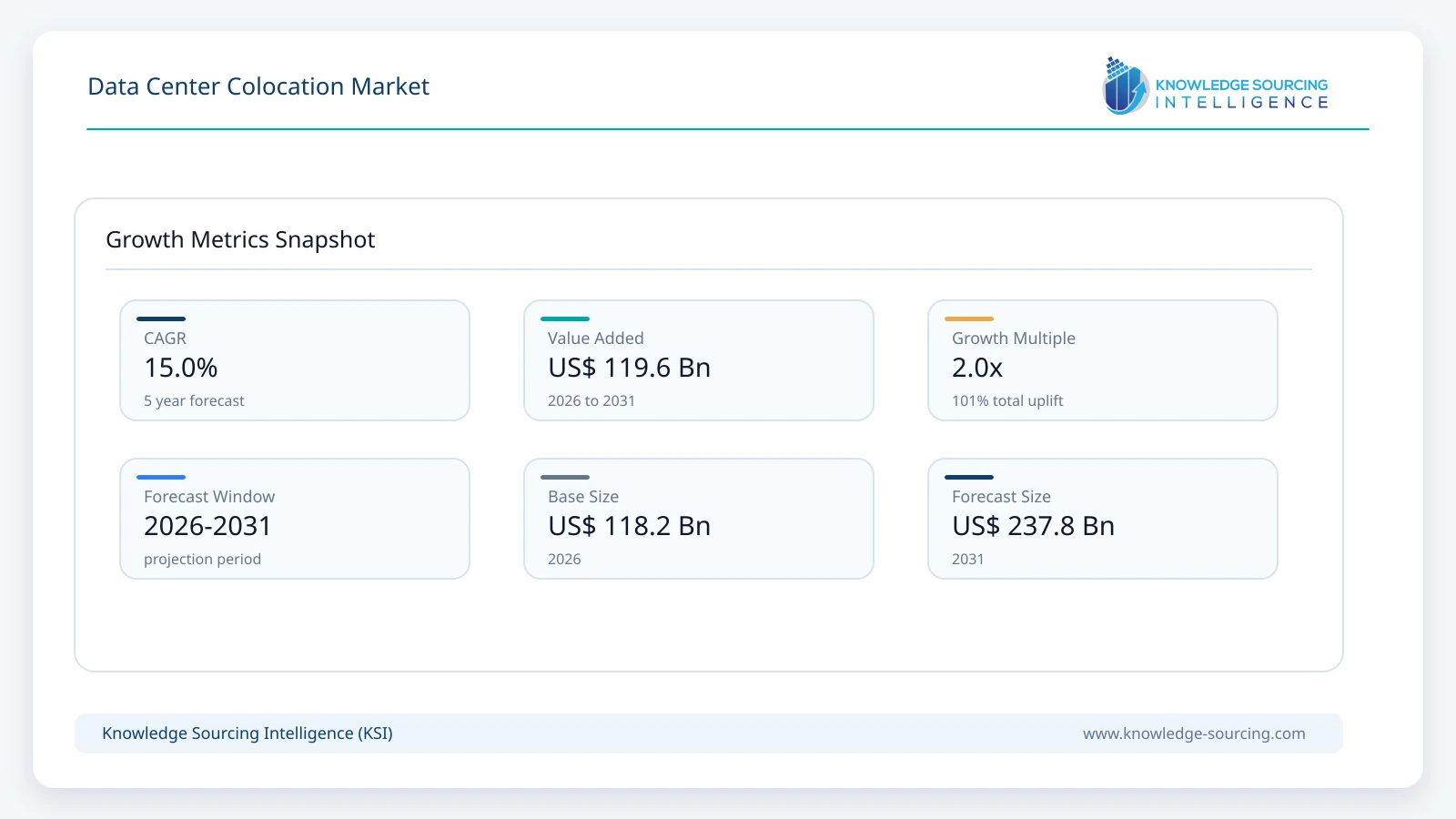
The global Data Center Colocation Market is forecast to grow at a CAGR of 15.0%, reaching USD 237.78 billion in 2031 from USD 118.22 billion in 2026.
Highlights:
- 1AI computing, hybrid cloud adoption, and enterprise modernization remain the primary demand catalysts for colocation infrastructure.
- 2Wholesale colocation represents a commercially important segment due to hyperscale cloud expansion and high-density computing requirements.
- 3Asia Pacific continues to attract substantial infrastructure investment driven by enterprise digitization and expanding internet economies.
- 4High-density power distribution, liquid cooling, and renewable energy integration are becoming important technology differentiators.
- 5Data sovereignty regulations and cybersecurity compliance standards are influencing infrastructure location decisions.
- 6Competition is centered on power availability, interconnection ecosystems, geographic reach, sustainability performance, and operational reliability.
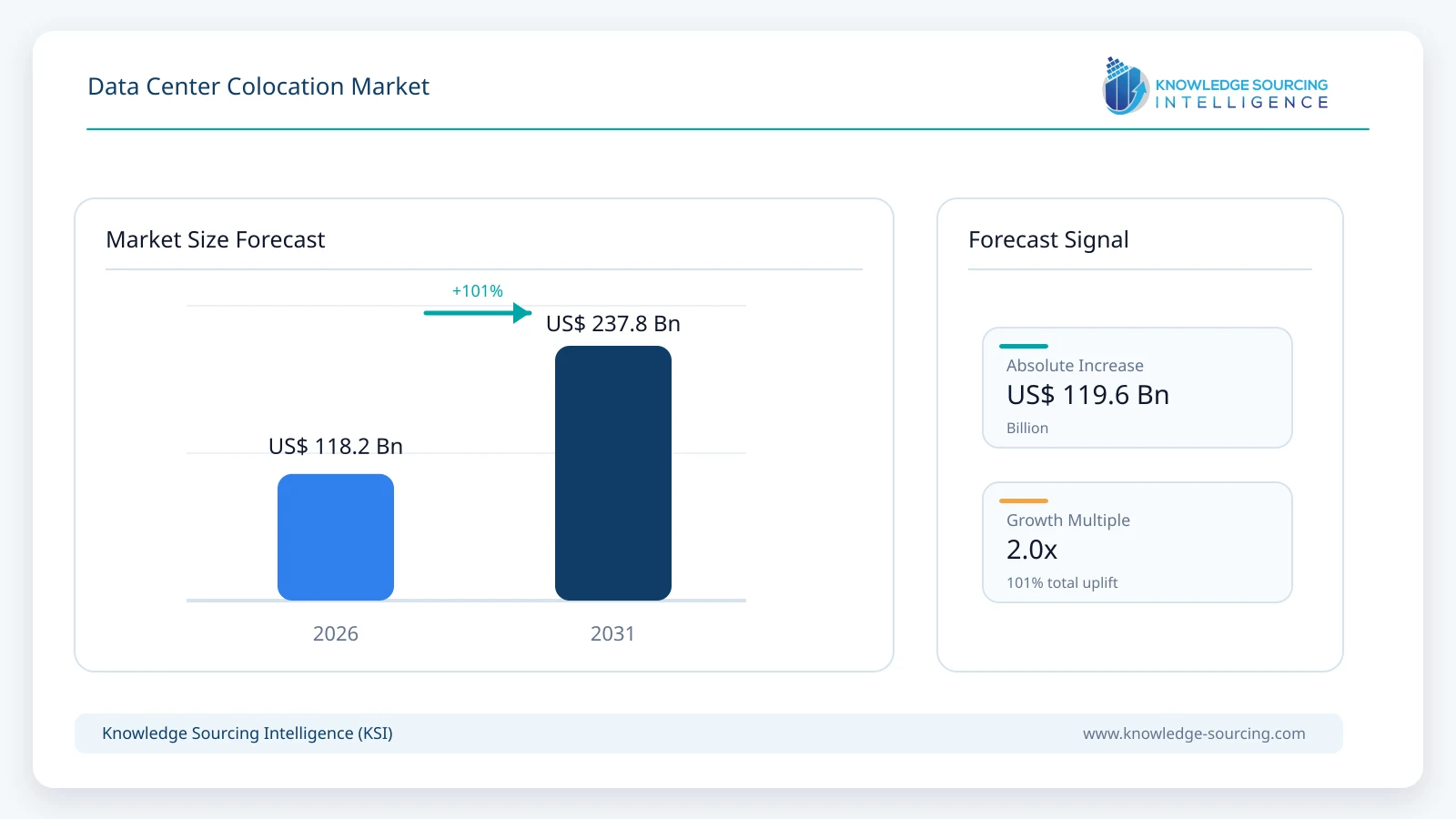
The data center colocation market comprises third-party facilities that provide secure physical space, power, cooling, network connectivity, and operational support for enterprise-owned IT infrastructure. Instead of constructing and managing dedicated facilities, organizations lease rack space, cages, suites, or dedicated halls within professionally operated data centers. This operating model enables enterprises to optimize capital allocation while gaining access to resilient infrastructure designed to support mission-critical applications, cloud connectivity, and regulatory compliance.
Demand for colocation services is being shaped by sustained growth in enterprise data generation, artificial intelligence (AI) workloads, cloud-native applications, financial transactions, digital media consumption, industrial automation, and connected devices. Organizations continue to reassess the economics of self-operated data centers as energy costs, hardware refresh cycles, cybersecurity requirements, and sustainability commitments increase operating complexity. Colocation has therefore become an infrastructure strategy rather than simply a real estate decision.
Enterprise procurement priorities have shifted toward facilities offering high power availability, carrier neutrality, low-latency interconnection, renewable energy procurement, physical security, and operational resilience. Large enterprises typically seek scalable deployments capable of supporting hybrid IT environments, while small and medium enterprises (SMEs) prioritize predictable operating expenditure, managed services, and rapid deployment timelines. Buyers also evaluate providers based on geographic diversity, disaster recovery capabilities, compliance certifications, and connectivity ecosystems.
Industry structure reflects substantial capital intensity. Facility construction requires long planning cycles, utility coordination, land acquisition, electrical infrastructure, and advanced cooling technologies. Consequently, competition centers less on price and more on location quality, available power capacity, interconnection density, sustainability performance, customer service, and expansion capability. Established providers with extensive metropolitan footprints and strong relationships with cloud service providers maintain competitive advantages because enterprise customers increasingly value interconnected digital ecosystems over standalone facility space.
The emergence of AI infrastructure has introduced new purchasing dynamics. High-density computing clusters require substantially greater power availability, liquid cooling readiness, and advanced electrical distribution systems than conventional enterprise workloads. This has increased demand for purpose-built colocation facilities capable of supporting accelerated computing while maintaining energy efficiency targets. At the same time, stricter data residency requirements across several jurisdictions continue to encourage domestic infrastructure deployment, creating opportunities for regional operators alongside global providers.
Market Drivers
Expansion of Hybrid Cloud and Multi-Cloud Architectures
Many enterprises have adopted hybrid infrastructure strategies that combine private infrastructure with multiple public cloud platforms. Colocation facilities provide direct network connectivity to cloud providers while allowing organizations to retain control over sensitive workloads. Buyers increasingly seek facilities with extensive carrier ecosystems and cloud on-ramps to reduce latency and network costs. Providers have responded by expanding interconnection services, creating additional revenue opportunities beyond traditional rack leasing.
Rising Demand for AI and High-Performance Computing Infrastructure
Artificial intelligence model training, inference workloads, and advanced analytics require substantially higher rack densities than conventional enterprise computing. Organizations deploying AI infrastructure often require facilities capable of delivering reliable high-capacity electrical supply and advanced cooling systems. Colocation operators are investing in liquid cooling technologies, upgraded electrical infrastructure, and modular expansion designs to address these specialized customer requirements. These investments strengthen long-term customer relationships while supporting premium pricing for high-density deployments.
Increasing Enterprise Focus on Capital Efficiency
Building enterprise-owned data centers demands considerable upfront investment, specialized personnel, and continuous technology upgrades. Many organizations prefer operational expenditure models that improve financial flexibility while reducing infrastructure management responsibilities. Procurement teams therefore evaluate colocation providers based on service reliability, scalability, contract flexibility, and operating cost predictability. This preference broadens the addressable customer base across both established enterprises and growing digital businesses.
Growth of Regulatory Compliance Requirements
Financial institutions, healthcare providers, government agencies, and telecommunications companies operate under increasingly stringent requirements for data protection, business continuity, and operational resilience. Certified colocation facilities simplify compliance by providing internationally recognized operational standards, physical security controls, environmental monitoring, and disaster recovery capabilities. These capabilities influence purchasing decisions where uninterrupted service availability carries substantial commercial consequences.
Market Restraints and Challenges
Power Availability Constraints
Power has become one of the most significant limiting factors for new colocation development. Many metropolitan markets experience delays in utility connections because electrical infrastructure expansion has not kept pace with digital infrastructure demand. Developers, customers, and utility providers all face longer project timelines, delaying capacity commercialization and increasing project costs. Operators are mitigating this challenge through early utility engagement, alternative energy procurement, and development in secondary markets.
Escalating Construction and Financing Costs
Construction materials, electrical equipment, cooling systems, and skilled labor continue to represent major capital expenditures. Higher financing costs also influence investment decisions for new facilities. Smaller operators may encounter difficulties securing funding for large-scale developments, contributing to industry consolidation. Providers increasingly adopt phased construction strategies to align investment with confirmed customer demand.
Sustainability Expectations and Energy Consumption
Large-scale data centers consume substantial electricity and water resources. Enterprise customers, investors, and regulators increasingly expect operators to demonstrate measurable progress toward carbon reduction objectives. Compliance with environmental commitments requires investment in renewable energy sourcing, energy-efficient cooling technologies, and transparent sustainability reporting. These initiatives improve long-term competitiveness but can increase near-term operating costs.
Supply Chain Complexity
Critical equipment, including transformers, generators, switchgear, cooling systems, and backup power components often involves extended procurement timelines. Delays in equipment availability can postpone facility commissioning and customer deployments. Operators reduce exposure through diversified supplier networks, long-term procurement agreements, and inventory planning for essential infrastructure components.
Major Segment Analysis
Wholesale Colocation
Wholesale colocation represents one of the most commercially influential segments because it serves hyperscale cloud providers, digital platforms, telecommunications operators, and enterprises deploying large-scale computing environments. Unlike retail colocation, wholesale customers typically lease dedicated suites or entire facilities, enabling customized infrastructure configurations and higher power densities.
Buyer requirements extend beyond physical capacity. Customers prioritize long-term power availability, scalable expansion options, network diversity, sustainability commitments, and contractual flexibility. Procurement decisions frequently involve multi-year infrastructure planning, making provider credibility, construction capability, and financial strength essential competitive factors.
Revenue characteristics also distinguish wholesale colocation from smaller deployments. Although customer volumes are lower, contract values are substantially larger and often include long-term commitments that improve revenue visibility. Providers therefore compete aggressively for strategic hyperscale customers while balancing customer concentration risk through diversified enterprise portfolios.
Demand is expected to remain supported by AI infrastructure expansion, cloud service growth, enterprise modernization initiatives, and increasing data localization requirements across multiple jurisdictions.
Regional Analysis
North America
North America remains a mature colocation market supported by hyperscale cloud investments, financial services, healthcare digitization, telecommunications infrastructure, and enterprise technology spending. Buyers prioritize interconnection density, operational resilience, renewable energy availability, and proximity to major metropolitan markets. Power availability constraints in several established markets encourage expansion into emerging regional locations.
Europe
European demand is influenced by data protection regulations, sustainability objectives, and enterprise cloud adoption. Organizations increasingly seek facilities demonstrating renewable energy procurement, efficient cooling technologies, and compliance with regional privacy requirements. Infrastructure investment continues across established digital hubs while secondary cities attract development due to available power capacity and favorable operating conditions.
Asia Pacific
Asia Pacific represents an important investment destination because of expanding internet penetration, cloud adoption, manufacturing digitization, financial technology growth, and government-supported digital infrastructure initiatives. China, Japan, India, South Korea, and Southeast Asian economies continue to attract domestic and international investment. However, regulatory diversity and infrastructure availability require localized market strategies.
Middle East & Africa
Governments across the Middle East are investing in digital economies, smart city programs, and sovereign cloud initiatives that support regional colocation demand. Enterprise modernization, telecommunications investment, and public sector digitization create additional opportunities. Nevertheless, infrastructure maturity and power availability vary considerably across countries.
South America
South American demand is supported by banking modernization, telecommunications expansion, e-commerce activity, and cloud adoption. Brazil remains the principal investment destination because of its large enterprise base and digital economy. Economic volatility, currency fluctuations, and infrastructure limitations continue to influence investment decisions throughout the region.
Competitive Landscape
Competition within the data center colocation market is characterized by substantial capital requirements, long infrastructure development cycles, and high customer retention rates. Providers including Equinix, Inc., Digital Realty Trust, Inc., NTT DATA, Inc., CyrusOne LLC, Vantage Data Centers, ST Telemedia Global Data Centres (STT GDC), CoreSite Realty Corporation, QTS Realty Trust, LLC, Iron Mountain Data Centers, Colt Technology Services Group Limited, Telehouse (KDDI Corporation), EdgeConneX, Inc., and DataBank Holdings Ltd. compete through network ecosystem strength, geographic coverage, power scalability, operational reliability, sustainability performance, and customer support capabilities.
Competitive differentiation increasingly depends on delivering high-density AI-ready infrastructure, renewable energy procurement, advanced cooling technologies, direct cloud connectivity, and expansion flexibility. Strategic partnerships with cloud providers, telecommunications operators, and renewable energy suppliers strengthen customer value propositions while supporting long-term infrastructure utilization.
Recent Developments
June 2026: Digital Realty announced strategic transactions including acquiring a two-gigawatt development site in the Kansas City metro and increasing ownership in Teraco, strengthening its global hyperscale and colocation platform.
May 2026: Equinix announced additional AI-ready data center capacity investments across multiple international markets to support high-density computing deployments. The expansion strengthens infrastructure availability for enterprise AI adoption.
March 2026: RadiusDC announced a definitive agreement to acquire phoenixNAP's Phoenix data center and colocation business, adding an operational colocation facility, interconnection assets, and future campus expansion rights in Arizona.
January 2026: Digital Realty announced its entry into Malaysia through the acquisition of TelcoHub 1 in Cyberjaya, expanding its carrier-neutral colocation and interconnection platform across Southeast Asia to address growing enterprise and hyperscale demand.
Regulatory and Policy Environment
The regulatory framework governing the data center colocation market continues to expand as governments emphasize cybersecurity, operational resilience, environmental sustainability, and data sovereignty. Privacy regulations such as regional data protection laws influence facility location decisions by requiring certain categories of information to remain within national borders. Financial institutions and healthcare organizations frequently require infrastructure providers to maintain internationally recognized security and operational certifications.
Environmental policies also influence investment planning. Operators increasingly align facility development with energy efficiency requirements, renewable electricity procurement programs, and carbon reporting obligations. Electrical infrastructure permitting, environmental impact assessments, and utility coordination remain important considerations during project development.
International standards covering information security, business continuity, environmental management, and energy management support procurement decisions by providing consistent benchmarks for operational quality. Enterprise customers frequently incorporate these certifications into vendor qualification processes.
Outlook and Strategic Implications
The commercial outlook for the data center colocation market will be shaped by AI infrastructure deployment, enterprise cloud connectivity requirements, sustainability expectations, and regional data governance policies. Investment priorities are expected to emphasize power capacity expansion, advanced cooling technologies, renewable energy integration, and network interconnection ecosystems capable of supporting increasingly demanding workloads.
Enterprise procurement will continue shifting toward long-term infrastructure partnerships rather than transactional capacity purchases. Buyers are expected to evaluate providers on operational resilience, geographic diversity, sustainability performance, regulatory compliance, and expansion capability alongside pricing considerations.
Competitive positioning will increasingly depend on securing reliable power resources, accelerating facility delivery, supporting high-density AI environments, and maintaining extensive interconnection ecosystems. While construction costs, utility constraints, and regulatory complexity present commercial risks, operators that align infrastructure development with enterprise workload requirements and regional compliance expectations will be well positioned to capture sustained demand over the forecast period.
Data Center Colocation Market Scope
| Report Metric | Details |
|---|---|
| Total Market Size in 2026 | USD 118.22 billion |
| Total Market Size in 2031 | USD 237.78 billion |
| Forecast Unit | Billion |
| Growth Rate | 15.0% |
| Study Period | 2021 to 2031 |
| Historical Data | 2021 to 2024 |
| Base Year | 2025 |
| Forecast Period | 2026 – 2031 |
| Segmentation | Colocation Model, Enterprise Size, End-User Industry, Geography |
| Companies |
|
Market Segmentation
By Colocation Model
- Retail Colocation
- Wholesale Colocation
By Enterprise Size
- Small and Medium Enterprises (SMEs)
- Large Enterprises
By End-User Industry
- IT and Telecommunications
- BFSI
- Government and Public Sector
- Healthcare
- Manufacturing
- Media and Entertainment
- Retail and E-commerce
- Others
By Geography
- North America
- United States
- Canada
- Mexico
- South America
- Brazil
- Argentina
- Others
- Europe
- United Kingdom
- Germany
- France
- Italy
- Spain
- Others
- Middle East and Africa
- Saudi Arabia
- UAE
- Others
- Asia Pacific
- China
- Japan
- India
- South Korea
- Taiwan
- Indonesia
- Thailand
- Others
Table of Contents
1. INTRODUCTION
1.1. Market Overview
1.2. Market Definition
1.3. Scope of the Study
1.4. Market Segmentation
1.5. Currency
1.6. Assumptions
1.7. Base and Forecast Years
1.8. Key Benefits for Stakeholders
2. RESEARCH METHODOLOGY
2.1. Research Design
2.2. Research Process
3. EXECUTIVE SUMMARY
3.1. Key Findings
4. MARKET DYNAMICS
4.1. Market Drivers
4.2. Market Restraints
4.3. Porter’s Five Forces Analysis
4.3.1. Bargaining Power of Suppliers
4.3.2. Bargaining Power of Buyers
4.3.3. Threat of New Entrants
4.3.4. Threat of Substitutes
4.3.5. Competitive Rivalry in the Industry
4.4. Industry Value Chain Analysis
4.5. Analyst View
5. GLOBAL DATA CENTER COLOCATION MARKET BY COLOCATION MODEL
5.1. Introduction
5.2. Retail Colocation
5.3. Wholesale Colocation
6. GLOBAL DATA CENTER COLOCATION MARKET BY ENTERPRISE SIZE
6.1. Introduction
6.2. Small and Medium Enterprises (SMEs)
6.3. Large Enterprises
7. GLOBAL DATA CENTER COLOCATION MARKET BY END-USER INDUSTRY
7.1. Introduction
7.2. IT and Telecommunications
7.3. BFSI
7.4. Government and Public Sector
7.5. Healthcare
7.6. Manufacturing
7.7. Media and Entertainment
7.8. Retail and E-commerce
7.9. Others
8. GLOBAL DATA CENTER COLOCATION MARKET BY GEOGRAPHY
8.1. Introduction
8.2. North America
8.2.1. By Colocation Model
8.2.2. By Enterprise Size
8.2.3. By End-User Industry
8.2.4. By Country
8.2.4.1. United States
8.2.4.2. Canada
8.2.4.3. Mexico
8.3. South America
8.3.1. By Colocation Model
8.3.2. By Enterprise Size
8.3.3. By End-User Industry
8.3.4. By Country
8.3.4.1. Brazil
8.3.4.2. Argentina
8.3.4.3. Others
8.4. Europe
8.4.1. By Colocation Model
8.4.2. By Enterprise Size
8.4.3. By End-User Industry
8.4.4. By Country
8.4.4.1. United Kingdom
8.4.4.2. Germany
8.4.4.3. France
8.4.4.4. Italy
8.4.4.5. Spain
8.4.4.6. Others
8.5. Middle East and Africa
8.5.1. By Colocation Model
8.5.2. By Enterprise Size
8.5.3. By End-User Industry
8.5.4. By Country
8.5.4.1. Saudi Arabia
8.5.4.2. UAE
8.5.4.3. Others
8.6. Asia Pacific
8.6.1. By Colocation Model
8.6.2. By Enterprise Size
8.6.3. By End-User Industry
8.6.4. By Country
8.6.4.1. China
8.6.4.2. Japan
8.6.4.3. India
8.6.4.4. South Korea
8.6.4.5. Taiwan
8.6.4.6. Indonesia
8.6.4.7. Thailand
8.6.4.8. Others
9. COMPETITIVE ENVIRONMENT AND ANALYSIS
9.1. Major Players and Strategy Analysis
9.2. Market Share Analysis
9.3. Mergers, Acquisitions, Agreements, and Collaborations
9.4. Competitive Dashboard
10. COMPANY PROFILES
10.1. Equinix, Inc.
10.2. Digital Realty Trust, Inc.
10.3. NTT DATA, Inc.
10.4. CyrusOne LLC
10.5. Vantage Data Centers
10.6. ST Telemedia Global Data Centres (STT GDC)
10.7. CoreSite Realty Corporation
10.8. QTS Realty Trust, LLC
10.9. Iron Mountain Data Centers
10.10. Colt Technology Services Group Limited
10.11. Telehouse (KDDI Corporation)
10.12. EdgeConneX, Inc.
10.13. DataBank Holdings Ltd.
Navigate
Trusted by the world's leading organizations











