
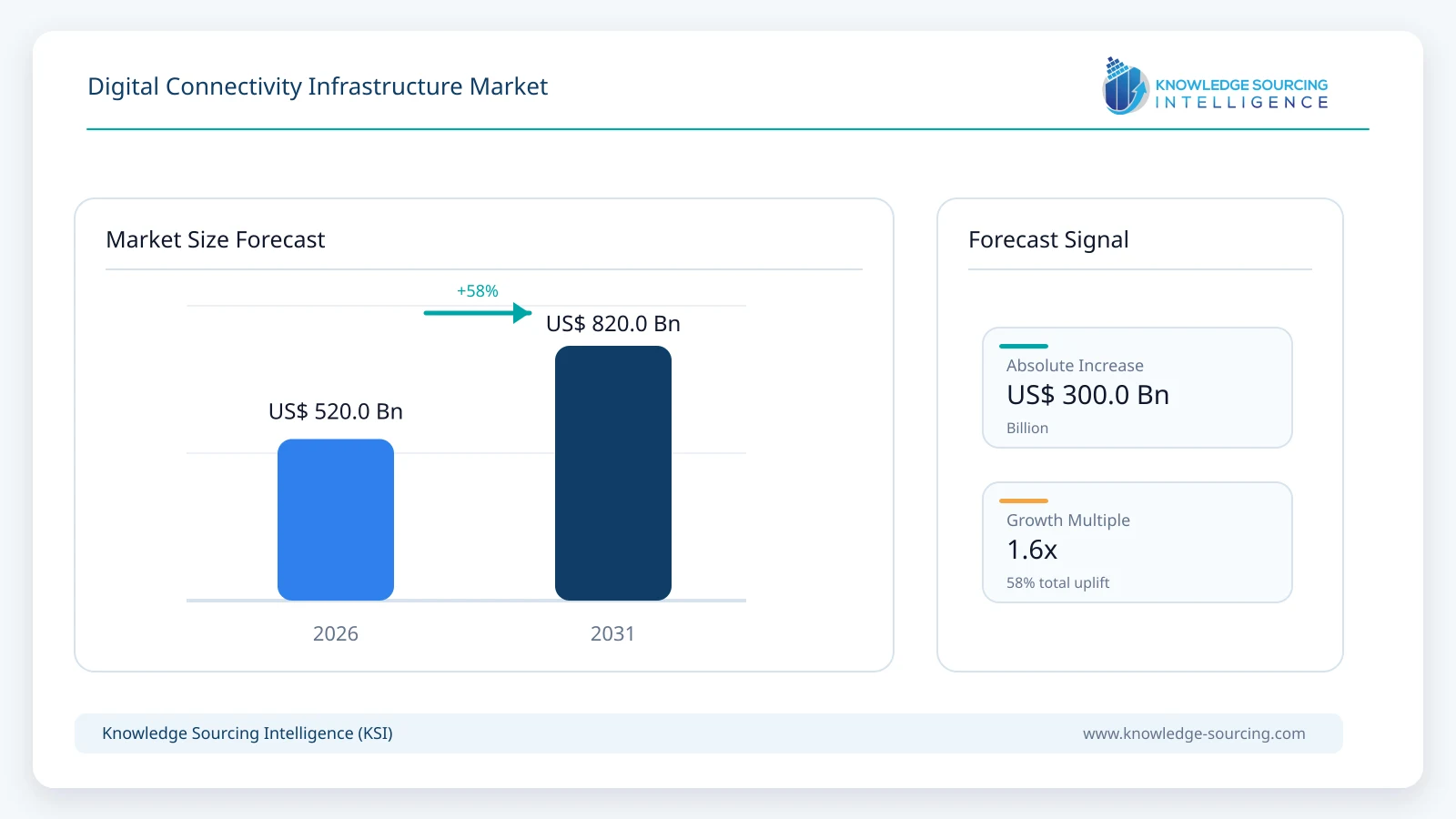
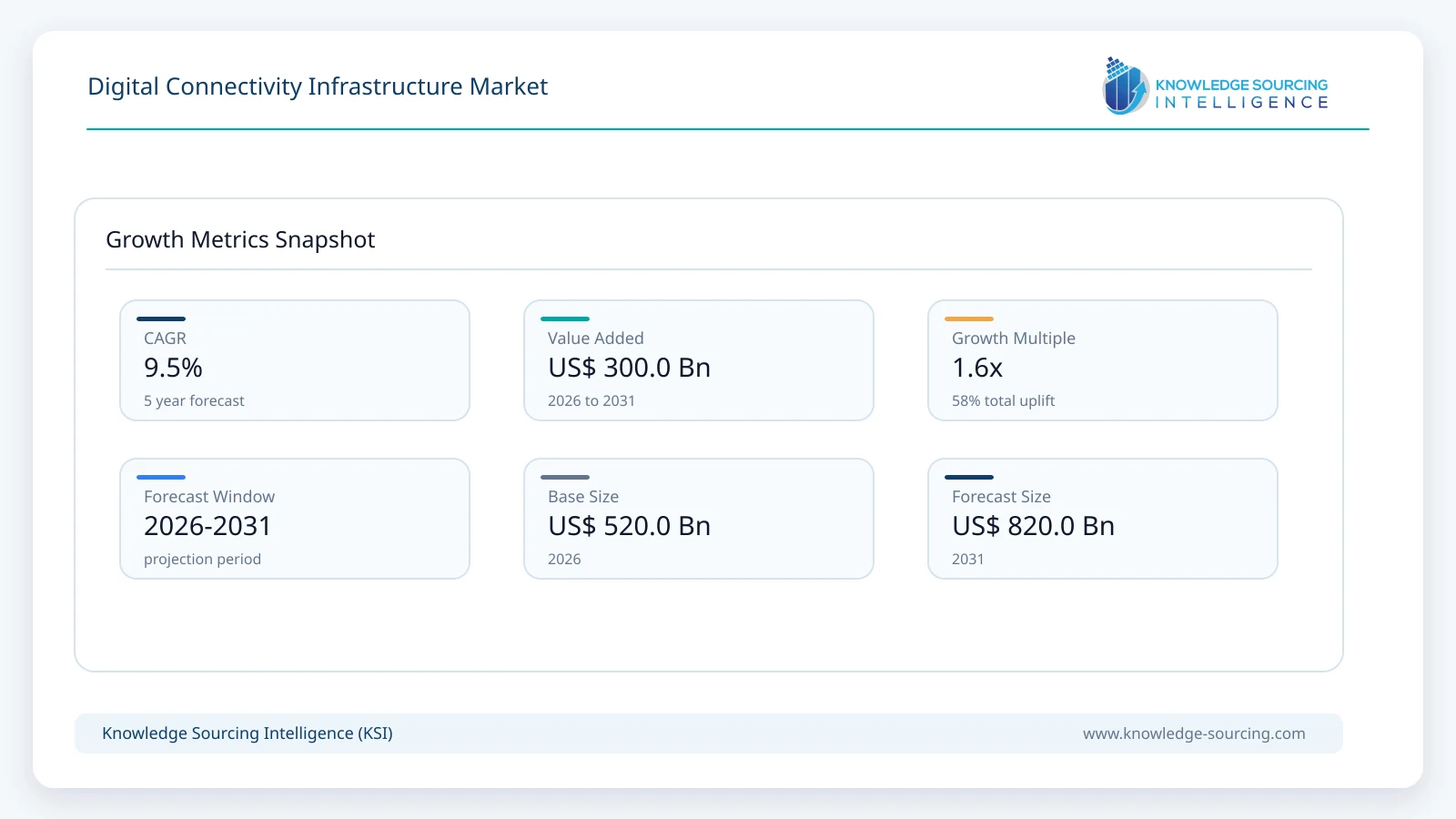
The global Digital Connectivity Infrastructure market is forecast to grow at a CAGR of 9.5%, reaching USD 820.0 billion in 2031 from USD 520.0 billion in 2026.
Highlights:
- 1Network infrastructure remains at the forefrontAccess, Core, and Edge Network Infrastructure is valued at USD 208.0 billion in 2026, representing 40.0% of the total market and making it the largest infrastructure layer.
- 2Fiber connectivity gains momentumFiber-to-the-Premises (FTTP) is projected to grow at a CAGR of 5.3% from 2026 to 2031, supported by rising demand for high-speed, reliable connectivity across residential and business networks.
- 3Asia Pacific takes the growth leadThe region is expected to reach USD 295.2 billion by 2031, up from USD 192.4 billion in 2026, maintaining its position as the largest geographic market with a 36.0% share in 2031.
- 4IT and Telecom anchors future demandThe end-user segment is forecast to expand from USD 202.8 billion in 2026 to USD 303.4 billion by 2031, reflecting sustained infrastructure investment across telecom networks and digital technology environments.
The 5G and eventual 6G network densification, the hyperscale data center, AI accelerator and high-speed interconnect buildout to help advance cloud and generative AI workloads, and national broadband-equity and universal-service programs filling last-mile fiber and wireless gaps are pulling growth forward simultaneously.
Digital connectivity infrastructure is an overlay of the telecom network infrastructure (access, core and edge) running over the physical compute infrastructure (data centers, colocation, on-premise and hybrid cloud) and the fiber, subsea cable and wireless transport layers that connect them. The term "gigabit access" is often used to denote this new trend, since historically these investment classes were treated separately, but recent developments have seen governments and operators increasingly considering them together in their plans and investment decisions, understanding that gigabit access is only useful if supported by appropriate compute, edge, and interconnection capacity.
Market Dynamics
Market Drivers
Scaling Generative AI training and inference workloads is creating an unprecedented capital expenditure on data centers, GPUs, liquid cooling systems, and high bandwidth interconnects, and inference workloads now make up more than 50 percent of AI compute need and demand will be geographically distributed.
Large public broadband-equity and universal service programs are rapidly driving fiber and wireless last-mile deployment in unserved and underserved areas, including the U.S. BEAD program and the European Union's Digital Decade connectivity targets, and activity will peak between 2026 and 2030.
The continued deployment of 5G, increasing enterprise IT modernization investments and the proliferation of volumes of connected devices are driving demand for access, core, and edge network infrastructure in both developed and emerging markets.
Market Restraints & Opportunities
Fewer than half of national funding for digital-transformation initiatives is planned to last beyond the end of 2026 in the EU, leading to funding-continuity risk for multi-year infrastructure programmes, and both data centre and fibre deployment timelines are being extended as a result of electrical grid constraints, permitting delays and rising construction costs.
New investment and deployment opportunities are emerging, however, including the trend towards modular and micro-data-center architectures, private sector capital inflows for digital infrastructure as an asset class and coordinated EU level mechanisms like the European Digital Infrastructure Consortia and Important Projects of Common European Interest, especially in less developed markets and areas where abundant renewable energy can be utilized for the location of facilities.
Market Segmentation
By Infrastructure Layer: Network Infrastructure
Network infrastructure accounts for a significant portion of the market as it forms the backbone of communications between end users, enterprises, and data centers, spanning 5G radio access networks, fiber access networks, core and edge routing and switching equipment, and other connectivity solutions. The segment is projected to expand at a CAGR of 2.7% during the forecast period.
Cisco Systems manufactures networking equipment, networking software, and solutions for the edge of the network, supporting enterprise and telecom connectivity infrastructures worldwide.
By Access Technology: Fiber-to-the-Premises (FTTP)
FTTP is the leading last-mile connectivity approach because it offers future-proof infrastructure, high scalability, and multi-gigabit speeds compared with fixed wireless and legacy copper solutions. Its role is particularly significant as broadband-equity funding supports high-capacity network expansion. The segment is projected to account for 32.0% of the market in 2031, reaching USD 262.4 billion.
In the United States, AT&T, Verizon, and Lumen Technologies continue expanding fiber deployments to capture last-mile opportunities supported by BEAD funding and private investment.
Regional Analysis
North America Market Analysis
The largest regional share is in North America, owing to the rapid growth of hyperscale data center investment, and vibrant AI-powered compute demand are driving growth.
Europe Market Analysis
The Digital Decade Policy Programme's 2030 'gigabit and 5G-everywhere' goals are driving Europe forward, with Germany, France, the Netherlands and the Nordics exhibiting a strong focus on fibre and data centre investments, though there is a policy focus area for funding continuity beyond 2026.
Asia Pacific Market Analysis
Government-led digital infrastructure initiatives in the Asia-Pacific are quite fast-paced in China, India, Japan, and South Korea, and digital transformation is rapidly accelerating in the enterprise segment due to the adoption of cloud and 5G.
Middle East and Africa Market Analysis
The UAE and Saudi Arabia are spearheading the digital transformation in the Middle East, with the region showing the quickest growth as both governments invest heavily in digital infrastructure and smart city initiatives.
South America Market Analysis
Investment in fiber and data centers is also on the rise in South America, with Brazil and Chile leading the way, and hyperscale cloud provider activity in the region growing.
List of Companies
Amazon Web Services
Microsoft Corporation
Google Cloud Platform
Alibaba Cloud
Huawei
Cisco Systems
Nokia
Ericsson
Equinix
Digital Realty
AT&T
Verizon
Lumen Technologies
Competitive Landscape
Amazon Web Services (AWS)
AWS maintains one of the world's biggest hyperscale cloud and data center infrastructures, with a strong focus on regionally expanding data centers, high-speed interconnect links, and custom silicon based on AI accelerators, such as its new Trainium chip family, to power global cloud and AI workloads.
Cisco Systems
Cisco is a worldwide leader in networking hardware and software, providing the foundation of core, access and edge network infrastructure for enterprise digital transformation and telecom operator connectivity buildout.
Equinix
Equinix offers enterprises, cloud providers and network operators a comprehensive suite of data center services, including exchanges, infrastructure deployment, and connections to a global facility footprint, for moving traffic and deploying infrastructure anywhere.
Analyst View
The digital connectivity infrastructure market is now two-tracked, with one track being driven by public policy to achieve universal broadband access, and the other track being driven by private capital to scale up in the areas of artificial intelligence and cloud computing. These trends will further merge over the 2026-2031 timeframe, with gigabit last mile, edge computing and hyperscale AI infrastructure all planned as part of the same investment category. The operators and vendors who can meet the demand for grid-capacity constraints, provide modular and quickly deployed infrastructure and are in sync with the public funding timelines are best positioned to seize the coming decade's growth.
Digital Connectivity Infrastructure Market Scope:
| Report Metric | Details |
|---|---|
| Total Market Size in 2026 | USD 520.0 billion |
| Total Market Size in 2031 | USD 820.0 billion |
| Forecast Unit | Billion |
| Growth Rate | 9.5% |
| Study Period | 2021 to 2031 |
| Historical Data | 2021 to 2024 |
| Base Year | 2025 |
| Forecast Period | 2026 – 2031 |
| Segmentation | Infrastructure Layer, Deployment Model, Access Technology, End-User, Geography |
| Companies |
|
Market Segmentation
By Infrastructure Layer
Network Infrastructure (Access, Core, Edge)
Data Centers & Colocation
AI Accelerators & Compute Hardware
Subsea & Terrestrial Cable Infrastructure
Software & Orchestration Platforms
By Deployment Model
On-Premise
Colocation
Public Cloud IaaS
Hybrid/Multi-Cloud
Edge/Far-Edge
By Access Technology
Fiber-to-the-Premises (FTTP)
Fixed Wireless Access
5G/6G Mobile Networks
Satellite Broadband
By End-User
IT & Telecom
BFSI
Government & Public Sector
Healthcare
Manufacturing & Industrial
Others
By Geography
North America
USA
Canada
Mexico
Europe
Germany
France
United Kingdom
Netherlands
Others
Asia Pacific
China
India
Japan
South Korea
Others
Middle East and Africa
UAE
Saudi Arabia
Others
South America
Brazil
Chile
Others
Table of Contents
1. EXECUTIVE SUMMARY
2. MARKET SNAPSHOT
2.1. Market Overview
2.2. Market Definition
2.3. Scope of the Study
2.4. Market Segmentation
3. BUSINESS LANDSCAPE
3.1. Market Drivers
3.2. Market Restraints
3.3. Market Opportunities
3.4. Porter's Five Forces Analysis
3.5. Industry Value Chain Analysis
3.6. Policies and Regulations
3.7. Strategic Recommendations
4. TECHNOLOGICAL OUTLOOK
4.1. AI Accelerators & Specialized Compute Infrastructure
4.2. Modular & Micro-Data Centers
4.3. Edge and Far-Edge Computing
4.4. Network Virtualization & Automation
5. DIGITAL CONNECTIVITY INFRASTRUCTURE MARKET BY INFRASTRUCTURE LAYER
5.1. Introduction
5.2. Network Infrastructure (Access, Core, Edge)
5.3. Data Centers & Colocation
5.4. AI Accelerators & Compute Hardware
5.5. Subsea & Terrestrial Cable Infrastructure
5.6. Software & Orchestration Platforms
6. DIGITAL CONNECTIVITY INFRASTRUCTURE MARKET BY DEPLOYMENT MODEL
6.1. Introduction
6.2. On-Premise
6.3. Colocation
6.4. Public Cloud IaaS
6.5. Hybrid/Multi-Cloud
6.6. Edge/Far-Edge
7. DIGITAL CONNECTIVITY INFRASTRUCTURE MARKET BY ACCESS TECHNOLOGY
7.1. Introduction
7.2. Fiber-to-the-Premises (FTTP)
7.3. Fixed Wireless Access
7.4. 5G/6G Mobile Networks
7.5. Satellite Broadband
8. DIGITAL CONNECTIVITY INFRASTRUCTURE MARKET BY END-USER
8.1. Introduction
8.2. IT & Telecom
8.3. BFSI
8.4. Government & Public Sector
8.5. Healthcare
8.6. Manufacturing & Industrial
8.7. Others
9. DIGITAL CONNECTIVITY INFRASTRUCTURE MARKET BY GEOGRAPHY
9.1. Introduction
9.2. North America
9.2.1. USA
9.2.2. Canada
9.2.3. Mexico
9.3. Europe
9.3.1. Germany
9.3.2. France
9.3.3. United Kingdom
9.3.4. Netherlands
9.3.5. Others
9.4. Asia Pacific
9.4.1. China
9.4.2. India
9.4.3. Japan
9.4.4. South Korea
9.4.5. Others
9.5. Middle East and Africa
9.5.1. UAE
9.5.2. Saudi Arabia
9.5.3. Others
9.6. South America
9.6.1. Brazil
9.6.2. Chile
9.6.3. Others
10. COMPETITIVE ENVIRONMENT AND ANALYSIS
10.1. Major Players and Strategy Analysis
10.2. Market Share Analysis
10.3. Mergers, Acquisitions, Agreements, and Collaborations
10.4. Competitive Dashboard
11. COMPANY PROFILES
11.1. Amazon Web Services
11.2. Microsoft Corporation
11.3. Google Cloud Platform
11.4. Cisco Systems
11.5. Nokia
11.6. Ericsson
11.7. Equinix
11.8. Digital Realty
11.9. AT&T
11.10. Verizon
12. APPENDIX
12.1. Currency
12.2. Assumptions
12.3. Base and Forecast Years Timeline
12.4. Key Benefits for the Stakeholders
12.5. Research Methodology
12.6. Abbreviations
Navigate
Trusted by the world's leading organizations











