
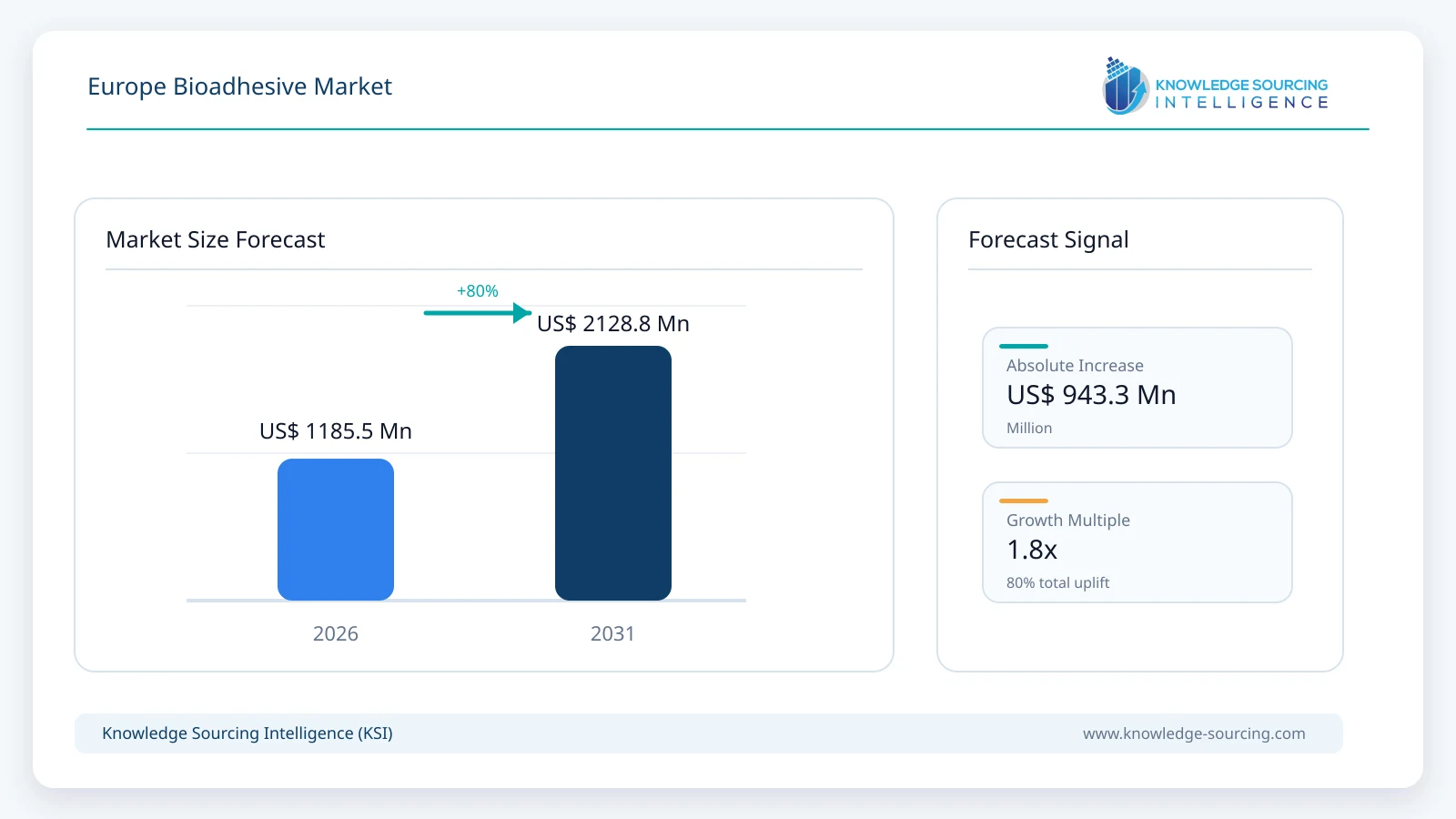
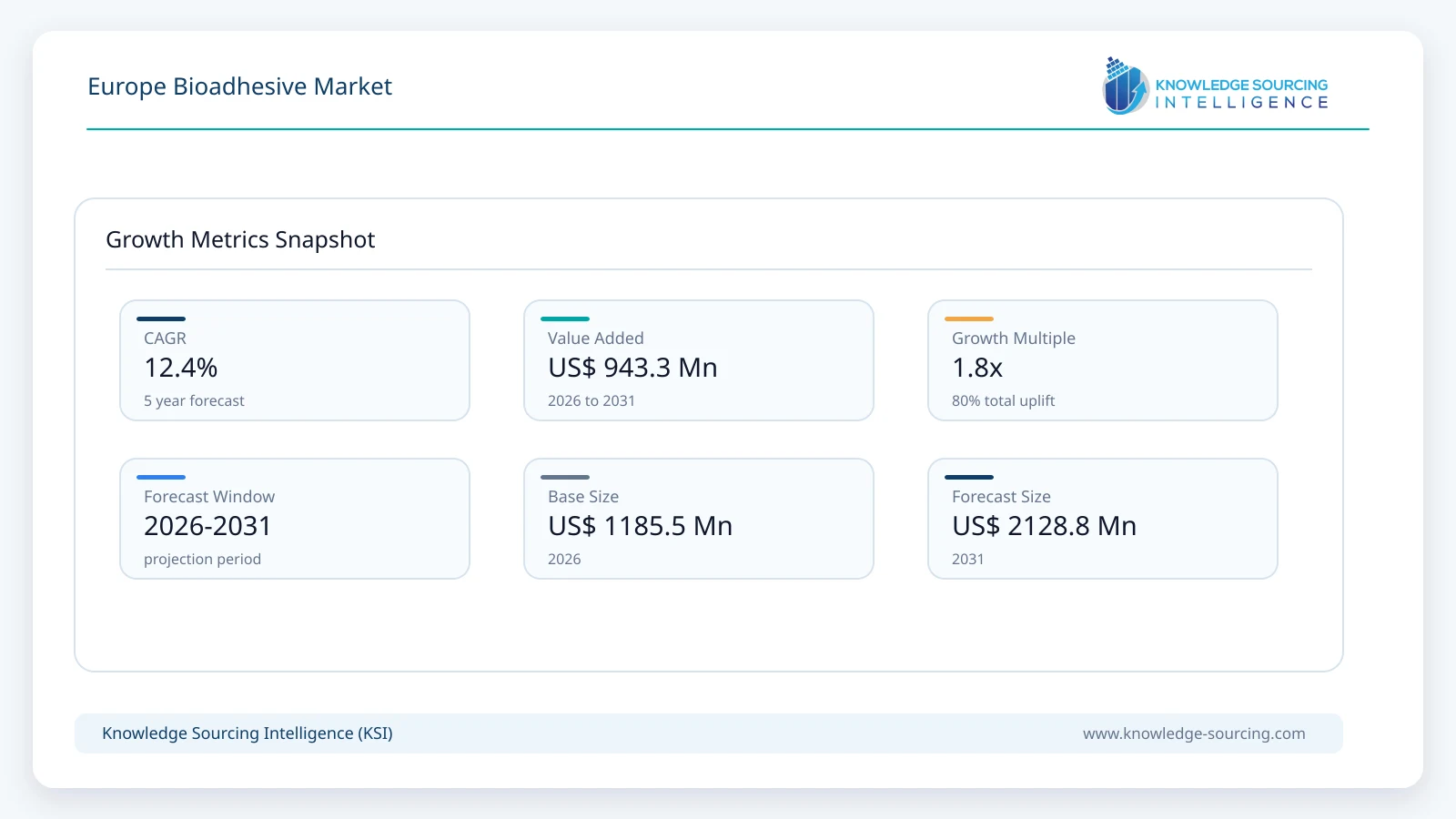
The Europe Bioadhesive Market is forecast to grow at a CAGR of 12.4%, reaching USD 2,128.8 million in 2031 from USD 1,185.5 million in 2026.
Highlights:
- 1Packaging demand is strengthening as European converters adapt adhesive systems to recyclability and PPWR requirements.
- 2Plant-derived chemistries are gaining commercial relevance where they deliver comparable performance without disrupting existing production processes.
- 3Water-based and hot-melt systems offer important routes for reducing solvent exposure while retaining industrial processing efficiency.
- 4Germany remains strategically important because of its chemical manufacturing base, packaging industry, industrial customers, and established bioeconomy policy framework.
- 5Regulatory scrutiny of hazardous substances is influencing formulation decisions, documentation requirements, and substitution priorities across adhesive applications.
- 6Competition is shifting toward application-specific solutions supported by technical validation, supply reliability, lifecycle evidence, and customer qualification.
The Europe Bioadhesive Market covers adhesives and bonding systems derived wholly or partly from renewable biological feedstocks, including plant-derived polymers, starches, proteins, cellulose derivatives, natural resins, and other bio-based materials. The market includes formulations used to join substrates in packaging, construction, healthcare, consumer products, and selected industrial applications. Bioadhesives can be water-based, hot-melt, solvent-based, reactive, or other formulations, depending on the chemistry and application requirements.
Commercial demand in Europe is increasingly being shaped by the interaction between adhesive performance, material circularity, chemical compliance, and customer sustainability targets. Buyers are not generally replacing conventional adhesives simply because a product carries a bio-based label. Procurement teams and converters typically require comparable bonding strength, processing speed, shelf life, application temperature, compatibility with existing equipment, food-contact suitability where relevant, and predictable supply. The commercial opportunity therefore depends on whether bio-based chemistry can satisfy the operating requirements of the application while improving the material profile of the finished product.
Packaging represents an especially relevant demand environment because adhesive selection can influence the recyclability, separability, material composition, and processing of finished packaging. The European Union's Packaging and Packaging Waste Regulation (PPWR) entered into force in February 2025 and began applying generally from August 12, 2026. The regulation establishes requirements covering packaging design, composition, recyclability, reuse, waste prevention, and related environmental performance. This creates a stronger need for adhesive systems that are compatible with packaging structures designed for recycling and resource efficiency.
The market is therefore not defined only by the replacement of petroleum-derived adhesive ingredients. It also includes formulation changes that reduce fossil-resource dependence, improve the environmental profile of bonding systems, support recyclable packaging architectures, or reduce hazardous chemical exposure. In practice, customers may evaluate bioadhesives through a combination of bio-based content, carbon footprint, recyclability, chemical composition, processing efficiency, and total cost of ownership.
Buyer behavior differs substantially by end use. Packaging converters usually prioritize line speed, bond strength, curing or setting characteristics, food-contact compliance, coating weight, machinability, and recyclability. Construction buyers place greater emphasis on substrate compatibility, moisture resistance, durability, worker exposure, and building-system performance. Healthcare customers require stringent control over purity, biocompatibility, sterilization compatibility, and process consistency. Consumer goods manufacturers tend to combine performance requirements with packaging, sourcing, and corporate sustainability objectives.
The industry structure includes large diversified chemical and adhesive manufacturers, specialist bio-based material developers, formulation companies, distributors, and downstream converters. Larger suppliers benefit from formulation expertise, technical service networks, production scale, customer qualification capabilities, and established distribution channels. Smaller technology companies can compete by introducing differentiated bio-based polymers or binders that address specific performance or regulatory problems.
Revenue generation is consequently tied to both adhesive consumption and formulation substitution. Growth can come from higher adhesive volumes in expanding packaging or consumer applications, but it can also come from customers switching from conventional chemistry to higher-value bio-based systems. Suppliers that demonstrate measurable operating benefits have greater scope to command a premium than suppliers relying solely on sustainability claims.
European policy is reinforcing this commercial logic. REACH places responsibility on manufacturers and importers to identify and manage chemical risks and provides mechanisms for restricting or replacing substances of concern where technically and economically feasible alternatives exist. This creates a continuing incentive for formulators to assess alternative chemistries before regulatory pressure becomes a direct purchasing constraint.
Market Drivers
Packaging Circularity and Recyclability Requirements
Packaging is one of the most commercially important demand mechanisms for bioadhesive suppliers in Europe. Adhesives are small components by weight, but their chemistry can influence whether multilayer packaging can be processed efficiently through recycling systems. Converters therefore increasingly evaluate adhesives as part of the complete packaging structure rather than as isolated formulation inputs.
The PPWR began applying across the European Union on August 12, 2026. It establishes a harmonized framework covering packaging placed on the EU market and introduces requirements related to recyclability, reuse, waste prevention, and material composition. The Commission also highlighted restrictions on PFAS in food-contact packaging when the new rules began applying.
This changes procurement criteria. Packaging manufacturers need adhesive systems that maintain bond performance while supporting the recyclability characteristics of the overall structure. Water-based, solvent-free, wash-off, and bio-based formulations can therefore gain commercial attention when they solve a specific recycling or material-composition problem.
The commercial implication is important: suppliers are increasingly required to demonstrate compatibility with the customer's packaging architecture rather than simply provide a technical data sheet. This favors companies with application laboratories, converter partnerships, recycling validation capabilities, and formulation resources.
Pressure to Reduce Fossil-Resource Dependence
European industrial policy continues to support greater use of renewable biological resources. Germany's National Bioeconomy Strategy, for example, seeks to strengthen a bio-based and circular economic model and supports research, resource efficiency, and greater use of biological materials across industrial sectors.
For adhesive manufacturers, this policy direction creates a broader platform for bio-based raw materials. Plant-based feedstocks can include starch, cellulose, natural oils, lignin-related materials, and other renewable inputs. The commercial case becomes stronger when these feedstocks can be incorporated without requiring major changes to customer equipment.
Buyers are also paying greater attention to upstream material sourcing. A bio-based ingredient with uncertain agricultural sourcing, volatile availability, or weak traceability may not provide a dependable procurement advantage. Suppliers therefore need to demonstrate feedstock origin, consistency, quality, and supply continuity.
Companies that can combine renewable feedstocks with industrial-grade consistency are better positioned to secure long-term qualification. This shifts competition from the simple percentage of bio-based content toward performance-adjusted sustainability.
Chemical Substitution and Regulatory Pressure
REACH continues to influence the European chemicals industry by requiring manufacturers and importers to manage chemical risks and by providing mechanisms for restriction or substitution of substances presenting unacceptable risks. The European Commission's 2026 Restrictions Roadmap update also identifies continued work on PFAS and other hazardous substance groups.
Adhesive formulators therefore face a continuing requirement to monitor substance restrictions and potential substitution pathways. The impact extends beyond the adhesive producer because converters and brand owners must also assess regulatory exposure within their supply chains.
Bio-based chemistry can benefit when it provides a technically credible alternative to problematic inputs. However, regulatory substitution does not automatically translate into bioadhesive adoption. A replacement must meet application specifications, remain commercially available, and avoid creating new compliance issues.
The commercial result is a stronger role for formulation development and regulatory support. Suppliers capable of providing technical documentation, ingredient traceability, safety information, and application testing can reduce qualification costs for industrial buyers.
Expansion of Sustainable Packaging Procurement
Brand owners and packaging converters are increasingly incorporating environmental criteria into supplier selection. Dow's 2025 packaging work, for example, described customer demand for recyclable, renewable, circular, and bio-based packaging solutions and emphasized collaboration with converters and brands through its Pack Studios network.
This procurement trend matters because adhesive suppliers are indirectly influenced by brand-level packaging commitments. A converter may be willing to test a new adhesive when a brand owner has established a target for recyclable or renewable packaging.
However, sustainability criteria typically sit alongside productivity and cost requirements. Suppliers must therefore show that the adhesive does not create unacceptable line-speed losses, higher scrap rates, shorter shelf life, or additional equipment investment.
The result is a shift toward commercially validated formulations. Customer trials, pilot-scale production, recycling testing, and lifecycle documentation can become decisive steps before a new bioadhesive reaches recurring volume orders.
Technology Improvements in Bio-Based Polymers
Advances in engineered biopolymers are widening the range of applications that can consider bio-based bonding systems. EcoSynthetix reported that its bio-based products are being used in wood composites, paper, paperboard, tissue, and other industrial applications, while its European commercialization activity expanded through distributor relationships.
This development demonstrates an important commercial mechanism. Customers are more likely to adopt bio-based materials when the technology provides a measurable production or economic benefit alongside environmental advantages.
The opportunity is particularly relevant for paperboard, tissue, wood composites, and packaging applications where renewable binders can replace or reduce conventional petroleum-derived inputs. As formulation performance improves, suppliers can target applications previously constrained by bond strength, moisture resistance, processing requirements, or cost.
Market Restraints and Challenges
Higher Formulation and Qualification Costs
Bio-based raw materials can carry higher costs than established fossil-derived alternatives, particularly when production volumes remain smaller or feedstock processing requires additional purification and modification. The price gap can become difficult to absorb in high-volume applications such as packaging.
The challenge affects adhesive manufacturers, converters, and brand owners. Suppliers must invest in formulation optimization and scale production, while customers must undertake testing before approving the alternative.
Mitigation depends on reducing total system costs rather than focusing solely on adhesive price. Lower application weight, reduced processing temperature, faster line speeds, lower waste, or improved recycling compatibility can help offset a higher material cost.
Feedstock Availability and Price Volatility
Bioadhesives depend on biological feedstocks whose availability can be influenced by agricultural output, forestry markets, food demand, weather conditions, and competing industrial uses. This introduces a different supply-risk profile from conventional petrochemical inputs.
Plant-based materials can also face scrutiny concerning land use, food competition, traceability, and sourcing practices. German government policy explicitly recognizes that where biological resources have competing uses, food security must remain a priority.
Suppliers therefore need diversified feedstock sourcing and stronger traceability systems. Long-term procurement agreements, regional sourcing, secondary raw materials, and mass-balance approaches can help reduce supply uncertainty.
Performance Limitations in Demanding Applications
Bio-based content does not guarantee equivalent performance across all adhesive technologies. Certain applications require precise thermal resistance, chemical resistance, moisture resistance, aging characteristics, or adhesion to difficult substrates.
This limitation affects adoption in construction, industrial assembly, medical products, and demanding packaging structures. Buyers are reluctant to compromise product reliability merely to achieve a higher renewable-material content.
Suppliers must therefore focus research on performance gaps rather than simply increasing bio-based content. Hybrid formulations, reactive chemistries, functional additives, and engineered polymers provide potential routes for achieving application-specific specifications.
Complex Regulatory and Documentation Requirements
European chemical regulation creates a substantial documentation burden for adhesive manufacturers. REACH requires relevant chemical information and risk management, while downstream customers may require additional information concerning composition, safety, recyclability, and sustainability attributes.
The challenge becomes more pronounced when bio-based materials contain multiple components or when feedstock origin needs to be documented. Suppliers must maintain reliable technical and regulatory records throughout the supply chain.
This can increase commercialization time for smaller companies. Strategic partnerships with distributors, compounders, testing organizations, and established chemical manufacturers can reduce customer qualification barriers.
Limited Standardization of Sustainability Claims
Buyers may encounter different methods for describing bio-based content, renewable feedstock use, carbon footprint, recyclability, or biodegradability. These attributes are not interchangeable.
A product can contain bio-based ingredients without being biodegradable, and a bio-based adhesive does not automatically make a finished package recyclable. Procurement teams therefore require more precise evidence.
The mitigation strategy is standardized testing, third-party certification where appropriate, transparent mass-balance accounting, and application-level validation. Suppliers that provide verifiable data can reduce confusion during procurement.
Major Segment Analysis
Packaging
Packaging is the commercially important segment within the Europe Bioadhesive Market because adhesive demand is closely linked to high-volume converting operations and European regulatory requirements concerning packaging waste.
Packaging manufacturers use adhesives for case and carton closing, labeling, flexible-film lamination, paperboard bonding, and other converting processes. The purchasing decision is highly operational. A formulation must deliver stable adhesion at production speed while remaining compatible with the substrate, coating equipment, storage conditions, and downstream recycling process.
The most attractive bioadhesive opportunities are therefore not necessarily applications where the adhesive itself represents the largest share of package material. They are applications where adhesive chemistry can remove a barrier to recyclability or reduce dependence on fossil-derived components without requiring major process changes.
Water-based and hot-melt technologies are particularly relevant because they can address solvent-management concerns while supporting industrial processing. Reactive and other advanced systems remain important where high bond strength, durability, or specialized substrate compatibility outweighs simple formulation considerations.
Buyer requirements are also becoming more integrated. A packaging converter may evaluate adhesive performance, coating weight, drying energy, recyclability, food-contact suitability, and supplier documentation in the same qualification exercise.
The PPWR reinforces this approach. The regulation requires packaging to meet increasingly specific requirements concerning recyclability, material use, reuse, and waste prevention, with several requirements becoming applicable from 2030.
Competition in this segment is consequently moving toward system-level solutions. An adhesive supplier that collaborates with film producers, converters, recyclers, and brand owners can address more of the customer's technical risk than a supplier selling an isolated formulation.
Dow's European packaging activities illustrate this model. Its adhesive portfolio includes water-borne, solvent-free, and other systems evaluated for compatibility with recycling processes, while its Pack Studios network supports application development with customers.
EcoSynthetix also demonstrates the relevance of bio-based materials to paper and packaging-related applications. The company reported European commercial wins for its SurfLock bio-based strength aid in tissue and paper applications during 2025, supported by a European distributor relationship.
For suppliers, the revenue opportunity extends beyond initial product sales. Once a formulation is qualified on a packaging line, switching costs can be meaningful because customers must validate performance, production stability, food-contact requirements, and finished-package behavior. Successful qualification can therefore support recurring demand.
Regional Analysis
Germany
Germany is strategically important because it combines a large chemicals industry, advanced manufacturing base, substantial packaging production, and established policy support for the bioeconomy. Its National Bioeconomy Strategy promotes renewable resources, resource efficiency, circular material flows, research, and industrial application of biological resources.
The country's industrial customer base supports demand for specialty adhesive technologies that can be qualified against demanding technical specifications. German packaging, automotive, construction, furniture, and consumer goods manufacturers also provide multiple routes for application development.
For suppliers, Germany is important not only as a sales market but also as a technology and customer-validation center.
United Kingdom
The United Kingdom remains an important European market for specialty adhesives because of its packaging, construction, healthcare, consumer goods, and manufacturing industries. Procurement decisions are strongly influenced by performance, chemical compliance, supply reliability, and sustainability objectives.
The market also benefits from the presence of multinational adhesive manufacturers and distributors capable of serving industrial customers across multiple applications. Suppliers targeting the UK need to manage regulatory requirements separately from EU requirements where applicable.
France
France offers opportunities in packaging, food-related manufacturing, construction, healthcare, cosmetics, and consumer goods. The country's large consumer-product industries create demand for adhesives used in packaging and product assembly.
Bio-based solutions can gain attention where brand owners and manufacturers seek renewable raw materials without compromising product aesthetics or manufacturing efficiency. Packaging applications are particularly relevant because European circularity requirements increasingly affect material selection across the supply chain.
Italy
Italy has a strong manufacturing ecosystem spanning packaging machinery, converting, furniture, footwear, consumer goods, construction materials, and industrial products. This diversity creates demand for specialized adhesive formulations.
The country's importance to the European packaging and converting supply chain makes it relevant for suppliers developing recyclable or bio-based adhesive systems. Technical support close to converters can be an important competitive factor because customers frequently require application trials before full-scale adoption.
Spain
Spain provides opportunities across food packaging, paper and board, construction, consumer goods, and industrial manufacturing. Its geographic position also supports distribution activity across Southern Europe.
The country's packaging industry creates demand for adhesive systems compatible with recyclable substrates and efficient converting operations. Distributor relationships can be particularly important for smaller bio-based technology suppliers seeking access to local converters.
Netherlands
The Netherlands is strategically relevant as a chemical, logistics, distribution, and materials-processing hub. Its role in European supply chains supports the regional distribution of specialty chemicals and bio-based materials.
EcoSynthetix has previously invested in dedicated European production infrastructure at a toll manufacturing facility in Oosterhout, illustrating the commercial value of the Netherlands as a manufacturing and supply-chain location for bio-based materials.
Others
Other European markets provide opportunities through specialized packaging, forestry products, construction, healthcare, and consumer-goods manufacturing. Northern European countries can be relevant for paper, forestry, and bioeconomy applications, while Central and Eastern European markets can provide additional demand as manufacturing capacity and packaging conversion expand.
The overall regional pattern favors suppliers with European production, warehousing, technical service, and regulatory support. Shorter delivery distances can reduce inventory requirements and improve customer confidence when bio-based raw materials have less mature supply chains.
Competitive Landscape
The competitive structure comprises diversified adhesive manufacturers, specialty chemical suppliers, bio-based material developers, and companies with application-specific technologies. The companies considered in this market analysis are HENKEL AG & CO. KGAA, 3M, ECOSYNTHETIX INC., DOW INC., ASHLAND, INC., THE COMPOUND COMPANY, and DANIMER SCIENTIFIC.
Competition is based less on bio-based content alone and more on the combination of performance, cost, regulatory compliance, technical service, production scale, and supply reliability.
Henkel has a broad Adhesive Technologies platform and has continued to position sustainability within portfolio management and product development. Its 2025 reporting describes assessment of the sustainability contribution of products across the value chain. In January 2026, Henkel announced the planned acquisition of ATP Adhesive Systems, expanding its adhesive solutions with water-based specialty tapes and additional hot-melt and solvent-based polymer tape capabilities.
3M competes through diversified adhesive and tape technologies across industrial applications. Its 2025 Annual Report identifies industrial adhesives and tapes within its Safety & Industrial business and highlights product development aimed at demanding engineering applications.
EcoSynthetix occupies a more specialized position centered on renewable chemicals and engineered biopolymers. Its commercial model emphasizes bio-based alternatives for paper, tissue, paperboard, wood composites, and related industrial uses. The company operates manufacturing infrastructure in Europe and North America and uses distributor relationships to extend commercialization.
Dow competes through polymer science, adhesive technologies, application laboratories, and packaging value-chain collaboration. Its European activities include recyclable packaging adhesives and bio-based or circular material solutions.
Ashland brings specialty chemistry and formulation expertise, including technologies positioned around lower-VOC and solvent-free attributes. The 2025 European Coatings Show activity demonstrated continued development of environmentally oriented specialty formulations for European customers.
The Compound Company and Danimer Scientific add specialist capabilities within the broader bio-based materials and formulation ecosystem. Their relevance is associated with differentiated material technologies and the potential integration of renewable or biodegradable components into industrial applications.
The competitive model therefore combines scale and customer access from diversified chemical companies with specialization from bio-based technology developers. Partnerships are particularly important because customers often need adhesive suppliers to work jointly with film manufacturers, paper producers, converters, recyclers, and brand owners.
Recent Developments
August 2026: The European Union began applying the Packaging and Packaging Waste Regulation across the EU, including new requirements affecting packaging design, recyclability, reuse, and PFAS in food-contact packaging. Commercial relevance: adhesive suppliers must increasingly demonstrate compatibility with recyclable packaging structures and changing chemical requirements.
February 2026: EcoSynthetix reported FY2025 results and confirmed two new European commercial accounts for SurfLock bio-based strength aids in the tissue industry through a distributor relationship. Commercial relevance: the development demonstrates the importance of distributors and application-specific validation in converting bio-based technologies into recurring European industrial demand.
January 2026: Henkel announced its planned acquisition of ATP Adhesive Systems, expanding its Adhesive Technologies portfolio into water-based specialty tapes while adding capabilities in hot-melt and solvent-based polymer tapes. Commercial relevance: the move strengthens Henkel's ability to provide multiple bonding formats to industrial customers and broadens its application coverage.
Regulatory and Policy Environment
The European regulatory environment is becoming an important commercial factor in adhesive formulation and procurement.
The Packaging and Packaging Waste Regulation is particularly relevant to packaging adhesives. Regulation (EU) 2025/40 applies to packaging and packaging waste regardless of material or origin and establishes requirements concerning packaging manufacturing, composition, recyclability, reuse, recovery, and waste management. The general application date was August 12, 2026.
For adhesive manufacturers, the regulation does not simply create demand for "green adhesives." Its commercial impact is more specific. Formulations must support the performance and recyclability of the finished packaging system. Adhesives that interfere with sorting, washing, reprocessing, or material recovery can face greater scrutiny.
The regulation also establishes longer-term requirements that affect investment planning. The European Commission notes that several measures, including requirements relating to recyclability and recycled plastic content, apply from 2030.
REACH remains the central chemicals-management framework. It requires manufacturers and importers to manage chemical risks and provides mechanisms for authorisation and restriction of substances of concern.
The 2026 REACH Restrictions Roadmap update shows that chemical restrictions remain an active policy area, including ongoing work involving PFAS and other hazardous substances. This creates an incentive for adhesive formulators to maintain substitution programs and evaluate alternative chemistries before restrictions directly affect product portfolios.
Food-contact applications require additional attention because adhesives can be used within structures that contact or are intended to contact food. Suppliers therefore need to maintain appropriate migration, safety, and composition documentation according to the specific application and jurisdiction.
Bioeconomy policies also influence the supply side. Germany's policy framework supports research, renewable biological resources, circularity, and industrial bio-based applications. Such policies can support innovation and demonstration activity, although commercial adoption ultimately depends on technical and economic performance.
For suppliers, regulatory readiness is becoming a competitive capability. Companies need strong substance databases, traceable raw-material sourcing, safety documentation, packaging recyclability evidence, and technical files that can withstand customer and regulatory review.
Outlook and Strategic Implications
The 2026–2031 outlook for the Europe Bioadhesive Market will be shaped by the intersection of regulation, packaging redesign, feedstock economics, technology performance, and procurement discipline.
Packaging is likely to remain a central commercial opportunity. The implementation of the PPWR from August 2026 gives converters and brand owners a regulatory reason to reassess packaging structures. Adhesives that facilitate recycling, support mono-material designs, enable clean separation, or incorporate renewable feedstocks can benefit when they meet production requirements.
Investment priorities should center on formulation performance rather than bio-based content alone. Suppliers need to improve moisture resistance, thermal stability, substrate compatibility, curing speed, application efficiency, and shelf life while maintaining renewable-material advantages.
Procurement is also likely to become more evidence-driven. Customers will increasingly ask suppliers to provide verified information concerning bio-based content, carbon footprint, raw-material sourcing, recyclability, chemical composition, and regulatory status. Suppliers that cannot provide consistent documentation may face longer qualification cycles.
Manufacturing location will remain strategically important. European customers often value shorter lead times and reliable technical support, particularly when alternative formulations are still undergoing qualification. Regional production, toll manufacturing, and distributor networks can reduce supply risk and improve customer responsiveness.
Feedstock diversification should also become a priority. Dependence on a single agricultural, forestry, or bio-based input can create exposure to supply disruptions and price fluctuations. Suppliers with multiple qualified feedstocks and flexible formulation platforms should be better positioned to manage raw-material volatility.
Competitive differentiation will increasingly depend on application partnerships. Packaging converters, paper manufacturers, recyclers, brand owners, and adhesive suppliers need to validate materials together because finished-product performance cannot always be inferred from individual components. Dow's Pack Studios model and EcoSynthetix's European distributor activity illustrate the importance of this value-chain approach.
Large diversified suppliers are likely to retain an advantage in customer access, technical infrastructure, and production scale. Specialist bio-based companies can counter this advantage through differentiated chemistry, faster product development, focused application expertise, and partnerships with established distributors or manufacturers.
The main risks remain cost competitiveness, inconsistent feedstock availability, performance limitations, regulatory uncertainty, and slow qualification cycles. A further risk is sustainability overstatement. Customers are likely to distinguish more carefully between bio-based content, biodegradability, compostability, recyclability, and lower carbon footprint.
Strategically, suppliers should therefore prioritize four areas. First, they should develop formulations that meet conventional performance specifications before emphasizing environmental attributes. Second, they should build reliable European supply chains for renewable feedstocks and finished products. Third, they should invest in recycling and application testing to demonstrate performance at the finished-package level. Fourth, they should strengthen regulatory documentation to anticipate chemical and packaging requirements.
Over the 2026–2031 period, the strongest commercial opportunities are likely to arise where regulatory requirements and customer economics point in the same direction. Packaging applications provide the clearest example because recyclability requirements create an external reason to reconsider adhesive chemistry, while bio-based materials can provide an additional sourcing and sustainability benefit.
The Europe Bioadhesive Market should therefore be viewed as a specialized materials market driven by measurable application outcomes rather than by sustainability positioning alone. Suppliers that combine renewable chemistry with consistent industrial performance, competitive economics, regulatory readiness, and dependable European supply are likely to capture the most durable customer relationships.
Europe Bioadhesive Market Scope:
| Report Metric | Details |
|---|---|
| Total Market Size in 2026 | USD 1,185.5 million |
| Total Market Size in 2031 | USD 2,128.8 million |
| Forecast Unit | Million |
| Growth Rate | 12.4% |
| Study Period | 2021 to 2031 |
| Historical Data | 2021 to 2024 |
| Base Year | 2025 |
| Forecast Period | 2026 – 2031 |
| Segmentation | Source, Technology, Industry Vertical, Country |
| Companies |
|
Market Segmentation
By Source
- Plant-Based
- Animal-Based
By Technology
- Water-Based
- Hot-Melt
- Solvent-Based
- Reactive and Others
By Industry Vertical
- Packaging
- Construction
- Healthcare
- Consumer Goods
- Others
By Country
- Germany
- United Kingdom
- France
- Italy
- Spain
- Netherlands
- Others
Table of Contents
1. INTRODUCTION
1.1. Market Overview
1.2. Market Definition
1.3. Market Segmentation
2. RESEARCH METHODOLOGY
2.1. Research Approach
2.2. Research Data and Sources
2.3. Data Validation and Triangulation
2.4. Market Size Estimation and Forecasting
2.5. Assumptions and Limitations
3. EXECUTIVE SUMMARY
3.1. Research Highlights
4. MARKET DYNAMICS
4.1. Market Drivers
4.2. Market Restraints
4.3. Porter’s Five Forces Analysis
4.3.1. Bargaining Power of Suppliers
4.3.2. Bargaining Power of Buyers
4.3.3. Threat of New Entrants
4.3.4. Threat of Substitutes
4.3.5. Competitive Rivalry in the Industry
4.4. Industry Value Chain Analysis
5. EUROPE BIOADHESIVES MARKET BY SOURCE
5.1. Introduction
5.2. Plant-Based
5.3. Animal-Based
6. EUROPE BIOADHESIVES MARKET BY TECHNOLOGY
6.1. Introduction
6.2. Water-Based
6.3. Hot-Melt
6.4. Solvent-Based
6.5. Reactive and Others
7. EUROPE BIOADHESIVES MARKET BY INDUSTRY VERTICAL
7.1. Introduction
7.2. Packaging
7.3. Construction
7.4. Healthcare
7.5. Consumer Goods
7.6. Others
8. EUROPE BIOADHESIVES MARKET BY COUNTRY
8.1. Introduction
8.2. Germany
8.3. United Kingdom
8.4. France
8.5. Italy
8.6. Spain
8.7. Netherlands
8.8. Others
9. COMPETITIVE INTELLIGENCE
9.1. Major Players and Strategy Analysis
9.2. Emerging Players and Market Opportunities
9.3. Mergers, Acquisitions, Agreements, and Collaborations
9.4. Vendor Competitiveness Matrix
10. COMPANY PROFILES
10.1. Henkel AG & Co. KGaA
10.2. 3M
10.3. EcoSynthetix Inc.
10.4. Dow Inc.
10.5. Ashland, Inc.
10.6. The Compound Company
10.7. Danimer Scientific
Navigate
Trusted by the world's leading organizations











