
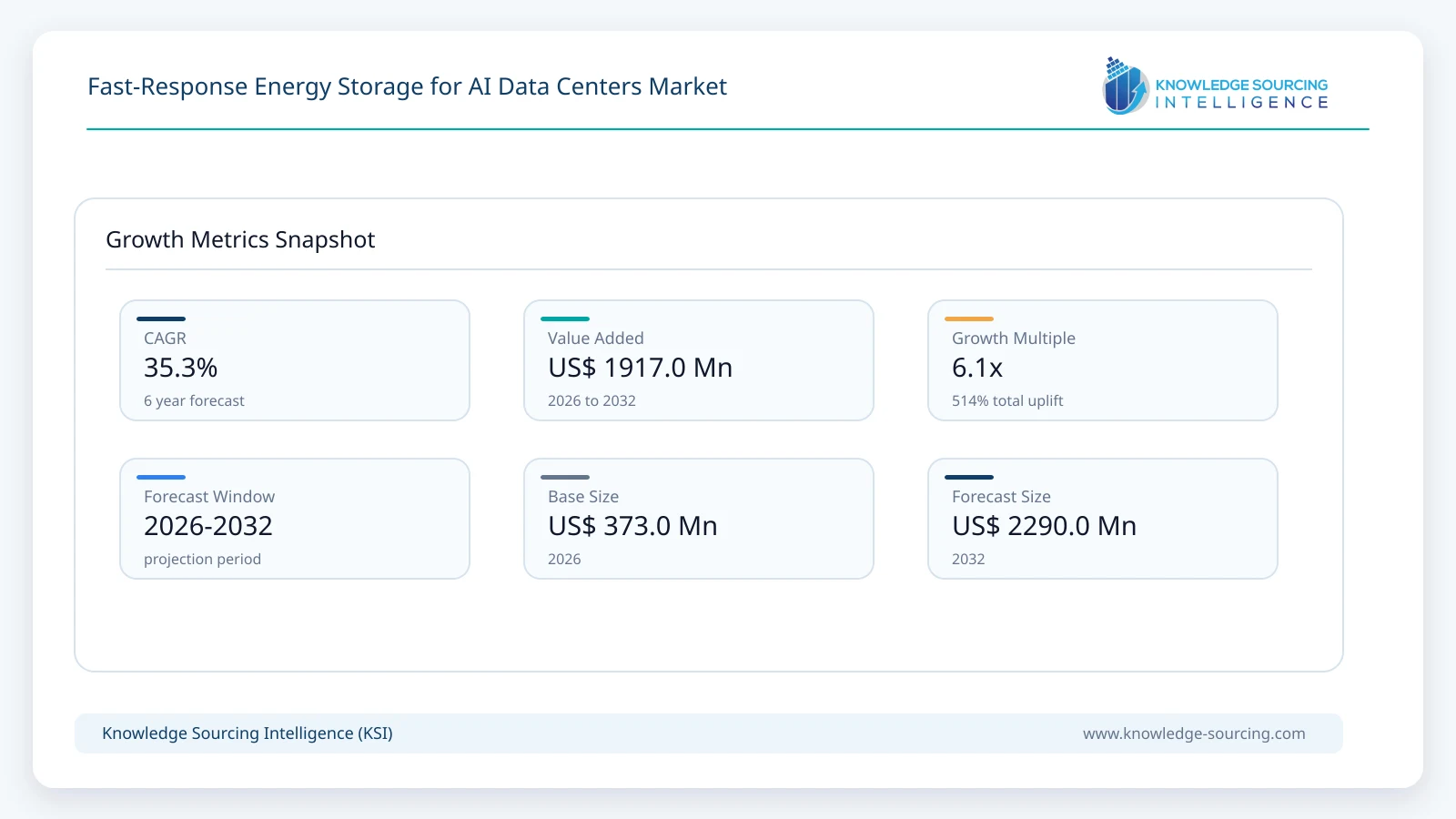
The Fast-Response Energy Storage for AI Data Centers Market is forecast to grow at a CAGR of 35.3%, reaching USD 2,290.0 million in 2032 from USD 373.0 million in 2026.
Highlights:
- 1AI workload variability is turning energy storage from passive backup into an active power-control layer within large data centers.
- 2Battery-supported UPS architectures increasingly use charge and discharge cycles to smooth rapid AI load fluctuations before they reach the grid.
- 3Lithium-ion systems lead current deployment because they combine UPS runtime, cycling capability, compact footprint and mature supplier availability.
- 4Nickel-zinc systems are emerging as a high-power alternative for repeated AI pulse cycling and conventional UPS runtime within the same cabinet.
- 5Supercapacitors target millisecond-to-second power excursions where very high cycle life and rapid discharge can reduce upstream overprovisioning.
- 6Flywheel systems remain relevant for short ride-through and high-cycle UPS applications where seconds of backup are sufficient before generator transfer.
- 7Grid constraints are expanding the role of facility-level BESS in load smoothing, demand response, interconnection support, and microgrid coordination.
- 8The market is shifting toward hybrid architectures that assign transient power, ride-through, and longer-duration duties to different storage technologies.
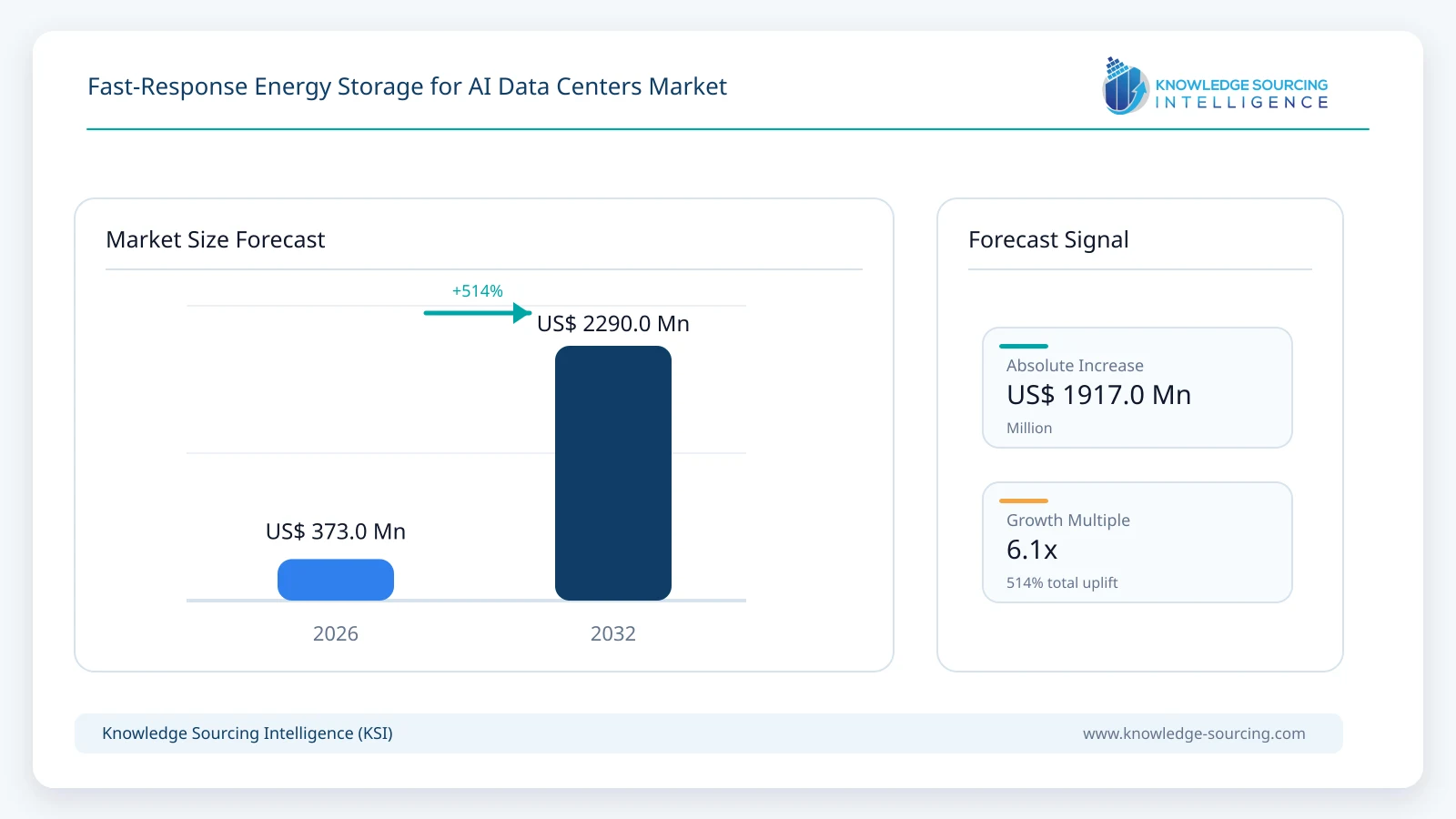
The market growth is supported by higher-density accelerator deployments, increasing adoption of actively cycled storage within UPS and dedicated power-buffering systems, and upgrades to operating AI facilities.
Market Overview
AI data centers are creating a new operating requirement between conventional UPS backup and utility-scale energy storage. The challenge is not simply how much energy can be stored, but how quickly and repeatedly the storage system can absorb or deliver power while maintaining state-of-charge headroom for outages and grid events. NVIDIA notes that BESS design for AI factories must account for computational load behavior, ramp rates, UPS modes, on-site generation, and transitions between grid-connected and islanded operation. This makes power rating, control response, cycling capability, and telemetry as important as nominal energy capacity.
Lithium-ion storage currently provides the broadest commercial base. Modern data-center lithium-ion cabinets can deliver high discharge rates, occupy less space than legacy lead-acid systems and support more frequent cycling. Schneider Electric is positioning battery-backed UPS systems as active load-smoothing assets for AI facilities, while Huawei SmartLi and Vertiv lithium-ion systems are designed around high-density data-center backup and monitoring. These systems can use a controlled partial state-of-charge window so that the battery retains reserve energy while repeatedly smoothing AI load excursions.
A separate high-power segment is developing around immediate-response technologies. Eaton and Panasonic are promoting supercapacitors for AI server burst loads and power-leveling applications, including rack, PDU, and facility-scale configurations. Skeleton Technologies has introduced supercapacitor-based UPS systems specifically for AI data centers, while ZincFive is targeting repeated AI pulse cycling with nickel-zinc battery cabinets. Flywheels offer another short-duration option for facilities that require seconds of ride-through before generators or other sources assume the load.
Facility-level BESS expands the market from power quality to grid interaction. Vertiv and CPower are using data-center BESS as virtual-power-plant resources, while NVIDIA and other infrastructure participants are developing flexible AI factories that can modify their grid draw. As a result, immediate-power systems are installed close to critical loads, while larger battery systems smooth the site-level demand profile. Hybrid architectures are expected to become more common because the optimal technology for millisecond pulses is not necessarily the most economical system for several minutes of ride-through or grid response.
Market Drivers
AI Dynamic Power and Load Smoothing
Large GPU clusters can create rapid changes in power demand that propagate through facility electrical systems. Storage placed at the rack, UPS or facility level can absorb peaks and supply short deficits, reducing current swings seen by upstream equipment. The value of this function increases as individual AI clusters become larger and more synchronized.
Grid Interconnection Constraints
Power availability has become a major constraint on new AI data-center development. BESS can make a facility more controllable from the utility perspective by limiting ramp rates, supporting ride-through, and enabling demand response. Storage therefore has potential value before the facility begins normal operation because it can support interconnection studies and flexible-load commitments.
Higher Power Density and Reduced Space for Backup Systems
AI facilities place a premium on white-space and electrical-room density. Lithium-ion, nickel-zinc, supercapacitor, and flywheel systems can reduce the footprint required for immediate power relative to conventional battery strings in selected applications. Compact storage also supports modular AI pods and prefabricated power systems.
Shift Toward Grid-Interactive UPS and Microgrids
UPS systems are increasingly integrated with battery controls, on-site generation, and microgrid management rather than operating only during outages. This enables stored energy to provide load smoothing, frequency support, demand response, and transition support while preserving the core resilience function.
Market Restraints
Competing Storage Technologies and Duty Cycles
AI power events span milliseconds to minutes, while outage backup can require longer runtime. No single technology optimizes power density, energy capacity, cycle life, safety, footprint and cost across all duties. Buyers must therefore match storage architecture to the actual load profile rather than selecting solely on energy capacity.
Battery Degradation and State-of-Charge Management
Frequent cycling can reduce battery life if systems are not designed for partial-state-of-charge operation and high-rate duty. Storage that is used for load smoothing must also retain sufficient reserve for outages and ride-through events, creating competing operational requirements.
Safety and Qualification Requirements
High-energy batteries, high-current supercapacitors and flywheels each introduce different protection and safety requirements. AI-factory deployments require validated fault response, telemetry, thermal management, and controls because a storage failure can affect large concentrations of expensive compute equipment.
Limited Operating History for AI-Specific Storage Duty
Traditional data-center UPS applications have long operating histories, but repeated dynamic-load mitigation for large AI clusters is a newer duty cycle. Product qualification and supplier credibility therefore remain important as operators evaluate performance claims and long-term lifecycle economics.
Segmentation Analysis
By Storage Technology
Deployment options include lithium-ion batteries, nickel-zinc batteries, supercapacitors, flywheel energy storage and hybrid or other high-power storage systems. Lithium-ion represents the broadest current commercial base because the same platform can support UPS backup, load smoothing and grid interaction. LFP chemistry is increasingly common in data-center applications because of its cycle life, thermal stability and established battery-management ecosystem.
Supercapacitors are positioned for the fastest and most repetitive power events. Their high cycle life allows frequent charge and discharge without the degradation profile associated with electrochemical batteries, making them suitable for rack-level, PDU-level and facility-level power smoothing. Nickel-zinc provides an intermediate proposition by combining conventional UPS runtime with high-rate pulse capability, while flywheels remain suitable for seconds of ride-through and very high cycling.
By Function
Commercial functions include dynamic load smoothing and pulse buffering, UPS bridging and fault ride-through, grid-interactive demand shaping, and generator or microgrid source stabilization. Dynamic load smoothing represents the most AI-specific use case because it responds directly to workload-driven power variability rather than a conventional utility outage.
Grid-interactive demand shaping is expected to become increasingly important as utilities impose ramp-rate, ride-through and flexibility requirements on large data-center loads. Facility-level storage can support these obligations while also providing resilience and demand-response value, improving asset utilization compared with battery systems reserved exclusively for emergency backup.
By Deployment Layer
Deployments span rack and row-level storage, UPS/DC-bus integrated storage, and facility or campus-level storage. Rack and row-level systems respond closest to the AI load and can prevent short transients from propagating upstream. UPS and DC-bus systems provide a shared buffer across multiple racks and combine dynamic-load mitigation with conventional critical-power functions.
Facility-level BESS operates at a larger electrical boundary and is increasingly used to shape the grid-facing demand profile, coordinate onsite generation and support interconnection. Hybrid architectures can combine a high-power local storage layer with a larger battery system, allocating short pulses and longer events to the technology best suited to each duty.
By Customer Type
Key buyers include hyperscale cloud providers, neocloud and GPU-cloud operators, colocation providers, sovereign AI and public-sector compute, and enterprise/HPC facilities. Hyperscalers and neocloud operators lead adoption because their concentrated GPU deployments create the largest dynamic loads and because power availability directly constrains the speed at which new compute can be commissioned.
Colocation providers represent a significant opportunity as they add high-density AI capacity for multiple tenants. Flexible storage can reduce the need to overbuild upstream infrastructure for every transient event while helping operators meet tenant uptime requirements. Sovereign AI projects and enterprise HPC facilities adopt similar technologies where grid quality, generator coordination or limited site capacity make fast-response storage economically valuable.
Regional Opportunity
North America
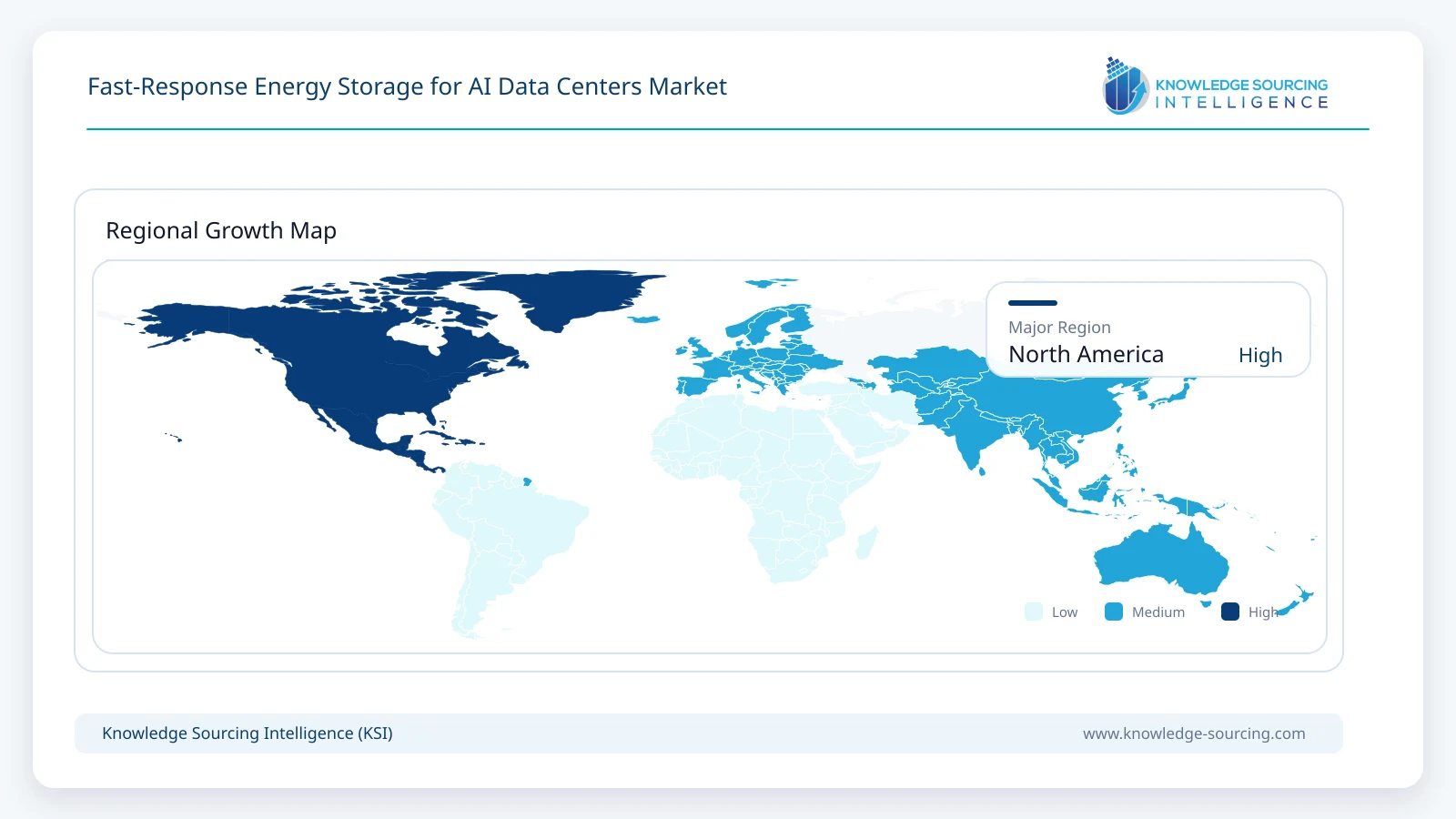
North America is the principal early market because of the scale of hyperscale and neocloud AI investment, grid-interconnection constraints in major data-center regions, and strong activity among UPS, BESS and immediate-power suppliers. Utility flexibility programs and virtual-power-plant participation also create additional value streams for facility-level storage.
China
China combines large AI infrastructure investment with extensive domestic capabilities in batteries, power electronics and data-center power systems. Local suppliers can integrate lithium battery cabinets, UPS systems and facility energy storage within large AI computing campuses, supporting both resilience and grid-interactive operation.
Asia Pacific excluding China
Regional demand is supported by AI data-center development in Japan, South Korea, Taiwan, India, Singapore and Southeast Asia. Space constraints in major hubs increase the value of high-power-density storage, while local battery and electronics manufacturing strengthens the supply ecosystem.
Europe
European adoption is shaped by grid constraints, power-quality requirements, renewable integration and increasing interest in flexible data-center loads. Grid-interactive UPS and BESS architectures can help operators manage constrained connections and support decarbonization goals while maintaining critical-power resilience.
Middle East and Rest of World
Large greenfield AI campuses in the Middle East provide an opportunity to integrate advanced storage from the initial facility design rather than retrofit it later. Storage is particularly relevant where AI facilities combine grid supply with onsite generation, renewables or microgrid architectures.
Competitive and Technology Landscape
Competition spans data-center power infrastructure suppliers, battery manufacturers, specialist immediate-power companies and grid-scale BESS integrators. Vertiv, Schneider Electric, Eaton, Huawei Digital Power, Delta Electronics, ABB and Socomec participate through UPS, battery and power-management platforms. ZincFive, Skeleton Technologies, Panasonic Industry and VYCON target specific high-power applications using nickel-zinc, supercapacitor and flywheel technologies, while battery and BESS suppliers provide cells, cabinets and power-conversion platforms for larger facility-level systems.
The competitive differentiator is shifting from stored energy alone toward response speed, cycling capability, power density, control integration and qualification for AI duty. Suppliers that can demonstrate repeatable performance under fast power ramps, maintain state-of-charge headroom and integrate with UPS, generators and grid controls are better positioned as operators move from conventional backup batteries to active energy-management systems.
Companies supplying fast-response storage and related power infrastructure include: ABB, CATL, Delta Electronics, Eaton, EnerSys, Fluence, Huawei Digital Power, LG Energy Solution, Panasonic Industry, Piller Power Systems, Saft, Samsung SDI, Schneider Electric, Skeleton Technologies, Socomec, Sungrow, Tesla, Vertiv, VYCON, ZincFive.
Recent Developments
September 2026: Emerald AI, Google and NVIDIA launched the AI Energy Management Alliance to advance flexible AI data centers that can dynamically manage electricity use in response to grid conditions, including the use of onsite storage and other energy resources.
September 2026: ZincFive launched a next-generation battery-management system for its nickel-zinc UPS battery cabinets, expanding monitoring and control for data-center immediate-power applications.
June 2026: NVIDIA published production-readiness guidance for BESS used in AI factories, covering load buffering, ride-through, telemetry, controls, state-of-charge management and supplier qualification.
June 2026: Skeleton Technologies announced UL 810A certification testing for a supercapacitor with a 3,500-ampere peak-current rating, positioning high-current supercapacitors for AI infrastructure power systems.
April 2026: The Open Compute Project added energy-storage-system guidance to its Open Data Center for AI initiative, covering safety, interoperability, telemetry and lifecycle management across AC, DC and hybrid architectures.
April 2026: Vertiv and CPower announced integration of Vertiv EnergyCore Grid BESS with CPower's virtual-power-plant platform to help data centers use behind-the-meter storage for interconnection support, demand response and grid services.
April 2026: ZincFive reported that its nickel-zinc data-center battery systems had surpassed 2 GW of delivered or contracted power, including products designed for conventional UPS and AI dynamic-load applications.
Fast-Response Energy Storage for AI Data Centers Market Scope:
| Report Metric | Details |
|---|---|
| Total Market Size in 2026 | USD 373.0 million |
| Total Market Size in 2032 | USD 2,290.0 million |
| Forecast Unit | USD Million |
| Growth Rate | 35.3% |
| Study Period | 2021 to 2032 |
| Historical Data | 2021 to 2024 |
| Base Year | 2025 |
| Forecast Period | 2026 – 2032 |
| Segmentation | Storage Technology, Function, Deployment Layer, Customer Type |
| Companies |
|
Market Segmentation
By Storage Technology
Lithium-Ion Battery Systems
UPS-Integrated Lithium-Ion
Short-Duration Facility BESS
Nickel-Zinc Battery Systems
Supercapacitor and Ultracapacitor Systems
Flywheel Energy Storage
Hybrid and Other High-Power Storage
By Function
Dynamic Load Smoothing and Pulse Buffering
UPS Bridging and Fault Ride-Through
Grid-Interactive Demand Shaping
Generator and Microgrid Stabilization
By Deployment Layer
Rack and Row-Level Storage
UPS and DC-Bus Integrated Storage
Facility and Campus-Level Storage
Hybrid Multi-Layer Storage Architectures
By Customer Type
Hyperscale Cloud Providers
Neocloud and GPU-Cloud Operators
Colocation Providers
Sovereign AI and Public-Sector Compute
Enterprise AI and HPC
By Geography
North America
China
Asia Pacific Excluding China
Europe
Middle East and Rest of World
Table of Contents
1. EXECUTIVE SUMMARY
1.1. Market Opportunity and Key Findings
1.2. AI Dynamic Power and Storage Requirement
1.3. Technology Adoption Outlook
1.4. Major Revenue Pools
2. RESEARCH SCOPE AND METHODOLOGY
2.1. Market Definition
2.2. Inclusion and Exclusion Criteria
2.3. Fast-Response Duty-Cycle Definition
2.4. Market Revenue Recognition
2.5. AI IT Load and Storage-Content Model
2.6. Forecast Methodology, 2026-2032
3. AI DATA CENTER POWER DYNAMICS AND STORAGE ARCHITECTURE
3.1. AI Workload Power Variability
3.2. Rack-to-Grid Propagation of Load Transients
3.3. UPS and DC-Bus Energy Storage
3.4. Rack and Row-Level Storage
3.5. Facility-Level BESS
3.6. Hybrid Energy Storage Architecture
3.7. Grid-Interactive Storage and Flexible Loads
4. MARKET SIZE AND FORECAST, 2026-2032
4.1. Global Market Revenue
4.2. Supported AI IT Load, MW
4.3. Installed Fast-Response Storage Power Capacity, MW
4.4. Storage Content per MW of AI Capacity
4.5. Technology-Mix Forecast
4.6. Forecast Sensitivities
5. MARKET BY STORAGE TECHNOLOGY
5.1. Lithium-Ion Battery Systems
5.1.1. UPS-Integrated Lithium-Ion
5.1.2. Short-Duration Facility BESS
5.2. Nickel-Zinc Battery Systems
5.3. Supercapacitor and Ultracapacitor Systems
5.4. Flywheel Energy Storage
5.5. Hybrid and Other High-Power Storage
6. MARKET BY FUNCTION
6.1. Dynamic Load Smoothing and Pulse Buffering
6.2. UPS Bridging and Fault Ride-Through
6.3. Grid-Interactive Demand Shaping
6.4. Generator and Microgrid Stabilization
7. MARKET BY DEPLOYMENT LAYER
7.1. Rack and Row-Level Storage
7.2. UPS and DC-Bus Integrated Storage
7.3. Facility and Campus-Level Storage
7.4. Hybrid Multi-Layer Storage Architectures
8. MARKET BY CUSTOMER TYPE
8.1. Hyperscale Cloud Providers
8.2. Neocloud and GPU-Cloud Operators
8.3. Colocation Providers
8.4. Sovereign AI and Public-Sector Compute
8.5. Enterprise AI and HPC
9. REGIONAL MARKET
9.1. North America
9.2. China
9.3. Asia Pacific excluding China
9.4. Europe
9.5. Middle East and Rest of World
10. TECHNOLOGY AND COMMERCIALIZATION OUTLOOK
10.1. Seconds-to-Minutes Storage Requirements
10.2. Battery Cycling and Partial-State-of-Charge Operation
10.3. Supercapacitor and High-Power Buffering
10.4. Flywheel Ride-Through
10.5. Hybrid Battery-Supercapacitor Architectures
10.6. AI Factory BESS Qualification
10.7. Grid-Interactive UPS and Virtual Power Plants
10.8. 800 VDC and Direct-DC Storage Integration
11. COMPETITIVE LANDSCAPE
11.1. Value Chain
11.2. Data Center Power Infrastructure Suppliers
11.3. Battery and BESS Suppliers
11.4. Immediate-Power Technology Suppliers
11.5. System Integration and Controls
11.6. Partnerships and Qualification Programs
12. COMPANY PROFILES
12.1. ABB
12.2. CATL
12.3. Delta Electronics
12.4. Eaton
12.5. EnerSys
12.6. Fluence
12.7. Huawei Digital Power
12.8. LG Energy Solution
12.9. Panasonic Industry
12.10. Piller Power Systems
12.11. Saft
12.12. Samsung SDI
12.13. Schneider Electric
12.14. Skeleton Technologies
12.15. Socomec
12.16. Sungrow
12.17. Tesla
12.18. Vertiv
12.19. VYCON
12.20. ZincFive
13. APPENDIX
13.1. Definitions and Abbreviations
13.2. Storage Duty-Cycle Classification
13.3. Forecast Assumptions
13.4. Source and Data Notes
Navigate
Trusted by the world's leading organizations











